



Abstract
The recent investigations ensure that the effect of an endoscope on the peristaltic flow is very important for medical diagnosis and it has many clinical applications such as gastric juice motion in the small intestine when an endoscope is inserted through it. Therefore, we have studied the problem of peristaltic flow with heat and mass transfer through the gap between coaxial inclined tubes where the inner tube is rigid and the outer tube has sinusoidal wave traveling down its wall. The inner tube fulfilled the slip condition while the outer tube has a no-slip condition. The lubrication approximation theory is utilized to simplify the normalized equations. The perturbation procedure is employed to concede the results for the pressure gradient and velocity field, whereas exact outcomes are established for the energy and concentration fields. Frictional forces and pressure rise per wavelength are calculated numerically. The impacts of embedded parameters are portrayed through graphs. It is found that fluid velocity reduces by increasing the couple stress parameter however the inverse effect is noted for the slip parameter. Furthermore, better pumping is viewed in the vertical tube as compared to the horizontal tube. A validity of perturbation solutions for velocity distribution is made with the finite element method and an admirable comparison is also noticed with previously published results.
Keywords
Introduction
The study of peristalsis motion has been mostly deliberated by many researchers due to its broad applications in biological sciences, industries, engineering, and biomedical fields in recent years. The most common applications of such mechanisms are seen in biomedical science, which are recognized in the esophagus, food transportation in the digestive tract, motion of cilia, and vasomotor in blood vessels, etc. In particular, such activity significantly inhibits the transportation of urine from the kidney to the bladder, the evolution of chyme and its flow into the intestinal tract, the movement of larvae, the transport of spermatozoa, the moment of ovulation in the female tube, the roller and artificial pumps, dialysis, etc. Peristalsis phenomena especially used for transportation of fluid from the region of lower pressure to higher ones. Most biomedical engineering problems, such as heart and lungs inspection instruments, peristaltic mechanism is used for blood pumping and other fluid flows. There are many peristaltic flow applications in the industry as well, such as the sanitary fluid transport, in the nuclear production of toxic liquid production and the transport of decaying liquid. Latham 1 firstly inspected the mechanical characteristics of peristalsis. In this analysis, investigators inspected the transportation of liquid through a peristaltic pump. Afterward, Shapiroet al. 2 employed lubrication approximation theory to analyze peristaltic flows through channel and duct. The sinusoidal motion of Jeffrey nanomaterial inside a non-uniform duct was scrutinized by Imranet al. 3 Farooqet al. 4 reported the entropy optimization and Newtonian heating concepts on sinusoidal wall motion through a non-uniform channel. Analysis of heat transport on the peristaltic process of Carreau liquid was explored by Noreenet al. 5 Saleemet al. 6 inspected the physical features of sinusoidal activity of hybrid nano-liquid through a curved tube with a ciliated wall. Inquiry of entropy generation for peristaltic process in a channel with variable viscosity was reported by Akbar and Abbasi. 7 Abbaset al. 8 developed the wall motion of Jaffrey fluid in a channel containing the impacts of a chemical reaction and Lorentz force. The role of double-Diffusion Convection and Induced Magnetic Field on Peristaltic Pumping of a Johnson–Segalman Nanofluid in a Non-Uniform Channel was studied by Khanet al. 9 Saeedet al. 10 discussed the impact of partial slip on the double diffusion convection and inclined magnetic field on peristaltic wave of six-constant Jeffreys nanofluid along asymmetric channel. Nanomaterials effects on induced magnetic field and double-diffusivity convection on peristaltic transport of Prandtl nanofluids in inclined asymmetric channel was reported by Akramet al. 11 The survey of relevant investigations can be seen in references.12–15
In several applications, the flow pattern communicates with the slip flow and the liquid exhibits a loss of adhesion on the wetted wall causing the liquid to slide along the wall. When the molecular mean free path length of the liquid is equivalent to the distance between the plates as in micro-channels or nano-channels, the liquid displays discontinuous impacts such as the slipstream experimentally established by Tretheway and Meinhart. 16 The impact of variable viscosity on hydromagnetic peristaltic activity past a channel containing velocity slip was inspected by Sinhaet al. 17 Bhattiet al. 18 investigated the endoscopy inquiry on peristaltic transportation of blood particle-liquid in the occurrence of slip situations. Slip flow on the peristaltic motion of Eyring–Powell liquid with wall assets was analyzed by Hina. 19 Abbaset al. 20 discussed the oscillatory slip flow of nanomaterials in a vertical porous channel using Darcy’s law with thermal radiation. The concept of hall current on the dynamic simulation of peristaltic process inside a compliant channel was studied by Imranet al. 21 Akramet al. 22 studied the impact of slip on the nanomaterial peristaltic pumping of magneto-Williamson nanofluid in an asymmetric channel under double-diffusivity convection. Slip impact on double-diffusion convection of magneto-fourth-grade nanofluids with peristaltic propulsion through inclined asymmetric channel was reported by Akramet al. 23 Sensitivity of the slip condition and viscoplastic effect of the micropolar-Casson fluid during a non-isothermal blade coating process was studied by Khaliqet al. 24 Thermal radiation has a valuable role in several high-temperature developments. It has multiple uses in various uses in the design of nuclear power plants in several manufacturing industries. This thought is also common in the development of engine cooling, furnaces, and boilers, and lots more. The radiative peristaltic activity of MHD micropolar liquid with entropy optimization inside a tapered channel was explored by Asha and Deepa. 25 Prakashet al. 26 inspected the nano liquid flow generated by magnetohydrodynamics peristaltic activity in the existence of thermal radiation. The combined impacts of heterogeneous-homogeneous reactions on the peristaltic activity of Rabinowitsch liquid model in the occurrence of thermal radiation was studied by Imranet al. 27 Recently, simultaneous aspects of wall properties and thermal radiation on the sinusoidal wall motion of Casson liquid were deliberated by Abbaset al. 28 Rafiq and Abbas 29 reported the impacts of viscous dissipation and thermal radiation on Rabinowitsch fluid model obeying peristaltic mechanism with wall properties.
The non-Newtonian fluids have received great attention during the recent years. The flow of non-Newtonian fluids is widely observed in industry and biology, for example, enhanced oil recovery, chemical processes such as in distillation towers and fixed-bed reactors and, in the applications of pumping fluids such as synthetic lubricants, colloidal fluids, liquid crystals, and biofluids (e.g. animal and human blood). The couple stress fluid is a special case of non-Newtonian fluid which is intended to take into account the particle size effects. The micro-continuum theory of couple stress fluid proposed by Stokes, 30 defines the rotational field in terms of the velocity field for setting up the constitutive relationship between the stress and the strain rate. Stokes’ micro-continuum theory is the simplest generalization of the classical theory of fluids, which allows for polar effects such as the presence of couple stresses, body couples and a non-symmetric stress tensor. The couple stress model plays an important role in understanding some of the non-Newtonian flow properties of blood. In view of these, the investigators have started working on the study of couple stress fluids in physiological endoscopic geometry for the last few decades, but very less literature available in this direction. For instance, slip impacts on the unsteady magneto-hydromagnetic peristaltic process of couple stress fluid past a porous medium was purposed by Sankad and Nagathan. 31 Impacts of convective and velocity slip conditions on the peristaltic process of couple stress fluid past an asymmetric porous channel using lubrication approximation theory were studied by Ramesh. 32 Tripathiet al. 33 reported the electro-magnetohydrodynamic impacts on the peristaltic activity of biological couple stress fluid past a complex wavy microchannel. Ramesh and Devakar 34 have made theoretical investigation on the peristaltic motion of couple stress fluid model in an endoscope. Impact of partial slip and lateral walls on peristaltic transport of a couple stress fluid in a rectangular duct was inspected by Akramet al. 35 Peristaltic mechanism of couple stress nanomaterial in a tapered channel with the assumptions of long wavelength and small Reynolds number was investigated by Rafiqet al. 36 Some important articles dealing with couple stress fluid have been reported through.37–41 In general, the physiological systems are inclined in nature. To the best of the authors knowledge no work is made to study the slip flow of a couple stress fluid in an inclined endoscope under the effects of thermal radiation and Soret number. In view of the aforementioned discussion and motivation, the present investigation is aimed to study the heat and mass transfer on the peristaltic pumping of couple stress liquid in an inclined tube with an endoscope with velocity slip condition. The lubrication approximation theory is employed for flow phenomena. The perturbation analysis has been employed to concede the result for pressure gradient and momentum equations, whereas exact outcomes are established for the energy and concentration fields. The impacts of embedded quantities are portrayed and deliberated by adopting a graphical approach. A motivation of the present analysis is the hope that such a problem will be applicable in many clinical applications such as the endoscope problem.
Problem formulation
Consider the propulsion of couple stress liquid in an inclined peristaltic endoscope geometry. The couple stress liquid occupies the space between two co-axial inclined tubes. The inner tube is uniformly circular and rigid while the outer tube has a sinusoidal wave traveling down its wall. The fluid motion is generated by sinusoidal wave trains propagating with constant speed c along the wall of the upper tube. The cylindrical coordinates


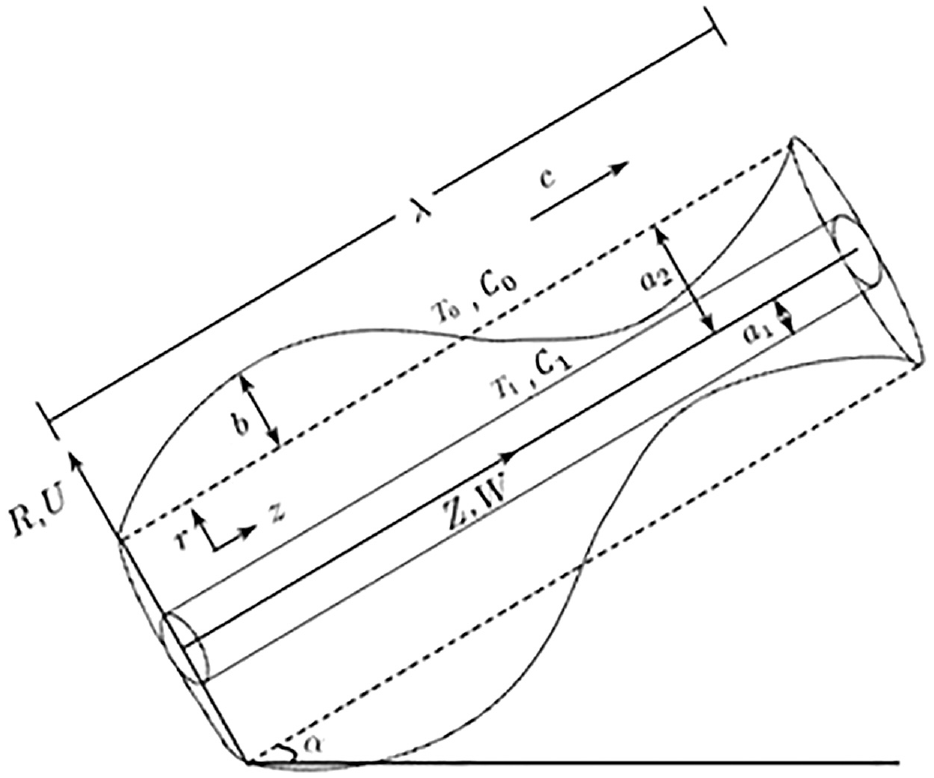
Geometrical appearance of the problem.
where
The constitutive equations concerning the force stress tensor


where

Using the equations (3) and (4), the governing equations (in the laboratory frame) for the inclined peristaltic motion of an incompressible couple stress fluid in the cylindrical polar coordinates



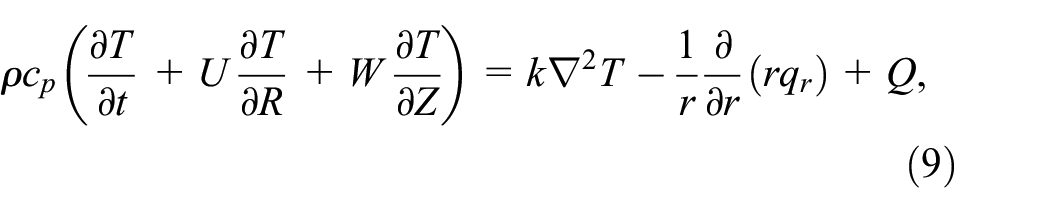

here
The flow is inherently unsteady in the laboratory frame

Utilizing equation (11) into equations (6) to (10), we get

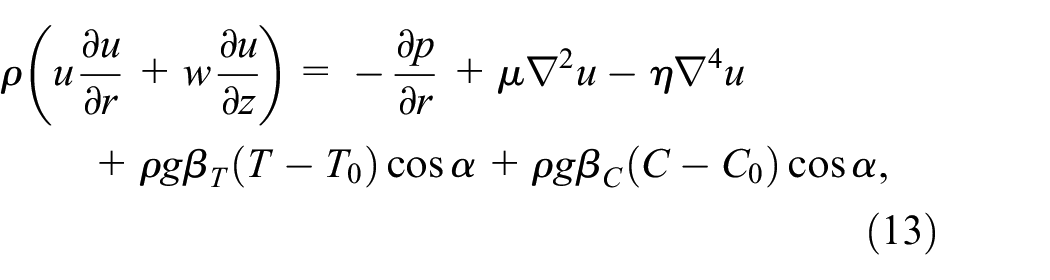
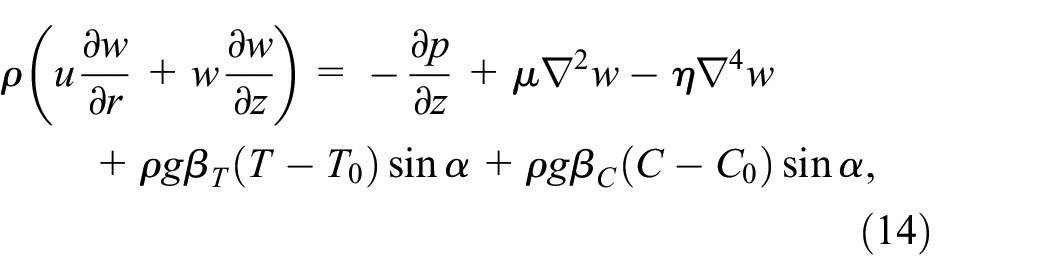


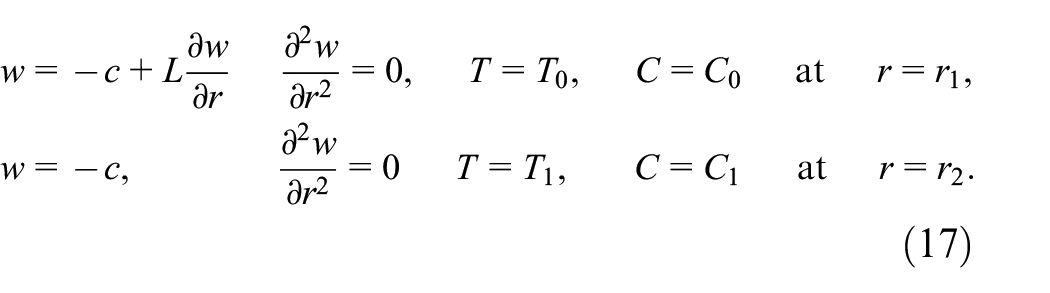
with corresponding boundary conditions
where
The radiative heat flux is given by27,28:

We initiate the following non-dimensional quantities

In terms of non-dimensional quantities as given in equation (18), equations (12) to (16) yield


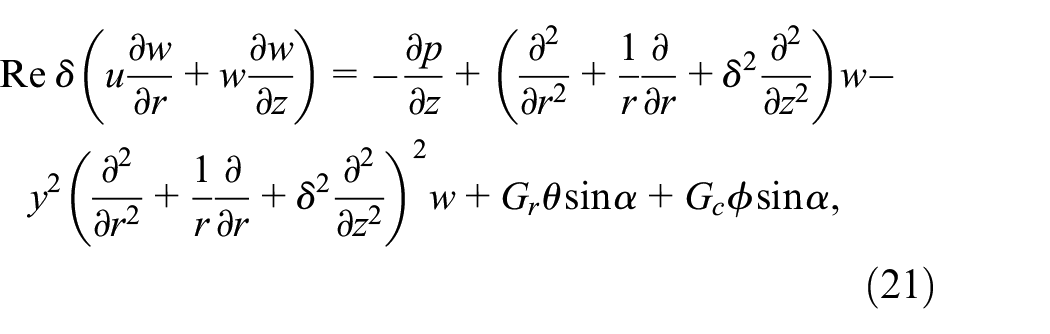

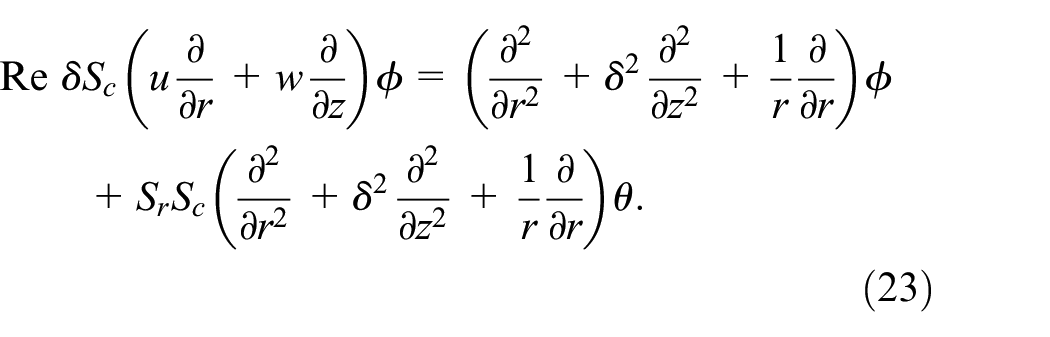
The above equations (19) to (23) are highly non-linear so it almost seems complicated to find the exact solution of these equations. Utilizing the lubrication approximations theory, that is,



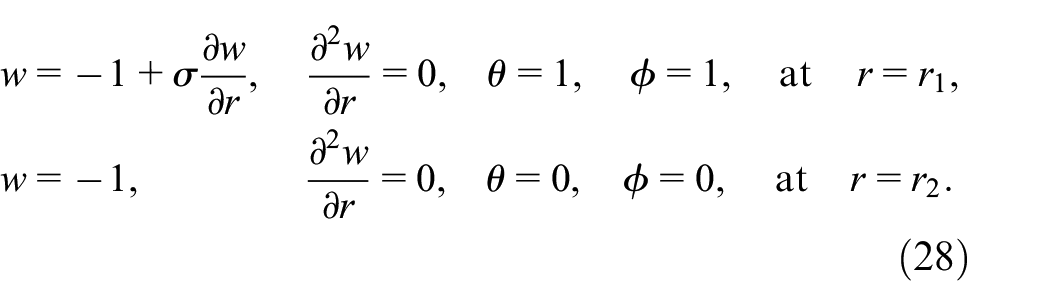
The transformed boundary conditions are given as
Solution of the problem
Analytical solution
Utilizing the boundary conditions (28) in equation (26), we obtain the temperature profile as follows:

Substitute equation (29), result of equation (27) with surface conditions (28) is found as

Perturbation solution
Since equation (25) is non-linear and hence it is difficult to obtain exact solution. Therefore, the regular perturbation analysis is utilized to acquire the outcome of velocity profile. For this purpose, we expand the flow quantity

Invoking equations (29) to (31) in equation (25) and by equating the terms such as powers of

The dimensionless volume flow rate is expressed as

Inserting equation (32) in equation (33), the pressure gradient can be found as

The inner and outer frictional forces

and
Numerical solution
To solve the deliberated model numerically, the simplified equations (25) to (27) with surface conditions given in equations (28) are solved by the finite element method based on Galerkin’s variational technique. The whole domain is divided into a non-uniform mesh of quadratic triangular elements employing a built-in pdetool in MATLAB. The tolerance point
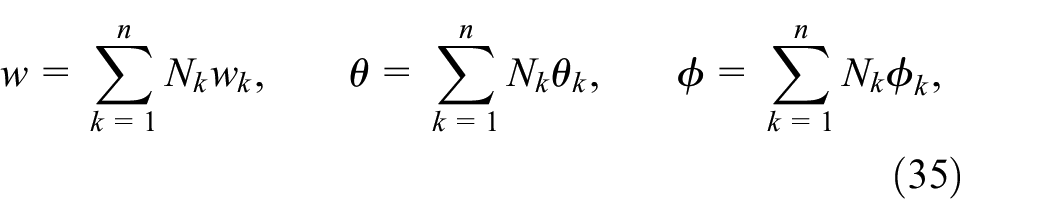
where


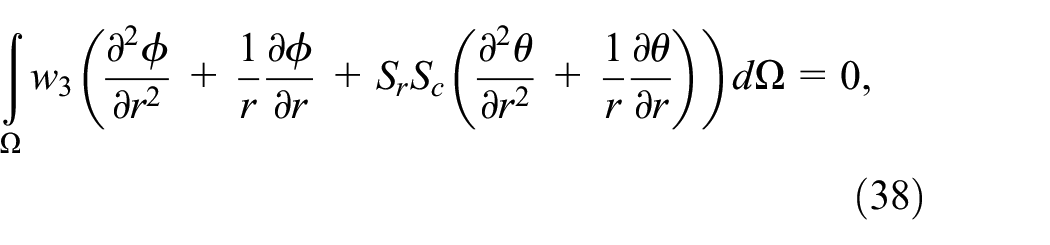
where


Results and discussions
This section explores the physical response of dissimilar parameters on the fluid velocity, temperature, concentration, pumping characteristics and streamlines. The expression specified in equation (34) cannot be resolved analytically so a numerical solution based on a suitable algorithm is required. Therefore, this integral is calculated numerically by employing the composite Simpson’s rule with spatial discretization number for the numerical process taken at 200. The computed convergence criterion was 10−10. A validity of perturbation solutions for velocity distribution is made with the outcome acquired by MATLAB through FEM as shown in Table 1. It can be established from this table that the numerical results greatly match with the exact solution for velocity distribution. In this analysis, the following default parameter values are adopted for computations:
Comparison of numerical and exact outcomes for diverse values of

The impacts of sundry variables on thermal profile are accessible in Figure 2(a) and (b). Figure 2(a) explores the impacts of heat generation/absorption parameter

Temperature profile for various values of (a) heat generation/absorption parameter
Figure 3(a) and (b) are sketched to depict the deviation of concentration profile. Figure 3(a) demonstrates the impacts of Schmidt number

Concentration profile for various values of (a) Schmidt number
Figure 4(a) and (b) is designed to scrutinize and deliberate the impacts of significant parameters on the momentum profile

Velocity profile for various values of (a) Grashof number
Figure 5(a) to (c) is outlined to explore the influences of significant parameters on pressure gradient

Pressure gradient

Pressure rise

Frictional force on the outer tube
The development of an internally circulating bolus that transports waves is a very relatable mechanism in fluid dynamics. This phenomenon has physical examples in blood clots and the transportation of food bolus in the gastrointestinal tract. This kind of event is characterized as trapping. The trapping mechanism of the streamlines

Streamlines for various values of slip parameter
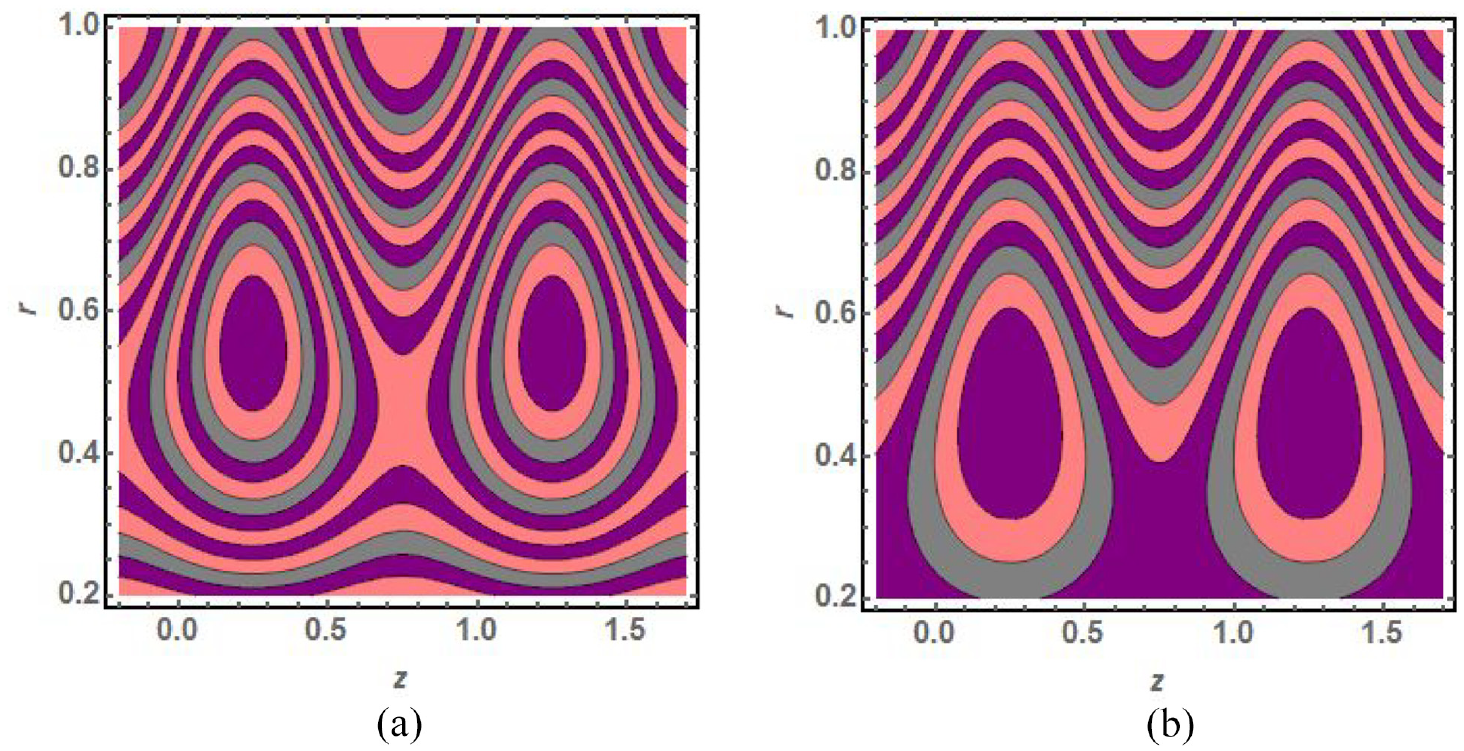
Streamlines for various values of couple stress parameter

Streamlines for various values of Grashof number
Validation
The purpose of this section is to check the accuracy of our outcomes. To verify obtained results, a comparison of limiting case of present investigation for the velocity profile in the absence of buoyancy parameter, velocity slip parameter and thermal radiation with the results reported by Ramesh and Devakar 37 (see Figure 11). This graph indicates that both findings are in good agreement.

Comparison of limiting case of the present study with the results of Ramesh and Devakar. 37
Conclusions
The effect of an endoscope on the peristaltic flow is very important for medical diagnosis and it has many clinical applications. It is a very important tool for determining real reasons responsible for many problems in human organs in which the fluid is transported by peristaltic pumping. The endoscope is also like a catheter which is used in contemporary medical science. Therefore, the peristaltic flow of couple stress fluid inside an inclined tube with an inserted endoscope under lubrication approximation theory has been studied. The inner tube fulfilled the slip condition while the outer tube has a no-slip condition. The perturbation solution of the peristaltic transport of couple stress fluid in an inclined tube with the endoscopies obtained. The pressure difference and frictional forces have been calculated numerically. The governing equations are simplified under the lubrication approach. The current analysis is among the first of this type which helps in understanding the role of Soret number and thermal radiation on the heat and mass transfer phenomena of couple stress fluid inside an inclined tube with an inserted endoscope with velocity slip condition. Future works can be done in this direction to scrutinize the impacts of nanofluid and chemical reaction on the flow properties. The summary of the performed study is as follows:
The temperature profile is directly proportional to heat generation/absorption and inversely proportional to thermal radiation parameter. The impact of heat generation/absorption very effectively regulates the thermal efficiency of dissimilar physiological liquids.
The concentration field is decreased by enhancing the values of Soret number and Schmidt number.
The velocity profile increases with an increase of couple stress fluid and velocity slip parameters.
Pressure gradient declines with the rise of couple stress fluid and velocity slip however, the opposite behavior is noted for Grashof number inclination angle.
Better pumping is seen in a vertical tube as compared to a horizontal tube.
The number of trapped boluses is decreased by enhancing the values of couple stress fluid parameter.
Footnotes
Appendix
Acknowledgements
We are thankful to the reviewers for their encouraging comments and constructive suggestions to improve the quality of the manuscript.
Handling Editor: Chenhui Liang
Declaration of conflicting interests
The author(s) declared no potential conflicts of interest with respect to the research, authorship, and/or publication of this article.
Funding
The author(s) received no financial support for the research, authorship, and/or publication of this article.
