




Abstract
The performance of the cage can directly affect the service life of the bearing. This paper presents a cage topology optimization method for improving the heat dissipation and structural stiffness. Firstly, a multi-objective structural topology optimization model is established based on the SIMP method and MMA algorithm, the effects of force and thermal load are considered comprehensively. Secondly, considering the centrifugal force and frictional heat, under the conditions of a given volume constraint, the bearing cage topology optimization model is carried out with heat dissipation weakness and compliance as the optimization objectives. Using iterative calculations based on the MMA algorithm and boundary smoothing processing, the structure with the optimal material layout is obtained. Finally, compared with the initial structures, the maximum temperature reduces about 27% and the maximum stress reduces about 14.8%. The results show that topology optimization can provide a reference for the design of bearing cages, which can improve the structural performance while reducing weight.
Keywords
Introduction
With the rapid development of the aerospace industry in ultra-high precision conditions, higher requirements are put forward for the performance of high-speed precision ball bearings. As a key component of the bearing, the performance of the cage will affect the service life of the bearing. The core of bearing cage research is thermal stability and dynamic characteristics, and the sliding friction of the bear during the working process can cause the cage to heat and wear-out. More than 25% of bearing failures are caused by frictional heat between balls and cage. 1 In the traditional cage design, the structural stiffness of the cage is improved by changing the cage material and the shape of the pockets, 2 while ignoring the cage structure design. Therefore, it is very necessary to study a novel cage, which can improve both heat dissipation and structural stiffness of the cage.
Many theoretical models have been established to analyze and improve the heat dissipation and structural stiffness of the cage. In terms of heat dissipation of the cage, Sathyan et al. 3 studied the influence of different pocket shapes on thermal friction of cage, and the contact characteristics and friction between cage and pocket was proposed by Houpert. 4 Bian et al. 5 considered the effect of temperature on the basic dimensions of the bearing and established a thermal deformation model. Ma 6 studied the effect of rotational speed and temperature on the heat generation rate of the cage, the results showed that the heat generation rate of the cage increased with the increase of rotational speed. Zmarzły 7 studied the effect of the race roundness and waviness deviations, radial clearance and total curvature ratio on the vibration. The results showed that the influence of the waviness and roundness of the race on the bearing is significant. Truonget al. 8 studied the effect of thermal effects on cage stiffness, the results showed that the thermally induced stiffness was related to the declines in the spindle natural frequencies. In improving the cage performance, Song 9 shorten the beam of the traditional cage, which reduces the manufacturing difficulty of the cage. Li and Chu 10 and Zhang and Lei 11 studied the influence of cage material and shape conditions, the study showed that the tensile strength of polyimide composites is enhanced effectively by adding a certain amount of carbon fiber and glass fiber. Shao and Xu 12 introduced PEEK material into the cage design. The PEEK material can improve the heat transfer effect with the maximum temperature reduction rate is 12.6%. Zheng and Deng 13 studied a bionic squirrel cage, the research results show that the cage can meet the operating requirements under the maximum bearing speed is 18,000 r/min, the maximum axial load is 14,000 N, and the maximum radial load is 2000 N. However, there are few studies on improving the heat dissipation and structural stiffness of cage structures, which has great research prospects.
Structural topology optimization has developed rapidly since it was proposed and has become a powerful tool for conceptual design of engineering structures. There are many topology optimization methods, such as the solid isotropic material penalization (SIMP), 14 evolutionary structural optimization (ESO) 15 and moving morphable component methods (MMC). 16 The SIMP method introduced intermediate density elements to represent material properties. Zuo and Zhao 17 and Gersborg-Hansen 18 applied the SIMP method to the thermal conduction topology optimization problem and took the heat dissipation weakness as the optimization objective to obtain a structural model with the best heat dissipation effect. Yanet al. 19 considered both the heat dissipation and the structural stiffness of the structure. Based on the SIMP method, an optimization method with heat dissipation weakness and compliance as the optimization objectives is proposed, and this method considered the influence of different weighting coefficients on the optimized configuration. Bracket et al. 20 and Zhuet al. 21 applied the SIMP method considering thermo-mechanical coupled to the engineering field, the results proved that this method can improve the heat dissipation and mechanical properties of the material. Mao and Yan 22 used topology optimization to design the battery rack in an AUV, and obtained the optimization results under different ratios of force and thermal loads. The results demonstrated that topology optimization can reduce the temperature gradient of the battery rack structure while bearing the force load. Tamijani 23 and Tianet al. 24 used topology optimization for the design process of composite and jacket support structures for offshore wind turbine. Mao 25 combined topology optimization with cage, but this method did not consider the effect of heat dissipation.
In this paper, we refer to many topological structures with good heat transfer performance in nature, such as honeycomb and bird nest structures. The goal of this paper is to design a novel high-precision ball bearing cage which using a topology optimization method that considers thermo-mechanical coupling. Firstly, based on the SIMP method, a multi-objective topology optimization model aiming at heat dissipation weakness and compliance is established. Then, taking the design of the bearing cage as an example, the optimal topology structure of the bearing cage under different weight factors is obtained. A practical model is used to verify the correctness of the thermo-mechanical coupled topology optimization model. Finally, using the finite element method to analyze the heat dissipation and structural stiffness of the cage before and after topology optimization.
Analysis and modeling of thermo-mechanical coupled topology optimization
Thermo-mechanical coupled problem
In the thermo-mechanical coupled topology optimization problem, the initial structure can be composed of space domain

Topology optimization of thermo-elastic.
Under the thermo-mechanical coupled problem of uniform temperature field, the finite element can be expressed as:

where
The thermal strain tensor

where
When the amount of temperature change is constant, the equivalent thermal load is related to the thermal expansion properties and elastic modulus of the material. Therefore, in the simplification process of equivalent temperature load, the concept of stress coefficient is introduced.
18
Thermal stress coefficient

where p is a penalization factor.
Using equations (1)–(3), the equivalent temperature load of the element in 2D problem can be simplified as:

Topology optimization model under force and thermal loads
In finite element problems considering thermo-mechanical coupling, the finite elements with large stress and high temperature properties that contribute the most to the structure should be retained. Using the finite element method, other elements should be considered to obtain the optimal structure while satisfying the volume constraints.
In this paper, the factor of heat dissipation is introduced on the basis of structural compliance, and the weighted method is used to deal with the ratio of heat dissipation and compliance. Thus, a multi-objective optimization model for minimizing structural compliance and weakness of heat dissipation under volume constraints is established. The objective function of the SIMP method takes the minimum compliance as the constraint objective, and the specific optimization objective function model is as follows:

where F is the overall load.
In the multi-objective topology optimization problem, under the premise of ensuring that different objectives have a similar magnitude of change rate, 16 the revised topology optimization model is as follows:
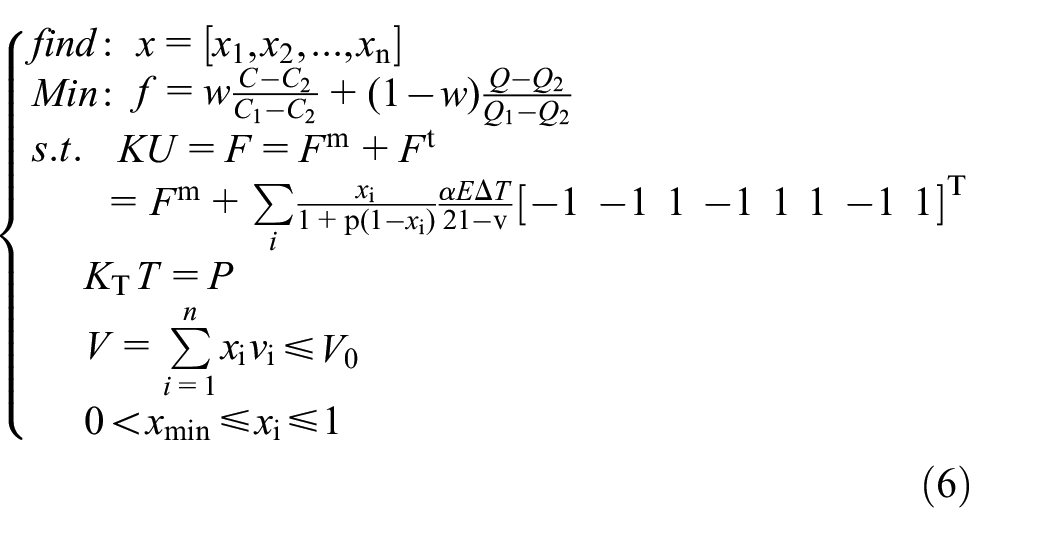
where
Sensitivity analysis of the objective function
In the iterative process of the design variables, the target sensitivity and volume sensitivity of the design variables need to be obtained. From equation (6), it can be concluded that the sensitivity of the objective function mainly includes two parts: compliance and temperature. The specific expression is as follows:

Sensitivity analysis of the compliance
According to the analysis of the heat balance and the equivalent thermal load, the compliance stiffness optimization objective function is written as

The direct method 26 was used to calculate the sensitivity information of the compliance objective function to the structural design variables:

The stress load vector

Submitting the equation (9), the sensitivity for the compliance is obtained:

where
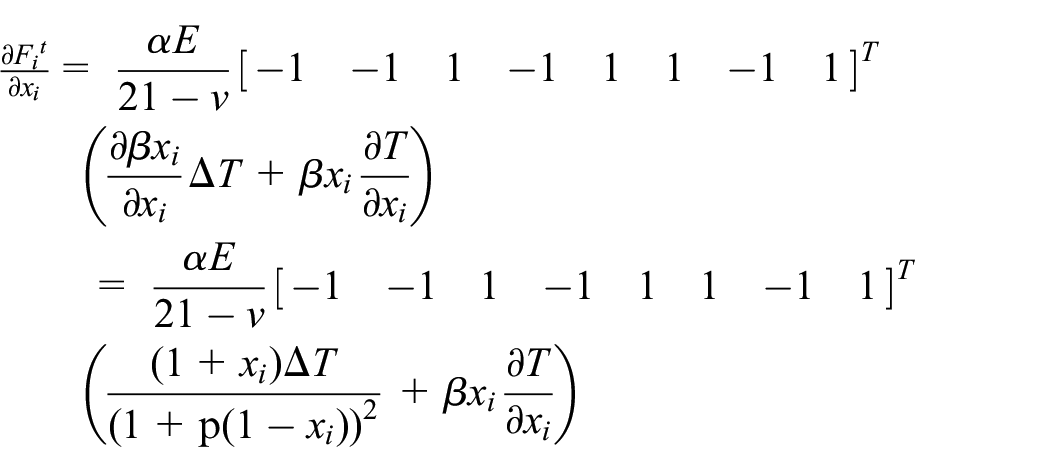
Sensitivity analysis for the temperature
In terms of calculating the sensitivity of the temperature field, the heat dissipation weakness due to the internal heat generation can be obtained

where T is the temperature vector, the expression of KT in finite elements based on the modified SIMP interpolation model is
The sensitivity of heat dissipation weakness is:

The structure analysis of high-speed precision ball bearing cage
Bearing assembly of control momentum gyroscope (CMG) is an important part to the attitude control in the spacecrafts because of its high control precision and large output torque. During the working process of high-speed precision bearings, various components lubricate and rub against each other, which together affect the temperature and structural stiffness of the bearing. The cross-sectional view of the high-speed precision bearing and the names of the corresponding parts are shown in Figure 2. As an important part of the bearing, the cage not only can improve the internal load distribution and lubrication of the bearing, but also can transfer the frictional heat during the working process.

The structure of high-speed precision ball bearings.
The heat of the cage during operation is mainly due to the friction between the cage and various components, the friction between the ball and the pocket is the main source. As shown in Figure 3(a), the sliding friction force between the cage and the pocket is determined by the size of the normal force between the pocket and the steel ball, the properties of the lubricating oil and the shape of the pocket. Its sliding friction heat generation rate and heat flow density can be expressed as:


Schematic diagram of the force of the cage: (a) sliding friction between balls and cage pockets and (b) The centrifugal force of the cage.
where
During the working process of the cage, the force mainly includes the effect of the steel ball, the centrifugal force and the unbalanced force. In this paper, only the influence of centrifugal force during the operation is considered. As shown in Figure 3(b), the centrifugal force is mainly affected by the mass and the rotation speed and diameter of the cage, the mass is affected by the material and the volume. The structural load is as follows:

where m is the mass, v is the rotation speed of cage during operation, r is the diameter of cage.
Analysis and topology optimization design of cage
Based on the thermo-mechanical coupling model, the shape of the cage is optimized. Compare of topology optimized cages and initial structure, analyze the changes in heat dissipation and structural stiffness of the cage at different speeds.
Optimization results for the cage
The structural stiffness and heat dissipation performance of the B7004C cage will have a significant impact on its actual operation, so we choose this type of bearing as the object of study, the specific information of the bearing is shown in Table 1. The outer diameter of the cage is 35 mm, the thickness is 2.5 mm, and the diameter of the pocket is 6 mm, the material of this type of cage is PTFE. During the topology optimization of the cage, the hollow cylindrical cage is expanded into a plate shape for analysis.
Specifications of B7004C bearing.

Figure 4(a) shows the initial structural design of the cage, where pockets are defined as non-design areas. Figure 4(b) shows the actual load condition of the cage during the topology optimization process. Due to the particularity of cage with plate structure, the displacement of the left and right boundaries is constrained to be 0. The stress of the cage considers the influence of centrifugal force, and the thermal load on the cage is the sliding friction force between the steel ball and the cage.

Structural optimization of cage: (a) the topology optimization model of cage and (b) the load condition of the cage.
In the actual topology of the cage, considering the speed at 6000 rpm, heat source intensity
Cage topology optimized configuration.
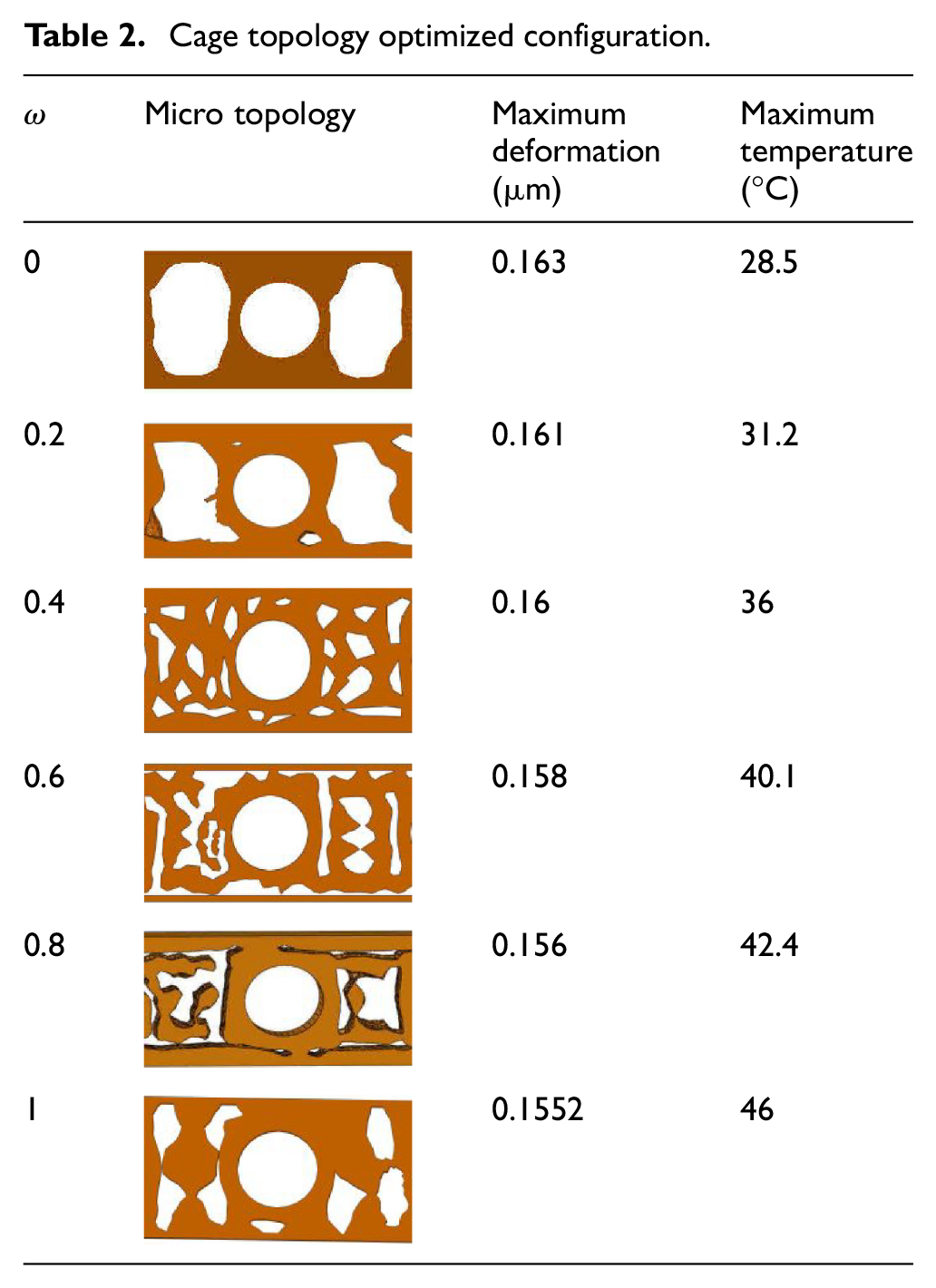
When the weight coefficient is 0, only the heat effect of the cage is considered, the heat is mainly due to the friction between the pocket and the ball. Thus, the main optimization area of the cage is concentrated on pocket. As the weight coefficient increases, the structural change of the cage transitions between heat dissipation and structural stiffness. In the topology optimization configuration with compliance as the optimization goal, the load of the main structure of the cage is centrifugal force, and the main optimization area is distributed from the sides to the center of the pocket.
From the maximum deformation and temperature difference of the optimized cage, when the weight coefficient is 0.4, the heat dissipation and the structural stiffness are improved at the same time. The comprehensive performance is the best.
The topology optimized configuration obtained by unfolding the cage in the circumferential direction cannot simulate the actual operating conditions, so the optimized configuration is reshaped into a ring cage in ANSYS. In the process of reshaping the cage, the boundary of the cage is smoothed by manual extraction, the final cage topology process is shown in Figure 5. From the topology optimization process of the cage that as the time step increases, the cage layout tends to be reasonable.

Topology optimization design of cage based on SIMP.
The structure of topology optimized cage
The topology of the cage unfolding in the circumferential direction cannot directly reflect the working conditions of the cage in actual work. Thus, the finite element method is used to restore the cage and simulate the structural stiffness and heat dissipation of the cage in operation.
Simulated cage at 6000 rpm, ambient temperature is 26°C. The frictional force between the pocket and the cage generates heat, assuming that the cage is subjected to heat flow

Temperature nephogram: (a) cage initial structure and (b) cage optimized structure.
As shown in temperature nephogram in Figure 6, the main heat generating part of the cage is the pocket, so its maximum temperature is concentrated around the pocket. Compared with the initial structure in Figure 8(a), the maximum temperature of the optimized cage is reduced by about 27%, and its average temperature is reduced. After optimization, the overall temperature field of the cage is more evenly distributed than the initial structure, and the temperature gradient is significantly reduced. Therefore, the heat dissipation performance of the optimized cage is improved.
The cage is easily deformed and broken during the working process, so the configuration of the optimized cage should be optimized at the part with a large bearing capacity. From the stress comparison in Figure 7(a), the maximum stress of the optimized cage is reduced from 0.47 to 0.41 MPa. Simultaneously, the stress distribution of the optimized cage is more uniform, and the phenomenon of stress concentration is less. As indicated by the stress and deformation in Figure 8(b), although the maximum deformation of the optimized cage increases from 0.138 to 0.16 μm, which is a slight increasement, but the area of large deformation is reduced and the large deformation is distributed to all parts of the cage. The average deformation of the cage is reduced from 0.0485 to 0.0453 μm, indicating that the optimized cage has better resistance to deformation. In the same operating environment, the structural stiffness of the optimized cage is improved.
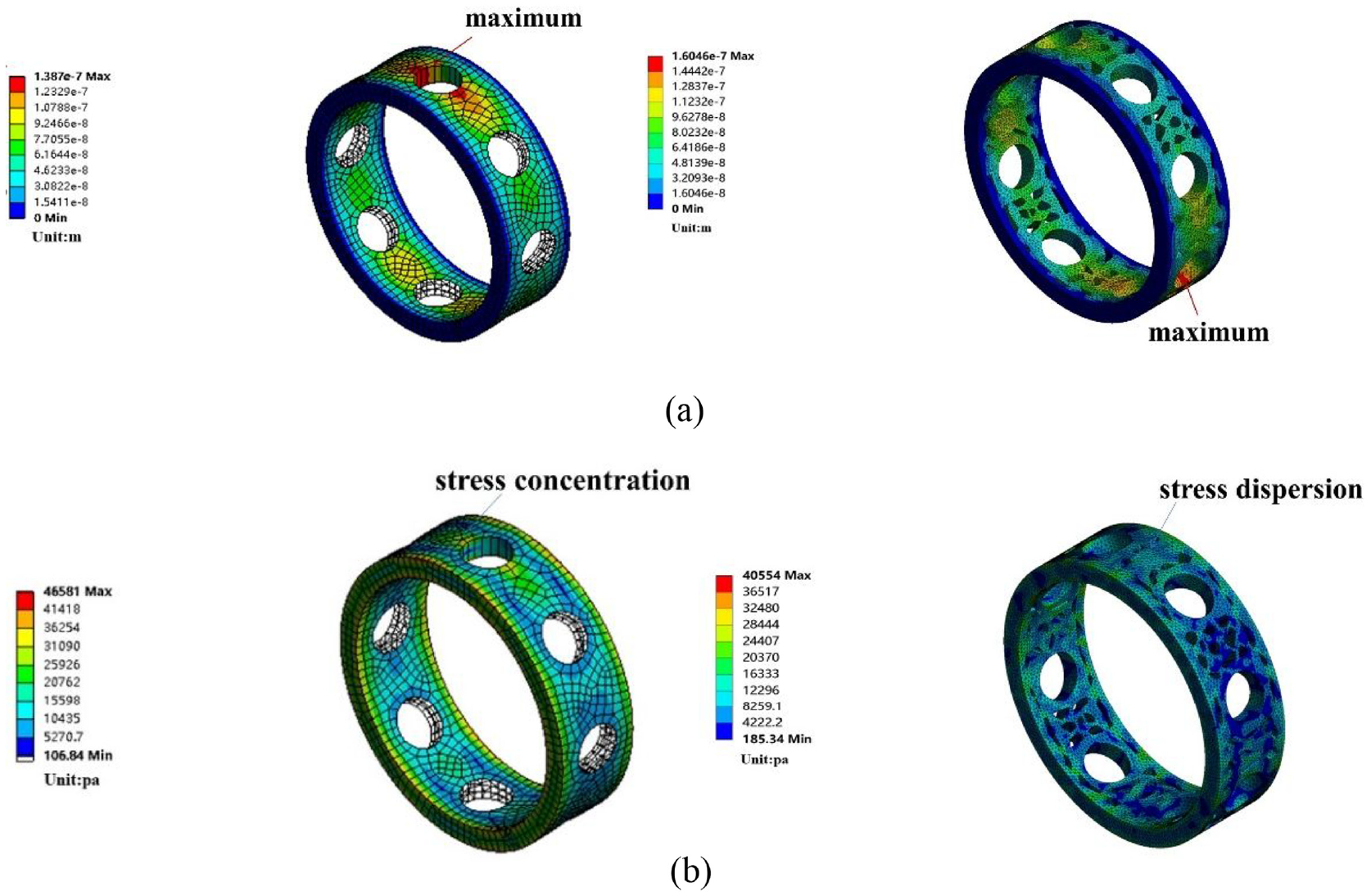
Comparison of structural performance: (a) comparison of stress contours and (b) comparison of deformation contours.

Results of the comparison of cage: (a) results of the comparison of temperature and (b) results of the comparison of structural performance.
Structural analysis under different rotational speed
The novel cage is designed by the topology optimization method, and the finite element simulation in section 4.2 confirms the improvement of structural stiffness and heat dissipation at a certain speed. In this section, the improved performance of the novel cage at different speeds will be discussed.
As the rotational speed of the cage increases, its temperature will increase under the same conditions. It can be seen from Figure 9(a) that at the same rotational speed, the maximum temperature and temperature gradient of the optimized cage are always lower than the initial configuration, and the heat dissipation is better. In terms of structural stiffness, the optimized cage reduces the maximum stress at the same rotational speed, and reducing the stress concentration. Therefore, the novel cage can be applied to various rotational speeds.

Comparison of performance at different speeds: (a) heat dissipation and (b) structural stiffness.
Experiments
Taking the radial stiffness of the cage as the research objects, the optimized cage and initial structure are manufactured by additive manufacturing technology. In this paper, the displacement of the cage under different radial forces is measured by experiments to evaluate the structural stiffness of the cage.
Experimental machine and operation
The radial stiffness evaluation of the cage can be realized by measuring its displacement under different radial forces. First, the cage is manufactured using additive manufacturing technology. Fused deposition modeling (FDM) is suitable for cage fabrication due to its ease of fabrication of complex part designs, and the printed cage structure is shown in Figure 10(b). Second, the precision tensile testing machine is used to evaluate the radial stiffness of the cage. The cage is placed on the pressure plate, the cage displacement under a specific radial force can be measured and the radial stiffness performance of the cage can be evaluated. The experimental machine is shown in Figure 10(a), and its specific parameters are shown in Table 3. Final, the displacement of the cage under different radial forces is measured and compared with the simulation results, while multiple experiments are performed to prevent accidental deviations during the experiment.

The main process of the experiment: (a) experimental platform, (b) the #D printing structure, and (c) loading.
Experimental machine specific information.

Analysis of experimental results
Compared with the original cage, the experimental results in Figure 11 show that the displacement of the optimized cage has less displacement under the same loading force. When the radial force is 5 N, the displacement of the cage is reduced by 16.7%, so the optimized cage has the better radial stiffness. The displacement-force relationship of the experiment results basically coincides with the simulation results, and the slight differences are caused by a combination of manufacturing errors, measurement error.

Comparison of experimental and simulation results under different forces.
In summary, the experimental results show the structural stiffness of the optimized cage is improved, which proves the feasibility of the topology optimization method in cage design.
Conclusion
In this paper, we establish a topology optimization model that considers force and thermal loads; then this model is applied to the optimal design of high-speed precision ball bearing cages. The conclusions of this paper are as follows:
Based on the thermo-mechanical coupled and the SIMP method, a multi-objective topology optimization model considering force and thermal loads coupling is established under the premise of given volume constraints. The method uses the direct method for sensitivity analysis and uses the OC criterion to solve optimization problems.
Taking the B7004C bearing cage as the research object, the topology optimization is carried out by simulating the force and thermal load in actual operation. By analyzing the heat dissipation and structural stiffness of the cage topology under different weight coefficients, the configuration with the best comprehensive performance is selected as the final cage topology optimization configuration.
Compared with the original cage, it is verified that the novel cage has improved the heat dissipation and structural stiffness based on weight reduction. The maximum temperature is reduced by about 27%, and the maximum stress is reduced by 14.8%. The overall performance of the optimized cage is improved at different rotational speeds. In addition, the improvement of the structural stiffness of the optimized cage is verified by experiments.
Footnotes
Acknowledgements
The authors would like to thank the editor and reviewers for their detailed comments which helped to improve the quality of this paper. The authors are grateful to Z.Y, F.G, J.W and F.D for his help with the preparation of Figures in this paper.
Handling Editor: Chenhui Liang
Author contributions
Conceptualization: Zhaohui Yang, Fan Guo and Fei Du; Data curation: Zhaohui Yang; Funding acquisition: Fei Du; Methodology: Jiexin Weng; Software: Jiexin Weng; Writing – original draft: Fan Guo.
Declaration of conflicting interests
The author(s) declared no potential conflicts of interest with respect to the research, authorship, and/or publication of this article.
Funding
The author(s) disclosed receipt of the following financial support for the research, authorship, and/or publication of this article: This work is funded by Science, Technology and Innovation Commission of Shenzhen Municipality (JCYJ20190806151013025), Beijing Key Laboratory of Long-life Technology of Precise Rotation and Transmission Mechanisms (NO: D5110200583).

Data availability statement
Not applicable.