




Abstract
The nonlinear continuous fatigue cumulative damage model proposed by Chaboche was modified considering the effect of crack closure on fatigue damage, and the fatigue cumulative damage and residual life evaluation model of remanufactured blanks was obtained. The related parameters of the modified model were obtained from the data of symmetric cyclic tensile and compression fatigue tests. The residual life evaluation model of remanufactured blanks was verified by the two-stage loading (high and low loading and low and high loading) tensile and compressive fatigue test. The results show that the calculated values of the model are in good agreement with the test values, which proves that the modified model can accurately predict the residual life of remanufactured blanks.
Introduction
With rapid economic development and population growth, the lack of various resources is becoming increasingly serious, highlighting the urgent need for energy conservation. Green remanufacturing technology is an effective method for saving resources. Green remanufacturing refers to a series of technical measures or engineering activities that take waste products as the remanufactured work blank and use advanced manufacturing technology as the means to repair and transform these products. 1
Local failure areas on the blank structure in the remanufacturing process can be repaired by advanced technological means. However, fatigue damage is a process of the continuous accumulation of damage; the accumulated fatigue damage generated during its long-term service still exists, and its degree of damage is closely related to the service history of the product, the state of use, the environment, and other factors. The service records of used products cannot fully record this information, and the accumulated fatigue damage analysis plays an important role in predicting the fatigue life of a build or structure. Different parameters have been used to measure the damage of the material after managerial loading from different perspectives. Therefore, how to accurately describe the cumulative fatigue damage in the remanufactured workblank is a key factor restricting the assessment of its remaining life.
In this paper, the nonlinear continuous fatigue cumulative damage model proposed by Chaboche was modified based on the effect of the crack closure on the fatigue cumulative damage, and a new model was obtained to evaluate the remaining life of remanufactured blanks with a view to obtaining higher predictions. This guarantees the normal working capacity of the material, the safety of its use, and the economic efficiency of the enterprise.
Literature review
Since Palmmgren introduced the concept of fatigue damage in 1924, researchers have proposed more than 50 fatigue cumulative damage models. 2 Crack closure is a common phenomenon and can be caused by a variety of potential factors such as debris, oxides, or chemical deposits within the crack. 3
In the 1950s, Zapffe and Worden 4 discovered special features with the aid of electron microscopy and showed that crack growth was cyclical. In the 1960s, Sihet al. 5 used the stress intensity factor to describe the expansion of fatigue cracks. In the 1970s, Wolf formally proposed the concept of crack closure, 6 Johan Singh et al. used the concept of crack closure proposed by Wolf to conduct an experimental study on fatigue crack propagation of AISI 316 (N) weld, and compared the results with the results measured by acoustic emission technology. The results were in good agreement. 7 Subsequently, based on previous studies, several other mechanisms leading to crack closure, such as roughness-induced crack closure, 8 oxidation-induced crack closure, 9 and phase change-induced crack closure, 10 have been proposed by researchers. Mcclung 11 considered plasticity-induced crack closure when studying the size of the forward and reverse plastic zone at the crack tip and developed new models for predicting the plastic zone size. Pippan and Hohenwarter 12 synthesized three types of crack closure, plasticity, roughness, and oxide, with special attention to the effect of the experimental measurements on the fatigue crack extension. Cuenca and Serna, 13 in order to evaluate the autogenous self-healing and self-healing ability of early ultra-high performance fiber-reinforced concrete, conducted experiments to compare and analyze the crack closure on the specimen surface with the help of digital microscope measurements. Based on the original method, Xie et al. 14 proposed the axial stress difference method for objectively obtaining the crack closure stress. Enaki and Macovei 15 proposed an RICC model and a new method to evaluate fatigue crack closure, simulate fatigue crack closure, perform crack closure, and evaluate real cracks in use. Khoei and Eghbalian 16 studied the evolution pattern of the damage and destruction of ductile metals in cyclic loading; their case study analyzed the fatigue behavior and life assessment of the alloy and compared the results with the experimental data. Aktaaet al. 17 developed a new fracture mechanics method to determine the mode varying crack loading and to predict the crack expansion capacity.
Commonly used models include the linear fatigue accumulation damage model, 18 the bilinear fatigue accumulation damage model, 19 the energy-based fatigue accumulation damage model,20–22 etc. These models are all designed to consider the effect of crack closure on fatigue damage. However, crack closure leads to the hindrance of fatigue crack expansion, so it can enhance the damage tolerance properties of materials and structures prone to fatigue fracture. Ignoring crack closure effects often leads to overly conservative life estimates, which can cause unnecessary material and economic losses.
Subsequently, the model proposed by Chaboche and Lesne 23 has been more widely used because it takes into account the effects of damage caused by stresses below the fatigue limit, the loading sequence, and the average stress, and the model parameters are easily accessible.24–27
Therefore, the effect of the crack closure on fatigue damage is considered in the life assessment analysis in this paper to improve the accuracy and economy of the life assessment model, which is of great significance for the life assessment of remanufactured blanks.
Modification of the nonlinear fatigue cumulative damage model
The nonlinear continuous fatigue cumulative damage model proposed by Chaboche and Lesne is as follows 23 :

For the uniaxial fatigue problem, Chaboche and Lesne suggests using equation (2) to express the relationship between the damage and the number of fatigue loads 23 :

In the above two equations,
Dattoma et al. and Giancane et al. suggested that

where if
Effect of the crack closure on fatigue damage
The crack closure mechanism was first proposed by Elber in 1970, whose experimental results showed that fatigue cracks could be closed. Elber believed that the fatigue crack would not expand at just any moment. The crack will open and expand only when the load is large enough to overcome the obstruction of the plastic zone at the crack tip. Before that, the crack would still be in a closed state even with the load. Accordingly, Elber proposed the concept of the effective stress intensity factor range:

In the formula,

In the formula,
According to the experimental data, the relationship equation between the effective factor of crack expansion
Expressions of effective factors for crack propagation.

In this paper, the low carbon steel Q345R produced by Masteel was the research object, so the expression provided in reference 7 was used to express the effect of the effective factor of the crack growth on the cumulative fatigue damage.
When the crack closure effect is taken into consideration, equation (1) can be modified:

Equation (2) can be modified:
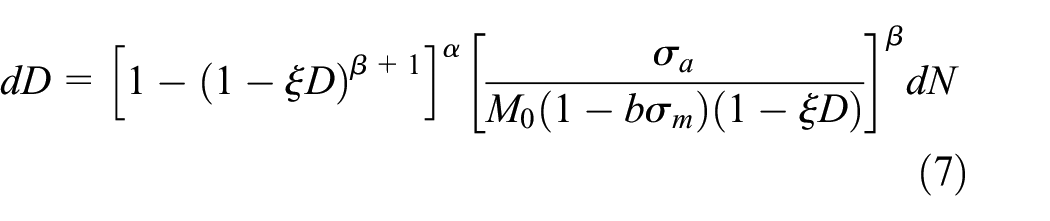
Assuming that the initial damage state of the metal material is

If the material does not fail after experiencing
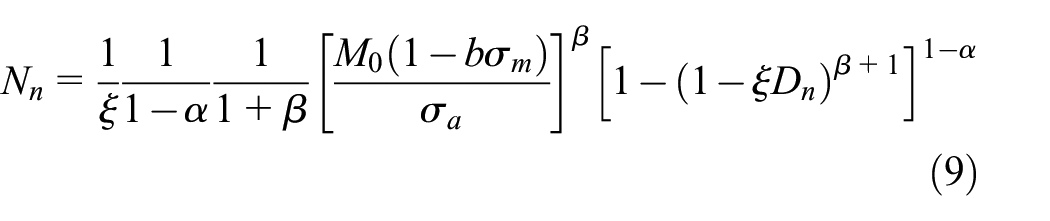
Substituting equation (9) into equation (8), the expression for the material damage variable after considering the crack closure effect is obtained as follows:

Determination of the model’s material parameters
In this paper, the Q345R steel produced by Masteel was selected to determine the material parameters of the nonlinear fatigue cumulative damage model. The main chemical composition and mechanical properties of Q345R steel are shown in Tables 2 and 3, respectively. The fatigue limit of the material involved in the model was determined by the fatigue test, and the shape and size of the specimen used in the fatigue test are shown in Figure 1.
Chemical composition of Q345R (wt%). 32

Mechanical properties of Q345R. 32


Shape and size of the fatigue specimen (unit: mm
The axial tensile and compressive fatigue test was carried out at room temperature in a standard atmosphere with a stress ratio of R = −1 and a frequency of 15 Hz. The test process was divided into six levels of stress, and three fatigue specimens were tested for each level of stress. The S-N curve of the Q345R steel obtained from the fatigue test is shown in Figure 2, and its fatigue limit was 197 MPa.

S-N curve of the Q345R steel.
Using the parameters of the material tensile strength
Remaining life assessment of remanufactured blanks
The evaluation of the residual life of the remanufacturing blank tests whether the used parts can be used for remanufacturing. If the residual life reached the lifecycle specified by the product, it could be used for remanufacturing. Otherwise, even if the used parts had no other damage, they could not be used for remanufacturing.
For remanufactured blank material, there is initial damage
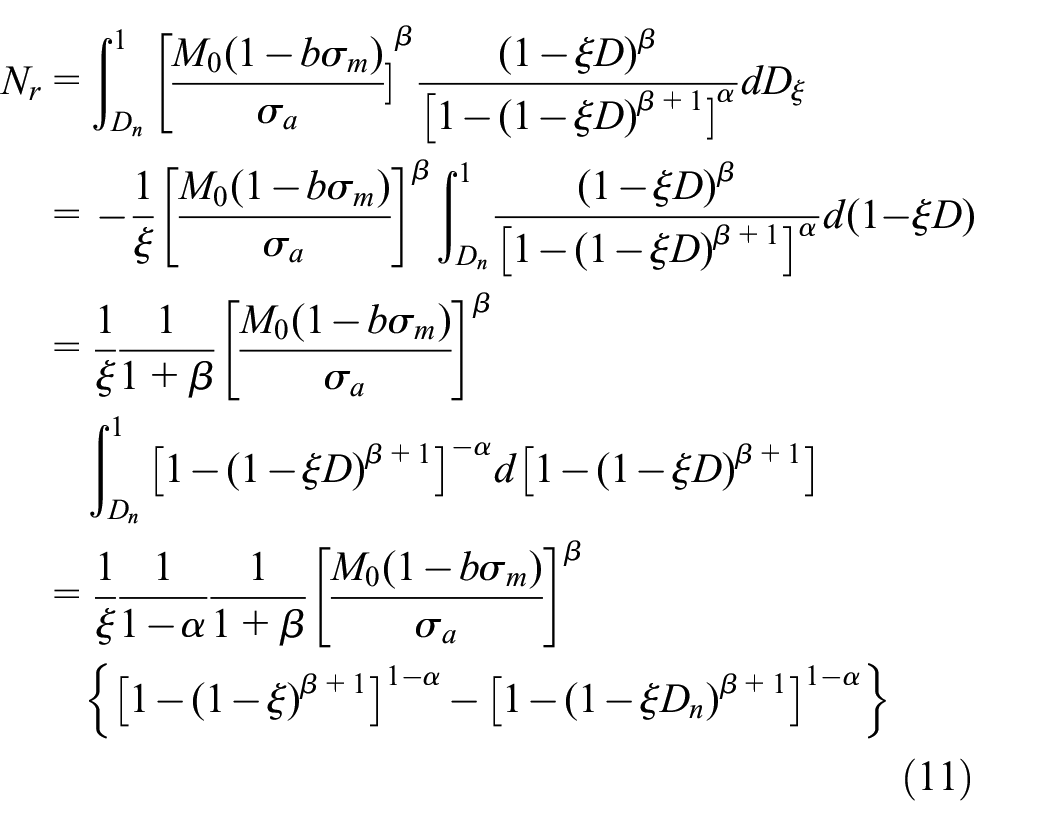
In the formula,
In order to simulate the service experience of the used parts, a two-stage stress tensile and compressive fatigue test was carried out on the material. The number of stress actions of the first stage was used to simulate the service life of the specimen before remanufacturing, and the number of stress actions of the second stage when the specimen was fractured simulated its remaining life. During the test, the stress ratio was R = −1, and the frequency was 15 Hz. A high–low (low–high) fatigue load was used to load the fatigue specimen. After loading under the first stress for a certain number of times, the fatigue load was converted to the second stress, which continued until the specimen failed. The remaining life of the specimen was calculated according to formula (11), and the actual action times of the second-stage load were compared to verify the correctness of the model.
The two-stage loads used in the two-stage stress tension and compression fatigue test were 340 and 300 MPa. There were two conditions in the test: first, high load was applied, then, it was converted to low load after 20,000 times, until the specimen broke; second, a low load was applied, then, a high load was applied after 50,000 times, until the specimen broke. The second-stage loading times were recorded and compared with the remaining life calculated by Equation (11). The results showed that the calculated results of the model were in good agreement with the test values with the low–high loading method, and the error between the two was only 13.76%; however, the error between the two was as high as 61.21% under the high–low loading method, and the accuracy of the model was poor. Through analysis, we found that the Chaboche nonlinear continuous fatigue cumulative damage model considered the influence of loading order; however, the effect of the loading order on the crack closure was not considered when the crack closure effect was introduced to modify the model. Hence, the model accuracy was poor.
In order to consider the influence of the load loading sequence on the crack closure effect, assuming a two-stage loading fatigue test, the number of acts of the first stage of the load was

In the formula,
The difference between the actual damage and the calculated damage was caused by the different effects of the different loads on the crack closure. Therefore, the effective crack growth factor was modified by the following equation:

In the formula,
Thus, equation (11) for the residual fatigue life of the remanufacturing blanks was modified as follows:

In the formula,
After introducing the loading sequence on the crack closure effect, the model accuracy was improved greatly. The main reason was the load; when the load shifted from one block to the other, the crack propagation mechanism changed obviously, and when load shifted from high to low or from low to high, the change law of the crack propagation mechanism was not the same. 26 So, considering the influence of the loading sequence, the accuracy of the model was improved by maintaining the actual situation of the crack propagation under load. The specific test and model calculation results are shown in Table 4. The calculation results of the Chaboche model are also listed in the table. The error between the calculated life of the Chaboche model and the test life was 21.25% in the case of low–high loading, while the error between the two was as high as 84.95% in the case of high–low loading. It was higher than that of the first revised model (13.76% and 61.21%) and much higher than that of the second revised model (4.09% and 12.98%).
Test and model calculation results.

The used fatigue life of the material was estimated from its service history; then, its initial damage
Conclusion
The symmetrical cyclic tension–compression fatigue test of the Q345R steel at room temperature was carried out, and the S-N curve of the tension–compression fatigue was obtained.
A two-stage load loading symmetric cyclic tensile fatigue test was introduced; the number of times the first-stage load was applied simulated the service life of the remanufactured blanks, and the number of times the second-stage load was applied simulated the remaining life of the remanufactured blanks.
The nonlinear continuous fatigue cumulative damage model proposed by Chaboche was modified with consideration of the effect of the crack closure on the damage, and the relevant parameters in the model were derived using the fatigue test data. The modified fatigue cumulative damage model was in good agreement with the test results.
The remanufactured blank remaining life assessment model was obtained from the modified nonlinear continuous fatigue cumulative damage model, and the blank remaining life assessment model was further modified through consideration of the influence of the loading sequence on the crack closure effect; the results of the secondary loading fatigue test showed that the model in this paper had high calculation accuracy and can fully meet the research needs.
Footnotes
Acknowledgements
The authors would like to gratefully acknowledge the Youth Foundation of National Natural Science Foundation of China, Grant No. 51105205, the Excellent Scientific and Technological Innovation team of Universities in Jiangsu Province, Grant No. 2019042, the Science and Technology Foundation of Guizhou Province, Grant No.2019040, and the Natural Science Research Project of Jiangsu Universities, Grant No.21KJB580018.
Handling Editor: Chenhui Liang
Declaration of conflicting interests
The author(s) declared no potential conflicts of interest with respect to the research, authorship, and/or publication of this article.
Funding
The author(s) disclosed receipt of the following financial support for the research, authorship, and/or publication of this article: This research was funded by the Youth Foundation of the National Natural Science Foundation of China, Grant No. 51105205, the Excellent Scientific and Technological Innovation team of Universities in Jiangsu Province, Grant No. 2019042, the Qinglan Engineering of Jiangsu, Grant No. 2022060, the Science and Technology Foundation of Guizhou Province, Grant No.2019040, and the Natural Science Research Project of Jiangsu Universities, Grant No.21KJB580018.

Data availability
Some or all data, models, or code generated or used during the study are available in a repository or online in accordance with funder data retention policies. The data used to support the findings of this study can be obtained from the authors upon request.