



Abstract
Weak fault detection of rolling bearing presents difficult, because the periodic transient signature produced via localized incipient damage is easily submerged by various interference components and background noise. Hybrid intelligent fusion method is a breakthrough strategy for revealing feature frequency of rolling bearing fault by comprehensively using a variety of intelligent signal processing technologies, possessing the advantage of each technology. Considering the rolling bearing often construct a transmission device combination with gear and shaft, its vibration signal is often vulnerable to other multi-morphology components, such as harmonic modulation, noise. Thus, how to identify the fault frequency in repetitive transients is crucial to accurately identify rolling bearing fault detection. To address this issue, a novel hybrid intelligent method is proposed to effectively apply on periodic transients extraction, enhancement and rolling bearing fault diagnosis. The innovation of this method is to solve three problems, namely, the separation of multi-morphology components, noise reduction without periodic transients distortion, weak fault frequency enhancement. The proposed method is tested and validated on simulated signal, rolling bearing fault signal from accelerated rolling bearing degradation rig. In addition, comparisons with other classical rolling bearing fault detection methods have been conducted to highlight the superiority of the proposed methodology.
Keywords
Introduction
Rolling bearing is a precise mechanical component of transmission device, which is often affected by axial load, radial load, impact load, and various external excitations under complex operating condition, as a result, the structural fatigue cracks can be easily induced in internal components. If appropriate maintenance strategies are not implemented in time, it is convenient to cause the breakdown of the transmission device, which may result in considerable economic losses. Therefore, weak fault detection of the rolling bearing is vital for ensuring the safety and reliability of transmission device.
In reality, rolling bearing fault vibration signal often exhibits similar transient translation phenomenon commonly, as a result, repetitive transients can be regarded naturally as the translation result of first transient. On the other hand, the rolling bearing fault vibration signal also contains strong interference components. Considering repetitive transients in vibration signal often reflect rolling bearing incipient fault, using proper signal processing methods to extract and enhance periodic transients from vibration signal, and furthermore identify fault frequency is primary for rolling bearing condition maintenance.
The typical methods for rolling bearing fault detection can be roughly considered as joint time-frequency,1,2 filter technology3,4 and time domain adaptive decomposition,5,6 such as variational mode decomposition (VMD), empirical mode decomposition. These methods prominently promote safety working level. Compared with time-frequency, morphological component analysis (MCA)7,8 uses parameterized waveform which can self-adaptive conform to actual signal structure characteristic and directly extract fault frequency consequently. Recently, some new approaches, for example, dynamic model theory, 9 based on blind deconvolution method, a series of improvement algorithms, such as minimum entropy deconvolution, 10 maximum correlated kurtosis deconvolution, 11 multipoint optimal minimum entropy deconvolution adjusted 12 also have been developed and applied for detecting fault. By utilizing filter technology, a series of application methods are utilized to enhance the repetitive transients induced by the localized defect in rolling bearing or determine the frequency band containing diagnostic information, such as spectral kurtosis, 13 Autogram, 14 and average Inforgram. 15 Besides, the sparse decomposition represented by resonance sparse signal decomposition (RSSD) 16 is also widely used, it can separate signal into different sub-signals according to resonant property. However, its separation effect is compactly related with parameter values in RSSD, so how to determine the reasonable values is an unavoidable problem, especially for the extraction of periodic transients. Furthermore, in the context of incipient rolling bearing fault, repetitive transients are often submerged by strong background noise, resulting in weak fault phenomenon, so it is necessary to develop a specific noise reduction method which can remove as many noise as possible while maintaining effectively periodic transients. As wavelet transform can effectively separate useful component and noise in time domain, threshold method based on wavelet transform is widely used consequently, such as NSDWT, 17 ACWT, 18 RSGWT 19 and so on. However, these methods present signal distortion deficiency when dealing with periodic transients. Due to down-sampled operation and sub-division operation, the existing wavelet transform presents translation-varying defect, if these methods are applied directly on periodic transients, the decomposed coefficient energy has large fluctuation. As a result, applying those methods to achieve noise reduction will inevitably miss some weak periodic transients. Concentrating on detecting rolling bearing incipient fault, a novel hybrid intelligent fusion diagnosis method need to address following issues, concentrating on how accurately extracting periodic transients from fault vibration signal, achieving noise reduction without periodic transients distortion, identifying and enhancing weak fault frequency from spectrum respectively.
Hence, a novel hybrid intelligence fusion method by making full use of RSSD, DTCWT and IES is proposed and can effectively make up for the deficiency of a single signal processing algorithm. In the new method, firstly, an optimal Q-factor resonance sparse decomposition is designed for achieving periodic transients extraction by the superior matching to sparse basis function. Furthermore, we also give a no distortion noise reduction based on dual tree complex wavelet adjacent coefficient contraction, it can not only effectively extrude transient component energy, but also has amplitude fidelity. Finally, we put forward an improved envelope spectrum and use it to identify and enhance rolling bearing weak fault frequency. Simulation signal and rolling bearing fault signal shows that the proposed hybrid intelligence fusion method can effectively be applied on rolling bearing incipient fault diagnosis.
Proposed method in this paper
The remainder of this paper is organized as follows. In Section 2, we give an optimal Q-factor RSSD to extract repetitive transients, and a neighcoeff threshold based on DTCWT is proposed to achieve noise reduction without distortion, finally, a weak fault frequency identification and enhancement based on IES is developed. As for rolling bearing incipient fault, we divide it into three dominating problems, as for each problem, we use targeted algorithm to solve it and achieve algorithm fusion which can effectively improve the accuracy of diagnosis. In Section 3, the performance of proposed method is validated using the simulated signal and compared with the reported methods. Section 4 presents the result of proposed method and reported methods on the experimental rolling bearing fault signal. The main conclusions are summarized in Section 5.
Solving solution of first problem: An optimal Q-factor RSSD
Assuming that rolling bearing fault vibration signal


In order to accurately extracting repetitive transients from fault vibration signal

Step1: Initialization. The correspondingly QH and QL initial value is 4.0 and 1.2 respectively, and the range of QH is from 1 to 40, the range of QL is from 1 to 10, as for redundancy factor r, its constant value is 3.
Step2: Optimizing QL value. We need to fix QH value at initial value. In every interval ΔQ, we take an assigned value to QL, and using RSSD to decompose vibration signal into high and low resonance component, calculating kurtosis value of low resonance component. Finally, through fitting algorithm, an optimal QL value can be obtained corresponding to maximum kurtosis value, which is symbolized as
Step3: Optimizing QH value. We fix QL value at
Step4: Iteration. As long as QH or QL does not meet the convergence condition, corresponding optimization process is continued, and replacing existing value, repeating step2-step3.
Step5: Termination. When both QH and QL converge to corresponding optimal values, and they do not exceed the specified number of iterations, the whole optimization process is finished.

An optimal Q-factor based RSSD based on stepwise iterative optimization.
Solving solution of second problem: A neighcoeff threshold based on DTCWT
Although the low resonance component
Step1: Transformation. The low resonance component

Step2: Grouping. Grouping wavelet coefficients at each scale, such as J scale (the number of members is defined as 1 in each group
Step3: Adjacent threshold reduces noise. Adopting NeighCoff contraction rule to process each wavelet coefficient



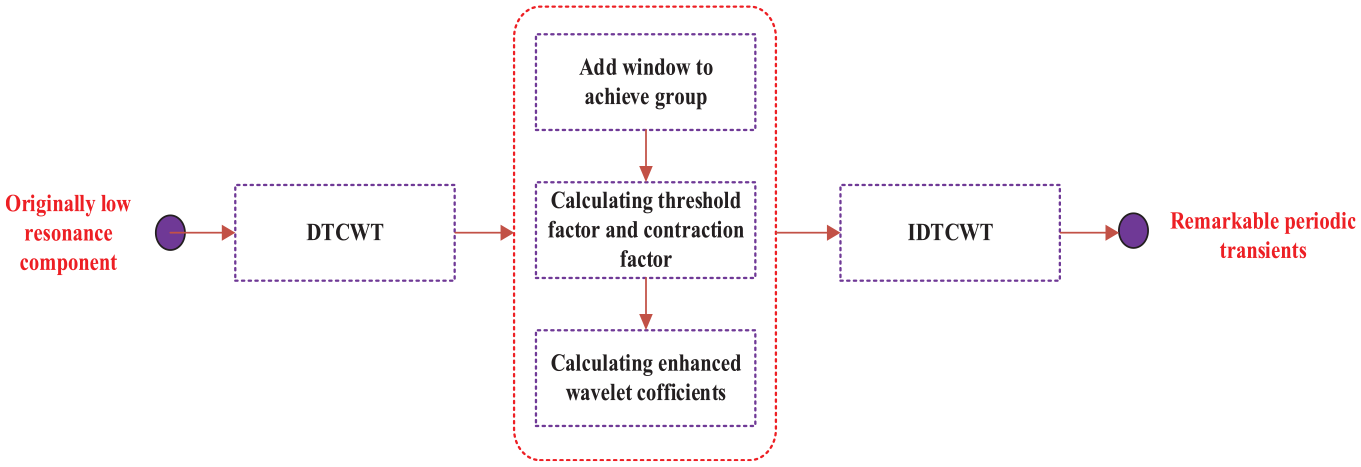
A noise reduction algorithm based on DTCWT neighcoeff threshold.
Finally, the wavelet coefficients by noise reduction are calculated in formula (9).

Step4: Inverse transformation. The remarkable periodic transients

Solving solution of second problem: a fault frequency identification and enhancement based on improved envelope spectrum
When we possess the remarkable periodic transients
To address this issue, a Candidate Fault Frequencies Optimization-gram (CFFOgram) is proposed to locate the informative spectral frequency band from SCoh as shown in Figure 3. It can automatically identify potential fault frequency based on local peak values of SCoh and converts the integral range from full frequency band to informative band which suppress the effect of interference. Furthermore, an improved ES (IES) based on CFFOgram is given to identify the fault-related cyclic frequencies. It is certain that this advantage can reveal the fault information hidden in the SCoh plane and is suitable for weak fault frequency enhancement of rolling bearing.
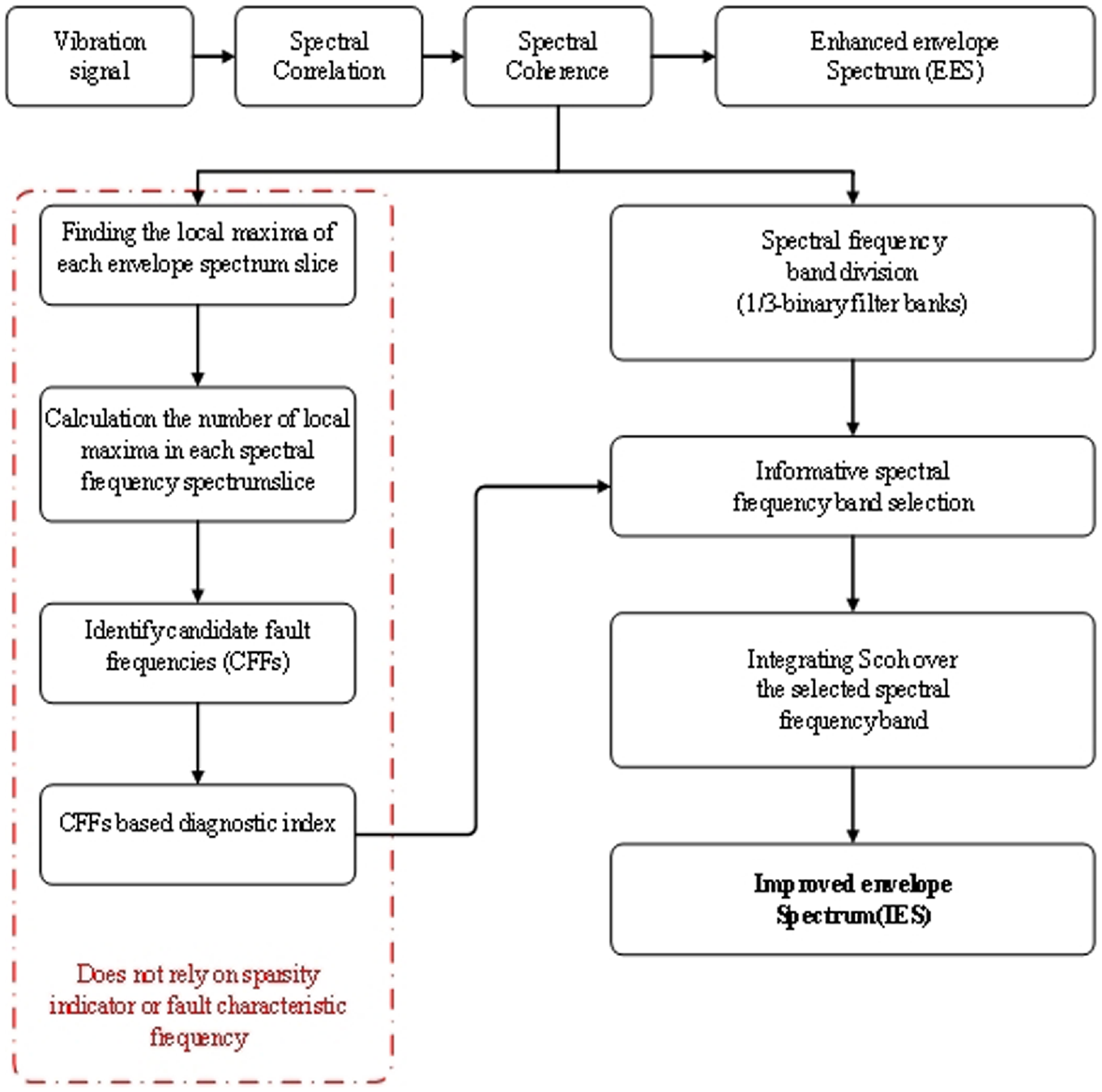
The flow chart of IES based on CFFOgram.
Given the remarkable periodic transients

Furthermore, we derive the double discrete Fourier transform of
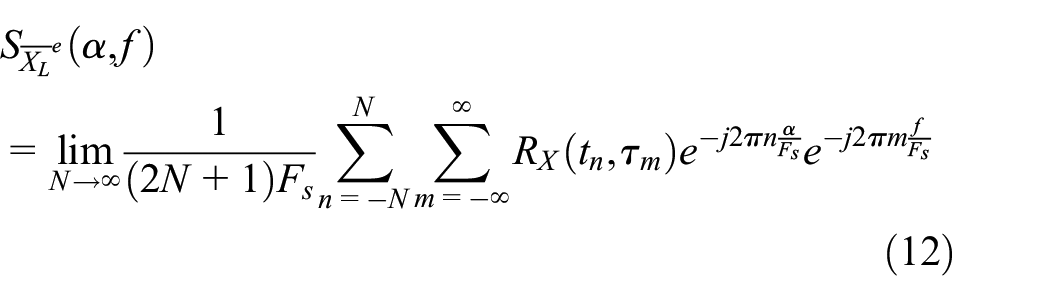

In order to compute IES conveniently, we give a normalized expression of

As
Firstly, we discretize

Secondly, we need to focus on the non-zero elements in the matrix

The n-th element
For any
If
The advantage of indicator

It can be seen that the CFFs

Besides, we use the ratio of the energy of all CFFs to the energy of

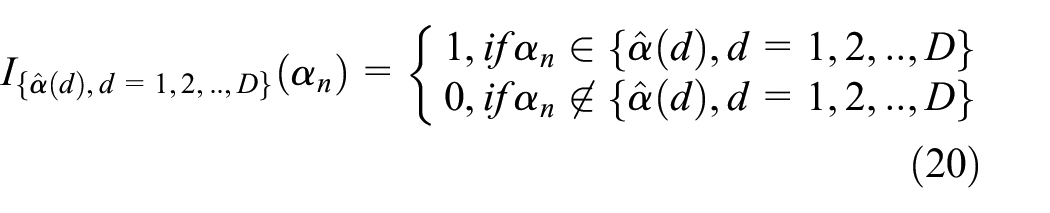
As for
Step1: Giving an appropriate window length Nw and maximum cyclic frequency
Step2: The full spectral frequency band in SCoh is divided into a series of narrowbands by using the 1/3-binary tree structure strategy, and calculating its corresponding
Step3: Identifying the CFFs on the entire SCoh plane and calculating the diagnostic index DI of corresponding narrow band
Step 4: Selecting the spectral frequency narrowband presenting the maximum DI value and its IES acts as the optimal envelope object to perform weak rolling bearing fault detection.
Finally, considering that the IESCFFOgram algorithm involves some parameters, their settings must be careful. For example, the window length of STFT Nw in fast SC algorithm determines the spectral frequency resolution, the maximum cyclic frequency

Simulation rolling bearing fault vibration signal analysis
Rolling bearing fault vibration signal model
In this section, we apply a simulation signal to demonstrate the feasibility of proposed method and corresponding flowchart is shown in Figure 4.

The demonstration on proposed method by simulation signal.
We give a rolling bearing fault vibration simulation signal as shown in formula (22).

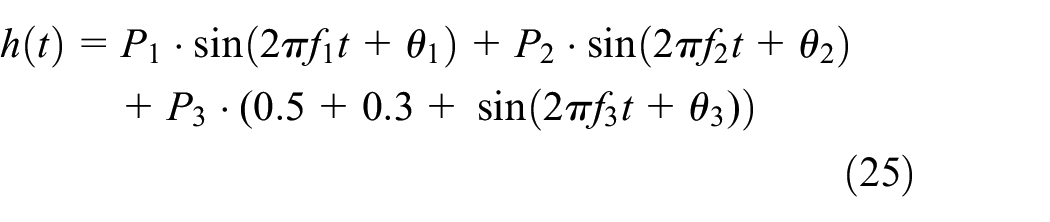
In above formula,

Where

As for
Parameters of the discrete harmonic signal.

As for

The simulated signal.
Furthermore, the spectrum in Figure 6 presents strong harmonic phenomenon in low frequency range, so that the fault-related frequency is barely identified in the resonance frequency band centered at 2.45 kHz.

The spectrum of simulated signal.
Adopting optimal Q-factor RSSD to separate signal

The varying low of Q-factor on the process of iteration.
According to the above procedures, the decomposition result is shown as follows. Figure 8 on top is high resonant component, reflecting obvious modulation characteristic, Figure 8 in the middle is low resonance component

Signal decomposition based on optimal Q-factor RSSD.
Furthermore, applying neighcoeff threshold based DTCWT on low resonance component

Sub-signals obtained by neighcoeff threshold based DTCWT.
Finally, we combine those sub-signals into a remarkable periodic transients

Remarkable periodic transients
Now, we give the SCoh of remarkable periodic transients

SCoh of enhancement low resonance component.

Envelop spectrum of EES.
For solving above problem, we use IESCFFOgram to enhance fault frequency by identifying the informative band of SCoh with
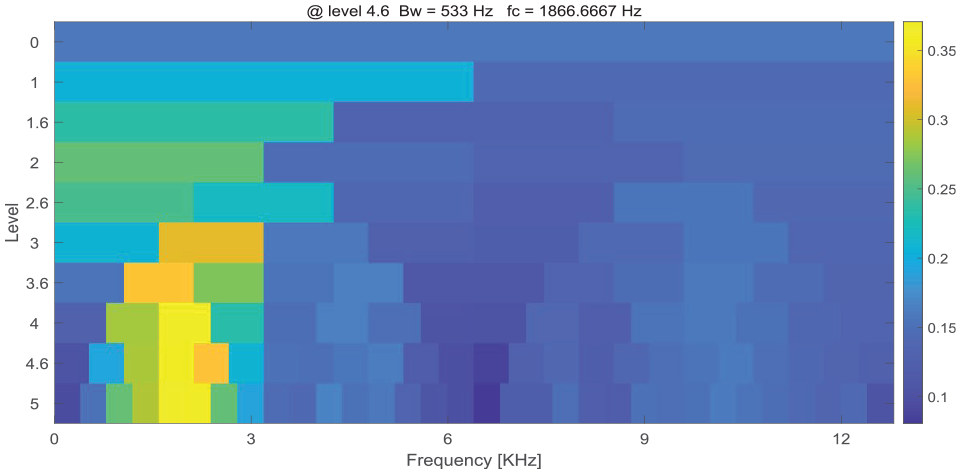
IESCFFOgram of enhancement low resonance component.
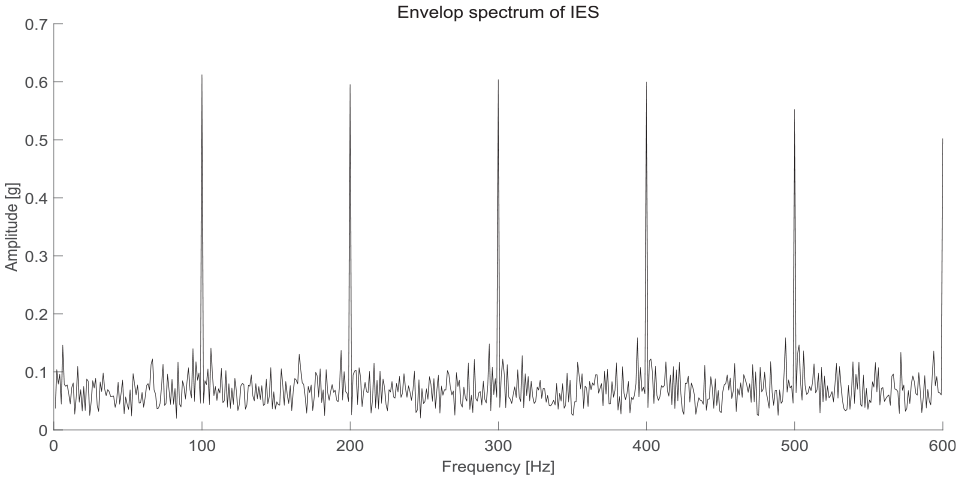
IES of simulation signal.
Anti-interference performance evaluation
For quantitatively analyzing the diagnosis effect of proposed method on incipient fault, an adjusted diagnostic feature (ADF) is utilized to quantify the performances of anti-interference in formula (26), the ADF is defined to be the sum of the H-harmonics of fault frequency fm under the given noise level, in this paper, the value of H is 5, where the

In this section, we also use the simulation signal in section 3.1, and the SNR which is changed by varying the standard deviation of the white noise from 0.29 to 15.29 with equal spacing of 1.5 is investigated to compare the result of proposed method on ADF. Figure 15 displays the ADF values determined by the proposed method and EES which is used in place of the IES.

ADF values for processing the simulated fault signal under the verity of different standard deviations.
It can be seen that the proposed method does have a slight advantage under the interference of strong background noise, as the noise becomes strengthening, indicator ADF decreases slowly, but this phenomenon is not very significant. Considering the dominating function of the IESCFFOgram is to enhance the weak fault frequency, in order to present its superiority, we also give the ADF values corresponding to EES instead of IESCFFOgram, it can be seen that the values is obviously lower compared with IES, and they are sensitive to strong noise, especially if the standard deviation exceeds 10, they fluctuate within.10,16 On the contrary, the proposed method demonstrated good resistance to the fluctuation. The above analysis fully illustrates that, in the presence of strong interference, the proposed method is a better choice for revealing the hidden fault information.
Verification with experimental rolling bearing outer ring fault
The simulation results have verified the effectiveness of proposed method on extracting periodic transients and identifying and enhancing feature frequency. In this section, the diagnostic performance is demonstrated on XJTU-SY early rolling bearing outer ring fault data from school of mechanical engineering in Xi’an Jiao Tong University. Figure 16 displays the rolling bearing accelerated life test bench used in this study comprising a digital display, motor speed controller, rotating shaft, AC motor, support bearing, hydraulic loading system, vertical acceleration sensor, horizontal acceleration sensor and test rolling bearing.

Rolling bearing accelerated life test bench.
The rolling bearing test bench produces variable working condition by adjusting radial force and speed, and style of fault rolling bearing is LDK UER204 as shown in Figure 17, its parameters is shown in following Table 2.
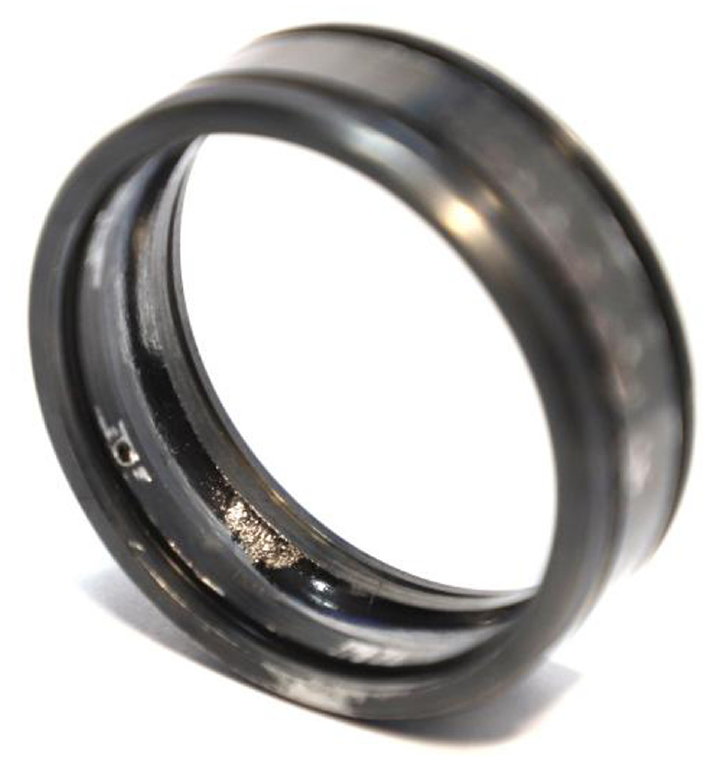
Outer race wear.
LDK UER204 rolling bearing parameters.

According to the theoretical calculation formula of rolling bearing fault frequency, corresponding outer ring fault frequency

Finally, the corresponding rolling bearing outer ring fault vibration signal is shown in Figure 18 in the full life cycle, its sampling frequency is 25.6 kHz.
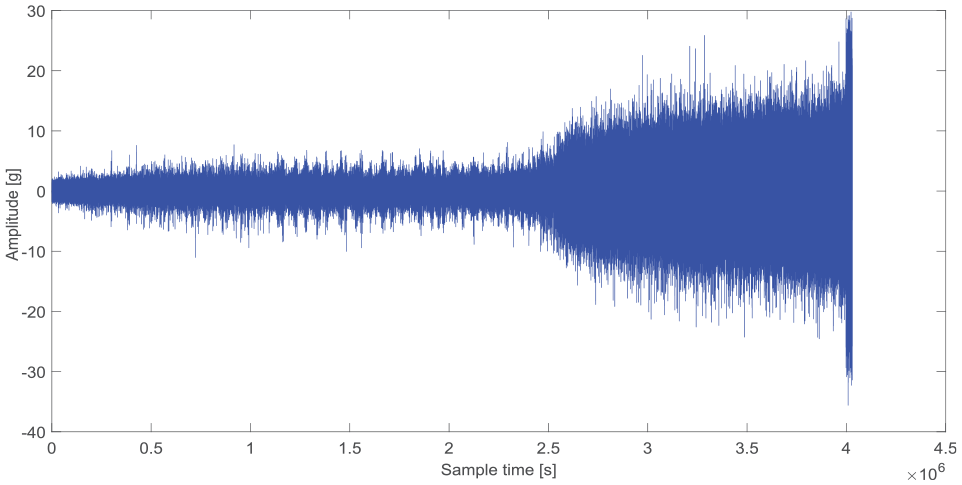
Fault vibration signal in full life cycle.
Due to the large noise amount in the fault vibration signal during the acquisition process on test bench, it can be seen from spectrum in Figure 19 that the spectral amplitude below 200 Hz is obvious, the fault frequency can not be identified directly. As a result, it is necessary to extract periodic transients and identify, enhance failure frequency in it. In order to validate the application value of the proposed method in rolling bearing early fault diagnosis, we intercept sub fault signal in full life cycle for analyzing it. Here we use

The spectrum of fault vibration signal.

Optimal low resonance component of outer ring fault signal.
Furthermore, we use neighcoeff threshold based on DTCWT to reduce noise in low resonance component by decomposing it into five sub-signals at four levels, and establish a remarkable periodic transients which has been enhanced impact property and shown in Figure 21. From the quantitative view, above conclusion can also be proven,

Remarkable periodic transients in outer ring fault signal.
Finally, we apply the IESCFFOgram to explore and enhance fault frequency by combination spectral frequency and cyclic frequency, and the results are displayed in Figures 22 and 23.

IESCFFOgram of outer ring fault signal.

IES of outer ring fault signal.
For comparison, the classical SCoh and its corresponding EES is also shown in Figures 24 and 25.

SCoh of outer ring fault signal.

EES of outer ring fault signal.
In actual, just by observing the cyclic axis in Figure 24, as the spectral frequency at
Furthermore, we use another fault sub-signal whose

SCoh of fault sub-signal.
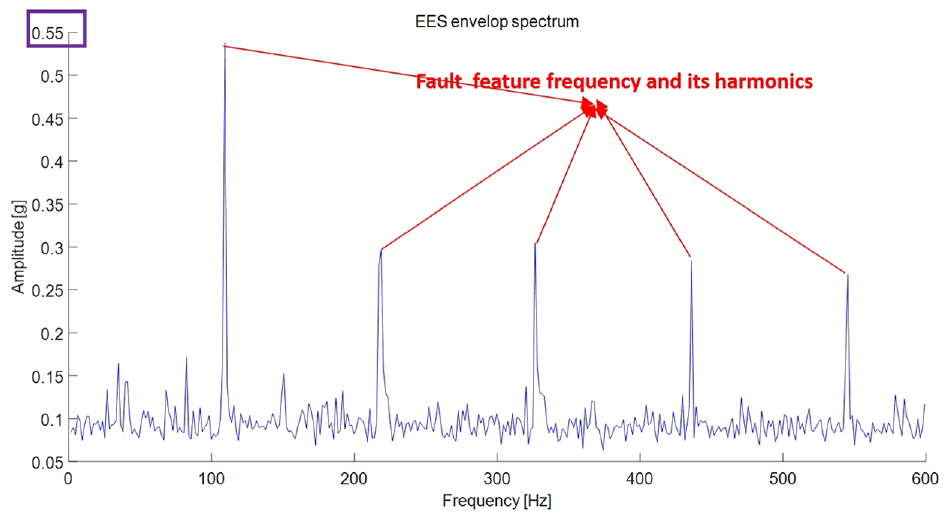
EES of fault sub-signal.
Applying the IESCFFOgram to obtain corresponding IES which is seen in Figure 28, there is no doubt that the proposed method can enhance fault feature frequency quantitatively.
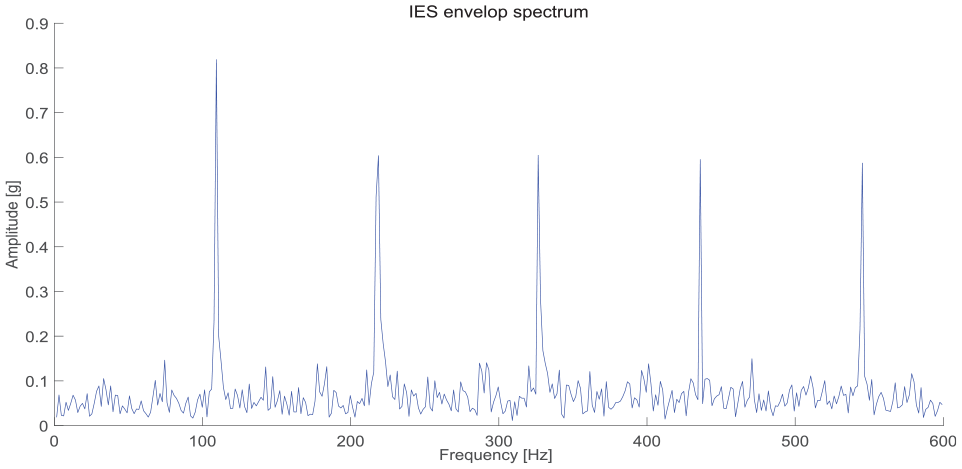
IES of fault sub-signal.
Conclusion
This paper proposes a hybrid intelligent fusion algorithm for extracting periodic transients and identifying, enhancing fault frequency for rolling bearing fault detection. The core and key innovation of this method is that it can periodic transients extraction without distortion and weak fault frequency enhancement. Firstly, we uses an optimal Q-factor RSSD to extract transient sub-signal from fault vibration signal. Then, a neighcoeff threshold based on DTCWT is applied to reduce noise. Finally, IES based on CFFOgram is to identify weak fault frequency. Simulation and experimental data from School of Mechanical Engineering, Xi’an Jiao tong University are applied to verify the effectiveness of proposed method. The following conclusions can be drawn from this study:
Q-factor is a core parameter directly related to low resonance component, and its selection plays a decisive role in extracting periodic transients. A strategy is given to obtain an optimal Q-factor for self-adaptive matching with periodic transients in fault vibration signal by using stepwise iterative algorithm which possesses good search and optimization advantage.
On account that the adjacent wavelet coefficients of periodic transients in low resonance component have a good correlation, the neighcoeff threshold in this paper can effectively reduce noise, improving SNR and enhance periodic impact property in low resonance component.
The IES based on IESCFFOgram can adaptively excavate the fault information hidden in the SCoh, and enhance weak fault frequency compared with EES. Therefore, it is suitable for the fault identification of rolling bearing.
In future research, we need to develop a proper health indicator to judge the failure stage of rolling bearing, if the indicator exceeds the threshold, or presents aberration, we can apply the proposed method in this paper as soon as possible to achieve early fault diagnosis. In addition, we should consider the feasibility of extending this method to fault diagnosis under variable speed condition. Finally, we also should solve the problem of identifying multiple informative spectral frequency bands of SCoh in future work.
Footnotes
Appendix
Handling Editor: Chenhui Liang
Declaration of conflicting interests
The author(s) declared no potential conflicts of interest with respect to the research, authorship, and/or publication of this article.
Funding
The author(s) received no financial support for the research, authorship, and/or publication of this article.
