




Abstract
The majority of FEA simulation software offers a library of material properties. However, the included materials are generic or the most common and do not represent the entire materials market. The problem is fairly solved by the material suppliers that usually provide the material properties of their products or by data available in materials databases. However, the information provided by the materials databases does not include experimental data nor provide information on the testing procedures. Due to this absence, users can not verify the information or its accuracy on the material database. Moreover, data related to material constitutive models, required for accurate simulations seems to be absent. This study focuses on the materials databases available as open-source or paid services, demonstrating that existing macroscopic materials databases do not have information on the experiments conducted nor have constitutive behavior characterization models.
Introduction
Material databases store information measured by researchers or technicians concerning materials and their use avoid repeated experimental measurements. Material databases obtain information through their own experimental tests, like Granta (ANSYS) 1 and Altair material data center, 2 or through scientific papers, which is done by MatWeb 3 and MatDat. 4 This latter information is properly referenced with the source’s DOI. The articles used as references generally publish the experimental results made on materials. An example of these cases is the article written by Gorsse et al., 5 which presents a compilation of the mechanical properties of 370 high entropy alloys (HEAs) and complex, concentrated alloys (CCAs).
The final purpose of material properties databases is to provide trustful information on a material and avoid repeated measurements and their inherent costs. Considering that, nowadays, everything is designed using simulation tools that require material information for their constitutive models, 6 the information provided by material databases becomes vital. Today, the majority of the solid mechanics simulation tools which consider the material macroscopic behavior, perform a Finite Element Analysis (FEA), a method of simulating real material behavior on computers that utilizes the Finite Element Method (FEM). 7
In turn, constitutive models are required for FEA to simulate material behavior. Constitutive models are described as equations characterizing the individual material and its reaction to applied loads.8,9 The constitutive models describe the response behavior of natural and manufactured materials under different mechanical and environmental conditions. FEA simulations’ accuracy depends on the accuracy of the constitutive models and, consequently of the source data. At the same time, the source data is usually acquired through performing experiments or using material databases.
The goal of this work is to identify the existing commercial material databases, the data, the features provided and their ease of use, and to understand what is necessary for a material database to be the best. First, the different possible features of a material database were studied. Then, the existent material databases were described with their features. The explanation of each analyzed material database is followed by a table comparing the different material databases regarding the different features. These materials databases were found through an extensive search of material properties databases. The conditions for the search were: (i) online access, (ii) the material database provides data for material properties, and (iii) isn’t exclusive for the use of an FEA software. In this work, the concept of material databases does not include programs with libraries of materials, such as CAD or CAM programs that include dedicated material libraries, however, which cannot be used autonomously.
Review on commercial macroscopic material databases
Material databases store material properties, mainly for FEA simulation. The material properties databases generally have information on mechanical, thermal, and electric properties. Some even include experimental data and constitutive models’ curves. Some even guide in the selection of the optimal material for the client’s needs.
Robust data on the material’s behavior (i.e., the constitutive model) is needed for reliable FEA simulations. Some simulation software companies provide a library of materials tested by them for their own FEA program to warrantee the material’s accuracy and gain trust. However, those are generic or widespread materials. Today, there is the need to design new parts using advanced materials. However, these materials are not well represented in the material databases. Due to this, there is the need to obtain such information from experimental tests, increasing the costs and time for obtaining robust simulations. The solution for this problem resorts to the use of material databases.
Material databases gather material properties from different sources, tests, labs, and suppliers. The accuracy of the information collected depends on the material database’s administration and knowledge, which can lead to inaccurate product design, resulting in failure or accidents.
Material databases and their features
For the current review and database assessment, the following features were taken into account:
Material ID number: this is a unique number to the material in the database, and it’s used to identify the material and its documentation, and differentiate it from the same material name, however, with different properties due to dissimilar treatments.
Material properties: this is the base of every material database, and it contains material group, material designation, chemical composition, heat treatment, microstructure, hardness, young’s Modulus, Poisson’s ratio, yield strength, ultimate tensile strength, elongation, reduction of area at fracture, true fracture stress, true fracture strain, cyclic yield strength, transition life, number of cycles corresponding to the endurance/fatigue limit, stress amplitude versus cycles, modulus of elasticity, fracture toughness, machinability, shear modulus, Izod impact, Charpy impact, electrical resistivity, thermal properties, and others.
Experimental data: the acquired raw data from the experiments are essential to the model’s parameter identification process and the model’s error.
Experimental procedure description: the process of obtaining the raw experimental data and the equipment used is needed to reproduce and verify the accuracy of the information provided, which improves its validity in the scientific community.
Models: constitutive models are essential to characterize a material’s behavior and are needed for the FEA software. Constitutive models can be defined by their formulation and resulting curvesClique ou toque aqui para introduzir texto.. 6
Parameters of each model for each material: these are the parameters obtained through the identification process 10 to accurately characterize a material’s behavior.
Data documentation/registration: this includes the source reference (e.g., DOI for scientific papers), contributor, experimental procedure description, equipment used for the experiments, and additional information regarding the material used for the experiments.
Data and access to suppliers: it’s a list of information regarding the manufacturers or selling companies for each material and their contact information for more information or personal requests.
Data and access to test laboratories: it’s a list of information regarding the test laboratories and contact information for personal requests.
Material comparison tool: a tool to easily compare two different materials’ properties.
Properties search engine: it’s an engine to search for materials by their name, Material ID number, or even by their properties.
Export data to FEA software: an export function to directly and easily use the material information on FEA software’s.
Export function: an export function to save or print the material’s properties for offline view.
KPI and recommendation engine: it’s a tool to recommend a material based on the design and project’s needs, together with an indicator of the quality of the material in the context it’s being applied. Other Key Performance Indicators (KPI) can also be offered.
Indicator concerning the quality of the model and its parameters set: the model’s accuracy in reproducing the material behavior assessment using indicators.
Material standard curves (using models): this feature represents the standard test curve obtained through the material’s constitutive model for standard tests.
Account and account verification: personal or professional accounts for users, test laboratories, and companies to upload information and improve trust.
Search history: a history of the searched materials by the user for easier tracking.
This state-of-the-art review analysis is about the features provided by the existing material databases, how the user accesses information, how the data was obtained, and how it is organized. The following sections present the analyzed material databases.
Commercial databases
MatWeb
MatWeb 3 is one of the most used material properties databases available on the internet because of its simplicity and trust gained by the users. Offering the essentials of a material database, MatWeb covers material properties from various categories, such as carbon, ceramic, fluid, metal, polymers, wood, composites, and pure elements. The search engine can be seen in Figure 1, where the material database offers the user a search for materials by their categories. They provide access to manufacturers’ and suppliers’ contact and allow the suppliers to advertise their materials on the material database.

(a) MatWeb’s search engine and (b) MatWeb’s material properties search engine. 3
Its main features are (i) properties’ search engine where users can search materials by their properties with a maximum of 3 properties simultaneously, (ii) files to be imported to FEA, and (iii) access to suppliers and labs.
In MatWeb, 3 it is highlighted the need for a comprehensive database with material properties at their fingertips to avoid time-consuming searches through volumes of technical articles and books. MatWeb was created in 2011 to focus on the engineering materials database business.
MakeItFrom
MakeItFrom 11 is a material properties database that generates data through a technical literature survey, including academic books and supplier documentation. It offers a selection of material properties covering metals to ceramics and polymers. Unlike MatWeb, MakeItFrom doesn’t have a search engine. Instead, it allows the user to search for the materials by their categories. Its main feature is the material comparison, as shown in Figure 2, where the user can compare the selected material with other materials of the same category.

MakeItFrom’s material properties. 11
From the research on MakeItFrom, its features are the material properties and the material comparison tools, proving it to be a material database with little to offer compared to other databases analyzed in this text, such as MatDat.
MatDat
MatDat, 4 just like MatWeb, is a material properties database that helps solve the problem. It’s a material database created to assist in the modeling and simulation of loaded structures and components. The information uploaded in this material database is appropriately referenced, as can be seen in Figure 3. However, this one requires a paid license to access this essential information.

MatDat’s material properties. 4
The user has to select the material designation in its search engine. Its different features are (i) the user’s ability to upload information to the material database and (ii) access suppliers and labs. Access to suppliers and laboratories allows the user to get contact information for maintenance services, suppliers to get a particular material, request a laboratory to perform an experiment on a specific material, or buy laboratory equipment. MatDat also offers standard curves generated using constitutive models, as shown in Figure 4, and their constitutive models and parameters. However, only premium users can access it. In Figure 4, the Ramberg-Osgood model 12 was fitted to a stress-strain monotonic tensile curve.
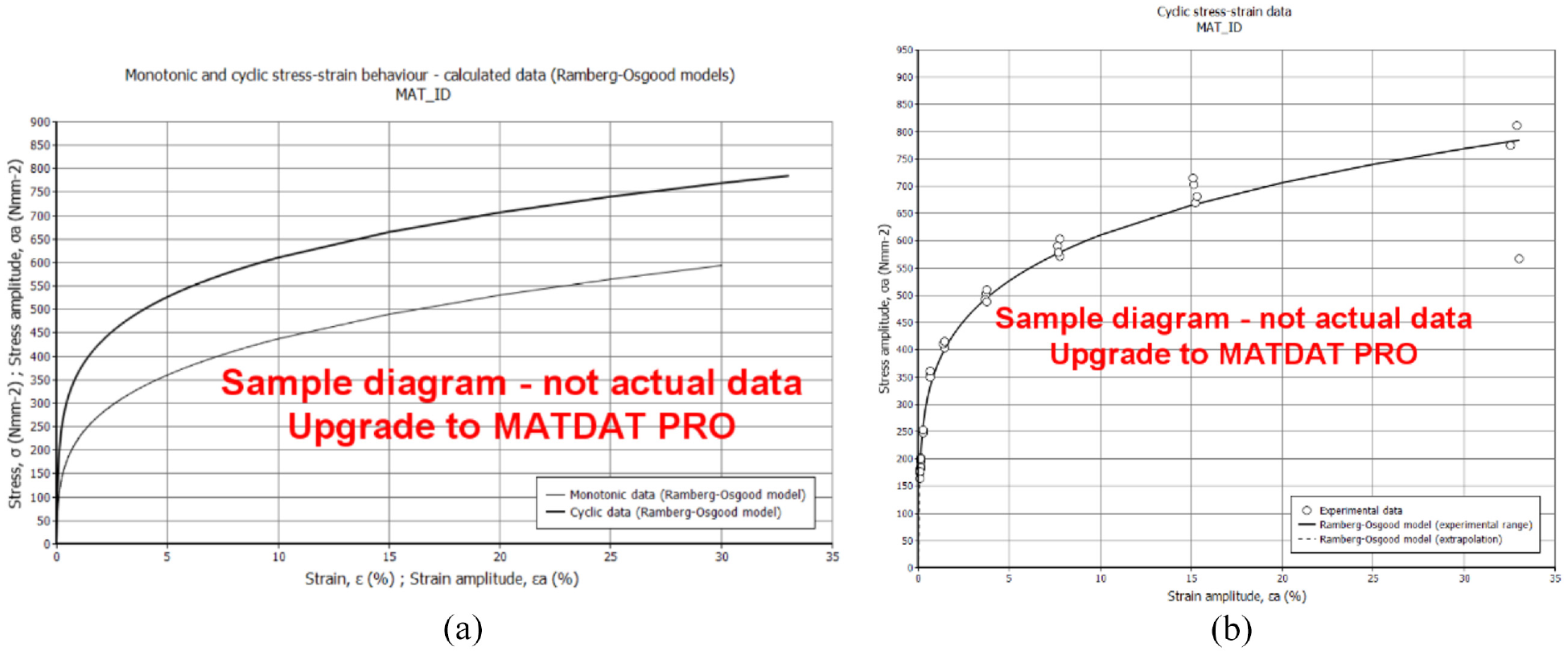
Sample model on MatDat 4 : (a) monotonic tensile data from the numerical model and also (b) experimental data comparison.
From the research made, MatDat was found to be one of the most complete material databases. Its features are (i) material ID number, (ii) material properties, (iii) experimental data, (iv) models, (v) parameters of each model for each material, (vi) data documentation/registration, (vii) data and access to suppliers, (viii) data and access to test laboratories, (ix) properties search engine, (x) export function to PDF, and (xi) material standard curves.
SteelNumber
SteelNumber 13 is a free searchable material properties database of engineering materials designed by scientists of the National Technical University KhPI. It focuses solely on European steels and alloys and, instead of a search engine, they have a material index for the material. Their material properties only include the material’s composition, tensile strength, yield strength, and elongation.
Its main features are access to suppliers and a properties search engine that allows a search with only one property as a filter. SteelNumber is a material database that offers too little compared to other material databases.
MatMatch
MatMatch 14 is similar to the previously described material properties databases, but its search engine is cleaner than the prior databases. MatMatch allows users to search materials by their name/grade, category, property, and suppliers. Their database includes materials from different categories: ceramic, composite, glass, metal, and polymers, as shown in Figure 5. This database offers a complete description of the material’s properties but lacks experimental data, experimental procedure description, models, or standard curves.
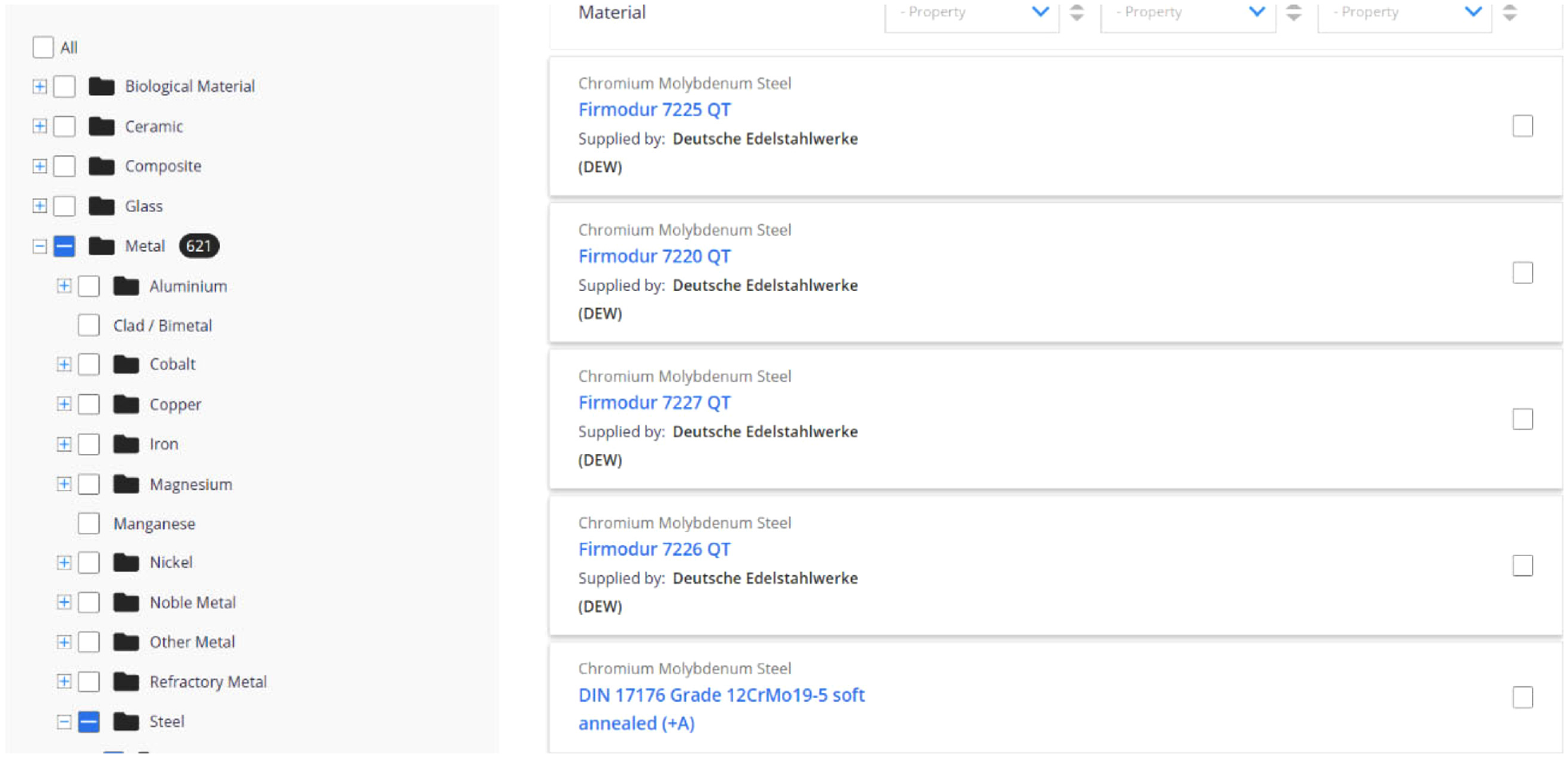
MatMatch’s search engine. 14
As a result of the research on this material database, the most important features found were material properties, data and access to suppliers, properties search engine, and export function to formats such as pdf.
ASM
ASM 15 is the leading and most known material properties database, offering several digital databases. One of those digital material databases was developed working together with Total Metal’s team toward a platform called Total Materia (see Section 2.2.10). Although the online material databases are all from paid services, the research analyzed their main features, such as (i) material properties, (ii) experimental data, (iii) models, (iv) parameters of each model for each material, (v) data documentation/registration, (vi) properties search engine, and (vii) material standard curves.
Material Connexion
Material Connexion, 16 just like the previous material properties databases, offers a library of materials. However, unlike other material databases, Material Connexion provides guidance on the choice of materials for a given project. Their service focuses on selecting and sourcing the material for the project’s needs.
This database’s features are (i) experimental data, (ii) data documentation/registration, (iii) data and access to suppliers, (iv) data and access to test laboratories, (v) properties search engine, and (vi) material standard curves. In this particular case, instead of a recommendation engine, the material database has a team of engineers to offer guidance on selecting materials and suppliers.
Prospector
Prospector 17 is a material properties database that covers adhesives, sealants, food, beverages, inks, household and industrial cleaners, lubricants, paint and coatings, cosmetics, plastics, plastic additives, and metals. This material database provides information on suppliers for the different materials on their index. It allows users to search for the material’s index and suppliers and also use a property search to find materials.
This material database features material properties, and access to suppliers and properties search engines. Therefore, this material database is not distinguishable from other material databases.
CINDAS LLC
CINDAS LLC 18 is a company that provides critically evaluated materials properties databases that include thermal, mechanical, electrical, physical, and other properties of various materials. Their main material database is ASMD, the web-based version of their Aerospace Structural Metals Handbook. The main features of the different databases are experimental data and properties search engines. Additionally, it also allows the user to interact with the provided charts.
The research on this material database shows that its main features and benefits are (i) material properties, (ii) experimental data, (iii) properties search engine, (iv) export function to PDF, and (v) material standard curves.
Total Materia
Total Materia 19 is a software with built-in material properties databases and other modules. Total Metals is their metals database module, which contains 15,000,000 properties registered on more than 350,000 materials . Total Materia has many components, such as Total Metals, PolyPLUS, Extended Range, DataPLUS, Enviro, Compliance, Suppliers, SmartComp, eXporter, and Tracker. It allows users to search on their material index, search by properties or use filters to search materials similar to MatWeb and MatMatch. In Figure 6, a model standard curve can be seen together with the interpolated values. Total Metals allows the user to export the material properties on a material card for FEA software. The component eXporter is also depicted in Figure 6, which shows the different protocols for exporting and the different FEA software compatible with the file exported from Total Materia.

(a) Total Materia’s model standard curve and (b) Total Materia’s eXporter component.
Total Materia’s features identified in the research are (i) material properties, (ii) experimental data, (iii) data and access to suppliers, (iv) data and access to test laboratories, (v) properties search engine, (vi) export function to FEA software, and (vii) material standard curves.
Knovel
Knovel 20 is a paid software that offers a vast library of books in a readable and editable format similar to PDF files interface-wise. Although not exactly a material properties database, Knovel allows users to search for material properties through handbooks, manuals, and databases, meaning that it has the source indicated, a feature found lacking in a lot of the researched databases. Knovel also allows the user to interact with a chart and select any point in the model-generated curve as shown in Figure 7.

Knovel’s demonstration of using point selection on the model generated curves. 20
From the research, Knovel’s features are (i) material properties, (ii) data documentation/registration, (iii) properties search engine, (iv) export function to PDF, and (v) material standard curves.
Evonik
Evonik 21 is a company that provides material properties on their high-performance polymers. Their search engine allows users to filter materials by their final market use: automotive, aircraft and aerospace, 3D printing, oil and gas, industry, building construction, medical, sports, lifestyle, and optics. Their material database also allows searching for material properties. However, even though the material database is from the manufactured and tested materials, their material properties don’t cover constitutive models and their standard curves.
From the research on this material database, the features found are (i) material properties, (ii) data and access to suppliers, (iii) data and access to laboratories, (iv) material comparison tool, (v) properties search engine, and (vi) export function to PDF.
TEEXMA
TEEXMA 22 is a company that provides a material properties database called TEEXMA for Materials. It’s a part of the software called TEEXMA that stores material properties. This software, owned by the Bassetti group 22 is a highly flexible tool, capable of working with various applications, and easily customizable. TEEXMA for materials guarantees the validity of their material properties by ensuring complete traceability of the user’s activity. It allows the integration of material data with other material database software like Jahm, MMPDS.
This material database’ features are (i) material properties, (ii) data and access to suppliers, (iii) data and access to laboratories, (iv) material comparison tool, (v) properties search engine, (vi) export function to FEA software, (vii) export function to PDF, and (viii) material standard curves.
Mat Navi
Mat Navi 23 is a Japanese material properties databases index whose objective is to contribute to develop new materials and selecting materials. The user must register to use those material databases in MatNavi, which offer basic material properties with a confusing user interface and search engine.
After researching the material databases shown on Mat Navi’s, their features are (i) material properties and (ii) export function to PDF.
Beamler
Beamler 24 is a company that offers 3D printing services. Beamler provides a material properties database for the materials they print, which are high-performance materials like tungsten, tungsten carbide, aluminum, pure copper, silicone, and technical ceramics. In this material database, the user can filter the search by manufacturers and by the material’s properties. This material database’ features are (i) material properties, (ii) data and access to suppliers, and (iii) properties search engines.
MMPDS
MMPDS Matplus 25 is a materials properties database based on their online handbook available on their web platform, offering an easy-to-access and searchable material database. It’s a scientific source of metallic materials data that has information on steel alloys, aluminum alloys, magnesium alloys, titanium alloys, heat-resistant alloys, of which they offer their material properties and references. The features found are (i) material properties, (ii) experimental procedure description, (iii) data documentation/registration, (iv) properties search engine, and (v) material standard curves.
Altair
Altair Material Data Center 2 is a material properties database that works similarly to Granta (Ansys) (see Section 2.2.21). It is a database created and supplied by Altair to use in their FEA software for an accurate and trustful simulation. This material database’s advantage is the easy access to approved and revision-controlled material’s data ready for prototyping and validation. Their search engine can be seen in Figure 8, where can also be seen the different categories for searching materials, their supplier, and the different FEA software compatible with the material card exported from this material database. In Figure 8 is shown the raw data provided for a selected material, however, this material database also provides computed curves and allows the user to export the material properties to FEA software.

(a) Altair Material Data Center’s raw data and (b) Altair Material Data Center comparing two material’s computed curves.
This material database has one of the easiest-to-use user interfaces. It provides a larger number of properties for each material in comparison to other material databases, and its main features are (i) material properties, (ii) experimental data, (iii) models, (iv) parameters of each model for each material, (v) data documentation/registration, (vi) data and access to test laboratories, (vii) material comparison tool, (viii) properties search engine, (ix) export function to FEA software, and (x) material standard curves.
TPSX
TPSX 26 is a material properties database built-in software. This material database offers basic properties for materials, and focuses on thermophysical properties. This material database provides data on over 1500 materials, compiled by various NASA centers and industry sources, and their goal is to provide easy and immediate access to material data for analysis, engineers, and designers in the aerospace field. However, it shouldn’t be used as the final and definitive source for material information. As a material database, this repository only covers the most basic requirement, which is the mechanical, physical, and thermophysical properties.
JAHM
Jahm 27 is a material properties database built-in software. Figure 9 shows the material’s properties and the different options for exporting to Solidworks or ANSYS through xml format. The materials are divided into different categories for an easy search, however, the user can also use the material’s name as search criteria.

JAHM’s export options to FEA software. 27
Its features are material properties, export function to FEA software, and material standard curves.
CompoSIDE
CompoSIDE material database 28 is a core module for CompoSIDE that provides a material properties library. This material properties database is marketed as a library for storing and managing material properties. It includes a materials library with generic composite materials, featuring a variety of orthotropic and isotropic materials such as plies, reinforcements, resins, metals, cores, adhesives, and wood. It is a library that incorporates multiple materials data which includes composites and other materials data.
The research on this material database concluded that its features are material properties and export function to FEA software.
ANSYS (Granta Materials)
Granta Materials 1 is a module containing a material properties database to use in Ansys simulation tools. This is a database curated by material data analysts, and it focuses specifically on simulation. It stores material properties researched by its research team to provide an accurate simulation for their FEA software.
This material database’ features are (i) material properties, (ii) behavior models, (iii) data and access to test laboratories, and (iv) export functions to FEA software.
NCode
Ncode 29 is a company that provides FEA software. It focuses on fatigue parameters for commonly used steels and aluminum alloys. This material database provides material properties and export functions to FEA software.
Aurora
Aurora 30 is software provided by TATA Steel. This automotive-focused material database offers access to representative material data and advanced material models to predict and enable accurate simulations. Their goal is to provide advanced material data and plasticity models to set up accurate and reliable forming and crash simulations.
Figure 10 shows Aurora’s material list with the different grades for each metal, the different types of datasheets, and material cards to export to FEA software. They show how the user can access the forming limit curve for plasticity by selecting the blue box. The user can choose the property to see on the exported excel datasheet on the different data types.
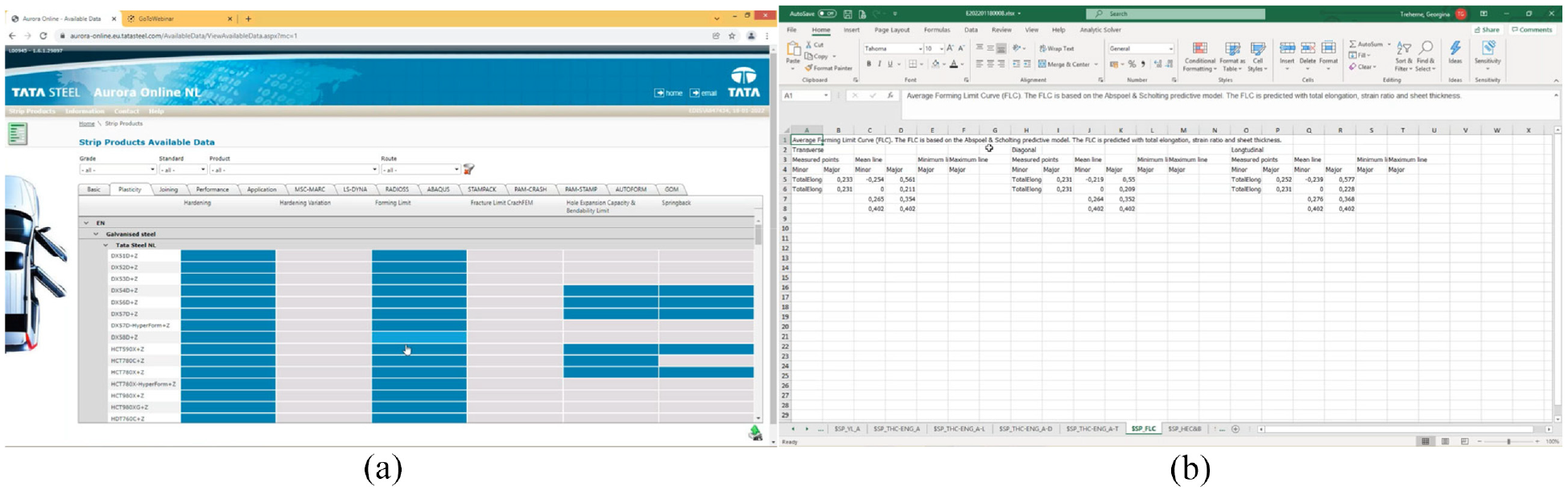
(a) Aurora’s selection of forming limit for plasticity and (b) Aurora’s exported raw data and model used for the curve. 31
The research done on this material database shows that it provides several new benefits that were lacking in the other material databases. This material database’s features are (i) material properties, (ii) experimental data, (iii) models, (iv) parameters for each model, (v) data documentation/registration, (vi) data and access to suppliers, (vii) export function to FEA software, and (viii) material standard curves.
Overall comparison
From the analyzed material databases, it was selected MatWeb, MakeItFrom, MatDat, and MatMatch as open-source databases for an overall comparison. For paid services, Material Connexion, Total Materia, Knovel, Altair, Jahm, and Aurora were chosen. A large number of paid services were selected due to the vast number of databases with the same features.
The features of the material properties databases that were focused on are as follows in Table 1.
Comparison of the features of the databases.

Material Comparison: Function to show two different materials and easily compare their properties; Contact to Suppliers: Contact information to the suppliers of a given material or research laboratories to request them to conduct experiments on a given material; Experimental Data: Raw experimental data is needed to create a model for a material; Models: Written models with their parameters to accurately simulate a material; Properties Search: Search engine for materials, given the properties needed; Client Service (Guidance): Help with choosing an adequate material given the design and needs of the client; FEA: Function to export the material properties to an FEA software.
As shown in Table 1, the material properties databases in evaluation are focused on the material properties, and most of the databases that additionally offer constitutive models are paid services or are databases used for their FEA software like Altair 2 or granta (ANSYS). 1 The most lacking feature in the researched databases is the material behavior characterization models and their parameters.
From this table, Altair and Aurora material databases take the lead with ten stars each. Although Altair presents supplier contacts and a good search engine for properties, Aurora makes itself noticed by its experimental data and its easy link to FEA. From the open material databases, MatDat is clearly the one that presents more features, being the only one with experimental data and calibrated constitutive models. Nevertheless, not all features are available freely.
Conclusion
The FEA offers a great solution to reduce costs and time on the design of products. However, most of the FEA software utilizes its library of materials, which contains generic materials. The suppliers of materials generally do not provide material behavior (characterization) models or parameters to use on FEA software, forcing the need for repetitive experimentation for the same material and model parameters identification for an accurate product simulation.
This review highlights the various material databases on the market and their features provided for the user. Although very complete, the material databases were found to be lacking. It was found in the research on FEA and Material Properties Databases that most don’t offer documentation, experimental data, and indicators. The existing Material Databases don’t provide documentation concerning the tests procedure and models applied or even their parameters. There is no indicator for the quality of the computer-generated model shown in some Material Databases. Due to the lack of constitutive models and their parameters, the accuracy of the material’s behavior characterization cannot be verified.
The most critical information for simulation is the accuracy of the constitutive material model (i.e., the virtual reproduction of the material behavior), however, this information was not found in any Material Database or FEA software. This type of information is only found in research groups and research papers. The majority of the research works compare the material behavior model with the results of experiments, requiring equipment, time, and resources.
Footnotes
Handling Editor: Chenhui Liang
Disclaimer
The results reflect only the authors’ view, and the European Commission is not responsible for any use that may be made of the information it contains.
Declaration of conflicting interests
The author(s) declared no potential conflicts of interest with respect to the research, authorship, and/or publication of this article.
Funding
The author(s) disclosed receipt of the following financial support for the research, authorship, and/or publication of this article: This project has received funding from the Research Fund for Coal and Steel under grant agreement no. 888153. The authors also gratefully acknowledge the financial support of the Portuguese Foundation for Science and Technology (FCT) under the projects PTDC/EME-APL/29713/2017 (CENTRO-01-0145-FEDER-029713), PTDC/EME-EME/31243/2017 (POCI-01-0145-FEDER-031243), and PTDC/EME-EME/30592/2017 (POCI-01-0145-FEDER-030592) by UE/FEDER through the programs CENTRO 2020 and COMPETE 2020, and UIDB/00481/2020 and UIDP/00481/2020-FCT under CENTRO-01-0145-FEDER-022083.
