



Abstract
A crucial part of the aircraft, the landing gear cabin door locking mechanism directly affects how well the landing gear retracts and how stealthily the aircraft operates. A reliability evaluation approach under multiple deterioration is provided, with a focus on the features of high reliability, small sample, and multiple performance degradation of the locking mechanism. The locking angle of the lock hook and the locking displacement offset of the lock hook are chosen as the characteristic quantities based on the analysis of the factors influencing the life of the locking mechanism; next, the Wiener process is used to model the degradation process of the selected characteristic quantities in order to obtain the failure probability density function for both; then, the multiple performance degradation reliability evaluation model is established using the Copula function, which can precisely and effectively characterize the coupled competitive relationships of multiple performance degradations. This model characterizes the stochastic correlation between the locking angle and the locking displacement of the lock hook. Following that, the Akaike information criteria (AIC) is used to choose the Copula function. Finally, the locking mechanism’s reliability assessment is carried out, as well as the evaluation findings are contrasted with those of the usual technique, which only takes into account a single failure performance characteristic quantity. A series of data analyses led to the conclusion that the approach is more relevant and accurate than that of the conventional method, and that it is not prudent to undervalue its dependability.
Keywords
Introduction
A crucial part of an aircraft, the landing gear cabin door locking mechanism directly affects the aircraft’s ability to retract its landing gear and perform stealth maneuvers, among other things. It is therefore more crucial than ever to research the dependability evaluation techniques for airplane landing gear cabin door locking mechanisms. However, due to the locking mechanism’s lengthy lifespan and great durability, there is a lack of failure data and a variety of failure mechanisms, making it challenging to evaluate the product’s reliability. 1 Based on the findings of previous studies, we have presented in this study a multi-performance degradation reliability evaluation approach for an airplane landing gear cabin door locking mechanism.
Researchers both domestically and internationally have made some progress in the dependability evaluation of locking systems. The influence of the gap between the lock hook and the lock ring on the latching and unlocking functions in the hatch locking mechanism was calculated by Liu et al. 2 using the Monte Carlo technique. In order to solve the reliability assessment problem associated with the failure, Zhuang et al. 3 addressed the wear of the aircraft locking mechanism and created a Copula function model. A wear reliability analysis and assessment approach for the locking mechanism and its system based on a mathematical model was presented by Yin and Wu 4 after they noted that the wear between the components is the primary cause of the locking mechanism’s failure. A reliability assessment method based on a performance margin model with a probability distribution to quantify the uncertainty was proposed by Li et al. 5 in response to a performance degradation problem caused by wear and multiple sources of uncertainty for the aircraft locking mechanism. A Wiener process-based reliability assessment method for the two-stage degradation of rotary joints in locking mechanisms was put forth by Shen et al. 6 In general, there aren’t enough research findings to determine the dependability of small-sample, high-reliability locking systems.
Given the high dependability and high cost of locking mechanisms as well as the frequently small sample sizes in experimental data, a thorough discussion of the reliability assessment methodology is warranted. A small-sample multi-factor reliability assessment method was researched by Sun et al., 7 who occasionally published research in this area. A multilayer Bayesian model and model solving approach for aircraft bearing performance reliability analysis under limited sample conditions were provided by Jin 8 as examples of approximation studies that are still available. For the features of small samples and long life of aerospace products, Zhao et al. 9 suggested a small sample life evaluation methodology based on Bootstrap theory. For degraded data in small sample scenarios, Wang et al. 10 suggested an accurate reliability inference approach based on the Wiener process with random drift parameters. In order to determine the reliability of an aircraft cabin door locking mechanism under numerous failure modes, Jia et al. 11 devised a B-P neural network method with considerable sampling that is more accurate than the traditional approaches. The limitations of the actual load history obtained through experimental analysis were discussed by Salvinder Singh and Abdullah, 12 who then used stochastic processes to forecast the accuracy of the automotive durability analysis of the crankshaft reliability life cycle under random stress loading.
It is particularly important to accurately characterize the degradation process because it is the source of the locking mechanism’s inability to complete the lock due to performance degradation brought on by component wear. 4 The Wiener process, which has grown to be the most fundamental and often used model in degradation modeling, offers good accuracy in simulating non-monotonic performance deterioration processes. 13 Based on the performance degradation data gathered for electronic measurement instruments, Tan et al. 14 developed a Wiener process-based performance degradation model and a reliability model for life prediction. A reliable reliability inference technique based on degenerate Wiener process data with random drift parameters was proposed by Wang et al. 10 For estimating the remaining service life of electronic items in light of the unpredictability and individual variability of the performance degradation process of electronic devices, Lin et al. 15 suggested a degradation model combining a Wiener-based process and Bayesian posterior estimation. In order to successfully estimate the model parameters, Pan et al. 16 suggested a reliability assessment approach based on the EM algorithm and Wiener process taking into account the measurement error. In light of the fact that wear degradation is a typical progressive failure mode and is characterized by randomness and uncertainty, Wang et al. 17 proposed a performance degradation model described by the Wiener process for predicting the remaining useful life (RUL) of an aero-hydraulic axial piston pump.
There are less studies on multi-factor degradation reliability assessment of locking mechanisms, despite the fact that Wiener process models have been applied to complicated mechanism degradation reliability assessment and life prediction problems. Similar research include Huang and Askin 18 investigation of the equipment reliability and reliability modeling for a single failure mode. In order to handle the problem of modeling degradation and evaluating dependability of machinery with numerous degradation characteristics, Cheng et al. 19 suggested a novel approach combining a dual Wiener process model with the Monte Carlo algorithm. A Copula function selection-based reliability modeling approach was put forth by Bao et al. 20 to address the reliability evaluation issue of products with different degradation quantities. For estimating the remaining life of a satellite momentum wheel, Liu et al. 21 have suggested a life prediction approach based on a Copula function with several degradation quantities. A new technique for assessing component reliability in the presence of various degradation processes was developed by Zhang et al. 22 using performance degradation data and the creation of state functions. In order to address the unavoidable transfer and accumulation of uncertainties between connected disciplines that result in dangerous turbine equipment, Meng et al. 23 devised a saddle-point approximation reliability analysis approach. Traditional reliability analysis techniques do not adequately account for multi-state reliability, hence Kan et al. 24 introduced a multi-state reliability analysis method for systems combining performance degradation and generic generating functions. For suspensions subjected to random loads from various sources, such as the environment, road conditions, and other sources of uncertainty, Abd Rahim et al. 25 suggested a reliability assessment approach based on wavelet decomposition method for automotive suspension fatigue life. When each body contains many degraded eigenvolumes, Qiet al.’s 26 Wiener process was utilized to simulate a single performance degradation process. A Copula function was then employed to explain the correlation between these degraded eigenvolumes. The degradation of a single performance parameter of a product was modeled by Pan et al. 27 using a Wiener process, and the coupling of multiple performance parameters of a product was modeled using a Copula function. These models not only accurately described the coupling correlation between multiple performance degradations, but also provided a method for calculating the Copula function. Yan 28 completed the multi-degradation modeling and also strictly defined the multi-degradation model. He proposed a general linear model to model the degradation process of single factor degradation and a Copula function to describe the correlation between degradation. By using examples, Yu 29 studied the selection of Copula function models examined the effectiveness of various approaches. A model based on the Archimedean Copula function was put forth by Sun et al. 30 to investigate how to represent the correlation between various performance metrics. As can be seen, Copula function is frequently used to handle the correlation between factors in multi-factor degradation problems.
It is clear that the reliability analysis based on the Wiener process and Copula function can be applied in the case of cabin door locking mechanisms with small sample sizes of failure data and multiple performance degradation in order to accurately assess the reliability of aircraft front landing gear cabin door locking mechanisms with multiple performance degradation. In this paper, the locking angle and locking displacement of the locking mechanism are selected as characteristic quantities based on the analysis of the factors influencing the life of the aircraft front landing gear cabin door locking mechanism; next, the performance degradation model of locking angle and locking displacement is established using the Wiener process as the benchmark; and finally, the failure probability density function of the locking mechanism and the failure probability density function of the locking mechanism are discussed. The Copula function is used to characterize the stochastic correlation between the locking angle of the lock hook and the locking displacement of the lock hook in order to obtain the reliability curve and the joint probability density function of the reliability of the locking mechanism. Different Copula function models are assessed using the Akaike information criterion in order to investigate their applicability and advantages. In order to investigate its accuracy and so confirm the validity of the assessment method, it is contrasted with the reliability evaluation approach that simply considers individual characteristic values.
Working principle and selection of characteristic quantity
Locking mechanism working principle
To ensure that the cabin door closes normally, the locking mechanism on the aircraft’s front landing gear is required. The fuselage cabin door cannot be horizontally aligned with the front landing gear cabin door when it is closed as the cabin door locking mechanism ages and deteriorates, causing a slight offset known as the step difference H, as depicted in Figure 1. The aircraft’s stealth performance will be compromised if the step difference is greater than the specified limit.

Schematic diagram of order difference.
The locking process of the front landing gear cabin door mechanism is as follows: first, the piston is hydraulically driven to push the connecting rod, causing the lock hook to move from the initial position to contact with the lock ring; second, the lock hook continues to rotate to the locked position from the original position, and then rises to the maximum rotation angle position owing to inertia; finally, the lock hook returns to the locked position due to its own gravity, as shown in Figure 2.

Schematic diagram of locking mechanism.
Locking mechanism degradation characteristic quantity selection
Following reference to the rolling bearing fault characteristics extraction method 31 and the key wear parts of the locking mechanism provided by the scientific research institutions, the selection of characteristic quantity plays a significant role in the reliability assessment of the mechanism, and quantifying the mechanism performance evolution process is a key part in the reliability assessment.
Selecting the proper deterioration characteristic quantity is essential because every time the front landing gear cabin door locking mechanism opens and shuts, the lock hook and lock ring make contact and cause wear.
When the locking mechanism is in the closed position, as shown in Figure 2, the locking angle is the angle formed between the upper horizontal portion of the lock hook and the vertical direction. The locking angle is chosen as the distinctive quantity since it must be altered when the lock hook and lock ring are worn.
According to Figure 2, the locking displacement is the angular separation between the lock hook and the horizontal surface of the cylinder when the locking mechanism is closed. The locking displacement is chosen as the characteristic quantity because when the lock hook and lock ring are worn, the location of the lock hook will vary and thus the locking displacement will also change.
Performance degradation model on the basis of Wiener process
Wiener process
The performance degradation process of the front landing gear cabin door locking mechanism is actually a stochastic process, and there are more types of degradation models, including linear and exponential models, but most of the models have a narrow model adaptation range, and the degradation increments in the experimental data follow a normal distribution, so the Wiener process with a wide model adaptation is chosen to analyze the degradation behavior of the front landing gear cabin door locking mechanism, and the performance degradation X(t) of the locking mechanism is considered as a standard Wiener process. 32
The degradation value of the sample at the initial time is X(0) = 0, the degradation amount of the lock sample at the time
The Wiener increment
The increment
It is assumed that no errors arise during the measurement of performance characteristic quantities and that there are no random effects throughout the degradation process.
Single performance parameter degradation model
For the phenomena where the front landing gear cabin door locking mechanism’s locking performance declines with usage, it is anticipated that the performance keeps declining as usage time grows. At time t, the amount of degradation
According to the nature of the Wiener process, it is assumed that the amount of performance degradation
Assume that the performance degradation
The above formula life distribution follows the inverse Gaussian distribution


The reliability of individual product performance parameters is expressed as follows

Multi-performance degradation model based on Copula function
Definition of Copula function
According to the principle of probability theory, if the degenerate variables of the institution are independent of each other, then the reliability function of the institution can be derived from the reliability function obtained under each degenerate variable; however, if the relationship between the degenerate variables of the equipment is unknown, the reliability function of the institution cannot be derived from the knowledge of simple probability theory. It is frequently uncertain how the individual degradation quantities of the process relate to one another. The Copula function is a correlation analysis technique that connects the joint distribution function to the marginal distribution function of a single degradation variable. A joint distribution can be broken down into many marginal distribution functions and a Copula function 33 that describes the correlation between the parameters, according to the Sklar theorem.
Let H be an k-dimensional distribution function with an edge distribution of

According to Sklar theorem, the Copula function can be used to characterize the joint distribution function of the marginal distribution function of each parameter as long as the choice of the Copula function C can be determined.
Multi-performance parameter degradation modeling
Assume that the front landing gear cabin door locking mechanism has m performance characteristic quantity with definite correlation. At time t, the performance degradation track can be denoted as

Suppose that the combined distribution function of the life of the locking mechanism

where θ is the parameter of Copula function. The reliability of the product can be shown as follows.

Where
Copula function selection credentials
The correlation between multiple performance failure characteristic quantities can be characterized by Copula functions, so the selection of the most suitable Copula function will be directly related to the accuracy of the characterized correlation. In this paper, a method for selecting the determined Copula function and the specific steps are proposed.
Trend graph
By plotting the degradation trend of the original data, it is obvious that the two characteristic quantities selected in this paper have a clear degradation trend during the working time. Comparing the trend graphs corresponding to the two characteristic quantities shows that the two trends are consistent, and thus it can be determined that the locking angle of the lock hook and the locking displacement offset of the lock hook are correlated.
Data distribution analysis
For the data obtained from the experiment, a scatter plot can be obtained by plotting it into a graph to observe whether the data are symmetrically distributed, etc., and to determine the relationship between the upper and lower tails of the data. In addition, by comparing the characteristics of different functions in many common Copula functions, we can roughly choose one or several suitable Copula functions.
Reliability function for a single performance characteristic quantity
The locking angle of the lock hook and the locking displacement offset of the lock hook are the two performance characteristics that were chosen for this work. The failure of the locking mechanism is often defined by the locking angle of the lock hook and the locking displacement offset of the lock hook, that is, when any of them reaches the failure criterion. In the examples below, the reliability functions corresponding to different Copula function models are plotted as a practical instance and contrasted with the reliability functions of the individual performance characteristic values.
Calculation of correlation coefficient
Typically, the Kendall correlation coefficient
Akaike information criterion
The Akaike information criterion is a widely used model selection method in statistical analysis, also known as the deficit pool information criterion. Following a thorough likelihood estimation, the AIC values of various Copula models are determined. The AIC value concept states that the closer a model is to the true distribution of the variables, and the better it fits the sample data, the smaller the AIC value. This criterion can therefore be used to choose the functional model that best fits the data distribution, and it has the following formulation.

where k is the number of parameters of the Copula model and
Parameter estimation for different functional models
Assume that the total number of front landing gear cabin door locking mechanisms is N. Then the performance test of the locking mechanism is conducted afterwards for K times, and the same batch of locking mechanisms for each performance test is the same time. The first test is set as the initial time
Let the degradation of performance characteristic quantity i of locking mechanism at the initial moment

According to the basic properties of the Wiener process, it is easy to obtain

The probability density function of the amount of performance degradation can be expressed as

Then its maximum likelihood function is
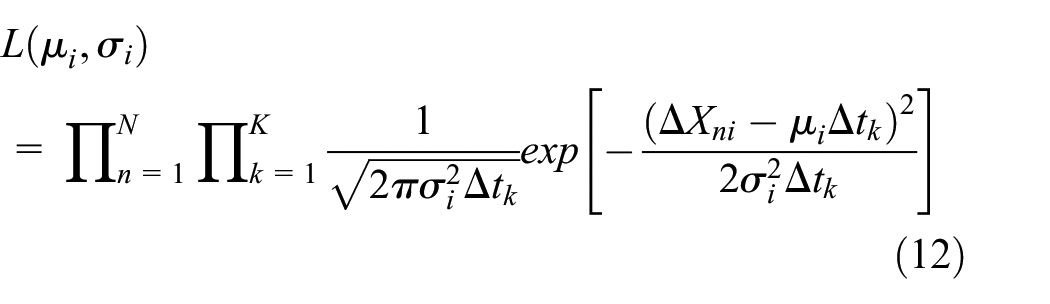
Parameter estimates of the Copula model are obtained by taking the logarithm of both sides of the above equation and taking the partial derivatives of


The obtained
Bring

Subsequently based on the obtained parameter estimates

in the formula,
By deriving the parameter θ above, the estimate of θ can be obtained.
Practical case study
In this section, a reliability assessment method backed by the Wiener process and Copula function is used to examine the dependability of an aircraft’s front landing gear cabin door locking system. The wear degradation of the performance characteristic quantity, which prevents the locking mechanism from locking properly, is the main mode of failure for the locking mechanism. As a result, the cabin door closes with a step difference, which compromises the aircraft’s ability to fly stealthily. According to the design parameters of the locking mechanism provided by the scientific research institutions, the failure thresholds are 1.2° and 1.0 mm, respectively. The locking angle offset of the lock hook (LALH) and the locking displacement offset of the lock hook (LDDLH) are the locking mechanism’s primary performance characteristics. Therefore, both were selected for performance degradation analysis in this paper. By carrying out the test operation in accordance with the required number, the deterioration of the performance characteristic quantity of the locking function of five locks was evaluated. The sensor for the locking angle offset of the lock hook (LALH) is a rotary angle sensor with an accuracy of less than or equal to 0.05°, and the sensor for the locking displacement offset of the lock hook (LDDLH) is a laser displacement sensor with a range of 25 mm and an accuracy of 0.02–0.0025 mm absolute error. When the sensor is selected, the sensor is selected according to the measurement accuracy required by the scientific research institutions, so the data measured by both are within the allowable error and can be regarded as error-free.
First, the degradation of the two performance characteristic quantities is investigated separately.
The degradation trends of the key performance characteristics of the locking angle offset (LALH) and the locking displacement offset (LDDLH) are shown in Figures 3 and 4, respectively. The test data for all moments were plotted as scatter plots as shown in Figure 5.
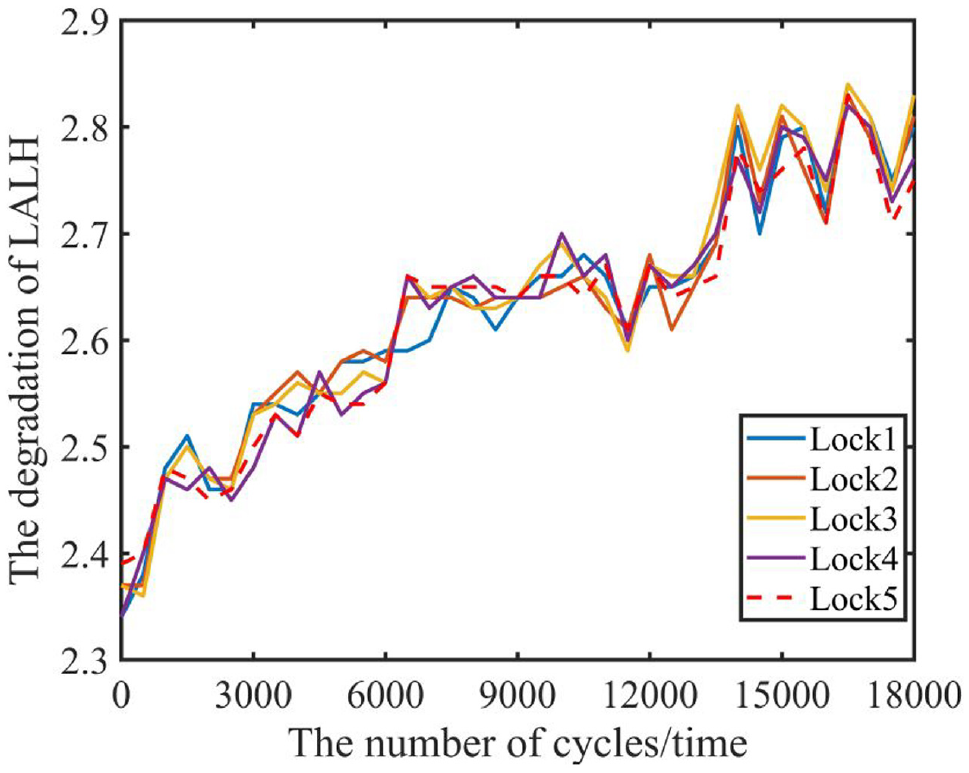
Locking angle evolution trend graph.

Locking displacement offset evolution trend graph.

Scatter chart.
The degenerate data are consequently submitted to a goodness-of-fit test in order to determine if the degenerate increments of the failure characteristic values obey a normal distribution. This is done in accordance with the characteristics of the Gaussian increments of the Wiener process. The specific operation is to use the Kolmogorov-Smirnov test, which yields the acceptance of the original hypothesis under significance, the evolutionary quantities of both characteristic quantities follow the Wiener process.
The results of simulating the deterioration of the two performance characteristics using the Wiener process are displayed in Table 1.
Results of parameter estimation for the Wiener process.

Subsequently, according to the obtained parameter estimates, the single-factor failure curve and reliability curve of the locking angle offset of the lock hook are obtained by substituting into equation (15); similarly, the single-factor failure curve and reliability curve of the locking hook displacement offset are easily obtained, as shown in Figures 6 and 7.

Reliability curve of single characteristic quantity of locking angle of lock hook.

Reliability curve of single characteristic quantity of lock hook displacement offset.
The Copula function is used to fit the two performance characteristic quantities together after the reliability analysis of a single performance characteristic quantity, and the reliability analysis taking into account the two performance characteristic quantities is then carried out.
The parameter values of the marginal distribution are generated by substituting them into equation (16), the parameter estimates of different Copula functions can all be obtained by maximum likelihood estimation, as shown in Table 2.
Parameter estimation for different Copula.

The following criteria are used to select the best Copula function.
Figure 5 displays a two-dimensional scatter plot of the degraded data for the two failure eigenvolumes. It is clear that the data’s distribution is generally symmetrical, and the bottom and top tails do not significantly correlate with one another. As a result, we select the Gaussian, Frank, Gumbel, and Clayton functions for the study based on the variety of Copula functions.
It is clear from the results in Table 3 and the scatter plots of the degraded eigenvolumes and correlation coefficients that the Clayton function is not appropriate since the eigenvolume data from the test are not sensitive to changes in the upper and lower tails. The Gaussian distribution is closest to the original data when combined with the Kendall correlation coefficient and Spearman correlation coefficient, and the remaining functional models have some gaps.
The AIC values for each Copula function are displayed in Table 4. The Gaussian distribution has a smaller AIC value than any other, indicating a better match and supporting the earlier analysis’s finding that the Gaussian distribution is more suitable.
Gaussian function is found to be closest to the locking angle single-performance characteristic quantity with no significant difference, and significantly different with the Frank function, Gumbel function, and Clayton function, but as shown in (3), the Gaussian function has a better AIC. This is because the values of the probability distribution functions obtained from each Copula function calculation are very similar.
Correlation coefficients of different Copula functions.

AIC values corresponding to different Copula functions.
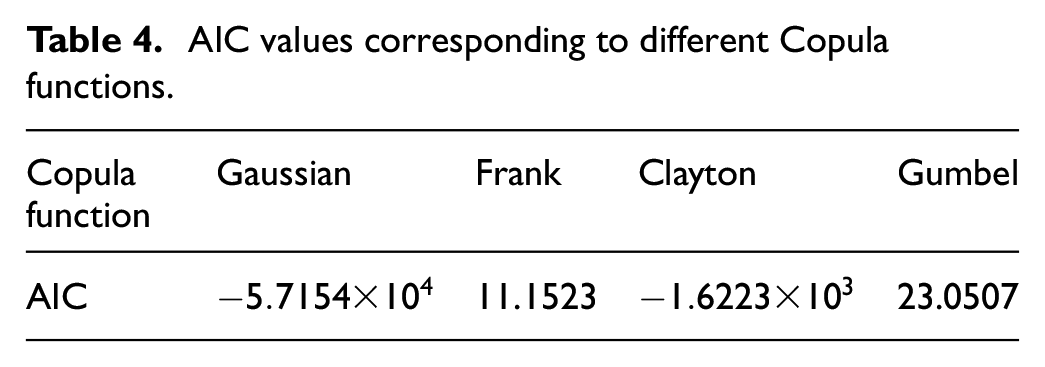
The best Copula function is ultimately decided to be the Gaussian function.
At last, the reliability function curve of the locking mechanism can be derived, as illustrated in Figure 8. On the basis of this method, the reliability function curves corresponding to different kinds of covariance functions, the actual cases, that is, the single performance characteristic quantities of the lock hook angle, the single performance characteristic quantities of the lock hook displacement offset case and the two related but independent cases are given.

Reliability curves corresponding to different Copula function models.
By examining Figure 8, the following facts can be established.
Compared to the multiple failure performance characteristic quantity degradation model, the single performance failure characteristic quantity degradation model has a significantly higher reliability. Distinct degradation scenarios are represented by different performance criteria for a complicated mechanism like the cabin door locking mechanism. This leads to the conclusion that the dependability of the cabin door locking mechanism may have been exaggerated by a reliability model that only takes the degradation of a single performance failure parameter into consideration.
Multiple linked deterioration models provide a better level of dependability than multiple independent degradation models. With longer working hours, the reliability gap between the two becomes larger. This suggests that if the correlation of two performance measures is ignored when the locking mechanism is operating both open and closed, the difference between the final anticipated reliability and the actual value would grow over time.
The Copula function-based multi-performance deterioration model’s reliability evaluation findings closely match the data. According to the locking mechanism’s defined service life, each Copula function model curve will be assessed in this study at its 18,000 actuation times. At around 18,000 operations, it appears that the Gaussian model almost matches the single-performance characteristic quantity degradation model (locking angle of the lock hook), but as the number of operations goes up, the Gaussian model’s reliability gradually drops below that of the single-performance case, and the reliability curves for the other Copula models are all marginally below that of the single-performance case. This demonstrated that the assessment approach in this study is more accurate than evaluation methods that merely take into account a single performance or a number of independent performances.
In conclusion, it has been shown that the method suggested in this paper is more applicable to the reliability assessment of complicated mechanisms with multiple performance degradation and more accurate than standard methods.
Conclusion
In order to more accurately assess the reliability of the locking mechanism under multiple performance degradation, this study suggests applying the reliability assessment method for multiple failure performance degradation based on Wiener process and Copula function to the cabin door locking mechanism with high reliability and small sample. While the Wiener process can effectively describe the stochasticity of the degradation process of the mechanism performance parameters, evaluating the reliability of complex mechanisms with a single eigenweight as the determining factor or taking into account the relationship between multiple eigenweights with a specific relationship is not accurate enough; and the coupling correlation of it can be properly described by the Copula function. The locking mechanism’s hook and lock ring come into contact with one another when it opens and closes, and their surfaces will eventually wear down. Therefore, it is possible that the reliability of the locking mechanism will be exaggerated for the specified lifetime if the correlation is disregarded and the mechanism’s dependability is solely assessed in terms of the degradation of a single performance. As a result, this paper provides an application example of an aircraft front landing gear cabin door locking mechanism, models the degradation process of a single performance characteristic using the Wiener process, models the degradation of multiple performance of the locking mechanism using different Copula models, and provides a method for determining the Copula function selection synthesis, which can precisely describe the correlation between the performance characteristics. Later, the accuracy and validity of the method are confirmed by comparing the evaluation results of the Copula function-based multi-performance degradation model with those of the conventional approach, which only takes into account a single performance characteristic quantity or multiple independent performance characteristic quantities.
Footnotes
Handling Editor: Chenhui Liang
Declaration of conflicting interests
The author(s) declared no potential conflicts of interest with respect to the research, authorship, and/or publication of this article.
Funding
The author(s) received no financial support for the research, authorship, and/or publication of this article.
