



Abstract
To solve the problem of performance degradation caused by supersonic phenomena under high gas supply pressures in orifice-compensated aerostatic journal bearings (OCAJBs), a double-row gas supply micron-groove-orifice aerostatic journal bearing (MGOAJB) is designed, and the SST k-ω turbulence model is used to analyze the influences of the supersonic phenomena on the gas film flow field under different gas supply pressures, gas film thicknesses and orifice diameters. Compared with traditional OCAJBs, under high gas supply pressure, supersonic phenomena occur near the gas film inlet in both the MGOAJB and the OCAJB. The Mach number, maximum pressure, temperature and Reynolds number of the OCAJB are higher than those of the MGOAJB, but the MGOAJB has a more stable gas film pressure due to pressure equalization. As the gas film thickness of the MGOAJB increases, the Mach number, Reynolds number and temperature near the gas film inlet increase, but the pressure decreases, the recovery of the pressure and temperature becomes more obvious when the gas velocity drops to a subsonic speed. With increases in the MGOAJB orifice diameter, the pressure, temperature and Reynolds number increase, the Mach number decreases, and the recovery of the pressure and gas temperature becomes more obvious.
Keywords
Introduction
As a kind of externally pressurized gas-lubricated bearing, orifice-compensated aerostatic bearings are new, highly technical products that can be used in extreme conditions such as very high or very low temperatures, ultrahigh speeds and ultraprecise applications, 1 and their performance largely depends on the gas supply pressure and restrictor structure.
Increasing the supply pressure can improve the performance, such as the load capacity and stiffness of orifice-compensated aerostatic bearings, but with the continuous increase in the supply pressure, the gas velocity accelerates from subsonic to supersonic, resulting in self-excited vibrations, shock waves, and even negative pressure and other phenomena that reduce the load capacity and stiffness.2–4 As early as 1961, researchers began to study the supersonic phenomena of orifice-compensated aerostatic bearings. Mori et al.5,6 analyzed the supersonic flow in a bearing gap and studied the pressure distribution in the gas film. When the gas supply pressure increases continuously, the pressure around the outlet of the orifices decreases rapidly, and the pressure drops sharply, which affects the load capacity. In 1984, Miyake et al.7,8 was the first researcher to propose the design concept to use gas under high pressure to lubricate heavily loaded bearings. Miyake et al. designed a very stiff bearing with a high gas supply pressure to take advantage of the fact that low pressure disturbance downstream of a supersonic flow cannot affect the pressure distribution upstream. Referring to the relevant design theories of the contraction sections in wind tunnels, other researchers 9 proposed a wall profile design suitable for the contraction section of thrust bearings lubricated with high-pressure gas so that the gas flow could theoretically undergo uniform flow in the gap, that is, the flow direction was parallel to the bearing race. In the classical Reynolds lubrication equation, it is assumed that the inertia force of the fluid in the gas film is ignored, but under high gas supply pressure, the average gas velocity in a gas film increases, and the influence of inertial forces should be considered. 1 The Reynolds equation of classical lubrication theory is no longer applicable. In the literature, 10 the Navier–Stokes (N-S) governing equations, including the inertia term, were solved using commercial computational fluid dynamics (CFD) software to calculate the supersonic flow field in a thrust bearing under high pressure. The numerical results and the conventional Reynolds equation were compared with the experimental results, and relatively accurate results were obtained. In the literature,11,12 the SST k-ω turbulent model is used to solve the supersonic flow field of thrust bearings under high gas supply pressure, and the calculation results are accurate. Although researchers have made many significant achievements in the supersonic flow field of orifice-compensated aerostatic bearings under high gas supply pressure, they are mainly based on thrust bearings, while journal bearings widely used in engineering are rarely studied.
Improving the restrictor structure of orifice-compensated aerostatic bearings is another way to improve their performance.13,14 By connecting the orifices with the pressure-equalizing grooves, a new micron-groove-orifice (MGO) structure is formed, which remarkably improves the load capacity and stiffness of the aerostatic bearing. Researchers15,16 improved the load capacity and stiffness of aerostatic bearings by setting different numbers and positions of pressure-equalizing grooves on the bearing surface. Researchers have designed radial groove-compensated 17 and trapezoidal groove-compensated aerostatic thrust bearings 18 to study the influence of the structural parameters on the static characteristics of aerostatic thrust bearings, and the static stiffness, bearing capacity and stability of the bearings were improved. Literature 19 reveals that the adoption of the MGOs can substantially improve the load capacity and stiffness of the bearing and make the bearing maintain a uniform stress, which enhances the operating accuracy and life of the bearing. By setting different forms of latitudinal and longitudinal grooves, the homogenization effect of these grooves on pressure is utilized to reduce the velocity of the pressure drop and increase the pressure on the atmospheric film flow field. 20 In the literature, 21 the resistance network method (RNM) is utilized to numerically solve the Reynolds equation required in the static performance of journal bearings with rectangular grooves and has good precision.
Combining the two aspects mentioned above, that is, when the gas supply pressure is increased, whether the gas film flow field of micron-groove-orifice aerostatic bearings will produce a supersonic phenomenon, what are the differences from orifice-compensated aerostatic bearings, whether it is more suitable for working under high gas supply pressure, and how the physical parameters (such as the Mach number, pressure, temperature, etc.) of the gas film flow field change with the gas supply pressure and structural parameters under the influence of supersonic phenomenon, etc., are all worthy of study. Therefore, in this paper, a double-row micron-groove-orifice aerostatic journal bearing (MGOAJB) is designed to study the influence of supersonic phenomena on the gas film flow field of aerostatic journal bearings under high gas supply pressure, enriching relevant theories and providing a basis for engineering applications.
Bearing structure of MGOAJB and OCAJB
Figure 1(a) shows a schematic diagram of the MGOAJB. Eight gas supply holes are provided around the externally pressurized gas bearing, and a double-row gas supply is adopted. At the outlet of the orifices on the inner surface of the bearing, axial microgrooves are arranged to form the MGO structure with the orifices; there are eight MGOs in the aerostatic bearing. For comparison, the structure of the OCAJB is shown in Figure 1(b). To prevent cylindrical surface compensation (cylindrical surface throttling has a lower load capacity and stiffness than orifice compensation), a circular stingy cavity is set at the end of the gas supply orifice (the gas film inlet) to ensure that the restrictive section is the orifice cross-section. 1
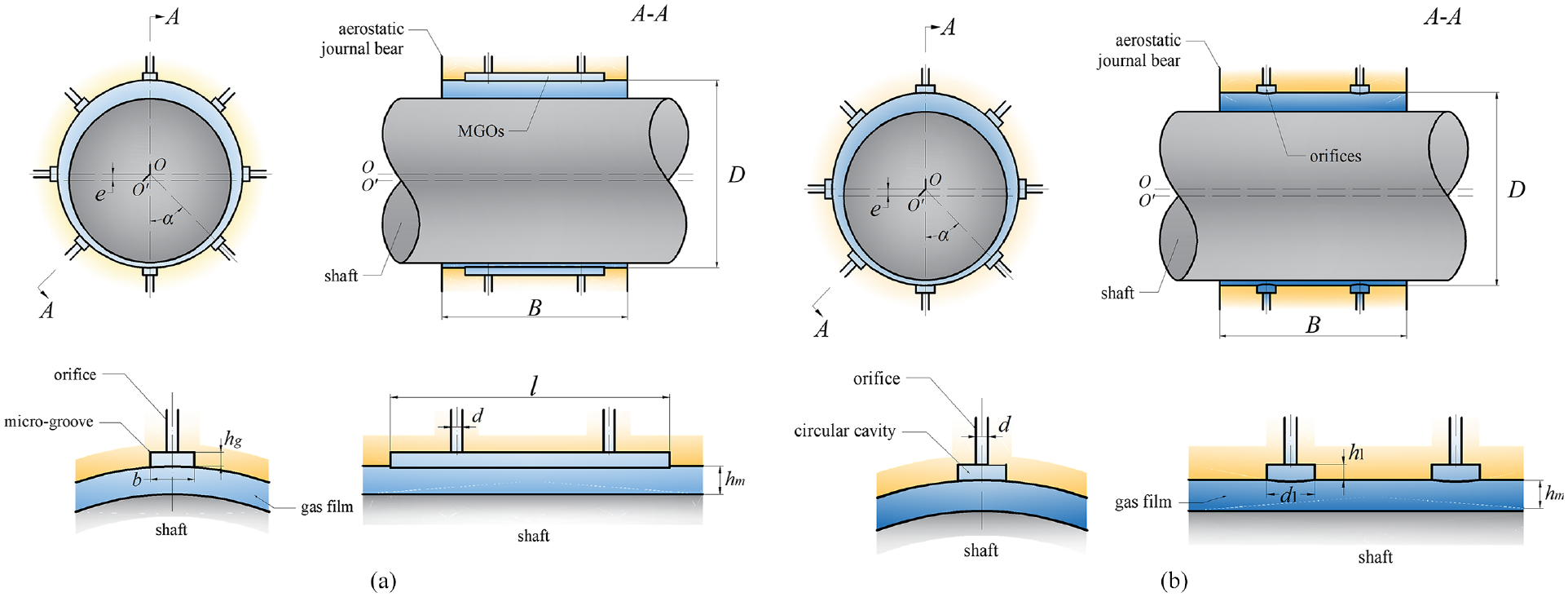
Schematic diagram of the structure and size of (a) MGOAJB and (b) OCAJB.
where
In general, to prevent cylindrical surface compensation (cylindrical surface compensation leads to a lower load capacity and stiffness than orifice compensation), a circular cavity is set at the end of the orifice to ensure that the restrictive section is the orifice cross-section.
1
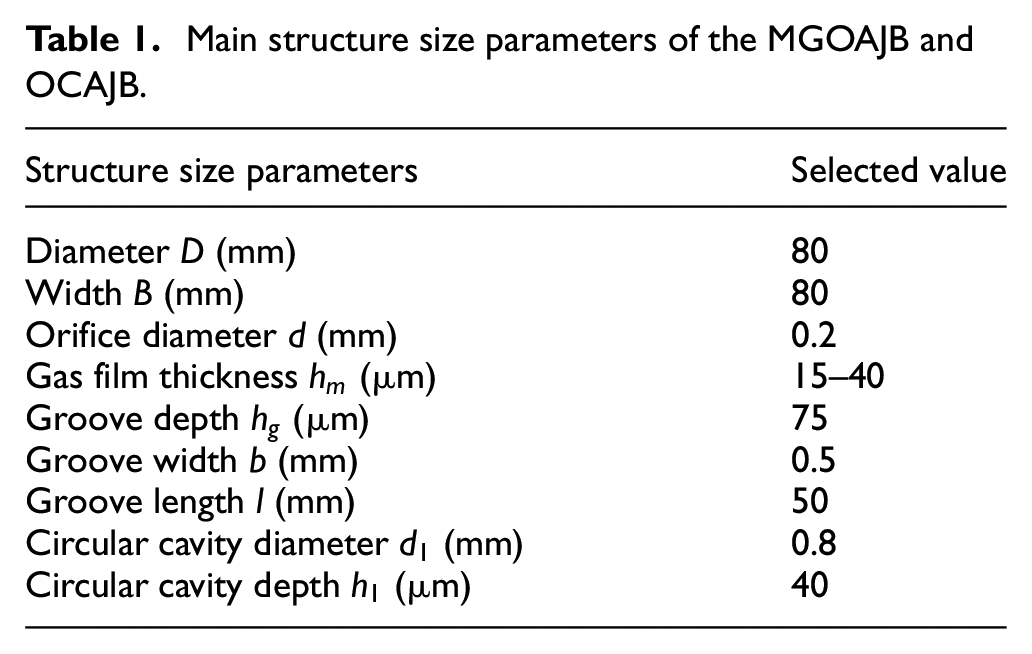
The main structure size parameters of the MGOAJB and OCAJB are shown in Table 1.
Main structure size parameters of the MGOAJB and OCAJB.
Mathematical model and simulation
Theoretical calculation of the gas film flow field under high gas supply pressure
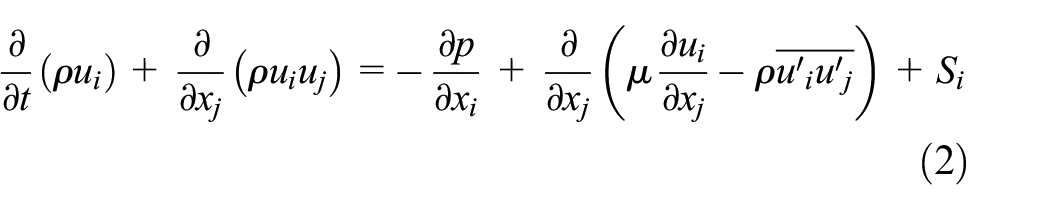
In previous studies, the classical Reynolds lubrication equation was the main means to calculate the gas film flow field. However, the Reynolds equation is derived on the premise that the Reynolds number is low (laminar flow) and the effect of inertia force is ignored. When the gas supply pressure and gas film thickness increase, flows become more complex, a supersonic region may be generated, and the influence of inertia force cannot be ignored.1,23 New governing equations must be established for the gas film flow field under high gas supply pressure. Researchers found that the shear stress transport (SST) k-ω turbulence model can effectively simulate the complex flow state near the gas film inlet under a high gas supply pressure. Compared with the laminar flow model, the results are more accurate and more consistent with the real gas film flow,11,12 and thus, the SST k-ω turbulence model is adopted in this paper to calculate the pressure distribution of a gas film flow field. The tensor forms of its governing equations are as follows11,23:
Continuity equation:

Momentum equation:
Energy equation:

Gas state equation:

where
The term related to the turbulence pulsation value

where

The turbulent viscosity

where

The transport equation of turbulent energy
Transport equation of turbulent energy:

Turbulence specific dissipation equation:

where
According to Liu et al., 1 when the gas supply pressure is large, the influence of the inertial force cannot be ignored, and the Reynolds number will increase accordingly. Therefore, it is necessary to calculate the Reynolds number to reflect the complexity of the gas flow.

Simulation
According to the principle of computational fluid dynamics (CFD) simulations, the gas in the restrictor and the gas film of the MGOAJB or OCAJB are taken as the research object. As shown in Figure 2, SolidWorks software is used to establish a three-dimensional model of the flow field in the MGOAJB. In general, the high-pressure gas flow enters the orifice after the pressure-stabilizing chamber in the aerostatic bearing spindle system, so the inlet of the pressure-stabilizing chamber is set as the pressure inlet of the high-pressure gas flow. The axial boundary of the gas film is set as the outlet of the gas film pressure. Because the double-row gas supply structure has symmetry in the bearing axial direction, the symmetry face is set along the axial direction, and half of the structure is simulated for simplification.

3D model of the gas film flow field of the MGOAJB.
The mesh tool in Workbench software, the method for partition grid division, is used to mesh the 3D model of the bearing flow field (Figure 3). For the MGO or orifice structure, the “Hex Dominant Method” command is used to divide the grid, and the element size is selected according to the geometrical dimensions of the orifices and grooves to ensure that there are enough grid cells and that the calculation time will not be too long due to excessive grids. Through trial and error, 0.05 mm is found to be appropriate; for the gas film, the “Sweep Method” and “Edge Sizing” commands are used to divide the gas film into 750 and 2100 equal parts along the axial and circumferential directions, respectively, to ensure that the element size of the grid is the same order of magnitude as that of the MGO and orifice. The “Face Meshing” command is used to divide the gas film into five equal parts along the gas film thickness direction. Finally, the boundary conditions are set according to the method shown in Figure 2, and the mesh files are exported.
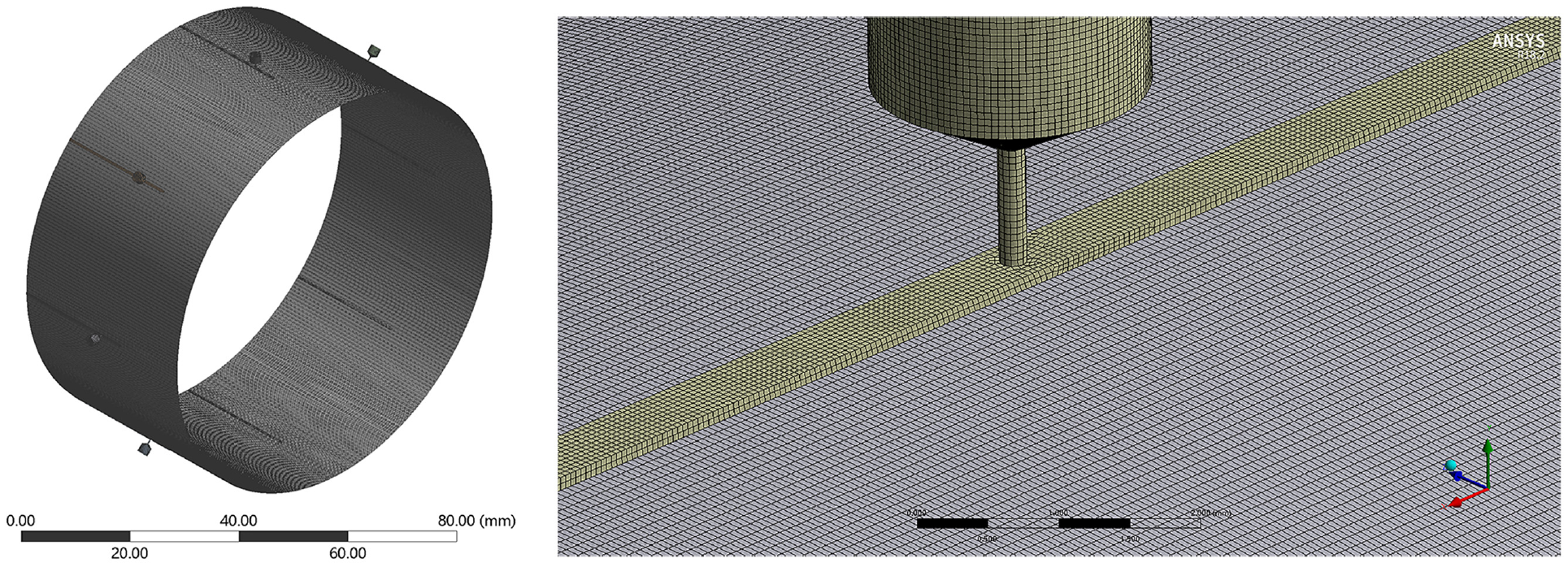
Meshing of the gas film flow field of the MGOAJB.
FLUENT software is used to simulate the flow field. According to Sun et al.,11,12 the SST k-ω model is more suitable for calculating the supersonic flow field and shock wave with an adverse pressure gradient, and thus, the SST k-ω model is used in this study to simulate the flow field under high gas supply pressure. The SIMPLEC algorithm is selected for iterative calculations, and the relaxation factor is adjusted to improve the convergence of the calculation. The simulation calculation flowchart is shown in Figure 4.
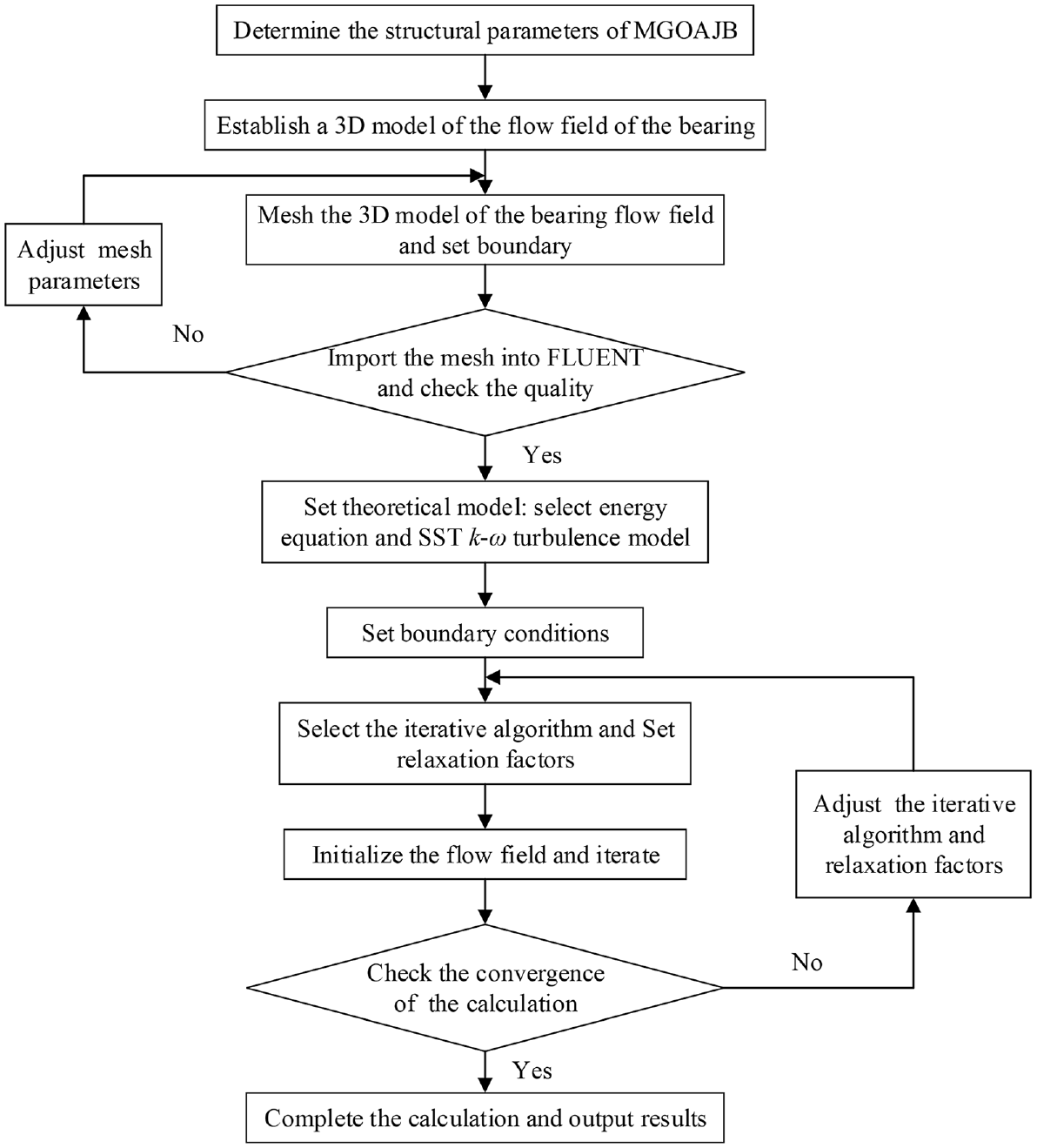
Flowchart of the simulation calculation.
In previous applications of aerostatic bearings, it is necessary not only to ensure sufficient load capacity of bearings but also to avoid the adverse effects brought by supersonic phenomena of the flow field. The use range of the gas supply pressure was limited between 0.4 and 0.6 MPa. However, to study the supersonic phenomena of the flow field of MGOAJB, reveal the changes in physical parameters in the supersonic region, and determine the differences and improvements compared with the OCAJB in this paper, the gas supply pressure is increased as much as possible to exceed 0.4–0.6 MPa limit. Considering existing experimental equipment with published research results, 0.9, 1.1, 1.3, and 1.5 MPa are adopted as the gas supply pressures at the pressure inlet in this paper,11,12 the inlet temperature is 20°C, and the pressure outlet of the gas film is connected with the external atmosphere.
Simulation results
As shown in Figure 5, the gas Mach number, pressure and streamline are shown from left to right. It is found that the supersonic region of the aerostatic bearings gas film flow field is mainly near the orifice outlet (gas film inlet), which is consistent with Liu et al.
1
and Sun et al.11,22 It can also be seen that when high-pressure gas (

Cloud image of the gas film flow field in the supersonic region under high gas supply pressures (

A comparison of the simulation results and the experimental data (
The gas flowing through the gas film enters from the subsonic flow into the supersonic flow and then rapidly descends to the subsonic flow. This is because the gas flow from the orifice to the turning point of the gas film is similar to the flow along the outer folded wall, and the change in flow direction and the curvature of the stream line produce expansion waves of gas, which make the gas flow speed increase while the pressure, density and temperature sharply decrease.22,23 Then, the supersonic flow is compressed by the wall of the gap between the gas film and generates a compression wave, which merges into a weak oblique shock wave or pseudoshock5,23 and causes the Mach number to change from supersonic flow to subsonic flow; on the other hand, the gas pressure begins to recover.
As shown in Figures 7 and 8, when the gas film thickness is reduced to

Cloud image of the gas film flow field in the supersonic region under high gas supply pressures (
Cloud image of the gas film flow field in the supersonic region under high gas supply pressures (
Results and discussion
Gas supply pressure
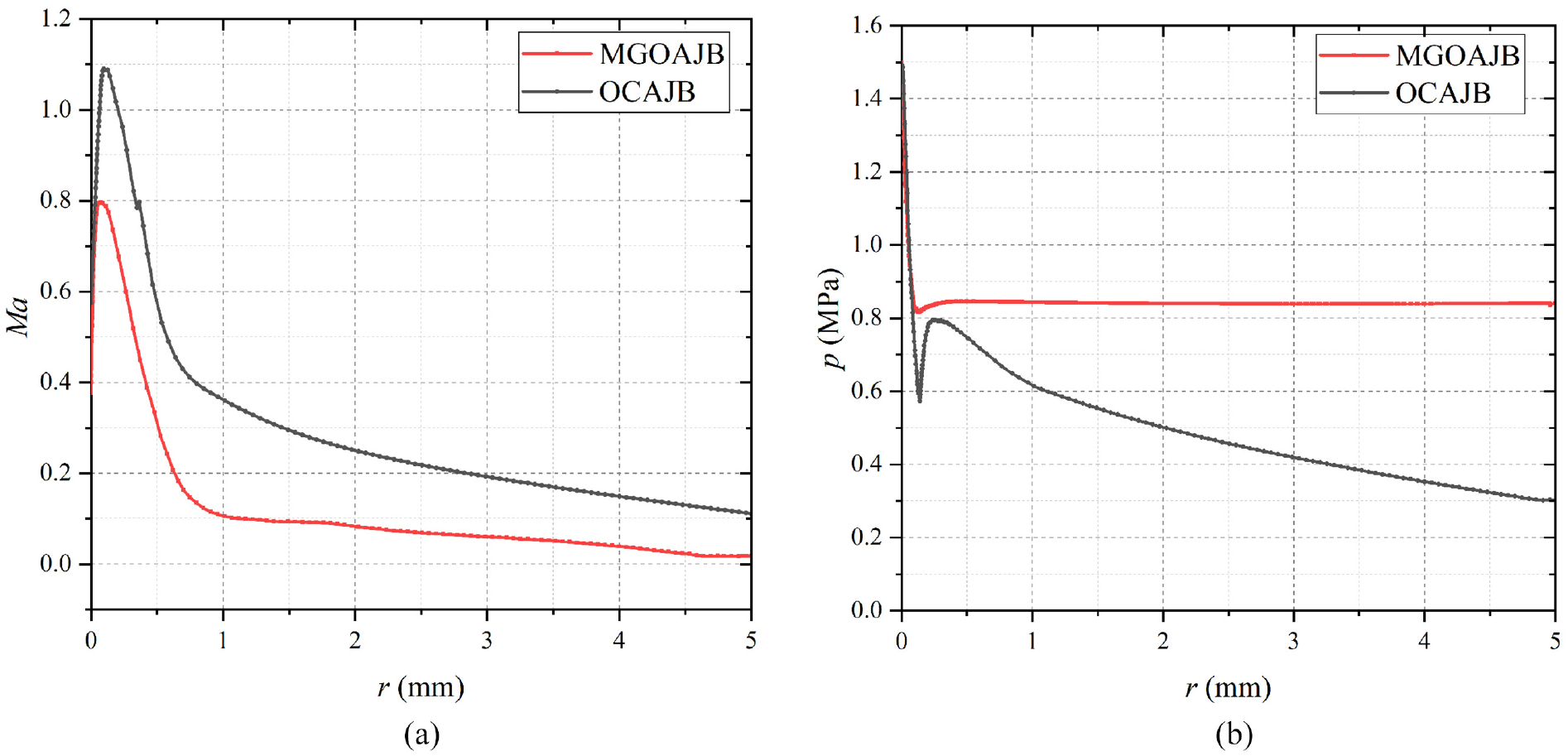
As shown in Figure 9, when high-pressure gas (

Influence of the gas supply pressure on the supersonic phenomena in the MGOAJB and OCAJB (
As shown in Figure 9(b), high-pressure gas (

Change in the gas film pressure in the supersonic region: (a) minimum gas film pressure in the supersonic region, (b) recovery of gas film pressure, and (c) maximum gas film pressure.
As shown in Figure 9(c), when the high-pressure gas enters the gas film, the gas temperature
The Reynolds number of the gas near the gas film inlet varies with the gas supply pressure, as shown in Figure 9(d). Because the flow turns and becomes more complicated, the Reynolds number at the gas film inlet ranges from 3200 to 3700 and decreases rapidly as
Gas film thickness
As shown in Figure 11(a), in MGOAJBs, when high-pressure gas (
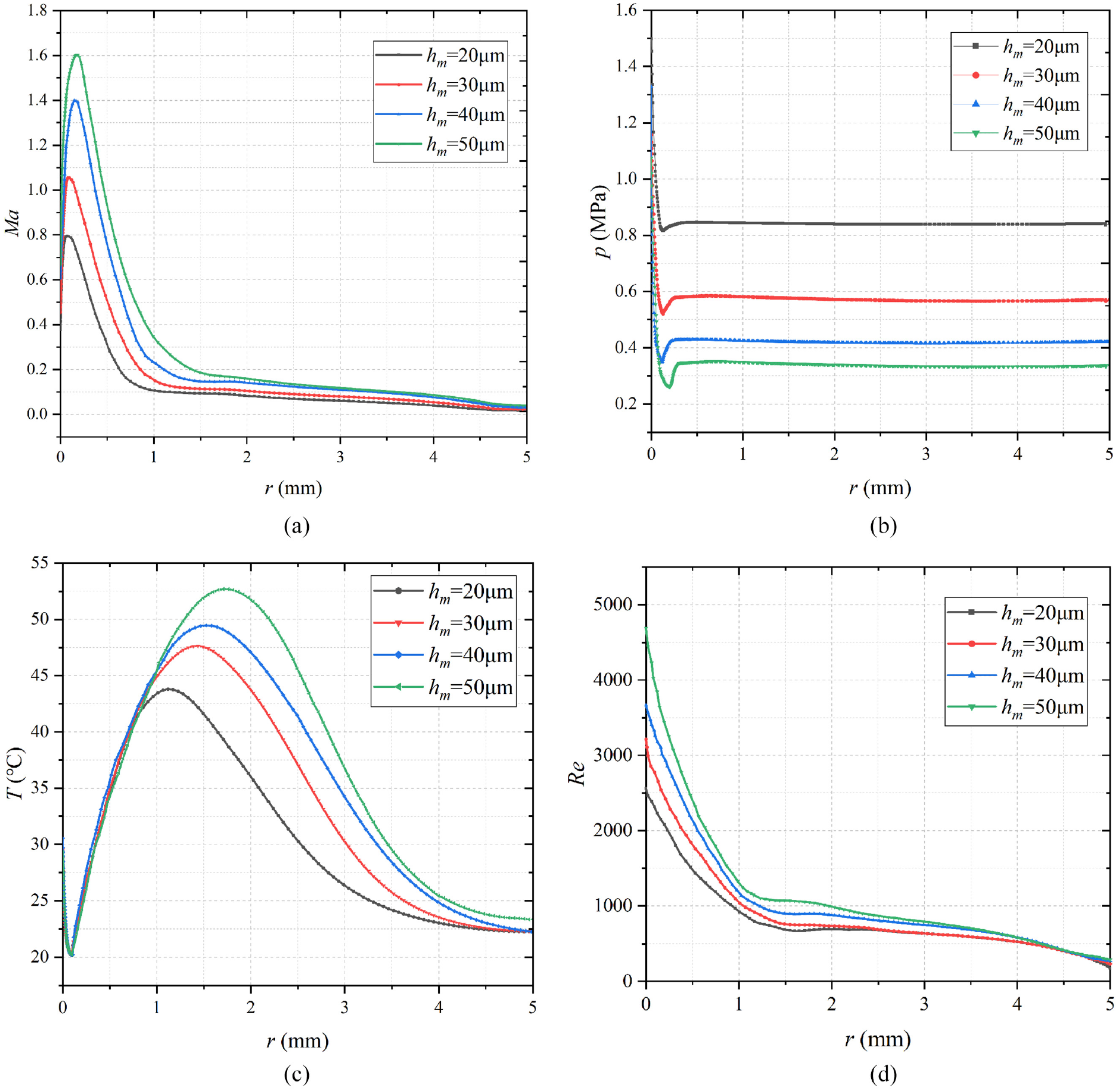
Influence of the gas film thickness on the supersonic phenomena in the MGOAJB (
As shown in Figure 11(b), high-pressure gas (
As shown in Figure 11(c), under high supply pressure, the temperature of the gas in the gas film gap drops to approximately 21.1°C in the supersonic region. When the gas rapidly descends to subsonic speed, the temperature increases. With the increase in the gas film thickness, the gas flow and velocity increase, the motion and collision between gas molecules become more intense, and the kinetic energy loss increases, leading to a rise in the gas temperature,
12
with maximum temperatures of 43.8°C, 47.6°C, 50.6°C, and 53.5°C. When
As shown in Figure 11(d), under high gas supply pressure, the Reynolds number rapidly decreases from the gas film inlet with increasing
In summary, although the MGOAJB has a lower gas flow velocity than the OCAJB under high gas supply pressure and the supersonic phenomenon is weaker than that of the OCAJB, it is necessary to make an appropriate choice for the gas film thickness in the design process of the MGOAJB under high gas supply pressure. If the gas film is too thick, the gas flow velocity is faster, the supersonic phenomenon is more obvious, the pressure loss is greater in the gas film and the gas temperature rises, leading to the load capacity and accuracy decline.
Diameter of the orifice
As shown in Figure 12(a), in MGOAJBs, when high-pressure gas (

Influence of the orifice diameter on the supersonic phenomena in the MGOAJB (
As shown in Figure 12(b), high-pressure gas (
As shown in Figure 12(c), under high supply pressure (
As shown in Figure 12(d), under high gas supply pressure, the Reynolds number rapidly decreases from the gas film inlet with increasing
In summary, it is necessary to make an appropriate choice of orifice diameter in the design process of the MGOAJB for operation under high supply pressure. If the diameter of the orifice is too small, the gas flow velocity is too fast, and the gas film pressure is greatly reduced. However, if the diameter of the orifice is too large, the dimensional difference from the gas film thickness becomes more significant, which results in the film pressure changing more dramatically when the gas flow changes from supersonic to subsonic speed. The diameter of the orifice is typically controlled between 0.15 and 0.25 mm.
Conclusions
A double-row gas supply micron-groove-orifice aerostatic journal bearing is designed, and the SST k-ω turbulence model is used to analyze the influences of the supersonic phenomena on the gas film flow field under different gas supply pressures, gas film thicknesses and orifice diameters. Under high gas supply pressure, supersonic phenomena occur near the gas film inlet in both the MGOAJB and OCAJB. After the high-pressure gas enters the gas film, the flow Mach number rapidly increases to supersonic and then sharply decreases to subsonic, while the pressure and temperature rapidly decrease and subsequently recover to the maximum value, and the Reynolds number reflects the complexity of the gas flow. The main conclusions are as follows:
With increasing gas supply pressure, the Mach number, gas film pressure, temperature and Reynolds number increase in the gas film under the influence of the supersonic phenomenon. Under the same gas supply pressure, the Mach number, Reynolds number and temperature of the gas flow in the OCAJB are higher than those of the MGOAJB, and the supersonic phenomenon is more obvious. Although the maximum gas film pressure of the OCAJB is slightly higher than that of the MGOAJB when the gas velocity drops to subsonic speed, the gas film pressure in the MGOAJB is more stable and higher than that in the OCAJB due to pressure equalization by the MGO structure.
With increasing gas film thickness of the MGOAJB, the Reynolds number of the gas increases, especially at the inlet of the gas film. The Mach number and temperature increase, but the gas film pressure decreases. The recovery of the gas film pressure and gas temperature becomes more obvious when the gas velocity drops to subsonic speed, as does the supersonic phenomenon in the gas film of the MGOAJB.
With increases in the MGOAJB orifice diameter, the gas film pressure, temperature and Reynolds number gradually increase, but the Mach number decreases, and the recovery of the gas film pressure and gas temperature becomes more obvious when the gas velocity drops to subsonic speed.
Footnotes
Appendix
Handling Editor: Chenhui Liang
Declaration of conflicting interests
The author(s) declared no potential conflicts of interest with respect to the research, authorship, and/or publication of this article.
Funding
The author(s) disclosed receipt of the following financial support for the research, authorship, and/or publication of this article: This research was funded by the Natural Science Foundation of Heilongjiang Province, Grant No. E2018001.
