




Abstract
To improve the static characteristics of orifice-compensated aerostatic journal bearings (OCAJBs) under high gas supply pressures, governing equations considering inertial forces are established based on the shear stress transport (SST) k-ω turbulence model, and a double-row gas supply micron-groove orifice aerostatic journal bearing (MGOAJB) is designed. The influences of the structural parameters of the micron-groove orifice (MGO), such as the groove cross-sectional shape, dimensional parameters and layout, on the static characteristics under high gas supply pressures are studied. The SST k-ω turbulence model can accurately simulate the pressure distribution of a gas film flow field under high gas supply pressures, and the MGO can effectively improve static bearing characteristics such as the load capacity and stiffness. The influences of the groove cross-sectional shape, groove depth, and groove width of the MGO are not significant, but the groove length, orifice diameter, and MGO layout have obvious impacts on the load capacity and stiffness of a bearing. Structural parameters should be reasonably selected in the bearing design process.
Keywords
Introduction
Aerostatic bearings are externally pressurized gas-lubricated bearings, and the gas supply pressure of aerostatic bearings is usually restricted between 0.4 and 0.6 MPa. 1 In most cases, the Reynolds equation can correctly describe the physical nature of gas lubrication problems, conforms to the actual physical process, and has satisfactory engineering accuracy. 2 With the continuous improvement in science and technology and production requirements, high-bearing and high-precision gas bearings are urgently needed. 3 Increasing the gas supply pressure is an effective method for improving the performance of aerostatic bearings. However, when the gas supply pressure is high, the influence of inertia force cannot be ignored, 4 the distribution of gas flow velocity and pressure in the gas film changes considerably, and the gas pressure in the gas film gap drops sharply, or negative pressure will even arise, which will reduce the load capacity and stiffness.5–8 In classical lubrication theory, it is assumed that the inertia force of the fluid in the gas film is ignored, 9 which is an assumption that does not apply to the above-mentioned working conditions. Researchers have long been concerned about the influence of fluid inertia on load capacity and have obtained many valuable research results. Although most of the results are related to thrust bearings or oil film bearings,10–14 they still have reference value for aerostatic journal bearings.
Improving the restrictor structure of aerostatic bearings is another way to improve their performance. Surface microstructure has been deliberately introduced on bearings and is a focus of increasing attention and expected to be a major component in future bearing structure design.15,16 In recent years, micron-groove orifice (MGO) high-performance gas-bearing lubrication technology has provided a new approach for solving such problems. Researchers have designed radial groove-compensated aerostatic thrust bearings 17 and trapezoidal groove-compensated aerostatic thrust bearings 18 and studied the influence of the structural parameters on the static characteristics of aerostatic thrust bearings, and the static stiffness, bearing capacity and stability of the bearings were improved. By setting different forms of latitudinal and longitudinal grooves, the homogenization effect of these grooves on pressure is utilized to reduce the velocity of the pressure drop and increase the pressure on the atmospheric film flow field. 19 Chen et al. 20 focuses on the influences of the dimensions of the rectangular equal-pressure groove, the diameter of the orifice and the angular deviation of the rotor on the load capacity, stiffness, and flow of a journal bearing. The number, position and layout of rectangular pressure-equalizing grooves have a significant influence on the load capacity of aerostatic journal bearings. 21
In this paper, a double-row gas supply micron-groove orifice aerostatic journal bearing (MGOAJB) is designed, the governing equations for a gas film flow field under a high gas supply pressure are established, and the influences of the structural parameters of the MGO such as groove cross-sectional shape, dimensional parameters, and layout on the static characteristics of a gas film flow field under high gas supply pressures are studied. The research results in this paper can be used to analyze the pressure distribution of a gas film flow field of an aerostatic journal bearing under high gas supply pressures and support the finding that the MGO structure can improve the static characteristics of such a bearing.
MGOAJB spindle system and the bearing structure
Spindle system
As shown in Figure 1, the MGOAJB spindle system is mainly composed of the front MGOAJB, rear MGOAJB, aerostatic thrust bearing, shaft body, rotor, stator, cylinder, piston, and return spring.

3D structure graphing of the MGOAJB spindle system.
When cutting, the high-pressure gas enters the spindle through the inlet on the cylinder, first passes through the gas path channel in the shaft body, then flows into the gas supply holes of the aerostatic thrust bearing and MGOAJBs, and finally enters the gap between the rotor and the bearings, forming a gas film with a certain load capacity and suspending the rotor for cutting.
Bearing structure
Figure 2(a) shows a schematic illustration of the MGOAJB. Eight gas supply holes are provided around the externally pressurized gas bearing, and a double-row gas supply layout is adopted. At the outlet of the orifices on the inner surface of the bearing (orifices 2, 5, and 8), axial microgrooves are arranged to form the MGO structure with these orifices, resulting in three MGOs in the aerostatic bearing. α represents the position angle of the gas supply hole relative to the bearing centerline,

(a) Schematic illustration of a MGOAJB and (b) structural parameters of an axial MGO.
As shown in Figure 2,
To avoid the adverse phenomenon caused by the increase in gas supply pressure and gas volume in the microgroove,1,21 the size of the MGO should be as small as possible on the premise of increasing the load capacity and stiffness. Usually,
For comparison, the structure of the orifice-compensated aerostatic journal bearing (OCAJB) is shown in Figure 3. To prevent circular surface compensation (circular surface throttling has a lower load capacity and stiffness than orifice compensation), a circular cavity is set at the end of the orifice (the gas film inlet) to ensure that the restrictive section is the orifice cross section.
4
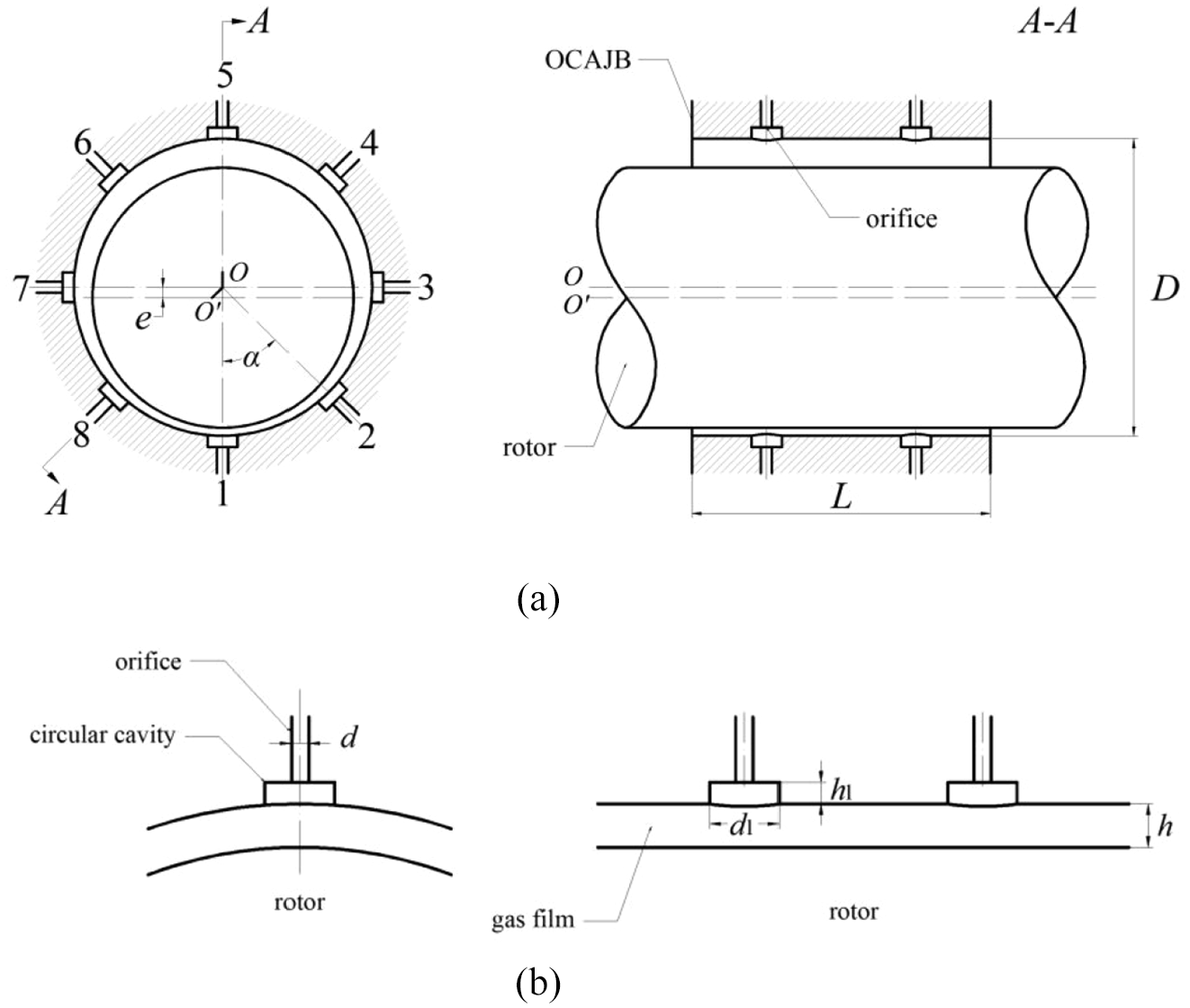
(a) Schematic illustration of an OCAJB and (b) structural parameters of orifices.
The main structural dimensions of the MGOAJB and OCAJB are shown in Table 1.
Main structural dimensions of the MGOAJB and OCAJB.

Mathematical model and simulation calculation
Pressure at a MGO outlet
The mass flow of gas entering the gas film through a single orifice is

where
The mass flow of gas entering the gas film through a single MGO 1 is

where
According to lubrication theory as presented in Wang, 1 the presence of a MGO is equivalent to the secondary compensation of an orifice, so

The mass flow of gas entering a gas film is

where
According to the principle of conservation of mass, the following relations are obtained:

According to equations (3) and (5), the outlet pressure of the MGO
Pressure in a gas film under high gas supply pressure
When the gas supply pressure is high, the average gas velocity in a gas film increases, and the influence of inertial forces should be considered. 1 The Reynolds equation of classical lubrication theory is no longer applicable; therefore, the newly established governing equations for laminar flow are as follows 2 :
Continuity equation:

Momentum equation:

Energy equation:

When the gas supply pressure increases, the Reynolds number at the gas film inlet considerably increases (
Continuity equation:

Momentum equation:

Energy equation:

where
The transport equation of turbulent energy and the turbulence specific dissipation equation 2 of the SST k-ω turbulence model are as follows:
Transport equation of turbulent energy:

Turbulence specific dissipation equation:


where
Load capacity and stiffness of a MGOAJB
Finally, the load capacity

The stiffness of the MGOAJB can be described by 4

where
Simulation calculation
According to the principle of computational fluid dynamics (CFD) simulation model establishment, the gas in the MGOAJB of Figure 2 is taken as the research object, and SolidWorks software is used to establish a three-dimensional model of the flow field of the MGOAJB. As the double-row gas supply structure has symmetry in the bearing width direction, only half of the structure is taken for calculation for simplification.
The mesh tool in Workbench software, for partition grid division, is used to mesh the 3D model of the bearing flow field (Figure 4). For the MGO structure, the “Hex Dominant Method” command is used to divide the grid, and the element size is selected according to the geometrical dimensions of orifices and grooves. In order to ensure that there are enough grid cells in MGO and that the calculation time will not be too long due to excessive grids, 0.05 mm is found to be appropriate after many attempts; for the gas film, the “Sweep Method” and “Edge Sizing” commands are used to divide the gas film into 750 and 2100 equal parts along the axial and circumferential directions respectively to ensure that the element size of the grid is the same order of magnitude as that of MGO. The “Face Meshing” command is used to divide the gas film into five equal parts along the thickness direction.

Meshing of the gas film flow field of the MGOAJB.
FLUENT software is used to simulate the flow field. The SST k-ω model is used in this study to simulate the flow field under a high gas supply pressure. The SIMPLEC algorithm is selected for iterative calculation, and the relaxation factor is adjusted to improve the convergence of the calculation. The simulation calculation flowchart is shown in Figure 5.

Flowchart of simulation calculation.
The static characteristics (load capacity and stiffness) of bearings studied in this paper refer to the macroscopic characteristics of bearings when there is no relative movement between bearing pairs or the relative speed is relatively low. 1 Therefore, the dynamic pressure effect caused by the spindle speed is ignored in this paper, and only the effect of the external pressure supply is considered. In previous studies, the use range of gas supply pressure was limited by work requirements and working conditions, which should not be too extreme; usually, the range of 0.4–0.6 MPa was selected. 4 To study the effect of MGO on the static characteristics of a bearing under a high gas supply pressure, the gas supply pressure is increased as far as possible to exceed the limit of 0.4–0.6 MPa in this paper. Combining the limits of existing experimental equipment with published research results, 0.9, 1.1, 1.3, 1.5, and 1.7 MPa are adopted as the gas supply pressures in this paper, and the outlet of the gas film is connected with the external atmosphere. To verify the influence of the MGO on the bearing characteristics of an aerostatic journal bearing under a high gas supply pressure, this study uses the OCAJB as a comparative reference. Pressure contour diagrams of the corresponding gas film flow fields are shown in Figure 6, where different colors in the figure represent different pressure values, with red to blue representing pressure values from high to low.

The pressure contour diagram of the gas film flow field (
Verification of simulation results
The accuracy of the simulation method in this paper is verified by the experimental data obtained from the experimental device shown in Figure 7. The results of load capacity with respect to eccentricity acquired from both the experiments and simulations are shown in Figure 8(a). The load capacity of the simulation results is slightly higher than that of the experimental results, but the difference is not significant. The variation trend of the simulated load capacity with eccentricity is in agreement with the experimental results, the simulation method in this paper is reliable and can be used to calculate the load capacity under a high gas supply pressure and ensure the accuracy of the results. According to the experimental tests, amplitudes of MGOAJB and OCAJB at

Experimental device and schematic diagram.
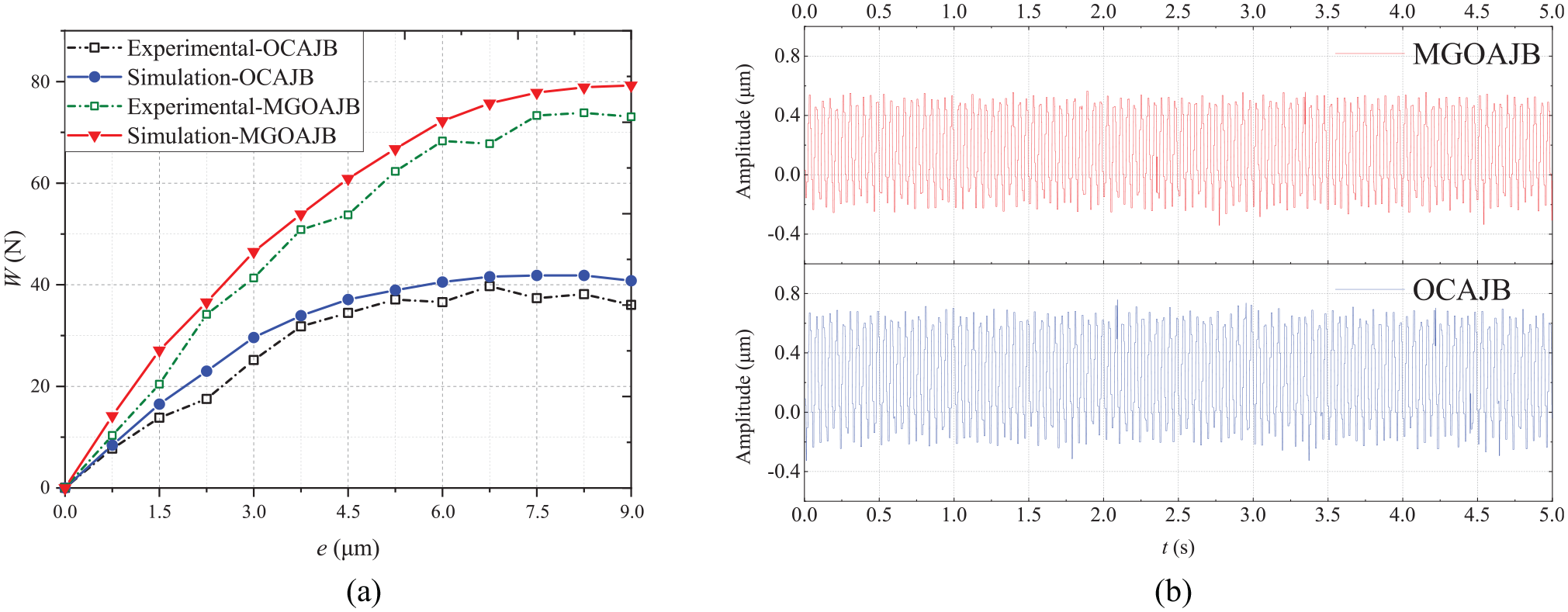
Verification of the accuracy of the simulation method: (a) load capacity and (b) amplitude.
Results and discussion
Influence on the load capacity and stiffness of a MGO
As shown in Figure 9(a), the load capacity of the MGOAJB is significantly improved with increasing eccentricity compared with that of the OCAJB under high gas supply pressures (0.9, 1.1, 1.3, 1.5, and 1.7 MPa). With the increase in eccentricity

Load capacity and stiffness of MGOAJB and OCAJB under high gas supply pressures: (a) load capacity and (b) stiffness.
As shown in Figure 9(b), the stiffness of the MGOAJB is also significantly improved with increasing eccentricity compared with that of the OCAJB. The stiffness is increased by 70.63%–112.74%, 62.12%–105.41%, 63.25%–88.37%, 55.04%–73.68%, and 57.24%–70.52% under each gas supply pressure (0.9, 1.1, 1.3, 1.5, and 1.7 MPa). Although the stiffness improves with increasing gas supply pressure, when
Under a high gas supply pressure (e.g.

3D contour maps of the gas film pressure distributions of the MGOAJB and the OCAJB (
Figure 11 shows the axial and circumferential distributions of the gas film pressure of the MGOAJB. The axial and circumferential pressure gradients of the high-pressure gas tend to be gentle due to the pressure-equalizing effect of the MGO structure, which inhibits the pressure attenuation far from the inlet of the gas film, expands the range of the high-pressure area, and improves the load capacity and stiffness of the aerostatic journal bearing compared to those of the OCAJB.

Axial and circumferential distributions of the gas film pressure: (a) axial distribution and (b) circumferential distribution.
Influence of the groove cross-sectional shape of a MGO
As shown in Figure 12, to study the influence of different groove cross sections on the static characteristics of the MGOAJB under high gas supply pressures, three kinds of groove cross sections of the MGO are adopted: rectangle, triangle, and arc, which are represented by REC-MGO, TRI-MGO, and ARC-MGO, respectively.

Schematic illustration of groove cross sections with the MGO: (a) REC-MGO, (b) TRI-MGO, and (c) ARC-MGO.
As shown in Figure 13, under high gas supply pressures, the load capacity and stiffness are not significantly affected by the different groove cross sections (rectangle, triangle, and arc). The load capacity and stiffness of the triangular section are slightly lower than those of the other two groove cross-sectional shapes (0.4%–10.2%), and the discrepancy is more obvious when the eccentricity is large (

Load capacity and stiffness of MGOAJBs and OCAJBs under high gas supply pressures: (a)
Influence of the MGO dimensional parameters
Taking the MGO with a rectangular groove cross section (REC-MGO) as the research object, the influence of the dimension parameters of the MGO on the load capacity and stiffness of an aerostatic journal bearing under high gas supply pressures is studied.
As shown in Figure 14(a), with the increase in the groove depth
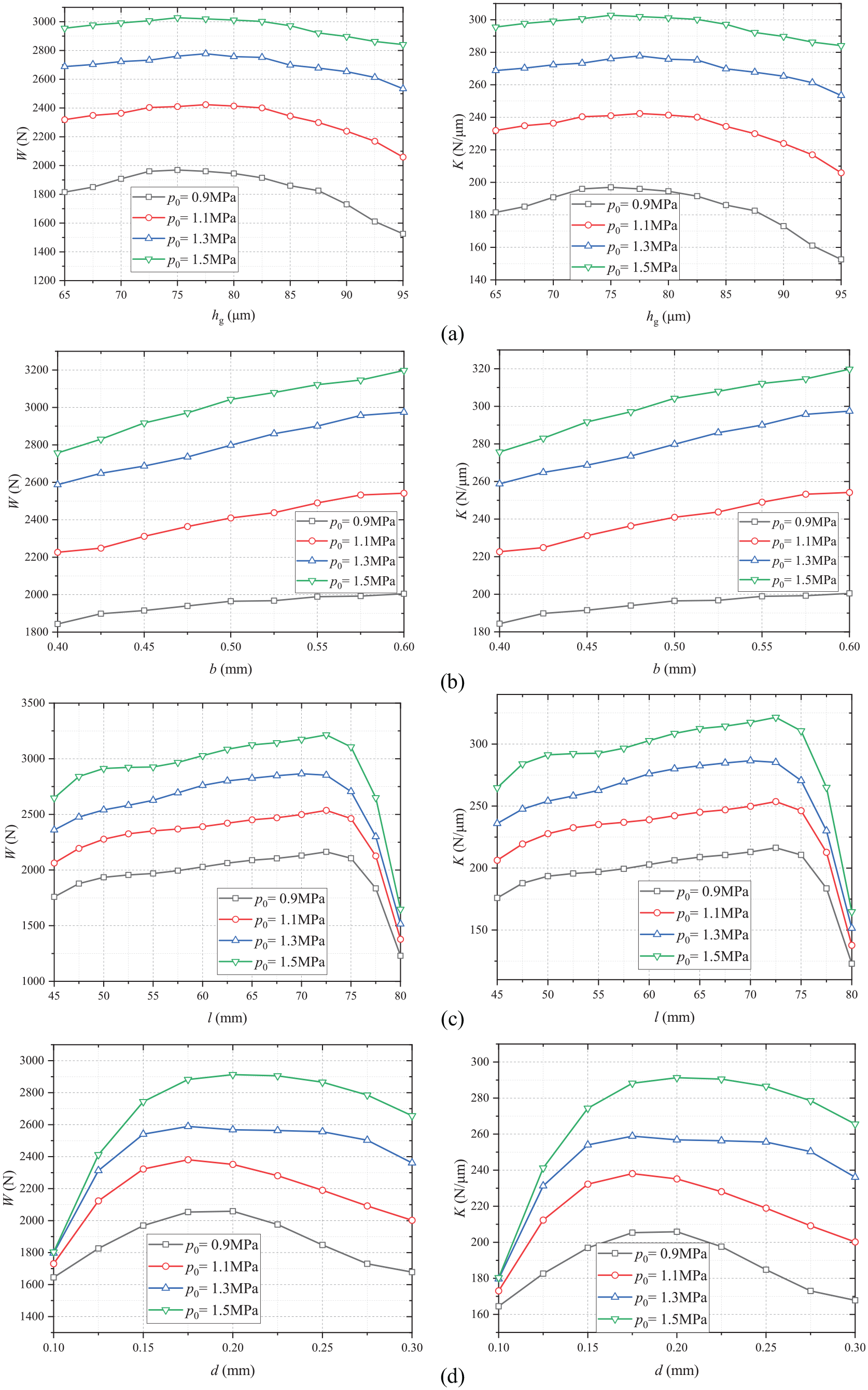
Influence of the dimensional parameters of a MGO on load capacity and stiffness: (a) variation in load capacity and stiffness along groove depth
Figure 14(b) shows that with the increase in the groove width
As shown in Figure 14(c), with the increase in the groove length
As shown in Figure 14(d), with the increase in the orifice diameter
Influence of the MGO layout
As shown in Figure 15, to study the influence of the MGO layout on the load capacity and stiffness of a MGOAJB under high gas supply pressures, five kinds of MGO layouts (two, three, four, and eight axial MGOs and two circumferential MGOs set up in the inner surface of the aerostatic journal bearings, represented by Layout I Layout II Layout III, Layout IV, and Layout V) are adopted. All the groove cross sections are rectangular.

MGO layouts: (a) Layout I, (b) Layout II, (c) Layout III, (d) Layout IV, and (e) Layout V.
As shown in Figure 16, under high gas supply pressures (0.9–1.5 MPa), the layout of the MGOs has a significant impact on the load capacity and stiffness of a MGOAJB. The load capacity and stiffness of Layout II increase by 13.26%–54.30% compared with those of Layout I, and those of Layout III by 8.35%–38.72% compared with those of Layout II. However, as the number of the axial MGOs continues to increase, the load capacity and stiffness decreases gradually; compared with the load capacity and stiffness of Layout III, those of Layout IV decreases by 3.56%–16.23%. The load capacity is derived from the pressure difference between the upper and lower halves of the bearing, and the difference in gas film thickness caused by eccentricity is an important reason for the formation of the pressure difference. 4 The MGO structure of Layout IV increases not only the pressure on the lower surface of the bearing (where the gas film is thinned) but also the pressure on the upper surface (where the gas film is thickened) so that the pressure difference decreases, thus reducing the load capacity. Therefore, when designing MGOAJBs, the MGO layout should be reasonably planned according to the force of the main chip and direction of the eccentricity.

Influence of the MGO layout on the load capacity and stiffness under high gas supply pressures: (a)
The load capacity and stiffness of Layout V are significantly lower than those of Layout II (12.68%–22.14%) and Layout III (22.40%–52.85%). When the eccentricity
The gas supply pressure
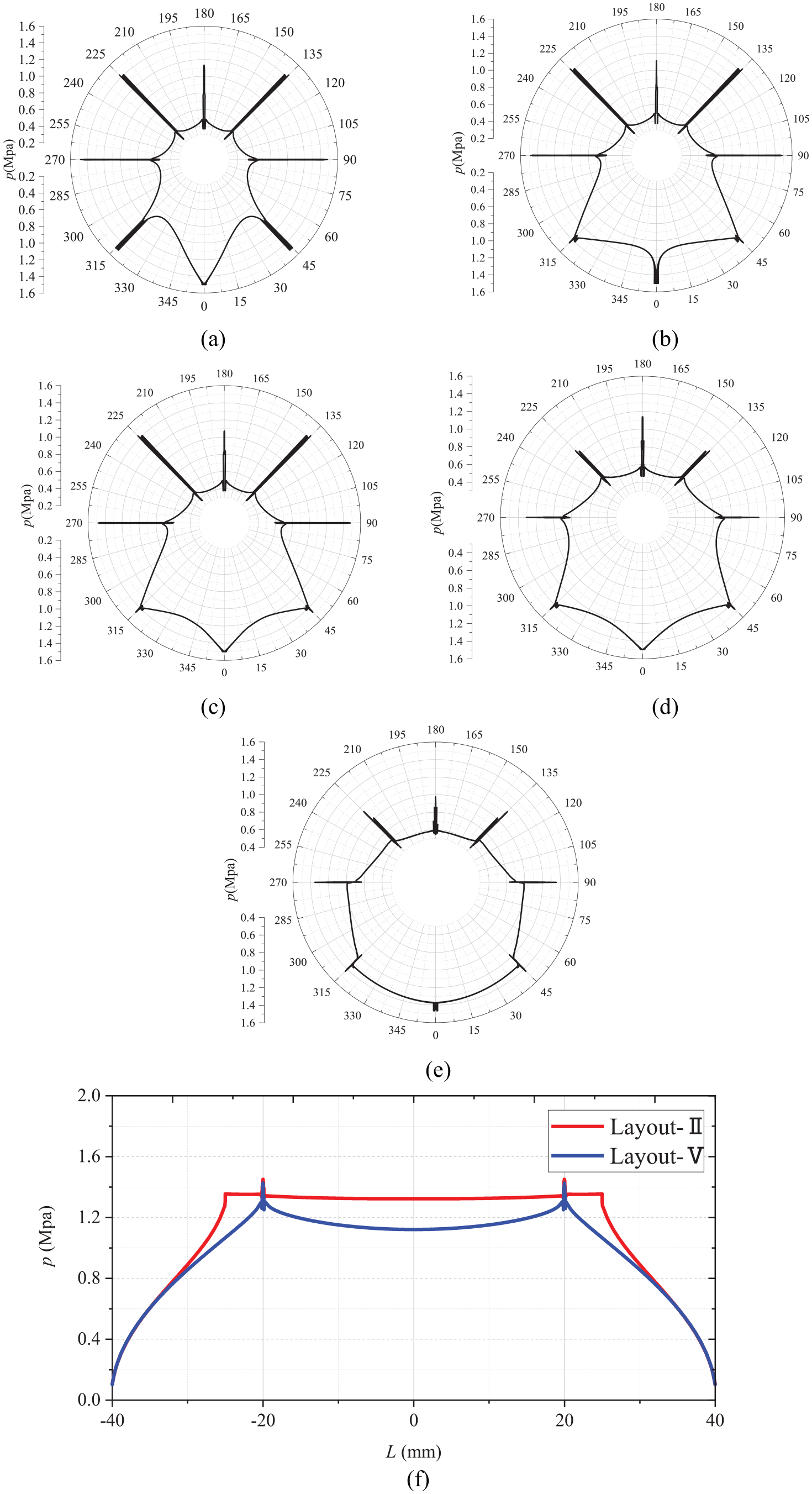
Circumferential and axial distributions of the gas film pressure: (a) Layout I, (b) Layout II, (c) Layout III, (d) Layout IV, (e) Layout V, and (f) axial distribution of the gas film pressure.
Conclusion
Increasing the gas supply pressure is an effective method to improve the static characteristics of aerostatic bearings. The gas supply pressure of the bearing is usually limited between 0.4 and 0.6 MPa, and when the gas supply pressure is too high, the Reynolds equation of classical lubrication theory is no longer applicable. Therefore, new governing equations based on the SST k-ω turbulence model are established, and the static characteristics under high gas supply pressure are improved in this paper by using the MGO structure. The following conclusions and results are obtained:
Under high gas supply pressures, the load capacity and stiffness of the MGOAJB are obviously improved compared with those of the OCAJB, and the MGO structure can improve the pressure distribution so that the load capacity and stiffness of the MGOAJB are higher than those of the OCAJB.
Under high gas supply pressures, the influences of the groove cross-sectional shape, groove depth, and groove width of the MGO on the load capacity and stiffness of a bearing are not significant. However, with increasing groove length, the load capacity and stiffness increase obviously; when the groove length is close to the bearing edge, the load capacity and stiffness sharply decline. With increasing orifice diameter, the load capacity and stiffness first increase and then decrease.
The MGO layout has a significant influence on the load capacity and stiffness of a bearing. With the increase in the number of axial MGOs, the load capacity and stiffness increase gradually and are higher than those with circumferential MGOs, but when the number of axial MGOs continues to increase, the increase in the load capacity slows or even stops.
In bearing design, structural parameters should be reasonably selected: the groove cross-sectional shape should be rectangular, the groove depth and width should be as small as possible while ensuring the increase in the load capacity, and the groove length should be as long as possible under the condition that it is not connected with the gas film outlet. The orifice diameter should not be too large or too small, and diameters of 0.15–0.25 mm are appropriate. The MGO layout should be reasonably planned according to the force of the main chip and direction of the eccentricity.
Footnotes
Appendix
Handling Editor: Chenhui Liang
Declaration of conflicting interests
The author(s) declared no potential conflicts of interest with respect to the research, authorship, and/or publication of this article.
Funding
The author(s) disclosed receipt of the following financial support for the research, authorship, and/or publication of this article: This research was funded by the Natural Science Foundation of Heilongjiang Province, Grant No. E2018001.
