




Abstract
The reliability assessment of fatigue life of automotive chassis parts is an important part of automobile safety. The fatigue endurance tests of automotive half-axles were carried out. The three-parameter Weibull distribution model was established according to the fatigue life distribution of samples. Using the right approximation method and the genetic algorithm to estimate three parameters of the distribution model and a comparative analysis was made. The results show that the initial life unreliability estimated by the median rank in the right approximation method had a large deviation from the true value, which may cause the iterative algorithm fall into the local optimal solution and affect the estimation accuracy. Therefore, a new parameter estimation method based on dual genetic algorithm was proposed. The newly proposed dual genetic algorithm not only improves the iteration speed, but also improves the accuracy of parameter estimation, which provides new ideas and theoretical basis for reliability assessment of mechanical components.
Introduction
There are many kinds of automotive chassis parts with complex structures so that if wear, fracture, or other problems occur, the operation of the entire chassis structure will be affected, then the whole vehicle system cannot work normally and lead to failure, even cause major traffic accidents and casualties. 1 Therefore, it is essential to predict the fatigue reliability of automotive chassis parts.
As for mechanical components, the manufacturing process, loading condition, the initial defects of components and the fatigue properties of materials are all random variables with uncertainty. Additionally, some researches show that a scatter factor may be demonstrated during the above conditions to affect the results of fatigue life of the same type of products.2,3 The fatigue life distribution of mechanical components can be analyzed statistically. 4
Weibull distribution is the most commonly used distribution model for describing the life of mechanical products, such as bearings, gears, and numerical control machines, etc.5–7 The three-parameter Weibull distribution is widely used in the fatigue life distribution model of mechanical components because it can describe the minimum fatigue life of samples and has strong adaptability.
At present, the main methods of estimating parameters of Weibull distribution are statistical estimation method,8,9 gray estimation method,10,11 maximum likelihood method,12–15 genetic algorithm,16–20 and right approximation method.21–27 These methods have different adaptability to different sample sizes, but basically all of them have high requirements on the initial value of iteration and need to go through complex calculations.
The right approximation method (RA method) converts the target distribution function into a linear function based on a specific transformation method. Then the least square method is applied to fit the optimal parameters, and approximates the optimal target parameters from the right side through continuous iterative calculation, which can effectively improve the calculation non-convergence problem. However, in the process of iteration, the right approximation estimation method needs to use the median rank as the initial iteration value of the life unreliability. As an empirical parameter, the median rank may deviate greatly from the true value, 28 which makes it easy for the iterative algorithm to obtain the local optimal solution rather than the global optimal solution, resulting in the inaccuracy of Weibull parameter estimation. The genetic algorithm (GA) is an adaptive and intelligent search technology with strong global optimization capabilities, which is widely used in complex nonlinear optimization problems.29,30 Generally, the genetic algorithm does not use external information during optimization iteration. It only uses the objective function value of each individual in the population to search based on the objective function. The iteration speed and accuracy of the algorithm are greatly affected by the initial population and constraint boundaries. 31 Therefore, combining the GA with the RA method in the Weibull distribution parameter estimation can effectively avoid the unreasonable selection of iterative initial values.
In this study, the fatigue endurance bench tests of automotive half-axles were carried out. A three-parameter Weibull distribution model was established according to the fatigue life distribution of the samples. The fatigue sample data were expanded based on a set of given reference Weibull distribution parameters. The Weibull three parameters were estimated for the expanded fatigue data by the RA method and the GA, respectively. The estimated parameters were compared with the given reference Weibull parameters to study the influence of the initial iteration value on the estimation accuracy. Furthermore, combining the RA method and the GA, a dual genetic algorithm (DGA) for Weibull distribution parameter estimation was proposed, which improves the iterative speed of parameter estimation and the accuracy of the result, and provides a new method and theoretical basis for the fatigue reliability evaluation of automotive chassis parts.
Fatigue endurance bench tests for automotive half-axles
The fatigue endurance bench tests for automotive half-axles were carried out on the eight-channel hydraulic servo fatigue test system. The samples were fixed on the test bench and the repeated torque was applied on the ends of them. The assembly was shown in Figure 1. The procedure of the test was as follows: First, applied a sine wave load with a loading frequency of 3.0 Hz. When the torque was reached the maximum value of

The fatigue endurance bench test for automotive half-axles.
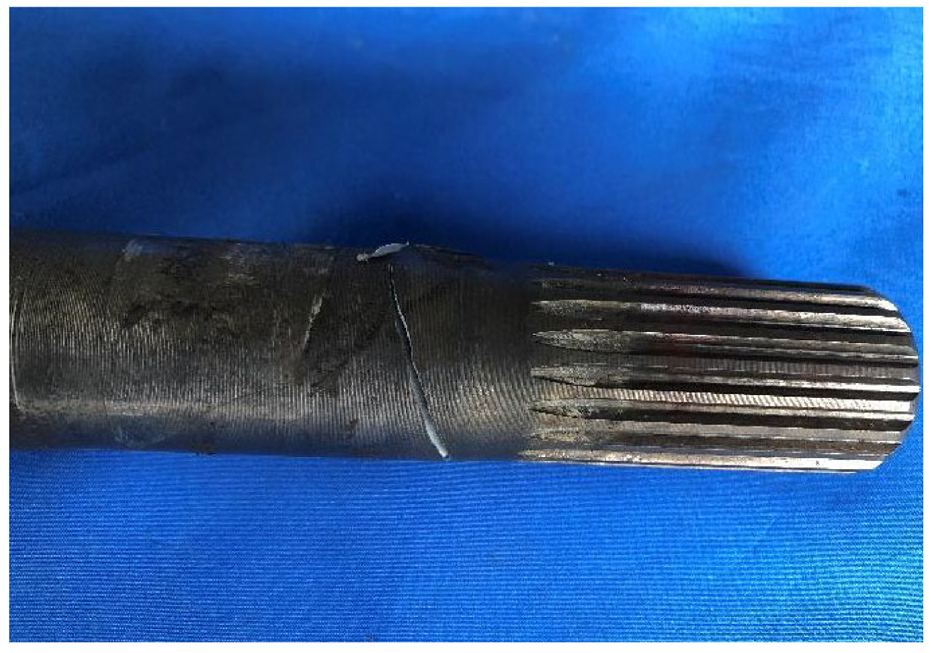
Fatigue failure of a half-axles.
The statistics of fatigue life of automotive half-axles.

The number of original test data of samples was so small that the data sample size needed to be expanded. The three-parameter Weibull distribution function was used to describe the fatigue life condition of the half-axles, and the probability density function expression was shown in equation (1). Where

Assume that the shape parameter was
The statistics of fatigue life of automotive half-axles.

Parameter estimation of Weibull distribution
Estimation of Weibull distribution parameters by the RA method
The RA method first converted the objective function into a linear function. Based on equation (1), the fatigue life distribution function of the structural component was given by equation (2), where

After taking the natural logarithm twice for the three-parameter Weibull distribution of equation (2), equation (3) was obtained as follows:

The median rank is the value that the true failure probability should have at the 50% confidence level when the

Assuming

In equation (5), let

Note that it is only necessary to assign the value of

The expression for the correlation coefficient

The correlation coefficient

The variation of correlation coefficient with location parameter.
It can be found in Figure 3 that the correlation coefficient
The initial estimated value of the life unreliability based on the GA
Substituting the fatigue life data into equation (2), and setting the parameters in the three-parameter Weibull distribution as the initial given parameters of
From equation (4), it is an empirical method of using the median rank to get the initial life unreliability
The genetic algorithm (GA) was used to optimize the initial value of life unreliability. The initial estimated value of the unreliability was denoted as

Using

If

Substituting each individual into equations (10) and (11) to evaluate the fitness. In the GA, the population type was set as Double vector and the fitness scaling was set as Rank. Individuals were randomly selected by using roulette. In addition, the crossover was set as Scattered, and the genetic binary vectors were randomly generated, which hybridized according to 0–1. The optimization algorithm was used for finding out a set of optimal

Calculation process and optimal parameters of the GA.
The initial life unreliability

Comparison of initial life unreliability obtained by median rank and the GA algorithm.
Determination of three parameters of Weibull distribution based on DGA
In actual situation, only the failure values
Step 1: Obtaining the data of the sample’s fatigue life from the fatigue endurance bench test of automotive chassis parts.
Step 2: According to the expanded data from Table 2, get a set of Weibull distribution parameters
Step 3: Subsisting the fatigue life data into equation (2) with the parameters of
Step 4: The unknown parameters of genetic algorithm established in this step were


The calculation process of the DGA.

The optimal parameters
Defining equation (13) as the objective function, obtaining the optimal parameters

The result of parameters estimation by the DGA.
Comparison of results accuracy of the DGA and the RA method
Calculating the life unreliability

Comparison of life unreliability between the DGA and the RA method.
To further compare the estimation accuracy of each parameter, the error values of three parameters calculated by equation (14) were listed in Table 3, where

Comparison of errors between the DGA and the RA method.

It can be seen from Table 3 that the errors of both
Conclusion
In this study, the fatigue endurance bench tests of the automotive half-axles were carried out. The three-parameter Weibull distribution model was established according to the test data. The right approximation method and the genetic algorithm were applied respectively to estimate the parameters of Weibull distribution, and the effect on results accuracy of the initial iterative value was explored. Additionally, the right approximation method and genetic algorithm were combined to propose a new estimation method named dual genetic algorithm. The main conclusions are as follows:
In the right approximation method, using the median rank to estimate the life unreliability deviated greatly from the real value. Using this value as the iterative initial value may cause the iterative algorithm to fall into the local optimal solution and affect the estimation accuracy.
A new estimation method named dual genetic algorithm was proposed to estimate the three parameters of Weibull distribution. Taking the distribution parameters obtained by the right approximation method as the reference value, the initial unreliability of fatigue life that closer to the real value was obtained by the first genetic algorithm. By setting the constraint on double objective function, the final three parameters of Weibull distribution were determined by the second genetic algorithm.
The dual genetic algorithm based on reference parameters of right approximation method can overcome the problem of local optimal solution effectively. In addition, by setting the constraint of double objective function, the dual genetic algorithm avoided the divergence in the iteration process, which improved the accuracy of parameter estimation and improved the iteration speed. This method provides new ideas and theoretical basis for reliability assessment of mechanical components.
Footnotes
Acknowledgements
The authors would like to thank the Guangzhou Mechanical Engineering Research Institute Co., Ltd., CRAT Testing & Certification Company Ltd., and South China University of Technology for providing funds and data support.
Handling Editor: Chenhui Liang
Declaration of conflicting interests
The author(s) declared no potential conflicts of interest with respect to the research, authorship, and/or publication of this article.
Funding
The author(s) disclosed receipt of the following financial support for the research, authorship, and/or publication of this article: This work was supported by Guangzhou Mechanical Engineering Research Institute Co., Ltd. (Project No. 1014300038).
