




Abstract
Reliability, Availability, Maintainability, and Dependability (RAMD) study of Tube-wells Integrated with Underground Pipelines (TIUP) is crucial as they are the backbone of the irrigation system. This study is carried out with an objective to perform RAMD analysis, and Failure Modes and Effects Analysis (FMEA) unified with the development of a novel stochastic model using Markovian approach to estimate the Steady-State Availability (SSA) of the TIUP. A real case study of a conventional TIUP system has been performed to validate theoretical and practical results of the proposed model. The failure and repair rates of all subsystems followed exponential distribution, and their impact on system/subsystem’s availability and other reliability measures has been investigated. All the repairs are perfect and random variables associated with failure and repair rates are statistically independent. The centrifugal pump and power supply units are the most critical components as far as reliability and maintainability aspects. The labor also plays a critical role in the operation of the TIUP system.
Keywords
Introduction
Agriculture is one of the oldest professions done by human beings after the inception of civilization. In the current age, a large portion of the population is involved in agricultural activities either directly or indirectly. The production of any crop depends upon irrigation, fertilizers, and improved varieties of seeds. The irrigation component is one that influences most the whole yield of the crop. Irrigation to crops in India is done from ancient times through wells, ponds, etc. In 1912, the first attempt was made in Punjab to draw water with the help of a tube-well. 1 During the last three decades, tube-well engineering emerges rapidly and now in northern part of India including Punjab, Haryana, etc., most of the farmers have their own tube-wells for irrigation. Tube-wells are installed in the fields, and then through the underground pipelines, water is transported to the fields. In this process, many components are involved that makes tube-wells integrated with underground pipelines (TIUP) a complex system.
The Tube-well with Integrated Underground Pipeline (TIUP) is a prominent source of irrigation in agricultural fields. Underground water is withdrawn and transported through the pipelines for irrigation purpose, as shown in Figure 1. The TIUP system comprises five main subsystems, they are: power supply unit, borewell unit, centrifugal pump, pipeline, and labor. All these units can be considered as series structure as failure of anyone causes the complete system failure, while at component level various type redundancies also utilized to increase the reliability and availability of the system.

TIUP system under consideration: (a) TIUP line, (b) shaft of TIUP, and (c) redundant energy units.
Kaneda and Ghaffar 2 presented some empirical results on the effects of tube-wells on the agriculture of Punjab. The operation of TIUP with high reliability is highly required as failure of its cause’s crucial economic effects on farmers including loss of income. Lack of irrigation can spoil the crops either partially or completely.
Several studies have been carried out to estimate the reliability of agricultural machinery. For instance, Najafi et al. 3 conducted a study on reliability investigation of agricultural machinery, namely sugarcane chopper harvester. Durczak et al. 4 established a mathematical model for reliability analysis of farm tractors based on actual failures data collected from a manufacturer. Soltanali et al. 5 proposed a sustainable production process in automotive manufacturing through reliability, availability, and maintainability methodologies. Da Silva et al. 6 proposed a methodology to diagnose the failure in the transmission system of agriculture tractors. This approach is based upon predictive maintenance-based software.
Hashimoto et al. 7 developed a criterion based upon reliability, resiliency, and vulnerability for water resource systems for performance evaluation. Feng et al. 8 used Markov Chain to forecast the agricultural water trajectory. Li et al. 9 estimated the reliability of village-level supply facility of groundwater irrigation in rural China. Mazumder et al. 10 performed reliability estimation of water distribution systems incorporating physical probabilistic pipe failure approach. Afsharnia et al. 11 suggested a model for the optimization of sugarcane harvester machine based on fault tolerance Bayesian network reliability by applying the concept of preventive maintenance. Alsharqawi et al. 12 suggested a model for water distribution network’s reliability prediction. Darvini et al. 13 carried out the performance estimation of water distribution systems by incorporating the leakage and temporal variability of water demand. Masciopinto et al. 14 discovered the applications of quantitative microbial risk assessment (QMRA) for safe agricultural water reuses in coastal areas. Elshaboury et al. 15 adopted a minimal cut set approach for the reliability estimation of water distribution networks.
Failure Mode and Effect Analysis (FMEA) is a well-known methodology for risk assessment and is rapidly used in complex systems. Stamatis 16 explained FMEA from theory to execution. Smaranda et al. 17 used FMEA in water supply systems. Arabian-Hoseynabadi et al. 18 used FMEA for wind turbine’s reliability evaluation. Hwang et al. 19 proposed resilience-based Failure Mode Effects and Criticality Analysis (FMECA) for regional water supply system. Patil and Kothavale 20 conducted FMEA analysis of CNC Turning Center. Kumar et al. 21 performed Reliability, Availability, Maintainability, and Dependability (RAMD) analysis and FMEA analysis of soft water treatment and supply plant.
Another popular approach for reliability evaluation of industrial systems when failure and repair rates follow memoryless property is the Markovian approach. Chiquet et al. 22 developed a mathematical model for a stochastic dynamic system and estimated the reliability with Markovian approach. Barak et al. 23 proposed a stochastic model for reliability analysis of a single-unit system with inspection subject to different weather conditions. Barak and Barak 24 studied the impact of abnormal weather conditions on various reliability measures of a repairable system with inspection. Adumene and Okoro 25 proposed a Markov model for reliability evaluation of offshore wind energy system under harsh environments. Aggarwal and Kumar 26 proposed a stochastic model for availability optimization of a crushing system of a sugar plant and optimized it using the Particle Swarm Optimization (PSO) algorithm.
RAMD analysis approach used extensively by researchers on time to repair and time to between failures data. Aggarwal et al. 27 carried out performance modeling of the skim milk powder production system of a dairy plant using RAMD analysis. Aggarwal et al. 28 performed mathematical modeling of the serial processes in refining system of a sugar plant using RAMD analysis. Saini and Kumar 29 conducted RAMD analysis for performance analysis of evaporation system in the sugar industry. Choudhary et al. 30 proposed RAM methodology for the cement industry and discovered the most sensitive component. Goyal et al. 31 evaluated the reliability, maintainability, and sensitivity of the sewage treatment plant’s physical processing unit to investigate the plant’s performance. Gupta et al. 32 carried out the analysis of cooling tower in steam turbine power plant using RAMD investigation. Patil et al. 33 used Markov chains in RAM analysis of a Computerized Numerical Control Turning Center. Velmurugan et al. 34 used RAMD approach for performance Analysis of Tyre Manufacturing System in the Small and Medium Enterprises (SMEs). Recently, Saini et al. 35 performed the availability optimization of condenser of STPP using metaheuristic methodologies. Kumar et al. 36 suggested an efficient model for operational availability optimization of cooling towers. Kumar et al. 37 suggested an efficient computational model for performance optimization of e-waste management plants (Table 1).
Review of system reliability evaluation techniques.

The extensive literature review reveals that the reliability evaluation of tube-wells integrated with underground pipelines has not been explored so far. There is also a need to study the effects caused by failures of such systems. Therefore, the objective of this work is to perform RAMD analysis, and FMEA unified with the development of a stochastic model using Markovian approach to estimate the long-run availability of the TIUP system. The effectiveness and adequacy of the proposed model is assessed and compared with a case study of a conventional TIUP system.
The remainder of this paper is structured as follows. In Section 2, material and methods are presented and illustrated. Specifically, RAMD and their statistical measures are described. In Section 3, the real TIUP case study is discussed in terms of system description, subsystems, notations, and assumptions. In Sections 4 and 5, the RAMD and the availability analysis are stated, respectively. In Section 6, system level FMEA is described and applied to the system under study. In Section 7, the overall analysis results are reported and discussed. Finally, some conclusions are drawn in Section 8.
Material and methods
Reliability
According to Billinton and Allan, 38 “reliability is the probability of an equipment performing its task adequately for a specified period intended under specified operating conditions.” Reliability can be calculated by using the following formula:

where
If the failure PDF is exponentially distributed, then:

where
Availability
According to Billinton and Allan, 38 “availability is defined as the probability that a component or system is performing its required function at a given time when it is used under stated operating conditions.” In simple words, availability is the probability of finding any product in operating state. It is classified as point, steady-state, and interval availability. Mathematically, the availability function is given by:

where
Maintainability
“Maintainability is defined to be the probability that a failed component or system will be restored to a specified condition within a period of time when maintenance is performed in accordance with prescribed procedures” Billinton and Allan. 38 In simple words, it is the probability that the failed system will be repaired to its working state. Maintainability function for exponential distribution is given by:

where
Dependability
It is a measure of the degree of consistency of performance. It provides a single measurement to assess the performance based on reliability and maintainability. If failure and repair rates followed exponential distribution, then dependability is the ratio of failure and repair rates. Mathematically, the dependability ratio is given by:

Availability function can be expressed in terms of dependability as

where
Mean-Time Between Failure (MTBF)
The average of the times between failures is called the Mean-Time Between Failures (MTBF) Aggarwal et al. 28 . Mathematically, it can be found by:

Mean-Time To Repair (MTTR)
The average of the repair times is called the Mean-Time To Repair (MTTR) Aggarwal et al. 28 . Mathematically, it can be found by:

where
Real case study: System description, assumptions, notations, and flow chart
System description
The configuration and working procedure of the components of TIUP system is described here. Figure 2 presents the configuration (i.e. the Reliability Block Diagram (RBD)) of the TIUP system. The failure and repair data required for the analysis are collected from the owner of the TIUP system. It is reported that all the repair facilities are available within 5 km range of the system. The information is given on following heads: subsystems, type of failures, number of failures, time to failure, time to repair and component failed for a period of 2 years.

Flowchart of TIUP system.
The system mainly suffers due to electrical and mechanical failures. The subsystem’s description is given as follows:
Power supply unit (PSU)
PSU is a significant component to operate the TIUP system. Farmers have various options of power, such as electricity (EL), diesel engine (ES), and tractor (TR). The economic condition of the farmer decides the number of power sources that can use to run the TIUP system. In the presented case, the farmer has all three sources of power to operate the TIUP system and can be used on standby as and when required. As the power supply from the state electricity board is very irregular, and it is generally available between 6:00 P.M. and 6:00 A.M. So, for the rest of the time, the electric power generated by the diesel engine or the tractor are used.
Borewell unit (BU)
In most of the TIUP systems, only one pipe is dragged into land up to water level. But in the considered system, two non-identical systems have been hauled into the ground at different depths. The primary pipe (P) is hauled up to 80 ft, while the secondary pipe (S) is dragged up to 35 ft approximately. Both of the pipes are connected through flanges. After that, a single pipe appears on the ground, and on its upper part, a T-type socket is fixed. On the one-part, an electric motor is fixed, while the end is fixed for the tractor/engine. In practice, the usage of two non-identical pipes would increase the amount of water.
Centrifugal pump unit (CPU)
It is the main component in tube-wells. It has several components, such as glen, router, shaft, bush, and bearing. Failure of any of these components causes the failure of the complete system. In practice, the centrifugal pump faces the highest number of failures and, thus, without a proper maintenance intervention, it will be very difficult to effectively operate it. In the present analysis, TIUP system have a SWV440C nominal head model centrifugal pump is used by the farmer. Its prime mover rate is 7 HP, speed 1500 rpm, and efficiency at 75%. It is connected to a power supply unit with a shaft.
Pipeline unit (PLU)
It is the underground line of PVC pipes buried below 3 ft of the surface. It connects the tube-well source point, and at a terminal point, there is a valve to release the water into the fields.
Labor unit (MU)
To operate the whole system successfully, a dedicated person (called labor) is required. Sometimes, in the absence of labor, or if the farmer stays far from the system, there is a chance that the pump runs dry due to the unavailability of the water in the well, and due to this, the electrical/ mechanical failures may take place.
Assumptions
The following assumptions have been made to carry out the analysis of the present work:
more than one failure will not occur at a time;
failure and repair rates of all components are exponentially distributed;
switch devices are perfect;
unit works as-good-as-new after every repair action.
Notations
The following notations have been utilized to develop the models:

Flow chart
In this section, the methodology used for reliability evaluation of TIUP is presented with the help of flow chart appended in Figure 3. Initially, the configuration of the TIUP system is investigated. The failure and repair rates of various sub systems is derived from the collected failure and repair data. The reliability, availability, maintainability, and dependability measures of all the subsystems are derived through developing the time dependent mathematical model for each subsystem. By using probabilistic arguments, the transient behavior of RAMD measures for whole system is derived. After that, to identify the steady state availability and most sensitive component of the TIUP system Markov analysis is performed. The Chapman-Kolmogorov differential-difference equations derived and simplified using algebraic methods for above stated rate of parameters. The risk assessment of the system is performed by using failure mode and effect analysis. The labels and function of all the components defined initially. The type of failures and their impact on system is analyzed. The severity, probability and detection frequency of the failures determined and RPN number is obtained. On the basis of RPN number, the policies are formulated to reduce the risk of failures.

Flow chart of reliability evaluation procedure.
RAMD analysis
The required data for RAMD analysis has been obtained with the help of the TIUP system owner. The data has been collected for the following questions: (i) Number of subsystems, (ii) number of failures of each subsystem, (iii) time to failures, (iv) time to repair, (v) type of failure, and (vi) name of the failed subsystem, for 2 years. The major failure faced by farmers are electrical, mechanical (related to router, bearing), and human. Based on the given information, the values of the various parameters are obtained and summarized in Table 2. By incorporating the above-stated assumptions and notations, changeover diagrams associated with each subsystem have been prepared and shown in Figure 4(a) to (c). By applying the Markovian birth-death process, Chapman-Kolmogorov differential equations Saini and Kumar 29 have been derived to obtain the RAMD measures of these systems.
Failure and repair rates of various subsystems.


(a) Changeover diagram of PSU, (b) changeover diagram of BU, and (c) changeover diagram of PU, CPU, and MU.
Power supply unit (PSU)
PSU has three units EL (i.e. Electricity and equipment), ES (i.e. Diesel engine), and TR (i.e. Tractor). Initially, the EL unit is operative while ES and TR are kept in cold standby. In practice, the failure of all three units causes a complete system failure. The state changeover diagram of the PSU system is appended in Figure 4(a). The differential equations associated with the state changeover diagram are given as follows:

Letting

Since

Similarly, expressions
Other measures of system effectiveness are as appended below in Table 3.
Important reliability characteristics of various subsystems.

Borewell unit (BU)
BU has two non-identical units, P (i.e. primary borewell) and S (i.e. secondary borewell). Initially, both units are in operative mode. In practice, the failure of both units causes a complete system failure. The state changeover diagram of the BU system is appended in Figure 4(b). The differential equations associated with the state changeover diagram are:

Letting

Since

Similarly, expressions
Other measures of system effectiveness are appended in Table 3.
Pipeline unit (PLU)
PLU has only one unit, and its failure causes the complete system failure. The state changeover diagram of the PLU system is appended in Figure 4(c). The differential equations associated with the state changeover diagram are:

Letting

Since

Based on the state changeover diagram, the availability of the system model is
Other measures of system effectiveness are appended in Table 3.
Centrifugal pump unit (CPU)
CPU has only one unit, and its failure causes the complete system failure. The state changeover diagram of the CPU system is appended in Figure 4(c). The differential equations associated with the state changeover diagram are:

Letting

Since

Based on the state changeover diagram, the availability of the system model is
Other measures of system effectiveness are appended in Table 3.
Labor unit (MU)
Labor is a very critical component in the irrigation system, and its failure causes complete system failure. The state changeover diagram of the MU system is appended in Figure 4(c). The differential equations associated with the state changeover diagram are:

Letting

Since

Based on the state changeover diagram, the availability of the system model is
Other measures of system effectiveness are appended in Table 3.
TIUP system time dependent system availability analysis
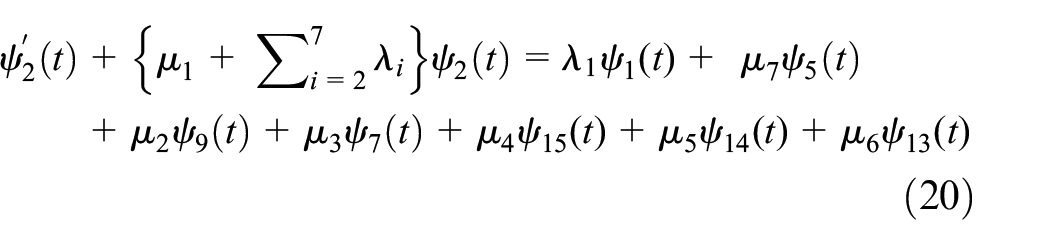
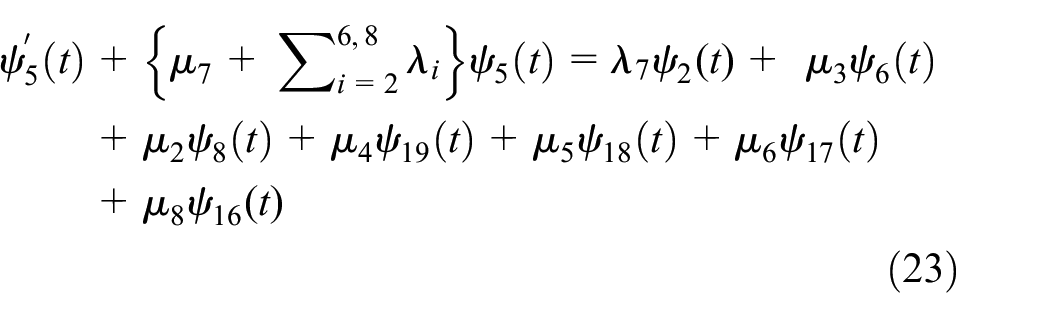
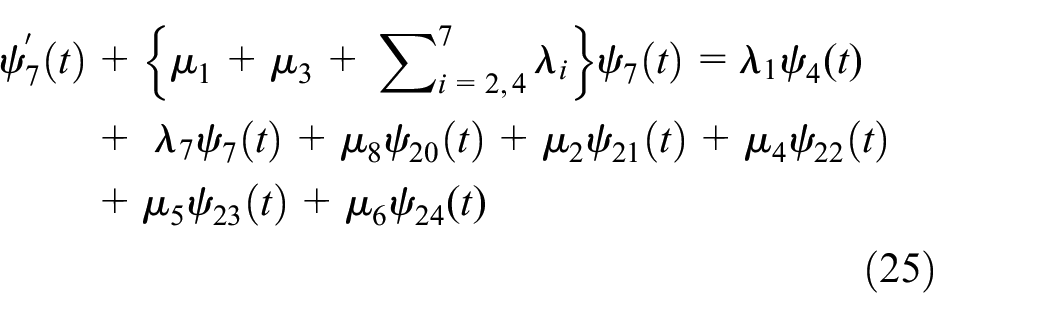
Among the RAMD measures, availability is a characteristic that can be used to identify the most sensitive components of the TIUP system. The operational procedure of TIUP is highly influenced by failure and repair rates. Thus, the impact of failure and repair rates on time dependent system availability has been investigated by mathematically analyzing the system. Using the assumptions and notations described above, a changeover diagram has been prepared and appended in Figure 5. It is observed that transition from one state to another state with some rate parameter. Here,





















Changeover diagram of TIUP system.
The initial conditions associated with the model are:

As the mathematical model of the TIUP system for time-dependent system availability is a very complex, and analytical solution of it is very difficult to obtain. So, using MATLAB R2019a the Runga-Kutta method of fourth order has been implanted to get the numerical solution.
The following formulation provides the numerical values of SSA for the TIUP system:

FMEA analysis
Failure Modes and Effects Analysis (FMEA) is an extensively used methodology in reliability engineering. Generally, FMEA is classified into three categories namely: design FMEA, process FMEA and system FMEA. Because of RAMD and steady state results of TIUP system, system level FMEA is applied here. In practice, it helps in identifying the probable failures, evaluate their effect on the operation of system and suggest solution processes to overcome those effects. 39 The FMEA outputs are helpful to rectify the errors in the design and production phase of any item. It involves examination of hardware, software, human and functional components of any system/process. The qualitative measurements of severity, occurrence, and detection are appended in Table 4.
Severity, occurrence, and detection rating.

In our investigation, maintainability is the issue of concern as the system operates in different environmental conditions under the open sky. Sometimes the system sinks in water also due to heavy rainfall and high level of seepage in the fields. Therefore, we visited the site of the tube-well and discussed the challenges faced by farmers to operate and maintain such systems. The data is collected from the farmer on the number of failures and time to repair. On the basis of that, FMEA at the system level has been performed as given below:
i. The system and its components were described carefully, and probable failure modes and their effects were determined. It is observed that the availability of operating equipment’s, labor and maintenance scheduling are the key factors affecting the TIUP system;
ii. The key cause of failure is also identified and appended in FMEA sheet, as shown in Table 4. It helps in deciding which kind of maintenance is required; On the existing failure modes there is no current control except maintenance planning and detection rate is high in the FMEA matrix;
iii. Risk Priority Number (RPN) has been calculated for each mode by multiplying severity (1–10), occurrence (1–10) and detection (1–10) ranges between 1 and 1000. The smaller value of RPN is better. RPN helps in identification that which problem must be solved on priority basis rather than focusing the whole;
iv. After observing the RPN values an action plan is suggested for the failure modes which have high RPN value.
v. It is observed that the disruption in electricity supply, unavailability of standby units like engine/ tractor, electronic item failure and mechanical failures are the factors responsible for the current maintainability level of TIUP unit.
Results and discussion
The failure of any component causes the complete failure of system that motivated to consider it as a series system. The reliability, availability, maintainability, and dependability expressions of series system can be derived by using the following expressions:


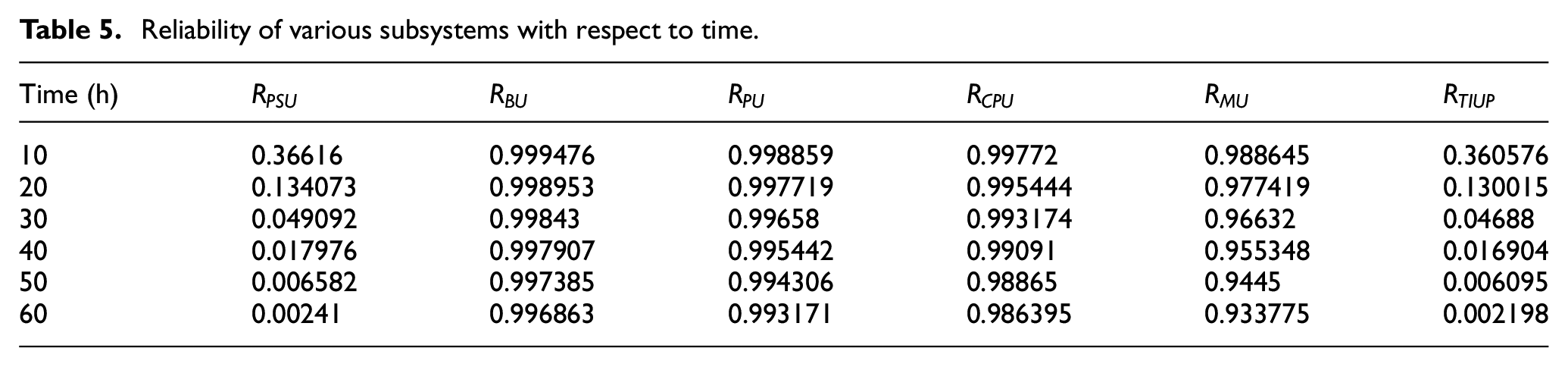
From Table 5, it is revealed that reliability of system decreases with respect to time for all subsystems as well as system. The power supply unit, labor unit and centrifugal pump attain minimum reliability that resulted that after 10 h system’s reliability is only 0.130015. After 60 h reliability of system decreases up to 0.002198 that is very crucial. While Table 6 revealed that borewell unit have lowest maintainability value and it takes maximum time to restore in operational condition after repair. From Table 5, it is revealed that power supply unit is the most sensitive component of the TIUP system and highly influenced the reliability of the whole system. The repair of pipeline and centrifugal pump takes time takes time in repairing.
Reliability of various subsystems with respect to time.
Maintainability of various subsystems with respect to time.

By making some variation in various failure and repair rates, the impact on time dependent system availability of system has been observed. A constant change of 50% has been made in all parametric values associated in repair rates. From Table 7, it is revealed that with respect to time steady state availability decrease slightly but variation in failure rate of some subsystems like power supply unit, secondary borewell, pipeline, and centrifugal pump influenced the most. Any change in failure rate of any subsystem causes the decline in availability of TIUP system. While Table 8 showed that any increment in repair rate resulted as the enhancement of the system availability. It is revealed by Table 7 that, the availability of the power supply unit is less in comparison of all other units in long run. This validates the results of RAMD analysis.
Impact of various failure rates on steady state availability of TIUP system.

Impact of various repair rates on steady state availability of TIUP system.

Conclusions
The key findings of the present study are pointed out as follows:
Through RAMD analysis, it is observed that steady state system availability of TIUP system is 0.965912 while TDSA is 0.9983249 after 400 h.
Power supply unit and labor are the less reliable subsystems which reduces the whole system reliability.
The reliability of TIUP system after 60 h is 0.002198 only.
The dependability ratio and its minimum value is greater than 0.9 for all subsystems and system that indicates that system availability is high.
It is revealed that whole system certainly restored in working conditions.
A constant change of 50% in all failure and repair rates highlighted significant increment of TIUP system reliability and maintainability, respectively.
Centrifugal pump is the most sensitive component in sense of variation in failure rate.
The systems which have provision of redundancy are highly reliable and available.
From FMEA analysis given in Table 9, it is observed that electricity and electric components and maintenance planning are the main factors for system failure with high RPN value 720 and 810 respectively.
The availability results derived by RAMD, and Markovian approaches shows that power supply unit is the most sensitive unit in TIUP systems and need extra care for successful operation.
FMEA of TIUP system.

Finally, it is concluded that the TIUP system can be made more reliable and available for use by taking care of most sensitive components through proper maintenance or providing spare units. Though, the present model is developed for TIUPs but the same methodology can be applied for other irrigation systems also. The present study is carried out on limited data and in future it can be extended by collecting large amount of data from various sources. Here, labor is only considered in terms of presence or absence only associated with considered system, in future study, competence of the various persons will be considered. The sensitivity analysis of system performance measures can be conducted in future work. As well as an effort can be made to achieve the global solution by applying some advanced metaheuristics, such as genetic algorithm, Gray-wolf optimization, and particle swarm optimization.
Footnotes
Handling Editor: Chenhui Liang
Declaration of conflicting interests
The author(s) declared no potential conflicts of interest with respect to the research, authorship, and/or publication of this article.
Funding
The author(s) received no financial support for the research, authorship, and/or publication of this article.
