




Abstract
This study examines the time-dependent, three-dimensional, laminar, incompressible, and inclined hydromagnetic flow of viscous fluid above a rotating disk. The disk is saturated in a porous space and moves vertically along axial direction. Heat transfer process is analyzed by the thermal radiation and convective boundary condition. Thermophoresis process is illustrated in the flow stream by mass equation. The similarity functions are exerted to transform the system of partial differential equations into a one independent variable expressions. The finite differences scheme is applied to the resultant dimensionalized system and then solved in iterative manner using Successive over Relaxation (SOR) method. The physical quantities are illustrated graphically in terms of velocity, thermal and concentration fields. Two-dimensional contour phenomenon and three-dimensional flow visualizations for some parameters are also sketched. The skin-friction co-efficient, frictional torque, Nusselt number and Sherwood number against selected parameters are discussed in tabular format.
Introduction
Flow phenomenon of viscous fluid across disk systems is a classical topic to study due to its practical/technological applications in flight mechanics, aircrafts engines, turbo machinery, spin coating, multi-pore distributors, rotor-stator systems to stabilize the effectiveness of turbine disks, medical equipment, oceanography, and microclimate systems. The rotating flows are relevant to chemically vapor deposition reactor used for the sedimentation of optical thin films in the electrochemical engineering. Turkyilmazoglu 1 obtained the analytic expressions for the compressible viscous fluid flow across a rotating porous disk and discussed the flow thermal characteristics. Asghar et al. 2 executed the flow and thermal features of viscous fluid through a rotating disk which stretches in radial direction with power-law velocity. Turkyilmazoglu 3 investigated the axisymmetric activated liquid flow about a rotating sphere in the occurrence of latitudinal stretching. Hafeez et al. 4 explored the flow phenomenon of Oldroyd-B fluid subjected to disk rotation by adopting BVP Midrich software. Doh et al. 5 investigated the silver nanoparticle influence in chemically reactive fluid flow produced by the disk rotation. They described that the flow velocity is enhanced by the disk thickness. Rauf et al. 6 addressed the supremacy of variable properties in compressible flow of viscous fluid across rotating disk. Shehzad et al. 7 elaborated the impact of Hall current in compressible fluid flow about rotating disk. The normalized form of flow model is tackled iteratively through SOR numerical procedure. Acharya et al. 8 reported the features of hybrid nanoparticles and Hall current in viscous fluid about rotating disk. Devi and Mabood 9 discussed the entropy anatomization and activation energy in Marangoni Maxwell nanofluid about a rotating disk. Abbasi et al. 10 examined the flow of elastico-viscous nanofluid comprising of motile microorganisms through a rotating disk. Naz et al. 11 analyzed the flow transportation for Eyring-Powell nanofluid across a rotating disk. A decreased in thermal field is observed due to increase in bioconvective Rayleigh number. Thermophoresis and Coriolis forces influence on peristaltic movement of viscous nanofluid through a rotating frame was studied by Mabood et al. 12 The exploration of physical phenomenon of fluid movements about disk movements specifically across vertically upward/downward movement of rotating disk has been of considerable interest now adays due to its significant industrial applications. Turkyilmazoglu 13 studied the fluid flow development and resultant thermal phenomenon caused due to rotating disk describing upward and downward motion vertically. Khan et al. 14 examined the non-linear thermal radiation analysis in Maxwell fluid about vertical upward/downward movement of rotating disk by bvp-4c technique. Manjunatha et al. 15 computed the numerical solution for flow model of magnetized nanofluid about a vertically moving spinning disk through RKF-45 technique. Kumar et al. 16 presented the thermal analysis for Casson hybrid nanofluid flow by a vertically upward/downward motion of rotating disk. Kumar and Sharma 17 analyzed the Soret and Dufour’s effects in flow of hybrid nanofluid over a vertically moving disk.
Convective thermal transport in fluids saturated by the porous space plays major role in petroleum engineering, geophysics, geothermal energy, hydrology, heat pipes, grain storage and coal combustors. Combustion efficiency is also based on porous medium. Combustion is implemented in surface burner and advanced boiler. Furthermore, uniform heat flux can also be acquired by implementing porous media through combustion systems and is useful in various industrial applications like paper drying processes. The analysis of fluid phenomenon across porous medium deals with the differential equation, which is based upon Darcy’s law. 18 Krishna and Chamkha 19 discussed the magnetic field implementation in elastico-viscous fluid between rotating rigid plates through porous space. Abbas et al. 20 considered the magnetic field impact in time-dependent oscillatory flow about rotating disk, which experience porous medium supremacy. Mabood and Das 21 analyzed the thermal melting features in hydromagnetic Casson fluid via linear horizontal surface through porous medium. They recognized that permeability and magnetic parameters are turned down the velocity field. Liu et al. 22 distinguished the convective-diffusion in magneto-hydrodynamic fluid flow about unsteady stretched surface occupies heterogeneous porous space. MHD flow phenomenon with nanofluid about rotating disk was presented by Reddy et al. 23 The fluid model experienced the effect of porous medium and solved in numerical way by finite element method.
Thermal radiation has important features in technological processes at large temperature scales and hence the effects of thermal radiation cannot be eliminated in heat transfer processes. Recent advancements of thermal radiation in the missiles combustion chambers, power plants, hypersonic flights, solar technologies, space vehicles and satellites have focused the realization of the scientists that energy can be transferred through electromagnetic waves. Reddy and Ferdows 24 discussed the behavior of thermal radiation and species transfer in dusty micropolar fluid through paraboloid revolution. Heat transfer rate is found as declining function of radiation parameter by RK integration method. Khan et al. 25 analyzed the impact of radiation in chemically reactive flow of Maxwell nanofluid across vertically moving disk. The influence of thermal radiation in three-dimensional revolving flow of Maxwell fluid about exponential surface was prescribed by Rashid et al. 26 using Homotopy procedure. Mishra and Kumar 27 considered the hydro-thermal nanofluid over permeable surface and scrutinized the thermal radiation impacts in flow behavior. Mahanthesh et al. 28 addressed the numerical analysis of non-linear convective Oldroyd-B fluid flow past a bi-directional stretching surface. Zhu et al. 29 studied the radiative flow of nanofluid with temperature jump and velocity slip boundary conditions using HAM.
The thermophoretic depositions of the particles is a major process in aerosol and electronic industries. The particles depositions can be influenced by various include turbulence, inertia effect, surface, geometry, thermophoretic and electrophoretic. The particles depositions by the thermophoretic factor are accounted in this investigation. Thermophoretic is a force, which is accounted by the small aerosol particles through temperature gradient and velocity gained by the particle is familiar as “thermophoretic velocity.” The process of thermophoresis in Newtonian fluid flow about speedily rotating disk was analyzed by Rahman and Postelnicu. 30 The results indicated that increased thermophoretic coefficient enhances the thermophoretic velocity, which also intensifies significantly by increase in relative temperature difference parameter. Alam et al. 31 investigated the particle’s thermophoretic deposition in flow phenomenon of viscous fluid across rotating disk. They elaborated that the axial thermophoretic velocity is of decreasing nature against increased Lewis number. Khan and Khan 32 discussed the thermophoretic effects in Burgers fluid flow about bidirectional surface. Concentration field was observed to be declining function of thermophoretic parameter. Doh and Muthtamilselvan 33 examined the flow features of micropolar fluid through rotating disk under the impact of thermophoresis. Ho et al. 34 discussed the combined influence of thermophoresis-electrophoresis on aerosol particle depositions rates across a wavy cone. Lu et al. 35 reported the thermophoretic depositions features of the particles across the air flow in a duct. Thermophoresis effect was enhanced with an increase in temperature gradient. Shehzad et al. 36 examined the incompressible flow of Maxwell fluid about spinning disk under the impacts of Cattaneo-Christov expressions and thermophoresis phenomenon. Irfan and Farooq 37 analyzed the thermophoretic hydromagnetic flow with variable liquid features by adopting the exponential surface.
In view of the above literature, the thermophoresis phenomenon in electrically conducting thermal flow stream of viscous fluid about a revolving and orthogonally moving permeable disk is not investigated yet. Thermophoresis influence finds key applications in the process of microscale thermophoresis that is useful in the characterization phenomenon of drug discovery screening process in pharmaceutical industry and biomolecular interactions. The radiative flow has numerous features in manufacturing processes like energy devices, hybrid engines, fuel cells, power systems and biomedicine procedures. Furthermore, the convective thermal transport involves in various engineering processes such as nuclear plants and thermal energy storage. The flow model in normalized form is solved through SOR method. Graphical and tabular descriptions are presented to elaborate the numerical results for various physical parameters.
Problem formulation
A vertically moving permeable rotating disk is considered. The fluid movement is generated by the upward/downward movement of the disk. The disk also revolves with angular speed

Physical form of the flow model.
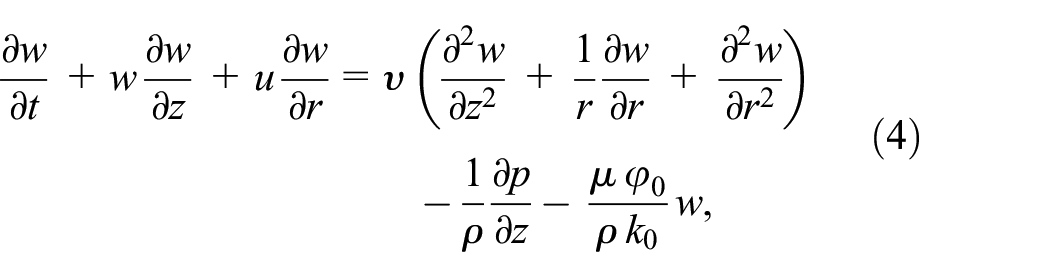
The flow constitutive equations are follows as8,13,14,30,39,40:




in which
The radiative heat flux is calculated as 8 :

Where

The thermophoretic velocities are defined by 30 :

in which
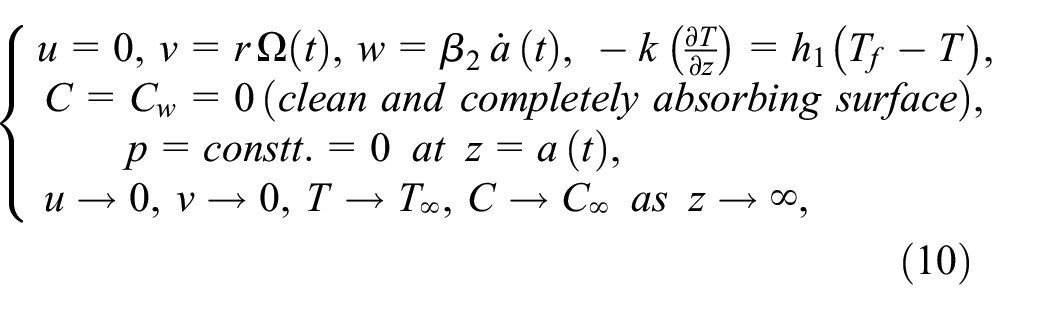
The suitable boundary conditions under flow assumptions are expressible as13,14,30:
where
The below similarity functions are considered13,14,30:

Switching equation (11) into the equations (1)–(6) and making use of equations (8) and (9), we have the following system:

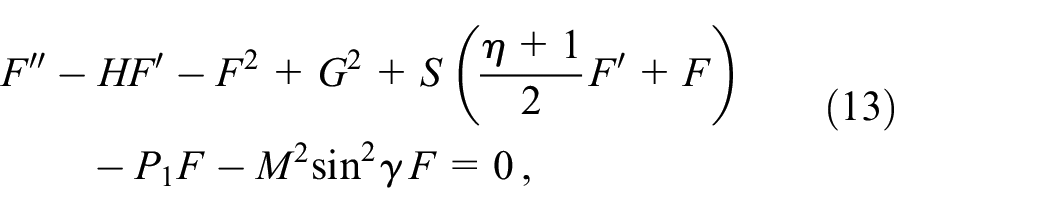


The boundary conditions (10) in view of (11) extract the following form:

Where
After integrating equation (15), the pressure distribution can be evaluated as:

Here
The most notable quantities are
Numerical solution
The essence of finite difference procedure is very close to numerical methods which are used to solve the differential equations. The derivatives are replaced in the differential equation through differential quantities in order to approximate the differential operator. The domain is split up in time and space. The solution approximations are calculated at time points or space. To solve the differential system (12)−(18), we adopted the following finite difference schemes6,7:


Here
The semi-infinite domain

Where the optimal relaxation parameter is determined as:

Here
Results and discussion
Numerical study is analyzed for the viscous fluid across orthogonally moving permeable rotating disk. The flow model incorporates the impacts of inclined magnetic field, porous medium and thermophoresis. A constant injection/suction is utilized at the surface of the permeable disk. The governing system is normalized through similarity functions. The normalized system consists upon the physical quantities
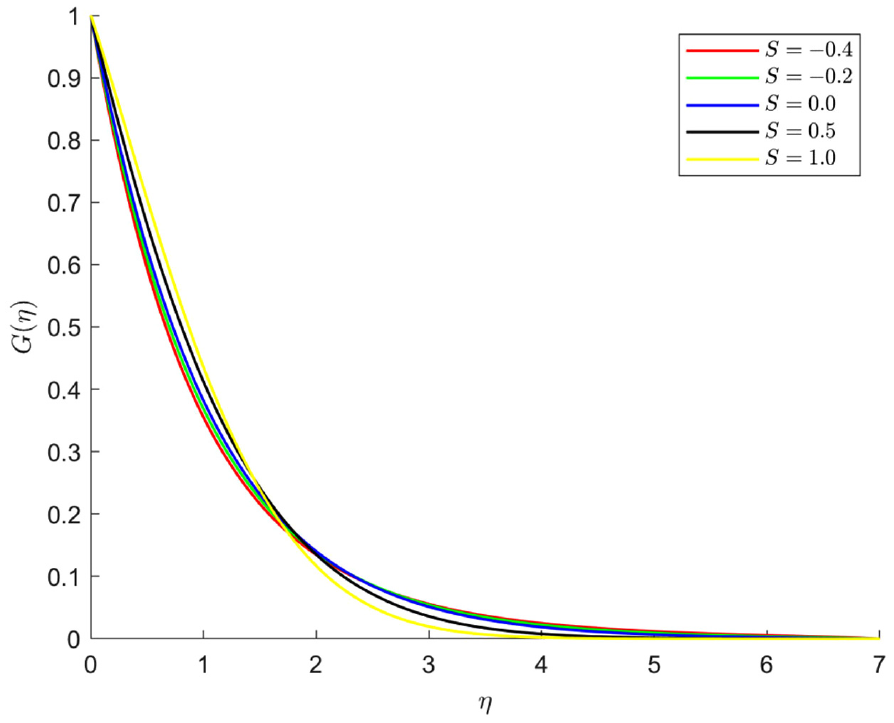
Figures 2 to 4 examine the behavior of contracting/expanding parameter on flow velocities

Effect of
Effect of

Effect of

Effect of

Effect of

Effect of
Figure 7 elaborates the influence of rotation parameter on velocity field

Effect of
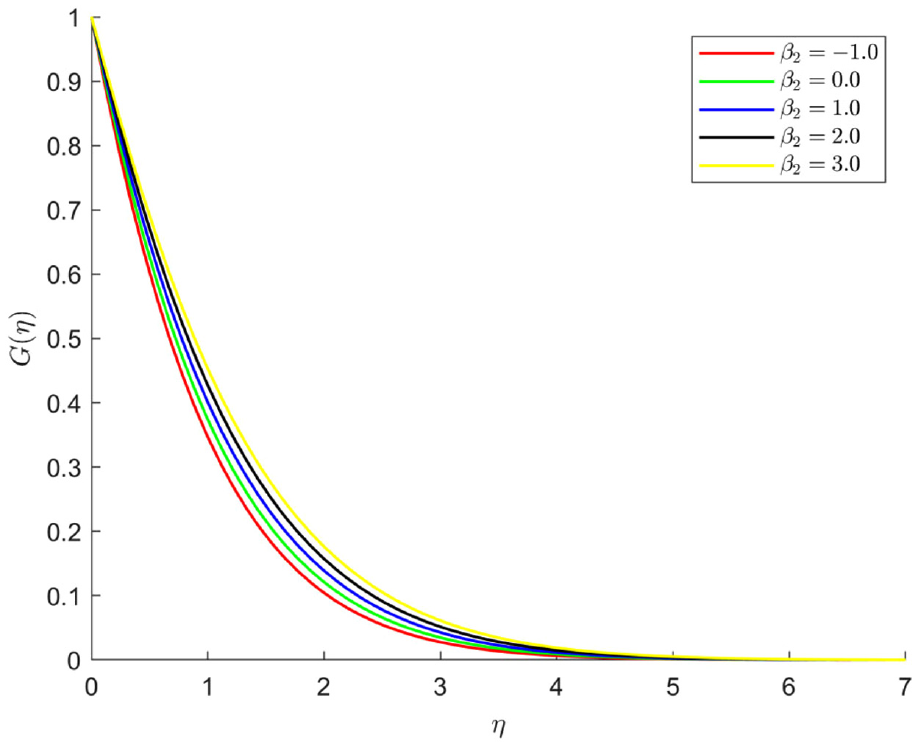
Effect of
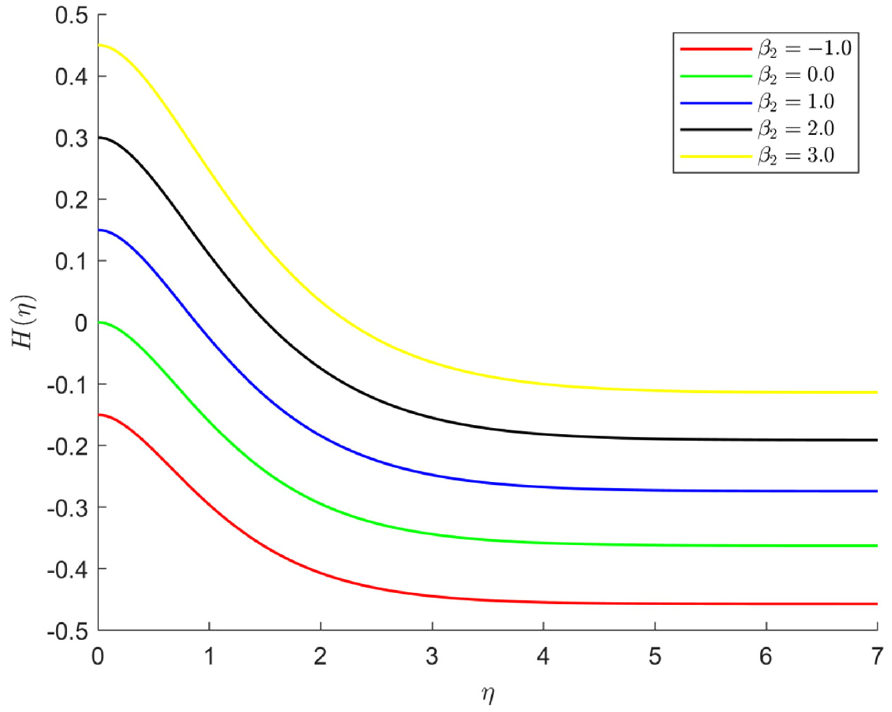
Effect of
The phenomenon of Prandtl number on temperature field is prescribed through Figure 11. Larger Prandtl number contributes to the reduction of thermal filed along with allied boundary layer thickness. As Prandtl number is inversely proportional to the thermal diffusivity. For larger

Effect of

Effect of

Effect of
Schmidt number effect is elucidated on concentration field by Figure 14. The concentration profiles exhibit increasing trend due to the enlargement in Schmidt number. The boundary conditions on to concentration field are also satisfied by the profiles

Effect of
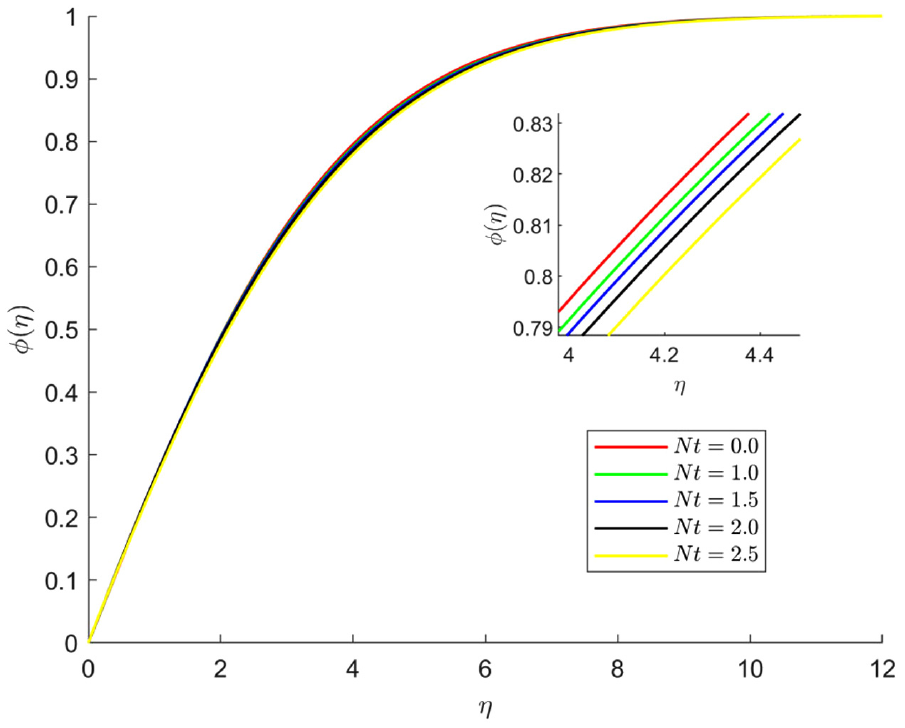
Effect of

Effect of
The contour graphs of the stream functions

Contours plot of

Contours plot of

Contours plot of

Contours plot of

Contours plot of
Figure 17 represents the contour graph of the stream function
The three-dimensional visualization of the stream functions

3D flow phenomenon of
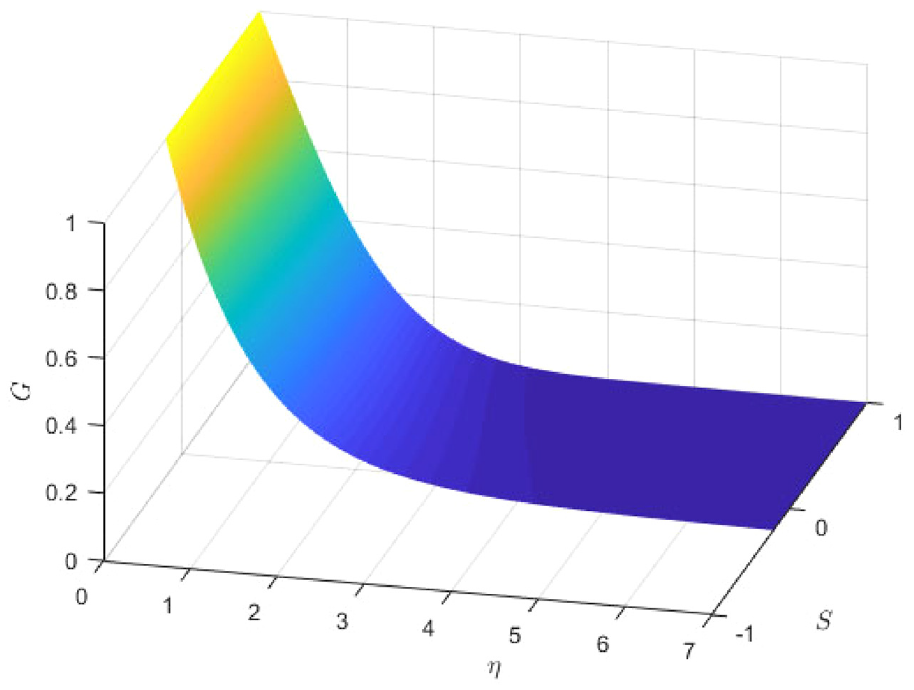
3D flow phenomenon of
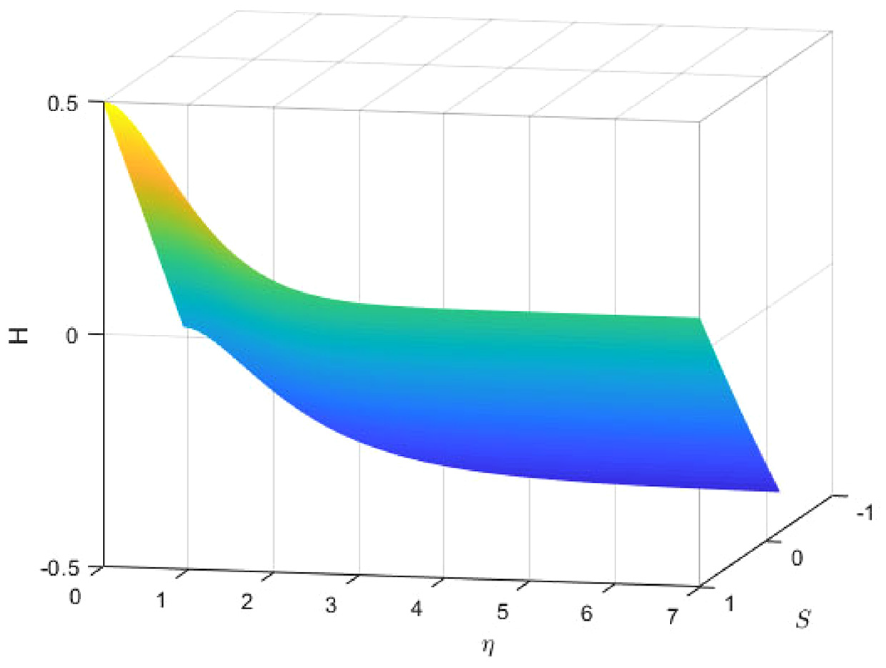
3D flow phenomenon of

3D flow phenomenon of

3D flow phenomenon of
Table 1 revealed the effects of magnetic and porosity parameters on the local skin-friction and frictional torque. A decreasing trend in local skin-friction is observed against the magnetic parameter porosity parameters whereas magnitude of the frictional torque is enhanced at the disk surface by such parameters
Shear stresses against

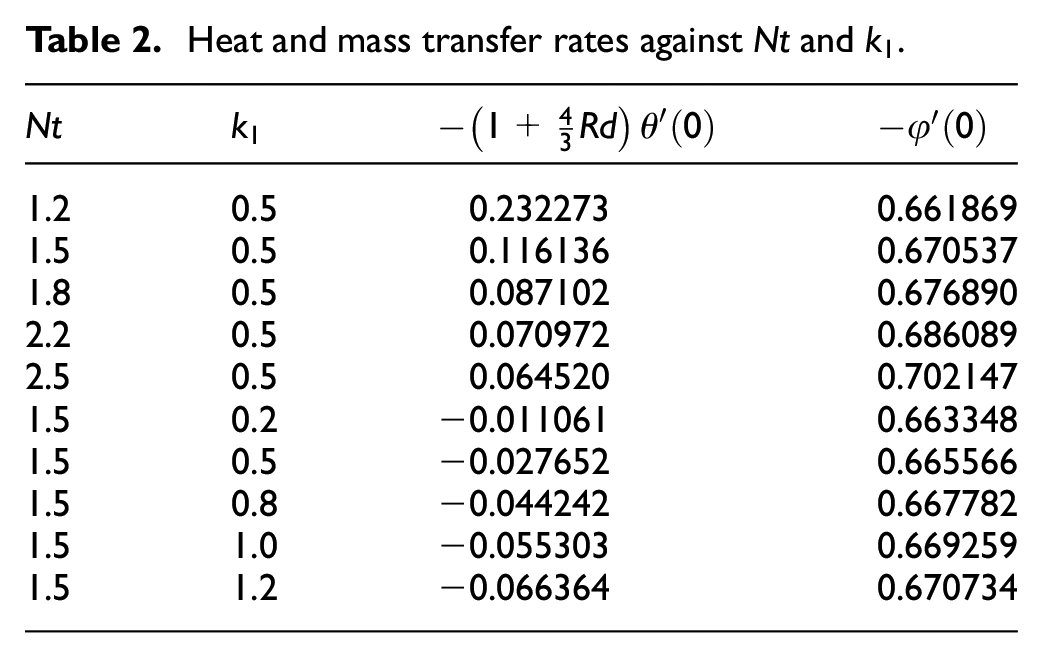
Heat and mass transfer rates against
Comparison of the local skin friction

Conclusions
An incompressible, laminar, and electrically conducting flow of viscous fluid is examined about vertical upward/downward moving disk. The disk also rotates along tangential direction and occupied space in a porous medium. The expression of thermal radiation is utilized in the energy equation. The convective condition of thermal transport is implemented through thermal boundary condition at the disk surface. The thermophoresis effects are visualized through mass equation. The mathematical model is treated numerical by applying first finite differences schemes and then iteratively solved through SOR method. Following are the main findings:
A decreasing trend in radial velocity curves is obtained against increased values of the porosity parameter.
The radial velocity profiles against contracting/expanding parameter act in similar way as the effects of wall blowing and suction at the rotating disk surface. The profiles along radial directions are first increased and then a reducing trend is noticed in such profiles.
The tangential velocity curves preserve increasing nature against the rotation parameter.
The temperature profiles with related thermal boundary layer thickness become larger due to the enhancement in the thermal Biot number.
The increased values of the temperature difference parameter
Local skin-friction is reduced, and frictional torque is enhanced by the modified values of the porosity parameter
The thermophoretic co-efficient is accountable in the increasing phenomenon of mass transfer rate.
Footnotes
Appendix
Handling Editor: Chenhui Liang
Declaration of conflicting interests
The author(s) declared no potential conflicts of interest with respect to the research, authorship, and/or publication of this article.
Funding
The author(s) received no financial support for the research, authorship, and/or publication of this article.
