



Abstract
The computational analysis of the second-order micropolar stagnation point flow of nanofluid over an exponentially permeable stretching sheet is considered. The freestream velocity with the thermal slip effects is taken into account in this analysis. This model is developed on the basis of flow assumptions and reduced into partial differential equations before applying the boundary layer approximations. The governing equations as a mathematical model are simplified with the help of suitable transformations. The differential system is further solved by using the bvp4c. Both graphs and tables are used to report observations. The skin friction and Nusselt number are reported for both weak and strong concentrations. The magnitude of skin friction is noticed greater for strong concentration in comparison with weak concentration. Subject to couple stress, the values of skin friction are relatively high for the case of weak concentration in comparison with strong concentration. Micropolar profile admit the direct relation toward micropolar parameter and micro-gyration parameter. Both Sherwood number and Nusselt number admits higher values for strong concentration as compared to weak concentration.
Introduction
The study of non-Newtonian fluids acknowledged notable attention by the researchers because of a wide range of applications. Owning to such importance as yet numerous non-Newtonian fluid models are introduced to encounter the flow field properties of fluids like the flow of an incompressible second-order fluid past a stretched sheet was considered by Rajagopal et al. 1
The issue involved continuous extrusion of a polymer sheet from a die, which is a polymer processing application. Bujurke et al. 2 investigated second order fluid flow along with heat transfer aspects by use of Noll and Coleman constitutive equations . This flow’s boundary layer properties were determined. Both thermal and velocity boundary layer thickness were closely examined. Pontrelli 3 examined the steady fluid flow of a second-grade homogeneous incompressible fluid across a stretching sheet. The flow partial differential equations are solved by using the collocation method. The solution dependency on the non-Newtonian parameter was explored, and the shear stress was provided along with several velocity distribution. The two dimensional flow of a viscoelastic fluid past a moving sheet was studied by Sadeghy and Sharifi. 4 They utilized the boundary layer approach for their investigation. HAM solution for second grade fluid over a porous plate was solved by Hayat and Khan. 5 Fetecau and Fetecau 6 discussed the solutions of second grade fluid for unsteady and unidirectional flows. Khan et al. 7 investigated the physical aspects of third grade nanoparticles with optimization of entropy. Flow of a viscoelastic fluid toward a fixed plate with non-axisymmetric Homann stagnation point was studied by Mahapatra and Sidui. 8 Shamshuddin et al. 9 examined the impacts of power law fluid model under the viscous dissipation with Hall current at exponential stretching sheet. Shamshuddin et al. 10 considered the impacts of Joule heating and viscous dissipation on magneto power law fluid model over exponential stretching sheet. Ferdows et al. 11 investigated the effects of radiative micropolar fluid flow with non Darcy porous medium having homogeneous–heterogeneous reactions. Dawar et al. 12 analyzed the effects of MHD micropolar nanofluid chemically over stretching surface. They also highlighted the effects of variable heat sink/source and velocity slips effects for micropolar nanofluid. The recent developments in this regard can be assess in References.13–15
The fluid with nanosized particles is termed as nanofluid. Owning to importance of nanofluids various authors reported their finds like Rahman et al. 16 discussed the suspended nanoparticles in the fluid flow past a porous exponentially stretching/shrinking by using the Buongiorno’s model. Thermal radiation, magnetic field effects with slip flow over a stretching/shrinking sheet with nanofluid was concluded by Abdul Hakeem et al. 17 Viscous dissipation and second order slip of melting heat transfer on magneto-hydrodynamics convective flow of a nanofluid past a stretching sheet was studied by Mabood and Das. 18 Kadir et al. 19 investigated the effects of von Karman swirling bioconvection over a rotating disk with the nanofluid flow. Beg et al. 20 offered the experimental results about the lubricity and rheology of drilling liquids enriched having nanoparticles. Shamshuddin et al. 21 examined the time dependent micropolar fluid flow over rotating desk under the multi-physico-chemical magnetic field. Numerical outcomes of nanofluid effects discussed by Kumar and Sokhal. 22 Khan et al. 23 studied the features of activation energy and Wu’s slip of bioconvection with magnetized couple stress nanofluid. Nadeem et al. 24 examined the impacts of CNTs with base fluid at rotating disk. Abbas et al. 25 reported the impact of induced MHD micropolar fluid at curved surface. The recent studies on the MHD nanofluid flow under the various flow assumptions can be reached out in References.26–29
We studied the non-Newtonian micropolar nanofluid flow with viscous dissipation over an exponentially stretching sheet. The thermal slip effects and suction/injection are also considered. The mathematical model is developed using the boundary layer approximation under the flow assumptions. The developed differential model is solved through the numerical technique namely bvp4c. Before our study, no one highlighted the effects on the boundary layer flow discussed. The ultimate results are shared by using tables and graphs.
Mathematical formulation
Non-Newtonian stagnation point micropolar fluid flow over an exponential stretching surface is considered. Both suction and injection are considered and specifically,



Flow of micropolar nanofluid pattern.
here, equation (1) represents the continuity equation, equation (2) represents the momentum equation, equation (3) represents the energy equation, equation (4) represents the concentration equation, and equation (5) represents the micropolar equation respectively. The endpoint conditions of the fluid flow are defined as

The suitable transformations are as follows:
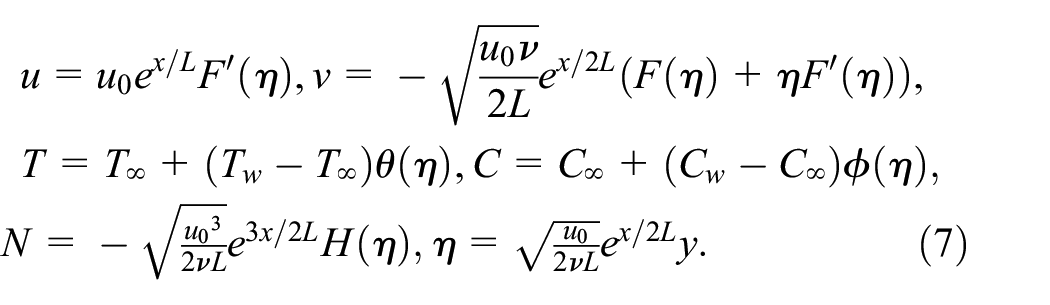
The suitable transformations are applied on equations (1)–(5) and we have,
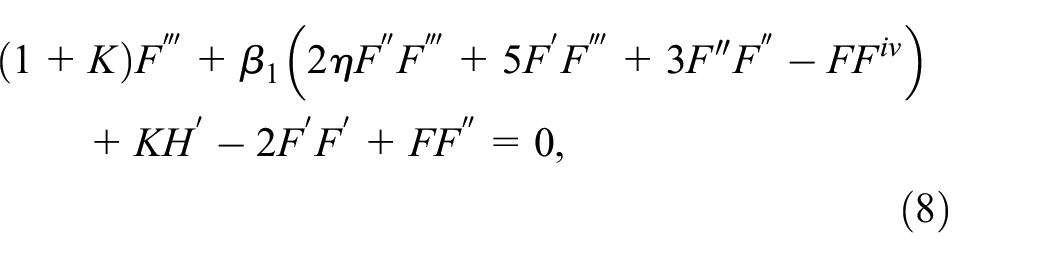



The reduced conditions are

where,
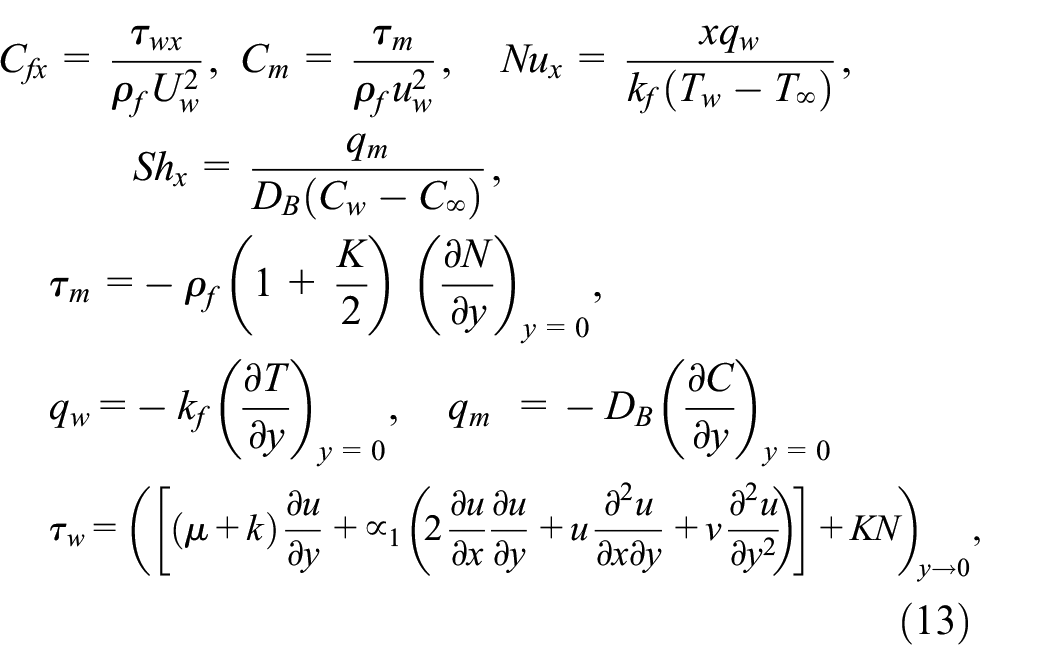
After dimensionalized the above equations, we have
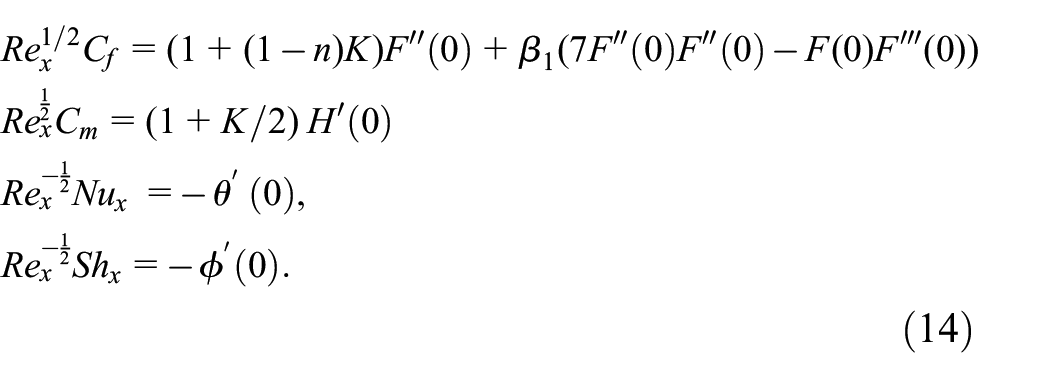
Numerical procedure
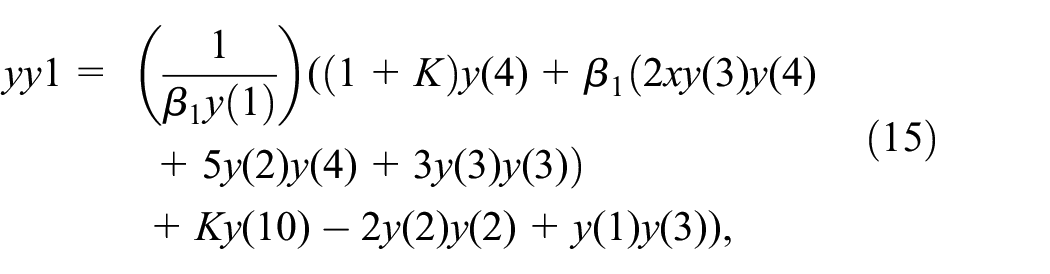
Equations (8)–(12) are nonlinear and hence cannot be solved exactly. Therefore we seek a numerical solution by using bvp4c through Matlab. The initial value problem subject to the above dimensionless system is as follows:



Dimensionless boundary conditions takes the form

It is important to note that the following values are used of default parameters

Results and discussion
The dimensionless system of nonlinear differential equations are solved through numerical technique. The physical effects of involving parameters under the flow assumptions are discussed in the form of tables and figures. The impact of flow variables on
Numerical results of skin friction coefficient and couple stress for different values of involving physical parameters in both cases strong (n = 0.0) and weak (n = 0.5) concentrations.

Numerical results of Sherwood Number and Nusselt Number for different values of involving physical parameters in both cases of strong (n = 0.0) and weak (n = 0.5) concentrations.
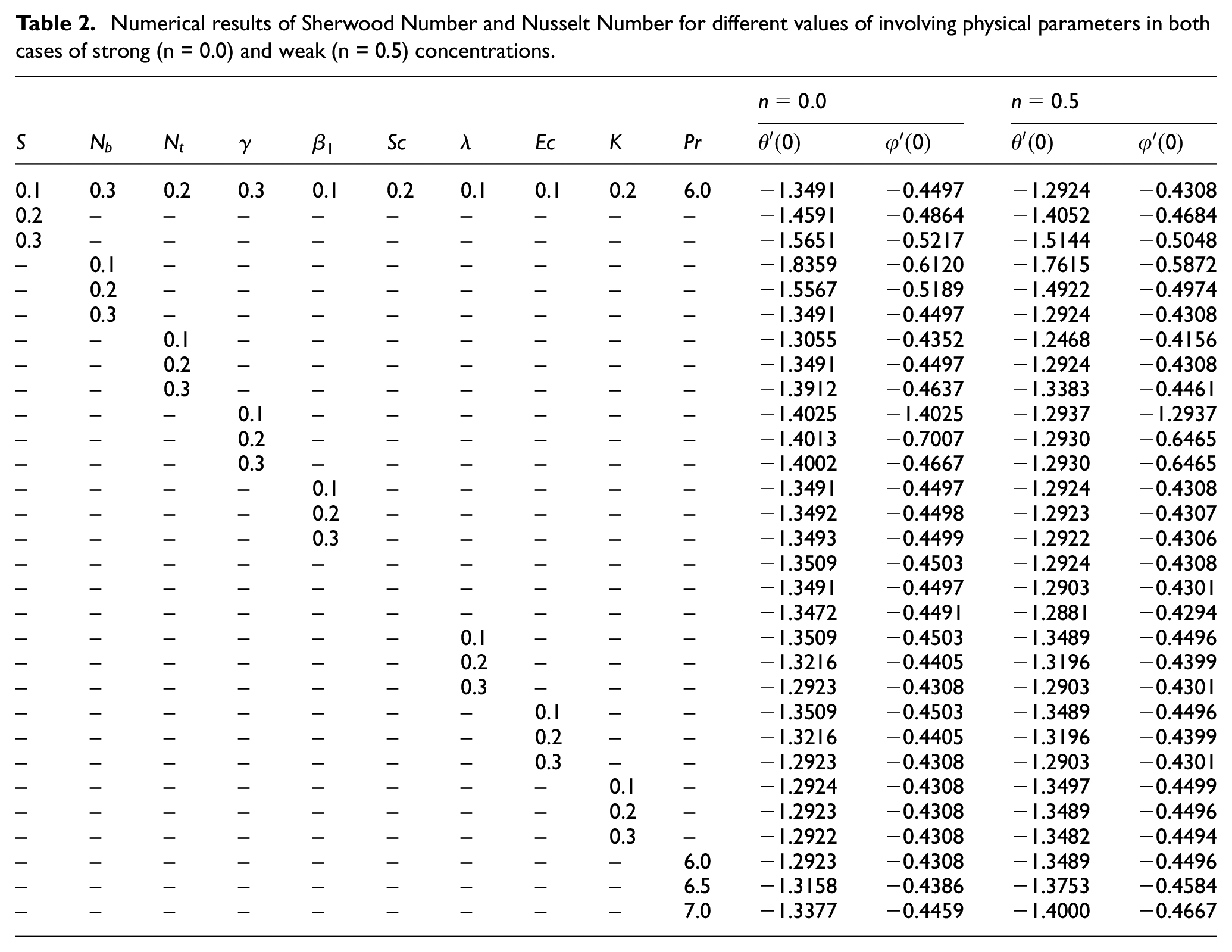
The influence of Schmidt number on the both numbers is offered in Table 2. The increasing values of Schmidt number cause decline in Nusselt number and Sherwood number for both cases for strong and weak concentration. The influence of Eckert number on both numbers is offered in Table 2. Increasing values of Eckert number cause decline in the Nusselt number and Sherwood number for both cases namely strong and weak concentration. The influence of micropolar parameter on the Nusselt number and Sherwood number is presented in Table 2. Trifling variations are noticed in this case. The influence of Prandtl number on the both numbers is presented in Table 2. The increasing values of Prandtl number enhance the Sherwood and Nusselt numbers for both cases namely strong and weak concentration.
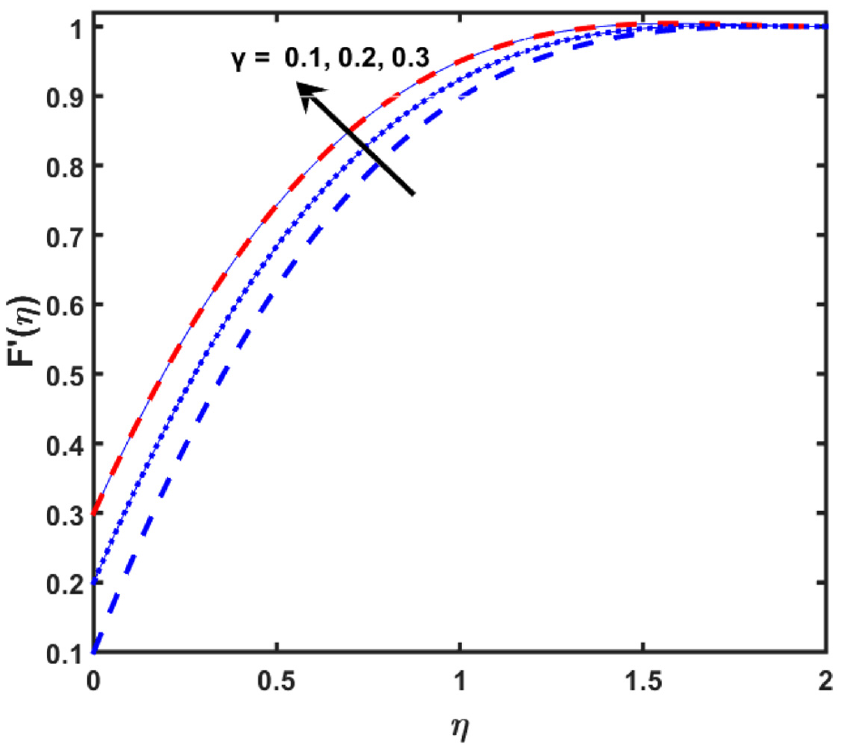
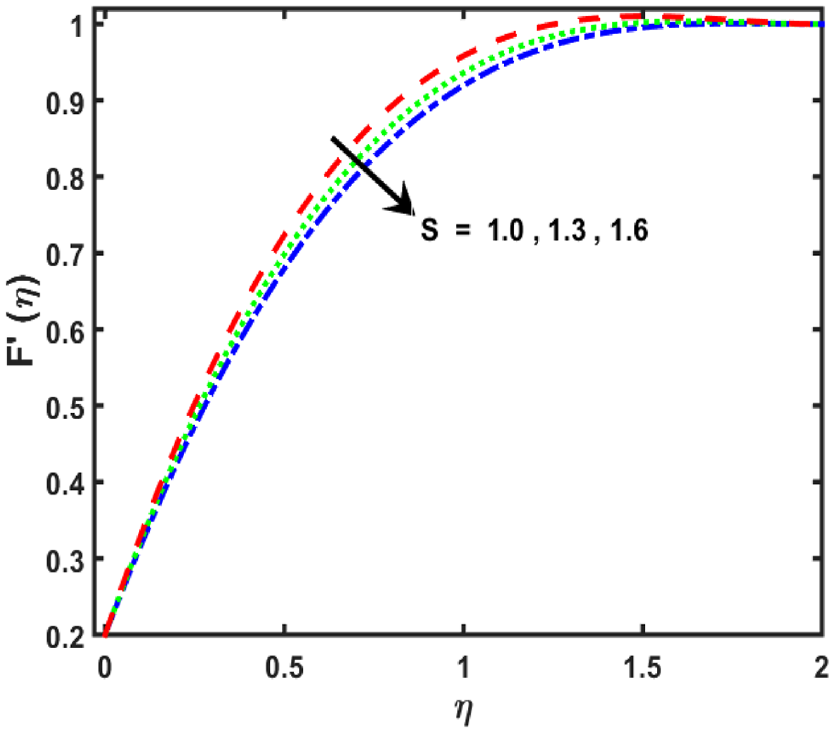
The impacts of the involving parameter on velocity, temperature, concentration, and micropolar profile are highlighted in the Figures 2 to 12. Figure 2 shows the impacts of K on the velocity. It is noted that velocity decreases with increase in micropolar parameter. Physically, vertex viscosity enhances which declines the velocity profile. The influence of material parameter on the velocity profile is given in Figure 3. Figure 3 indicates that velocity of the fluid declines by increasing the values of the material parameter

Effect of K on the

Effect of
Effect of

Effect of

Effect of

Effect of

Effect of

Effect of

Effect of

Effect of
Conclusions
Non-Newtonian micropolar fluid flow along with suspended nanoparticles subject to an exponentially stretching surface under the stagnation point flow is considered in the current analysis. The key outcomes are as follows:
The values of skin friction are higher in magnitude for the case of weak concentration (n = 0) in comparison with strong concentration (n = 0.5).
The magnitude of couple stress is observed higher for the case of strong concentration (n = 0.5) as compared to weak concentration (n = 0).
Significant variations are noticed for Nusselt and Sherwood numbers toward involved flow parameters subject to strong and weak cases.
Fluid velocity is found as increasing function of
Fluid temperature admits direct relation toward Ec,
Micropolar profile shows direct relation toward
Footnotes
Appendix
Acknowledgements
Authors would like to thank Prince Sultan University for their support through the TAS research lab.
Handling Editor: Chenhui Liang
Declaration of conflicting interests
The author(s) declared no potential conflicts of interest with respect to the research, authorship, and/or publication of this article.
Funding
The author(s) received no financial support for the research, authorship, and/or publication of this article.
