



Abstract
Aircraft maintenance technology is related to flight safety. It is not only a significant guarantee for the safety of passengers’ lives and property but also an important means for airlines to reduce costs and improve profitability. This paper focuses on aircraft maintenance decision-making, analyzes the current situation and defects of maintenance decision-making, applies knowledge graph technology to this field, and constructs aircraft maintenance knowledge graph; through the character analysis of sample data and experimental comparison, the key factors affecting the accuracy of aircraft maintenance decisions are found; few-shot knowledge reasoning technology is introduced to improve the maintenance strategy reasoning algorithm. In the 737NG aircraft maintenance decision-making system of an airline, the feasibility and effectiveness of the method are verified, which provides strong support for flight safety.
Introduction
Since 2005, China has ranked among the world’s largest air transport countries. With the further development of the aviation industry, aircraft safety is a priority. The safety of flights is crucial for the lives of passengers, employees, and the future of aviation. As soon as a safety event emerges, it is not only a massive loss of property for states and airlines but also a disaster for the families of all members. Therefore, there should be zero tolerance for the safety issues of the aircraft, and aircraft maintenance is a vital part of that.
The digitization of the aviation maintenance industry is accelerating and artificial intelligence is gradually changing the technical architecture of aircraft maintenance. Compared with open source of knowledge, aircraft maintenance data has significant domain feature: (1) Various forms. Fault information varies in content and form. (2) Complex structure. It is difficult to conduct a comprehensive analysis and effective utilization of data efficiently. (3) Lack of open sources of expertise. Making maintenance decisions requires in-depth use of aircraft maintenance professional knowledge, but the professional knowledge base in the current field is scarce and not comprehensive enough.
Efficient management and full use of massive and complex maintenance data are important bases for maintenance decision-making. What’s more, they’re a critical link in guaranteeing flight safety. Aircraft maintenance data includes maintenance records, electronic maintenance manuals, and technical tracking databases. These datasets contain both structured and unstructured natural language data (such as related records made by maintenance personnel at work). Existing studies focus on structured data, but for unstructured natural language, concepts need to be extracted first, and then the correlation between concepts needs to be established. The knowledge graph can excavate, analyze, construct knowledge and the interrelation between knowledge to fully meet the above requirements. In addition, the existing methods have some defects in the processing of related data. Traditional techniques for managing aircraft maintenance data typically rely on relational databases, which are difficult to store, evaluate, and mine for decentralized data. The data analysis can reveal the consistency and correlation of maintenance data. However, its ability to deal with unstructured data is weak, and the analysis process is complex. As a semantic network, the knowledge graph has strong expressiveness and modeling flexibility, and can effectively deal with complex associated data. It is one of the effective methods to solve the above problems. 1
We summarize our contributions as follows:
We have done a lot of original work and constructed the aircraft maintenance knowledge graph. Based on the data source provided by an airline as the corpus, we process a large number of aircraft maintenance knowledge with highly complex structure, such as AAMM maintenance manual and technical tracking manual, extract a total of 9848 triples by using techniques such as entity recognition and relationship extraction and construct the aircraft maintenance knowledge graph.
We introduce knowledge reasoning technology to optimize aircraft maintenance decision-making, solve the long-tail distribution problem of domain knowledge by using few-shot reasoning, improve aircraft maintenance knowledge graph, and further improve the accuracy of aircraft maintenance decision-making.
We conducted extensive experiments, and experimental results demonstrate that the proposed method achieves remarkable results in aircraft maintenance assistance decision-making, which can provide a reference and theoretical basis for predictive maintenance in other fields.
Related work
In recent years, management and decision-making in the field of aircraft maintenance have attracted much attention. Various approaches have been proposed, which can be broadly grouped into four categories: (1)
Analyzes and comparison of aircraft maintenance relevant studies.

Based on the aforementioned flaws, some researchers have introduced knowledge graph technology to the aircraft maintenance decision-making, allowing data to be structured in a more intuitive cognitive form and improving the accuracy of intelligent decision-making. Some scholars have proposed a method of constructing a knowledge graph of aviation safety events to solve the problem that existing research cannot effectively use the massive data accumulated by aviation safety. 19 Other researchers studied the aviation industry’s data characteristics and management needs and proposed a method for constructing a semantic knowledge base for aviation utilizing knowledge graph technology, which serves as a reference for constructing a knowledge base in this field. 20 In other related studies, some authors elaborated on the method of constructing the knowledge graph of aviation field equipment quality management and provided relevant references for the construction of the aviation knowledge graph. 21 Other authors have comprehensively summarized the current status and development of aircraft engine fault diagnosis, analyzed the necessity and feasibility of knowledge graphs for aircraft fault management and diagnosis, and described related technologies in detail. 22 Some researchers use knowledge graph technology to diagnose aircraft power supply faults, demonstrating that knowledge graph technology has a promising future in the field of aircraft fault diagnostics. 23 In practice, aircraft status data is dynamically updated over time, but present maintenance work is passive decision-making, troubleshooting can only be done when a failure occurs, and predictive maintenance cannot be done. Using knowledge graph technology to predict maintenance measures is an important method to effectively avoid risks, improve the accuracy of maintenance decision-making, and reduce maintenance costs.
Based on the research situation, this article mainly studies the following issues:
Our approach
This paper applies knowledge graph technology to the field of aircraft maintenance, constructs a knowledge graph of aircraft maintenance, and uses knowledge reasoning technology to optimize aircraft maintenance decision-making.
Overview of knowledge graph
The knowledge graph is a structured semantic knowledge base that can quickly and accurately describe the concepts and relationships that exist in the real world. It uses entities as nodes and relationships as edges, and stores data in the form of SPO triples, namely <entity, relationship, entity>. The knowledge graph can build heterogeneous knowledge in the field, establish associations between knowledge, and solve the problems of data fragmentation, data diversification, complexity, isolated islands, and low value of single data. Figure 1 is an example of a knowledge graph.

Example of knowledge graph.
Construction of aircraft maintenance knowledge graph
We use the data derived from the aircraft technical tracking system to construct the aircraft maintenance knowledge graph using a bottom-up approach. First, data preprocessing: organize the acquired data, establish attribute constraints and integrity constraints, filter and delete redundant data, delete punctuation and stop words by referring to stop word dictionary, and then use word segmentation tools to segment text information. Then store entity-centric data. Each piece of data, such as “fault description,” is an independent node, and the association between entities is stored as a “relationship.”Figures 2 and 3 show some relational triples of the aircraft maintenance knowledge graph.

Part of aircraft maintenance knowledge graph.

Overall diagram of aircraft maintenance knowledge graph.
Knowledge reasoning for aircraft maintenance
According to the characteristics of domain data, TransE 24 is used for aircraft maintenance knowledge reasoning. The TransE 24 model represents entities and relationships as triples (h, r, t). In the aircraft maintenance knowledge base, the maintenance measures are taken as the relationship, and the fault information and troubleshooting scheme is taken as the head/tail entities, based on which the triplet is established. For example, “boarding gate light is on after take-off” as the head entity, “maintenance measures” as the relationship, “adjusted boarding gate guide arm” as the tail entity, forming a triple (boarding gate light on after take-off, maintenance measures, adjusted boarding gate guide arm), indicating that there is a “maintenance measure” relationship between the entity “boarding gate light on after take-off” and the entity “adjusted boarding gate guide arm.” Through the training of a large number of knowledge triples, new possibilities can be deduced to optimize the maintenance strategy.
It’s worth mentioning that the TransE model has circumstances where modeling data with multiple relationships is difficult. However, because domain expertise in our field of research is widely diverse, TransE has little impact on the outcome of knowledge reasoning at the application level of aviation maintenance (the similarity between different maintenance measures corresponding to the fault is low). Moreover, TransE has a good generalization effect, is simple and easy to expand, and is more convenient and faster in practical application. We are exploring how to further optimize this problem, which is our next research focus.
Overview of TransE
As shown in Figure 4, the TransE 24 algorithm continuously adjusts h, r, t (vectors of head, relationship, and tail) to make (h + r) equal to t as much as possible, that is:


TransE model.
Algorithm
The overall algorithm flow is shown in Table 2.
TransE algorithm flow.

Experiment
In this section, we conduct a link prediction experiment to evaluate the performance of knowledge reasoning in the field of aircraft maintenance.
Dataset
We take data from an airline company’s aircraft technical tracking system, do data preprocessing and event extraction, and then construct a preliminary complete aircraft maintenance knowledge graph using the bottom-up method. In the experiment, we choose a portion of the knowledge graph’s maintenance knowledge for reasoning. The details of the dataset are shown in Table 3.
Dataset statistics (each column represents the number of entities, relationships, triples).

Implementation details
The selected aircraft maintenance knowledge is divided into two categories for knowledge reasoning. The first type computes the distance to the fault (h) + measures (r) to query the troubleshooting plan (t), predicts the troubleshooting plan corresponding to the fault; the second computes the distance of the component (h) + the fault (r) to query the fault information, predict possible component failures. The specific process is shown in Tables 4 and 5.
Troubleshooting schemes for predicting certain faults.

Prediction of possible faults of a component.

Evaluation standard
Take a correct triple-A as an example, replace the head/tail entity of A with other entities in the dataset in turn to generate n triples. Calculate the h + r − t values of the n triples, sort the results in ascending order, and record the sequence number k of the sorted value of A. If there are m correct triples in the first k − 1 corresponding triples, change the sequence number of a to k − m. Repeat this operation for all correct triples. Use the ranking of the correct triples to evaluate the results of the experiment, and the evaluation criteria are Hits@10 and MR. Hits@10 is the proportion of correct entities in the top 10, and MR is mean rank.
Experimental result
Reasoning results of aircraft maintenance knowledge
Find the optimal learning rate of TransE, 24 and draw a line graph of the trend of loss with the number of rounds, as shown in Figure 5.

Change of training loss value.
According to the characteristics of the task, after many experiments, we set the hyperparameter value, learning rate: 0. 007, batch_size: 30, epoch: 500. It can be seen that as the training progresses, the loss continues to decrease in a small range of shocks. We selected the top-three results as reference maintenance measures and listed the corresponding accuracy. Taking “height above 20,000FT remains abnormal” as an example, the probability of the top-three results being correct is 70.5% through knowledge reasoning. The recommended maintenance measures and their accuracy are as follows: (1) Conduct elevator authority test (91%). (2) Calibrate the position sensor (89%). (3) Adjusting stabilizer sensor (87%). Finally, we select the correct triples from the aircraft maintenance knowledge graph as an argument to evaluate the performance of the two types of reasoning, and the experimental results are shown in Table 6.
Experimental results of aircraft maintenance knowledge reasoning.

It can be seen from the table: (1) fault-measures have a better reasoning effect, and the accuracy of discovering new knowledge in combination with the knowledge base is higher. This demonstrates the efficacy of our method in the realm of aviation maintenance decision-making. (2) The mean rank (MR) of the two types of knowledge reasoning is 22.36 and 8.7. That is to say, when the 22.36/8.7th candidate entities are ranked on average, the appropriate and effective tail entities can be matched, and the reasoning efficiency is low; the proportion of correct entities in the top 10 (Hits@10) is 0.18 and 0.67 respectively, indicating that the accuracy of reasoning is low. Overall, the reasoning effect produces unsatisfactory results. The reason may be that there is a problem of few-shot in maintenance knowledge, which leads to low efficiency and accuracy of knowledge reasoning. Therefore, we further analyze the knowledge graph of aircraft maintenance.
Aircraft maintenance knowledge analysis
In the constructed aircraft maintenance knowledge graph, we discovered that a major portion of the maintenance data has a long-tail distribution, implying that some faults have just a few maintenance measures. We call this kind of data “few-shot knowledge.” As shown in Figure 6, the “cabin temperature is zero” in the figure is the few-shot knowledge.
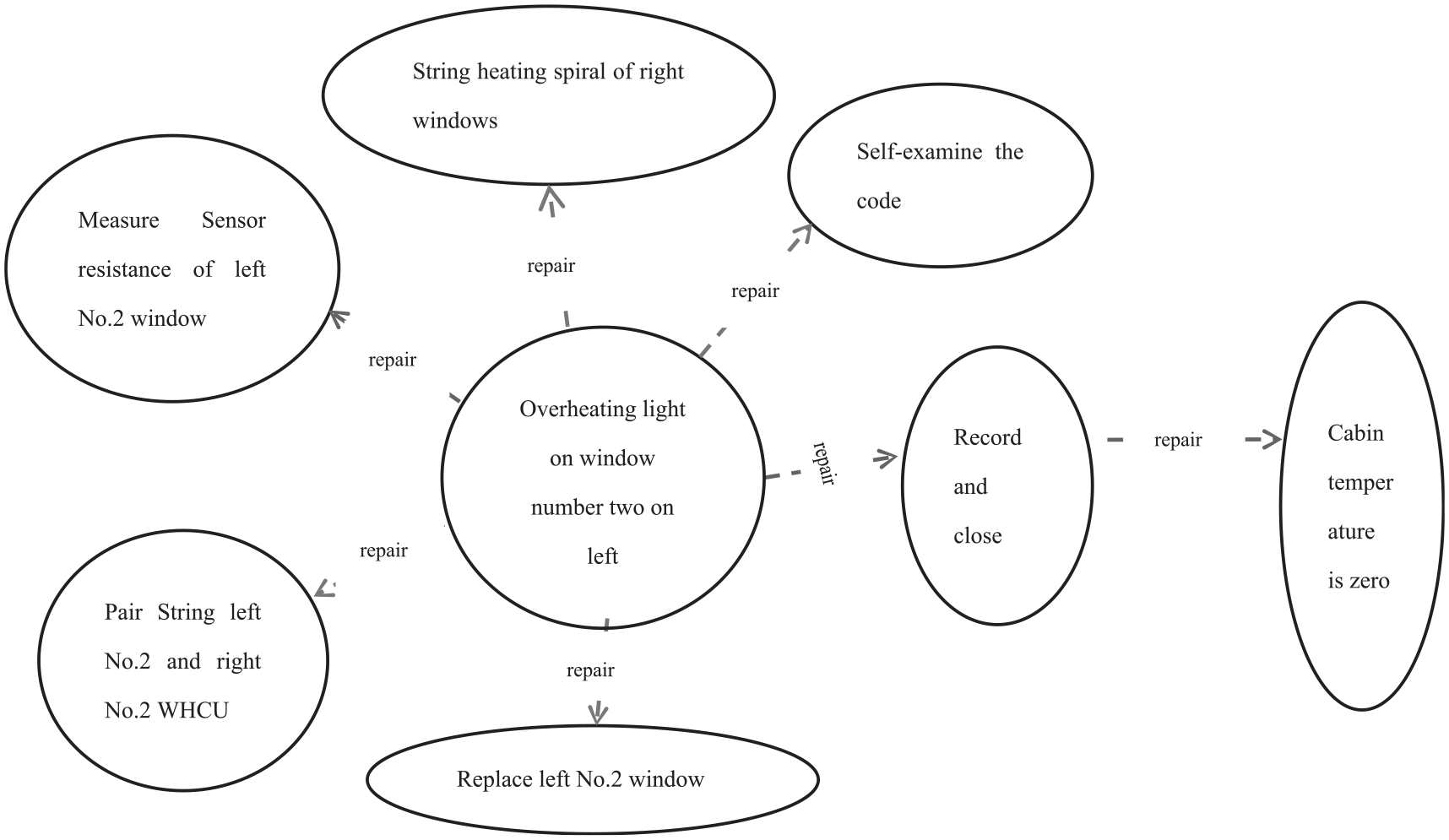
Example of the few-shot maintenance knowledge.
According to statistics, there are less than 350 relational triples of certain knowledge in the aircraft maintenance knowledge graph, and the percentage is greater than 40%. Detailed statistical information is shown in Table 7. Existing reasoning methods require a large number of training examples, and the generalization ability of few-shot knowledge is poor; knowledge reasoning models trained with few-shot knowledge tend to overfit the head entity and ignore the category of the tail entity in prediction, which leads to the reduction of the accuracy of knowledge reasoning. Therefore, it’s crucial to address the few-shot problem of aircraft maintenance knowledge.
Statistics on the few-shot knowledge of aircraft maintenance.

Few-shot knowledge reasoning for aircraft maintenance
We use FAAN 25 to infer the few-shot knowledge in the aircraft maintenance knowledge graph to solve the problem of the long-tailed distribution in the aircraft maintenance knowledge graph. The embedding of relation r is defined as:

Where h and r is the pre-embedded entity vector. Define a scoring function to calculate the similarity between neighbor relationship and few-shot relationship:




Where (·) is the RELU activation function,






The algorithm procedure is shown in Table 8.
Few-shot knowledge reasoning algorithm flow.

The model is trained by using the triples of background knowledge graph and training set, as well as the few-shot reference triples of validation set and testing set. Before the model starts training, the entity embedding is initialized by using TransE, the maximum number of neighbors is set to 20. The embedding dimension is set to 100 and the transformer layers are set to 3 and 4. Use dropout and adjust the rate to {0. 1, 0. 3}, edge γ is fixed to 5.0 to avoid overfitting. Evaluate every 200 training steps, within 1000 steps, the model with the highest validation MRR was selected as the optimal model, and the optimal hyperparameter was adjusted. The specific model training process is shown in Table 9.
Model training process.

To evaluate the performance of few-shot knowledge reasoning in the field of aircraft maintenance, we measured the rankings of all triples in the candidate samples that replaced the tail entity. Two evaluation indicators are reported on the dataset: MRR and Hits@10. MRR is mean reciprocal rank, Hits@10 is the proportion of the correct entities in the top 10. Find the model with good effect, and draw the process broken line chart of the changing trend of model loss with rounds during the training, as shown in Figure 7.

Change of training loss value.
According to the characteristics of the task, after many experiments, we set the hyperparameters value, batch_size: 60, lr: 4e−5. The loss value of the fifth model continues to decline in a small range of shocks and is lower than the loss of the first four models, which is the optimal model. Selecting the correct triples as arguments, the MRR and Hits@10 values of aircraft maintenance few-shot knowledge reasoning are 0.479 and 0.763, respectively. The Comparison of data volume after processing of few-shot data is shown in Figure 8. Figure 8 illustrates that raw data (Fault, Maintenance, Scheme) has the fewest data volume (only 31), which is significantly fewer than other forms of data. Following a few-shot knowledge reasoning, the number of instances (Fault, Maintenance, Scheme) increased seven-fold to 230, greatly narrowing the difference. Simultaneously, the volume of other types of data has increased dramatically, and the general distribution is very uniform. It is clear that FAAN is effective for few-shot knowledge reasoning in the field of aircraft maintenance. In addition, processing few-shot data effectively expands the fault coverage space, thus improving the accuracy of maintenance decisions. With the few-shot fault knowledge that “cabin temperature is zero” as the input, we still choose the top-three of the reasoning results as the reference measures. The probability of the top-three results being correct is 72.9% through knowledge reasoning. The maintenance measures and their correct probability are as follows: (1) Perform air-conditioning health check (92%). (2) Clean the cabin temperature sensor screen (90%). (3) Replace the temperature control panel (88%).

Data volume comparison: (a) data volume statistics before enhancement and (b) data volume statistics after enhancement.
Ablation study
We conducted an ablation experiment to examine the effectiveness of few-shot knowledge reasoning, and the results are shown in Table 10. Among them, A represents the prediction result without a few-shot knowledge reasoning, and B represents the prediction results with a few-shot knowledge reasoning, the numbers in boldness represent the optimal results. Experiments show that few-shot knowledge reasoning greatly improves the accuracy of knowledge reasoning in the field of aircraft maintenance.
Experimental results of ablation study.

Bold numbers indicate the best results.
Case study
This project builds a 737NG aircraft maintenance decision-making system based on the knowledge graph and verifies the maintenance decision-making reasoning method proposed in this paper. First, log in as a “maintainer” and enter the main page to operate related functions, as shown in Figure 9.
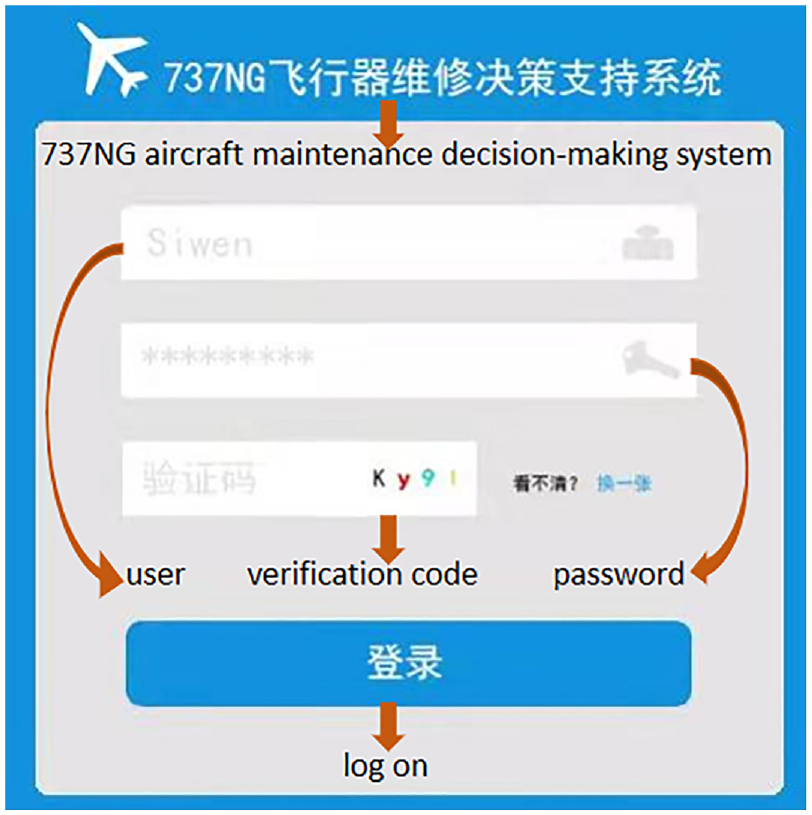
“Technical personnel” login main interface.
We use knowledge graph technology to supplement and improve the existing aircraft maintenance decision-making system to provide decision-making assistance for aircraft maintenance personnel. Enter the fault name, the knowledge graph is analyzed, reasoned, and compared, return the troubleshooting scheme and recommended measures required for the fault. However, the suggestion can only be used as a feasible exploration and must be demonstrated in practice. To a certain extent, it enriches the maintenance methods and improves maintenance efficiency. The query and result display interface of maintenance decisions is shown in Figure 10.

Query and result display interface of maintenance decision: (a) maintenance decision query interface and (b) maintenance decision result display interface.
Performance comparisons
As discussed in the related work, we follow the knowledge graph construction process described in Li et al., 1 but they didn’t carry out follow-up work, namely data enhancement and aircraft maintenance decision support. At the same time, similar to the work of Cao et al. 22 and Nie et al., 23 a considerable part of the studies only diagnose and manage specific faults. Therefore, we built a knowledge graph covering the entire aircraft fault information, and implemented a decision-making system based on the aircraft maintenance knowledge graph, allowing relevant workers to receive more comprehensive technical services. Besides, due to the current aircraft model being relatively concentrated, there is an uneven distribution of sample data. We further analyze aircraft maintenance data and utilize few-shot reasoning techniques for knowledge completion to achieve data enhancement, alleviating the unsolved problem of incomplete diagnostic space coverage caused by uneven data distribution and long-tail distribution in Cao et al. 22 and Santos et al. 14 Figure 11 shows a comparison of data distribution, while Figure 12 shows a comparison of the accuracy of maintenance decisions based on the original and enhanced data sets. As shown in Figure 11, the data amount of “component” in the original data is the smallest, which differs greatly from that of the other two types of data. However, with few-shot reasoning, the number of samples increases significantly and the overall distribution tends to be uniform. With the resolution of the data problem, the accuracy of the maintenance decision in Figure 12 also improved significantly. Finally, like our service terminal, Yuan et al. 9 provides services for aircraft maintenance AR. However, compared with the method, the knowledge graph based aircraft maintenance decision method in this paper enhances the correlation between data, improves the data utilization rate, the accuracy and interpretability of maintenance decision, and thus significantly improves the response effect and satisfaction.

Data distribution comparison: (a) data distribution statistics before enhancement and (b) data distribution statistics after enhancement.

Comparison of maintenance decision accuracy.
Discussion on method applicability
The method we proposed actually applies to all aircraft types of China Southern Airlines. Since the maintenance records and related data of 737NG are relatively complete at present, this method has been tried out on 737NG, hence this paper takes 737NG as an example to illustrate. Furthermore, because the knowledge graph is a graph database of meta-knowledge structure that is independent of aircraft type, our model has a certain elasticity. Therefore, from the analysis of the principle, this method is suitable for all aircraft types. For example, hypersonic vehicles 26 and wave rider aircraft. 27 We will further sort out other aircraft types in the follow-up work.
Conclusion
This paper analyzed the present status and defects of aircraft maintenance decision-making systems in recent years from the aspects of technology and application. This article adopted knowledge graph technology to organize, represent and store a large number of complex related data in this field, and build a knowledge graph of aircraft maintenance. In addition, the problem of few-shot found in the experiment is solved by the application of few-shot knowledge reasoning technology, which aims at improving the accuracy of aircraft maintenance decision-making. This paper also proposed new possibilities to optimize maintenance strategies to reduce or avoid unexpected failures to ensure flight safety further. The experiments have proved that the method used in this article can play an auxiliary role in aircraft maintenance decision-making, which can provide relevant reference and theoretical basis for predictive maintenance in various fields. In future studies, a great deal of experimental research would be conducted through the fusion of multi-source information for knowledge reasoning.
Footnotes
Handling Editor: Chenhui Liang
Declaration of conflicting interests
The author(s) declared no potential conflicts of interest with respect to the research, authorship, and/or publication of this article.
Funding
The author(s) disclosed receipt of the following financial support for the research, authorship, and/or publication of this article: Natural Science Foundation of He’nan Province (No.152102210068); Foundation of He’nan Educational Committee (No.18A520026).
