



Abstract
Magnetic drive centrifugal pumps have compact structure and lower efficiency than ordinary centrifugal pumps. The surrogate-based optimization technique was applied to improve the performance of a high-speed magnetic drive pump with the help of numerical simulations. Eight geometrical parameters of the impeller were considered as the design variable. About 290 samples of impeller were generated by optimal Latin hypercube sampling (OLHS) method, and the corresponding efficiencies of all the impeller samplings were obtained from numerical simulation. The performance test of the prototype pump was carried out, and the experimental results were in good agreement with the numerical simulation results. The hydraulic efficiency at 1.2 Qd of the magnetic drive pump was set as the optimization objective. Using response surface methodology (RSM), surrogate models were established for the objective functions based on the numerical results. The multi-island genetic algorithm (MIGA) was used to optimize the impeller. The hydraulic efficiency of the optimal impeller at rated flow rate was 72.89%, which was 6.23% higher than the prototype impeller.
Keywords
Introduction
The magnetic drive pump realizes non-contact torque transmission through the magnetic coupling, and changes the dynamic seal into the static seal, to make the pump completely leak free. It is often used to transport toxic, harmful, flammable, and explosive mediums. However, owing to the low transmission efficiency of magnetic coupling, the efficiency of the magnetic drive pump is lower than that of ordinary centrifugal pumps.1–3 Due to its high usage, the optimization of the magnetic drive pump and other turbomachinery is very important to reduce global energy consumption, and to increase their performance.4–9
At present, optimization methods based on computational fluid dynamics (CFD) technology have been more often applied to enhance the performance of turbomachinery. Compared with the traditional trial-and-error method, the combination of an optimization method with numerical simulation for pump performance improvement can shorten the development cycle and reduce the experimental resources. 10 Many researchers have carried out optimization of pumps and other turbomachinery with the help of numerical simulations. Some of them focus on improving the pump performance by optimizing impeller blade shapes.
Thakkar et al. 11 presented an optimization approach for improving the performance of a sanitary centrifugal pump. The CFD technology, the response surface methodology (RSM), and a multi-objective optimization algorithm were integrated to optimize the blade angle and width. The results show that the pump head and efficiency are enhanced by 9.154% and 10.15%, respectively. Pei et al. 12 adopted the artificial neural network and the particle swarm optimization algorithm to improve the blade angle distribution for enhancing the efficiency of a centrifugal pump. Kim et al. 13 considered the hub and tip blade angles as variables to optimize the impeller of a counter-rotating-type pump-turbine, in order to improve the pump and turbine mode efficiencies. Suh et al. 14 improved the efficiency and outlet static pressure of a multi-phase pump by optimizing the shape of the impeller and the diffuser blade.
Some researchers focus on the optimization of the impeller meridional plane to improve the performance of pumps. Sen-Chun et al. 15 employed genetic algorithm and back propagation neural network algorithm to conduct the optimization of impeller meridional plane of a pump as turbine. Zhao et al. 16 constructed an automatic simulation optimization platform based on ISIGHT software. The pump design software CFturbo, PumpLinx, and MATLAB were systematically integrated to conduct the optimization of the LBE-cooled main coolant pump. The multi-objective optimization of the meridian plane was carried out to improve the energy conversion capability of the main coolant pump. Shim and Kim 17 hired surrogate-based optimization techniques to optimize the impeller meridional plane, the hydraulic performance and operating stability of the pump were improved.
In addition, there are some literatures discuss the optimization of pump operation stability. Qian et al. 18 conducted the optimization of blade thickness distribution to reduce the hydro-induced vibration. The vibration performance of the prototype impeller, the traditional splitter blades, and the optimized impeller were compared and analyzed. Based on three-dimensional unsteady RANS analysis, the pressure fluctuations in the volute under rated flow rate were compared between original and optimized designs. 19 The surrogate-based optimization was performed to improve the hydraulic performance of the centrifugal pump. Shim et al. 20 considered radial force as one of the optimization objective functions to improve the performance of a centrifugal pump with double volute. Both the radial force and the amplitude of the radial force fluctuation were reduced by the optimization of the geometric parameters. Further, Wang et al. 21 compared the prediction accuracies of three surrogate models (Response surface model, Kriging model, and Radial basis neural network) on the optimization of centrifugal pump, and found the RSF model predicted the highest efficiency.
The hydraulic performance of the pump depends on the structural parameters of the impeller and volute. The hydraulic design is very important for the performance of the pump, but the conventional empirical design often cannot achieve the optimal matching of the geometric parameters of the impeller. Therefore, it is necessary to optimize the geometric parameters of the impeller to improve the hydraulic performance of the pump. Although there are many literatures on the optimization of pumps, there are few reports on the comprehensive optimization of impeller meridional plane and blade parameters to improve pump performance. In addition, the magnetic drive pump is usually compact in structure, and it is difficult to achieve the optimum matching among the geometrical parameters of the impeller due to the limitation of the size during the design, resulting in low pump efficiency. The optimization of the high-speed magnetic drive pump is not explored by the researchers. So, inspiring from these research gaps, this paper presents an efficient method for the optimization of a high-speed magnetic drive pump. To improve the pump performance, the multi-Island genetic algorithm (MIGA) combined with RSM, design of experiments (DOE), and CFD technology, have been applied comprehensively to get an optimal impeller.
Prototype pump model
A high-speed magnetic drive centrifugal pump with a shrouded impeller is studied in this paper. The design parameters volumetric flow rate, head, and rotational speed of the magnetic drive pump are 30 m3/h, 130 m, and 8000 rpm, respectively. The parameters of the prototype impeller are listed in Table 1, and the 2-D diagram of the prototype impeller is shown in Figure 1. The pump impeller is a typical shrouded impeller with five cylindrical blades with a wrap angle of 120°. The shroud corner radius R1 and hub corner radius R2 are given in Figure 1. The prototype impeller is designed by the velocity coefficient method, and many geometric parameters are obtained by the designer based on experience, so there is a lot of space for optimization.
Design parameters of prototype impeller.


2-D diagram of prototype impeller.
Numerical methods
Governing equations
In the simulation, the fluid is assumed to be incompressible and homogeneous. The Navier-Stokes equation based on the Newtonian fluid are as follows 22 :


Where u is the velocity, p is the pressure, ρ is the mixture density, μ is the viscosity,
In this study, the commercial code CFX 19.2 was adopted for the flow field simulation. The k-epsilon (k-ε) turbulence model is usually used in rotating machinery, and it has the characteristics of fast convergence and high precision. 23 Because a large number of impeller models need to be calculated in the process of optimization. In order to save time, the k-ε turbulence model which with faster convergence speed for our work was employed to conduct the steady-state CFD simulation of the optimization. In addition, the k-omega (k-ω) turbulence model was used to conduct the CFD simulation of the optimized impeller.
Mesh generation
The three-dimensional model of the computational domain was established according to the geometrical parameters of the pump. The whole computational domain of the magnetic drive pump was divided into four subdomains, suction pipe, impeller, volute, discharge pipe, as shown in Figure 2. The ICEM-CFD software was employed to mesh the computational domain. The suction pipe and the discharge pipe adopted hexahedral structured grids, while impeller and volute adopted unstructured grids.

Computational domain.
Mesh independence analysis result is listed in Table 2. When the total number of grid cells reaches 4.8 million, the hydraulic efficiency of numerical simulation is stable. The whole computational mesh elements of the prototype impeller used in this study is approximately 4.8 million, as shown in Figure 3. The grid cells number of suction pipe, discharger pipe, impeller and volute are 0.22, 0.2, 0.66, and 3.75 million. The y+ value of the mesh in the impeller and volute domain are within 70. The uncertainly and error of the adopted grid scheme are shown in Table 3.24–26 Furthermore, the grid cells number of all the impeller models used for CFD analysis during the optimization process was greater than 0.6 million.
Mesh independence test results.


Mesh of computational domain.
Uncertainly and error analysis results of grid.

Boundary conditions
The impeller was set as rotating domain and the speed is 8000 rpm, while the other domains were specified as stationary domain, as shown in Figure 2. The boundary conditions were set as follows: the total pressure was set to the inlet with a 5% turbulence intensity, the outlet was specified the mass flow rate. A no slip wall with a smooth surface was set in each domain. The interface between rotating domain and stationary domain is set as the frozen rotor type, and the association between interface grids adopts GGI mode. In addition, the root mean square residual error is used in the numerical simulation, and the residual error of convergence is less than 10−4.
Optimization methods
The process flowchart of the optimization is demonstrated in Figure 4. First of all, the steady-state CFD simulation of the prototype pump is conducted by CFX. The pump performance obtained by numerical simulation is verified by the experimental results. Then, the hydraulic efficiency is considered as the optimization objective, and eight geometric parameters of the impeller are selected as the optimization variables. The OLHS method is employed to conduct the design of experiments. Numerical simulation of the sample impeller models is conducted, and the pump performance is obtained. Since the functional relation between variables and objective function is difficult to be described by methods of algebra, an approximate model is established between the variables and pump performance by using RSM. Then, MIGA is selected in ISIGHT software for comprehensive optimization, and an optimal impeller is obtained. Finally, the inside flow characteristic of the optimal impeller is studied in detail to demonstrate the performance improvement of the pump.

The flowchart of the optimization.
Optimization objective and design variables
Since the pump requires high efficiency under large flow conditions, the hydraulic efficiency at 1.2 Qd (Qd: design flow rate) was considered as the optimization objective. In order to ensure that the pump head meets the design requirements, the pump head was taken as the constraint condition, and the range was 128–132 m.10,16 The efficiency and head of the pump can be defined as following 11 :


Where η is pump efficiency, H is pump head, ρ is the density of the fluid, g is the gravitational acceleration, Q is the flow rate, T is the torque of impeller (including blades, hub, and shroud), ω is the angular velocity, Δh is the height difference of inlet and outlet, Poutand Pin, is the total pressure at the outlet and inlet, respectively.
The pump performance depends upon various geometrical parameters of the impeller. The shape of the blade11–14 and the profile of the impeller meridional plane15–17 have significant impact on the efficiency and head of the pump. In the present study, the eight geometrical parameters of impeller, namely blade inlet angle β1, blade outlet angle β2, blade wrap angle φ, No. of blades Z, leading edge thickness of blade T1, trailing edge thickness of blade T2, shroud corner radius R1, and hub corner radius R2 were considered as the design variable. The shroud corner radius R1 and hub corner radius R2 control the profile of the impeller meridional plane, as shown in Figure 1, and the other six variables control the blade shape. The other geometrical parameters of the impeller are fixed to match the impeller with the pump casing. The ranges of the eight variables are specified, as listed in Table 4.
Range of design variables.

Design of experiments
The design of experiments needs to consider that samples can reflect the whole design space.27,28 The optimal Latin hypercube sampling (OLHS) method can distribute all experimental points in the design space with a good space filling property and homogeneity.29,30 In this study, to ensure the homogeneity of the distribution of design points, the OLHS method was employed to create the variable matrix. The ISIGHT software was used to generate 290 groups of experimental samples. Then a set of sample impeller models with different variables were built, and the objective function of the impellers was obtained by CFD simulation. Some of the sample impeller parameters and simulation results are listed in Table 5.
Some of the 290 samples and simulation results.

Surrogate model and optimization algorithm
Surrogate-based optimization techniques can significantly improve the efficiency of optimization. 31 The RSM model is one of the widely used surrogate models in the process of experimental optimization. 11 The RSM is a statistical method that explores the relationship between the objective function and the design variable. The methodology based on RSM is convenient and easy to implement, which leads to save time and cost of experimental work. There is a highly nonlinear relationship between the performance of high-speed magnetic drive pumps and geometrical parameters of impeller. 32 In order to establish a reliable mathematical model, the RSM approximation model between hydraulic and design variables was constructed based on the results of DOE. The RSM approximate model was assumed to be a second-order polynomial, and it can be defined as following 17 :

Where X represent variables and n is the number of design variables. From left to right, the model includes an intercept, linear terms, quadratic interaction terms, and squared terms. The accuracy of the coefficient set of the polynomial is evaluated using regression analysis with an analysis of variance.
Genetic algorithm is often used to solve complex engineering problems. Multi-island genetic algorithm is improved on the traditional genetic algorithm and has better global solving ability and computational efficiency. MIGA divides each population into several subgroups, namely “islands,” which can suppress the phenomenon of prematurity in traditional genetic algorithms. In present study, the MIGA was employed to optimize the constructed RSM approximate model.
Results and discussions
Test setup and numerical simulation validation
In order to verify the numerical results, the performance experiment of the prototype pump was carried out on the closed-loop high-speed pump test rig, which was composed of a water tank, pipelines, valves, sensors, and control cabinet, as shown in Figure 5. 23 The flow rate was adjusted by the outlet valve and measured by a turbine flowmeter, and the measurement accuracy was ±0.5%. The pump head was calculated by measuring the inlet and outlet pressure of the pump. The ranges of pressure sensors were −0.1 to 0.1 MPa at inlet and 0 to 2.5 MPa at outlet, and the measurement accuracy was ±0.5%. The rotational speed of the pump was measured by a photoelectric sensor with an error was 0.1%.

Test rig.
The validation results of CFD analysis with experiments are shown in Figure 6. The simulation efficiency and the test efficiency cannot be compared because the test efficiency including efficiency of the magnetic coupling, motor and frequency converter. Hence only the pump head of the test and the simulation are compared in Figure 6. The numerical results agreed well with the experimental results at all flow rates. The test head under the rated flow is 134.4 m, while the CFD simulation head is 133.05 m, and the error is 1%. The maximum error between test and simulation under the off-design condition is 3.9%.

Comparison of CFD and experimental results.
Numerical simulation results of samples
Steady-state CFD simulation of 290 sampling points generated by DOE was carried out, and the corresponding pump performance at 1.2 Qd was obtained. The calculation results of the impeller schemes with different input parameters are shown in Figure 7. The maximum and minimum hydraulic efficiency are 75.5% and 63.9%, respectively. The maximum and minimum head of the pump is 140.4 and 119.27 m, respectively. It can be seen that the pump performance corresponding to the impeller with different parameters varies greatly. The maximum deviations of hydraulic efficiency and head for all impeller samples are 11.6% and 21.13 m, respectively.

Simulation results of different impeller schemes.
Results of optimization
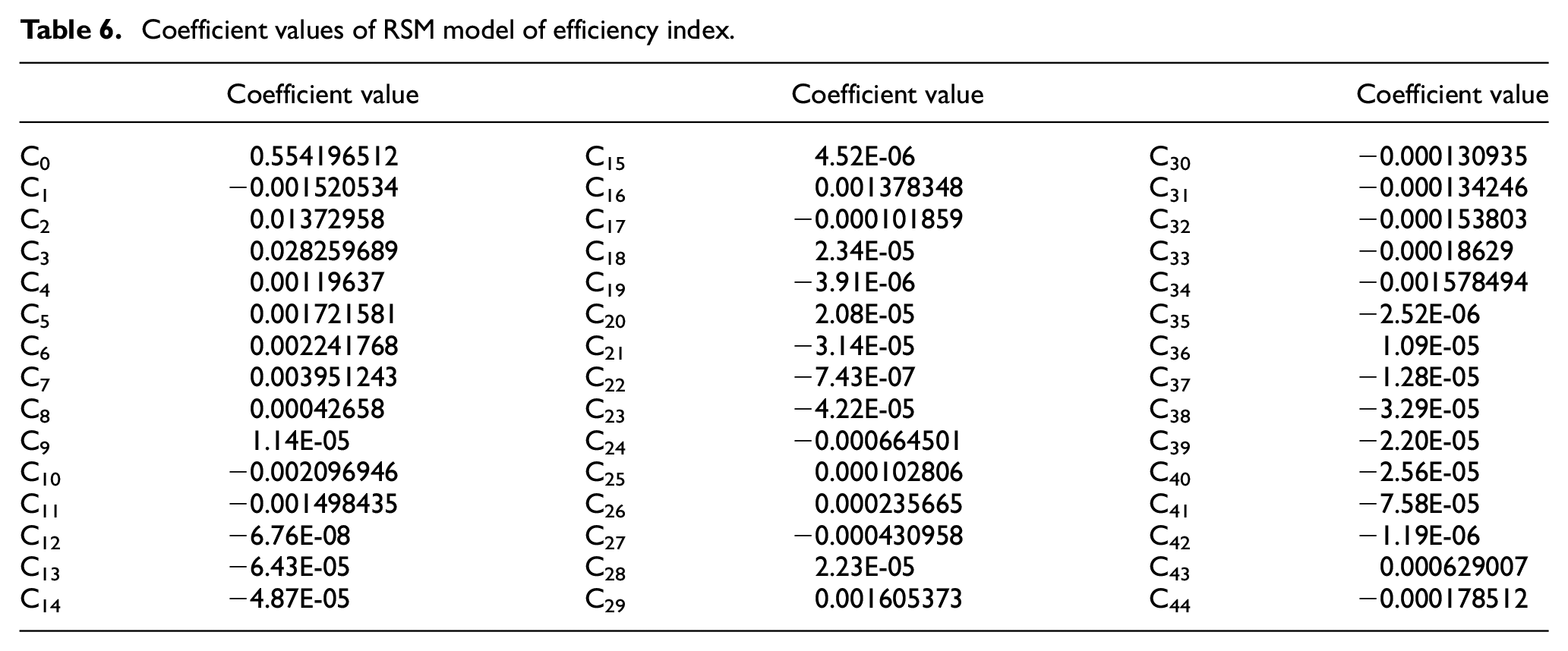
In the present work, the RSM model is performed based on the numerical sets generated by the OLHS method. In ISIGHT software, with design variables as input, pump efficiency, and head as response, the RSM approximation model was established between the objective function and design variables. The regression equation of the pump efficiency and pump head obtained by the RSM is given in equation (6).
where X1∼X8 represent φ, T1, T2, β1, β2, R1, R2, Z, respectively. In the formula, C0∼C44 are the coefficients of the equation, which is attached in Tables 6 and 7.
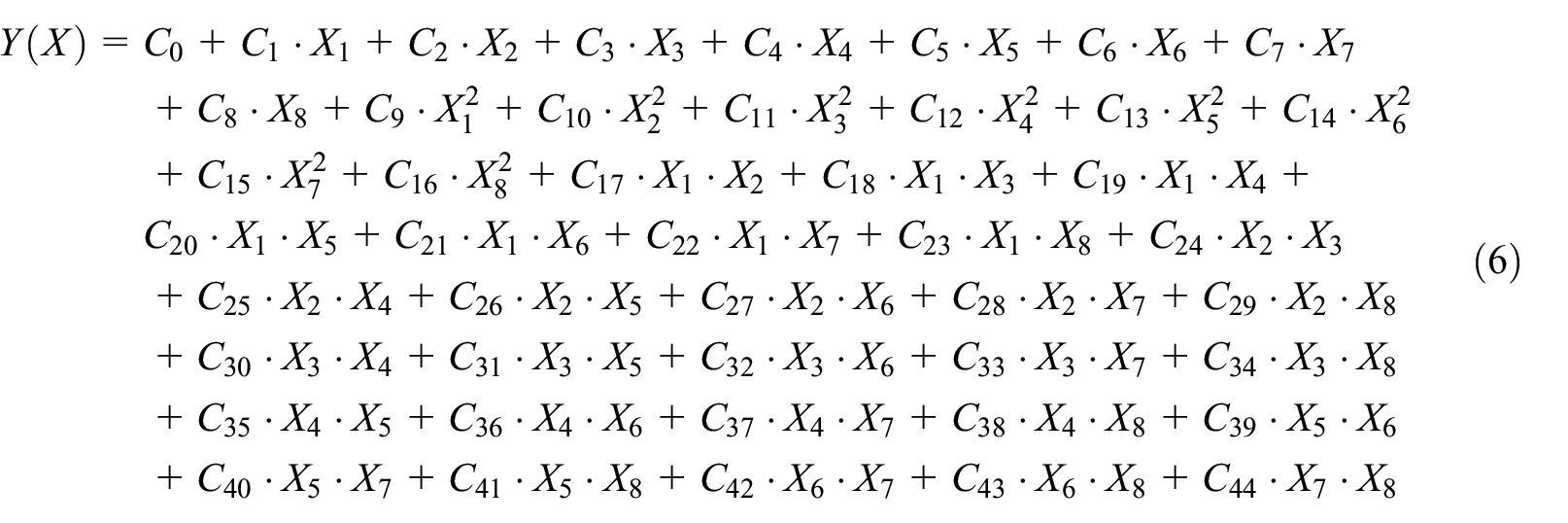
Coefficient values of RSM model of efficiency index.
Coefficient values of RSM model of head index.

Assessing the accuracy of the approximate model is very necessary before conducting the optimization with MIGA. The R-square error is used to analyze the deviation between the results of the numerical simulation and those predicted by the RSM approximate model. The closer the R-square value is to 1, the higher the model reliability is. Fifteen sample points were randomly selected for R-square error analysis, as shown in Figure 8. It can be seen that R-square value of efficiency and head are greater than the acceptable level of 0.9, 14 which indicates that the RSM approximate model has faithful prediction accuracy. Therefore, the established approximate model can be used for the hydraulic optimization of the high-speed magnetic drive pump.

Prediction accuracy of surrogate model: (a) efficiency and (b) head.
The MIGA was used to optimize the approximate model and obtain the optimal impeller parameters. In the ISIGHT software, some parameters of the MIGA were set as follows: the sub-population size was 50, the number of islands was 10, the number of generations was 20, the rate of crossover was 0.9, the rate of mutation was 0.01, and rate of migration was 0.01. The optimal design scheme was obtained through 10,000 steps of iteration. The geometric parameters of the optimal and prototype impeller are listed in Table 8. Compared with the prototype impeller, the wrap angle φ of the optimal impeller model is increased by nearly 20°, and the blade outlet angle β2 decreased by about 4°, and other parameters changed slightly.
Comparison of impeller parameters.

Comparison of the pump performance
Numerical simulation of the optimal impeller model under different flow rates was carried out, and the performance curve of the pump was obtained. The performance comparison between the optimal impeller and the prototype impeller is demonstrated in Figure 9. At each flow rate, the hydraulic efficiency the optimal impeller is obviously higher than those of the prototype impeller, while the pump head changes slightly. The hydraulic efficiency and pump head of two impeller models at 1.0 Qd and 1.2 Qd are listed in Table 9. The results indicate that hydraulic efficiency is significantly improved through optimization. The hydraulic efficiency of the optimal impeller is 6.23% and 4.44% higher than that of the prototype impeller at 1.0 Qd and 1.2 Qd, respectively. In addition, by comparing the predicted results and CFD simulation results of the optimal impeller at 1.2 Qd, the deviations of hydraulic efficiency and pump head are 2.06% and 0.3%, respectively. It is indicated that RSM approximate model can accurately predict pump performance.
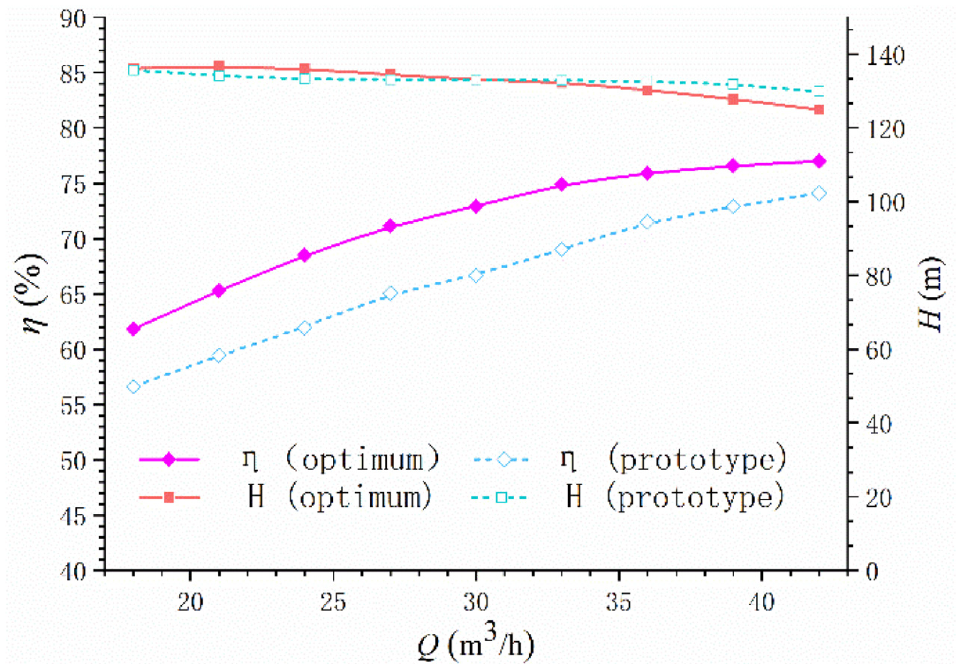
Performance of prototype and optimal impeller.
Comparison of optimization results.

The losses in the pump include leakage, disk friction, hydraulic losses in impeller and volute, and mechanical loss. This paper only optimized the impeller without changing the volute and the magnetic coupling. Compared with the prototype impeller, the optimized impeller only changed the blade shape, the profile of hub and shroud, and did not change the impeller diameter. The changes of leakage, disk friction and mechanical losses in the pump can be ignored. Through the optimization of the impeller, the hydraulic loss in the pump is reduced and the hydraulic efficiency of the pump is improved.
Comparison of the flow field
The internal flow fields of the prototype pump and the optimal pump under different flow conditions are compared and analyzed. The pressure distribution at mid-span of the two impellers is shown in Figure 10. For the two impeller models, there is a negative pressure region at the impeller inlet under different flow rates. The static pressure gradually increases from the impeller inlet to the volute outlet. The pressure in the optimal pump is significantly higher than that of the prototype pump at 0.7 Qd. The pressure in the two pumps is basically the same at 1.0 Qd and 1.2 Qd.
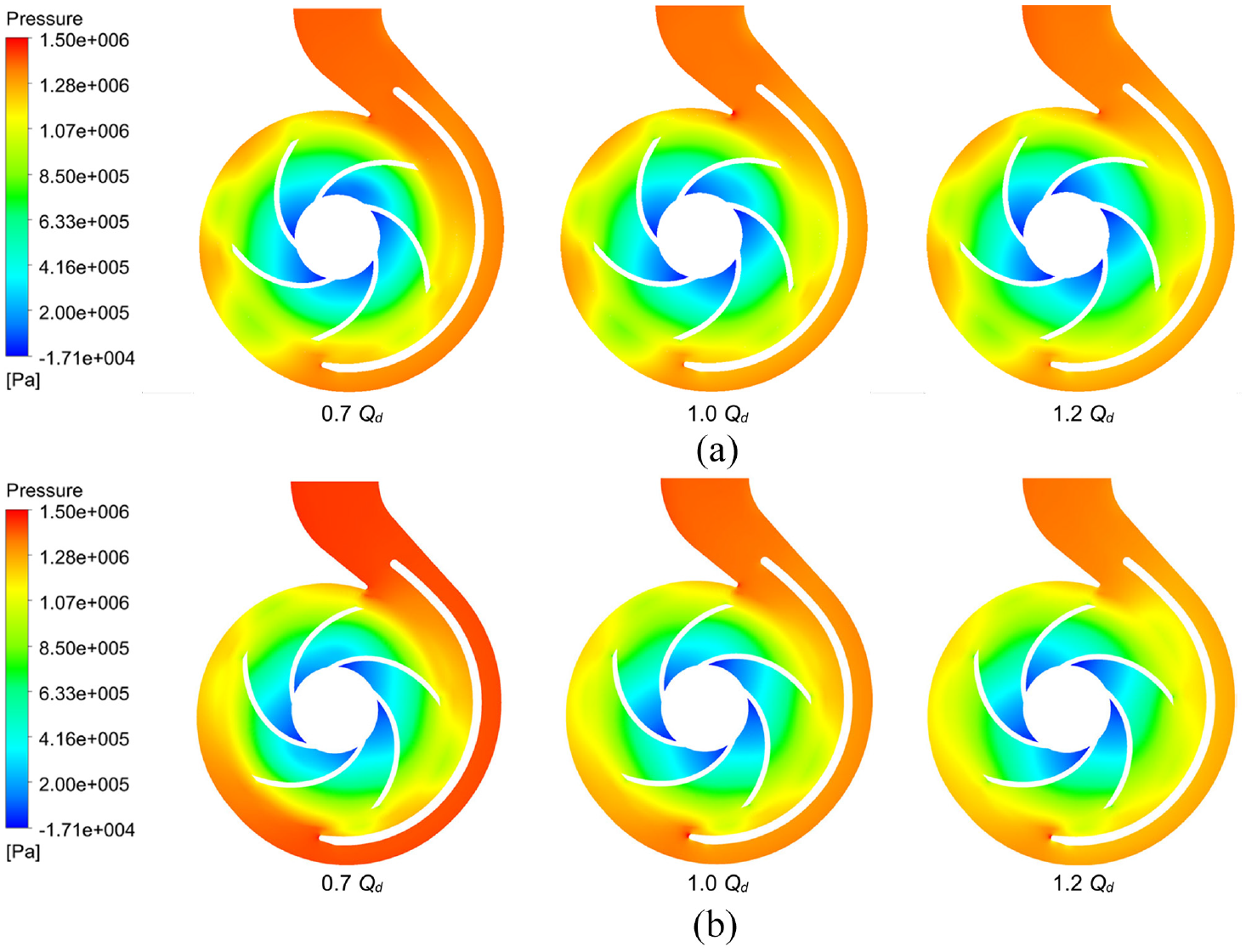
Pressure distribution of pump: (a) prototype impeller and (b) optimal impeller.
The streamlines at the mid-span of the optimal and the prototype impeller under various flow rates are illustrated in Figure 11. For the two impeller models, the streamlines in the pump are smooth, and the flow condition is good at 1.2 Qd. However, several vortexes exist in the blade channel near the tongue due to rotor-stator interaction at 1.0 Qd and 0.7 Qd, especially in the low flow rate. The flow condition of the optimal impeller is better than that of the prototype impeller. The flow field of optimal impeller at 0.7 Qd is significantly worse than that of 1.0 Qd and 1.2 Qd. This may be owing to the maximum efficiency of 1.2 Qd is considered as the optimization objective in this paper, which makes the best efficiency point of the optimal impeller shift to the large flow rate and cannot guarantee the efficiency of the low flow rate.

Streamline of the pump: (a) prototype impeller and (b) optimal impeller.
Conclusions
In this study, a set of impeller samples of the high-speed magnetic drive pump were designed based on the OLHS method. Through steady-state numerical simulation of impeller samples, the hydraulic efficiency and head at 1.2 Qd were obtained. The surrogate models were constructed for the objective functions based on the numerical results. The MIGA was hired to optimize the impeller. The conclusions are as follows:
The RSM approximate model between the objective function and the design variables was established. The deviations of hydraulic efficiency and pump head between the predicted and the numerical simulation results at 1.2 Qd were 2.06% and 0.3%, respectively.
The hydraulic efficiency of the optimal impeller under rated flow rate was 72.89%, which was 6.23% higher than that of prototype impeller.
The streamline distribution in the optimized impeller was smooth, and the internal flow was improved under the design condition.
In the current work, eight design variables are selected to optimize the impeller without considering the blade width. In the future work, the parameters which have a significant impact on the pump efficiency should be considered as variables to optimize the impeller, and the geometric parameters of the volute should be optimized to further improve the pump efficiency. In addition, the performance under design flow rate shall be considered as the objective function. Further, the number of samples can be appropriately reduced to shorten the optimization cycle.
Footnotes
Appendix
Handling Editor: Chenhui Liang
Declaration of conflicting interests
The author(s) declared no potential conflicts of interest with respect to the research, authorship, and/or publication of this article.
Funding
The author(s) disclosed receipt of the following financial support for the research, authorship, and/or publication of this article: This work is supported by National Natural Science Foundation of China (No. 51806082) and Jiangsu Province’s Key Research and Development Program of China (No. BE2018085), the authors express their gratitude for their support.
