



Abstract
Different volume concentrations (1.2, 0.6, 0.3 wt%) of Fe3O4/water nanofluids and for different Reynolds number (Re) varying from 2180 to 9160 were used experimentally. The aim of work is to study the effect of applying various magnetic field intensity 15.1, 30.3, 45.5 mT on heat transfer enhancement in a horizontal pipe heated with constant heating flux of 420 W. Results showed that Nusselt number (Nu) increases with increasing Re for the nanofluids and water regardless the presence or absence of the magnetic field. Also, higher values were obtained than water. The average increase in Nu for Fe3O4-nanofluids is 16.7% relative to water when the magnetic field is not applied. However, the average increase in heat transfer coefficient and Nusselt number are 9.4%, 26.1%, 31.3% and 8.8%, 13.1%, and 23.9% in the presence of magnetic field
Introduction
Nanofluids are a mixture of base fluid and nanoparticles, commonly, less than 100 nm in size. Nanofluids are a new class of nanomaterials that offer significant advantages of superior thermophysical properties with higher values of base numbers (Nusselt, Prandtl, Darcy) when compared to base fluids. Due to high thermal conductivity, nanofluids can be used in many engineering applications, for example, automotive sector, medical devices, and electronic devices
Experimental work of the effect of magnetic field on the heat transfer enhancement using nanofluids was carried out by several researchers. Among them, the work done by Nakharintr and Naphon 1 in which they studied the effect of applying nanofluids single jet on a mini-channel heat sink under the application of magnetic field on heat transfer characteristics. It was found that Nu increased with the application of magnetic field, furthermore, and at higher values of magnetic field strength. Naphon and Wiriyasart 2 investigated experimentally the combined effect of pulsating flow and magnetic field on the heat transfer and flow characteristics in the micro-fins heated tube at temperature 20°C and heating flux (120–160 W) using nanofluids. Different values of Re (1000–2400) and nanofluids concentrations of 0.25% and 0.50% by volume were used in the experimental work. Results showed that Nu increases under the application of magnetic field and pulsating flow by a value of 6.23% higher than those without magnetic field effect. Also, Nu increases with higher values of magnetic field strength and nanofluids concentration, respectively. Karmi et al. 3 investigated the effect of particle volume fraction, temperature, and magnetic field strength on the thermal conductivity of hematite (Fe2O3) and magnetite (Fe3O4) water based nanofluids. Volume concentration range between 0% and 4.8% and the temperature range of 20°C–60°C were used. It was found that thermal conductivity is inversely proportional with temperature in the presence of magnetic field. Also, Fe3O4 nanofluids showed higher values of thermal conductivity than Fe2O3 nanofluids. Furthermore, a relationship between thermal conductivity of iron oxide magnetic nanofluids and volume fraction, temperature, and magnetic field strength was developed. Huminic et al. 4 investigated experimentally the effects of temperature (20°C–70°C range), weight concentration (0.5, 1.0, 2.0, and 4.0 wt% range) on thermal conductivity of iron oxide/water nanofluids. Results showed that nanofluids have high values of thermal conductivity at higher values of volume concentration and temperature, respectively compared with base fluid.
Numerical analysis research papers on heat transfer enhancement using nanofluids under the application of magnetic field were found in the open literature. Soltnipour et al. 5 numerical work was to investigate the influence of applying different circumferential angles of magnetic field on heat transfer enhancement in a curved pipe. It was found that at low magnetic numbers, the optimal circumferential location of the magnetic source is ϕopt = 180° which leads to the maximum heat transfer enhancement, and for high magnetic numbers, the optimal operating condition occurs at ϕ = 0 and ϕ = 60° depending on the magnetic number. Singh et al. 6 investigation of ferrofluid flow through a mini-channel in the presence of both constant and alternating magnetic field led to an increase of 17.41% in heat transfer. More work by Singh et al. 7 was carried out but on different application in which they worked on developing a ferrofluid based heat exchanger for PVT systems. Similar results were obtained. Bezaatpour and Goharkhah 8 numerical investigation showed that Nusselt number increased with the increase of volume fraction and magnetic field strength when they used iron oxide/water nanofluids in the heat sink with the presence
Of magnetic field, Selimefendigil et al. 9 studied numerically the effects of volume concentration, Reynolds number, magnetic field strength, and inclination angle on forced convection of nanofluids flow in a branching channel. Results obtained showed that Nusselt number increased with the increase of volume concentration and magnetic field strength. More numerical work by Hajiyan et al. 10 and found that heat transfer is enhanced with the presence of magnetic field when magnetic nanofluids was inside a square enclosure. Vafeas et al. 11 studied the effects of applying different magnetic field and volume concentration, respectively on a laminar flow in a different curved cylindrical annular duct. They found that the velocity of the flow increased with the increase of magnetic field and volume concentration. Mousavi et al. 12 investigation revealed that Nusselt number increased by about 40% with the increase of applied magnetic field strength in a helical tube. Hekmat and Ziarati 13 studied the effect of constant and alternating magnetic flux density on heat transfer enhancement in mini/micro thermal systems using ferrofluids flow of constant Reynolds number (Re = 66). Results showed a considerable increase in heat transfer at higher values of both constant and alternating magnetic field. Selimefendigil and Öztop 14 used Galerkin weighted residual finite element method to investigate natural convection of nanofluid in an inclined cavity including a curved shaped conductive partition under the impact of inclined magnetic field. Several parameters were used in this investigation such as Rayleigh number inclination angle of the cavity, Hartmann number, angle of the magnetic field, curvatures of the conductive partition, conductivity ratio, and volume fraction. Results showed that Nusselt number increased with the increase of Rayleigh number, volume fraction whereas it was reduced with higher values of Hartmann number. Also, a decrease in Nusselt number was observed when the radii of the vertical and horizontal elliptic curved partitions were increased. Siddiqui and Sheikholeslami 15 used a TiO2-water based nanofluid flow in a channel bounded by two porous plates to investigate analytically the effect of an oblique magnetic field. They found that by increasing volume fraction of the TiO2 nanoparticles, magnetic field intensity and angle, the fluid speed decreases, and the temperature increases, respectively. Temperature increase means that heat transfer increases and Nusselt number enhanced. Fadaei et al. 16 investigated the effects of magnetic field intensity, and the type of magnetic field source (i.e. a permanent magnet or current-carrying wire) on the forced-convection heat transfer of magnetic nanofluids in a constant heated pipe. It was found that by applying the magnetic field, Nusselt number increased, and it increased by 196% under the application of permanent magnetic field of 3 × 10⁵ A/m for each one. Al Kalbani et al. 17 used different types of nanofluids in a square enclosure under the application of magnetic field to study numerically the heat transfer and fluid flow of natural convection. It was found that heat transfer is enhanced with the increase the concentration of volume fraction of nanofluids. However, a reduction in heat transfer was observed as Hartmann number decreased. Asfer et al. 18 used a ferrofluid flowing in a heated circular stainless-steel tube to investigate the presence of magnetic field ld on the convective heat transfer characteristics. Results showed that there is no enhancement in laminar convective heat transfer for ferrofluid as compared to its base fluid in the absence of magnetic field. Also, Nusselt number increased with an increase in the magnetic field gradient. This was observed when they used double-inline arrangement of magnets.
Based on the previous work in the open literature, it was concluded that most of the researcher’s work was on studying and investigating the effect of magnetic field strength on heat transfer enhancement of laminar flow nanofluids. However, experimental research studies on forced convective heat transfer with turbulent flow was in heated pipes with constant heating flux in the presence of magnetic field is scarce. Therefore, the research in this paper has been carried out using magnetite
Proposed experimental setup
Experimental rig
The proposed experimental rig setup is depicted in Figure 1. As shown, the experimental system consists of test section (insulated copper pipe), centrifugal pump, pipe lines, air coolant heat exchanger, storage tank with stirrer, electromagnet, data acquisition system, and personal computer. The storage tank of 15 L capacity is made of glass to store the Fe3O4 nanofluid mixture and is constantly stirred during experiment time so that all points in the tank becomes equal in temperature. Moreover, the used mixer ensures nanofluid stability during the test. The air cooled heat exchanger is used to keep the Fe3O4 nanofluid at the inlet test section at constant temperature. The Fe3O4 nanofluid is forced through the test section with an aid of a circulating centrifugal pump of 0.5 Hp through a flow meter of 10–80 L/min range capacity. The suction side of the copper pipe is connected to a storage tank. The flow rate of the Fe3O4 nanofluid is controlled with a bypass valve arrangement, and the required quantity of fluid is allowed into the test section through a flow meter as shown in Figure 2. The test section is a straight copper pipe of the inner diameter of 1.1 cm, outer diameter 1.27 cm, and length 120 cm. The copper pipe is heated uniformly by chrome heater of 20 mm gauge diameter and 420 W rating power so that the entire test section is subjected to constant heat flux boundary condition. The test section is insulated with rock wool insulation of thermal conductivity 0.040 W/m2 K, thickness 4 cm, and density 12 kg/m3 in order to minimize the heat loss from the test section to the surrounding. The hydrodynamic entry section is long enough to accomplish a fully developed flow at the entrance of the heat transfer test section. Two K-type thermocouples were mounted on the surface of the pipe at the inlet and outlet surfaces to measure the surface temperatures of the pipe and two K-type thermocouples were located at the inlet and exit of the test section to measure the working fluid (Fe3O4 nanofluid) inlet and outlet temperatures as shown in Figure 2. The K-type thermocouples are calibrated before fixing them at the specified locations. U-tube manometer with mercury as manometer liquid is provided for measuring the pressure drop across the test section. Electro-magnetic field is applied perpendicular to the flow direction near the inlet testing section and can be changed by altering the AC current supply to the magnet measured by a digital multimeter. Three values of magnetic field (15.1, 30.3, 45.35 mT) were used. These values were selected based on the work by Goharkkhah et al. 19

Experimental test rig.

Schematic diagram of the test rig.
Preparation of Fe3O4/water nanofluids
For a synthesis of nanoscale Fe3O4, 8 g of ferrous chloride tetrahydrate (FeCl2.4H2O) in 150 mL of acidic deoxygenated distilled water and 16 g of ferric chloride hexahydrate (FeCl3.6H2O) in 200 mL acidic deoxygenated distilled water were dissolved separately. The Ferrous chloride solution has been added gradually to the ferric chloride solution in a flask reactor with three open necks under vigorous stirring and in presence of N2 gas at 70°C conditions as shown in Figure 3. After stirring for 30 min, black nanoparticles start precipitation. The stirring process was continued for two hours to reach solution pH = 9 using NH4OH. The precipitates were separated by filter paper and washed several times with distilled water and ethanol until pH is neutral. Finally, the obtained magnetite nanoparticles were dissolved in 1 L volume of distilled water used as the base fluid. The nanofluid was dispersed using an ultrasonic processor (UP 200S, Hielscher Company, Germany) at 100% amplitude and 0.5 cycles for 15 min. In addition, the pH of nanofluid was adjusted at 9 pH value using NH4OH. This procedure was repeated 10 times in order to prepare 10 L ferro-nanofluid. Moreover, ethanol was used as a surfactant. The authors ensured adequate dispersion of the magnetite nanoparticles in water by monitoring the magnetite nano-fluid stability on the shelf. It was stable for several days due to the strong repulsive forces between the nanoparticles. Three volume fraction 1.2%, 0.6%, 0.3% were prepared using the procedure above.
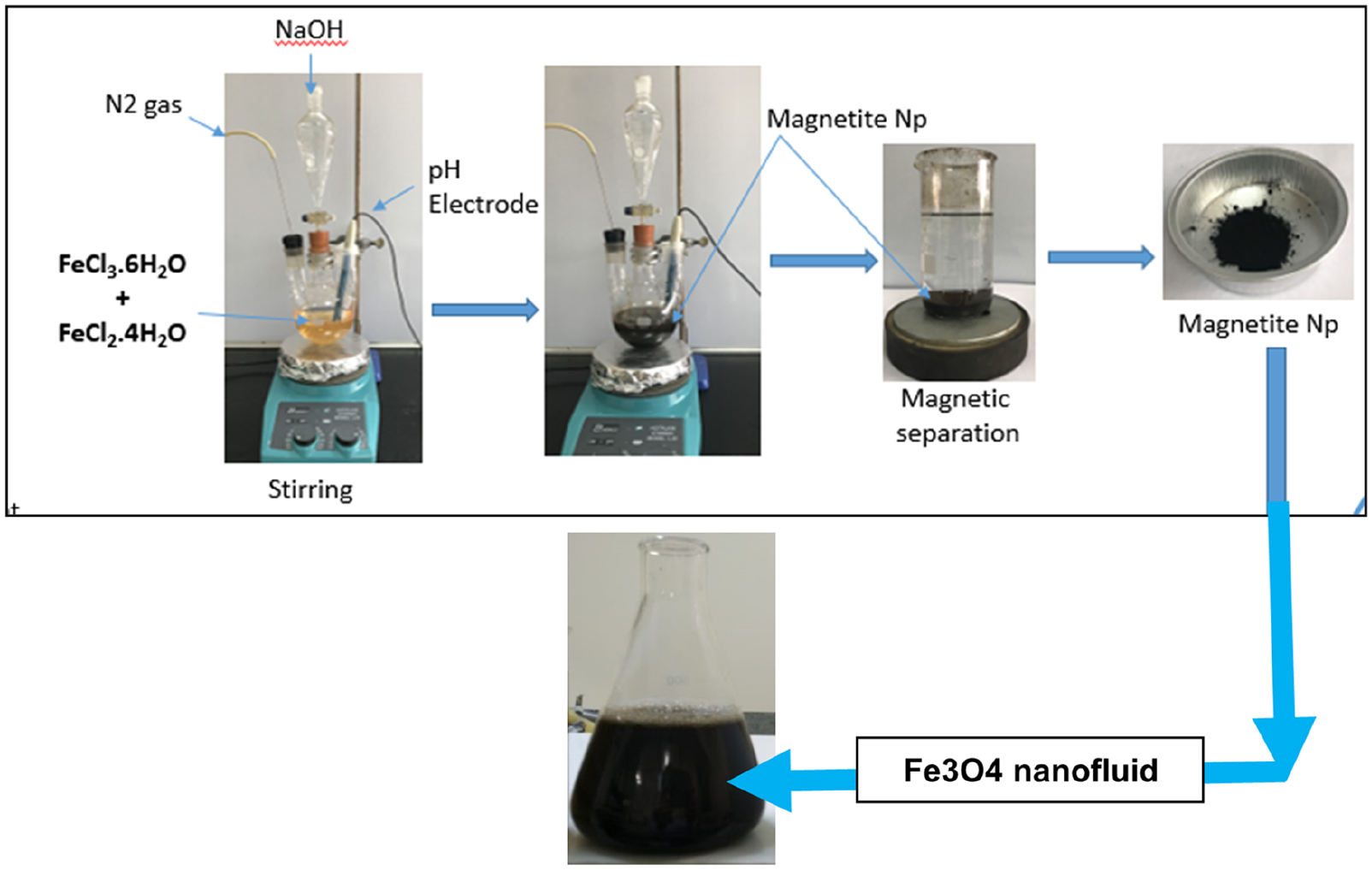
Fe3O4 nanofluid preparation.
The samples were analyzed for physical properties (particle size distribution and morphology). Analytical analysis was performed included X-ray diffraction (XRD) using Cu Kα radiation source by Shimadzu X-ray diffractometer (XRD-6000). Scanning Electron Microscope (SEM) images were captured using (SEM, FEI company – Inspect F50/FEG (Schottky Field Gun) high vacuum (6e−4 Pa Everhart-Thornley SE detector Solid-State BSED)). Also, viscosity was determined via (Brookfield Viscometer, USA), as well as nanofluid density measured using pycnometric method. Results of nano-magnetite XRD showed that the XRD pattern revealed that the produced nanopowder is magnetite as shown in Figure 4. Six typical peaks at 30°, 35.4°, 43.3°, 53.7°, 57°, 63° were matched with the following crystal faces of pure magnetite (220), (311), (400), (422), (511), and (440), respectively. Based on Scherrer equation, the mean particles size was equal (10.3 nm).
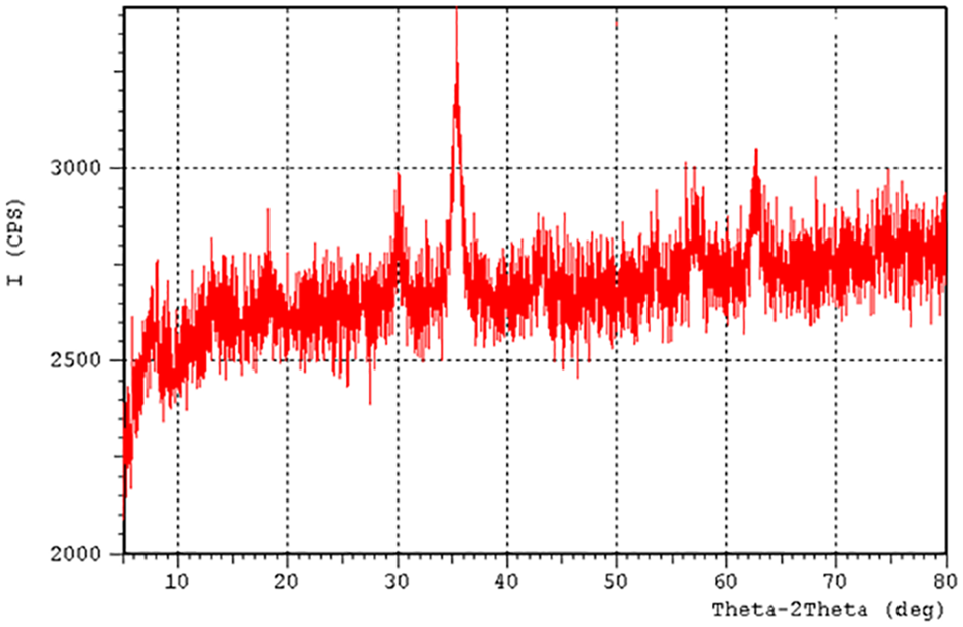
XRD patterns of Fe3O4, six characteristic peaks at 30°, 35.4°, 43.3°, 53.7°, 57°, 63°.
Based on Alexander and Klug, 20 the crystallite size can be computed as:

where:
K is a constant commonly equal to 0.9, λ is the X-ray wavelength 1.5418 A°.
β is the width at half the maximum intensity, in radians = 0.8131 × π/180.
θ is the Bragg angle (in degrees) = 35.4/2 = 17.7.
The mean particles size L can be computed and equal to 10.3 nm. The Scanning electron microscope (SEM) image as shown in Figure 5 revealed that the magnetite powder particle size is within the nano range around 10nm with spherical shape.

Scanning electron microscope (SEM) image of nano-magnetite at 16,000 × magnification.
Theory of work
Heat transfer governing equation
Convective heat transfer coefficient of fluid
The specific constant heating flux

Where:
The convective heat transfer by coolant is given as:

Where
The convective heat transfer coefficient along the heating section of the pipe is given by:

Where
Combining (2), (3), (4) to give an expression for convective heat transfer coefficient

Nusselt number
Nusselt number is given by 21 as follows:

Where
Thermal performance factor
Thermal performance factor (TPF) which represents the ratio of the relative effect of change in heat transfer rate represented by Nusselt number to change in friction factor. It is defined in equation (7) 22

Where, subscripts nf and bf represent nanofluid and base fluid, respectively
Governing equations of nanofluid properties
Volume fraction of nano particles
The volume fraction of nanofluid is expressed as:


Where
Effective thermal conductivity of nanofluid
Based on effective medium theory EMT, randomly dispersed, and uniformly sized spherical particles, Das et al, 23 reported that Maxwell investigated the conduction analytically through a suspension particle and showed that the effective thermal conductivity of nanofluid can be calculated as:

Where,
Density of nanofluid
The density of a nanofluid is based on the classical theory of two-phase mixture given in Deiss et al., 24 Behzadmehr et al. 25

Where
Specific heat capacity of nanofluid
The following equation is proposed for determining specific heat capacity of nanofluid and assessing heat transfer performance of nanofluids26,27

Where,
Dynamic viscosity of nanofluid
The dynamic viscosity of nanofluid can be computed as follows:

Where,
Governing equations of fluid flow
Mean velocity
The mean velocity of nanofluid can be computed as follows:

Where
Reynolds number
Reynolds number is calculated based on pipe diameter as follows:

Where
Pressure drop differential
Pressure drop in the pipe can be determined as follows:

Where
Electromagnetic field strength
The electro-magnetic field strength is calculated as follows:

Where
Experimental procedure
The main objectives of this current work is to investigate experimentally heat transfer enhancement using water and Ferro-nanofluids (Fe3O4/water) in a constant heated pipe under the application of magnetic field by varying the following parameters:
Flow rates ranging from 1000 to 6000 mL/min.
Different values of magnetic field strength (15.1. 30.3, 45.4 mT).
Different values of nanofluids concentration by weight (
The experiments have been conducted using various volume flow rates of water and ranging from 1000 to 4200
For each flow rate, the required measurements for all experiments are; volume flow rate considered
Water as the working fluid
The first experiment was conducted using water as the flowing fluid through a heated copper pipe under constant heat flux of 420 W. Enough time was given to the system to reach the steady state conditions. Different flow rates (1000, 2000, 3000, 3800, 4200
Fe3O4 ferro-nanofluid of concentration (0.3, 0.6, and 0.3 wt%) as the working fluid
Applying the same procedure as in Section 4.1, several experiments were carried out using Fe3O4 nanofluid without the presence of magnetic field, and in the presence of different magnetic field intensity (15.1, 30.3, 45.5 mT), respectively. Same measurements were recorded as in Section 4.1 were recorded.
Results and discussions
Properties of Fe3O4 nanofluids
In order to determine the properties of Fe3O4 nanofluids used in the experimental work, the volume concentration of nanoparticles
Properties of Fe3O4 nanofluid of concentrations by weight

Fluid flow and heat transfer characteristics determination of water and Fe3O4 nanofluids
In order to determine the fluid flow properties of water and Fe3O4 nanofluids in the studied range of fluid flow rates, volume concentration by weight wt%, the fluid velocity
Pressure drop characteristics
Effect of magnetic field strength on pressure drop
Pressure drop is an important parameter to consider in the application of nanofluids in a heat exchanging equipment. Figure 6(a) and (b) illustrates the variation of pressure drop as a function of Reynolds number for water and for Fe3O4 nanofluids in the absence and presence of magnetic field strengths

(a) Variation of pressure drop with Reynolds number for various magnetic field strength
Effect of Fe3O4 nanofluid concentration on pressure drop
To show clearly the effect of Fe3O4 nanofluid concentrations (0.3, 0.6, 1.2 wt%) on pressure drop, Figure 7 is plotted as a function of Reynolds number at a specified magnetic field strength

Variation of pressure drop with Reynolds number for various Fe3O4 nanofluid concentrations (0.3, 0.6, 1.2 wt%) at a specified
Heat transfer characteristics
Heat transfer coefficient characteristics
Effect of magnetic field strength on heat transfer coefficient
Figure 8(a) to (c) show the variation of heat transfer coefficient with Reynolds number for water and Fe3O4 nanofluids at magnetic field strength

(a) Variation of heat transfer coefficient with Reynolds number different magnetic field strength
Effect of Fe3O4 nanofluid concentration on heat transfer coefficient
Figure 9(a) to (d) are plotted to show the variation of Nusselt number with Reynolds number for different concentration by weight (0.3, 0.6, 1.2 wt%) at a specified magnetic field strength. Similar trends are noticed and it can be seen that heat transfer coefficient enhanced with increasing Reynolds number and Fe3O4 nanofluid concentration. A similar trend was observed in nanofluids by other researchers. 37 Due to the mixing effect of particles near the wall, Brownian motion, particle migration, re-arrangement of the particles, and reduction of boundary layer thickness, the enhancement of heat transfer coefficient is obtained. It is noticed that large rise of heat transfer coefficient for all concentration of ferrofluids compared to water.

(a) Variation of heat transfer coefficient with Reynolds number for Fe3O4 nanofluids concentration by weight (0.3, 0.6, 1.2 wt%) at a specified magnetic field strength
Nusselt number characteristics
Effect of magnetic field strength on Nusselt number
To order to study the effect of magnetic field strength variation

(a) Variation of Nusselt number with Reynolds number for different magnetic field strength
This is may be due to the chain-like structures formed in applied magnetic fields, which caused the convective heat transfer coefficient increased, and consequently Nusselt number Nu. In the presence of applied magnetic field, magnetic moments had the tendency to align with the applied magnetic field. When the magnetic force rather than the thermal motion exerted a major influence on magnetic nanoparticles. the nanoparticles adhered together and formed chains oriented along the direction of the applied field. Thus, the chains connected the nanofluids flow and the pipe wall acting as thermal passages which leads to an enhancement in heat transfer.
38
The average Nusselt number enhancement of 8.8%, 13.1%, and 23.9% is obtained in the presence of magnetic field strength
Effect of Fe3O4 nanofluid concentration on Nusselt number
To study the effect of Fe3O4 Nano-fluids concentration by weight (0.3, 0.6, 1.2 wt%) on Nusselt Number at different Reynolds Number at a specified magnetic field strength

(a) Variation of Nusselt number with Reynolds number for Fe3O4 nanofluids concentration by weight (0.3, 0.6, 1.2 wt%) at magnetic field strength
Thermal performance factor characteristics
The combined effect of Nusselt number and friction factor is employed to assess the overall hydrothermal behavior of the nanofluids in the heated pipe using performance evaluation criterion as expressed in equation (7).
Effect of Fe3O4 nanofluids concentration on thermal performance factor
Figure 12(a) to (d) show the variation of thermal performance factor as a function of Reynolds number for various concentration of ferrofluids by weight (0.3, 0.6,1.2 wt%) at a specified magnetic field strength

(a) Performance factors for the ferrofluids at (0.3, 0.6, 1.2 wt%) in the absence of magnetic field
Effect of magnetic field strength on thermal performance factor
Figure 13 show the variation of thermal performance factor with Reynolds number for different magnetic field strength
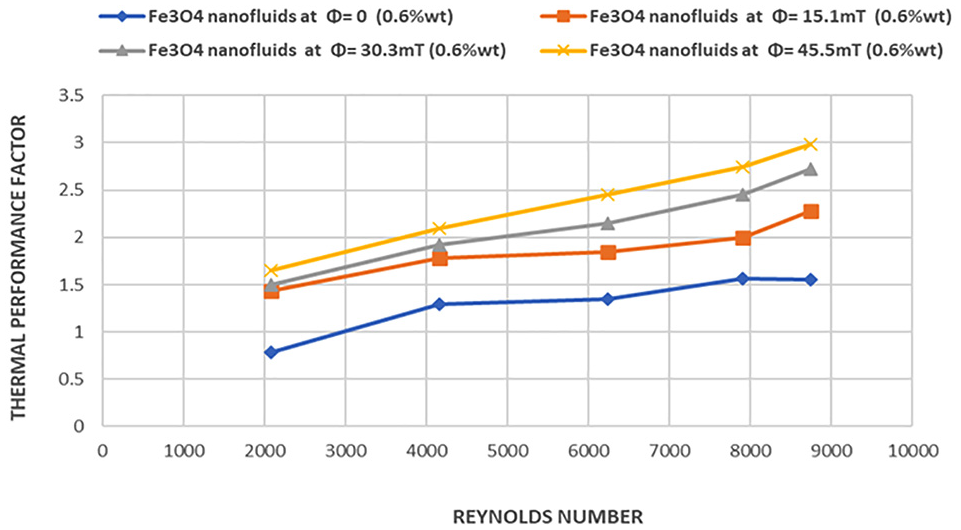
Performance factors for the ferrofluids for different magnetic field strength
Uncertainty Analysis
In order to assess the reliability of the experimental facility, the uncertainties of the experimental data are determined. The work calculation of the data uncertainties are based on the work.42–44 If x is a function of n independent variables, then the uncertainty in x, which is written as


Where
The instruments used in the experimental analysis and their accuracy are given in Table 2
Variables uncertainties based on the instruments specifications.

Based on equations (18) and (19), the maximum uncertainties of the heat flux, heat transfer coefficient, Nusselt number, Reynolds number, and pressure loss are calculated and the results are presented in Table 3
Uncertainty of physical quantities.

Conclusion
Experimental work using Fe3O4/water nanofluids to investigate the effect of magnetic field strength of turbulent flow on heat transfer enhancement, and consequently Nusselt number in a heated pipe with constant heating flux has been carried out. The experimental work used various concentration by weight (1.2, 0.6, 0.3 wt%) and various magnetic field strength
The Nusselt number was enhanced in the presence of magnetic field strength
Thermal transfer coefficient and consequently Nusselt number is effected intensively by the presence of magnetic field and increase with the increasing of magnetic field strength. The average increase in heat transfer coefficient and Nusselt number are 9.4%, 26.1%, 31.3% and 8.8%, 13.1%, and 23.9% in the presence of magnetic field
Enhancement of the heat transfer coefficient of Fe3O4/water nanofluids in the heated pipe is due to the accumulation of nanoparticles in the direction of magnetic field applied, and these accumulated nanoparticles worked as heat passages in the pipe.
Thermal transfer coefficient and consequently Nusselt number are enhanced with increasing in ferrofluid concentration. This is due to the increase in thermal conductivity of nanoparticles.
Pressure drop increases with the increase of Reynolds number for water and Fe3O4 nanofluids, respectively, which mat attributed to the increase in viscosity. Also, higher pressure drop values was noticed with the increase of magnetic field strength of Fe3O4 nanofluids.
it is found that the performance factor is above unity in the presence and absence of magnetic field strength. This means that Nusselt number enhancement is higher than friction changes, which indicates the applicability of the heated pipe in the improvement of heat transfer.
These results can be useful for enhancing heat transfer in many engineering applications such as heat exchangers, medical devices, and electronic devices.
Footnotes
Appendix
Acknowledgements
The authors would like to express their gratitude and appreciation to Philadelphia University, the Deanship of Academic Research and Graduate Studies, and to the Mechanical Engineering Department for their continuous support. Also, would like to extend their deepest thanks to the Royal Scientific Society (RSS) for their assistance and support throughout the project.
Handling Editor: Chenhui Liang
Declaration of conflicting interests
The author(s) declared no potential conflicts of interest with respect to the research, authorship, and/or publication of this article.
Funding
The author(s) received no financial support for the research, authorship, and/or publication of this article.
