




Abstract
The theme of this paper is to scrutinize hydromagnetic flow of Jeffrey fluid subject to stretched curved sheet. Heat expression is developed through dissipation, magnetic force and radiation. Entropy generation is also studied. First order isothermal reaction is examined. Nonlinear ordinary differential systems are found through adequate transformation. Here we have used the ND-based numerical solution method to develop numerical results. Impact of sundry variables on temperature, fluid flow, concentration and entropy rate are discussed. Performance of skin friction and heat transport rate via flow parameters are graphically studied. An increase in curvature variables lead to improve velocity and thermal field. Higher approximation of radiation enhances temperature. An intensification in drag force is seen versus Deborah number. Larger approximation of Brinkman number boosts up entropy analysis.
Introduction
Flow due to stretched surface is significant in fiber spinning, glass fiber, rubber sheet, nuclear reactor, fission reactions, glass blowing, paper production, hybrid-powered engines, annealing of copper wires, cooling of large metallic plates, micro-manufacturing and many others. Thermal and solutal transportation phenomena subject to stretched surface with suction and injection effects are investigated by Gupta and Gupta. 1 Khan et al. 2 reported the hydrothermal effect of nanomaterials toward a stretching surface with thermal transport rate. Thermal transfer analysis in magnetized viscoelastic fluid with variable heat source/sink over a stretched sheet is demonstrated by Abel and Nandeppanavar. 3 Lok et al. 4 analyzed the non-orthogonal flow subject to stretchable medium. Bao and Yang 5 analyzed the bifurcation of the wrap flow in a generalized manner. Melting and activation energy analyses for viscoelastic bioconvective nanofluids toward a stretchable surface with random and thermophoretic motion is illustrated by Khan and Alzahrani. 6 Thermal transfer analysis for time-dependent viscous fluid flow subject to stretching permeable cylinder is inspected by Si et al. 7 Mustafa et al. 8 examined a mathematical model for two-dimensional steady and incompressible nanomaterials flow. Some studies regarding stretched medium are presented in Refs.9–24
Non-Newtonian liquids are to be more efficient than Newtonian liquids. Non-Newtonian liquids are those fluid which hold Newton law viscosity in nonlinear way. Exotic lubricants, paints, oils, clay coating, cosmetics and shampoos are examples of non-Newtonian liquids. Because of their applications in industry, engineering, physiology, and biosciences, non-Newtonian fluids have gained considerable attention. Hayat et al. 25 investigated the MHD Jeffrey liquid flow in the presence of a radially growing surface. Thermal and solutal transport analyses for Jeffery liquid due to a stretchable sheet is explained by Shehzad et al. 26 Abbasi et al. 27 analyzed the thermal influence in hydromagnetic Jeffrey nanoliquid flow with random and thermophoretic motion. Hydromagnetic peristaltic flow of Jeffrey liquid in a cylinder-shaped tube was investigated by Tripathi et al. 28 Maninaga Kumar and Kavitha 29 studied Jeffrey liquid flow between two fixed and revolving disk with suction two parallel circular disks. Farooq et al. 30 explored the features of Jeffrey liquid flow with isothermal chemical reactions. Mohd Zin et al. 31 investigated heat conduction augmentation for time-dependent Jeffrey nanomaterials flow with Lorentz force. Hayat et al. 32 analyzed the hydrothermal Jeffrey liquid flow subject to a variable stretching sheet. Few investigations regarding non-Newtonian are presented in Refs.33–37
The Objective of this research is to explore entropy rate in magnetohydromagnetic Jeffrey liquid flow over a curved stretchable surface. Heat equation is discussed in presence of dissipation, Lorentz force and radiation. Furthermore, binary reaction is discussed. Here our prime concentration is on heat and entropy analysis. Ordinary differential equations are obtained through suitable parameters. Here we used ND-solve based numerical method to develop computational results. Variation of thermal field, entropy rate, concentration and fluid flow against emerging parameters are examined. Significance performance of drag force and Nusselt number graphically analyzed. Figure 1 sketch to show the residual error. Individual residual errors with CPU time are mentioned in Table 1.
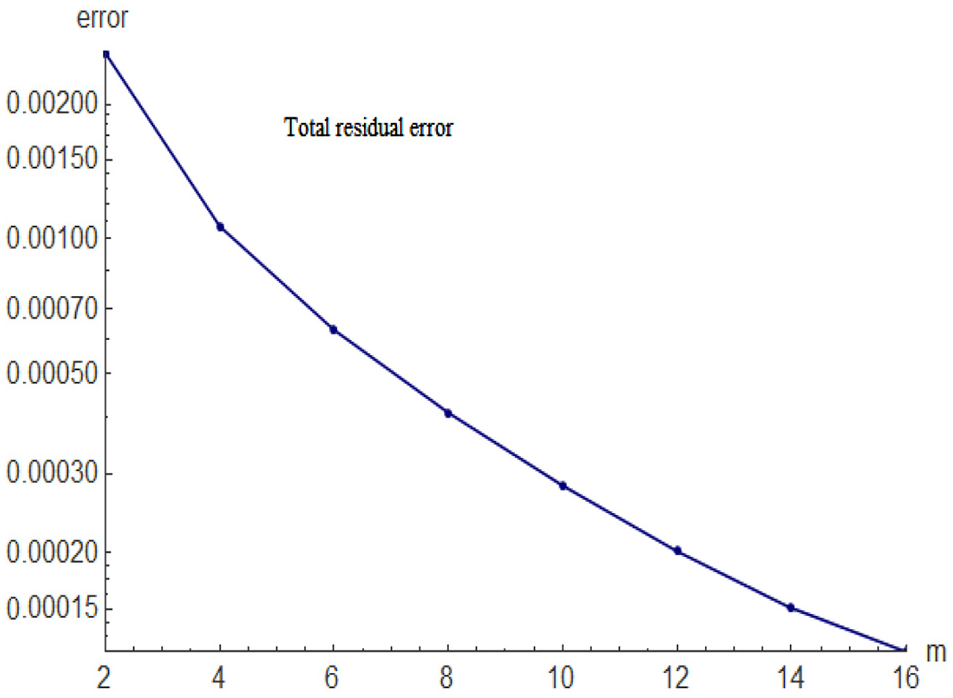
Total residual error.
Individual residual errors.

Statement
Here an incompressible magnetohydromagnetic flow of Jeffrey fluid toward a bended surface is considered. Dissipation, Lorentz force and radiation impacts are deliberated in heat equation. Isothermal chemical reaction is considered. Entropy communication is developed through thermodynamics second law. Consider stretching velocity is
Governing equations satisfy


with

Here

Here (
By using the concept of boundary layer, we have


with
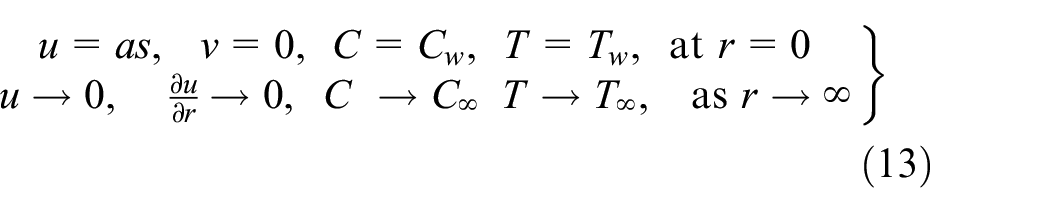
Letting

We get



with

In which
By avoiding the pressure from equations (13) and (14) we get

Engineering quantities
The velocity and temperature gradient are defined as

with

One can found


Entropy generation
It is expressed as

We have

In above expression
Figure 1 sketch to show the residual error.
Individual residual errors with CPU time are mentioned in Table 1.
Graphical results
Effect of sundry variable on temperature, fluid flow, entropy rate and concentration are examined. Thermal transport rate and friction force are addressed.
Velocity
Impact of fluid flow versus curvature parameter is portrayed in Figure 2. An increment in velocity profile is observed for increasing the curvature parameter (



K via f′ (η).
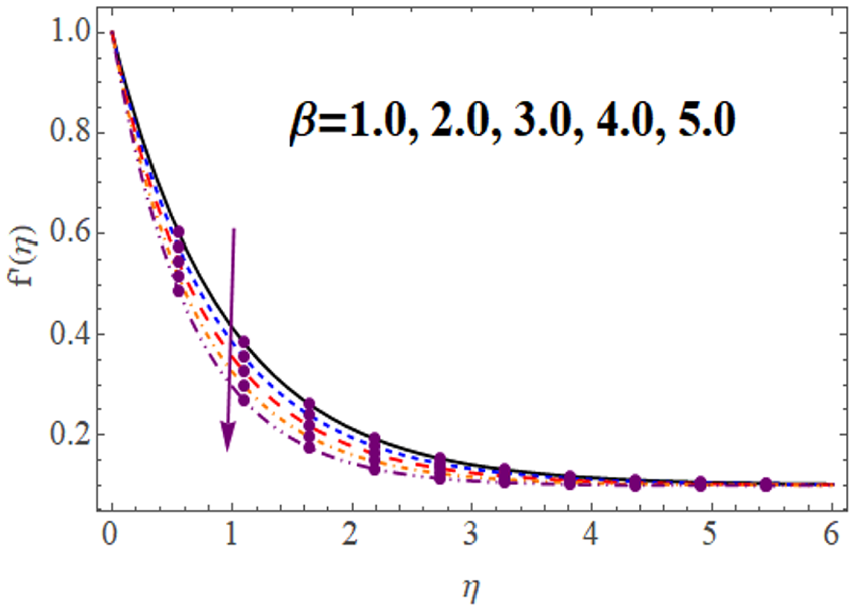
β via f′ (η).
Temperature
Influence of (

K via θ(η).

Rd via θ(η).
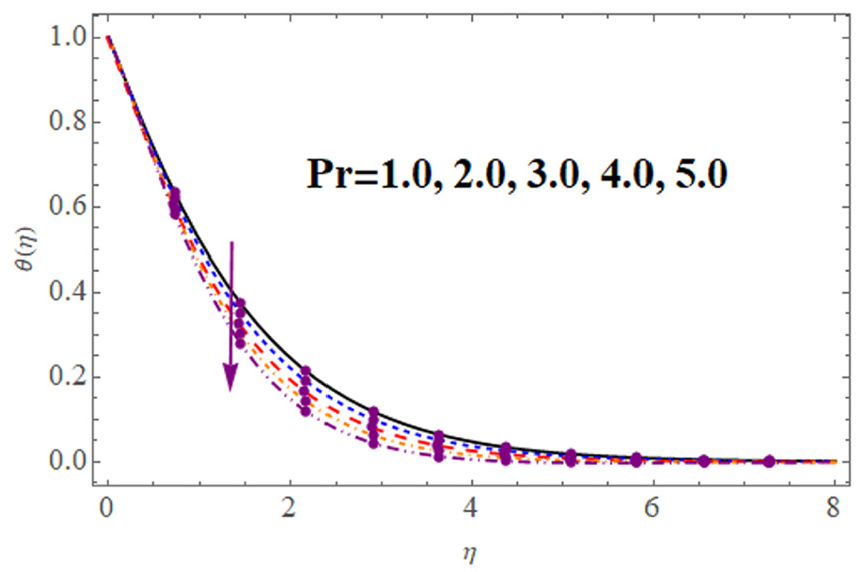
Pr via θ(η).

M via θ(η).
Concentration
Impact of concentration versus curvature parameter is shown in Figure 8. An increment in concentration is noted through increasing the curvature parameter (

ϕ(η) via K.

ϕ(η) via Sc.
Entropy generation
Figure 10 show the effect of

NG via α1.

NG via B r .

NG via λ1.
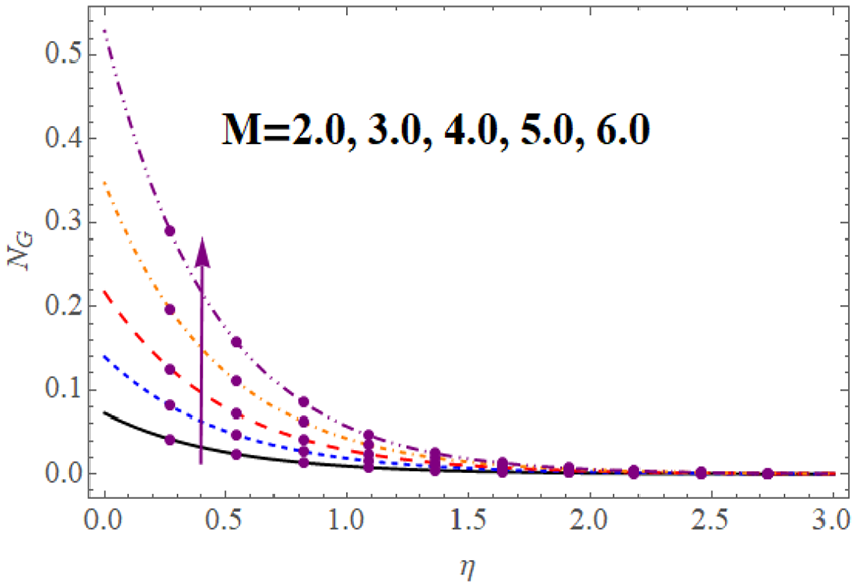
NG via M.
Quantities of interest
Figures 14 to 17 highlighted the characteristics of influential variables on drag force (
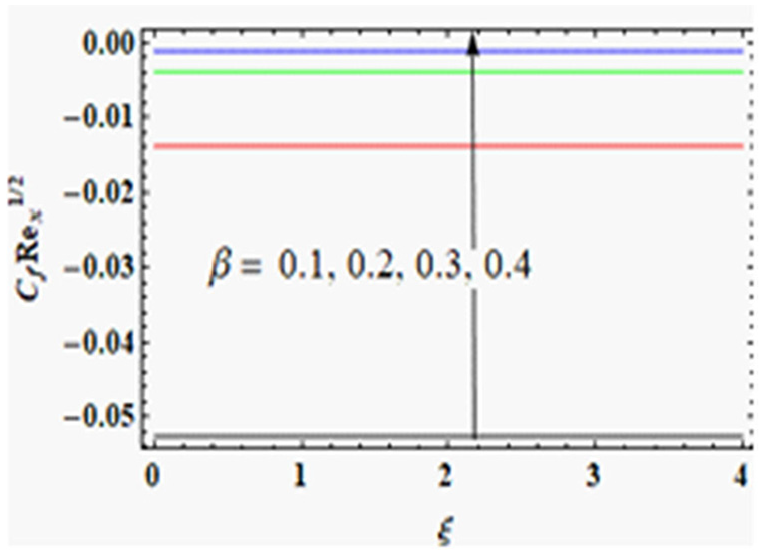
Crs via β.

Crs via λ1.

Nu via M.

Nu via M.
Velocity gradient
Influence of Deborah number (
Nusselt number
Effect of thermal transport rate against (
Concluding remarks
Main findings are given below.
Velocity distribution is boosted for curvature (
An intensification in (
Reduction in temperature is noted for Prandtl number.
Concentration decreases verses Schmidt number, while opposite result seen for curvature parameter.
An amplification in entropy rate is noted through thermal ratio variable and Brinkman number.
An amplification in entropy is noticed for magnetic variable.
An intensification in drag force is observed for relaxation time and Deborah number.
Heat transfer rate boosts up versus curvature variable, while reverse trend holds for magnetic variable.
Footnotes
Handling Editor: Chenhui Liang
Declaration of conflicting interests
The author(s) declared no potential conflicts of interest with respect to the research, authorship, and/or publication of this article.
Funding
The author(s) disclosed receipt of the following financial support for the research, authorship, and/or publication of this article: Financial support of Pakistan Academy of Sciences through Higher Education Commission (HEC) of Pakistan is gratefully acknowledged.
