




Abstract
Nanofluids play a prominent role in the development of various electronic structures and technological devices. Herein, we devise new and efficient techniques for overcoming the problems faced by the base fluids. This article describes water-based carbon nanotubes, including two major types of single-wall carbon nanotubes (SWCNT) and multi-wall carbon nanotubes (MWCNT). A mathematical model is considered for unsteady three-dimensional CNTs nanofluids flow with a uniform magnetic field between two revolving disks. The basic equations of the modeled flow problem are solved by the BVPh 2.0 package which is implemented using the Optimal Homotopy Analysis Method (OHAM). It has been observed that by stretching the top disk while keeping the lower disk stationary, the rotation aspect is reduced, whilst radial velocity near the top disk significantly increases. Moreover, The higher the values of unsteadiness parameter, the more accurate the temperature profile.
Introduction
In the realm of thermal engineering, such as heat pipes and heat exchangers, the innovative use of nanotechnology and nanofluids to meet energy requirements is a vital and remarkable field.
In general, water and other common liquids have a low thermal efficiency, which means that more energy is required to get the desired results. To address this demand, base liquids with smaller particles (1–100 nm) are employed. Choi and Eastman 1 introduced the term nanoparticle immersed into a base fluid. Nanofluid is a composition of tiny metal nanoparticles dispersed in a base solvent for use in heat and cooling applications. These nanoparticles are made from a variety of metals and are employed in a variety of applications. Carbon nanotubes (CNTs) are a subclass of the carbon family, which is typically employed for heat enhancement applications. They take the shape of a nanotube and range in size from a few nanometers to a few millimeters (1–50 nm). Carbon nanotubes (CNTs) have a wide range of applications in a variety of sectors, mostly in material sciences, where their remarkable and unique features have propelled them to the forefront. 2 Exposure to significant thermal and electrically conductive nanocomponents such as CNT in transporter fluids while tailoring nano-fluid mixtures can improve the electrical and thermal properties of fluids (liquid scattering of nanoparticles). Because of their low electrical and thermal conductivities, typical working fluids have intrinsically inferior properties, and this prearrangement declares an inventive solution for overpowering them. Nanofluids have a wide range of applications due to their unique features and relevance, including solar panels, atomic reactors, electronics, and heat absorbers, among others. Electrical resistance in the system decreases as a result of the carrier fluid and CNTs in this example, allowing the rate of hydrogen production to increase.
Iijima 3 are pioneers in the study of CNTs and the explanation of their electrical properties as well. Choi et al. 4 provide a perspective on nanoparticle uses from a broad perspective. When they conducted a study on thermal conductivities, in their study, they added carbon nanotube to oil or ethylene glycol and found a 50% rise in thermal conductivity. Eastman et al. 5 had uncovered by the addition of copper nanocomponents of the volume portion below 1%, the thermal conductivity of the oil increases up to 40%. Xue 6 has introduced a new model of effective thermal conductivity of CNT-based composites. The author chose a circular nanotube which are having a broader hub remainder dependent on the Maxwell hypothesis and hence this foreseen model likewise assigns specifics of fluid dispersion of thermal properties of CNTs. Ding et al. 7 investigated the heat transfer properties of aqueous suspensions of multiwalled carbon nanotubes (CNT nanofluids) flowing via a horizontal tube. They have been noticed a 30% enhancement at 25°C by measuring the thermal conductivity of CNTs at various temperatures, but a 79% improvement at 40°C. Using scale analysis as a tool Buongiorno 8 had developed formal convection of heat transfer analysis of nanofluids in their top-class study. He has looked at seven slip mechanisms that could result in a relative velocity between the nanoparticles and the base fluid. In nanofluids, the only important slip mechanisms are Brownian diffusion and thermophoresis.
Later on, Wen and Ding 9 had studied the characteristics of thermal conductivity in carbon nanotubes. They debated on the capability of the thermal conductivity that is due to the suspension of MWCNTs and noticed increment in the heat transfer rate when the concentration profile of CNTs increases. The effect of slip condition in the heat transfer flow of carbon nanotubes over a flat surface has been reported by Khan et al. 10 They utilized two kinds of CNTs, single- and multi-wall CNTs, with water, kerosene, or engine oil as base fluids. Bakhshan et al. 11 numerically investigated the thermal performance of nanofluid flow in a heated cylindrical pipe. They have concluded that MWCNT-based nanofluid has a reduced thermal resistance, a higher heat transfer coefficient, and a minimal temperature difference between the evaporator and condenser sections. In the stretched flow of nanofluid saturating porous media, Sheikholeslami et al. 12 studied thermal exchange in a permeable medium utilizing nanofluid flow. The thermal conductivities of SWCNTs and MWCNTs had been studied by Hone 13 and Antar et al. 14 They looked at the thermal conductivity of SWCNTs up to 6600 W/mk and MWCNTs up to 3000 W/mk. Heat analysis methods of CNTs traveling across a flat tube were investigated by Ding et al. 7 They investigated improvements in nanofluids based on Reynold’s number and mixes of CNTs. Kumaresan et al. 15 investigated the increase of CNTs in nanofluids as a function of Reynold’s number. Meyer et al. 16 conducted experiments to investigate the augmentation in the heat transfer rate of the liquid due to the disruption of MWCNTs traveling through a straight tube. Khan et al. 17 used slip boundary conditions to examine the thermal efficiency of the CNTs nano liquid.
The effect of magnetic field in steady three dimensional rotating flow of nanofluid over linear stretching sheet has been considered by Shah et al. 18 They have used Single wall CNTs and multi-walled CNTs as a nano-scale materials. They concluded that the greater heat transfer rate is offered by the nanofluid with higher density CNTs nanoparticles. Ramzan et al. 19 investigated the flow of hydromagnetic nanofluid between two movable rotating disks containing carbon nanotube suspension in Ethylene glycol as the base fluid. They found that as thermal stratification grows, the thermal profile declines. Gul et al. 20 perceived a nanofluid flow comprising multi and single-walled carbon nanotubes immersed in Ethylene glycol over a stretching cylinder in a porous medium. The impact of thermal radiation in electrically conducting flow of nanofluid over shrinking sheet has been reported by Mahabaleshwar et al. 21 They have observed that carbon nanotubes have significant properties for improving heat transfer processes, which have been extensively developed in manufacturing industrial applications, particularly in Nano medicine and cancer treatment. Recently, Reddy and Sreedevi 22 analyzed the characteristics of hybrid nanofluid flow in square cavity in the presence of thermal radiation and entropy generation. They studied the problem numerically and concluded that when single-walled carbon nanotubes of volume fraction 0.05 are suspended in the base fluid, heat transfer rate increases from 6.2% to 15.6%, while silver nanoparticles of volume fraction 0.05 enhanced heat transfer rate from 6.2% to 10.4%.
From literature, it is very clear that three dimensional unsteady flow of nanofluid between two disks is not yet reported. In this paper, we inspect the physical properties of electrically conducting nanofluid utilizing CNTs as nanoparticles. The two sorts identified as SWCNTs and MWCNTS have been used in the based liquid of water. For the solution of the problem, the OHAM23,24 technique was applied. The existing research has been expanded from the stable case to the unsteady situation.25,26 The reported work was also expanded upon by the use of sustained and functional SWCNTs/MWCNTs nanofluids flow. For the suggested problem, the influence and range of embedded parameters are also estimated, and the findings are compared to the literature.
Formulation
Consider the physical geometry of two rotating and parallel disks. In three-dimensional space, the unsteady axisymmetric water-based flow of carbon nano liquid within two disks is observed, which includes two subgroups of CNTs. One is SWCNTs and the other one is MWCNTs.



The terms fluid temperature and pressure are denoted by T and p. Moreover,
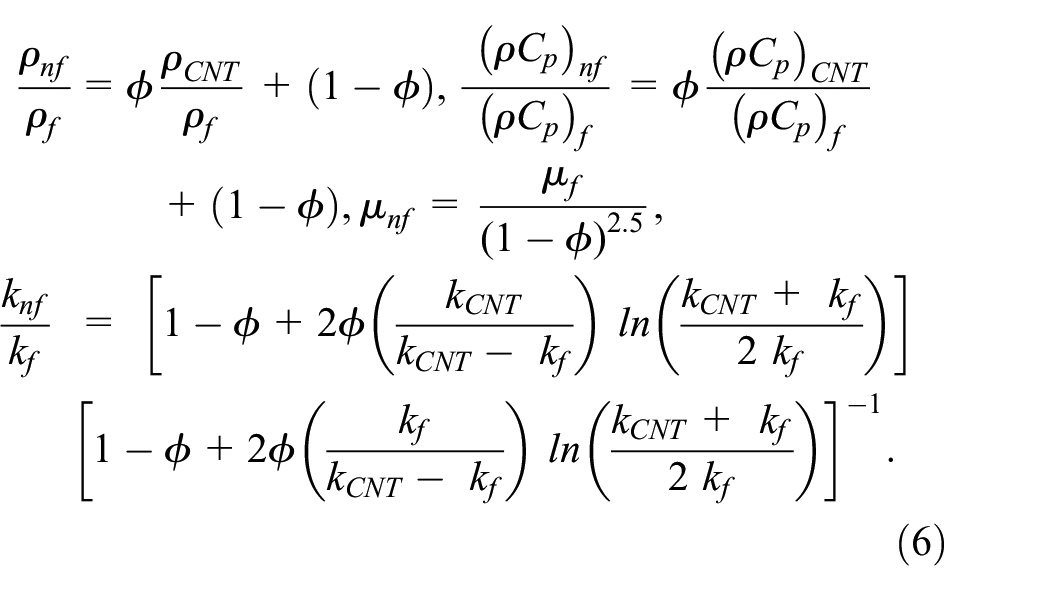
The physical conditions match the steady cases.25,26

Where
The similarity transformations of Von Karman is as follows:
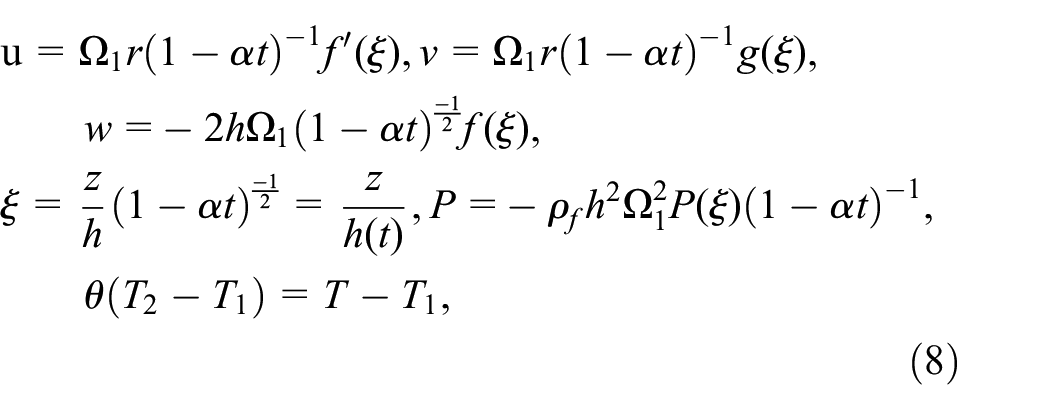
The basic equations (1)–(5) are transformed using the similarity transformation as indicated in equation (8), and the obtained equations in the transformed form are as follows.

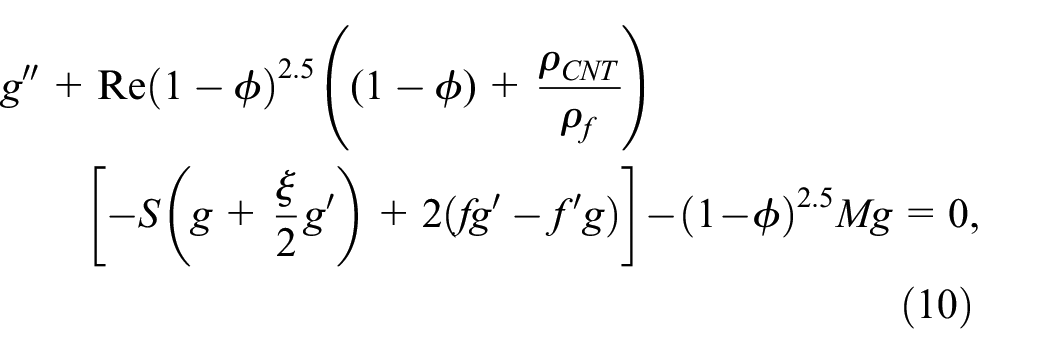

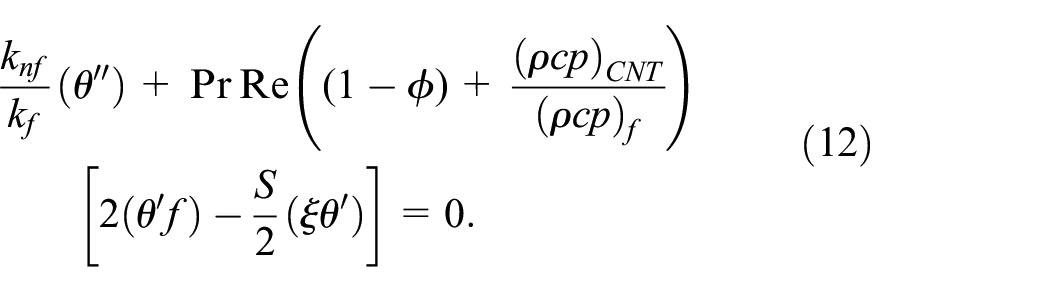
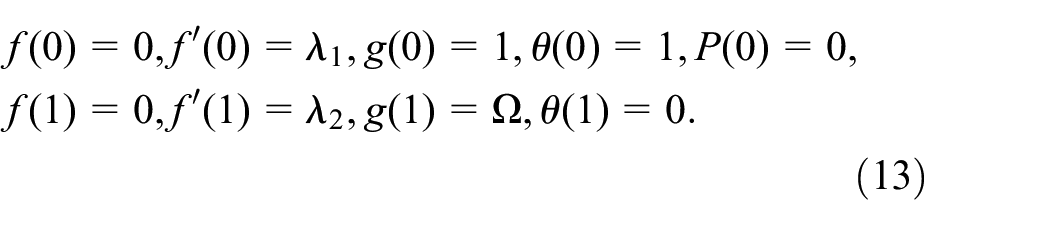
The physical conditions are given in (7) are changed as follows:
The physical parameters that are non-dimensionalized are as follows:
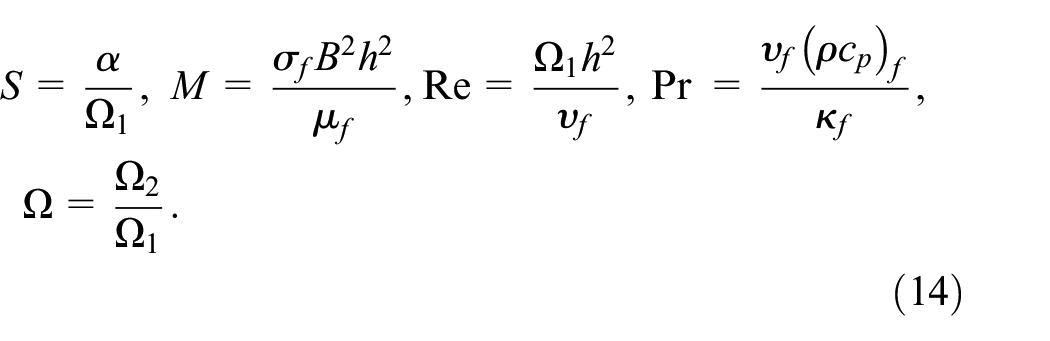
Here
At the lower disk shear stress can be calculated as follow:


On the lower disk, the drag force is restrained through

Solution By OHAM
The BVP h 2.0 package of the Optimal Homotopy Analysis method (OHAM)24–26 was utilized to solve the problem.3,27–30 The purpose of this package is to reduce the error residual to a maximum of 30th order estimates. This method is still in in the latest research.31–33 The trial solutions for the higher-order linear terms are desired initially. For the nonlinear problem, the trial solution or initial guesses are as follows:

The linear operators for the higher-order term are as follow:

In aggregate formats, the auxiliary linear operators are defined as follow:

Here



The Liao25,26 definition for the total sum of the square of residual error is as follow:

Results and discussion
This article examines the transient CNTs flow of nano liquid through two parallel and revolving disks. According to Xue,
6
up to 4% of the volume fraction is taken for the solid material. To address this issue, OHAM based package of BVPh 2.0 is used. The accuracy of this package has been computed numerically and displayed. The following sections provide a complete discussion of the numerical and physical outputs. More importantly, even in the case of small values for

Geometry of the problem.
Radial velocity
Figure 2 illustrates the rotation and stretching of the disks, as well as their effect on the flow. The lower disk is fixed on

Stretching parameter

Unsteadiness
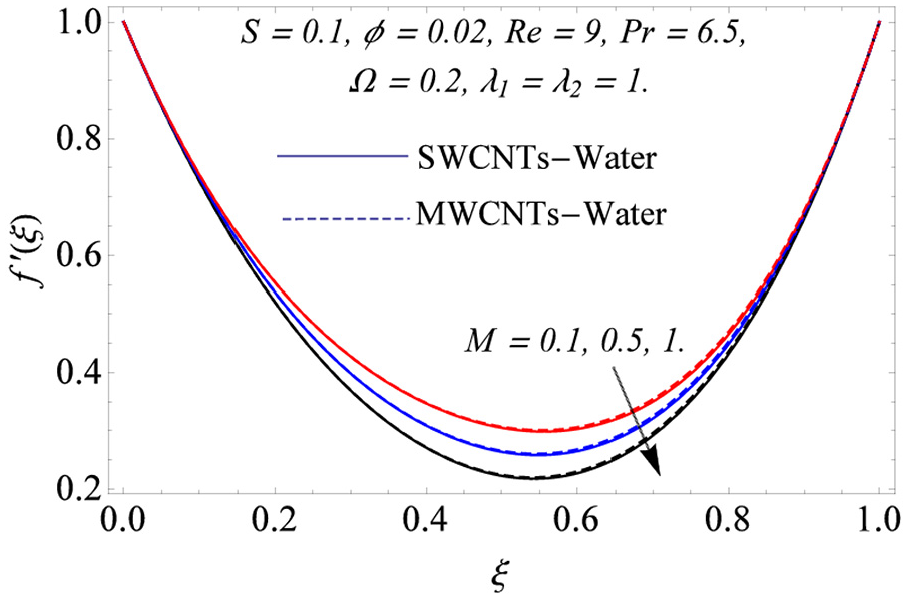
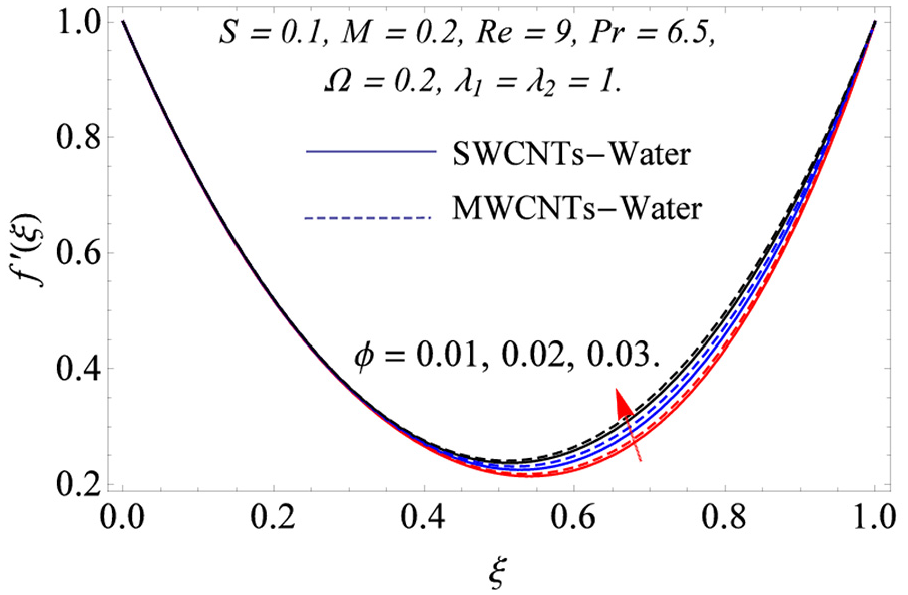
Figure 4 depicts an interpretation of the magnetic parameter M in the velocity distribution of nanomaterials such as single and multi-walled nanotubes. This shows that as the value of M rises, the velocity declines. In fact, as M increases, so does the Lorentz force. This is the reason as M rises, the Lorentz force also rises, causing particle collisions. The velocity of the particles decreases due to resistance between them Figure 5 illustrates an evaluation of the radial velocity profile caused by
M versus
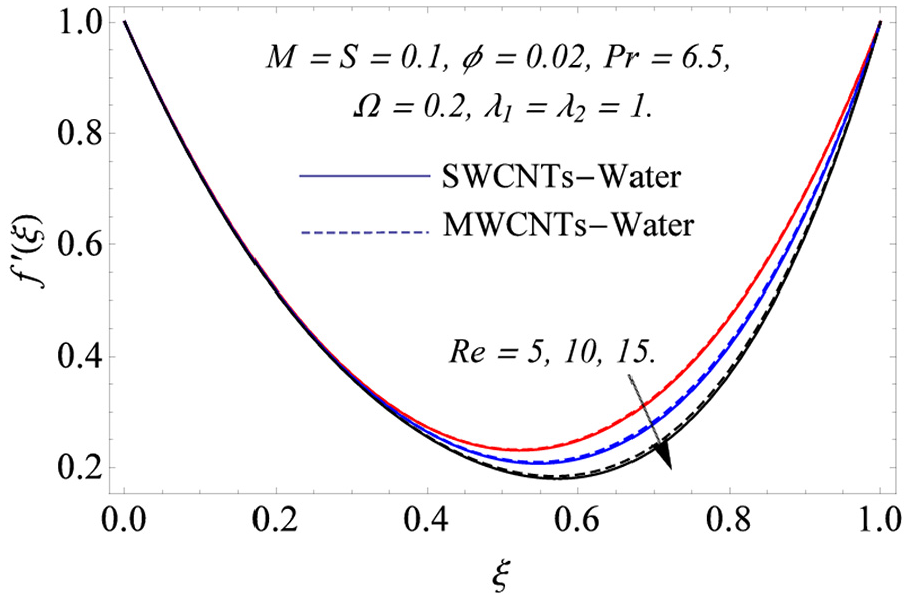
Re versus
Axial velocity
Figure 7 demonstrates that as we enhance the magnetic parameter value M, the motion of the particles gets slow down and as a result, the profile’s motion also gets slow down. Generally, greater amounts of M thin the momentum boundary layer, and the magnetic field is applied to a fluid that is capable of transmission, producing a force of resistance called the Lorentz force. This force is accountable for slowing the fluid’s development. This force slows movement on a horizontal surface and overcomes the axial velocity-identified movement layer. This trademark is maintained for a few levels before the activity is halted. The magnetic field parameter affects movement differently. The magnetic field distinctively tends to add to the fluid’s confinement. The influence of ϕ on nanoparticles velocity including SWCNT and MWCNT is depicted in Figure 8. This shows that as the value of ϕ augments, the axial velocity of the liquid rises. The nanofluid thermal conductivity increased due to increasing ϕ, As a result, an increase in ϕ increases the thermal conductivity of nanofluid. Substantially, the nanoparticle volume part ϕ is used for energy transfer. As a result of a larger measure of ϕ, the firm powers between the fluid particles become weaker and the speed field increases. The pivotal speed will now be increased via widening ϕ.
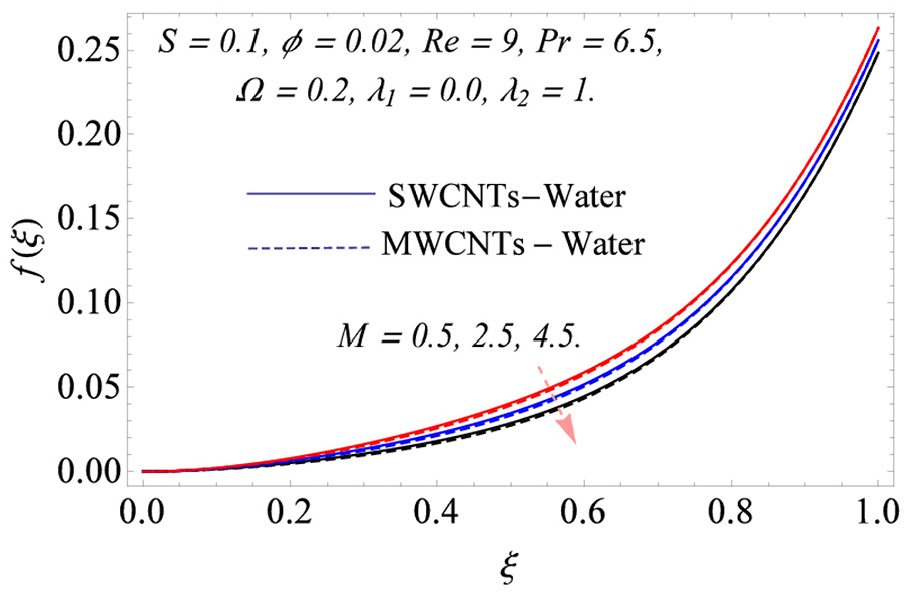
M versus

Figure 9 portrays an investigation of the axial velocity profile affected by the Reynolds number Re in nanoparticles such as SWCNT and MWCNT. It has shown that as the Reynolds number Re has risen, the axial velocity significantly reduces. The explanation for this is that the ratio between inertia to viscous force is the Reynolds number when the Reynolds number rises; the inertial force controls the stream instead of viscous forces. As a result, for higher Reynolds number approximation, Re speed hinders and motion falls off steadily to the surroundings. The working forces are revolutionary, and they prevent liquid molecules/atoms from flowing. Robust viscous forces are well-protected from liquid motion. With increasing solid inertial forces, the boundary layer flow of fluid movement decreases. The impact of unsteady parameter S on the velocity distribution of nanoparticles like SWCNT and MWCNT is exhibited in Figure 10. It shows that as the value of S increases, the velocity decreases. In addition, in the presence of unstable parameter S, the velocity encounters resistance, the barrier to return is recorded in the additional arguments.

Re versus

S versus
Azimuthal velocity
Figure 11 The impact of unstable parameter S vs azimuthal velocity is shown in Figure 11. The higher the value of the unsteadiness, the more difficult the flow trend becomes which reduces the azimuthal velocity of the nano liquid. The effect of S seems to be impactful in SWCNTs. The nanoparticles in ϕ such as SWCNT and MWCNT give an azimuthal velocity profile as displayed in Figure 12. As the value of ϕ rises, so does the azimuthal velocity of the fluid. In reality, the thermal conductivity of the nano liquid raised due to increasing ϕ. The interpretation of the azimuthal velocity profile caused by the unsteady parameter S in nanoparticles such as SWCNT and MWCNT is displayed in Figure 13. The plot illustrates that as S values increase, the velocity decreases. That is, when unsteady parameter S is present, velocity encounters opposition, and an in-return reduction is observed.
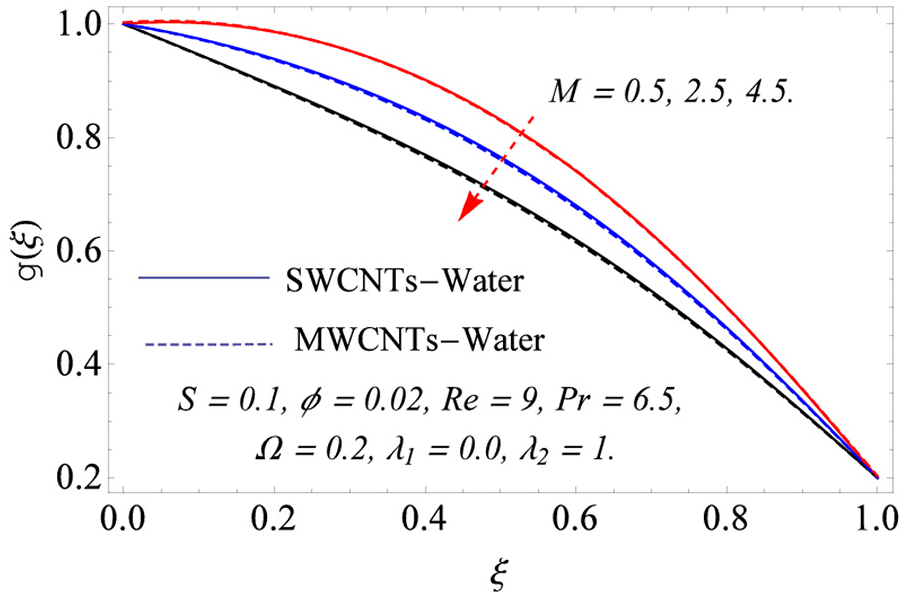
M versus


S versus
Pressure field
Figure 14 depicts the analysis of the pressure field caused by pi in nanoparticles such as SWCNT and MWCNT. This shows that when we rise pi, the term pressure rises because the concentration of nanomaterials rises, and thus the pressure rises. As the concentration augments, the liquid becomes thick, causing the conflicts of molecules/atoms to augment and exert unbelievable pressure on each other and on vessel boundaries. This type of liquid is highly beneficial for blood circulation and the concentration of drugs. Figure 15 depicts an evaluation of the pressure field caused by Reynolds number Re in nanoparticles including single and multi-walled nanotubes. With increasing Reynolds number Re, the pressure drops. Due to inertial forces, pressure in the broader path of motion instantly decreases to zero. Because the forces between molecules of particles and the fluids are strong enough, the particles cannot move easily, necessitating a greater amount of pressure to move the particles.


Re versus
The consequence of unsteadiness parameters on the pressure field of nanoparticles such as SWCNT and MWCNT is shown in Figure 16. The graph suggests that adding the amounts of the unsteady parameter S results in a decrease in pressure. The main reason is that as the value of the unsteady parameter S augments, so does the boundary layer thickness and consequently the pressure. As a result, as the amount of unsteady parameter S increases, so does the pressure field.
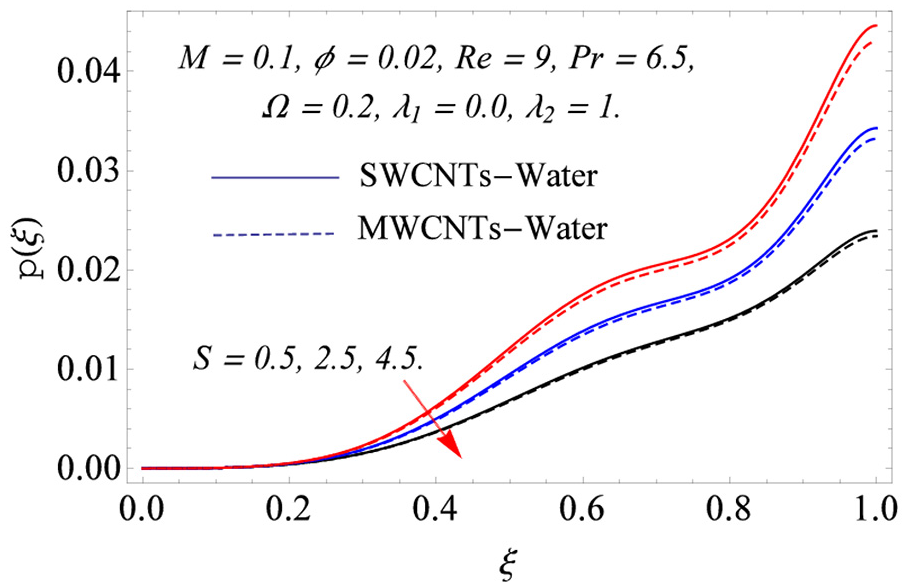
S versus
Temperature field
Figure 17 reveals the influence of ϕ on temperature distribution in nanomaterials consisting of single and multi-walled nanotubes. This shows that as the value of ϕ rises, so does the temperature of the fluid. Augmenting ϕ augmented the thermal conductivity of the nano liquid. Nanofluids are used to improve heat transfer, and as a result, the main parameter of nanomaterial like volume fraction has a significant contribution in increasing the thermal field ϕ. Increasing the amount of ϕ improves the temperature field. As a result, by increasing ϕ, the temperature profile will significantly raise. Analysis of the temperature distribution due to Reynolds number Re in nanomaterials like single and multi-walled nanotubes is displayed in Figure 18. It reveals that as the Reynolds number Re grows, the temperature diminishes. This is attributable to the fact that a higher Reynolds number indicates that inertial forces are the power factor when compared to viscous forces. These inertial forces act as the dominant component in the distinction of viscous forces. Such types of inertial forces are remarkable, and they keep atoms and fluid molecules in place. To separate the fluids’ atoms and molecules, an excess of heat energy is required. As a result of such forces, the sizzling point of the fluid rises. Figure 19 demonstrates the effects of the volatile parameter S on the temperature distribution of nanoparticles such as single and multi-walled nanotubes. It has shown that as S increases, the temperature rises. The reason is that that improving the unsteadiness parameter S helps increase the thermal conductivity, and thus heat is capable to boost the temperature profile, causing the temperature profile to enhance.


Re versus

S versus
Figure 20. The flow chart for the applied method is displayed in Figure 20.

Flow chart for the model.
Numerical outputs
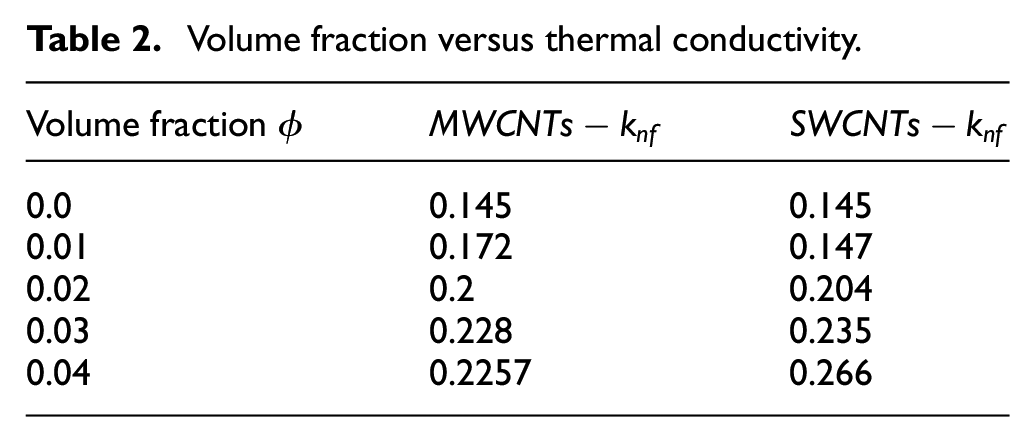
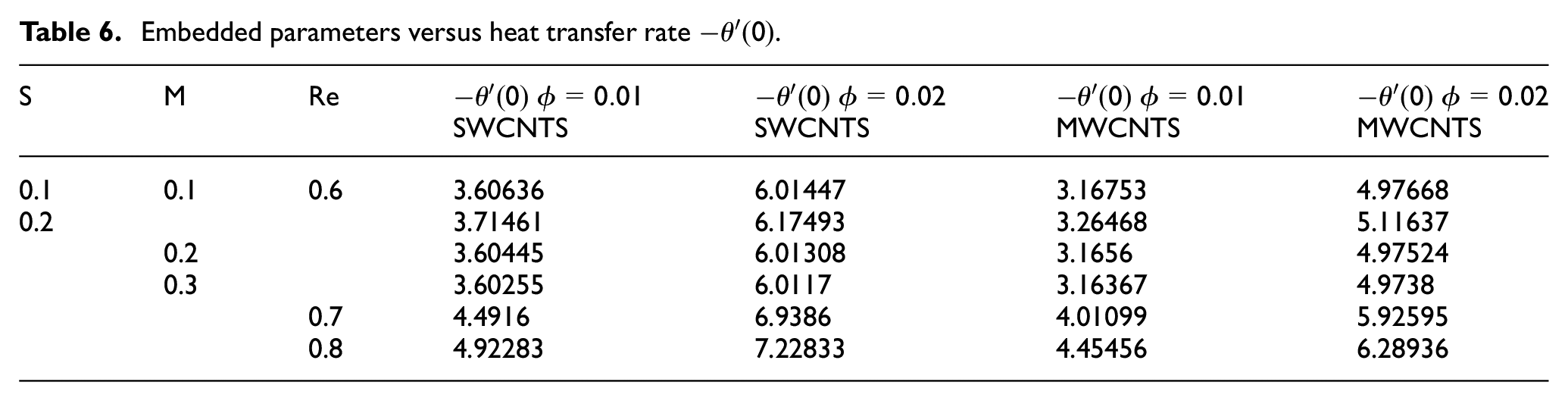
Table 1 describes the thermophysical properties of solid materials and conventional fluid. The quantities in Table 2 represent the solid materials volume fraction and have been taken up to 4% as Xue suggests. Table 3 quantitatively displays the residual error, radial velocity, pressure field, azimuthal velocity, and temperature profile correspondingly. The influence of physical restrictions vs the friction forces
The base solvent and solid nanomaterial properties.

Volume fraction versus thermal conductivity.
The square residual error and total sum.

Embedded parameters versus skin fraction

Embedded parameter versus Skin Friction coefficient

Embedded parameters versus heat transfer rate

Conclusion
The article investigated the flow of transient water-based CNTs nanofluids in two parallel and revolving disks in the presence of a magnetic field. The values of various parameters have been compared through two different types of CNTs (SWCNTs, MWCNTs). To solve this problem, the OHAM based package of BVPh 2.0 is used. Under the influence of physical parameters, the disks rotate in the same and opposite directions. Different modes for rotating two disks, including, rotating in one direction, rotating in opposite directions, fixing one disk and rotating the other, play significant role in industry and mechanical engineering.
The main results obtained are as follows:
Stretching the upper disk, while keeping the lower disk straight, reduces the rotation tendency and the flow decline in the vicinity of the lower disk, whereas increasing the radial velocity near the upper disk.
❖ The unsteadiness tends to increase frictional force for increasing values and decreases the azimuthal velocity of the nano liquid. The effect of the unsteadiness parameter is noted as useful in SWCNTs.
❖ The rotation characteristic is noticed reduced by stretching the top disk while keeping the lower disk fixed, whereas radial velocity near the top disk tends to increase.
❖ It has been noticed that as the concentration augments with augmenting volume fraction, the liquid becomes thick and the boundaries of the vessel require incredible pressure. This type of fluid is extremely beneficial to blood flow and medication concentration.
❖ As the Reynolds number augments resulting pressure drops.
❖ The larger the value of S, the better the temperature profile. It is because of this reality, augmenting the unsteady parameter S augments the thermal boundary layer, and so heat is capable to augment the temperature profile, which in turn augments the temperature distribution.
❖ The spinning of the disks in one direction allows faster moments of nanoparticle molecules and facilitates the flow trend.
❖ When compared to MWCNTs, the SWCNTs’ profound thermal efficiency allows for faster temperature exchange.
Footnotes
Handling Editor: Chenhui Liang
Declaration of conflicting interests
The author(s) declared no potential conflicts of interest with respect to the research, authorship, and/or publication of this article.
Funding
The author(s) received no financial support for the research, authorship, and/or publication of this article.
