




Abstract
In recent decades, post-colonial and anti-racist activists around the world have initiated debates about the representation of colonialism in public space. In Germany, too, the treatment of colonial street names and monuments has become a subject of controversy. What is unique to the debate on the memory of colonialism in Germany, though, is how it is deeply entangled with memories of other political regimes, in particular National Socialism and the German Democratic Republic. To comprehend today's memory–political conflicts, it is therefore important to understand how memories of the colonial past have changed over time and how they have been influenced by memories of those other regimes. This article demonstrates that there are multi-layered memories associated with (post-)colonial monuments in Germany. To this end, it closely examines three memorial sites: the Pogge bust in Rostock, the Bremen elephant and the corner of Wilhelmstraße/An der Kolonnade in Berlin. It illustrates how these sites have served as focal points in public discourse and memory practices, highlighting the various layers of meaning different actors have attached to them throughout the twentieth and twenty-first centuries. Tracing the construction and usage of these sites, the article reveals the (in)visibility of different historical layers and the memory–political negotiations surrounding them. It shows how the complex interplay of these entangled layers of memory is not adequately represented at the memorial sites themselves. In conclusion, the article suggests (re-)designing memorial sites in a way that highlights the struggles related to the past and reveals the relationships between different layers of memory, fostering a deeper understanding of the history of remembrance.
Keywords
Roughly 200.000 people joined the Black Lives Matter protest in Germany in the late spring of 2020. At the same time, construction workers in Berlin completed a building that could arguably be called Germany's largest and newest colonial monument: the reconstructed Stadtschloss (City Palace). ‘Whereas all over Europe colonial monuments are dismantled, Germany erects a new one’, colonial historian Jürgen Zimmerer commented on the completion of the building. 1 Under the umbrella of the Humboldt Forum behind a baroque façade topped by a dome with a golden cross, the building now houses collections of non-European art and ethnographica – including looted artefacts.
It would be too easy to dismiss this concurrence of anti-colonial protests and the nostalgic glorification of German imperialism as a simple anachronism. After all, the reconstruction of the palace and the establishment of the Humboldt Forum incited fierce protest and public debate from the beginning. Moreover, since the mid-2000s at the latest, post-colonial and anti-racist activists have addressed the colonial legacies in many German cities and initiated intense debates on colonial monuments, as well as street names, memorial plaques and museum and university collections. What complicates and distinguishes memorial cultures 2 in Germany is that they deal with the past of several political regimes – from the German Empire, through the Weimar Republic, National Socialism and the two Germanies of the Cold War period, to the current reunified Federal Republic. It is not only a matter of reflecting on what the histories of these past regimes mean for us today, but also of recognising that present memories of the colonial past (as well as of other periods) have been continuously shaped by the political regimes that followed.
In this article, we turn to specific memorial sites in which these struggles materialised. There is a ‘reciprocal exchange’ between monuments and the sites in which they are placed. 3 On the one hand, monuments as material objects are constituted by their surroundings, the historical meaning of the locality and by the various actors that interact with them. On the other hand, a monument also transforms its surroundings. We therefore investigate memorial sites as material and social spaces, in their complex and dynamic interaction of materiality, use and context. 4 We see these sites as expressions of what Aleida and Jan Assmann have identified as cultural memory. They serve to negotiate, stabilise and mediate group identities. 5 However, we do not understand these identities as closed or fixed and reject the notion of a static and cohesive national memory. For this reason, we also do not use Pierre Nora's concept of lieux de mémoire, although our focus on memorial sites might suggest this. 6 As Cornelia Siebeck has pointed out, the concept fails to address our main interest: the conflicts and inconsistencies that characterise memorial cultures and the role that power plays within them. 7 Instead, we look explicitly at the struggles over the memory of different aspects of German history as they relate to three specific memorial sites and examine how these struggles have transformed these sites over time.
To explore the complex negotiations and political struggles surrounding memorial sites, we employ the image of layered memories as an analytical lens. Reinhart Koselleck introduced the metaphor of temporal layers (Zeitschichten) to describe the phenomenon that humans experience different temporalities at once, which are related but not completely dependent on each other. 8 Although Koselleck did not develop the term to analyse memorial cultures, it has been influential within this context. As Achim Saupe points out, temporal layers are often used to describe the different layers of construction and usage that make up memorial sites. It is important to acknowledge that staging, reconstructing or preserving certain layers (instead of others) is always a memorial–political decision. 9 We do not see the layers as static sediments that build up over time. Rather, we want to show that different time periods are addressed in these places and that which periods are addressed can change over time. In addition, people can connect different memories with these places and attribute different meanings to them, meanings that also change over time. A dynamic concept of ‘layers’ is therefore particularly suited to studying the ‘social history of remembering’, as it allows us to ask who is referring to which past and in which context. 10
To explore the political struggles over (post-)colonial memorial sites, this paper closely investigates three different examples: in the first part, we examine two colonial monuments – one in East and one in West Germany – in a longitudinal analysis from the 1880s to the present. We investigate who invoked the colonial past at these sites, when, how and why. In the second part, we demonstrate how various memorial–political actors draw upon different temporal layers at one location: a street corner along Wilhelmstraße in Berlin Mitte. We relate the development and present design of the memorial site to debates over the impact of National Socialism and colonialism and their representation in public space. All three examples reflect the temporal and spatial complexity of layered memories.
We are writing this article against the backdrop of an intense academic and public debate that wrestles with the relationship between colonialism and fascism, racism and anti-Semitism and their continuities, overlaps and differences. 11 What often gets lost in the increasingly polarised exchanges is the fact that, over the last 20 years, post-colonial activists and scholars as well as experts in memorial education in Germany have advocated for the inclusion of colonial history into concepts of historical–political education. 12 With our contribution, we want to bring the debate back to the specific memorial sites. We analyse how and when colonial monuments and the sites surrounding them became focal points of public discussions and practices, foregrounding the multi-layeredness of their meanings throughout German twentieth- and twenty-first-century history. In the following, we trace the construction and use of the three memorial sites, show which temporal layers have been addressed when, how and why and demonstrate how they have been related to each other. As a conclusion from this analysis, we reflect on how awareness of the multi-layeredness of memorial sites may change the way we approach and design them in the future.
1. Colonial memories in East and West
1.1 Monumentalising colonialism (1880–1945)
The following longitudinal approach to (post-)colonial memorial cultures focuses on two rather typical monuments: a bronze bust dedicated to the ‘Africa explorer’ Paul Pogge in the East German town of Rostock, and a 10-m-high elephant statue made of red clinker bricks situated in the West German town of Bremen. The Pogge bust was erected in 1885 and seems to be one of the oldest colonial monuments in Germany. 13 Pogge, who had been born near Rostock, was known primarily for two expeditions to the Congo Basin on behalf of the Afrikanische Gesellschaft (African Society) in 1875–77 and 1880–84. He died at the end of this second journey in Luanda (Angola), only a month before Chancellor Otto von Bismarck placed the first territories in Africa under German ‘protection’. 14 The Afrikanische Gesellschaft and the Gesellschaft für Erdkunde (Geography Society) supported the construction of the monument. Together with other European geographical societies, they were instrumental in exploring the African continent and forming the basis of the Scramble for Africa. At the dedication ceremony in the central Rosengarten, a member of Pogge's expedition compared him to David Livingstone and Henry Morton Stanley and praised his diplomatic dealings with the African population. 15 In the mid-1880s, Pogge thus stood for claims that Germans were on par with other colonial powers and possibly even made better, less violent colonisers. His monument was also intended to promote German colonial aspirations among the wider German populace.
However, in the following decades, Pogge does not seem to have been a significant point of reference for colonial advocates or opponents. In 1901, his bust was moved to a less central spot in front of the military hospital at Leibnizplatz (Figure 1). 16 By then, Germany had consolidated its rule over the territories in Africa and established further colonies in the Pacific and on the east coast of China. German troops had also participated in the brutal overthrow of the Yihetuan movement in China. Only a few years later, they violently suppressed Africans’ resistance in Southwest and East Africa. 17 As Joachim Zeller demonstrates, most colonial memorials now honoured German soldiers and their commanders. 18 In this setting, a figure like Pogge, with no military accomplishments, offered less potential for identification and political legitimation. The word Afrikaforscher (Africa explorer) and the dates of his birth and death were added to the plinth sometime in the 1920s or 1930s, as Rostock's residents had apparently started to forget who and what the bust on Leibnizplatz represented. 19 The brutal colonial wars had changed the way German colonialism and its agents were represented in public space and added new layers of meaning to the memorial landscape.
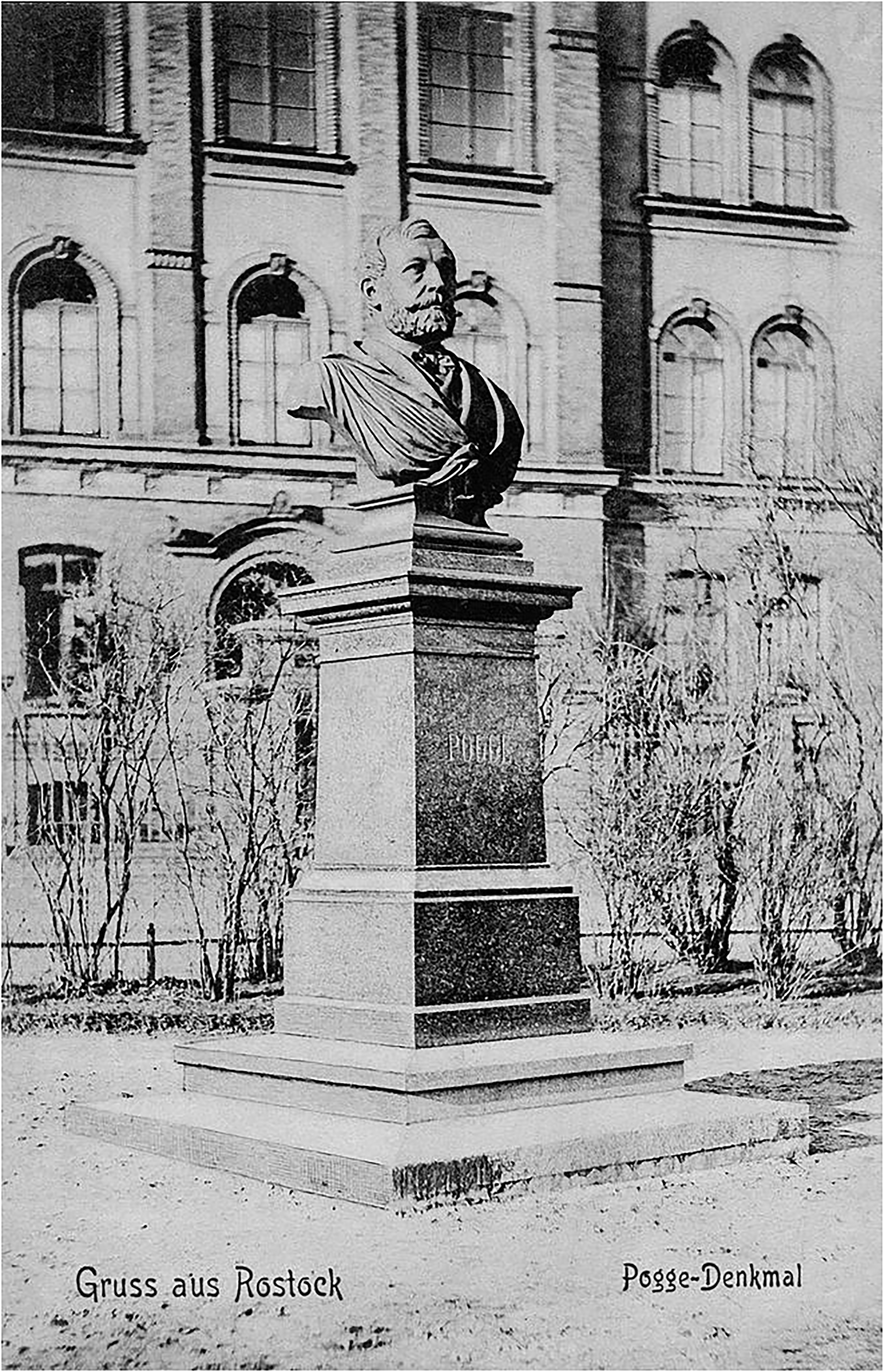
Pogge bust at Leibnizplatz, Rostock, 1901–45 (Historical Postcard, n.d.) (Wikimedia Commons: n.a., public domain).
Our second example, the Bremen elephant, was built during the interwar period, marked by democratic awakenings but also by stark revisionism against the Treaty of Versailles. Bremen, a harbour city, had benefited from German colonial trade early on. Adolf Lüderitz, the merchant who had deceitfully acquired large parts of what would later become the colony of German Southwest Africa, hailed from the city as well. These circumstances fuelled a strong local colonial revisionist movement. In September 1926, the Colonial Working Group Bremen applied to the city for permission to erect a colonial monument. However, Social Democrats and Communists who held the majority in the city assembly opposed the proposal. After the National Socialists, who were sympathetic to the colonial movement, achieved a landslide victory in November 1930, the city finally approved the project. 20
The monument was built in 1931 in a small park not far from the railway station and the nearby Kolonial- und Überseemuseum (Colonial and Overseas Museum). Once finished, visitors could enter a semi-subterranean crypt at the head of the elephant. It held a stone table with a book listing the 1.490 names of soldiers who had died in the German colonies during World War I. However, the inscription ‘Our Colonies’ 21 over the door, and the names of the former colonies on the sides, marked the monument as more than just a memorial for dead soldiers. They made a clear revisionist statement. Portraits of Lüderitz and Paul von Lettow-Vorbeck, the general who had commanded German troops in East Africa during World War I, decorated the back of the monument to remind the public of the beginnings and the final battle for the colonies. 22
The installation of the colossal monument did not go unopposed. Communist and Social-Democratic members of the city assembly tried to prevent the opening ceremony. One of them, Luise Eildermann, called the elephant a ‘symbol of this chaotic capitalist society’ and a ‘stigma of humanity’ that would have been better replaced by a playground. 23 Eventually, the inauguration took place under massive police protection in July 1932, just a few months before the National Socialists seized power. The speeches at the ceremony clearly echoed the idea of Volk ohne Raum (‘people without space’), an ideology that linked the colonial movement to the National Socialists. 24 Friedrich von Lindequist, the former governor of German Southwest Africa and deputy chairman of the Deutsche Kolonialgesellschaft (German Colonial Society), claimed that Germany was ‘too narrow’ for 65 million people, and Lettow-Vorbeck, now a resident of Bremen, feared that ‘without colonies, a flourishing nation must suffocate’. 25
During the following years of dictatorship, the elephant continued to serve as a rallying point and propagandistic tool. 26 However, while the National Socialists took up the colonial movement's demand for the return of the colonies, they primarily pursued their imperial goals – territorial expansion, settlement and racial supremacy – in continental Europe. 27
1.2 Removal and rediscovery (1945–89)
After the end of the war, the four Allied authorities had to deal with the often-intertwined legacy of German colonialism and fascism in public space. The Western Allies were primarily concerned with removing monuments, street names and museums from the Nazi era. In Bremen, the city council prevented the demolition of the elephant in 1945 by removing the inscriptions referring to ‘our colonies’. 28 Over the following years, the decontextualised animal sculpture stood in the park, like the metaphorical elephant in the room: something that the public could not overlook but did not address. Thus, the elephant reflected West Germany's way of dealing with the colonial past in general.
In East Germany, colonial history was subsumed under a Marxist–Leninist meta-narrative. As the Soviet administration dismantled all colonial monuments after 1945, it did not ignite or stimulate a broader societal discussion about Germany's colonial past. 29 Instead, memorials and statues like the Pogge bust simply disappeared from public space along with other monuments dedicated to the military or nobility. They were all targeted by the new regime as part of an imperial past that had led to fascism. Since Pogge had already ceased to be a figure of identification earlier, it is unlikely that the citizens of Rostock paid much attention to his disappearance. The Pogge bust probably ended up in the City Museum and was eventually melted down in the early 1960s. 30 However, the site in the Rosengarten, where it had first been erected, was restaged. In 1946, the city constructed the Monument to the Victims of Fascism here, symbolically asserting communism's triumph over imperialism and fascism in a central city location.
Although there were considerable differences between West and East Germany in the way local authorities dealt with the physical remnants of colonialism and its glorification, memory cultures in both countries also showed parallels. Neither East nor West German society publicly confronted Germany's colonial past during the post-war years. Paradoxically, however, it was precisely the preservation of colonial monuments in West Germany that allowed them to become focal points of critical debates about colonialism, racism and imperialism from the late 1960s onwards. In East Germany, on the other hand, colonial monuments could no longer become a source of public contention due to their low-profile removal.
As pro-colonialist references to the past eroded in the course of global decolonisation, so did the stone elephant in Bremen. By the time the city discussed its restoration in the 1980s, a local but internationally well-connected anti-apartheid movement had emerged, showing their solidarity in particular with the South-West Africa People's Organisation and its struggle against the South African occupation of Namibia. In 1987, its members rededicated the elephant as an anti-colonial memorial and demanded that it be permanently transformed into a memorial site for the victims of colonialism and apartheid. A year later, the metalworkers’ union IG-Metall donated an anti-apartheid monument, which was erected next to the elephant. When Bremen joined the European initiative ‘Cities against Apartheid’ in 1989, the city assembly officially approved the restoration and rededication. 31
In May 1990, Bremen inaugurated the now anti-colonial monument with a Namibia Freedom Festival just a few weeks after the state had officially gained independence. To mark the occasion, the organisers wrapped the elephant in ‘shackles’ made from banners that denounced racism and apartheid, which were cut and removed at the end of the ceremony. 32 A bronze plaque at the foot of the monument critically commented on the elephant's history and pointed to the responsibilities arising from Germany's colonial past.
1.3 Reconstruction and the local post-colonialist protest (1990–present)
The reunification of the two German states in 1990 changed the memorial landscape again. A reconstruction wave hit Eastern Germany, with numerous cities deciding to rebuild buildings such as the Stadtschloss in Berlin, but also monuments, including some colonial ones. Civil society groups initiated the reconstructions, reappropriating local memorial culture that had previously been in the hands of the state. The municipalities supported these campaigns but left the funding to private actors. 33 In Rostock, a local historical society campaigned for the Pogge bust to be reinstalled. The Volksbank (a German co-operative bank) donated it, with the intention of giving back a ‘piece of history’ to ‘the Hanseatic citizens and their guests’. 34 A local newspaper's headline read: ‘Lost culture comes back’. 35 Thus, initially, the supporters were not primarily concerned with honouring Paul Pogge but with revising the demolition of the previous monument and, more generally, the historical policy of the Soviet Zone/German Democratic Republic (GDR). They referred to a particular temporal layer while ignoring the others.
However, Pogge's resurrection did not go unchallenged. Germany's largest boulevard newspaper, Bild, accused the city administration of erecting a monument to a racist. As proof, the author quoted Pogge's derogatory descriptions of Africans. 36 A letter to the editor of another paper described the quoted passages as the breeding ground for the genocide of the Ovaherero and Nama. 37 These accusations carried weight in the political context of 1995. Only 3 years earlier, the district of Rostock–Lichtenhagen had been the scene of the largest racist pogrom in Germany since 1945. Amid the applause and participation of thousands of locals, neo-Nazis had attacked a home for asylum seekers and the residence of Vietnamese contract workers for several days. The city administration was therefore still concerned about the city's image. Nevertheless, it decided to re-erect the Pogge monument with a new bronze cast by local sculptor Jo Jastram, close to its original place at the other end of the Rosengarten (Figure 2). In doing so, it followed the argument of local historian Hartmut Schmied, who claimed that Pogge had been mis-understood, quoted out of context and unjustly accused of racism. 38 This line of reasoning was eerily similar to the way many Rostock residents saw themselves – mis-understood and wrongly defamed as racists after the events of Lichtenhagen. 39
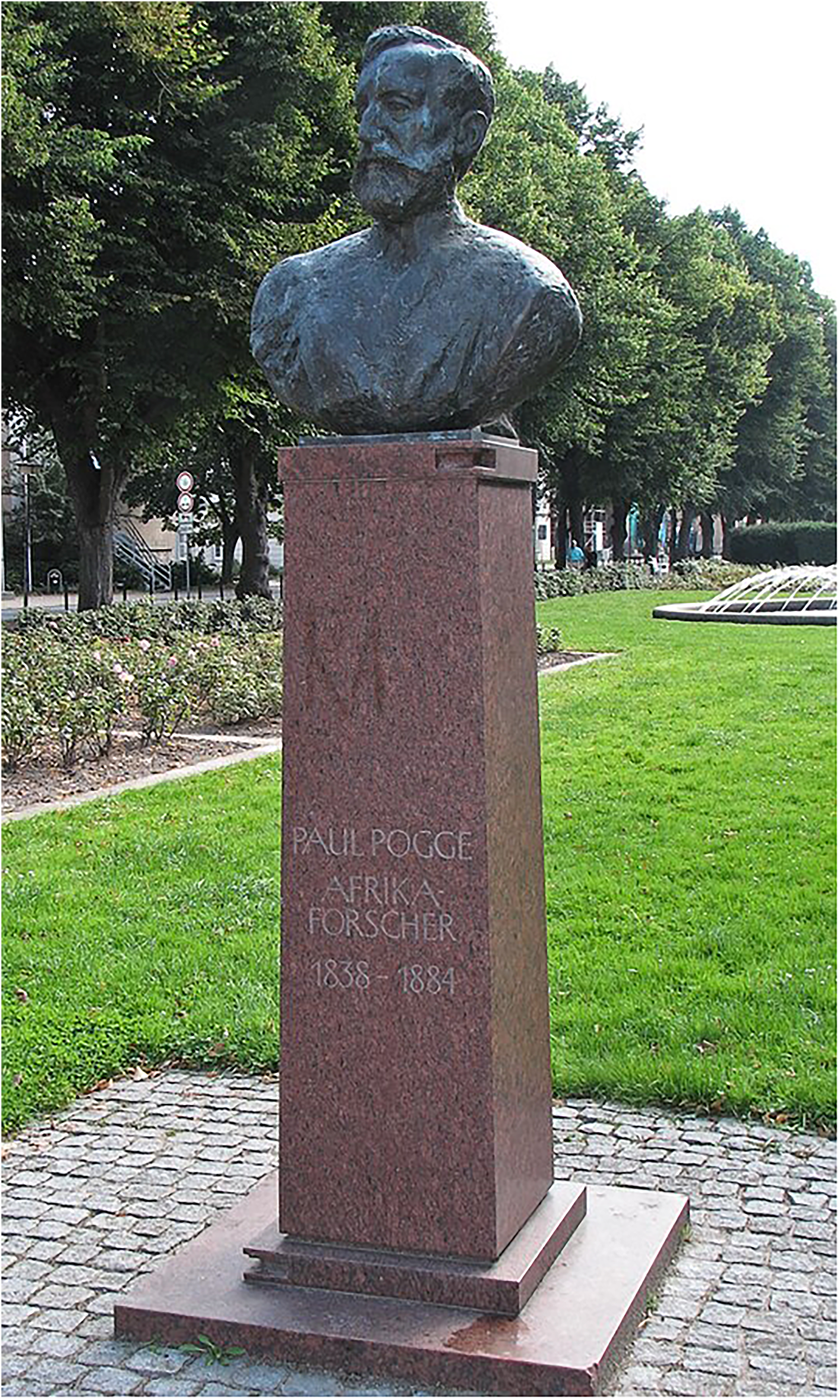
Pogge bust (by Jo Jastram) at Rosengarten, Rostock, 1995–2020 (Wikimedia Commons: Darkone 2005, CC BY-SA 2.5 Deed).
A broader debate on colonial monuments and Germany's colonial past in general did not start until the mid-2000s, when local post-colonial activists, Africa-diasporic initiatives and smaller grassroots organisations initiated discussions on the decolonisation of public space. Three anniversaries helped to boost and bundle such efforts in 2004 and 2005: the 100th anniversaries of the colonial wars in Southwest and East Africa and the 120th anniversary of the Berlin Africa conference. A network of post-colonial initiatives in various cities emerged that addressed the local colonial legacies and traces of colonialism. 40
Media and politics took up the discussion as well. Various developments stimulated the conversation. First of all, the colonial past was addressed in a broader debate about the restitution of looted artefacts and human remains held by museums and universities throughout Germany. 41 Discussions were fuelled by plans to reconstruct the Stadtschloss with the Humboldt Forum museum complex inside, which divided the public. 42 Second, the demands of Ovaherero and Nama representatives for an official apology by the German government and for reparations gained more attention. 43 As public awareness of the genocide and other colonial crimes grew, questions arose about the historical and ideological relationship between colonialism and National Socialism and how both are remembered today. Third, parts of the German public have slowly begun to deal with the fact that Germany is a country with a long and ongoing history of immigration. Correspondingly, memorial policies and practices have started to reflect the diversity of, and sometimes the rifts within, German society. 44 These debates about the relevance of the colonial past for the present do not take place in isolation but in constant exchange with memory-cultural developments in other parts of the world.
These latest developments also manifested in the anti-colonial monument in Bremen. In 2009, the local non-profit organisation Der Elefant!, together with local politicians, cultural workers and committed neighbours, erected a memorial dedicated explicitly to the victims of the genocide in colonial Namibia. 45 The memorial consists of stones from the Omaheke Desert that were brought to Bremen and arranged in a circle in close vicinity to the elephant (Figure 3). The new memorial not only increased the visibility of the victims of German colonialism but also offered a place to commemorate their loss. It did so at the same spot where their deaths had been erased for so many decades.
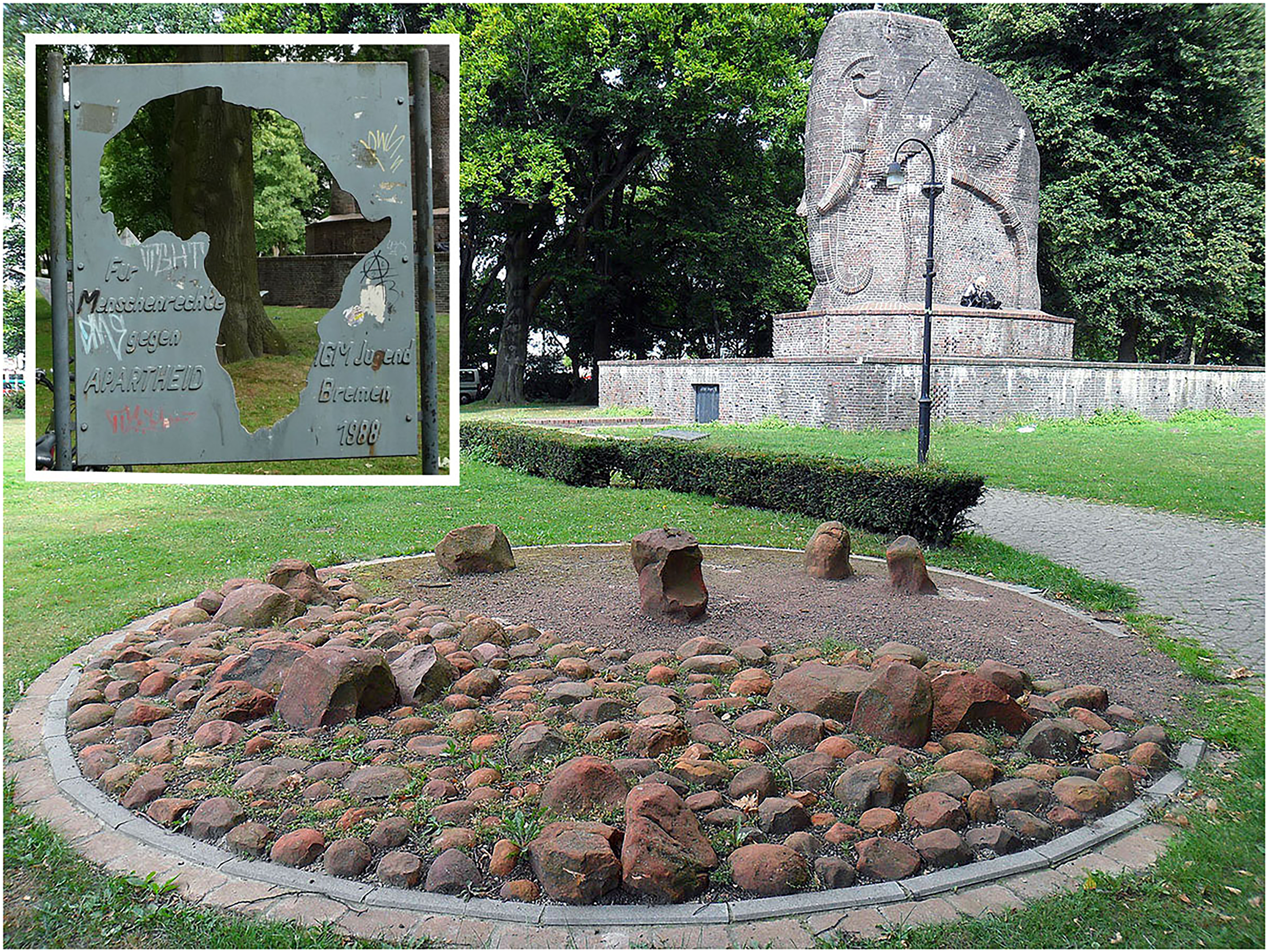
Anti-apartheid monument (top left), Omaheke Stones Memorial (bottom centre) and (anti-)colonial Elefant (top right), Bremen (Wikimedia Commons: Immanuel Giel, public domain, 2009; Chrischerf 2012, CC BY-SA 3.0 Deed).
A similar struggle to integrate critical voices is taking place in Rostock. Since 2016, members of the association Soziale Bildung e.V. have been addressing colonial traces in the city. In 2018, they founded the initiative Rostock postkolonial. The members have developed an app and offer guided city tours. 46 When the city announced plans to redesign the Rosengarten, they approached the cultural office with a demand that the Pogge bust no longer be presented in its current form. 47 However, the cultural office did not rely on the expertise of the initiative but commissioned a professional expert opinion. In contrast to local historian Schmied 30 years earlier, colonial historian Jonas Kreienbaum clearly labelled Pogge as a racist and a pioneer of European colonialism. 48 After such a verdict, it now seemed evident that something had to happen to or with the monument.
Rostock postkolonial proposed altering the bust or challenging it with a counter monument. 49 Kreienbaum recommended tilting it to indicate its fall. 50 However, the heirs of the artist Jastram refuse their consent to alter the artwork. Rostock postkolonial also suggested removing the bust and placing it in the Museum of Cultural History, where it could be contextualised with an exhibition. 51 However, this would remove Pogge – and with him the discussion about the German colonial past – from public space. Eventually, the city re-erected the bust in a less central location of the Rosengarten and complemented it with a detailed inscription describing Pogge's travels and worldview. This text was co-produced by city officials and Rostock postkolonial. The activists see this as a partial victory. However, they will not be satisfied until the Pogge bust has been ‘supplemented by a critical counter-monument’ and the city develops a concept of remembrance that includes colonialism. 52 Hence, the public controversy may not be over.
Over the years, the colonial monuments discussed here have changed their function and meaning in public space several times. Pogge has been regarded as a successful colonial explorer, a symbol of imperialism (in its broadest sense), a local identification figure of a (neo-)conservative restoration and a racist pioneer of European colonialism. The elephant, which at the time of its construction embodied a glorification of the colonial past and revisionist goals, now symbolises the successful overcoming of colonialism and apartheid, solidarity with the inhabitants of the former colonies and an acknowledgement of the crimes committed there by Germans. The longitudinal analysis of the two monuments shows that memories of Germany's colonial past were always closely linked to the (selective) memories and omissions of other historical periods and events. Layers of memory were not simply superimposed on one another. Rather, various historical actors repeatedly activated certain layers at different points in time and ignored others. The comparison between West and East Germany demonstrates that there is no single (post-)colonial memorial culture. Rather, the memorial sites bear witness to the continuous struggles over the past and its significance for the present and future.
2. Memories on a street corner
According to Kenyan author Yvonne Adhiambo Owuor, Berlin is an ‘unsecured, multi-layered world crime scene of historic proportions’. 53 Here, we discuss the street corner of Wilhelmstraße–An der Kolonnade in Berlin-Mitte as a contested space in which this world crime scene is present in several layers of memory. 54 This street corner hosts an ensemble of different commemorative elements in which several layers of memory overlap, converge, materialise and interact. However, they are visible to varying degrees. Their significance, relevance and relationship to each other are contested and are part of broader discussions about the decolonisation of public space. Disentangling these layers can help address central issues in current German debates about (colonial) memory.
When approaching the street corner, located in the former eastern part of the city, surrounded by GDR architecture and hosting small shops and flats, one can spot three rather inconspicuous memorial plaques and a high-rising sculpture showing a steel silhouette of a face (Figure 4).
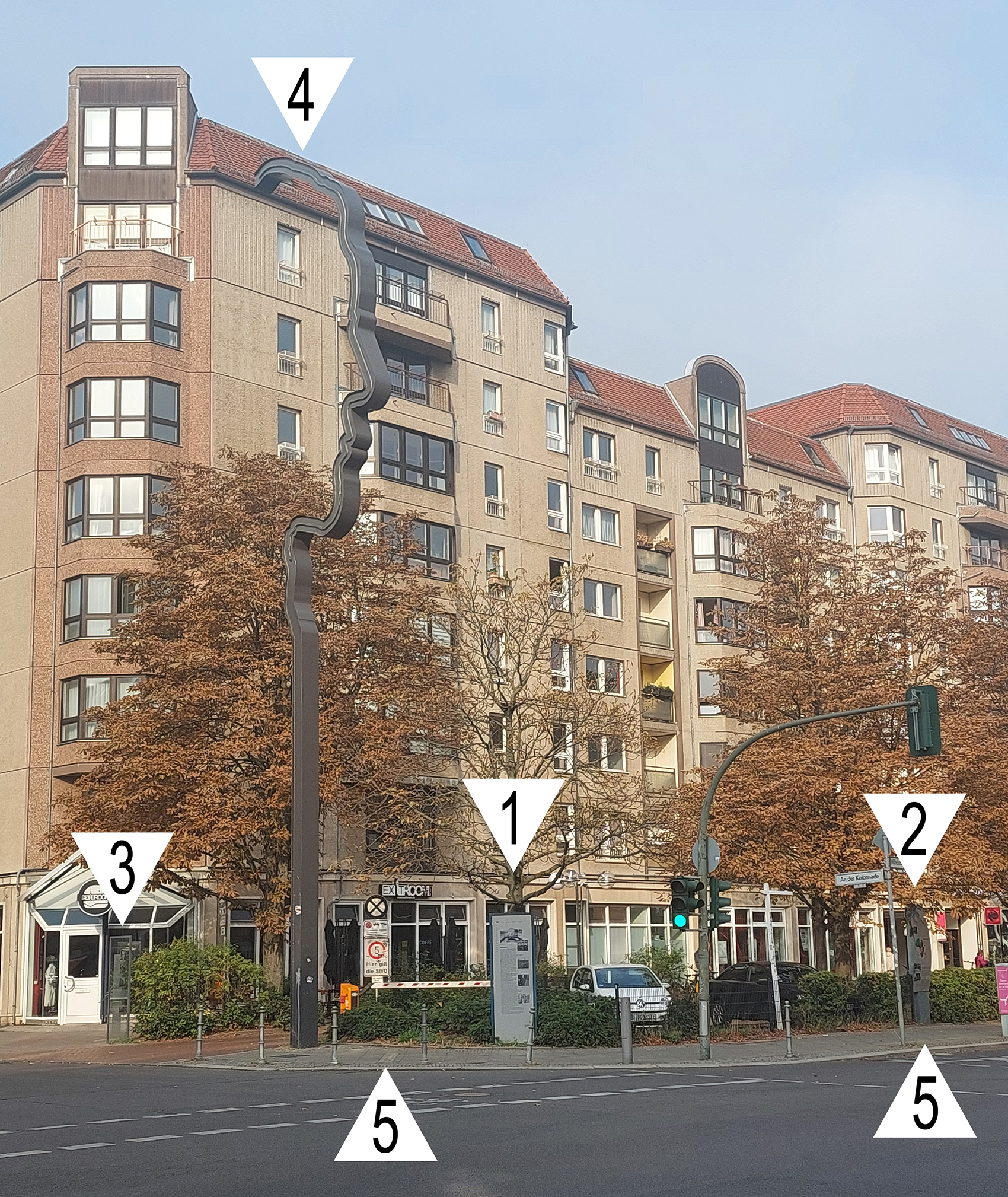
Street corner Wilhelmstraße–An der Kolonnade: plaque ‘History Mile’ (1), plaque ‘Africa Conference’ (2), plaque ‘Georg Elser’ (3), Elser Sculpture (4), Elser Quotes (5) and Berlin (Ulrike Schaper and Dörte Lerp, 2024).
Apart from the accumulation of plaques and the sculpture, this corner seems unspectacular at first glance. However, it is located on the site of the former Wilhelmstraße 77, where the Alte Reichskanzlei used to be. The Reichskanzlei was the residence and official building of the Chancellor of Germany between 1878 and 1945. Besides the Berlin Africa Conference, which took place in the building's banquet hall, President Paul von Hindenburg also appointed Adolf Hitler as Chancellor there in January 1933. Hitler later had private living spaces there and established his final headquarters in a bunker under the garden in 1945. At the end of World War II, the building was destroyed along with most of the surrounding Government Quarter. In 1949, the Soviet military administration ordered that the remains of the building be demolished. In 1961, the Berlin Wall was built less than 500 m away, dividing the Wilhelmstraße, named after the Prussian King Friedrich Wilhelm I, into two parts. In the 1980s and 1990s, the area around the corner was included in a reconstruction plan, resulting in the buildings that now line the street corner.
2.1 Remembering Wilhelmstraße as the centre of political power
Although there are no structural remains from the pre-war period, the site has been charged with historical meaning and has undergone a variety of commemorative interventions. The earliest visible sign was a plaque set up in 1996. It was installed, together with over 20 other plaques on Wilhelmstraße as part of the street exhibition Geschichtsmeile Wilhelmstraße (‘Wilhelm Street History Mile’). 55 The Senator for Building, Housing and Transport commissioned the Geschichtsmeile, but it was executed by the Topography of Terror Foundation, whose purpose is to distribute ‘historical information about National Socialism and its crimes and to encourage people to actively confront this history and its aftermath’. 56 One of the institution's main activities is curating the historic site where important institutions of Nazi terror were located between 1933 and 1945. The site is situated just a few hundred metres south on Wilhelmstraße. For years, the Foundation fought to establish a documentation centre at this location. The Geschichtsmeile, however, was to remember ‘all layers of the past – Prussianism, Imperial Era, Weimar Republic, Nazi Regime, GDR Era’, as Andreas Nachama, then director of the Foundation, assured in the early planning process of the project. 57
The plaque erected at the site of the former Alte Reichskanzlei provides information about the building's history from its construction in 1736. It mentions the building as the venue of the Berlin Congress of 1878 and the place where Chancellor Max von Baden announced the abdication of Kaiser Wilhelm II in 1918. The plaque indicates that Hitler used the building as a residence and that he committed suicide in the ‘Führerbunker’ (Führer's bunker) under the garden. The text of the plaque ends with the demolition of the building in 1949 and the construction of new buildings at the site in the 1980s and 1990s. 58 In a nutshell, this plaque is part of the city's broader post-unification efforts to make the history of the former Government Quarter visible. The Geschichtsmeile addresses the longer history of the site but was highly motivated by the attempt to officially acknowledge the horrors of National Socialism.
2.2 Remembering the Berlin Africa Conference and its aftermath
The Geschichtsmeile plaque was accompanied by a second plaque on 26 February 2005, the 120th anniversary of the end of the Berlin Africa Conference. 59 Installed just a few metres away, the second plaque provides information about Bismarck's intention for the Berlin Africa Conference, summarised as an effort to resolve conflicts between the imperial powers over African territories while excluding Africans as political subjects. The plaque marks the conference as the beginning of an almost total division of Africa between European powers and a more efficient colonisation, which led to the degradation, deprivation of rights, dispossession of Africans and the destruction of their cultures. 60 An image of Ovaherero people in chains also commemorates the genocidal colonial war. In contrast to the first plaque, the second one thus foregrounds the colonial past related to the site.
The ‘Afrika-Forum’, a non-governmental organisation created in 1996 to promote dialogue between Africa and Europe, initiated this second plaque. They set it up to make the German public aware of the colonial history of this location and stress Germany's involvement in European imperialism more broadly. They also intended to counter the silencing of the colonial past in the first plaque. They thus challenged the narrative of the site presented by the first plaque. 61 If we assume that monuments ‘represent an interpretation of history’ and are often ‘erected to reinforce a narrative’, we can read the second plaque as an objection to a historical narrative that downplays Germany's involvement in colonialism. 62 It is a visible sign of a post-colonial counter-narrative that understands colonialism as an inherent part of German history. The juxtaposition of the two plaques demonstrates the temporal layers of this site, as well as the biased representation of different layers of memory in Germany's institutionalised memorial culture. It is also a material manifestation of the intensifying debates on German colonial heritage after the anniversary of the Berlin Africa Conference in 2004.
Moreover, the site is located in the vicinity of an area rich in memory–political interventions. Leading up to Wilhelmstraße is M*straße, a prominent site of anti-racist struggle, named after the derogatory term ‘Mohr’ (‘moor’) in connection with Prussia's involvement in the eighteenth-century enslavement trade. 63 On M*straße, there is also a metro station of the same name, located on the site of the former Wilhelmplatz, which was destroyed during World War II. In December 1949, the East Berlin Magistrat (‘city council’) renamed Wilhelmplatz – and shortly thereafter, the metro station – after Ernst Thälmann, a communist politician who had been killed by the Nazis. After the reconstruction of the area in the 1980s, the square was barely recognisable. Moreover, an additional area in Berlin-Prenzlauer Berg had been named after Thälmann. The city thus integrated Thälmannplatz into the former Wilhelmstraße, which had been renamed Otto-Grotewohl-Straße after the first Prime Minister of the GDR in 1964, and was changed back to Wilhelmstraße in 1993. 64 The metro station was accordingly named Otto-Grotewohl-Straße. On the first anniversary of the German reunification in 1991, the senator of transport in Berlin changed the name of the metro station to M*straße as part of an initiative to rename stations that had been named after socialist politicians. The renaming and re-renaming of Wilhelmstraße and the nearby metro station were visible signs of top-down memorial politics that attempted to anchor a particular view of Germany's past in public space by deeming certain people (un)worthy of being honoured with a street name. In dedicating the place to Thälmann, the socialist city council tried to erase Prussian heritage and the commemoration of an ‘imperialist warlord’. 65 Instead, it enshrined an important founder of German communism in public space. 66 In the post-unification era, the re-establishment of the original names aimed at removing the traces of GDR ideology from the cityscape.
Afrodiasporic and post-colonial initiatives have in turn demanded the renaming of M*straße and the metro station of the same name since the late 1990s, due to its racist implications. 67 Throughout Germany, conflicts over colonial street names have been central to debates on how colonialism is remembered and the decolonisation of urban space. 68 Since 2014, the territory around the underground station ‘M*straße’ has been the venue for an annual festival on 23 August, the International Day for the Remembrance of the Slave Trade and its Abolition. Each year, M*straße has been symbolically renamed. Slowly, the activist work and the broader public debate it stirred also influenced official politics. In August 2019, the Berlin House of Representatives approved a request by members of the then ruling Social Democratic, Left and Green parties to develop a city-wide concept to investigate and commemorate the history of colonialism and its consequences in the state of Berlin. 69 As a result, the city expanded the implementing regulations of the Berlin Street Law to allow the renaming of streets that reference colonialism and racist-imperialist ideologies. In August 2020, the decision to rename M*straße finally passed the Berlin-Mitte City Council. In the future, this street will be named after Anton Wilhelm Amo, an eighteenth-century Black African philosopher and the first African to receive a PhD in Germany. 70 However, the actual renaming has not taken place due to several hundred pending legal proceedings by residents. 71 This illustrates a conflict between a newly emerging post-colonial memorial culture and a conservative and right-wing memorial culture that draws on widespread resentment towards the renaming of colonial and racist street names. 72 It is no coincidence that right-wing political actors in particular reject the renaming as a sign of unnecessary political correctness, immigration, gentrification and globalisation. 73
The spatial proximity of M*straße to the site of the Alte Reichskanzlei places the second plaque in the larger context of the anti-racist and decolonising struggles for which the M*straße stands. Within these broader struggles, the site was included in a yearly commemorative ritual, the Gedenkmarsch, initiated in 2006 and supported by numerous post-colonial and anti-racist initiatives since then. The Gedenkmarsch not only honours the victims of colonialism and enslavement but also demands a public acknowledgement of racist crimes such as the genocide of the Ovaherero and Nama, the looting of human remains and cultural artefacts, the persecution and murder of Black people by the National Socialists and more recent instances of deadly police violence against people of colour. It begins either at the underground station M*straße or at the site of the former Alte Reichskanzlei, where a wreath is laid at the base of the second plaque. The march also links Wilhelmstraße to other contested memorial sites, establishing contextual connections between them.
These struggles, however, are still mainly supported by the African/Black community, as well as migrant and civil society organisations. Colonialism is not yet given the same weight in federal or state memorial concepts as, for example, National Socialism and the Holocaust or the crimes of the GDR regime. Tellingly, no representative of the state or the city was present when the second plaque was installed. 74 Non-governmental organisations such as the Committee for the Erection of an African Memorial in Berlin have been demanding a memorial to commemorate the victims of colonialism for 20 years. Because the Berlin Africa Conference epitomises colonialism, they consider its location to be the most suitable spot for such a memorial. The current configuration of the street corner thus also points to the absence of such a memorial. This absence highlights that the official politics of memory in Germany – often associated with the term Vergangenheitsbewältigung (‘coming to terms with the past’) – have long focused on National Socialism (and the GDR) and marginalised colonialism. 75 Material representation through memorials reinforces a specific narrative within the contested field of cultural memory, while non-representation corresponds to, or follows from, marginalisation. By installing a plaque in remembrance of the Berlin Africa Conference and demanding a memorial for colonialism and its victims, the organisations involved insist that the colonial past be adequately represented in public space, integrated into Germany's institutionalised memorial culture and recognised as constitutive for contemporary German society.
The second plaque is thus not only a response to the omission of colonial history in the first plaque but also a visible sign of the broader struggle for the decolonisation of public space. In the absence of state-sponsored memorials for colonialism on this site, the former location of the Alte Reichskanzlei and the broader surroundings, including M*straße and the resistance to its renaming, also represent the hesitancy in official engagement with colonialism and its consequences. They have, in a way, become signs of an unwillingness to deal with colonial legacies and racism in a large part of the (white) population.
2.3 Remembering German resistance against National Socialism
The third plaque at the street corner belongs in the context of Vergangenheitsbewältigung as well, as it addresses the horrors of National Socialism and resistance to it. Installed in 2011, it commemorates Georg Elser, who tried to assassinate Hitler in Munich in 1939 and was murdered in the Dachau concentration camp in 1945. The memory of Elser has itself undergone a chequered development. Until the interrogation transcripts became accessible in 1964, his assassination attempt was often dismissed as staged, and even after that, he continued to be neglected by research, media and official commemorative events. This changed only in the 1980s, not least on the occasion of the 50th anniversary of the assassination attempt in 1989. Nevertheless, Elser remained a lesser-known and controversial figure within the resistance for a long time. 76
The plaque accompanies a 17-m-high sculpture showing the silhouette of Elser's face, which overlooks the memorial plaques and several trees on the street corner. It is also closest to the first plaque, which addresses the National Socialist past of the site. Initiated by the author Rolf Hochhuth and supported by the Christian Democratic Party, the Berlin House of Representatives decided to erect a memorial to Elser in 2008. 77 The memorial was realised on Wilhelmstraße, even though the location had been contested in the planning process. 78 Elser's biography has no direct link to the location, but the memorial was intended as a counterforce to any attempts to turn the site of Hitler's former bunker into a place of pilgrimage, as Hochhuth made clear in his opening speech. By shifting focus to an opponent and victim of the Nazi regime, the memorial functions as a counter-monument to the potential instrumentalisation of the site by neo-Nazis. It foregrounds German resistance, with quotes from Elser that are set in the pavement near the sculpture and the first plaque, highlighting his motives to ‘stop the war’ and ‘prevent even greater bloodshed’. 79 The memorial, therefore, emphasises the crimes of the Nazis and resistance to them, adding another layer of meaning to the site.
As Valentina Rozas-Krause puts it in her convincing reading of the site, it is ‘filled with seemingly random objects and littered with memories’. 80 She emphasises the conflict between the layers of memory that the various monuments and plaques invoke at this corner. 81 As accurate as her analysis of the current situation is, we do not share her conclusion that the Elser monument – and with it the memories of National Socialism – now occupy the square, and that it therefore cannot host an anti-colonial monument.
Currently, the different layers of memory invoked at the site are reflected in different memorials, expressing a latent rivalry over what this corner stands for. The interplay between the memorials calls various contested topics to the fore, such as the historical relationship between colonialism and fascism, between the German colonial genocide and the Holocaust, and the relationship between past and current racisms and exclusions. The architecture still speaks of the GDR's endeavours to overwrite the site's imperialist and fascist past. Similarly, the post-unification efforts to undo the GDR politics of memory are still traceable in the street names. In its uncoordinated outset, this ensemble stands for the contested relationship among different memorial cultures.
We read the commemoratively crowded site of the former Alte Reichskanzlei not only as a reflection of the complex history of racism and violence in Germany. It also symbolises the complexity of how colonialism and National Socialism, including the Holocaust, are remembered and related to each other. The site has thus become a space of contention, reflecting the tension between efforts to decolonise public spaces and the commitment to preserving the memory of Nazi crimes. However, even though monuments pretend to be eternal and often veil their partiality, the contestation of monuments – not least in the context of the Black Lives Matter movement – refutes this claim. 82 Hence, the current design of the street corner does not necessarily have to remain the same in the future. A redesign of the entire site could integrate both a monument for the victims of colonialism and the Elser monument, while at the same time bringing the different plaques and monuments into more explicit dialogue. Integrated into an intentionally and visibly multi-layered memorial site, the corner of Wilhelmstraße could not only refer to different phases of German history through monuments that compete for space and recognition but also address their relation to each other.
3. Conclusion
Even though the critical examination of German colonialism and its traces in public space dates back to the 1960s, a significant public discussion only began in the 2000s. Since then, a growing anti-racist movement and some historians inspired by post-colonial approaches have increasingly engaged with the colonial past. Black activists, especially women, played an essential role in initiating this process. 83 By now, numerous initiatives exist that advocate for official recognition of German colonial crimes, for reparations and restitution, and also – not as a substitute – for an appropriate way of dealing with this past in the public sphere.
At the same time, the commemoration of National Socialist and GDR crimes and injustices has been institutionalised and nationalised since the 1990s. The Federal Republic of Germany formally recognises remembrance as a national obligation, which finds expression in official memorial days and state-funded memorial sites. 84 So far, attempts to integrate colonialism into this institutionalised and nationalised memorial culture have failed. 85 However, while institutionalisation brings recognition and public funding, it also creates new problems. On the one hand, there is the risk of forgetting that much of Germany's institutionalised memorial culture today was developed and fought for over decades, often against great political and societal resistance. When some post-colonial critics present current forms of Vergangenheitsbewältigung as a social consensus that has always existed and criticise the omission of colonialism from it, they ignore those previous struggles. 86 On the other hand, institutionalisation harbours the risk of giving the ‘impression that the right lessons have already been learned from history’. 87 Demonstrating pride in Germany's so-called achievements as the ‘Erinnerungsweltmeister’ (‘world champion of memory’) potentially immobilises commemoration and limits the opportunity to create new connections to the past and confront present-day exclusions.
Simply adding colonialism to the current memorial landscape might therefore not be the best response to the challenge of publicly acknowledging it. Incorporating colonialism into institutionalised memorial culture bears the risk of rendering the struggles over the colonial past equally invisible. A closer reading of the memorial sites we analysed shows that the absorption of critical engagement into more institutionalised forms of memorialisation presents its own challenges. The transformation of the Bremen elephant into a still-monumental anti-colonial memorial, for example, has ambivalent effects. One could argue, with Winfried Speitkamp, that where the citizens of Bremen and Germany once expressed their colonial domination and revisionist goals, they now demonstrate their ostensible capacity for atonement and purification, their ability to learn from the past. 88 Seen this way, the elephant expresses moral superiority alongside the willingness to confront German colonial crimes and atrocities. Similarly, the decision to reinstall the Pogge bust in Rostock, albeit with an explanatory plaque, could be read as a history of appropriating criticism in a way that almost neutralises it and affirms hegemony over memorial culture. Ultimately, the public's treatment of these memorial sites will determine whether the dangers of institutionalisation are addressed in a productive way.
Discussions about Germany's colonial past have been subject to various conjunctures over time, often related to regime changes. These layers must be taken into account when dealing with colonial monuments and memorial sites. As monuments gain meaning only in a particular context, they cannot be reduced to their material form or aesthetic value. They can only be read in relation to the symbolic practices, historical understanding and political situation of the time. In the nineteenth century, Wilhelmstraße represented German imperial rule. During this period, it was uncontroversial to publicly honour colonial explorers and soldiers through monuments and street names. 89 While the Pogge bust lost its symbolic significance between 1918 and 1945, the Alte Reichskanzlei remained a centre of power and thus embodied the respective political regime, especially during the period of National Socialism. Although the GDR erased the physical remnants of the imperial and colonial past at both sites, nostalgic restoration after 1990 was therefore only possible in the case of the Pogge bust. However, even here it met with fierce criticism within the changing landscape of memorial cultures from the mid-2000s onwards.
As we have demonstrated, addressing colonialism in public space has involved constant conflicts of interpretation and power struggles over the past. The Pogge bust, the Bremen elephant and the corner on Wilhelmstraße are all shaped by several entangled layers of memory. Sometimes, (some of) these layers are visible, but their presence and relationship to one another are not explicitly reflected within the sites. The site of the elephant in Bremen, for example, now comprises a monument, plaques and a memorial. Their erection followed changes in the ways the colonial past was remembered – changes that eventually transformed a colonial memorial site into an anti-colonial one. The corner of Wilhelmstraße also consists of several plaques and a sculpture. Different interventions accentuated different phases and events in history within this site, without, however, relating them to each other. In Rostock, finally, the current memorial critically exposes Pogge's biography but renders the complex history of the site nearly invisible.
While the changes in memorial culture materialise in these sites, this process of negotiation is not addressed on a meta-level, making it difficult for contemporary visitors without prior knowledge to understand the complex relationships between the different layers of memory. Without contextualisation, it is difficult to understand their emergence and to decipher what they can tell us about memorial cultures in Germany. We therefore suggest the memorialisation of memorial cultures. The multi-layeredness of memorial sites needs to be exposed and made explicit. Memorial sites should be designed in such a way that the struggles over the past – and the relationships between different layers of memory – become visible. 90
Footnotes
Declaration of conflicting interests
The authors declared no potential conflicts of interest with respect to the research, authorship and/or publication of this article.
Funding
The authors disclosed receipt of the following financial support for the research, authorship and/or publication of this article: This work was supported by the UNA Europa Seed Funding.
