



Abstract
This article examines a set of entanglements between settler memory and a monument in a nation that does not acknowledge that it ever had a colonial history. It looks at the efforts of exiled Finnish settlers to keep alive the memory of Petsamo as ‘their homeland’ through a monument they set up in Ivalo, Northern Finland, in 1985. Before being forced out of Petsamo, a province on the Arctic Ocean, by the Soviet Union in 1944, Finnish settlers tried to reshape Petsamo from a multi-ethnic borderland into a Finnish homeland for over two decades. Their settler memory is inscribed on and funnelled through this Ivalo monument, via claims of belonging and connection to a lost homeland. The monument set up by the settlers is meant to speak to their specific stories, their version of the past and of themselves. It serves settler purposes, declaring settler belonging to the broader public, to the nation and even to the world. It maintains and channels settler memory to future generations and remains uncontested and largely ignored in today's Finland.
When one travels far north in Finnish Lapland, hundreds of kilometres past the Arctic Circle, the main highway cutting through these northern spaces passes through the village of Ivalo – a small municipality of around 3,000 residents that acquires a more cosmopolitan feel as visitors flock there during the inevitably short arctic summer. Most visitors come to enjoy nature, fishing, hiking and other forms of outdoor recreation. Probably only a few pay any attention to the lone monument that stands next to the highway, on a grassy patch close to a central roundabout in the village. The monument, loosely translated as ‘Diaspora of an Arctic Ocean People’ (Jäämeren kansan evakkotie, in Finnish), depicts three men and a single woman holding a baby. It also contains a plate with Finnish place names and a separate text: ‘Petsamo 1920–1944. To the Homeland. The Petsamo Association’.
Petsamo refers to the area reaching the Arctic Ocean, sandwiched between Russia and Norway. Now part of Russia, Petsamo was once part of Finland and the place names on the monument identify the Finnish communities that once stood there. The men, in turn, epitomise Finnish archetypes associated with Petsamo: a miner, a fisherman and a forest worker. They are accompanied by a crying Indigenous Skolt Sámi woman. The men stand steadfast, masculine and proud, while the Indigenous woman looks humbled, frail and defeated (Figure 1).
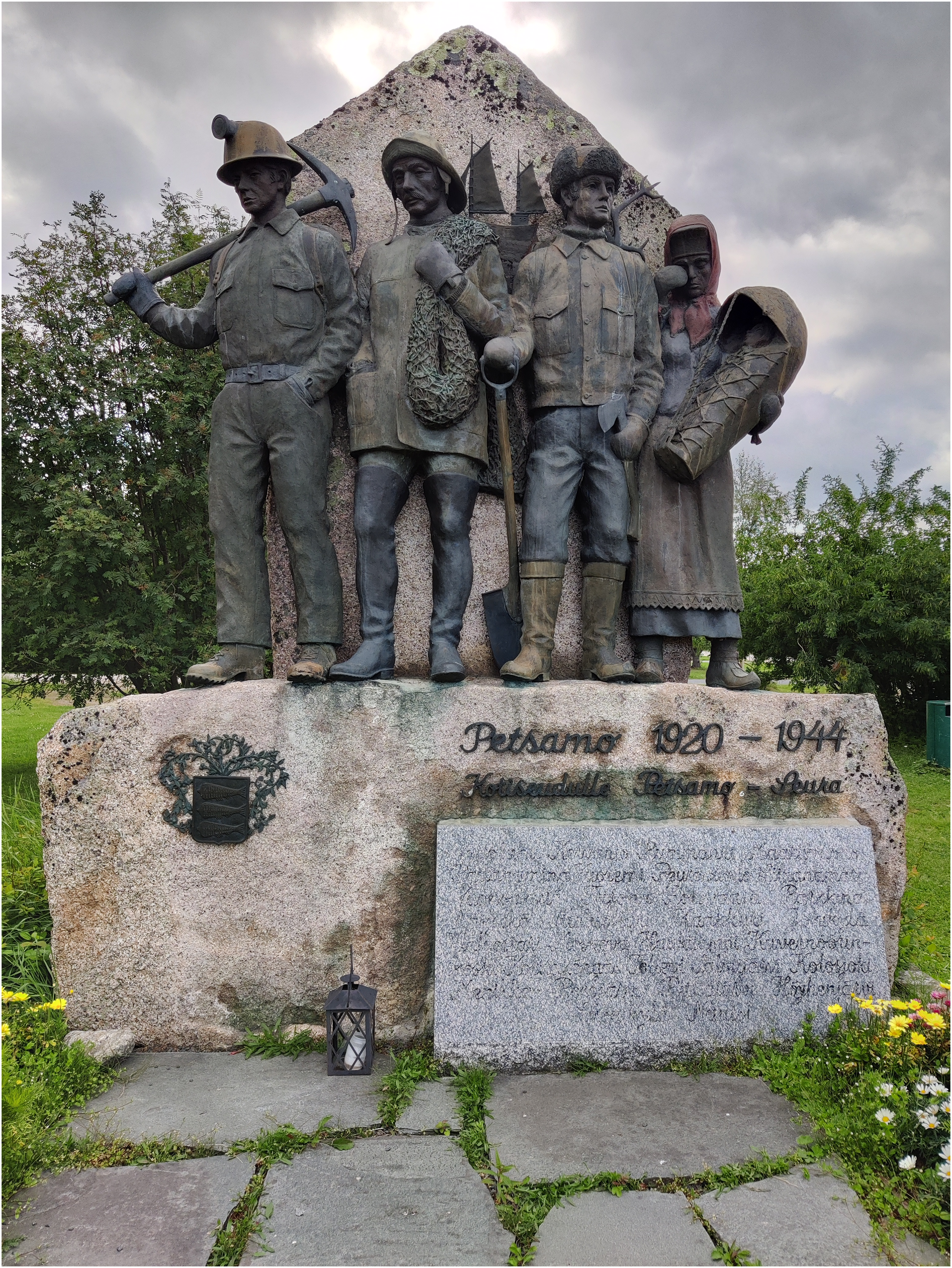
Diaspora of an Arctic Ocean People monument in Ivalo, Finland. Photo by Janne Lahti, 26.7.2021.
By 1920, Finland had secured its newly gained independence in the midst of the turbulent war years, the fall of the Russian Empire and a bloody civil war. Many Finns had high hopes for the territorial expansion of Finnish borders eastwards. These visions did not materialise despite several failed paramilitary expeditions on the Finnish borderlands between 1918 and the early 1920s. But Finland did gain one territorial acquisition in the Tartu Peace Treaty of 1920 – Petsamo on the Arctic Ocean. Finns also sought to actively colonise and settle this area. Between 1920 and 1944, Finnish settlers tried to reshape Petsamo from a multi-ethnic Arctic borderland of Skolt Sámi, Norwegians, Karelians, Russians and Finns into a Finnish homeland. Striving for efficient territorial incorporation, Finns settled, assimilated other ethnicities, built transportation connections and utilised natural resources. But it all came to an abrupt end in 1944 when, being on the losing side of World War II, Finland saw the Soviet Union annexe Petsamo. All Finnish settlers were forced to leave the area immediately. Some 40 years later, in 1985, it was these exiled settlers and their descendants whose efforts led to the installation of a statue in Ivalo.
If it once stood as a ‘great colony for Finnish hopes and dreams’, as one Finnish travel writer visiting the area in 1929 pointed out, 1 then today Petsamo has practically vanished from Finnish public memory. Signs of this ongoing amnesia are everywhere. Petsamo remains absent from the Finnish elementary and high school curriculum and there are few university courses touching any aspect of its history. Academic scholarship on Petsamo also remains rare. 2 Indeed, it is telling that in 2021 there was the 100th anniversary of the first Finnish summer in Petsamo, but officially Finland ‘forgot’ to commemorate it. There were no ceremonies and no museum exhibitions marking the event. 3 No academic conferences or symposia were organised, except for one online webinar. 4 Indeed, it seems as if the nation has chosen to actively forget its short-lived expansionist project. This stands in stark contrast to the memory of Karelia, a territory Finland also lost to the Soviet Union at the end of World War II. Karelia is widely celebrated in Finnish memory, including through its numerous statues. 5
However, while the nation seems to have forgotten, the exiled settlers and their descendants have not. While they could not return to Petsamo even to visit, because the Soviet Union kept the border closed for decades, they established a heritage organisation in 1972: the Petsamo Association (Petsamo seura). Three years later, they began publishing their own still-ongoing journal, Petsamolaista. 6 In short, they strove to keep the memory of Petsamo alive in their own communities and in Finland more broadly. But they have actually done much more than that. In a way, they have engaged in ‘memory competition’ – a struggle against time and looming oblivion. 7 They have produced what I call ‘settler memory’, comprising certain kinds of claims of belonging and connection to the now-lost colony – to a place that was, in fact, a multi-ethnic borderland but is being constructed in memory narratives as a Finnish ‘homeland’. This, despite the fact that the colony was lost decades ago, and in a nation that does not acknowledge that it ever had a colonial history (Figure 2).
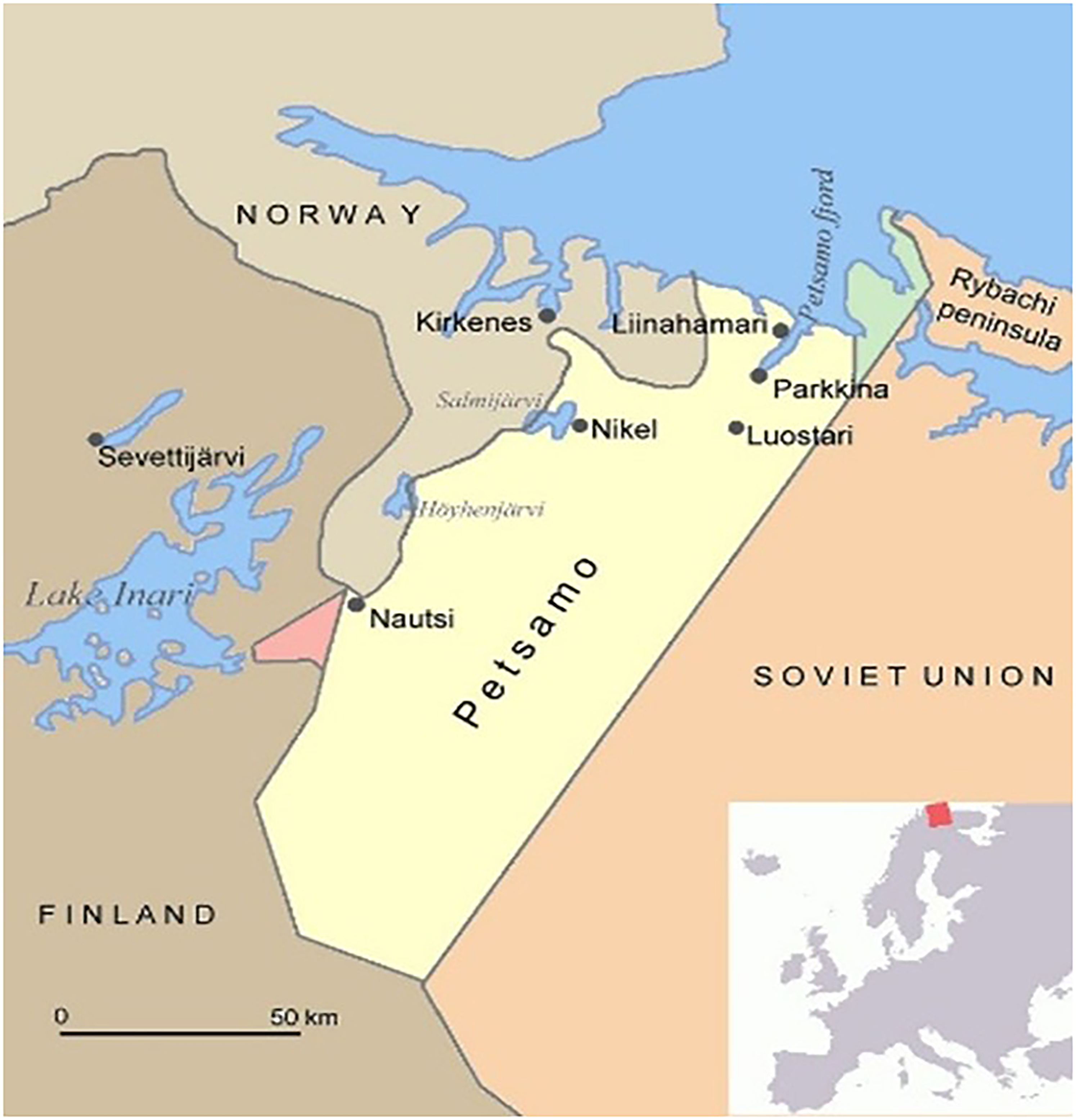
Map of Petsamo area in northern Finland. Courtesy of Wikimedia Commons.
While, as a structure and as a historical process, settler colonialism is about replacement and substitution, settler memory also concerns these similar mechanisms of power, affirming a certain version of the past – of settler heroics, sacrifice and belonging – for the present and future generations. 8 In his use of the concept, Kevin Bruyneel notes that settler memory ‘undermines critical attention to white settler society as a whole’. Bruyneel focuses on how settler memory engages in obscuring exploitative colonisation and the disavowal of contemporary Indigeneity, thus diluting – or watering down – settler colonialism. 9 This article, in turn, stresses another aspect of settler memory: the collective narrations and messages the settlers produce for the purpose of belonging, for making certain historical claims – in this case, for a ‘homeland’. This belonging is a dynamic and continuous process, and a struggle that needs constant reaffirming over time. It needs to be made known and distributed in texts, as well as visualised and performed in monuments. Together, the written word and the visual monument convey the settler version of the past and their role in it. In the pages of Petsamolaista journal, Finnish settlers imagined the land as theirs and envisioned themselves as best suited for the land. The Ivalo monument stands as a testimony and statement of these notions, projecting a message of an ostensibly just and natural connection.
Settler memory – and also actual settler colonisation – is motivated by the desire to transform the superficial historical bond, ‘we just came here’ – and, in the Petsamo case, ‘we just stayed for a brief while’ – into a more natural and deeper rootedness, along the lines of ‘this land made us and we made this land’. Settlers have a meeting with destiny; it is their destiny to settle, their rightful claim. It is somehow made to appear natural, even inevitable. This forms the core of settler memory in Petsamo. Settler memory operates through the renewal of one's own culture on the occupied land, in order to ‘civilise’ it, and at the same time via an attempt to indigenise the settlers, to make their belonging seem normal. In the case of Petsamo, this settler memory also includes the settlers’ attempt to maintain this double purpose of civilising and being native long after the colony was lost. Settlers remain settlers even when forced out, when no longer living in the settler colony. 10 The monument in Ivalo epitomises and reinforces this connection. In fact, it is the monument's primary purpose and function. If monuments in general are entangled not only with the commemoration of historical events and figures but also with broader themes of belonging, memory and identity, then this monument in Ivalo is set up by the settlers to speak their specific stories, their version of the past and of themselves. It serves settler purposes, declaring settler belonging to the broader public, to the nation and even to the world. It maintains and channels settler memory to future generations and remains uncontested and largely ignored by the nation.
When looking at settler memory as history told on and through the Ivalo monument, this article addresses broader settler-colonial spatial practices and identities. While memorial statues and structures imply permanence, these lieux de mémoire – sites and containers of group memory for something that is no longer there – are not settled and are always changing. 11 Monuments reveal and obscure, they remember and they forget, they showcase certain histories while omitting others. Monuments may seek to concretise a single version of history. They mark something worthy of remembering, often something essential to a national or group experience. 12 The monument thus creates a space where visitors or residents can be taught a particular interpretation of the past. Yet the monuments are subject to constant tensions, open to reinterpretation as the social and cultural climate around them rethinks its past. Monuments offer opportunities for dialogical memorialisation and they are reinterpreted, removed and destroyed. As surrounding physical and cultural landscapes change, monuments are carefully maintained or are forgotten. 13
This article depicts settler colonialism in the Arctic that failed not because of Indigenous insurgency but because it was overpowered by a rival power, and looks at how it is remembered by exiled settlers and their descendants living in the former settler nation, in denial of its own colonial past and thus prone to actively forgetting it. It touches on how a short-lived yet ambitious settler project is understood in a country that sees itself as a nation that has never had any colonies and that has considerable difficulty recognising that it may have had a colonial history.
I begin with a brief discussion of how colonial history has been forgotten in Finland and how this has only recently begun to change. I then track settler memories of Petsamo, exploring how a monument was seen as necessary to ensure that the memory of Petsamo would not vanish – that certain narratives of history and belonging, which settlers were actively promoting through their publications, would remain vibrant. My focus here is on the strands of personal and family experience that settlers have chosen to highlight in the periodical of the Petsamo Association, Petsamolaista – a publication created to collect and preserve settler stories and memories of Petsamo. Finally, I turn to the origins of the settler monument as an expression of collective settler identity and consider the expectations that are now being placed on it.
It has become fairly common in recent years for scholars in Belgium, Italy or Germany to comment that their countries suffer from ‘colonial amnesia’ – that histories of colonialism have been swept aside from national narratives, or that persistent public and academic notions exist which frame colonialism as a minor episode in their histories. 14 Amnesia is often paired with notions of exceptionalism – the belief that the nation in question acted as ‘good colonisers’, that they were somehow exceptionally benevolent in their colonial projects and interactions with peoples and environments. In this interpretation, violence, exploitation and racism – all the ugly parts of colonialism – are seen as things only others committed. Strands of forgetting and selective narratives of ‘white innocence’ and ‘exceptionalism’ also endure in Finland and other Nordic countries as they seek to disassociate from the violent and exploitative pasts typically associated with colonialism. 15 But studies of Nordic colonialism have gained increased attention in recent years – whether examining Nordic involvement in British, German or other empires, Nordic expansion and assimilation in Sápmi, or the cultural influence and penetration of colonial thinking across Nordic societies. 16
In Finnish perception, colonialism has predominantly been seen as something that happened a long time ago and far away, and that did not concern Finland or the Finns. 17 Finns remained detached from colonial networks of settler projects, knowledge production and material exchanges. Instead, the national metanarrative emphasises the innocence of a small yet sturdy nation overcoming foreign-imposed hardships through perseverance, hard work, cohesion and sisu, or grit. For a long time, the scholarly consensus supported this vision. Outside Sámi studies, Finnish historians have consciously rejected all colonial connotations in the national historiography. Recently, however, a rising number of scholars have questioned these premises, inspired by postcolonial theory, ‘new’ imperial history, settler-colonial studies and other developments in academic inquiry and beyond, such as the Black Lives Matter movement. 18 Scholars have scrutinised Finnish involvement in the global slave trade, settler colonialism on the Finnish borderlands or diverse forms of connection by Finnish people and groups in the world of empires. 19
Nevertheless, the still-prevalent public understanding of national history has led to a metanarrative of colonial rejection – widely accepted ‘common truths’ with overlapping strands. The first strand, absolute rejection, is the notion that there is no colonialism in Finnish history, that Finns in the past did not participate in that violent and ugly past. The second strand is that, even if there was occasional involvement, Finnish participation is framed as a more peaceful and benevolent colonial association compared to other Europeans. Thus, even if it existed, Finnish colonialism was surely ‘exceptional’, meaning more humane, marginal or merely complicit in the larger story. This is typical, for example, in the way the Finnish migrant experience to North America is understood – even the term ‘settler’ is typically avoided when referring to Finns in this context. 20 The third strand of the argument states that Finns were victims of Swedish and/or Russian aggression and that this constitutes Finland's only colonial history. Obviously, the landmass that constitutes Finland today has a long and at times chequered history under these regimes, until gaining independence in 1917. But being subjects of imperial rule does not preclude other kinds of colonial histories – the kind in which Finns acted as colonisers and imperial agents, whether as colonial administrators, missionaries, travellers, soldiers or settlers.
The fourth strand of this argument asserts that, even if Finns actively participated in colonial ventures, surely Finland has never had any colonies of its own since gaining independence. As settlers, Finns took part in the projects of other colonial empires – from southern Africa to Argentina, and from Australia to Minnesota, Oregon and other reaches of North America. But they also took lands much closer to home – within the area of today's Finland and its borderlands. They took them from the Sámi, historically referred to as ‘Laps’ by outsiders, in what today is still called Lapland. This happened over generations, dating back to the 1600 s, while land use and rights are still contested between Finns and Sámi today. 21 This is where Petsamo comes in – in the contest of Finnish borderlands and expansion. For a little over two decades, Petsamo was a Finnish settler-colonial project. Those who settled sought to make the land their own, seldom questioning their right to be there. They made a multi-ethnic borderland into a Finnish homeland.
During the summer of 1921, the surroundings of the current ‘Diaspora of an Arctic Ocean People’ monument in Ivalo teemed with life as Finns from different walks of life and various corners of the nation made their way up to Petsamo. During that first Finnish summer of Petsamo, an influx of Finnish travellers, researchers, government officials and others filled the trails and riverways of Lapland. Ernst Lampen, a prolific travel writer who was there, contemplated that the ‘flood’ of traffic constituted a kind of Finnish ‘pilgrimage’ destined for Petsamo. 22
Petsamo was added to Finland's territory in the 1920 Peace of Tartu and officially became part of the Finnish nation in January 1921. It stood on the northern border of a marginal European power, and in practice was at first a largely unknown appendage, with a mostly foreign population, culture and religion (Petsamo's Skolt Sámi, Russian and Karelian inhabitants were predominantly Russian Orthodox, while Finns were mainly Lutheran). Petsamo was hard to reach, isolated and sparsely populated by a few thousand residents. Finland, in turn, was a poor country that had gained its independence in 1917 after a century of Russian rule. Furthermore, Finns stood desperately divided as a consequence of a bloody Civil War in 1918, when neighbours killed each other as working-class Reds were pitted against the non-socialist, more conservative Whites. With support from Imperial Germany, the latter had won – but the scars of mass executions and deadly prison camps were visible everywhere.
To measure up as a civilised nation, Finland had much to prove in an era when territorial expansion and possession of colonies were seen as significant indicators of national strength and a level of civilisation. Herein lies the significance of Petsamo for contemporaries. It shows how the boundaries of Finnishness –Finnish space and land – have been changing, blurred and contested. 23 In Petsamo, Finns could test whether the newly independent Finland could measure up as a civilised European nation by showing whether it could colonise and incorporate territory like a civilised nation should – and, in the process, advance European white civilisation to a borderland and frontier that appeared wild, unknown, exotic and Asiatic. Finnish settlers saw that they brought European civilisation to Petsamo, as they sought to make the multi-ethnic Petsamo into a Finnish space and to assimilate the Skolt Sámi through education and the Lutheran faith. They also tended to view the processes of colonisation as beneficial and progressive, and the Sámi as one of the world's vanishing races – prone to disappear and/or assimilate when coming into contact with the ostensibly racially superior Finns. 24 Finns saw opportunities in fishing, and the mining industry also took off in Petsamo at Kolosjoki with its nickel mines, altering the landscape in the 1930s and linking Petsamo more effectively to the Finnish and global economy. Finns also built the Arctic Ocean Highway. Fully opened in 1931, this roadway physically connected Petsamo to the Finnish heartlands. One could take a car from the capital, Helsinki, on the Gulf of Finland and, in a matter of days, drive some 1,600 km to Petsamo. Mining, coupled with the modern highway, brought in more Finnish settlers, tourists and money. Other industries were established, and agriculture extended to new lands. Furthermore, for many contemporaries, Petsamo represented a first step in territorial expansion, especially among those Finns dreaming of a ‘Greater Finland’ that would extend not only to the Arctic Ocean but toward East Karelia and the White Sea in Russian territory. 25 A member of the Finnish delegation in Tartu, Väinö Voionmaa – who was also a history professor and member of parliament – expressed that the Finns belonged to the Arctic Ocean, as ‘a new era of Finnish economic and cultural dominance, prosperity and progress was at hand’. For him, Petsamo was a question of ‘survival in northern Finland’ and of ‘living space’; of ‘opening up a valuable production source and an important colony for our entire country. It is also independent Finland's first step out into the great free world. And it will be the first sign of an expanding Finland […] Our entire people, without distinction, all its layers, are in perfect agreement that now is the moment for Finland to go to the Arctic Ocean’. 26 National strength, vitality and the boundaries of civilisation also occupied the minds of Finnish settlers.
Settler memory
It is notable that, 40 years after losing their homes, these former Petsamo residents still referred to themselves as ‘Petsamoans’, as if still belonging to what they saw as lost homelands. It is also notable that, in their minds, the rest of Finland never truly understood their connection. Instead, the country was bound to forget their very existence and the sacrifices they had made. Settler memory is all about belonging and connection: establishing Petsamo as a Finnish space – no matter how artificial that claim may have been in the eyes of others – and keeping that notion alive, especially as others seemed prone to forgetting it. As Kevin Bruyneel perceptively notes, ‘just as memories make a house a home, collective memory can make a space into a place and speak to a collectivity's relationship to land and legacy that threads together a sense of identity and meaning over time’. 28 When coming to terms with their forced exile, these Finnish ex-settlers viewed Petsamo as both a land of the past – lost to a foreign power – and a place of mythic connection, of eternal belonging.
Settlers around the world habitually showcase a desire and need to make themselves native and local – meaning that they would be perceived to belong to the place – and, in this way, to erase their own traces, their own outsiderness and conquest. 29 This seems to fit the settler memory in Petsamo. Take, for example, the words the penned by the exiled settler Tuulikki Soini in the Petsamolaista journal in 1983. ‘Common memories unite, linking us together as a tribe of a shared destiny’ is how she describes Finnish settlers in Petsamo. It was these ‘tenacious people of Petsamo who made the impossible possible – draining swamps, raising cattle and a whole new generation of people’, she continues. Destiny, grit, hard work and the promotion of civilised life epitomise this memory. Finns remade Petsamo – a tough but also ‘rich’ and ‘hauntingly beautiful’ land – into a homeland by shaping the land itself. 30 In doing so, they acquired a common destiny, a shared purpose and identity.
When examining settler memory in Petsamo, it quickly becomes obvious why the settler types found in the Ivalo monument are those who engage with nature, take control of it and extract its bounty – but also set down roots. Finnish settlers often worked as fishermen, miners (after the Kolosjoki nickel mines opened in Petsamo in 1937) and in forestry. They connected with nature on a daily basis, felt a special connection to the land and wanted to become part of the land. In settler colonialism, nature is often like a blank canvas on which the settler begins to paint their own destiny and reform their own society. The arrival of the settlers lifts the curtain and starts the action. In fact, the settler is the action. But the land is the canvas into which the settlers insert themselves, seek a place in it and depict a profound connection with it – as Soini does above.
Petsamo was frequently represented as wild and untouched before the arrival of settlers. ‘The land was like a new-born’, writes the Finnish settler Rauni Kivenlinna. To this ‘new-born’, Finns came ‘to experience everything they could of the virgin land, as they called it’. 31 The idea of unfished waters and untouched forests was integral to this memory narrative. There was a strong sense of awakening, of encountering pure, virgin land in the settler writings. On one trip to the mountains of Petsamo, where Sámi people had in fact been living for generations, a Petsamo resident wrote: ‘This is a new wild world for us, where only the animals of nature live and roam’. 32
In depicting Petsamo as an empty space, these settlers were employing a popular colonial trope to assert that the land was not used by its current residents and was thus available for civilised peoples looking to settle there. It was not yet a true homeland for anyone, the settlers claimed. Empty lands could justifiably be taken; they had no rightful pre-existing owner. As these settlers wrote that they were encountering unused lands and waters, they erased the Indigenous Sámi histories of the area while establishing their own arrival and eventual dominance.
Another settler who wrote to the Petsamolaista journal, Mailis Huttunen – whose husband worked as a physician in Petsamo – looked back on her stay as an adventure in the wilds of the north. Huttunen was amazed by the mountains and the vastness of space. She felt that the terrain ‘was like a landscape of the moon’ – formidable and barren. The mountains behind their house were particularly impressive and ‘loomed up black and foreboding’. For some people, Huttunen stated, Petsamo proved too much: the mountains fell on them and they could not sleep when the sun did not rise for several months in winter or when it did not set at all in the summer. This ‘harshness of the Arctic climate is unbearable for some people’, Huttunen declared. But for her, this was not the case – as is so typical in the stories of Finnish settlers. Nature might have been tough, but the settler proved tougher. 33
Reprinted in Petsamolaista, Petsamo song – composed for the tenth anniversary of Finnish Petsamo by the Finnish poet Uuno Kailas in 1931 – states: ‘the land, rugged, beautiful, is the land of Petsamo’. Big, wild and harsh, nature is defiant and sometimes dangerous. It is not tame, nor is it what the inhabitants would be used to in other parts of Finland. Petsamo was a frontier area into which the settlers ventured, demanding courage from themselves and defying nature. Their challenge in remaking this borderland into a homeland was immense and laborious. But Petsamo was also a gateway to potential greatness – for the settlers and for Finland. As the song ends: ‘Even now, as a gateway to the melted sea, it [Petsamo] leads our eyes to new paths. If there is a good star leading our people, then perhaps the road to Petsamo is also a path to greatness for us’. 34
Asserting their right to belong through narratives in which the environment is depicted as empty and as a challenge the settlers must overcome, it is also logical that settlers also depict how, as a people, Finns were best suited for this land and the land was just right for the Finns. It was a perfect match. Thus, not only was the land empty before the Finns got there – it was all somehow preordained, as if the land had just rested in waiting for the settlers to show up. Soini argues along these lines, explaining how these actual newcomers – the Finns – deserved to be called indigenous. This was because they were able to tame the wilderness, establish a family and a civilised community and create a future. 35 For Soini and others like her, nature and the land were magnificent, big and beautiful – sometimes unforgiving, but also, eventually, tamed, productive and homely. In the process, the land was made civilised, which meant it became productive and Finnish.
In settler stories, the land provided generous crops – and especially ample fishing. 36 In settler memory, fishing became a reflection of nature's generosity and benevolence towards settlers, but also of settlers’ ability to take what they needed from nature. Fishing stories relate how this harsh northern province could provide something vital in abundance. In fact, more and bigger fish were caught there than almost anywhere else before. Or at least, this is the message conveyed by many of the stories. 37
Because of settler efforts, work and sweat, Petsamo became like the rest of Finland – but in a kind of special way: a wilder version of the rest of Finland, with a Finnish civilising mission. Petsamo, with its strength and harshness, was harnessed as part of the settlers’ own identity. The settlers carried Petsamo with them – and in their memories – as a frontier region which they had shaped into a homeland through their own efforts. It was a profound and powerful connection – where, Soini deemed, Petsamo was a ‘lifeforce’ for Petsamoans. 38
The Ivalo monument espouses this settler memory of ‘lifeforce’, where an area is re-conceptualised as ‘one's own land’ through land-shaping, work, family, posterity – through sweat and blood. It is, in a sense, brought into civilisation's orbit. Mining played a pivotal role in this settler mindset, assuring them that their presence was justified and that they brought civilisation.
In Finnish settler memory, the nickel mines at Kolosjoki, which began in the late 1930s, represented a significant impulse towards modernity. ‘It was only after the start of mining in Nikkel and the completion of the Kolosjoki road that a major migration’ to Petsamo began, writes a Petsamo resident. 39 Mining affirmed the linkage of Petsamo to Western, European civilisation. It brought in more people and businesses, and spurred the construction of homes. It brought new energy. ‘English, Swedish and Finnish were spoken – the latter of course being the dominant language’, says Kivilinna. Like many others, this settler emphasises how ‘money started to come in’ when there were 1,600 workers and ‘a couple thousand more were on the way’. By then, Kivilinna says, there were already ‘department stores, small shops, cafés, a post office, a school, a customs office and a ferry to Norway’ being built in Salmijärvi, near the mines. 40
Settler monument
It was a hot and sunny day on 14 July 1985, and the atmosphere was full of excitement and pride, writes one Petsamoan. She had made the long journey to Ivalo from Haukipudas, near Oulu and some 500 kilometres away, noting that others had come from as far as Stockholm and Kiruna in Sweden. 41 In all, there was a sizeable crowd of an estimated 1,000 people gathered in Ivalo for the unveiling of the monument. Olav Beddari, a current inhabitant of the Petsamo-Norway border region, spoke at the ceremony. He addressed the crowd on how the year 1944 will not be forgotten – when the people of Petsamo lost their homes and the region where many of them, he claimed, ‘had such deep roots’. Beddari pointed out that with the loss of Petsamo, ‘the new generations certainly do not have the same ties and feelings as those of us who remember the old days’. 42 Although Beddari hoped that younger people would grow more interested in their roots and discover their family connections, he also prophesied that those who remember the old days are beginning to die out and that, with them, the personal connections would vanish.
The ‘To the homeland’ text on the monument is a powerful indicator of the type of message it seeks to convey – both in the present and for future generations. In fact, this text and the listing of Finnish names for communities in Petsamo showcase how the monument makes claims for Petsamo to be remembered exclusively as a Finnish space. It is this message and memory that Beddari fears is disappearing – and that needs continual reinforcing. It is this message that is conveyed on the monument itself and that was the Association's purpose for having it built.
Yet, there is also the inclusion of a Sámi woman. Of course, from 1920 to 1944, Petsamo remained – on some level – as much a multi-ethnic borderland as a Finnish homeland. It was a cluster of separate identities and ethnic enclaves, as well as cross-cultural interactions. The monument partially seems to recognise this by including the Sámi woman. First, it should be noted that most Skolt Sámi also had to leave Petsamo in 1944 and settled within Finnish borders. They are a diasporic people then, too. In fact, many of them today reside in relative proximity to the monument in Ivalo, while most Finnish settlers are scattered across the country. Second, the monument does not depict the Skolt Sámi as equal to the settlers. While the settlers stand unperturbed, masculine and proud, the Sámi woman wipes tears from the corners of her eyes. Thus, the statue emphasises the image of the settlers as strongly masculine and the Indigenous people as delicately feminine – a stereotypical view often seen in colonial projects around the world. 43 On the other hand, it is noteworthy that the Skolt Sámi woman is part of the statue in the first place – and that she stands alongside the settlers, not as overtly subordinate to them, nor as a threat. This would indicate the partial inclusion of the Skolt Sámi in the Finnish Petsamo story, at least on some level. 44
Nevertheless, it seems obvious that those present in Ivalo on that July day in 1985 felt and vocally expressed that the key purpose of the monument was to keep the connections to and memories of Petsamo alive. Settler memories were installed on the Ivalo monument – and never was it clearer. In addition to Beddari's emotional speech, Mirjam Kälkäjä, a Finnish journalist and writer born in Petsamo, recited a poem further affirming the bond between the settlers and their homeland. Kälkäjä spoke about how Petsamo was a place of ‘faith’, a ‘new land when taken from the palm of God's hand’ by the settlers. The land empowered the Finns and the Finns made the land blossom. It was a pure, unspoiled connection: ‘power swelled on the shoulders of a man, the energy of a woman's hand was blessed […] people were on the move […] a house rose, a village’. 45 In front of a dedicated audience, Kälkäjä was, de facto, preaching the settler gospel to the believers.
The ‘Diaspora of an Arctic Ocean People’ monument was initiated at the Petsamo Association's yearly meeting in 1977, and it came about through much struggle and effort. It called for planning, location scouting and rigorous negotiations with communal officials and landowners. Finding the sculptor and deciding on the form, material and appearance also took their time and effort. Certain kinds of rocks needed to be located and hauled in from a distance. 46 The whole undertaking required money, which in turn meant fundraising and pleas to the Association membership for aid. Getting the project off the ground proved difficult, and in 1984, half of the required funds were still missing. During the years leading up to the unveiling, the Association and its periodical, Petsamolaista, continuously rallied for the monument. Several editorials called it their grand endeavour – one that demanded all settlers contribute. 47 In all these ways, the monument was always a communal settler effort, reflecting the exiled settlers’ needs and stemming from their initiatives. The Petsamolaista special issue released in 1985 in honour of the monument was finally able to proudly declare: ‘Together we made this happen!’ 48
The Petsamo Association had also entertained the possibility of a memorial within the boundaries of Petsamo to honour the Finnish dead whose gravesites remained in the area. However, the placement of the memorial in Parkkina, in Petsamo, was not successful, as the Association could not reach an agreement with Russian officials. Thus, the Association turned its focus to locations within the Finnish boundaries. A commemorative plaque for the Finnish dead in Petsamo was eventually set up in Nellimi, Inari – on the Finnish side of the border – in 2005. 49
Monumentalising settler memory had been an urgent priority for the Association since the late 1970s, as we have seen – and it remains so. In fact, as recently as 2005, monumentalisation was seen as the sole purpose of the Association by its then – and current – chair. ‘The people of Petsamo may be forgotten unless we monumentalise them strongly enough with various actions. Our time needs to be used for that. For our future generations to come, these will all be very distant history’. He also added that ‘there is no other mission’ for the Association than this. 50
The Ivalo monument served this purpose while representing a united front – keeping the exiled settlers united and involved, and touching all settlers. While the sense of community among those Finnish settlers active in the Association appeared strong in the early 1980s, there was still a very real fear – referred to by Beddari and others – that not only would the nation forget them and Petsamo, but that, as a diasporic people, their communal unity would disappear as original settlers passed away. One exiled settler felt that ‘The current generation are no longer evacuees. They are no longer expatriates – they have assimilated into the local population and have gradually forgotten their original customs and habits. Only the older people still have dreams of distant Petsamo’. 51
Petsamoans in exile lived in all corners of Finland, and they never numbered more than 5,000 or 6,000 people – so these concerns seemed all the more justified. 52 The passing of time, displacement and dispersal, and small numbers all made the monument – getting it established, and the message it was supposed to convey – all the more important. By 1985, many settlers had already ‘assimilated’ into the Finnish mainstream and to the local cultures of their new regions and communities. As such, this talk – and fear – of assimilation reveals a belief that the Finnish settlers of Petsamo formed their own culture and customs, at least in their own minds; that they were distinct and unique because of their settler experience. In their minds, their homeland was – and remained – Petsamo, forever. Or, as one exiled settler put it: ‘The spirit must not be quenched even if we [now] travel unfamiliar roads. We remain inspired by the shared memories of a land [Petsamo] so dear to us. A landscape that cannot be forgotten even if you live to be a hundred years old’. 53
Epilogue
In October 2015, a group of protestors climbed onto the equestrian statue of the C.G.E. Mannerheim – a Finnish war leader and national hero – located at the centre of the Finnish capital, Helsinki. They attached to the statue banners with the Greenpeace logo that read ‘Save the Arctic’, and another that read ‘Self-determination!’ 54 Demanding the Finnish government uphold its commitments to Sámi rights, this protest is one of very few targeting monuments to have occurred in Finland in recent years. It is not representative in any sense, as there is no widespread discussion on monuments and their role in public spaces or on movements targeting potentially contested memorials of the nation's past. A short walk from the Mannerheim monument stands the statue of Tsar Alexander II, the Russian ruler of Finland in the mid-1800s. Located at the heart of the central square of the capital, a monument to a foreign ruler arouses questions mainly among the many tourists who buzz around this busy site – but there is no talk among Finns of removing it. Nor is there any such talk regarding the ‘Diaspora of an Arctic Ocean People’ monument.
Still, Finnish history comes with colonial connotations, and Finland has monuments relating to colonial rule and expansionism. While the state-produced monuments at the heart of the capital do not arouse much emotion, the settler-built monument far north of the Arctic Circle gathers as little attention as the colony and Finnish colonisation it celebrates. It is a monument intimately linked to settler memory and a sense of self – in a time when the colony has long been lost. There are no calls to get the land back either. The monument conveys and funnels, commemorates and celebrates the settlers’ story – oblique and forgotten by the general public, but kept alive by those who lived and experienced Petsamo first-hand. But precisely because the monument is born of settler efforts, telling their version of history, it must be analysed as such – as an expression of group-specific memory produced for specific purposes. As Edward Said notes, this kind of collective memory is ‘a field of activity in which past events are selected, reconstructed, modified and endowed with political meaning’. 55 In the case of Petsamo, the settlers’ monument explains the nature of Finnishness in a region that was supposed to have a Finnish future, but ultimately did not – because a stronger conqueror took it away. The loss of a homeland, as happened in Petsamo in 1944, shattered the settlers’ worldview, their future disappeared, and their belonging was threatened with vanishing. The settlers’ meaning and identity were suddenly called into question – or, worse, erased. They had been excluded from their own history, just as they had been excluded from their own homes. It is here that the monument plays an important function. It counters the exclusion, presenting the settlers as both belonging to the former colony and as victims of forceful expulsion – thus seemingly legitimising their actually fractured connection and affirming their belonging. In reality, however, they were mostly newcomers to Petsamo, although some families had been in the area longer. After all, most Finns did not have deep roots in Petsamo. Building such roots in just two decades was hardly plausible.
Then what does this monument tell us about Finnish colonial memory – what is remembered, and what is forgotten? How does the monument in Ivalo reflect Finnish memory cultures of colonialism? Settler memory is a ritualised process of selective remembrance, and through such processes, settlers narrate their professed connection to land, to their own imagined past and to the nation itself. Settler memory reaffirms the settlers’ claim to belonging – to the annexation of, and authority over, land. It upholds belonging. Memory, as told on the monument, makes the settler belong.
Finnish settlers created stories in which Petsamo was seen primarily as a Finnish space. They thus took over the area through their stories, rewriting its histories to fit the ways in which the Finns brought civilisation to virgin lands. Their aim was to make the area their own. In the process, they carved a special role for themselves. They engaged in a process of building peoplehood – of who a people is, how it is suited to the land and vice versa. All of this is embedded in the Ivalo monument.
