




Abstract
The article analyses how the Alternative for Germany (AfD) conflated images of the traditional family with the nation and a racially-defined notion of ‘Volk’, consciously repackaging terms from the 1930s for current political use. Taking a comparative and historical perspective, the article situates the family rhetoric and policies of the AfD in the historical debates on family, reproduction, and women that characterized Germany from the post-war period to the early 21st century. Exploring how the AfD sought to portray and regulate women's roles and reproductive decision-making, the article argues that the party sought to produce an authentic take on family and gender politics, the racism of which went practically unchallenged. It presents four analytical dimensions to grasp the specific biologist family-centrism and anti-gender approach of the AfD in comparison to National Socialism family rhetoric and policies. Sources come from official party platforms, less formal speeches and social media content of party representatives, newspaper coverage and reports by the German Intelligence Service, Bundesamt für Verfassungsschutz.
During the German parliamentary election campaign in the summer of 2017, a massive billboard captured the attention of passers-by in German towns and cities: A smiling pregnant woman, young and white-skinned, lay on the grass, above the slogan: ‘New Germans? We make them ourselves’. 1 Rather openly, both the image and the subtitle referred to the classical tropes of the National Socialist cult of motherhood: blond, young, able-bodied maidens reproducing for the benefit of the German nation (Figure 1). 2
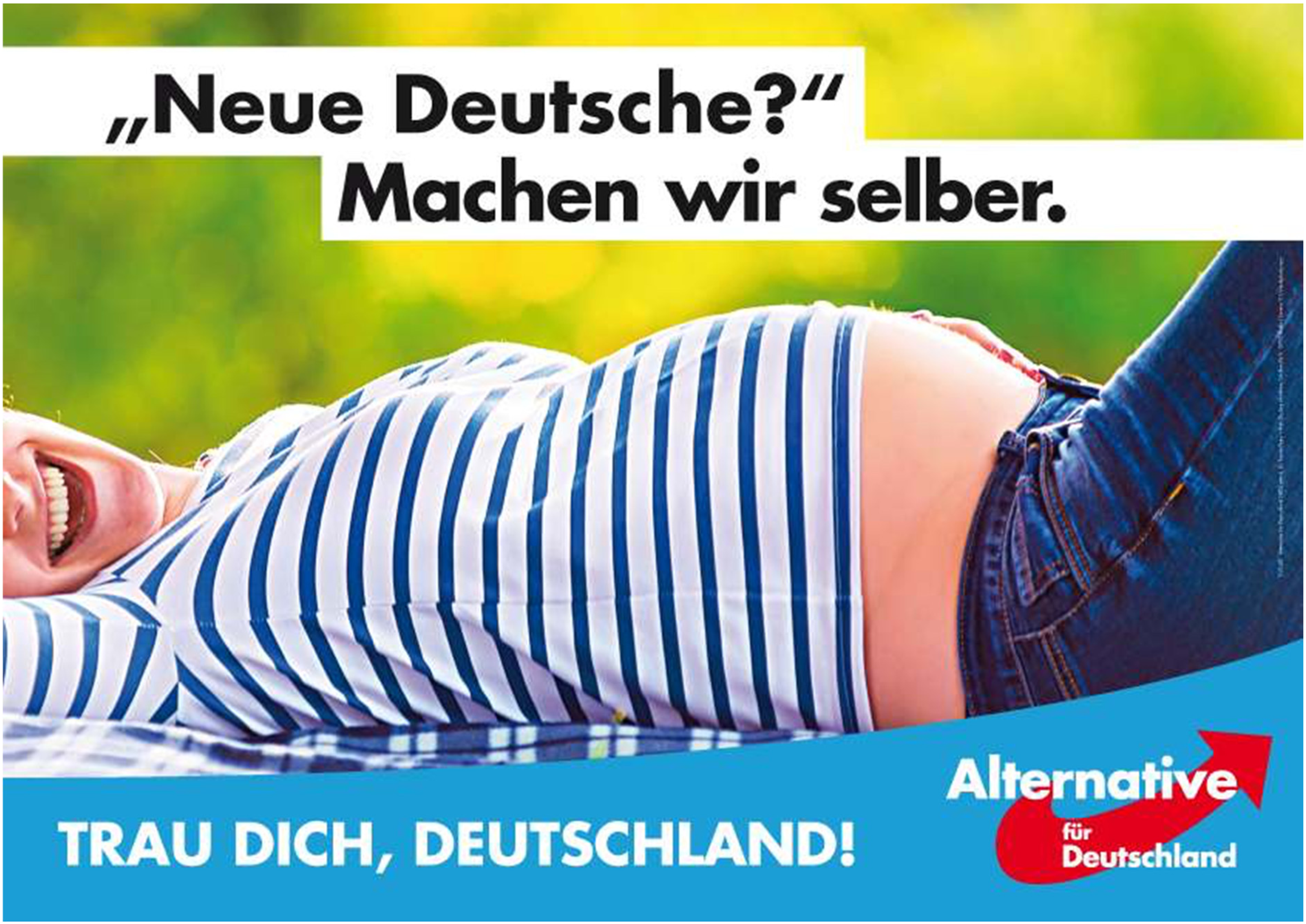
This AfD campaign poster is taken from the 2017 election campaign. Image downloaded from https://cdn.afd.tools/wp-content/uploads/sites/111/2017/07/BTW2017_Plakat_Neue_Deutsche_Ansicht_Q.pdf (accessed 26 August 2020).
This open appeal to bio-politics, ethnocentrism and xenophobia came from the right-wing and populist party Alternative für Deutschland (AfD) – Alternative for Germany. Placing the ‘white healthy family’ at the centre of its political programmatic and campaign iconography, the AfD presented itself as the true German ‘pro-family’-party committed to protecting the German nation. Along a similar vein, the co-founder and then-chairwoman of the AfD, Frauke Petry, posed with her baby son asking ‘And what is your reason to fight for Germany?’ (Figure 2)
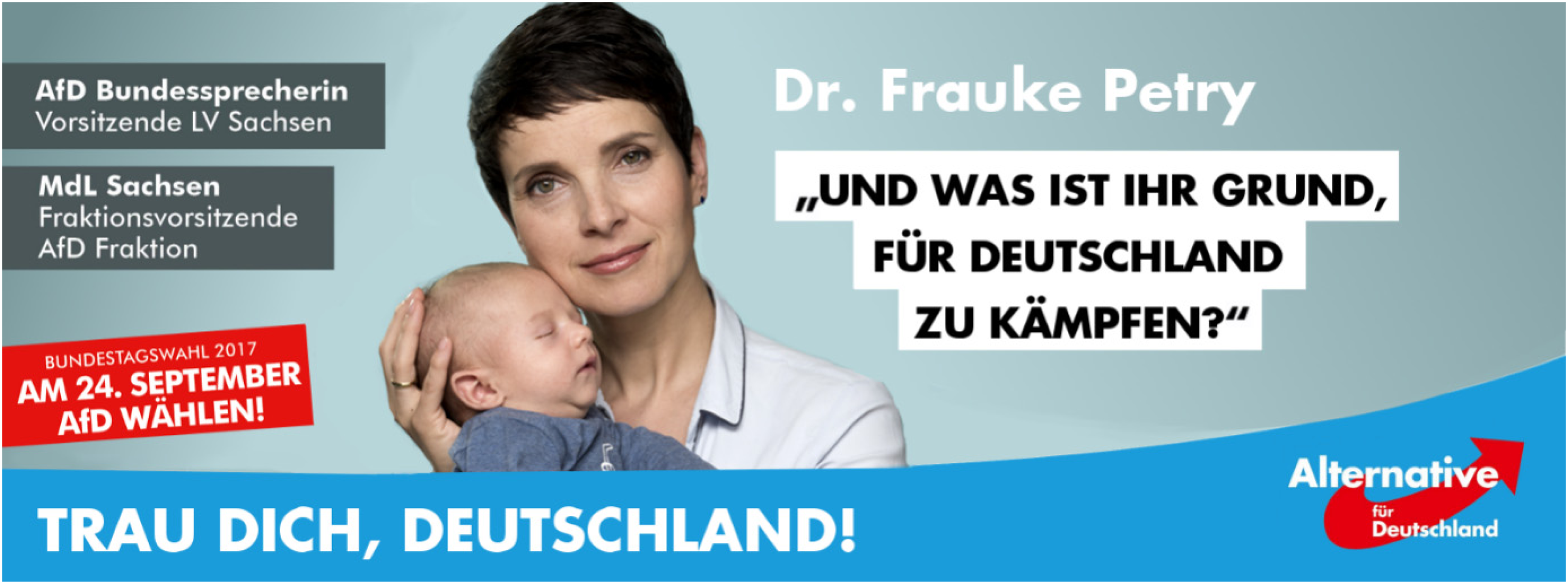
This AfD campaign poster is taken from the Facebook page of Frauke Petry (dated 31 July 2017). Image downloaded from https://www.facebook.com/Dr.Frauke.Petry/photos/d41d8cd9/1556434114409230/ (accessed 22 October 2020).
The picture and the message of the poster linked reproduction, womanhood and the family to the fight for a renewed German state. It was a motherly duty, so the message went, to stand up and fight to preserve one's child's future. This future required a German nation composed of an ethnically purified populace. The fight for Germany's future would be a war of the cradle, with great dependence on mothers’ attempts to stem the tide of the ‘Great Replacement’ created by masses of non-white immigrants and their high reproduction rates. To underscore this point, the AfD reintroduced ‘Volk’ into the political debate, a term that had previously been discredited due to its eugenic connotations and role in legitimizing the National Socialist policies of exclusion. In an interview with the German Newspaper Die Welt in September 2016, Petry claimed that the term ‘Volk’ needed to be purged of its tainted Nazi-legacy and racist content and be equated simply with ‘nation’: ‘We should strive to re-establish a positive connotation of the term. To equate Volk with racism to me seems absolutely wrong’. 3
Founded in 2013 as a party of EU-sceptics, the AfD has since developed into a radically nationalist, populist force with a strong right-wing component. 4 Capitalizing on German voters’ anxieties of globalization, immigration and social change, the AfD expanded quickly, especially in the Eastern German regions. It grew into the third biggest political fraction in the German parliamentary elections in the autumn of 2017 (12.6% of the vote and 94 seats), scored high in the election of the European Parliament in May 2019 (11% of the German vote), and finally became the second biggest political fraction in the elections in the Eastern German federal states of Brandenburg, Saxony and Thuringia in the autumn of 2019. Concerned about possible infringement on democratic tenets and values, the German Intelligence Service (Bundesamt für Verfassungsschutz, BfV) classified the party and its youth organization Junge Alternative für Deutschland (JA) as a case for inspection (‘Prüffall’) in 2019 and as suspect of being hostile to the constitution (‘Verdachtsfall’) in 2021. 5 In March 2022, the Cologne Administrative Court confirmed the BfV's classification. 6 Despite recent losses, the AfD still forms a relevant fraction in the Federal Parliament (10.3% of the vote in 2021) and is currently represented in every Regional Parliament (Landtag) except for Schleswig-Holstein (2022).
In the following, I argue that – although barely noticed by political commentators or historical analysis – the concept of the heteronormative, patriarchal family and an appeal to abide by firm gender norms have played a central role in the AfD's quest to enter the political mainstream and, ideally, the German Government. The attempted ‘biological’ reconstruction of the ‘German family’ was displayed in the controversial ‘new Germans’ campaign poster of the summer of 2017. The images associated with this campaign anchor my analysis of the rhetoric and policies of the AfD to historical debates on family, reproduction and women in Germany throughout the 20th and early 21st centuries. I argue that the metalanguage of the family permitted the party and its key figures to effectively extend the boundaries of the discourse to infuse eugenic and racist reasoning into the political mainstream. While the idea of ‘biologically’ strengthening the family served to legitimize the re-introduction of the term ‘Volk’ alongside the nation, the AfD's family concept seems both rooted in history and completely timeless. On the one hand, it evokes notions of an idealized ‘golden age of marriage and family’, supposedly situated in the first half of the 20th century (and before the time of ‘destructive liberal experiments’ of the 1960s and the 1970s) – and thus echoes a radicalized version of Ronald Reagan's pro-family rhetoric of the 1980s. On the other hand, the party presents its idea of naturalized gender norms and the nuclear family consisting of male breadwinner, homemaker mother and their biological children as universal and timeless – and thus promises to purge the nation of the stains of liberal value change by guiding German families back to the ideal form.
Analytically, focusing on family and gender policies of the AfD from a historian's perspective yields three important findings: First, the field of family and gender is an important cornerstone for modern political ideologies, and is particularly salient for right-wing ideologies. The family is commonly considered the foundation and nucleus of society, while family values and gender roles, reproductive decision-making and population policies stand at the centre of controversial political debate in modern societies. Gender is likewise important, as gender essentialism is a foundational part of right-wing beliefs about hierarchy and inequality. Secondly, the field of family and gender can serve as relatively ‘safe terrain’ for AfD politicians – compared to more fraught fields such as immigration, internal security and Holocaust remembrance, where any comment or activity is closely monitored by the German Intelligence Service. An emerging body of scholarship from the political and social sciences has found that European right-wing and populist movements tended to use anti-gender sentiments as ‘symbolic glue’ or an ‘affective bridge’ to win support and, in turn, undermine the liberal democratic order. 7 This article demonstrates that dynamic with respect to the AfD, and adds a historical perspective: drawing on the idea that the heteronormative patriarchal nuclear family was the foundation of the nation and thus deserved protection – a concept that had been central in post-war Germany –, the AfD managed to secure support from far beyond the traditional right-wing camp. Although contemporary populism and right-wing extremism in general and the AfD in particular stand at the centre of considerable research activity, most critical approaches do not apply a distinct historical perspective – a striking gap in the research literature this article is seeking to fill. While some recent publications have investigated the gender policies of the AfD, 8 historical studies that address the interconnection of gender and nationalism tend to focus mainly on the 19th century. 9 Lastly, although there is a rich literature on anti-feminist movements in the Kaiserreich, the Weimar Republic and the 1990s, anti-feminist tendencies in the two German states after 1945 have not been objects of scholarly scrutiny so far. 10
This article proceeds in three sections: The first section provides a brief overview of National Socialist reproductive policies and its post-1945 legacies in the Federal Republic of Germany (FRG) to provide a point of comparison with the family policies and gender concepts of the AfD. The second section considers how the official party platforms of 2016, 2017 and 2019 conceptualized women mainly as reproducers and places this analysis in a much-neglected historical perspective. The third section investigates how leading party representatives targeted the reproduction of migrants and Muslims in less formal speeches and Facebook posts as demographic threats to the German ‘Volk’. In this section, I am also interested in uncovering the historical lines of reasoning addressed to support such racist and ethnonationalist claims. In my conclusion, I compare National Socialist and (neo-)conservative family rhetoric and reproductive policies with that of the AfD, and thereby develop four analytical dimensions to grasp the AfD's particular biological family-centrism and anti-gender approach.
The archive for this analysis includes the party platforms (General Platform of 2016, German Parliamentary Election Platform of 2017, European Parliamentary Election Platform of 2019), 11 speeches and articles by major party representatives, as well as analyses of the press coverage in the German weeklies Die Zeit and Der Spiegel between June 2016 and February 2020 12 and materials of the German BfV. A secret 400-page report on the AfD that was leaked in January 2019 proved an especially important source, given that it voiced serious doubts about the constitutionality of the party itself, including some of its most radical branches and personalities (thus triggering further investigations), and it provided a preliminary analysis of speeches, social media posts and tweets produced by leading AfD functionaries. 13
The topic comes with methodological pitfalls given that studying a contemporary party requires the analysis of open source material and online content. To add historical depth, the contemporary dissection of AfD materials is situated in the voluminous research on National Socialist gender norms and family policies, while also comparing the AfD's family agenda to traditional family politics of conservative parties in Germany after World War II.
In the Nazi State, a racist doctrine was the official guideline of family policies. The National Socialist regime both constructed an idealized notion of the ‘hereditarily healthy family’ and its counterpart, the ‘racially or socially degenerate family’. It used the family to introduce a selective racial policy, striving to control reproduction, family life, and eventually the entire private sphere. 14 Already in Mein Kampf, Hitler had demanded that all racially valuable members of the German ‘ethnic community’ had the duty to reproduce, 15 whereas the NSDAP Party Platform of 1932 cautioned that the survival of the nation depended on ‘the formation of families’: ‘Their final destruction would mean the end of all humanity’. 16 Whereas ‘wanted families’ enjoyed a wealth of pro-family rhetoric and social policies, ranging from moral support to financial assistance, ‘unwanted families’ lived under constant threat. Either accused of ‘bad racial traits’ or ‘unwanted socio-political behaviour’, they became victims of coercive measures, ranging from discrimination to forced sterilization and murder. As the case of euthanasia victims and their families demonstrates, the lines between ‘wanted’ and ‘unwanted’ families could easily blur. 17
With regard to Nazi bio-politics, two aspects are of special importance: The first aspect, as stressed by the Nazi State, propagated and glorified Aryan women's reproductive roles, 18 which nevertheless implied the mobilization of women within the ‘ethnic community’ and, later, in the war effort. 19 In numerous speeches, Hitler continued to remind German women of their ‘natural duty’ of childbirth as woman's ‘battle ground’: ‘With every child she bears, she fights her fight for the nation’. 20 Secondly, the Nazi regime tied motherhood to a racist paradigm. Already with the eugenic laws of the early 1930s (Gesetz zur Verhütung erbranken Nachwuchses 1933, Gesetz zum Schutz der Erbgesundheit des deutschen Volkes (Ehegesundheitsgesetz) 1935), the regime drew a clear line to exclude ‘racially unwanted’ women from procreation. 21 As the war progressed, an increasingly number of slave labourers were relocated from Eastern Europe to the Reich. Following Nazi racist logic, their reproduction had to be ‘contained’. While contraception and especially abortion were forbidden for Aryan women, the regime sought to impose contraception and even abortion on non-German women from Eastern Europe. 22 When these women managed to carry their pregnancy to term and give birth, their new-borns – numbering in the tens of thousands – were, however, starved to death in so-called ‘Ausländerkinder-Pflegestätten’, while the mothers had to remain in slave labour. 23
These policies towards ‘unwanted’ mothers and children were far more effective than Nazi appeals to the duties of Aryan motherhood, as illustrated by the fact that during this time the German birth-rate stagnated at around two children per women. 24 Yet the glorification of German motherhood lived on: Not only could German mothers of the post-war period rally behind the image of the brave and industrious ‘Trümmerfrau’, 25 they also were praised as the backbone of the imagined post-war family by well-known contemporary sociologists such as Helmut Schelsky. 26 Depicting women as silent and dutiful reproducers who were thoroughly apolitical, Nazi reproductive policies might have even facilitated German women's transition into the post-war society – as their willing support for the regime escaped critical scrutiny for quite a long time. 27
While women had earned the vote after World War I and pushed for a number of liberal reforms in the fields of sexual morals, reproductive decision-making and education during the Weimar Republic, 28 the National Socialist double demand on Aryan women as reproducers and backbone of the segregated ethnic community, had a largely undiscussed afterlife in the two German states. 29 Women in the German Democratic Republic (GDR) were granted formal equality – which basically meant that they were needed as parts of the workforce – but had to balance the triple shift as workers, homemakers and mothers. Interestingly, their work-force participation did not topple the traditional gender order, which meant that women continued to be responsible for the tasks of homemaking and mothering. 30 On the other side of the iron curtain, their sisters in the FRG were sent home in the first decade after the war to rebuild their war-struck families and provide comfort to their husbands. 31 Recent studies have revealed the crucial impact of the moral codes of the Catholic Church, at least on West German conservatism and the initiatives of the family department that provided housing and family allowances to cater to the patriarchal nuclear family. 32 Social scientists as well as the first family minister Franz Josef Wuermeling (1953–1962) favoured the patriarchal family and heteronormative marriage as antidotes both to Communism and Nazism. 33 As a result of heated debates on women's equal rights and the Gleichberechtigungsgesetz (Equal Rights Decree) of 1957, however, more options for women's agency emerged in the 1950s even prior to the women's movement of the late 1960s. Investigating these negotiations that signal a more ambivalent process than a simple ‘road to the West’ or ‘Westernization’, current research stresses the need to reconsider the history of West German democracy from a gendered perspective. 34 Notably, in both German countries, women's formal citizen rights and legal equality were not accompanied by a lasting shift in the gender order that enabled women (and men) to overcome essentialized gender norms. 35 While the GDR struggled with the contradictions between formal equality and the additional strains that workplace participation, household and childcare placed on East German women, the FRG hailed the patriarchal family and a dualistic gender order. 36 In the West in particular, it remained women's task to come to terms with the burdens of Nazism by integrating into a newly framed patriarchal society – although small gains such as part-time work could be made. 37 Even during the late 1960s and the 1970s, commonly coined as a period of fast social and normative change, women's rights and decision-making options did not rank centre stage, as recent studies have argued. 38 The aftermath of reunification in the 1990s even reinforced gendered spheres as East German women had to learn that neither first-trimester abortions on demand nor effective childcare were common currency in the West – although current histories of the time have shown only minor interest in these forms of ‘gender trouble’. 39
After the World War II, the family remained the key unit of bio-political approaches in Germany and across Europe: Countries consolidating after the Second World War sought to strengthen their ‘healthy families as the foundation of the nation’ while eagerly denouncing eugenics as Nazism. In the immediate aftermath of the war, some countries such as Poland and France adopted thoroughly pro-natalist policies to counter the losses of war, before gradually accepting birth control and legal abortion. 40 Although the GDR made first-trimester abortion available on demand in 1972, 41 West Germany remained rather reluctant to legalize abortion. The punitive law that strictly forbade abortion (§218) was not revised until 1976, and only then with a tepid and restrictive ‘indications approach’ that upheld abortion as a crime, which is only exempt from punishment subsequent to several indications and mandatory counselling. 42 Moreover, the Nazi past still shaped discussions of disability, reproductive decision-making and legal abortion in the FRG. On the one hand side, the German state continued to discriminate against individuals with disabilities, and supported eugenic sterilizations of disabled persons into the 1980s. 43 On the other, anti-abortion activists and the Catholic Church equated abortion with ‘euthanasia’ and helped to contain women's decision-making rights. When the Christian Democrats came to power in 1982, their program of an ‘intellectual and moral turnaround’ (‘geistig-moralische Wende’) primarily addressed family values, blocking abortion reform and emphasizing traditional gender roles and the value of nuclear family. 44 To stimulate reproduction rates and offer alternatives to female workforce participation, the conservative coalition issued a law that recognized child-rearing as a socially relevant task and granted mothers a monthly allowance (Erziehungsgeld) in 1985, which was later combined with additional old-age benefits for mothers. 45 Despite this heightened emphasis on traditional family values and gender norms, the expected growth of the birth-rate did not materialize – apparently women's and couples’ responses to conservative family policies were all but monolithic. However, the Kohl Era's (1982–1998) conservative rigidity in terms of family policies, gender norms, abortion rights and the ensuing ‘modernization deficit’ in matters of gender equality fully came to the fore when the GDR collapsed. In the early 1990s, women's access to abortion, childcare and workplace equality was negotiated anew – and East German women were shocked to find themselves deprived of such basic, albeit central, rights as available childcare and legal abortion on demand. Here, not only a ‘modernization deficit’ of the West German state in terms of gender norms and values became tangible, but East German women's rights, demands and experiences were marked as less important and even ‘selfish’ – compared to the objective of (male-dominated) political re-unification. 46 Whether such blatant negation of women's legitimate claims, in the long run, paved the way for the AfD's attacks on women and gender rights remains an open question.
Another decade later, at the beginning of the new millennium, German debates on reproductive decision-making were firmly anchored in European and global human-rights discourses. While the UN Convention on the rights of persons with disabilities of 2006 enforced equal rights of persons with disabilities, EU rights discourses and strategies to support women's rights underscored demands for gender equality. 47 And it was in this moment of social liberalization that right-wing parties such as the German AfD stepped onto the contemporary historical stage, contributing to a European far-right agenda of family policies – as did the Yellow Wests in France, the Populists in the Netherlands, the FPÖ in Austria, the PIS Party in Poland, followed by Italian and Hungarian Nationalists, only to name a few.
In 2010, German right-wing politician (former social democrat) and intellectual Thilo Sarrazin had paved the way for a new right-wing movement when he published his influential and vitriolic discussion on the reproductive decline of the white middle class (Deutschland schafft sich ab – (Germany disposes of itself). 48 To him, the staggering white birth-rate was a result of the assumed fecundity of Muslim immigrants who produced masses of little girls wearing ‘head scarves’ (‘Kopftuchmädchen’) who would soon become mothers of more offspring themselves. On a national scale, the AfD could build on these foundations while, starting in Dresden, the protest movement ‘Pegida’ (‘Patriotische Europäer gegen die Islamisierung des Abendlandes’ – Patriotic Europeans against the Islamization of the Abendland) took the protests against ‘non-white reproduction’ to the streets. 49 Thus, while National Socialist Germany was the only European regime to openly advocate ‘race’ and ‘nation’ as central guidelines of its policy, West German and post-1990 political discourses also contained references to the ‘natural’ dualistic gender order, the importance of the heteronormative family as the unit of reproduction, and the worth of white offspring. However, it was the AfD that – capitalizing on anxieties as well as citizens’ disappointment with party politics and the democratic state in general – promised to protect the family against the hazards of both immigration and social change.
German women as reproducers: qualitative analysis of the party platforms 2016, 2017 and 2019 in historical perspective
In the three platforms of 2016, 2017 and 2019, the AfD foregrounded family issues and endorsed women's reproductive roles. By doing this, the party transported a specific reading of an idealized historical European past (condensed in the idea of the Abendland) that glorified heteronormativity, ‘ethnic purity’ and a firm gender order. 50 Five different dimensions stand out: First, all appeals to (German) women's reproductive capacity were couched in a rhetoric of salvation. Emphasizing a perceived dramatic decline of the ethnically German and Western European population, the AfD called for a battle of the cradle – to preserve the German people. 51 The General Platform of 2016 put it even more bluntly: ‘More children instead of mass immigration’. 52 In its platform for the European Parliamentary Election of 2019, the AfD argued that the low birth-rates endangered ‘the preservation of the rich and varied European culture for future generations: Civilizations that lose their population, will perish from history one day’. 53 As a cure, the AfD recommended a pronatalist policy using the examples of France, Poland and Hungary. 54 For instance, the Polish PIS and the Hungarian Fidesz party of Premier Victor Órban have recently introduced generous financial incentives such as child benefits and marriage loans to strengthen the birth-rate of the ‘right’ segments of the population. Moreover, the quote directly alluded to the Nazi rhetoric of population loss, racial degeneration and cultural ‘suicide’. Hitler had argued in Mein Kampf and political speeches that a healthy, racially-sound population was crucial for the preservation of the German Volk as the bearer of European culture. 55 These assertions reached beyond Germany. The former Italian Secretary of State Matteo Salvini (Lega Nord, 2018–2019), directly echoed the tune of the AfD program: In his speech at the annual convention of the right-wing network World Family Congress in Verona in 2019, Salvini declared Italy needed to produce more babies ‘as a country without babies is a dying country’. 56 Such statements and international networks suggest that the AfD's program and rhetoric are representative of a transnational trend to limit women's rights and confine them once more to biologically-defined gender roles while attempting to ‘purge’ and re-appropriate elements of Nazi reproductive policies to enhance the national, ethnically homogenous birth-rate. 57
The second dimension referred to the traditional family as the foundation of the nation and Volk that had to be strengthened at all costs. For the AfD, the patriarchal family stood as the nucleus (Keimzelle) of civil society, and the party demanded a new active family policy that especially fostered large families. 58 Obviously, for the AfD, only heterosexual married couples and their biological children counted as ‘family’ in the proper sense. 59 To incentivize this family formation, the AfD proposed marriage loans ‘to enable parents to buy real estate while the debt would be reduced with every new-born child’ – with strong echoes to the Nazi Ehestandsdarlehen policies. 60 This pronatalism went hand in hand with the discrediting of single-parent families as dysfunctional and the promise to modify no-fault-divorce, which the AfD interpreted as detrimental to the preservation of marriage and family. 61 Specifically, the AfD denounced both the West German family law reform of 1976 and the East German family law of 1965 of having facilitated easy divorce at the expense of the traditional family. 62
The third dimension centred on a reorganization of women's work and childcare. Full-time motherhood and a male breadwinner were endorsed as the ‘natural’ family concept while working motherhood was discredited as a vital danger to the emotional development of young children. Instead, women were encouraged to stay home to take care of their children – especially during the first three years of the children's life. 63 A position paper of the AfD in Nord Rhine-Westphalia expressed it paradigmatically: ‘The best day-care for a toddler is on mummy's lap’. 64 In the party platforms, women's participation in the labour force was presented as the result of dire economic necessity or as pure selfishness, and never as a personal or legitimate choice of self-fulfilment or as a valuable contribution to civil society. 65 Here, the AfD denounced the epochal (and transnational) trend of women's participation in the labour force, especially since the second half of the 20th century. 66
The fourth dimension addressed the protection of the life of the unborn, and relied on vehement criticism of legal abortion under the headline ‘welcome-culture for new-borns and unborn’ – a well-crafted attack on the original term ‘welcome-culture for migrants’ introduced into the political debate by Chancellor Angela Merkel in 2015. 67 Arguing that only 3% to 4% of the current number of 100,000 abortions per year were legitimate and necessary (for criminal or medical reasons), the party declared that all other terminations were unwarranted and served only women's convenience. The AfD promised to foster adoptions and to support ‘women in need’, and warned women of potential health risks such as the ominous ‘post abortion syndrome’. It concluded resolutely: ‘Abortion is not a human right as the right to life or bodily integrity’. 68 In addition, ‘the AfD fights all attempts to trivialize and publicly fund abortions or even regard them as a human right’. 69 Thus, the party denounced women's fight for legal abortion over the entire 20th century, as well as the human rights framing of reproductive decision-making initially introduced by UN in the late 1960s. 70
The fifth dimension consisted in a vocal assault on Gender research. For the AfD, Gender Studies aimed at ‘destroying the natural polarity of gender characteristics’. Thus, the party promised to withdraw all research funding on the national and European level and ban affirmative action quota systems, school sex education and even non-discriminatory language. 71 ‘Gender ideologies’, according to the argument of the AfD, especially weakened the traditional family, to them a direct violation of the German constitution. 72 Conversely, the AfD upheld the idea of biological gender differences and women's specific tasks as reproducers. The concept of ‘natural gender roles’ neatly fit into standard transnational anti-gender discourse, but with a specific anti-EU twist that denounced the Amsterdam treaty's introduction of gender mainstreaming in 1997. In the context of Germany, the AfD sought to discredit and abolish more than two decades of gender research and anti-discrimination politics. 73 In its platform for the European election, the party rejected reproductive technologies and adoption as an option for homosexual couples, and lambasted surrogacy as a selfish strategy that neglected the well-being of children and indulged parents’ self-realization. 74 While religious fundamentalists and anti-LGBTQIA+ movements in other parts of the world have also stressed the problematic and potentially exploitative aspects of surrogacy, the AfD denied same-sex partners any right to reproductive decision-making altogether.
Taken together, these five dimensions clustered around the different meanings of women as reproducers – the duty to reproduce for the Volk, traditional family values, women as caregivers, the right to life of the foetus, and ‘natural gender roles’. For the AfD, women did not figure primarily as individuals that could claim human rights or the right to make decisions about their bodies and careers, but as vessels for enhancing the birth-rate. Interestingly, each of these dimensions can be traced back to Hitler's programmatic book Mein Kampf and appeared in several major speeches of the ‘Führer’ and Reich Chancellor as well, loaded with the virulent racism of the Nazi era. While this does not suggest simplistic analogies between today's AfD and the NSDAP of the 1930s, the AfD's readiness to sacrifice women's reproductive – and, thus, human rights for the benefit of the ‘traditional family’ in a more or less explicit violation of European gender rulings and international human rights, merits further scrutiny and stands out as a historical attempt to turn back the processes of normative pluralization since the 1970s. Thus, the AfD presented a reading of the German past that indulged in an anachronistic vision of the traditional family and sought to ‘normalize’ biologist reasoning. By this, National Socialism appeared as only one less important element of German history in the greater context of the European occident and its rich culture that had to be protected at all cost. But did (and does) the AfD also advocate explicitly racist goals in the realm of reproduction and family? A closer inspection of the rhetoric and political planning of the party targeting migrants and refugees provides additional insight.
Demographic threats to the German Volk across time: The reproduction of migrants and Muslims in speeches and social media posts
The 2019 report of the BfV, recent statements made by AfD members, and newspaper coverage, demonstrate that the party employs xenophobic and racist tropes in their treatment of migrants and Muslims with regard to their reproductive decision-making. Across Europe, similar discourses, which disparage Muslims and refugees as hyper-fertile, have offered a rallying ground for right-wing and populist activism to promote an ethnically exclusive concept of the heteronormative family. In addition, the Verfassungsschutz focuses primarily on the AfD's rhetoric in fields such as immigration policies and internal security, and thus devotes little (if any) attention to openly racist propaganda that is linked to the family.
In AfD politicians’ formal and more informal statements on the reproduction of migrants, I have identified four arguments that – placed in a historical perspective – invite an analysis of longer traditions of biologist and racist concepts of the family. First of all, AfD politicians applied their pronatalist reasoning only to ‘German families’, arguing that more ‘German babies’ were needed to stem the tide of immigrant fertility. This strand of reasoning can be traced back to Sarrazin's argument that the German people ran the risk of shrinking to ‘a minority within a Muslim country’ while being ‘too sluggish and indolent as a Volk and a society’ to produce enough babies. 75 As in the party platforms, women figured primarily as reproducers, but this glorification of motherhood was always ethnically exclusive: For example, the notorious chairmain of the AfD in Thüringen, Björn Höcke, declared in a speech in Jüterborg in March 2017: ‘To counter the demographic disaster unfolding since the last 40 years […] we need, obviously, a “Yes” to children – not any children, but, of course, German children in Germany’. 76 In another speech in Gera in August 2017, he blamed the former secretary of defence, Ursula von der Leyen, for having declared that ‘The children of migrants are our future’, and concluded instead: ‘German children are our future’. 77 The local AfD chapter of Gifhorn-Peine went even further and suggested on its FaceBook account to allocate a lump sum payment of Euro 614 to ‘every German family’ – instead of supporting refugees with surplus money from the 2016 tax revenues. 78 The AfD was thus signalling that the government supported refugee families at the expense of ‘German families’, which lacked financial incentives to reproduce.
Several AfD functionaries linked this quest for more German babies to the preservation of the country and ‘Volk’ with warnings of what they termed a ‘Islamist birth jihad’, a second dimension. 79 In 2018, for instance, Björn Höcke quoted the Turkish President Recep Tayyip Erdoğan who had addressed the Turkish population in Germany: ‘Make five children, not just three. For you are the future of Europe’, and concluded: ‘Dear friends, that was a call for an Islamist birth-jihad in Europe’. 80 Another AfD politician, Marc Jongen, then Deputy Regional Chairman of AfD Baden-Württemberg, echoed that the ‘jihad […] is not only waged with weapons […] There are many different forms and one of them is through birth and a high birth-rate’. 81 The AfD North Rhine-Westphalia put it even more bluntly in a FaceBook post of March 2018: ‘Nearly 185,000 children of foreign women – an increase of 25%. Together with the births by migrant women who already have German citizenship, easily another 100,000 Mohameds, Achmeds and Aishas must be added. A city the size of Münster just added in one year. […] ‘We conquer Europe through the bellies of our women’, an Imam claimed in England. This pervert plan bears fruit, apparently also here in Germany’. 82 This was exactly the rhetoric of the Great Replacement, in this case invoked to discredit German migration policies as a menace to Europe and the occident, enshrined in the mythical idea of the Abendland. 83
The third dimension connects the idealized German family and the concept of the violent Muslim migrant: German women and girls appear as victims of rape and murder, and immigrant men are described as hypersexual, violent aggressors in a specific twist of Orientalist discourse. 84 Spurred by the sexual violence of the Cologne night of New Year's Eve 2015/2016, 85 AfD politicians repeatedly insisted that German women and girls were vulnerable to rape and violence by aggressive migrants, while neglecting to mention the prevalence of domestic violence and sexual assaults enacted by ‘German men’. While the chairman of the AfD in Mecklenburg-Vorpommern, Dennis Augustin, claimed that ‘German young men had to watch helplessly a muslim mob descend on their women and girlfriends like monkeys’ in a speech in July 2017, 86 his colleague from Saxony, Jörg Urban, went on to blame democratic society as a whole, ‘as many young girls are being led into the arms of their rapists and murderers. Politicians, journalists, the churches, teachers, associations – all tell the girls not to discriminate against so-called ‘refugees’ but to take care of them’. 87 The notorious Höcke, finally, made clear that the ‘our women and our daughters’ were made victims of ‘an ideology, which, in its culturally destructive [kulturzersetzend] character is only a deduction of criminal, historical socialism’. 88 This last quote linked the racist discrimination against migrants, especially Muslim men, and the critique of the governing parties as infested by socialism and thus dangerous to European culture. Again, such tirades resonated with the rhetoric of Hitler's speeches and writings, where he tirelessly blamed Judeo-Marxism for the attempted destruction of Aryan culture and European civilization itself. 89
Taken together, the AfD mobilized racist stereotypes for an ethnonationalist concept of ‘Volk’ and ‘nation’, based on the reproduction of the right (that is, white and German) kind of people. Warning of an ‘Islamist birth jihad’ and assaults on ‘German women and girls’, party representatives amalgamated well-known tropes of ‘the other as rapists’ and ‘the war of the cradle’ into contemporary images of a failing immigration policy. This strategy also emphasized eugenic readings of ‘German’ men (as protectors and fighters) and women (as peaceful reproducers), who had to unite in fighting the ‘Great Replacement’. Culminating in the claim that Germany was facing an Umvolkung – a term originally coined by the National Socialists to conceal the ethnic cleansing carried out in the occupied territories during World War II –, the AfD managed to depict Germans as victims of current immigration policies. 90 Maximilian Krah, since 2019 Member of the European Parliament for the AfD, declared in October 2018 that the German government was practicing Umvolkung through a ‘fundamental change of the ethnic composition of the population’, ‘knife attacks, rape, and Islamization’, as well as ‘compassion for perpetrators and discrimination of protest’. 91 This perception of an ongoing Umvolkung/‘Great Replacement’ reclaimed ‘Germany for the Germans’ – a tried-and-true National Socialist tenet. AfD politicians demanded that rather than caring for economic migrants from all over the world, the current government should foster the German family. 92 This brings me to the fourth and final dimension: the appeal to the German family as the germ cell of the Volk in a eugenic sense to counter the threat of Umvolkung and the like – emphasized not in official party platforms but in speeches and social media posts.
As early as 2015, Björn Höcke had declared the following in a speech in Erfurt: ‘Only the traditional family – which consists of father, mother, child – is the germ cell of society and state and will provide for our future as community’. 93 A year earlier, he had postulated in front of the AfD's youth organization that gender polarity and the family as the germ cell would serve to support ‘the higher development of mankind’. 94 Here, links to Nazi rhetoric were quite explicit. In 1943, for example, after 10 years of racial discrimination and the genocide of the European Jewry being executed amidst a brutal war of extermination, the NSDAP presented three guidelines for its future population policy: ‘(1) to foster the hereditary healthy family with many children as the natural germ cell of the Volk, (2) to secure the biological growth of the Volk through rising birth-rates, (3) to keep German blood and German honour pure vis-à-vis people of alien blood’. 95 Currently, these ideas can be traced especially in the Volkish settlement movement (Völkische Siedlerbewegung) that has been mushrooming in the rural regions of Eastern Germany during the last decade. 96 In such areas, close networks with AfD politicians and other far-right circles also help to spread the concept of rural Aryan settlements, as the latest expertise of the Amadeu Antonio Foundation has argued recently. 97
Given these resounding similarities in discourse and policy proposals, the question arises: Why is the AfD not denounced as an outright neo-Nazi party, but rather supported as an ultra-conservative or even populist one by many voters? Apparently, it does not help to conceive of the party's electorate as protest voters or people alienated with politics in general. Instead, one central element of the answer might be that much of the AfD propaganda focuses on the family. AfD's gender and family policies used to provoke much less reaction by the democratic parties than any allusion to blatantly racist or right-wing tenets. Thus, the AfD managed to ‘couch its “völkische Weltsicht” (Volkish world-view) in the seemingly harmless context of gender and family policies, receiving merely the label ‘conservative’ in this field”, as contended by Elisa Gutsche recently. 98 Whether this might change in the near future and whether the democratic parties will succeed in fighting the AfD's ascendency remains completely open.
Conclusion
The rhetoric of Volk and family employed by the AfD can be subsumed in four main analytical dimensions: the need for more ‘German babies’ to counter the effects of the ‘Great Replacement’, the idea of an ‘Islamist birth jihad’ that threatens the ‘West’ or the ‘Abendland’, German women and girls as victims of Muslim men's sexual assaults, and, finally, the family as the ‘germ cell’ of a reinvigorated nation. As this historical analysis demonstrates, the party consciously rephrased historical tenets of National Socialism, namely the image of the family as a biologist ‘germ cell’, the claim that it was women's prime duty to reproduce, the fear of the destructive effects of ‘alien blood’, the idea that Germans (and Western Europeans) were the bearers of Western culture, the denunciation of socialism as purely destructive, the perceived need to protect the German Volk and to forge an ethnically homogenous population. On one hand, this was new rhetoric resonating with a current wave of ethnonationalism in Western Europe. On the other hand, it represented continuities with the gender essentialism of the Weimar period and the post-war period of national reconstruction in the 2nd half of the 20th century. Referring to these well-known tropes in the light of contemporary problems and cautiously cleansing them of their most immediate racist and anti-Semitic content, the AfD presented itself as the sole protector of German women and families against the backdrop of globalization, immigration, ‘gender fascism’ and the overall menace of the ‘Great Replacement’.
Amongst the different elements, the family in particular served as an ideal terrain to shift the boundaries of the discourse and integrate racist rhetoric without being denounced as a Neo-Nazi party: While the BfV reacted sensitively to the AfD's racist and ethnonationalist propaganda that targeted migrants and the democratic order as such, it did not focus much on the party's gender critique, anti-abortion stance and family rhetoric. The field of gender and family opened up a wide and prolific field of action for the AfD, where it could draw on long – and still effective – German and international traditions of anti-feminism – in the name of ‘Volk’ and nation-state.
While the AfD in its official party platforms endorsed the traditional family in the realm of family policies, values, gender relations, reproductive decision-making and abortion legislation, it apparently struck a chord that was also acceptable for parts of the conservative mainstream in Germany. When addressing their supporters, however, the party representatives voiced their concern in more explicitly racist terms and regarded the family as a site of Volkish reconstruction that relied on the superiority of ‘ethnic Germans’ and helped to contain the ‘biologist menace’ of immigration. This double speech – constituting the conservative appeal to family values in official platforms, and the racist rhetoric in oral presentations and social media – seemed to have worked perfectly well, opening up ways of identification for supporters and sympathizers alike and concealing part of the most acid and racist content from public scrutiny as ‘just family policies’.
While it does not come as a surprise that AfD supporters accepted even outright racist rhetoric, the observation that parts of the conservative mainstream could align with the party's emphasis on the traditional family and a segregated gender order demands further explanation. Here, a long-term perspective on the history of gender equality and its limits in Germany as suggested in this article seems particularly promising: As the analysis has shown, current fundamentalist appeals to strengthen family values in the face of social change can draw on a secular trend in Germany, namely the long-standing enshrinement of the traditional nuclear family, the male breadwinner and the heteronormative marriage that solidified after World War II. In this sense, the AfD's strategy to focus on the family discloses an important blank spot in our democratic society that has profoundly historical roots.
Footnotes
Funding
The author disclosed receipt of the following financial support for the research, authorship, and/or publication of this article: This work was supported by the Deutsche Forschungsgemeinschaft in the framework of SFB 1150 Cultures of Decision-Making, Münster University.
