




Abstract
Qualitative researchers often invoke history as backdrop rather than as a constitutive force. We introduce the Digging Method, an archaeologically inflected framework that integrates temporal depth into qualitative inquiry by treating organizations as stratified formations. The method translates four archaeological sensibilities; stratification, depth, residues/legacies, and erasure, into a transparent, auditable protocol comprising four stages: (1) mapping temporal layers through explicit periodization and reflexive rationale; (2) collecting heterogeneous residues across archives, intergenerational interviews, material artefacts, spaces, and symbols; (3) layered analysis via stratum-tagged coding that tracks continuities/ruptures and treats absence as data; and (4) relational interpretation that links strata to contemporary practices, ideologies, and governance. Hypothetical illustrations (a long-established university, a family firm, a public health agency, and a technology start-up) demonstrate how the approach surfaces persistent meanings, contested silences, and the co-presence of multiple pasts. We position the Digging Method as complementary to ethnography, grounded theory, narrative, and process research while adding explicit procedures for analyzing how accumulated layers shape present action. We also specify quality and ethics safeguards (strata x source triangulation matrices, audit trails, reflexive memos, protocols for handling sensitive archives). Framed as history-as-method, the Digging Method advances the historic turn by enabling temporally rich, cross-disciplinary, and ethically attentive analyses that are replicable and reviewable. We conclude with guidance on integrating stratigraphic coding into existing designs and discuss limitations (layer blurring, archive sparsity) and future directions (metrics for layer density/erosion, digital residues, and integration with longitudinal case designs).
Keywords
Qualitative inquiry has long provided textured accounts of organizational life, giving scholars access to lived experience, meaning-making, and emergent processes. Ethnographies of workplaces, narrative studies of identity, and grounded theory analyses of routines have generated valuable insights into how organizations function in the present. Yet despite this richness, the past is often treated as mere background rather than as an active, stratified force shaping the present. Organizational temporality is thereby flattened: history is invoked for scene-setting or as illustrative anecdotes, rather than analysed as layered, enduring, and contested.
Classic work on organizational memory drew attention to the persistence of the past. Walsh and Ungson’s (1991) influential framework demonstrated how residues of prior decisions, routines, and relationships endure to condition current action. This line of thought established that memory is not confined to individual cognition but is distributed across organizational repositories such as procedures, artefacts, culture, and physical arrangements. However, what remains underdeveloped are methodological tools that make such residues systematically visible in empirical research. The consequence is a tendency for scholars to gesture to history rather than systematically excavate how the past persists and constrains present action.
In recent decades, the so-called “historic turn” in organization studies has challenged this tendency. Scholars have argued for temporal depth and historiographical reflexivity, demonstrating why and how the past matters for identity, legitimacy, change, and strategy (Decker et al., 2020; Maclean et al., 2016). This work has expanded the range of sources deemed relevant for organizational research: archives, oral histories, visual artefacts, and material infrastructures have all been mobilised to show how past traces inform the present. In addition, the historic turn has underscored that history is not a neutral record but a socially constructed and contested narrative, raising questions of power, selectivity, and silence (Clark & Rowlinson, 2007; Rowlinson et al., 2014).
At the same time, the historic turn has not been without controversy. Historians have frequently criticised organization scholars for treating the past instrumentally, selecting episodes to illustrate theoretical arguments, while management researchers have argued that descriptive chronologies, without conceptual framing, offer limited analytical value (Rowlinson et al., 2014). This tension has produced a fertile but unresolved debate: how can scholars both respect the integrity of historical sources and generate theoretically meaningful insights? The Digging Method responds to this challenge by offering a systematic protocol that bridges these concerns. It grounds analysis in concrete residues, archival materials, and spatial and symbolic dimensions, while also producing interpretations that speak to organizational theory.
Despite these advances, there remains limited methodological guidance on how to conduct stepwise, layered analyses that move beyond surface narrative. Most contributions focus on whether and which historical materials to mobilise, or on the epistemological debates between history and organization theory. Less attention is paid to procedures that can systematically trace sediments across time in a transparent and auditable manner. For instance, while archival research has been emphasised as a source of “hard traces” (Decker, 2013), and narrative analysis has been used to interpret stories of organizational pasts, the field lacks a coherent protocol for integrating multiple layers of residues, archival, material, discursive, and spatial, into a unified analysis.
This article responds to this gap by proposing the Digging Method, an archaeologically informed framework that treats organizations as stratified sites. It conceptualises organizations as layered formations in which residues of past ideologies, structures, and practices accumulate and continue to shape present processes.
Translating core archaeological sensibilities into qualitative inquiry, the Digging Method specifies a structured analytic procedure for tracing temporal layers and relating present practices to their historical strata (Ricoeur, 2004; Rowlinson et al., 2014).
Our aim is methodological: to provide a practical and transparent protocol that enables researchers to systematically trace how temporally layered residues shape present organizational life.
This article makes three contributions. First, it conceptualises organizational stratigraphy as an analytic object. Second, it specifies a transparent, stepwise procedure for tracing temporal layers and residues. Third, it addresses issues of quality, reflexivity, and ethics specific to stratigraphic analysis.
In doing so, we advance the agenda of the historic turn by moving beyond surface-level narratives to engage critically with the coupled processes of remembering and forgetting that contour organizational life today (Decker et al., 2020; Maclean et al., 2016; Rowlinson et al., 2014). The Digging Method invites organizational researchers to excavate rather than merely describe, to reveal the layered temporality of organizations, and to recognize history not as backdrop but as a constitutive force.
Background & Methodological Gap
Qualitative traditions provide powerful lenses for grasping the complexity of organizational life. Among the most influential, grounded theory furnishes systematic, inductive procedures for theorising through iterative coding and constant comparison (Glaser & Strauss, 2017). Its strength lies in its disciplined openness to emergent categories and its capacity to generate mid-range theory directly from data. Ethnography, by contrast, yields thick description through immersive fieldwork, foregrounding the situated practices and meanings of organizational actors (Van Maanen, 2011). Narrative inquiry directs attention to stories as sites of identity construction and sensemaking, treating participants’ accounts as key vehicles through which organizational realities are produced and contested (Czarniawska, 1997). Each of these approaches has substantially expanded our capacity to capture lived experience, emergent process, and the interpretive work that sustains organizations.
Yet these traditions remain largely present-oriented. Grounded theory typically analyses interviews or observations conducted in the here-and-now, building theory from contemporary data. Ethnography, with its commitment to participation and long-term immersion, similarly centres on present practices and interactions. Narrative inquiry, while more open to retrospective accounts, often treats historical material as an actor’s current narrative resource rather than as a layered, structuring force that continues to shape practice. As a result, historical residues are often acknowledged but rarely operationalised as systematic data.
Organizational memory research made early inroads into this problem by recognising the enduring influence of past decisions, routines, and relationships. Walsh and Ungson’s (1991) framework identified repositories, individuals, culture, transformations, structures, and ecology that carry forward residues of experience into present action. Subsequent research has elaborated on these insights, showing how artefacts, routines, and discourses sediment organizational memory (Anteby & Molnár, 2012; Feldman & Feldman, 2006). However, most qualitative designs still mobilise these concepts descriptively, using “memory” or “legacy” as explanatory labels rather than systematically excavating the processes through which such residues endure, interact, or disappear.
Scholars of collective memory further remind us that remembering is always accompanied by forgetting. What is actively recalled is inseparable from what is strategically silenced, neglected, or erased (Connerton, 2008). In organizational research, however, this duality is seldom treated systematically. While commemorations, rituals, or anniversaries may be analysed as acts of remembering, the methodological treatment of absence, such as missing documents, suppressed voices, or silenced episodes, remains underdeveloped. Without explicit procedures for analysing erasure, scholars risk reproducing the selective narratives that organizations themselves construct. This gap underscores the importance of designing tools that allow both presence and absence to be examined as data.
The historic turn in organization studies has highlighted the need for temporal depth and historiographical reflexivity. Scholars have urged us to treat organizations not as synchronic entities but as processes embedded in layered histories (Maclean et al., 2016; Rowlinson et al., 2014). Important work has demonstrated how archives, oral histories, and artefacts can be harnessed to study identity, strategy, and institutional change (Decker, 2013; Ybema, 2014). However, much of this guidance remains at the level of epistemological debate, how to reconcile history and organization theory, or which types of sources count as legitimate, rather than specifying procedures that researchers can follow to conduct layered analysis in a transparent and auditable manner.
This methodological shortfall has practical consequences. In the absence of systematic protocols, historical materials often appear only as scene-setting or illustrative context, while the analytic focus remains squarely on the present. Organizational temporality is thereby rendered linear: a “before” and “after” framing that risks obscuring how multiple pasts persist simultaneously in the present. For example, a firm’s founding ideology may continue to shape its strategic narratives decades later, even as material infrastructure from a later growth phase coexists and interacts with those older commitments. Without a method to trace such overlaps, researchers risk flattening the temporal complexity of organizational life.
What is needed, then, are methodological tools that align with the proposition that organizational temporality is stratified rather than linear. Researchers require approaches that (a) conceptualise the past as multilayered strata carried forward into the present, (b) specify how to identify and sample residues across archives, interviews, spaces, and symbolic systems, and (c) render the analytic process transparent and auditable to guard against selective interpretation or romanticising traces. Meeting these requirements would not only extend organizational memory research but also advance the historic turn’s agenda of temporal depth and historiographical reflexivity (Maclean et al., 2016; Rowlinson et al., 2014).
The Digging Method proposed in this article responds directly to this gap. Drawing inspiration from archaeological excavation provides a structured framework for identifying, coding, and interpreting layered residues. Rather than treating historical data as supplementary context, the method positions them as constitutive elements of organizational life, shaping what is possible in the present. In so doing, it bridges the methodological lacuna between the concept of persistence and the analytic procedures needed to trace it empirically.
The Digging Method
Metaphorical Foundation
Archaeological excavation begins from the premise that sites are stratified formations rather than homogeneous wholes. Layers accumulate through time; each stratum holds residues of prior practices, materials, and meanings. Excavation is therefore not neutral fact-recovery but a form of interpretive labour that situates traces in situ within wider historical and cultural milieus (Hodder, 1999; Lucas, 2012). Archaeologists stress that every layer embodies not only material deposits but also absences, gaps, and silences. What survives and what erodes, what is preserved and what is erased, all reflect historical processes of power, conflict, and contingency.
We treat organizations analogously. Like archaeological sites, organizations accrue sediments over time, strategic decisions, ideological commitments, cultural norms, symbolic artefacts, procedural routines, and material infrastructures that endure even as new layers are added. A merger, for instance, may deposit structural and cultural traces that persist long after formal integration. Similarly, a founding mission statement may be reinterpreted but never fully erased, resurfacing in symbolic rituals decades later. These residues, often hidden from everyday view, condition contemporary action and shape what is remembered, forgotten, or strategically silenced (Rowlinson et al., 2014).
The metaphor reframes qualitative inquiry from observing surfaces to excavating strata. As a disciplined heuristic (Cornelissen et al., 2008), it foregrounds stratification (organizations as temporally layered formations), sedimentation (residues of prior practice structuring present activity), and contextual reconstruction (reading traces in relation to both organizational and broader historical contexts). Anchored in these principles, the Digging Method specifies procedures for making layered histories empirically tractable (Cornelissen et al., 2008; Hodder, 1999; Lucas, 2012). In doing so, it extends qualitative traditions by treating organizational temporality as material and stratified, rather than as a narrative backdrop.
Importantly, metaphors in organization studies are not simply rhetorical devices but generative heuristics that open new lines of inquiry (Cornelissen et al., 2008). The excavation metaphor highlights depth, sequence, and layering, enabling us to see organizations not as flat or continuous but as multi-temporal formations. At the same time, the metaphor must be used reflexively: unlike archaeological sites, organizations are not literally buried in soil but are constituted through discursive, material, and symbolic processes. Recognising both the productivity and the limits of the metaphor is crucial for methodological rigour.
Core Principles
Stratification
Strategic decisions, cultural shifts, and structural reforms deposit successive strata, each encoding a regime of meaning, practice, and ideology. For example, a national airline may retain traces of state ownership long after privatisation, with bureaucratic routines persisting alongside newer market-driven practices. Recognising sequence and discreteness enables researchers to locate contemporary practices within their historical layers rather than treating them as singular or novel (Hodder, 1999; Maclean et al., 2016).
Depth
Traces of the past vary in visibility, from surface-level discourse and policy documents to buried archives, neglected artefacts, and tacit routines that endure in practice, paying attention to multiple depths guards against mistaking apparent novelty for rupture. A corporate rebranding may seem like a sharp break, yet deeper inspection may reveal continuity in physical infrastructures or ritualised behaviours (Lucas, 2012). Depth thus requires researchers to probe beneath the visible discourse to identify the less-obvious sediments that continue to shape action.
Residues and Legacies
Past practices persist as material, symbolic, and procedural residues, “memory in place”, that shape interpretation and constrain change (Rowlinson et al., 2014; Walsh & Ungson, 1991). Examples include organizational slogans that survive in employee folklore, obsolete technologies that still underpin core systems, or rituals that persist despite formal restructuring. Such legacies are not inert; they provide resources for sensemaking, identity work, and resistance. Analysing residues highlights how the past actively conditions present possibilities.
Erasure and Selective Memory
Excavation reveals not only what endures but also what has been silenced or overwritten. Organizations selectively carry forward elements of the past to protect legitimacy, obscure failure, or craft identity (Connerton, 2008; Trouillot, 1995). For instance, firms may highlight stories of entrepreneurial innovation while muting episodes of labour conflict or scandal. Forgetting is thus not simply an absence but an active social process, often contested among organizational actors. Recognising erasure alerts researchers to the politics of memory and the role of silence in shaping contemporary narratives.
Note on the Metaphor
While the excavation metaphor provides a powerful heuristic, it also risks overdeterminism if interpreted too literally. Unlike archaeological sites, organizational layers are not physically deposited in soil but are constituted through ongoing practices, discourses, and artefacts. Layers may overlap, blur, or be reinterpreted rather than forming a discrete sequence. In organizational settings, such blurring may also occur deliberately, as actors reinterpret or obscure elements of the past for political, reputational, or legitimacy-related reasons. A reflexive stance, therefore, requires researchers to treat stratigraphy not as a mechanical analogy but as an analytical lens for disciplined inquiry. Used critically, the metaphor foregrounds temporality, persistence, and erasure while remaining attentive to the interpretive and contested nature of organizational life.
Procedure
The Digging Method unfolds through four interconnected stages that together provide a systematic protocol for excavating organizational strata. While presented sequentially, these stages are iterative in practice, with insights from later steps prompting refinements in earlier mappings.
Mapping the Site
The first step is to delineate the major temporal layers of the organization under study. Researchers develop a temporal cartography by identifying founding moments, crises, mergers, technological shifts, leadership transitions, or regulatory reforms. These events serve as plausible boundary markers for strata. For example, a university might be mapped into a founding period tied to a national mission, an internationalisation phase in the 1980s, and a financial crisis in the 2000s.
This mapping is not merely chronological but interpretive: it frames which residues are likely to be encountered and guides sampling. Periodisation requires an explicit rationale for why a given moment constitutes a rupture or transition. Reflexivity is crucial here, as the very act of dividing time imposes an analytic order onto organizational history (Suddaby & Foster, 2017). Researchers should document their reasoning, creating an audit trail that later readers can evaluate.
Collecting Residues
Once strata are mapped, the second step is to assemble heterogeneous traces. The Digging Method encourages researchers to triangulate across media and generations, resisting reliance on a single data type. Possible sources include. (1) Archives: minutes, reports, policy documents, annual statements, press releases. (2) Interviews: across generational cohorts (e.g., retired employees, mid-career staff, newcomers) to capture layered perspectives. (3) Material artefacts: office layouts, uniforms, tools, architecture, and everyday objects. (4) Symbolic markers and rituals: logos, ceremonies, commemorations, slogans. (5) Spatial arrangements: the persistence of certain buildings or physical infrastructures that encode organizational memory.
Triangulation surfaces both complementary and competing memories, enabling the researcher to detect not only continuities but also contestations. For instance, official archives may portray a merger as smooth, while oral histories emphasise cultural conflict. By capturing residues from multiple angles, the method minimises the risk of selective interpretation (Decker, 2013; Ybema, 2014).
Layered Analysis
The third step involves analyzing materials with respect to the mapped strata, rather than relying solely on emergent themes. Researchers code each excerpt or trace according to both thematic content and temporal stratum. This stratum-tagged coding allows continuities, ruptures, and transformations to be tracked systematically.
Layered analysis makes visible how practices, discourses, and artefacts cluster within certain periods and how they shift across layers. For example, “service to the nation” might appear in early documents as a civic duty, later as international prestige, and more recently as market competitiveness. Without a layered approach, these shifts could be misread as inconsistency rather than transformation across strata.
Crucially, analysis attends not only to presence but also to silence and absence. Erased traces, such as missing files, absent topics in official reports, or muted episodes in organizational memory, become analytic data in their own right. Recognising absence as evidence prevents researchers from overemphasising visible residues while ignoring what has been strategically forgotten (Maclean et al., 2016).
In practical terms, stratum-tagged coding can be implemented using widely used qualitative data analysis software. Programs such as NVivo, ATLAS.ti, and MAXQDA allow researchers to assign both thematic codes and attributes representing temporal strata, enabling excerpts to be tagged simultaneously by theme and layer. For example, in NVivo, temporal strata can be defined as document attributes (e.g., “founding,” “crisis,” “transformation”), while thematic patterns are captured through standard coding procedures. Similarly, in spreadsheet-based approaches (e.g., Excel), excerpts can be organized in a matrix where each row represents a data segment and columns capture both thematic codes and temporal strata. These tools facilitate analytic transparency and support a clear audit trail of stratigraphic coding.
Relational Interpretation
The final step is to connect historical strata to present practice. This involves asking. • How do prior routines enable or delimit current possibilities? • Which ideologies persist beneath formal organizational change? • Which absences or silences indicate selective forgetting?
Relational interpretation treats organizational life as an ongoing negotiation with multiple pasts rather than a linear progression. The aim is to produce an integrative narrative that demonstrates how historical residues and erasures shape current practices, policies, and identities (Rowlinson et al., 2014).
The Digging Method at a Glance
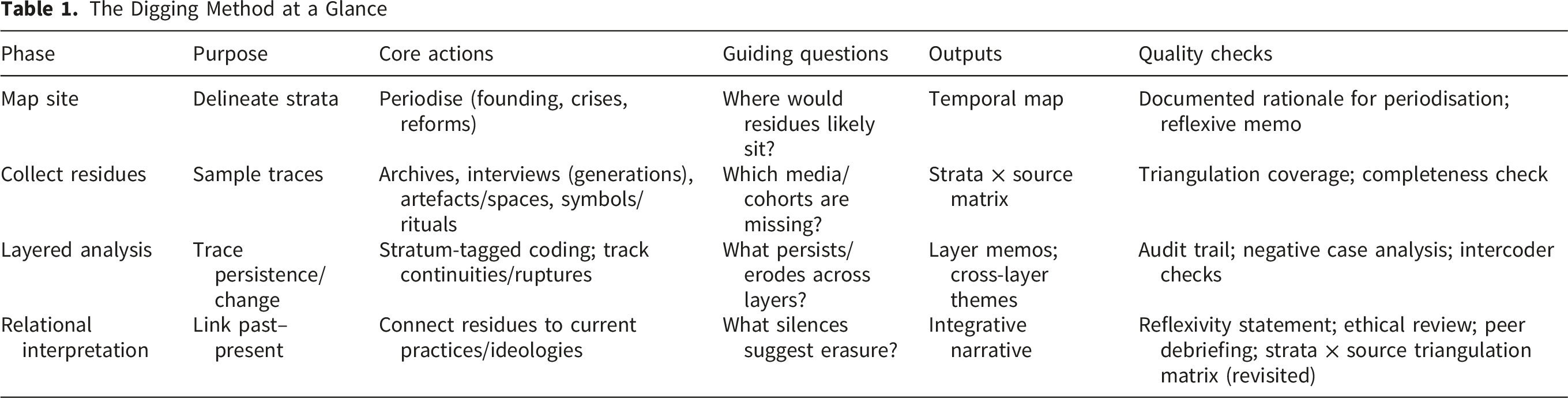
This table is not only a summary but also a practical checklist. It helps researchers ensure they have explicitly mapped strata, sampled across sources, coded by layer, and reflected ethically on silences. It also encourages transparency by specifying outputs (maps, matrices, memos, narratives) that can be shared or archived.
Illustrative Example
To demonstrate the utility of the Digging Method, consider several hypothetical settings that show how layered residues can be traced across time. These examples are illustrative rather than empirical, designed to make the method’s procedures concrete.
Long-Established University
Mapping the Site
Key strata might include an early-twentieth-century founding tied to a national mission, an expansion and internationalisation phase during the 1980s, and financial crises with restructuring in the 2000s (Suddaby & Foster, 2017). Each of these periods leaves discernible traces in documents, practices, and physical infrastructures.
Collecting Residues
Evidence spans founding charters and inaugural speeches; 1980s annual reports articulating global ambitions; interviews with retired professors, mid-career staff, and junior faculty; material traces such as original campus buildings and continued use of the historic crest in digital branding (Decker, 2013; Ybema, 2014).
Layered Analysis
“Service to the nation” persists but shifts meaning: civic duty in the founding era, international prestige during expansion, and market competitiveness in more recent decades. Episodes of conflict, for example, 1970s student protests, are muted in official archives yet reappear in oral histories, evidencing selective remembering and silencing (Maclean et al., 2016).
Relational Interpretation
The founding mission continues to frame current strategy: even as global rankings dominate, ambitions are still narrated through the idiom of national service. Selective forgetting stabilises a storyline of smooth progress, occluding contested pasts and sanitising the record (Rowlinson et al., 2014).
Hypothetical Scenario
This hypothetical scenario shows how residues from different strata can be connected: a 1972 student-union banner archived in a basement (material residue) contradicts the glossy 1985 prospectus that omits protest history (documentary silence), while a retired dean’s interview links both to a present-day policy discouraging campus demonstrations, illustrating how layered residues shape governance today.
Family-Owned Manufacturing Firm
Mapping the Site
A mid-century founding era when the firm produced simple tools; a diversification phase in the 1980s; and a transition to second-generation leadership in the 2000s.
Collecting Residues
Company newsletters, factory layouts, and interviews with both founders and descendants; artefacts such as obsolete machines still stored in warehouses; symbols such as a family crest retained in branding.
Layered Analysis
Founding values of craftsmanship persist but shift in meaning: from artisanal pride (the founding era) to efficiency (diversification) to heritage marketing (the second generation). Employee accounts highlight silenced episodes of labour conflict, absent from official newsletters but present in oral histories.
Relational Interpretation
The persistence of the family identity legitimises current strategies but also constrains innovation, as appeals to “our tradition” are used to resist change.
Public Health Agency
Mapping the Site
Established after World War II, expanded during welfare state reforms in the 1970s, and restructured under austerity policies in the 2010s.
Collecting Residues
Archival policy documents, long-serving staff interviews, posters from past vaccination campaigns, and changes in the architecture of regional offices.
Layered Analysis
The ethos of “care for all” persists but transforms: from nation-building welfare in the 1940s, to modernisation in the 1970s, to efficiency-driven managerialism in recent decades. Silences emerge around controversial epidemics that were mishandled, with official archives omitting details that appear in oral testimony.
Relational Interpretation
Current strategies still invoke “universal care,” but the practical meaning has narrowed, showing how inherited rhetoric conceals structural erosion.
Technology Start-Up
Mapping the Site
Founded in the mid-2010s during a boom in digital platforms, experienced a crisis after investor withdrawal, and stabilised under a new CEO.
Collecting Residues
Founders’ blogs, investor pitch decks, office décor from the start-up era, and interviews with both original and later employees.
Layered Analysis
“Disruption” rhetoric persists but is reinterpreted: first as rebellion against incumbents, later as disciplined innovation under investor oversight. The crisis period is silenced in official communications but recalled vividly by early employees.
Relational Interpretation
The founding narrative of “disruption” continues to shape culture, but its meaning has shifted, revealing how start-ups accumulate layers of ideology more quickly than older organizations.
These hypothetical examples demonstrate that the Digging Method is adaptable across diverse organizational forms, universities, family firms, public agencies, and start-ups. They show how mapping strata, collecting heterogeneous residues, conducting layered analysis, and interpreting relationally can be operationalised in practice. More importantly, they highlight how residues and silences are not confined to a single organizational type but are constitutive of organizational life more broadly.
Empirical Illustration: Applying the Digging Method to CEO Narratives
To further demonstrate how the Digging Method can be operationalized in practice, we provide a brief illustration using a publicly available interview with former Polaris and CNH Industrial CEO Scott Wine. The purpose of this illustration is methodological rather than empirical: it demonstrates how the four analytic stages of the Digging Method, strata mapping, residue identification, stratum-tagged coding, and relational interpretation, can be applied to qualitative material. The illustration draws on selected excerpts from the interview and shows how layered residues can be identified and interpreted across organizational time.
Step 1 – Mapping Strata
Illustrative Mapping of Temporal Strata in the CEO Interview

Having identified the temporal layers, the next step is to examine the residues that appear across these strata.
Step 2 – Residues
Illustrative Residues Identified in the CEO Interview
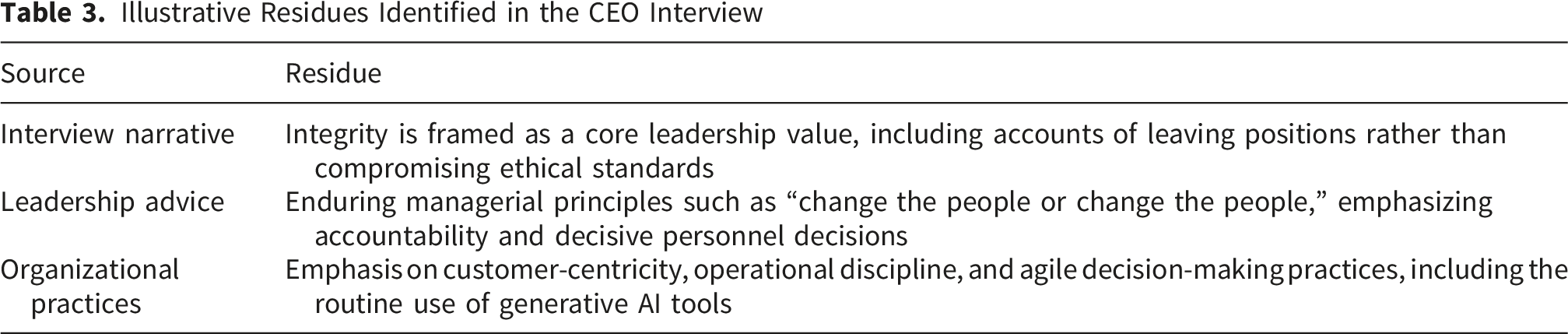
These residues provide the analytical material for the next stage, where excerpts are coded according to both thematic content and temporal layer.
Step 3 – Stratum-Tagged Coding
Stratum-Tagged Coding of Interview Excerpts
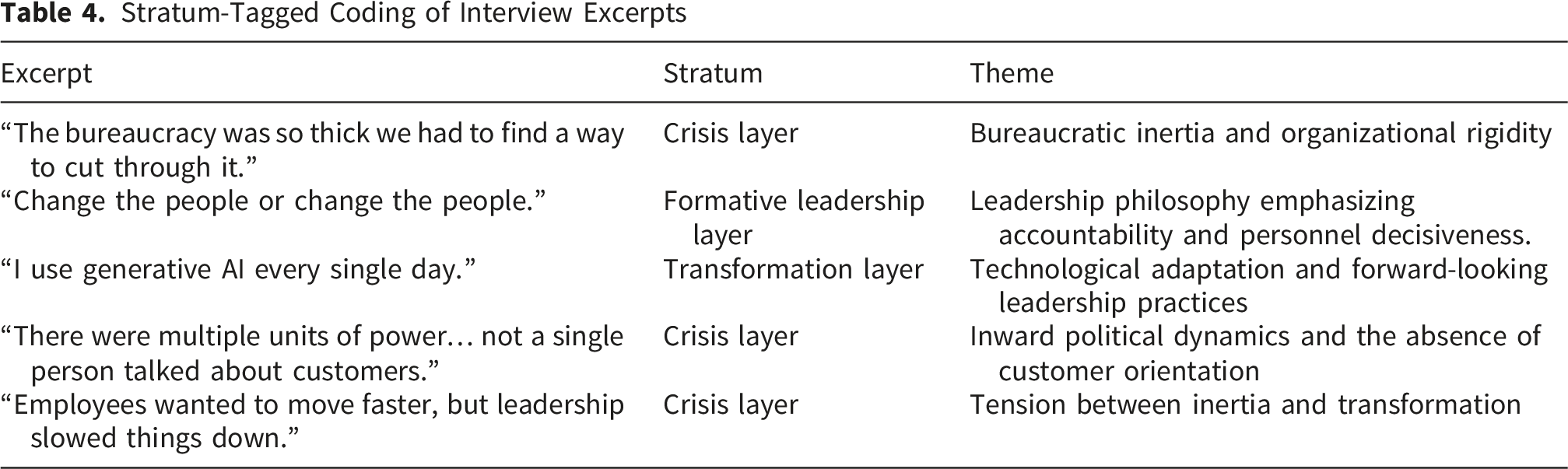
Coding excerpts in this way allows the researcher to examine how different residues interact across strata and how historical layers dynamically shape contemporary organizational interpretations.
Step 4 – Relational Interpretation
The coded excerpts allow the analysis to move from layered description toward relational interpretation. In this illustration, the stratigraphic reading highlights how bureaucratic residues within CNH’s organizational structure constituted a crisis layer characterized by inward political dynamics and the absence of customer orientation, thereby shaping the difficulty of organizational transformation.
At the same time, formative leadership imprints from Wine’s earlier experiences, particularly the emphasis on accountability and decisive personnel decisions, provided guiding principles for navigating these constraints. In this sense, the formative leadership imprint does not merely coexist with the crisis layer but actively shapes the trajectory of transformation by legitimizing decisive personnel interventions that may otherwise be resisted within bureaucratic structures. The principle of “change the people or change the people” thus functions as a historically rooted interpretive resource that enables the leader to confront entrenched power centers and organizational inertia.
Interpreting the excerpts across layers makes visible how contemporary organizational change is negotiated through the dynamic interaction between inherited structural residues and historically rooted leadership orientations. More broadly, this illustrates how residues from earlier strata can operate not only as constraints but also as enabling mechanisms for organizational change.
How the Digging Method Differs From Existing Historic-Turn Approaches
Research in the historic turn of organization studies has emphasized the importance of incorporating historical context, archival materials, and temporality into organizational analysis (Decker, 2013; Maclean et al., 2016; Rowlinson et al., 2014). Studies in this tradition often encourage scholars to examine how past events shape present organizational practices and identities. The Digging Method builds on this tradition but contributes a more explicit analytic protocol for conducting layered historical analysis.
Whereas existing approaches typically rely on general guidance for working with historical materials, the Digging Method specifies a four-stage analytic procedure: mapping temporal strata, collecting heterogeneous residues, conducting stratum-tagged coding, and interpreting relationships across layers. This protocol provides a structured way to trace how practices, narratives, and absences persist or transform across different organizational periods.
Importantly, the method does not replace existing qualitative or historical approaches; rather, it offers a complementary analytic lens that foregrounds temporal layering and the interaction between residues from different historical strata. By making the analytic steps explicit, the Digging Method aims to enhance methodological transparency and provide researchers with a practical procedure for examining how multiple pasts coexist within contemporary organizational life. In this sense, the Digging Method is less a new data source and more a structured analytic procedure for working with temporally layered qualitative materials.
Discussion
It is important to emphasize that the Digging Method is not tied to any single theoretical framework. Rather than prescribing a particular interpretation of organizational history, the method provides a structured analytic procedure for identifying and interpreting temporally layered residues within qualitative materials. Researchers may apply the method in combination with different theoretical perspectives, such as institutional theory, organizational memory, identity, or change processes, depending on their research questions. In this sense, the Digging Method functions as a methodological lens for examining how multiple pasts remain active within contemporary organizational life.
The Digging Method adds historical depth and temporal stratification to qualitative inquiry. By treating organizations as stratified sites rather than synchronic entities, it equips researchers to make the layered persistence of the past empirically visible. This provides an auditable procedure for showing how legacies of prior decisions, ideologies, and structures are embedded in present practice (Decker et al., 2020; Maclean et al., 2016). The contribution is threefold:
Methodological: The method extends organizational and collective memory research beyond repositories and narratives by specifying procedures for analysing layers of remembering and forgetting as material, symbolic, and discursive strata (Rowlinson et al., 2014; Walsh & Ungson, 1991). Its stepwise protocol, mapping, collecting, layered analysis, and relational interpretation, offers clarity and replicability in an area often dominated by interpretive flexibility.
Theoretical: The method provides a vocabulary for analyzing layered organizational histories, foregrounding how past residues condition the present. This offers new traction on classic debates about inertia, legitimacy, and change. For instance, stratigraphic analysis highlights not just continuity versus rupture but the co-presence of multiple pasts within ongoing practice.
Practical: The method enables scholars and practitioners to interrogate how selective memory shapes governance, strategy, and culture. By tracing both residues and silences, it can inform critical reflection on institutional narratives and policy-making, for example, how a university’s founding ethos continues to frame present-day rankings discourse.
Beyond offering a procedural guide, the Digging Method also enables a distinctive analytical perspective. By systematically mapping temporal strata and coding residues across layers, the method allows researchers to observe how multiple organizational pasts coexist and interact within present practices. This layered perspective makes visible patterns that may remain obscured in conventional thematic analysis, such as the persistence of inherited routines, the selective erasure of contested histories, or the coexistence of conflicting organizational logics. In this sense, the Digging Method does not simply organize historical materials; it helps reveal how organizational actors continuously negotiate between inherited residues and emerging interpretations of the past.
Relation to Other Methods
The Digging Method complements rather than replaces established qualitative traditions. It shares grounded theory’s inductive ethos but foregrounds temporal layeredness alongside emergent coding (Glaser & Strauss, 2017). Where grounded theory often collapses temporality into categories, stratigraphic analysis insists on situating codes within specific strata.
Relative to ethnography’s thick description, the method widens the temporal aperture, situating observed practice within historically sedimented contexts (Van Maanen, 2011). Ethnography excels at detailing cultural meanings, but stratigraphic analysis shows how those meanings are inherited, transformed, or erased across time.
Narrative and process studies attend to stories and flows, yet the Digging Method offers additional procedures for linking stories to strata and identifying patterned erasures. A protest absent from official archives but present in oral histories, for example, can be systematically coded as a silence rather than left as anecdotal contrast.
Process research further sharpens the comparison. Process studies foreground how organizational phenomena unfold through sequences of events and activities. While invaluable for tracing emergence and change, such studies often conceptualise time as a linear flow. The Digging Method complements this approach by emphasising layered persistence: not only how processes evolve forward, but also how they are shaped by sediments from prior eras. This dialogue between stratigraphy and process research opens new avenues for theorising how inherited residues condition trajectories of organizational change.
Finally, the method also resonates with historical institutionalism and path dependency research, which analyse how early decisions shape later outcomes. Traditional accounts highlight critical junctures and increasing returns that lock institutions onto particular paths (Pierson, 2000). The Digging Method adds nuance by showing that institutions rarely move along a single linear path; instead, multiple pasts coexist and overlap, some reinforcing lock-in, others quietly enabling transformation. By emphasising layered coexistence, stratigraphic analysis makes visible the simultaneity of persistence and change.
Rigor and Ethics
We treat rigour and ethics as integral to stratigraphic inquiry, given that excavation can resurface sensitive histories and contested memories. Our approach foregrounds auditability, reflexivity, and harm minimisation throughout.
Triangulation and Auditability
We combine archives, interviews, artefacts, and spatial analysis; maintain a strata x source matrix; and keep a documented audit trail of sampling decisions, codebooks, and analytic memos. Peer debriefing and negative case analysis probe alternative explanations, while intercoder reliability checks ensure coding consistency (Lincoln & Guba, 1985; Miles et al., 2014).
Layer-Aware Coding
Excerpts are tagged for both theme and stratum to preserve temporality. Suspected erasures are explicitly coded (e.g., silence: policy dispute (1970s)), enabling systematic treatment of absence as data.
Reflexivity
A positionality note specifies the researcher’s access, prior affiliations, and interpretive stance. Memos record how the researcher’s location shapes excavation choices and readings of traces.
Ethics Across Time
Confidentiality must be maintained for multi-generational participants; sensitive archives require careful handling (e.g., embargoes, redactions); and potential harms from re-identification must be considered when resurfacing “forgotten” events. Explicit statements about rights/permissions to reproduce archival materials and artefacts are necessary.
Bias Mitigation and Significance Criteria
To avoid romanticising residues or over-weighting striking artefacts, we pre-specify what makes a trace analytically significant (e.g., cross-source corroboration, recurrence across strata, process relevance).
These procedures ensure that stratigraphic inquiry is not only imaginative but also methodologically robust and ethically attentive.
Limitations and Future Research
Like any metaphor, stratigraphy has limits. The excavation metaphor risks over-determinism, suggesting that organizations are mechanically layered when in practice they are dynamic and contested. Layers may blur, overlap, or be reinterpreted rather than remaining discrete. Researchers must remain reflexive about the metaphor’s scope.
Applicability may also vary by organizational type. In contexts where archives are sparse or layers compressed, such as digital-born start-ups, the method may be harder to apply. Conversely, in long-lived institutions such as public agencies or universities, stratigraphic analysis is likely to be especially fruitful.
The method may also require adaptation in purely digital-native organizational contexts, where “material artefacts” and “spatial arrangements” are primarily virtual (e.g., Slack histories, Notion workspaces, or GitHub repositories), and where residues may take more ephemeral and platform-dependent forms.
Future Research Directions Include
Empirical Pilots
Testing the method in contrasting settings such as public agencies, family firms, and tech companies to refine procedures and identify domain-specific challenges.
Integration With Longitudinal Case Designs
Combining stratigraphic coding with process tracing to link layered residues to observed change trajectories.
Metrics for Layer Density or Erosion
Developing indicators to compare sites systematically, such as the thickness of archival strata or the visibility of erasures.
Digital Residues
Exploring how digital archives, platforms, and data infrastructures create new forms of sedimentation and erasure, and how AI-assisted tools might aid excavation.
Ethical Dilemmas
Investigating how resurfacing silenced or forgotten histories may create reputational risks, legal disputes, or moral conflicts, and how researchers can navigate these responsibly.
Conclusion
The Digging Method reframes history not as a passive backdrop but as an active method for organizational inquiry. By operationalising excavation as a disciplined heuristic, it equips qualitative researchers to demonstrate how past ideologies, routines, artefacts, and silences continue to shape present practice. Rather than treating history as an illustrative context, the method positions it as constitutive of organizational life.
Our contribution has been threefold. Methodologically, we have articulated a stepwise procedure, mapping strata, collecting heterogeneous residues, conducting layered analysis, and offering relational interpretation that enables researchers to excavate organizational temporality in a transparent and auditable way. Theoretically, we have proposed a layered temporal lens to understand how residues of the past persist, overlap, and are erased over time. In practice, we have provided tools for recognising how memory and forgetting contour strategy, identity, and governance in contemporary organisations.
In doing so, the Digging Method complements and extends existing qualitative repertoires. Grounded theory, ethnography, and narrative approaches remain essential, but the Digging Method widens the temporal aperture, making visible the co-presence of multiple pasts in present practices. It responds to long-standing calls from the historic turn for methods that not only debate the use of history but also provide concrete protocols for tracing its stratified influence.
The approach also carries implications for organizational practice. By showing how selective remembering and forgetting stabilise official narratives, stratigraphic inquiry can encourage critical reflection among managers, employees, and stakeholders. Understanding how past crises, ideologies, or silenced conflicts persist within current routines may open possibilities for more reflexive governance and ethical decision-making.
At the same time, the method has its limits. The excavation metaphor can risk over-determinism if taken literally, and organizations remain dynamic, contested arenas rather than static sites. Layers may blur, overlap, or be strategically reinterpreted. We have therefore emphasised reflexivity and ethics, recognising that resurfacing forgotten histories can create risks as well as insights.
Ultimately, the Digging Method invites organization scholars to excavate rather than merely describe. It calls attention to how organizations are made and remade through layered temporality, showing that residues and silences are as important as current practices. By embedding historical depth into qualitative research, the method contributes to more temporally rich, auditable, and ethically attentive accounts of organizational life.
Beyond organization studies, the Digging Method also holds promise for interdisciplinary application. Sociologists, anthropologists, and historians may find its focus on layered temporality useful for exploring how communities, professions, or social movements sustain continuity across generations. Cultural historians might apply the approach to rituals and symbols, while political scientists could adapt it to study how institutional legacies persist in policy regimes. By offering a structured vocabulary of strata, residues, and erasures, the method creates a shared framework for engaging diverse disciplinary debates about how the past lives on in the present.
We hope that future research will adapt, test, and extend the Digging Method in diverse contexts, from universities and public agencies to family firms and digital start-ups. In doing so, scholars can both refine the protocol and explore the distinctive stratigraphic patterns that characterise different organisational forms. By advancing methodological innovation, the Digging Method seeks to deepen the dialogue between history and organization studies, offering a durable framework for investigating how the past remains alive in the present.
Footnotes
Ethical Considerations
Not applicable. This manuscript presents a methodological framework and does not involve human participants, human data, or human tissue.
Consent to Participate
Not applicable. No data were collected from human participants.
Consent for Publication
Not applicable. The article does not contain any data from identifiable individuals.
Funding
The author received no financial support for the research, authorship, and/or publication of this article.
Declaration of Conflicting Interests
The author declares no potential conflicts of interest with respect to the research, authorship, and/or publication of this article.
Data Availability Statement
Not applicable. This is a conceptual and methodological article; no empirical data were collected or analyzed.