This article undertakes a wayamiilbuwawanha, a looking back through and with the seven principles of Waya Yindyamarra Songspiral Methodology (Rogers, 2025), in order to deepen understanding of how the methodology functions as a Wiradjuri matrilineal ontological and methodological approach to research. Grounded in Wiradjuri matrilineal ontology and informed by Indigenous Women’s Standpoint Theory, the article extends the earlier formulation of Waya Yindyamarra by making its analytic process more explicit and demonstrating how it can be operationalised across historical, ancestral, visual, and poetic texts. Through engagement with Wiradjuri language, Martin’s (2008) seven entities of Country, colonial historical records about Wiradjuri women, ancestral stories, collage, and poetic inquiry, I show how Waya Yindyamarra works as both a methodology and a living mode of analysis and creation. In doing so, the article reaffirms Wiradjuri women as life givers, transmitters of bloodline, totem, knowledge, responsibility, and story, while demonstrating how story itself operates as methodological teacher, analytic guide, and generative force in Indigenous research.
This article centres story as method, methodology, and ontological relation. It deepens Waya Yindyamarra Songspiral Methodology (Rogers, 2025) by showing more explicitly how the methodology functions as a Wiradjuri matrilineal approach to research and how it can be operationalised in practice. Grounded in Wiradjuri matrilineal ontology and informed by Indigenous Women’s Standpoint Theory (Moreton-Robinson, 2013), the article demonstrates how story, language, Country, and creative practice work together in the analysis and generation of knowledge. While my earlier formulation of Waya Yindyamarra introduced the seven principles of the methodology, this article extends that work in three ways. First, it makes the methodological process more explicit by showing how the principles can guide the interpretation of stories, texts, and creative works. Second, it deepens the methodology through a Wiradjuri matrilineal lens, affirming Wiradjuri women’s roles as life givers, transmitters of bloodline, knowledge, law, and story. Third, it demonstrates that Waya Yindyamarra is not only a framework for analysing existing stories, but also a generative methodology through which new stories, images, and poems can be brought into being.
In this article, Wiradjuri ancestral stories, including Gugaa the goanna, Myee the buugang moth, and the Seven Sisters, are approached as methodological teachers and brought into conversation with Martin’s (2008) seven entities of Country: Mayiny (people), Garray (land), Galing (water), Balugan (animals), Dhabugarra (plants), Yirung (sky), and Marra (climate/weather). Together, these illuminate the interwoven relations that shape Wiradjuri ways of being, doing, and knowing. Applying a Wiradjuri matrilineal lens, as called for by Moreton-Robinson’s (2013) Indigenous Women’s Standpoint Theory, I then use Waya Yindyamarra to re-read colonial accounts of Wiradjuri women alongside ancestral and contemporary creative storying. In doing so, I show how the methodology can be used not only to return to story, but also to birth story through poetic inquiry and collage. By applying the framework to itself, this article also enacts the central movement of Waya Yindyamarra: turning backwards in order to go onward, spiralling more deeply into methodological and ontological conversation. This recursive movement honours the songspiral that underpins the methodology.
The article proceeds in five parts. I begin by situating Waya Yindyamarra within Wiradjuri matrilineal ontology and Indigenous Women’s Standpoint Theory. I then revisit the seven principles through Wiradjuri language and Martin’s (2008) seven entities of Country. Next, I demonstrate the methodology through the interpretation of colonial and academic records about Wiradjuri women, followed by an analysis of Wiradjuri ancestral stories. Finally, I show how Waya Yindyamarra can be enacted through embodied visual and poetic inquiry before reflecting on its methodological contribution, limits, and future possibilities.
Spirals of Transformation
As a matrilineal nation, we Wiradjuri have always recognised the central role of women and mothers as carriers of law, story, and authority. I open this re-turn to Waya Yindyamarra by situating the discussion within a matrilineal lens, grounding the methodology in the ancestral inheritance of Wiradjuri women’s responsibilities, ancestral stories, and historical sources that, when read carefully, reveal the centrality of our embodied Wiradjuri ontology and cosmology. This ontological and epistemological grounding is essential to the methodological work that follows. It is informed by Moreton-Robinson’s Indigenous Women’s Standpoint Theory, which reminds us that “the relationship between Australian Indigenous women’s knowledges and experiences will be different to that of Indigenous men because of our embodiment, our relations to different country, people and ancestral creator beings and our social location” (Moreton-Robinson, 2013, p. 339).
Taking up this standpoint provides both a challenge and an opportunity: to recognise and value Wiradjuri women’s cultural knowledges while honouring the distinct positionality, responsibilities, and standpoint of Indigenous women within contemporary Indigenous research. Waya Yindyamarra intentionally guides researchers to weave in time with the rhythms and cycles of Country. Through yindyamarra, we are called to walk slowly and gently, taking care to sit with stories that show us how we, as Wiradjuri women, relate to all aspects of Country, sky, land, water, and beyond. As Martin (2008) explains, this requires us to attend carefully to the patterns within stories and to wait with patience as interpretations emerge, allowing these to tell the patterns within their own stories, in their own ways. This requires researchers to watch and wait with patience as the interpretations and representations of these patterns emerge, which can occur as dreams, or in the form of words and pictures seen in our daily lives (Martin, 2008).
This orientation is not background context to the methodology. It is the ground from which Waya Yindyamarra proceeds. The methodology emerges from Wiradjuri women’s embodied relation to Country, story, kin, and ancestral inheritance, and it asks the researcher to move in accordance with those relations.
Waya Yindyamarra Songspiral Methodology (Rogers, 2025) retains its original identity, structured around seven principles named in Wiradjuri language. Just as Wiradjuri women have always journeyed across Country for activities both large and small, for meetings, celebrations, ceremonies, and the gathering of grasses, yams, and nuts with tools such as digging sticks and dilly-bags, I continue this work as both researcher and developer of the methodology. My aim is to continue collecting and sharing knowledge that contributes to the local sustenance, survivance, and continuance of Wiradjuri people, knowledges, and research, as well as Indigenous communities further afield. I remain guided in this journey by yindyamarra, deep respect, and care, just as I am when I weave.
As I loop through the original methodology, carefully re-turning over and over, I seek to strengthen this methodological tool, which may be understood as a metaphorical dilly-bag. This dilly-bag matters because it is intended to hold precious stories, knowledges, and tools, especially when applied to Wiradjuri knowledge. Weaving is steady, repetitive, slow, and careful work, taught and passed down through mothers, aunties, grandmothers, and great-grandmothers. It spirals outwards and onwards. So too does this methodology, grounded in the ancestral inheritance of Wiradjuri women’s responsibilities, ancestral stories, and historical sources that, when read through a Wiradjuri matrilineal lens, reveal aspects of our embodied ontology and cosmology.
Language Belongs to Country
The first step in this journey of re-turning to the seven principles of Waya Yindyamarra Songspiral Methodology is a re-view of the principles themselves, beginning with language. This stage forms the first analytic movement of the methodology. As demonstrated by the Wiradjuri word for “placenta”, which is also the word for “birthplace” and “the spot or soil on which a child is born” (Dolan, 2024), Wiradjuri language carries relational meanings that cannot be separated from Country, body, and story. For this reason, the methodological process begins by returning to the Wiradjuri language terms that frame the principles, as they provide essential insight into the relatedness of the methodology and the research it informs.
I use the Wiradjuri term waya-miilbu-wawa-nha, meaning ‘look back’ (Winch, 2018), to describe the re-turning process undertaken here. As Wiradjuri woman Jessica Russ-Smith (2024) explains:
The process of waya-mii-l-bu-wa-wa-nha is itself a story…Waya (turn), miil (eyes), buwa (come-towards), wa (with feet), nha (by self now)… When I re-turn and come towards Country I re-hear the stories of my grandmothers. In re-turning and re-hearing my grandmother’s stories, I am a grandmother. When my feet are home my eyes are able to re-turn and re-see my giilang [story]—that I am womb, I am future, I am grandmother, I am granddaughter (pp. 96–97).
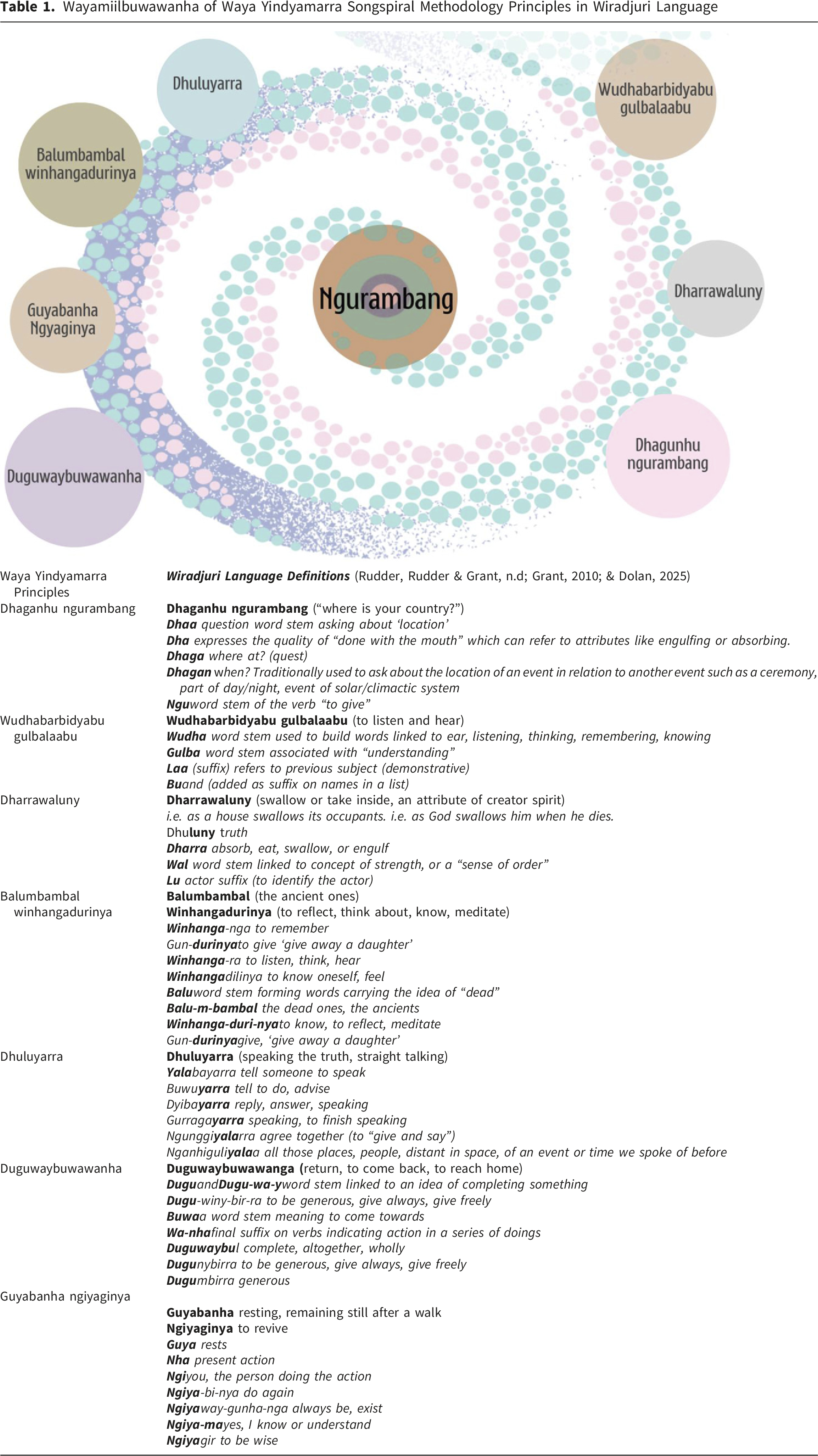
Guided by this understanding, I returned to the principles and their Wiradjuri names, extending my understanding by attending to the multiple meanings of each term. This involved noting meanings, tracing related words, and coming alongside the deeper ancestral learnings these connections revealed. Table 1 records this stage of analysis, showing how the principles were deepened through language and relational interpretation.
Wayamiilbuwawanha of Waya Yindyamarra Songspiral Methodology Principles in Wiradjuri Language
Dhaexpresses the quality of “done with the mouth” which can refer to attributes like engulfing or absorbing.
Dhagawhere at? (quest)
Dhagan when? Traditionally used to ask about the location of an event in relation to another event such as a ceremony, part of day/night, event of solar/climactic system
Nguword stem of the verb “to give”
Wudhabarbidyabu gulbalaabu
Wudhabarbidyabu gulbalaabu (to listen and hear)
Wudhaword stem used to build words linked to ear, listening, thinking, remembering, knowing
Gulbaword stem associated with “understanding”
Laa (suffix) refers to previous subject (demonstrative)
Buand (added as suffix on names in a list)
Dharrawaluny
Dharrawaluny (swallow or take inside, an attribute of creator spirit)
i.e. as a house swallows its occupants. i.e. as God swallows him when he dies.
Dhuluny truth
Dharraabsorb, eat, swallow, or engulf
Walword stem linked to concept of strength, or a “sense of order”
Baluword stem forming words carrying the idea of “dead”
Balu-m-bambalthe dead ones, the ancients
Winhanga-duri-nyato know, to reflect, meditate
Gun-durinyagive, ‘give away a daughter’
Dhuluyarra
Dhuluyarra (speaking the truth, straight talking)
Yalabayarra tell someone to speak
Buwuyarratell to do, advise
Dyibayarrareply, answer, speaking
Gurragayarraspeaking, to finish speaking
Ngunggiyalarra agree together (to “give and say”)
Nganhiguliyalaa all those places, people, distant in space, of an event or time we spoke of before
Duguwaybuwawanha
Duguwaybuwawanga (return, to come back, to reach home)
DuguandDugu-wa-yword stem linked to an idea of completing something
Dugu-winy-bir-ra to be generous, give always, give freely
Buwaa word stem meaning to come towards
Wa-nhafinal suffix on verbs indicating action in a series of doings
Duguwaybul complete, altogether, wholly
Dugunybirra to be generous, give always, give freely
Dugumbirra generous
Guyabanha ngiyaginya
Guyabanha resting, remaining still after a walk
Ngiyaginya to revive
Guyarests
Nhapresent action
Ngiyou, the person doing the action
Ngiya-bi-nya do again
Ngiyaway-gunha-nga always be, exist
Ngiya-mayes, I know or understand
Ngiyagir to be wise
Our Wiradjuri matrilineal ontology reminds us that everything and everyone is connected through ongoing cycles of birth, death, and renewal, with ancestors and ancestral beings continuing to guide through Country and its spiritual teachings. As Moreton-Robinson (2000) affirms, “Indigenous women perceive the world as organic and populated with spirits which connect people and places…the reality of spirituality is a physical fact because it is experienced” (pp. 18–19). Returning to Wiradjuri language and the seven principles of Waya Yindyamarra therefore becomes a methodological act: one that requires us to reflect on the meanings of our words and the embodied knowledges they carry.
By speaking and embodying the language of our ancestors, we come alongside Country. Martin (2008) describes Country through seven entities: people, skies, land, waterways, animals, plants, and climate (p. 66). While these are inseparable in practice, they provide a way of deepening the process of waya-miilbu-wawa-nha as we re-view the principles. It was through sitting with these entities, and relating them to my own embodied and lived experiences of Wiradjuri Country, that this methodology was first developed. That grounding remains at the core of its ongoing spiral of methodological development.
To continue this process, I bring Martin’s concept of the seven entities of Country into conversation with Waya Yindyamarra through story. Martin reminds us that stories are the means through which we access the embodied teachings of Country:
understanding of the contexts, the conditions and agents that exist within our world…will continue to be encoded, expressed and preserved…in Stories…Stories about what is known, what is being known and what is yet to be known…thus they are grounding, defining, comforting and embracing (Martin, 2008, pp. 20, 65).
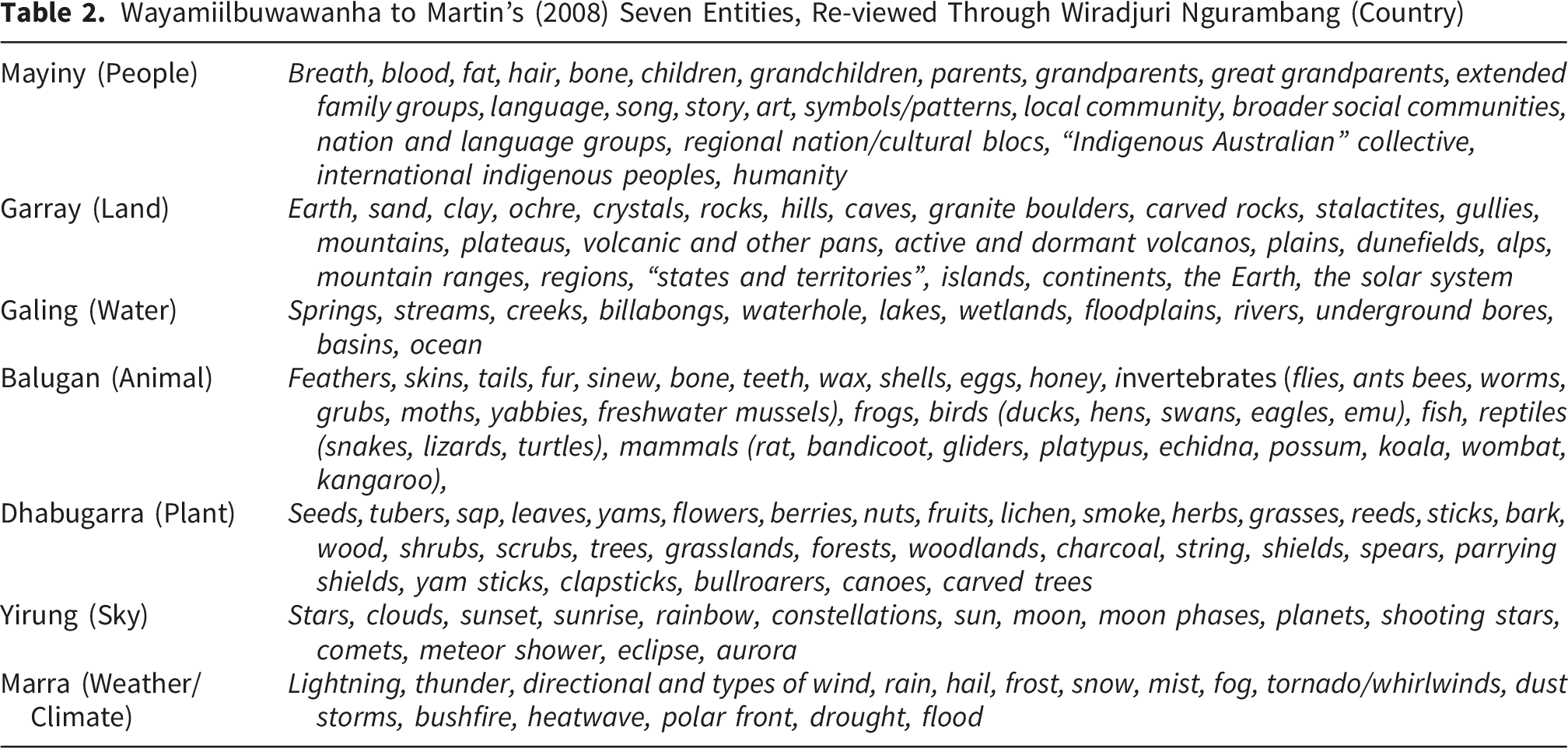
In my wayamiilbuwawanha of Martin’s work, I returned to my previous writings and reflected on the relatedness that sits beneath all aspects of Country. I documented these reflections over time, allowing patterns to emerge as I came alongside the seven entities. Table 2 presents a portion of this analytic process. In this table, each entity is named in Wiradjuri language, reflecting the methodological commitment to begin with language and to remain accountable to Country. The table does not capture all reflections, nor do these reflections sit neatly within single entities; rather, it offers a window into a relational and iterative process.
Wayamiilbuwawanha to Martin’s (2008) Seven Entities, Re-viewed Through Wiradjuri Ngurambang (Country)
Mayiny (People)
Breath, blood, fat, hair, bone, children, grandchildren, parents, grandparents, great grandparents, extended family groups, language, song, story, art, symbols/patterns, local community, broader social communities, nation and language groups, regional nation/cultural blocs, “Indigenous Australian” collective, international indigenous peoples, humanity
Garray (Land)
Earth, sand, clay, ochre, crystals, rocks, hills, caves, granite boulders, carved rocks, stalactites, gullies, mountains, plateaus, volcanic and other pans, active and dormant volcanos, plains, dunefields, alps, mountain ranges, regions, “states and territories”, islands, continents, the Earth, the solar system
Martin’s (2008) seven entities provide a frame for the ontological basket within which Waya Yindyamarra is woven. Stories act as the fibres that bind Country, entities, and methodological principles together:
First Stories are our Law…there exists a responsibility for stories to be protected and remembered…Living stories of relatedness is ‘coming amongst’ the entities and ‘coming alongside’ them…The immersion is not only physical, but spiritual, social, intellectual, emotional… observing, discerning, filtering, applying, reflecting, sharing, and confirming. Then you do it all over again… (pp. 79–80).
These words reflect Wiradjuri cosmology, in which all entities of Country are connected through story. Within this framework, analysis is not a process of extraction but of coming alongside, returning, and re-relating. This requires yindyamarra in how stories are approached, held, and shared. Through this process of wayamiilbuwawanha, I returned to the Waya Yindyamarra principles and sat them alongside my expanded understanding of the entities in Table 2. I was reminded that, regardless of context, each entity remains connected to Country, and that this relatedness underpins all aspects of Wiradjuri cosmology. From this grounding, the seven principles of Waya Yindyamarra spiral outward (Image 1).
Wayamiilbuwawanha on Waya Yindyamarra Principles, through ngurambang/Country
Image 1 offers a way of coming alongside stories through a Country-centred framework. It shows how stories function as the connecting thread in the weaving process, linking all entities of Country, including mayiny (people).
As a matrilineal framework, Waya Yindyamarra positions these stories as central to the methodology, particularly Balumbambal Winhangadurinya, ancestral stories that embody Wiradjuri ways of being, doing, and knowing. Martin (2008) reminds us that such stories teach us how to act and how to know. Through a matrilineal lens, we recognise that these teachings are carried through women’s responsibilities and relations. We turn to stories as we do to our Old Women: as sources of strength, discipline, care, and guidance.
The next stage of this wayamiilbuwawanha therefore involves returning to Wiradjuri ancestral stories, bringing them into conversation with stories about Wiradjuri women, and continuing the deepening of Waya Yindyamarra as a methodological practice.
Giilang (Story)
As this journey continues, I turn to published stories about Wiradjuri women in order to show more explicitly how Waya Yindyamarra can be applied in practice. This stage of the article asks what becomes visible when colonial and academic records are re-read through a Wiradjuri matrilineal and Country-centred lens. In this section, story remains central, but the form of telling shifts. For brevity, and to make the analytic process more visible, I use tables to document this wayamiilbuwawanha. The tables allow the methodology to be seen in motion, showing how excerpts were gathered, placed in relation to the seven entities of Country and the seven principles of Waya Yindyamarra, and then reflected on through a matrilineal Wiradjuri lens.
The source set for this stage includes colonial-era authors who recorded observations about Wiradjuri women or Wiradjuri social and ceremonial life, G. Bennett (1834), J. Hood (1843), R. H. Mathews (1896, 1897, 1897b), and J. Mathew (1899), together with a contemporary source by Spry et al. (2023), included to provide balance and guidance in relation to historical Wiradjuri practices and women’s business. These texts were selected because they contain references, however partial and mediated, to Wiradjuri women’s roles, relations, and responsibilities. They were not treated as transparent truth. Rather, they were re-read cautiously, with the understanding that colonial texts are shaped by distortion, omission, and the colonial gaze. Within Waya Yindyamarra, they can only be approached relationally and read against their own grain, in conversation with Country, matrilineal ontology, and contemporary Wiradjuri knowledge. As such, each of these sources were read with a matrilineal lens, and the aim of gleaning data specifically about Wiradjuri matrilineal ontology, epistemology and axiology.
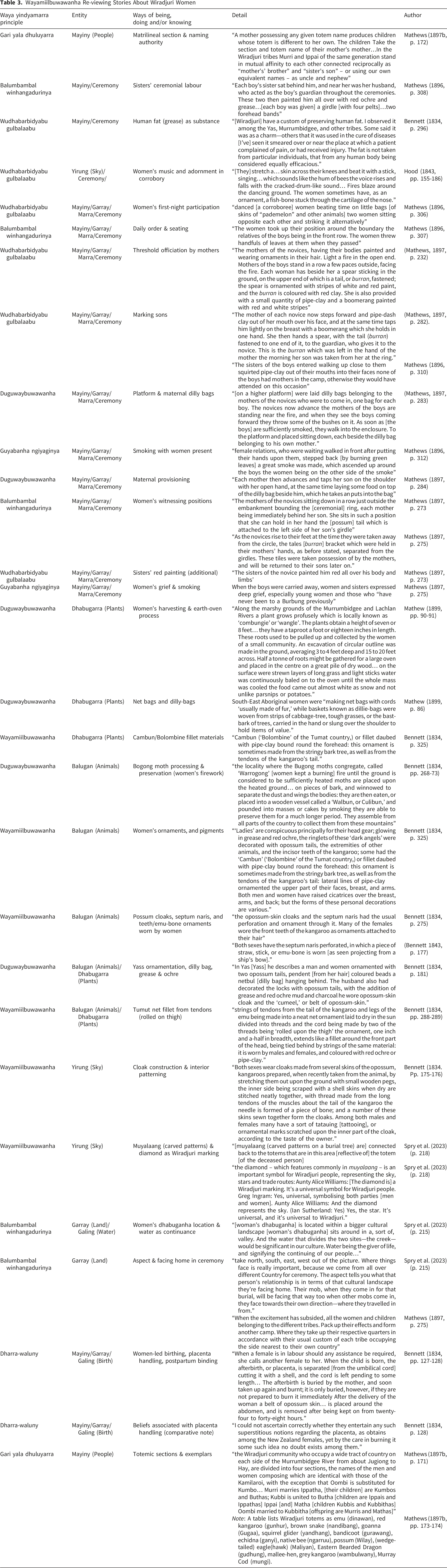
Table 3 records the first stage of this analysis. Here, quotations and observations are organised through the seven entities of Country and the seven principles of Waya Yindyamarra. This makes visible how the texts begin to speak differently when read through a matrilineal framework. Across the table, recurring patterns emerge: women’s centrality to descent and totemic order; mothers’ and sisters’ ceremonial roles; women’s work with fibre, bags, roots, skin, teeth, bone, and ornament; women’s responsibilities in birthing and placenta handling; and women’s relation to land, water, sky, and dhabuganha. Rather than appearing as marginal figures in the archive, Wiradjuri women begin to emerge here as carriers of kinship, ceremony, provisioning, protection, and continuity.
Wayamiilbuwawanha Re-viewing Stories About Wiradjuri Women
Waya yindyamarra principle
Entity
Ways of being, doing and/or knowing
Detail
Author
Gari yala dhuluyarra
Mayiny (People)
Matrilineal section & naming authority
“A mother possessing any given totem name produces children whose totem is different to her own. The children Take the section and totem name of their mother’s mother…In the Wiradjuri tribes Murri and Ippai of the same generation stand in mutual affinity to each other connected reciprocally as “mother’s’ brother” and “sister’s son” – or using our own equivalent names – as uncle and nephew”
“Each boy’s sister sat behind him, and near her was her husband, who acted as the boy’s guardian throughout the ceremonies. These two then painted him all over with red ochre and grease…[each boy was given] a girdle [with four pelts]…two forehead bands”
“[Wiradjuri] have a custom of preserving human fat. I observed it among the Yas, Murrumbidgee, and other tribes. Some said it was as a charm—others that it was used in the cure of diseases [I’ve] seen it smeared over or near the place at which a patient complained of pain, or had received injury. The fat is not taken from particular individuals, that from any human body being considered equally efficacious.”
“[They] stretch a… skin across their knees and beat it with a stick, singing… which sounds like the hum of bees the voice rises and falls with the cracked-drum-like sound… Fires blaze around the dancing ground. The women sometimes have, as an ornament, a fish-bone stuck through the cartilage of the nose.”
“danced [a corroboree] women beating time on little bags [of skins of “pademelon” and other animals] two women sitting opposite each other and striking it alternatively”
“The women took up their position around the boundary the relatives of the boys being in the front row. The women threw handfuls of leaves at them when they passed”
“The mothers of the novices, having their bodies painted and wearing ornaments in their hair. Light a fire in the open end. Mothers of the boys stand in a row a few paces outside, facing the fire. Each woman has beside her a spear sticking in the ground, on the upper end of which is a tail, or burran, fastened; the spear is ornamented with stripes of white and red paint, and the burran is coloured with red clay. She is also provided with a small quantity of pipe-clay and a boomerang painted with red and white stripes”
“The mother of each novice now steps forward and pipe-dash clay out of her mouth over his face, and at the same time taps him lightly on the breast with a boomerang which she holds in one hand. She then hands a spear, with the tail (burran) fastened to one end of it, to the guardian, who gives it to the novice. This is the burran which was left in the hand of the mother the morning her son was taken from her at the ring.”
“The sisters of the boys entered walking up close to them squirted pipe-clay out of their mouths into their faces none of the boys had mothers in the camp, otherwise they would have attended on this occasion”
“[on a higher platform] were laid dilly bags belonging to the mothers of the novices who were to come in, one bag for each boy. The novices now advance the mothers of the boys are standing near the fire, and when they see the boys coming forward they throw some of the bushes on it. As soon as [the boys] are sufficiently smoked, they walk into the enclosure. To the platform and placed sitting down, each beside the dilly bag belonging to his own mother.”
“female relations, who were waiting walked in front after putting their hands upon them, stepped back [by burning green leaves] a great smoke was made, which ascended up around the boys the women being on the other side of the smoke”
“Each mother then advances and taps her son on the shoulder with her open hand, at the same time laying some food on top of the dilly bag beside him, which he takes an puts into the bag”
“The mothers of the novices sitting down in a row just outside the embankment bounding the [ceremonial] ring, each mother being immediately behind her son. She sits in such a position that she can hold in her hand the [possum] tail which is attached to the left side of her son’s girdle”
“As the novices rise to their feet at the time they were taken away from the circle, the tales [burran] bracket which were held in their mothers’ hands, as before stated, separated from the girdles. These tiles were taken possession of by the mothers, and will be returned to their sons later on.”
When the boys were carried away, women and sisters expressed deep grief, especially young women and those who “have never been to a Burbung previously”
“Along the marshy grounds of the Murrumbidgee and Lachlan Rivers a plant grows profusely which is locally known as ‘combungie’ or ‘wangle’. The plants obtain a height of seven or 8 feet… they have a taproot a foot or eighteen inches in length. These roots used to be pulled up and collected by the women of a small community. An excavation of circular outline was made in the ground, averaging 3 to 4 feet deep and 15 to 20 feet across. Half a tonne of roots might be gathered for a large oven and placed in the centre on a great pile of dry wood… on the surface were strewn layers of long grass and light sticks water was continuously baled on to the oven until the whole mass was cooled the food came out almost white as snow and not unlike parsnips or potatoes.”
South-East Aboriginal women were “making net bags with cords ‘usually made of fur,’ while baskets known as dillie-bags were woven from strips of cabbage-tree, tough grasses, or the bast-bark of trees, carried in the hand or slung over the shoulder to hold items of value.”
“Cambun (‘Bolombine’ of the Tumat country,) or fillet daubed with pipe-clay bound round the forehead: this ornament is sometimes made from the stringy bark tree, as well as from the tendons of the kangaroo’s tail.”
“the locality where the Bugong moths congregate, called ‘Warrogong’ [women kept a burning] fire until the ground is considered to be sufficiently heated moths are placed upon the heated ground… on pieces of bark, and winnowed to separate the dust and wings the bodies: they are then eaten, or placed into a wooden vessel called a ‘Walbun, or Culibun,’ and pounded into masses or cakes by smoking they are able to preserve them for a much longer period. They assemble from all parts of the country to collect them from these mountains”
“‘Ladies’ are conspicuous principally for their head gear; glowing in grease and red ochre, the ringlets of these ‘dark angels’ were decorated with opossum tails, the extremities of other animals, and the incisor teeth of the kangaroo; some had the ‘Cambun’ (‘Bolombine’ of the Tumat country,) or fillet daubed with pipe-clay bound round the forehead: this ornament is sometimes made from the stringy bark tree, as well as from the tendons of the kangaroo’s tail: lateral lines of pipe-clay ornamented the upper part of their faces, breast, and arms. Both men and women have raised cicatrices over the breast, arms, and back; but the forms of these personal decorations are various.”
Possum cloaks, septum naris, and teeth/emu-bone ornaments worn by women
“the opossum-skin cloaks and the septum naris had the usual perforation and ornament through it. Many of the females wore the front teeth of the kangaroo as ornaments attached to their hair”
“In Yas [Yass] he describes a man and women ornamented with two opossum tails, pendent [from her hair] coloured beads a netbul [dilly bag] hanging behind. The husband also had decorated the locks with opossum tails, with the addition of grease and red ochre mud and charcoal he wore opossum-skin cloak and the ‘cumeel,’ or belt of opossum-skin.”
“strings of tendons from the tail of the kangaroo and legs of the emu being made into a neat net ornament laid to dry in the sun divided into threads and the cord being made by two of the threads being ‘rolled upon the thigh’ the ornament, one inch and a-half in breadth, extends like a fillet around the front part of the head, being tied behind by strings of the same material: it is worn by males and females, and coloured with red ochre or pipe-clay.”
“Both sexes wear cloaks made from several skins of the opossum, kangaroos prepared, when recently taken from the animal, by stretching them out upon the ground with small wooden pegs, the inner side being scraped with a shell skins when dry are stitched neatly together, with thread made from the long tendons of the muscles about the tail of the kangaroo the needle is formed of a piece of bone; and a number of these skins sewn together form the cloaks. Among both males and females many have a sort of tatauing [tattooing], or ornamental marks scratched upon the inner part of the cloak, according to the taste of the owner.”
Muyalaang (carved patterns) & diamond as Wiradjuri marking
“[muyalaang (carved patterns on a burial tree) are] connected back to the totems that are in this area [reflective of] the totem [of the deceased person]
“the diamond – which features commonly in muyalaang – is an important symbol for Wiradjuri people, representing the sky, stars and trade routes: Aunty Alice Williams: [The diamond is] a Wiradjuri marking. It’s a universal symbol for Wiradjuri people. Greg Ingram: Yes, universal, symbolising both parties [men and women]. Aunty Alice Williams: And the diamond represents the sky. (Ian Sutherland: Yes) Yes, the star. It’s universal, and it’s universal to Wiradjuri.”
Women’s dhabuganha location & water as continuance
“[woman’s dhabuganha] is located within a bigger cultural landscape [woman’s dhabuganha] sits around in a, sort of, valley. And the water that divides the two sites—the creek—would be significant in our culture. Water being the giver of life, and signifying the continuing of our people…”
“take north, south, east, west out of the picture. Where things face is really important, because we come from all over different Country for ceremony. The aspect tells you what that person’s relationship is in terms of that cultural landscape they’re facing home. Their mob, when they come in for that burial, will be facing that way too when other mobs come in, they face towards their own direction—where they travelled in from.”
“When the excitement has subsided, all the women and children belonging to the different tribes. Pack up their effects and form another camp. Where they take up their respective quarters in accordance with their usual custom of each tribe occupying the side nearest to their own country”
“When a female is in labour should any assistance be required, she calls another female to her. When the child is born, the afterbirth, or placenta, is separated [from the umbilical cord] cutting it with a shell, and the cord is left pending to some length… The afterbirth is buried by the mother, and soon taken up again and burnt; it is only buried, however, if they are not prepared to burn it immediately After the delivery of the woman a belt of opossum skin… is placed around the abdomen, and is removed after being kept on from twenty-four to forty-eight hours.”
Beliefs associated with placenta handling (comparative note)
“I could not ascertain correctly whether they entertain any such superstitious notions regarding the placenta, as obtains among the New Zealand females, yet by the care in burning it some such idea no doubt exists among them.”
“the Wiradjuri community who occupy a wide tract of country on each side of the Murrumbidgee River from about Jugiong to Hay, are divided into four sections, the names of the men and women composing which are identical with those of the Kamilaroi, with the exception that Oombi is substituted for Kumbo… Murri marries Ippatha, [their children] are Kumbos and Buthas; Kubbi is united to Butha [children are Ippais and Ippathas] Ippai [and] Matha [children Kubbis and Kubbithas] Oombi married to Kubbitha [offspring are Murris and Mathas]”
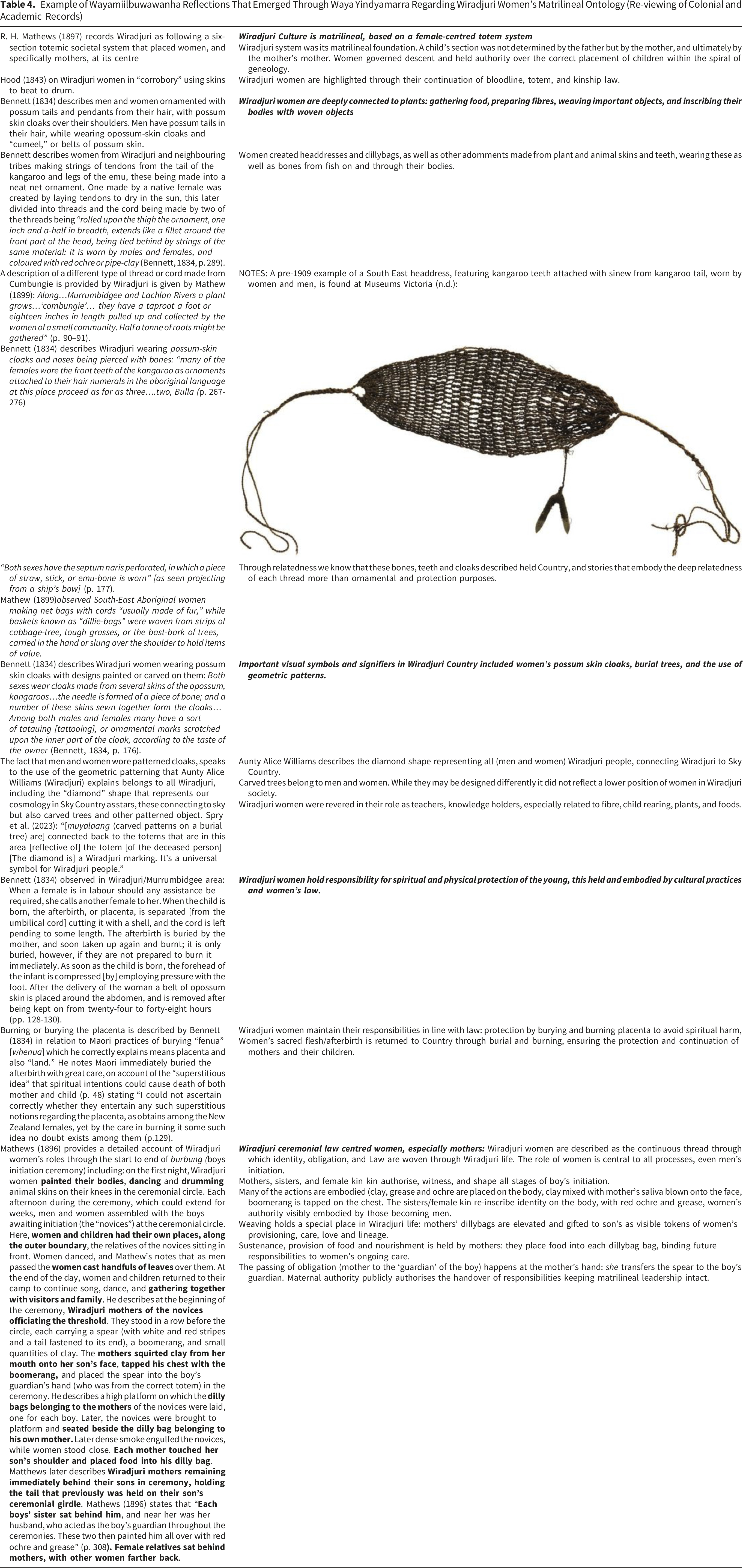
Table 4 records the second stage of the process. It moves from excerpt and classification to interpretive reflection, showing what emerged when the patterns in Table 3 were considered through Wiradjuri matrilineal ontology. Several insights became especially clear. First, Wiradjuri social organisation is represented as matrilineal, with section and totemal placement passing through mothers and mothers’ mothers. Second, women, especially mothers and sisters, are shown as central to ceremonial law, not peripheral to it. Third, women’s embodied practices, including birthing, placenta handling, marking the body, provisioning through dilly bags, and the transfer of obligations in ceremony, reveal women’s authority as relational, material, and ontological. Fourth, women’s work with plants, fibres, skins, adornments,(Table 5) and patterned objects shows that making is itself a site of law, knowledge, and Country-held relation.
Example of Wayamiilbuwawanha Reflections That Emerged Through Waya Yindyamarra Regarding Wiradjuri Women’s Matrilineal Ontology (Re-viewing of Colonial and Academic Records)
R. H. Mathews (1897) records Wiradjuri as following a six-section totemic societal system that placed women, and specifically mothers, at its centre
Wiradjuri Culture is matrilineal, based on a female-centred totem system
Wiradjuri system was its matrilineal foundation. A child’s section was not determined by the father but by the mother, and ultimately by the mother’s mother. Women governed descent and held authority over the correct placement of children within the spiral of geneology.
Hood (1843) on Wiradjuri women in “corrobory” using skins to beat to drum.
Wiradjuri women are highlighted through their continuation of bloodline, totem, and kinship law.
Bennett (1834) describes men and women ornamented with possum tails and pendants from their hair, with possum skin cloaks over their shoulders. Men have possum tails in their hair, while wearing opossum-skin cloaks and “cumeel,” or belts of possum skin.
Wiradjuri women are deeply connected to plants: gathering food, preparing fibres, weaving important objects, and inscribing their bodies with woven objects
Bennett describes women from Wiradjuri and neighbouring tribes making strings of tendons from the tail of the kangaroo and legs of the emu, these being made into a neat net ornament. One made by a native female was created by laying tendons to dry in the sun, this later divided into threads and the cord being made by two of the threads being “rolled upon the thigh the ornament, one inch and a-half in breadth, extends like a fillet around the front part of the head, being tied behind by strings of the same material: it is worn by males and females, and coloured with red ochre or pipe-clay (Bennett, 1834, p. 289).
Women created headdresses and dillybags, as well as other adornments made from plant and animal skins and teeth, wearing these as well as bones from fish on and through their bodies.
A description of a different type of thread or cord made from Cumbungie is provided by Wiradjuri is given by Mathew (1899): Along…Murrumbidgee and Lachlan Rivers a plant grows…‘combungie’… they have a taproot a foot or eighteen inches in length pulled up and collected by the women of a small community. Half a tonne of roots might be gathered” (p. 90–91).
NOTES: A pre-1909 example of a South East headdress, featuring kangaroo teeth attached with sinew from kangaroo tail, worn by women and men, is found at Museums Victoria (n.d.):
Bennett (1834) describes Wiradjuri wearing possum-skin cloaks and noses being pierced with bones: “many of the females wore the front teeth of the kangaroo as ornaments attached to their hair numerals in the aboriginal language at this place proceed as far as three….two, Bulla (p. 267-276)
“Both sexes have the septum naris perforated, in which a piece of straw, stick, or emu-bone is worn” [as seen projecting from a ship’s bow] (p. 177).
Through relatedness we know that these bones, teeth and cloaks described held Country, and stories that embody the deep relatedness of each thread more than ornamental and protection purposes.
Mathew (1899)observed South-East Aboriginal women making net bags with cords “usually made of fur,” while baskets known as “dillie-bags” were woven from strips of cabbage-tree, tough grasses, or the bast-bark of trees, carried in the hand or slung over the shoulder to hold items of value.
Bennett (1834) describes Wiradjuri women wearing possum skin cloaks with designs painted or carved on them: Both sexes wear cloaks made from several skins of the opossum, kangaroos…the needle is formed of a piece of bone; and a number of these skins sewn together form the cloaks…Among both males and females many have a sort of tatauing [tattooing], or ornamental marks scratched upon the inner part of the cloak, according to the taste of the owner (Bennett, 1834, p. 176).
Important visual symbols and signifiers in Wiradjuri Country included women’s possum skin cloaks, burial trees, and the use of geometric patterns.
The fact that men and women wore patterned cloaks, speaks to the use of the geometric patterning that Aunty Alice Williams (Wiradjuri) explains belongs to all Wiradjuri, including the “diamond” shape that represents our cosmology in Sky Country as stars, these connecting to sky but also carved trees and other patterned object. Spry et al. (2023): “[muyalaang (carved patterns on a burial tree) are] connected back to the totems that are in this area [reflective of] the totem [of the deceased person] [The diamond is] a Wiradjuri marking. It’s a universal symbol for Wiradjuri people.”
Aunty Alice Williams describes the diamond shape representing all (men and women) Wiradjuri people, connecting Wiradjuri to Sky Country.
Carved trees belong to men and women. While they may be designed differently it did not reflect a lower position of women in Wiradjuri society.
Wiradjuri women were revered in their role as teachers, knowledge holders, especially related to fibre, child rearing, plants, and foods.
Bennett (1834) observed in Wiradjuri/Murrumbidgee area: When a female is in labour should any assistance be required, she calls another female to her. When the child is born, the afterbirth, or placenta, is separated [from the umbilical cord] cutting it with a shell, and the cord is left pending to some length. The afterbirth is buried by the mother, and soon taken up again and burnt; it is only buried, however, if they are not prepared to burn it immediately. As soon as the child is born, the forehead of the infant is compressed [by] employing pressure with the foot. After the delivery of the woman a belt of opossum skin is placed around the abdomen, and is removed after being kept on from twenty-four to forty-eight hours (pp. 128-130).
Wiradjuri women hold responsibility for spiritual and physical protection of the young, this held and embodied by cultural practices and women’s law.
Burning or burying the placenta is described by Bennett (1834) in relation to Maori practices of burying “fenua” [whenua] which he correctly explains means placenta and also “land.” He notes Maori immediately buried the afterbirth with great care, on account of the “superstitious idea” that spiritual intentions could cause death of both mother and child (p. 48) stating “I could not ascertain correctly whether they entertain any such superstitious notions regarding the placenta, as obtains among the New Zealand females, yet by the care in burning it some such idea no doubt exists among them (p.129).
Wiradjuri women maintain their responsibilities in line with law: protection by burying and burning placenta to avoid spiritual harm,
Women’s sacred flesh/afterbirth is returned to Country through burial and burning, ensuring the protection and continuation of mothers and their children.
Mathews (1896) provides a detailed account of Wiradjuri women’s roles through the start to end of burbung (boys initiation ceremony) including: on the first night, Wiradjuri women painted their bodies, dancing and drumming animal skins on their knees in the ceremonial circle. Each afternoon during the ceremony, which could extend for weeks, men and women assembled with the boys awaiting initiation (the “novices”) at the ceremonial circle. Here, women and children had their own places, along the outer boundary, the relatives of the novices sitting in front. Women danced, and Mathew’s notes that as men passed the women cast handfuls of leaves over them. At the end of the day, women and children returned to their camp to continue song, dance, and gathering together with visitors and family. He describes at the beginning of the ceremony, Wiradjuri mothers of the novices officiating the threshold. They stood in a row before the circle, each carrying a spear (with white and red stripes and a tail fastened to its end), a boomerang, and small quantities of clay. The mothers squirted clay from her mouth onto her son’s face, tapped his chest with the boomerang, and placed the spear into the boy’s guardian’s hand (who was from the correct totem) in the ceremony. He describes a high platform on which the dilly bags belonging to the mothers of the novices were laid, one for each boy. Later, the novices were brought to platform and seated beside the dilly bag belonging to his own mother. Later dense smoke engulfed the novices, while women stood close. Each mother touched her son’s shoulder and placed food into his dilly bag. Matthews later describes Wiradjuri mothers remaining immediately behind their sons in ceremony, holding the tail that previously was held on their son’s ceremonial girdle. Mathews (1896) states that “Each boys’ sister sat behind him, and near her was her husband, who acted as the boy’s guardian throughout the ceremonies. These two then painted him all over with red ochre and grease” (p. 308). Female relatives sat behind mothers, with other women farther back.
Wiradjuri ceremonial law centred women, especially mothers: Wiradjuri women are described as the continuous thread through which identity, obligation, and Law are woven through Wiradjuri life. The role of women is central to all processes, even men’s initiation.
Mothers, sisters, and female kin kin authorise, witness, and shape all stages of boy’s initiation.
Many of the actions are embodied (clay, grease and ochre are placed on the body, clay mixed with mother’s saliva blown onto the face, boomerang is tapped on the chest. The sisters/female kin re-inscribe identity on the body, with red ochre and grease, women’s authority visibly embodied by those becoming men.
Weaving holds a special place in Wiradjuri life: mothers’ dillybags are elevated and gifted to son’s as visible tokens of women’s provisioning, care, love and lineage.
Sustenance, provision of food and nourishment is held by mothers: they place food into each dillybag bag, binding future responsibilities to women’s ongoing care.
The passing of obligation (mother to the ‘guardian’ of the boy) happens at the mother’s hand: she transfers the spear to the boy’s guardian. Maternal authority publicly authorises the handover of responsibilities keeping matrilineal leadership intact.
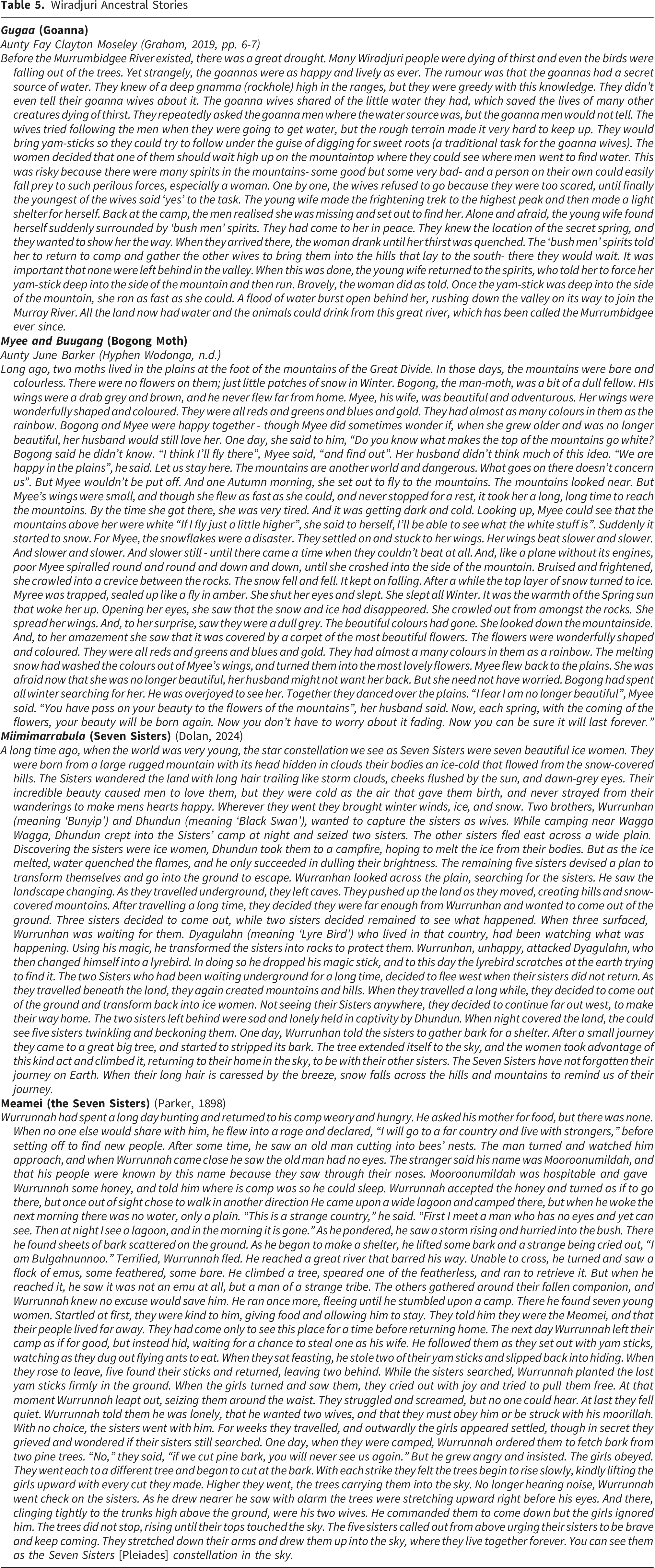
Wiradjuri Ancestral Stories
Gugaa (Goanna)
Aunty Fay Clayton Moseley (Graham, 2019, pp. 6-7)
Before the Murrumbidgee River existed, there was a great drought. Many Wiradjuri people were dying of thirst and even the birds were falling out of the trees. Yet strangely, the goannas were as happy and lively as ever. The rumour was that the goannas had a secret source of water. They knew of a deep gnamma (rockhole) high in the ranges, but they were greedy with this knowledge. They didn’t even tell their goanna wives about it. The goanna wives shared of the little water they had, which saved the lives of many other creatures dying of thirst. They repeatedly asked the goanna men where the water source was, but the goanna men would not tell. The wives tried following the men when they were going to get water, but the rough terrain made it very hard to keep up. They would bring yam-sticks so they could try to follow under the guise of digging for sweet roots (a traditional task for the goanna wives). The women decided that one of them should wait high up on the mountaintop where they could see where men went to find water. This was risky because there were many spirits in the mountains- some good but some very bad- and a person on their own could easily fall prey to such perilous forces, especially a woman. One by one, the wives refused to go because they were too scared, until finally the youngest of the wives said ‘yes’ to the task. The young wife made the frightening trek to the highest peak and then made a light shelter for herself. Back at the camp, the men realised she was missing and set out to find her. Alone and afraid, the young wife found herself suddenly surrounded by ‘bush men’ spirits. They had come to her in peace. They knew the location of the secret spring, and they wanted to show her the way. When they arrived there, the woman drank until her thirst was quenched. The ‘bush men’ spirits told her to return to camp and gather the other wives to bring them into the hills that lay to the south- there they would wait. It was important that none were left behind in the valley. When this was done, the young wife returned to the spirits, who told her to force her yam-stick deep into the side of the mountain and then run. Bravely, the woman did as told. Once the yam-stick was deep into the side of the mountain, she ran as fast as she could. A flood of water burst open behind her, rushing down the valley on its way to join the Murray River. All the land now had water and the animals could drink from this great river, which has been called the Murrumbidgee ever since.
Long ago, two moths lived in the plains at the foot of the mountains of the Great Divide. In those days, the mountains were bare and colourless. There were no flowers on them; just little patches of snow in Winter. Bogong, the man-moth, was a bit of a dull fellow. HIs wings were a drab grey and brown, and he never flew far from home. Myee, his wife, was beautiful and adventurous. Her wings were wonderfully shaped and coloured. They were all reds and greens and blues and gold. They had almost as many colours in them as the rainbow. Bogong and Myee were happy together - though Myee did sometimes wonder if, when she grew older and was no longer beautiful, her husband would still love her. One day, she said to him, “Do you know what makes the top of the mountains go white? Bogong said he didn’t know. “I think I’ll fly there”, Myee said, “and find out”. Her husband didn’t think much of this idea. “We are happy in the plains”, he said. Let us stay here. The mountains are another world and dangerous. What goes on there doesn’t concern us”. But Myee wouldn’t be put off. And one Autumn morning, she set out to fly to the mountains. The mountains looked near. But Myee’s wings were small, and though she flew as fast as she could, and never stopped for a rest, it took her a long, long time to reach the mountains. By the time she got there, she was very tired. And it was getting dark and cold. Looking up, Myee could see that the mountains above her were white “If I fly just a little higher”, she said to herself, I’ll be able to see what the white stuff is”. Suddenly it started to snow. For Myee, the snowflakes were a disaster. They settled on and stuck to her wings. Her wings beat slower and slower. And slower and slower. And slower still - until there came a time when they couldn’t beat at all. And, like a plane without its engines, poor Myee spiralled round and round and down and down, until she crashed into the side of the mountain. Bruised and frightened, she crawled into a crevice between the rocks. The snow fell and fell. It kept on falling. After a while the top layer of snow turned to ice. Myree was trapped, sealed up like a fly in amber. She shut her eyes and slept. She slept all Winter. It was the warmth of the Spring sun that woke her up. Opening her eyes, she saw that the snow and ice had disappeared. She crawled out from amongst the rocks. She spread her wings. And, to her surprise, saw they were a dull grey. The beautiful colours had gone. She looked down the mountainside. And, to her amazement she saw that it was covered by a carpet of the most beautiful flowers. The flowers were wonderfully shaped and coloured. They were all reds and greens and blues and gold. They had almost a many colours in them as a rainbow. The melting snow had washed the colours out of Myee’s wings, and turned them into the most lovely flowers. Myee flew back to the plains. She was afraid now that she was no longer beautiful, her husband might not want her back. But she need not have worried. Bogong had spent all winter searching for her. He was overjoyed to see her. Together they danced over the plains. “I fear I am no longer beautiful”, Myee said. “You have pass on your beauty to the flowers of the mountains”, her husband said. Now, each spring, with the coming of the flowers, your beauty will be born again. Now you don’t have to worry about it fading. Now you can be sure it will last forever.”
Miimimarrabula (Seven Sisters) (Dolan, 2024)
A long time ago, when the world was very young, the star constellation we see as Seven Sisters were seven beautiful ice women. They were born from a large rugged mountain with its head hidden in clouds their bodies an ice-cold that flowed from the snow-covered hills. The Sisters wandered the land with long hair trailing like storm clouds, cheeks flushed by the sun, and dawn-grey eyes. Their incredible beauty caused men to love them, but they were cold as the air that gave them birth, and never strayed from their wanderings to make mens hearts happy. Wherever they went they brought winter winds, ice, and snow. Two brothers, Wurrunhan (meaning ‘Bunyip’) and Dhundun (meaning ‘Black Swan’), wanted to capture the sisters as wives. While camping near Wagga Wagga, Dhundun crept into the Sisters’ camp at night and seized two sisters. The other sisters fled east across a wide plain. Discovering the sisters were ice women, Dhundun took them to a campfire, hoping to melt the ice from their bodies. But as the ice melted, water quenched the flames, and he only succeeded in dulling their brightness. The remaining five sisters devised a plan to transform themselves and go into the ground to escape. Wurranhan looked across the plain, searching for the sisters. He saw the landscape changing. As they travelled underground, they left caves. They pushed up the land as they moved, creating hills and snow-covered mountains. After travelling a long time, they decided they were far enough from Wurrunhan and wanted to come out of the ground. Three sisters decided to come out, while two sisters decided remained to see what happened. When three surfaced, Wurrunhan was waiting for them. Dyagulahn (meaning ‘Lyre Bird’) who lived in that country, had been watching what was happening. Using his magic, he transformed the sisters into rocks to protect them. Wurrunhan, unhappy, attacked Dyagulahn, who then changed himself into a lyrebird. In doing so he dropped his magic stick, and to this day the lyrebird scratches at the earth trying to find it. The two Sisters who had been waiting underground for a long time, decided to flee west when their sisters did not return. As they travelled beneath the land, they again created mountains and hills. When they travelled a long while, they decided to come out of the ground and transform back into ice women. Not seeing their Sisters anywhere, they decided to continue far out west, to make their way home. The two sisters left behind were sad and lonely held in captivity by Dhundun. When night covered the land, the could see five sisters twinkling and beckoning them. One day, Wurrunhan told the sisters to gather bark for a shelter. After a small journey they came to a great big tree, and started to stripped its bark. The tree extended itself to the sky, and the women took advantage of this kind act and climbed it, returning to their home in the sky, to be with their other sisters. The Seven Sisters have not forgotten their journey on Earth. When their long hair is caressed by the breeze, snow falls across the hills and mountains to remind us of their journey.
Wurrunnah had spent a long day hunting and returned to his camp weary and hungry. He asked his mother for food, but there was none. When no one else would share with him, he flew into a rage and declared, “I will go to a far country and live with strangers,” before setting off to find new people. After some time, he saw an old man cutting into bees’ nests. The man turned and watched him approach, and when Wurrunnah came close he saw the old man had no eyes. The stranger said his name was Mooroonumildah, and that his people were known by this name because they saw through their noses. Mooroonumildah was hospitable and gave Wurrunnah some honey, and told him where is camp was so he could sleep. Wurrunnah accepted the honey and turned as if to go there, but once out of sight chose to walk in another direction He came upon a wide lagoon and camped there, but when he woke the next morning there was no water, only a plain. “This is a strange country,” he said. “First I meet a man who has no eyes and yet can see. Then at night I see a lagoon, and in the morning it is gone.” As he pondered, he saw a storm rising and hurried into the bush. There he found sheets of bark scattered on the ground. As he began to make a shelter, he lifted some bark and a strange being cried out, “I am Bulgahnunnoo.” Terrified, Wurrunnah fled. He reached a great river that barred his way. Unable to cross, he turned and saw a flock of emus, some feathered, some bare. He climbed a tree, speared one of the featherless, and ran to retrieve it. But when he reached it, he saw it was not an emu at all, but a man of a strange tribe. The others gathered around their fallen companion, and Wurrunnah knew no excuse would save him. He ran once more, fleeing until he stumbled upon a camp. There he found seven young women. Startled at first, they were kind to him, giving food and allowing him to stay. They told him they were the Meamei, and that their people lived far away. They had come only to see this place for a time before returning home. The next day Wurrunnah left their camp as if for good, but instead hid, waiting for a chance to steal one as his wife. He followed them as they set out with yam sticks, watching as they dug out flying ants to eat. When they sat feasting, he stole two of their yam sticks and slipped back into hiding. When they rose to leave, five found their sticks and returned, leaving two behind. While the sisters searched, Wurrunnah planted the lost yam sticks firmly in the ground. When the girls turned and saw them, they cried out with joy and tried to pull them free. At that moment Wurrunnah leapt out, seizing them around the waist. They struggled and screamed, but no one could hear. At last they fell quiet. Wurrunnah told them he was lonely, that he wanted two wives, and that they must obey him or be struck with his moorillah. With no choice, the sisters went with him. For weeks they travelled, and outwardly the girls appeared settled, though in secret they grieved and wondered if their sisters still searched. One day, when they were camped, Wurrunnah ordered them to fetch bark from two pine trees. “No,” they said, “if we cut pine bark, you will never see us again.” But he grew angry and insisted. The girls obeyed. They went each to a different tree and began to cut at the bark. With each strike they felt the trees begin to rise slowly, kindly lifting the girls upward with every cut they made. Higher they went, the trees carrying them into the sky. No longer hearing noise, Wurrunnah went check on the sisters. As he drew nearer he saw with alarm the trees were stretching upward right before his eyes. And there, clinging tightly to the trunks high above the ground, were his two wives. He commanded them to come down but the girls ignored him. The trees did not stop, rising until their tops touched the sky. The five sisters called out from above urging their sisters to be brave and keep coming. They stretched down their arms and drew them up into the sky, where they live together forever. You can see them as the Seven Sisters [Pleiades] constellation in the sky.
Read through Waya Yindyamarra, these stories do not simply provide information about Wiradjuri women. They instead open a path for re-reading the archive through Country, relation, and matrilineal law. What emerges is not a complete account, nor one that can stand alone from ancestral story or living knowledge, but a set of traces that, when brought into right relation, affirm the centrality of Wiradjuri women to bloodline, totem, ceremony, material culture, care, and continuance. This movement of re-reading prepares the next turn of the spiral, in which I return to Wiradjuri ancestral stories as methodological teachers in their own right.
Ancestral Stories
We now turn to a different movement within the wayamiilbuwawanha cycle, one that looks backwards in order to go forwards. In line with Waya Yindyamarra, this requires a return to Wiradjuri ancestral stories, not as illustrative examples, but as methodological teachers. This stage of the article asks what methodological guidance emerges when ancestral stories are engaged as sources of law, relation, and instruction.
Three publicly available Wiradjuri stories are engaged here, Gugaa (goanna), Myee (bogong moth), and Miimimarrabula (Seven Sisters), each shared by Wiradjuri women and retold through my own understanding. A fourth version of the Seven Sisters story, recorded by K. Langloh Parker (1898), is also included to acknowledge the ongoing presence of non-Indigenous tellings and to maintain balance with the contemporary context in which these stories circulate. These stories are not treated as fixed texts, but as living knowledges that continue to teach, guide, and transform methodological practice.
Within Waya Yindyamarra, ancestral stories are approached as carrying ontological law. As Moreton-Robinson (2013) reminds us, ancestral beings provide the rules for what can and cannot be done, embodying relations between humans, Country, and the spiritual world through ongoing cycles of transformation and connection. In this sense, ancestral stories do not simply describe the world, they enact it. They hold instructions for how to live, relate, and know.
The first stage of analysis involved returning to these stories through wayamiilbuwawanha, attending to how each story expresses relationships across Country, kinship, and transformation. Across Gugaa, Myee, and the Seven Sisters, recurring patterns became visible: women acting with responsibility to community survival, women holding and sharing life-giving knowledge, women refusing relations that break law, and women transforming in response to changing conditions. These patterns are not abstract themes, but expressions of Wiradjuri matrilineal ontology in action.
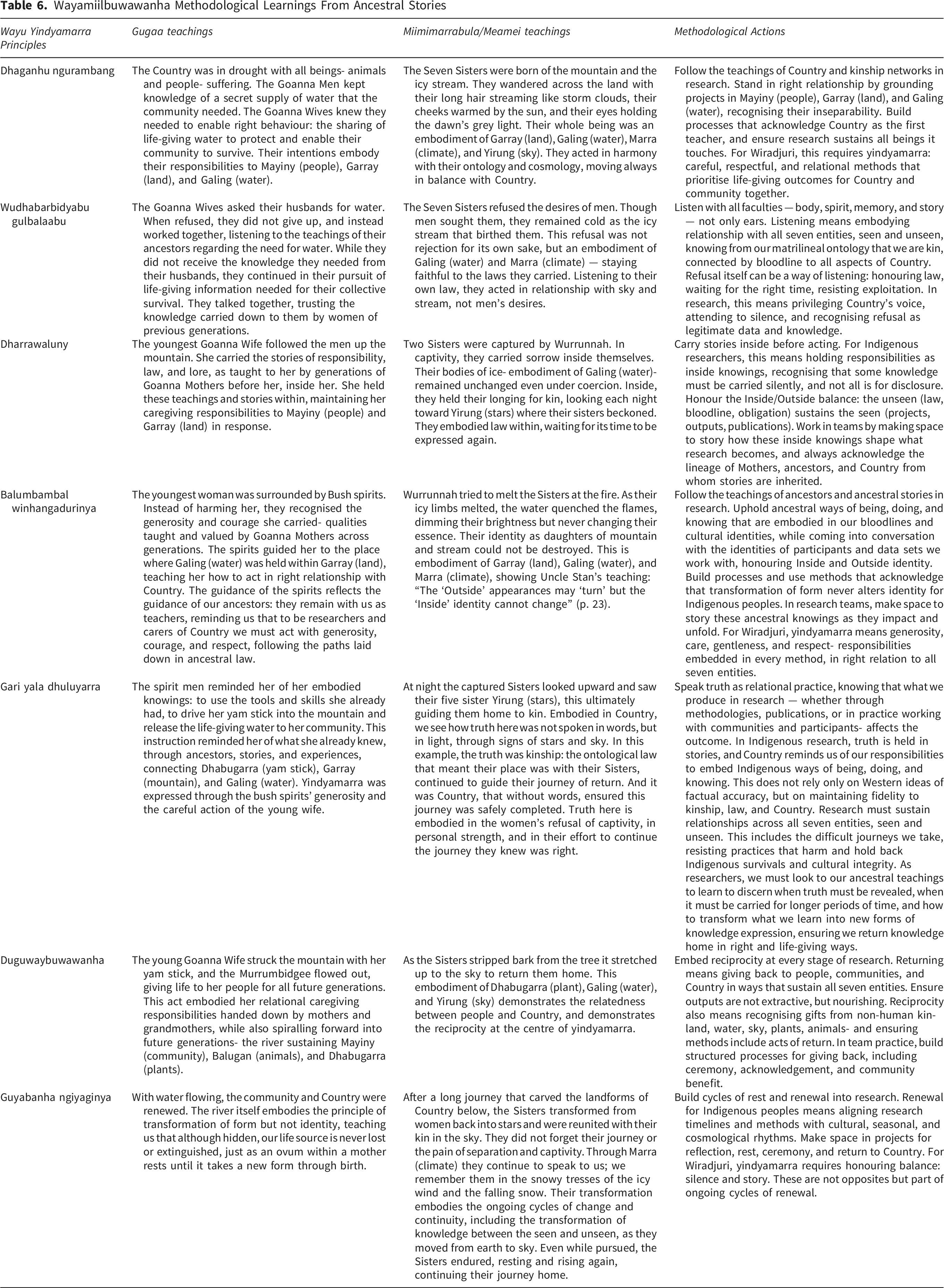
The second stage of analysis is recorded in Table 6. Here, the teachings emerging from each story are brought into conversation with the seven principles of Waya Yindyamarra. This table shows how ancestral stories move from being sources of knowledge to guiding methodological practice. Each principle is not imposed onto the stories, but emerges through them, translating ancestral teachings into methodological actions.
Wayamiilbuwawanha Methodological Learnings From Ancestral Stories
Wayu Yindyamarra Principles
Gugaa teachings
Miimimarrabula/Meamei teachings
Methodological Actions
Dhaganhu ngurambang
The Country was in drought with all beings- animals and people- suffering. The Goanna Men kept knowledge of a secret supply of water that the community needed. The Goanna Wives knew they needed to enable right behaviour: the sharing of life-giving water to protect and enable their community to survive. Their intentions embody their responsibilities to Mayiny (people), Garray (land), and Galing (water).
The Seven Sisters were born of the mountain and the icy stream. They wandered across the land with their long hair streaming like storm clouds, their cheeks warmed by the sun, and their eyes holding the dawn’s grey light. Their whole being was an embodiment of Garray (land), Galing (water), Marra (climate), and Yirung (sky). They acted in harmony with their ontology and cosmology, moving always in balance with Country.
Follow the teachings of Country and kinship networks in research. Stand in right relationship by grounding projects in Mayiny (people), Garray (land), and Galing (water), recognising their inseparability. Build processes that acknowledge Country as the first teacher, and ensure research sustains all beings it touches. For Wiradjuri, this requires yindyamarra: careful, respectful, and relational methods that prioritise life-giving outcomes for Country and community together.
Wudhabarbidyabu gulbalaabu
The Goanna Wives asked their husbands for water. When refused, they did not give up, and instead worked together, listening to the teachings of their ancestors regarding the need for water. While they did not receive the knowledge they needed from their husbands, they continued in their pursuit of life-giving information needed for their collective survival. They talked together, trusting the knowledge carried down to them by women of previous generations.
The Seven Sisters refused the desires of men. Though men sought them, they remained cold as the icy stream that birthed them. This refusal was not rejection for its own sake, but an embodiment of Galing (water) and Marra (climate) — staying faithful to the laws they carried. Listening to their own law, they acted in relationship with sky and stream, not men’s desires.
Listen with all faculties — body, spirit, memory, and story — not only ears. Listening means embodying relationship with all seven entities, seen and unseen, knowing from our matrilineal ontology that we are kin, connected by bloodline to all aspects of Country. Refusal itself can be a way of listening: honouring law, waiting for the right time, resisting exploitation. In research, this means privileging Country’s voice, attending to silence, and recognising refusal as legitimate data and knowledge.
Dharrawaluny
The youngest Goanna Wife followed the men up the mountain. She carried the stories of responsibility, law, and lore, as taught to her by generations of Goanna Mothers before her, inside her. She held these teachings and stories within, maintaining her caregiving responsibilities to Mayiny (people) and Garray (land) in response.
Two Sisters were captured by Wurrunnah. In captivity, they carried sorrow inside themselves. Their bodies of ice- embodiment of Galing (water)- remained unchanged even under coercion. Inside, they held their longing for kin, looking each night toward Yirung (stars) where their sisters beckoned. They embodied law within, waiting for its time to be expressed again.
Carry stories inside before acting. For Indigenous researchers, this means holding responsibilities as inside knowings, recognising that some knowledge must be carried silently, and not all is for disclosure. Honour the Inside/Outside balance: the unseen (law, bloodline, obligation) sustains the seen (projects, outputs, publications). Work in teams by making space to story how these inside knowings shape what research becomes, and always acknowledge the lineage of Mothers, ancestors, and Country from whom stories are inherited.
Balumbambal winhangadurinya
The youngest woman was surrounded by Bush spirits. Instead of harming her, they recognised the generosity and courage she carried- qualities taught and valued by Goanna Mothers across generations. The spirits guided her to the place where Galing (water) was held within Garray (land), teaching her how to act in right relationship with Country. The guidance of the spirits reflects the guidance of our ancestors: they remain with us as teachers, reminding us that to be researchers and carers of Country we must act with generosity, courage, and respect, following the paths laid down in ancestral law.
Wurrunnah tried to melt the Sisters at the fire. As their icy limbs melted, the water quenched the flames, dimming their brightness but never changing their essence. Their identity as daughters of mountain and stream could not be destroyed. This is embodiment of Garray (land), Galing (water), and Marra (climate), showing Uncle Stan’s teaching: “The ‘Outside’ appearances may ‘turn’ but the ‘Inside’ identity cannot change” (p. 23).
Follow the teachings of ancestors and ancestral stories in research. Uphold ancestral ways of being, doing, and knowing that are embodied in our bloodlines and cultural identities, while coming into conversation with the identities of participants and data sets we work with, honouring Inside and Outside identity. Build processes and use methods that acknowledge that transformation of form never alters identity for Indigenous peoples. In research teams, make space to story these ancestral knowings as they impact and unfold. For Wiradjuri, yindyamarra means generosity, care, gentleness, and respect- responsibilities embedded in every method, in right relation to all seven entities.
Gari yala dhuluyarra
The spirit men reminded her of her embodied knowings: to use the tools and skills she already had, to drive her yam stick into the mountain and release the life-giving water to her community. This instruction reminded her of what she already knew, through ancestors, stories, and experiences, connecting Dhabugarra (yam stick), Garray (mountain), and Galing (water). Yindyamarra was expressed through the bush spirits’ generosity and the careful action of the young wife.
At night the captured Sisters looked upward and saw their five sister Yirung (stars), this ultimately guiding them home to kin. Embodied in Country, we see how truth here was not spoken in words, but in light, through signs of stars and sky. In this example, the truth was kinship: the ontological law that meant their place was with their Sisters, continued to guide their journey of return. And it was Country, that without words, ensured this journey was safely completed. Truth here is embodied in the women’s refusal of captivity, in personal strength, and in their effort to continue the journey they knew was right.
Speak truth as relational practice, knowing that what we produce in research — whether through methodologies, publications, or in practice working with communities and participants- affects the outcome. In Indigenous research, truth is held in stories, and Country reminds us of our responsibilities to embed Indigenous ways of being, doing, and knowing. This does not rely only on Western ideas of factual accuracy, but on maintaining fidelity to kinship, law, and Country. Research must sustain relationships across all seven entities, seen and unseen. This includes the difficult journeys we take, resisting practices that harm and hold back Indigenous survivals and cultural integrity. As researchers, we must look to our ancestral teachings to learn to discern when truth must be revealed, when it must be carried for longer periods of time, and how to transform what we learn into new forms of knowledge expression, ensuring we return knowledge home in right and life-giving ways.
Duguwaybuwawanha
The young Goanna Wife struck the mountain with her yam stick, and the Murrumbidgee flowed out, giving life to her people for all future generations. This act embodied her relational caregiving responsibilities handed down by mothers and grandmothers, while also spiralling forward into future generations- the river sustaining Mayiny (community), Balugan (animals), and Dhabugarra (plants).
As the Sisters stripped bark from the tree it stretched up to the sky to return them home. This embodiment of Dhabugarra (plant), Galing (water), and Yirung (sky) demonstrates the relatedness between people and Country, and demonstrates the reciprocity at the centre of yindyamarra.
Embed reciprocity at every stage of research. Returning means giving back to people, communities, and Country in ways that sustain all seven entities. Ensure outputs are not extractive, but nourishing. Reciprocity also means recognising gifts from non-human kin- land, water, sky, plants, animals- and ensuring methods include acts of return. In team practice, build structured processes for giving back, including ceremony, acknowledgement, and community benefit.
Guyabanha ngiyaginya
With water flowing, the community and Country were renewed. The river itself embodies the principle of transformation of form but not identity, teaching us that although hidden, our life source is never lost or extinguished, just as an ovum within a mother rests until it takes a new form through birth.
After a long journey that carved the landforms of Country below, the Sisters transformed from women back into stars and were reunited with their kin in the sky. They did not forget their journey or the pain of separation and captivity. Through Marra (climate) they continue to speak to us; we remember them in the snowy tresses of the icy wind and the falling snow. Their transformation embodies the ongoing cycles of change and continuity, including the transformation of knowledge between the seen and unseen, as they moved from earth to sky. Even while pursued, the Sisters endured, resting and rising again, continuing their journey home.
Build cycles of rest and renewal into research. Renewal for Indigenous peoples means aligning research timelines and methods with cultural, seasonal, and cosmological rhythms. Make space in projects for reflection, rest, ceremony, and return to Country. For Wiradjuri, yindyamarra requires honouring balance: silence and story. These are not opposites but part of ongoing cycles of renewal.
Across Table 6, we see how stories function as methodological instruction. Gugaa teaches the responsibility to act in right relation with Country and to share life-giving knowledge for collective survival. The Seven Sisters teach refusal, endurance, and the importance of remaining faithful to kinship and law, even under pressure. Myee teaches transformation, renewal, and the continuity of life across changing forms. These teachings are then articulated as methodological actions: standing in right relation to Country, listening beyond words, carrying knowledge inside, following ancestral ways, speaking truth relationally, returning knowledge, and building cycles of renewal into research practice. Column 3 in Table 6 brings these threads together, weaving story into method in the way songspirals combine journeys across Country. Through this process, story is not separated from analysis. Instead, story produces method. The principles of Waya Yindyamarra are shown here to be both embedded within ancestral narratives and enacted through them. Across this journey, recurring methodological insights emerge. Wiradjuri Old Women and Ancestors teach us not to abandon kinship obligations, to share knowledge and sustenance even in scarcity, to endure and adapt when conditions change, and to recognise that transformation is constant. Care, kinship, creation, and renewal are therefore not only responsibilities but also methods, ensuring continuity across generations and places.
As Wiradjuri, we understand that every stage of life is a moment of transition, and that transformation is ongoing (Grant, 2010). A songspiral methodology requires us to embrace this reality: to spiral backwards into ancestral story and prior work, and forwards into new forms of knowledge and practice. Guided by Indigenous Women’s Standpoint Theory (Moreton-Robinson, 2013), this return to story enables me to articulate my embodied position as a Wiradjuri woman, while expanding the methodology through matrilineal responsibilities. Research carried out through a matrilineal framework must centre embodied ways of knowing. Women’s bodies and practices are not metaphorical, but are sites of law, knowledge, and relation. To honour this is to recognise our deep matrilineal connectedness. From this grounding, I now move to demonstrate how Waya Yindyamarra can be enacted through embodied visual and poetic inquiry. This stage makes explicit what was implicit in the earlier formulation of Waya Yindyamarra: that ancestral story does not only sit alongside method, but generates it.
In this final stage, Waya Yindyamarra is enacted through embodied visual and poetic inquiry. Here, analysis and creation are not separate processes. Rather, they operate together as methodological practice. Visualisation, collage, and poetic inquiry function as ways of carrying, interpreting, and generating story, allowing the researcher to work with image, memory, feeling, and relation as analytic modes. This stage demonstrates that Waya Yindyamarra is not only a framework for reading story, but also a methodology for making and returning story in ways that remain accountable to Country, kin, and ancestral law.
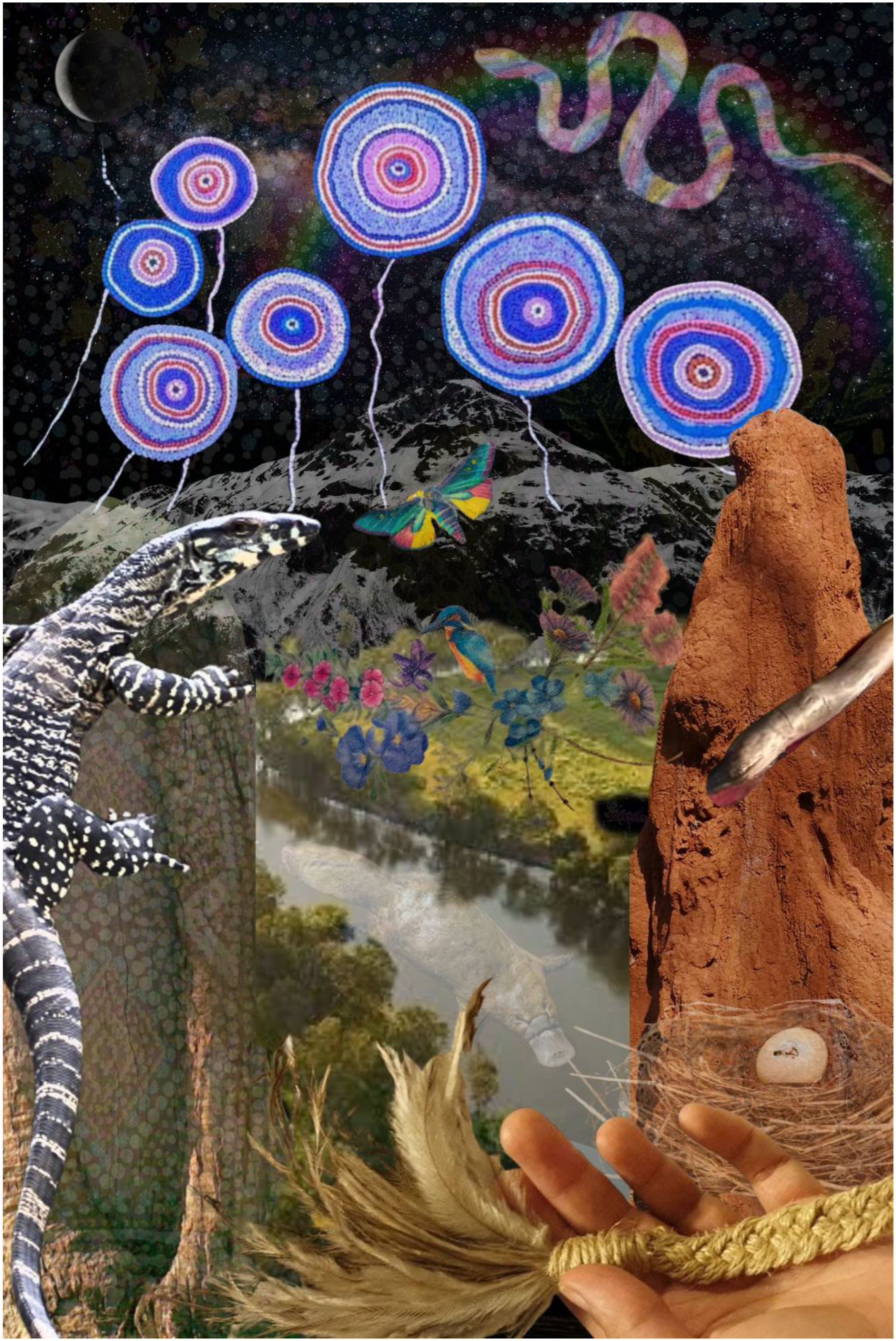
When thinking about the Waya Yindyamarra framework, I envisaged a carved tree reaching into the sky, echoing the branches that gently assisted the Seven Sisters to return home to Sky Country. The seven stars guided research paths, each one representing one of the seven Waya Yindyamarra principles, reminding us of the responsibilities we carry on our research journeys and guiding us as we look to our cosmology held in the constellations at night. As I reflected on this, I remembered how far the Bogong moth travels each year, and our Wiradjuri journeys with other southeastern communities to feast on Bogong moths, reminding me that Indigenous research is always collective. I thought of Myee, and the alpine mountains rising in the background, covered in snow that can both kill and enforce rest and cycles of renewal, reminding me that research must create growth and transformation for the people and Country we work beside.
At the base of the tree, I saw a termite mound with a digging stick releasing our life-giving Wiradjuri rivers. I remembered that women are life givers, just as our rivers are our life force, a constant reminder of renewal and responsibility. I saw a nest hidden in the mound, gugaa’s eggs hatching, reminding me of the yindyamarra required to grow and hold research stories, ideas, and actions inside. Climbing the tree, I saw a goanna, her patterned skin reflected in the carved markings beneath her, geometric diamonds or stars, Wiradjuri symbols representing men and women, reminding us we are from the stars and will return to the Milky Way if we act with yindyamarra, respect, and care. Above, many stars shone, reminding me of our Old Women and ancestors in the sky, watching and guiding us.
This process of wayamiilbuwawanha is itself analytic. The vision is not separate from interpretation, but a way of bringing together story, Country, memory, and methodological principle into relation. As Martin (2008) explains:
The dreams, visions, images, imaging and experiences of serendipity and synchronicity become important to interpreting and translating the research stories. Thus, these processes become a vital part of the Indigenist researcher’s methods…reframing draws on Aboriginal frames of reference and referents to distil colonial and non-Aboriginal knowledges… responding to dreams, visions, ideals, spiritual teachings, goals and theories… to accept these dreams, visions as reflections of unknown or unrealised potential…to express these in speech, art…to use the symbolic expressions for action…as techniques, methods and devices for the Indigenous researcher to use in the project of harmonisation of the research stories (pp. 97–98).
Image 2 reflects this vision of the wayamiilbuwawanha journey.
Reflection on wayamiilbuwawanha Waya Yindyamarra
As I complete this journey, I share a poetic inquiry as a lived demonstration of Waya Yindyamarra in both creation and analysis. This stage enacts the methodology rather than describing it. The poem sits in conversation with two visual collages: the first turns inward to reflect on the Waya Yindyamarra process itself, tracing its spiral of return through layered text, images, and materials gathered in relation to Country; the second follows my poetic inquiry practice, mapping how fragments, found lines, and felt experience are shaped into verse while remaining accountable to kinship and place. Read together, the poem and collages show how Waya Yindyamarra operates as a methodological practice of making, holding, and returning story.
This poem is an embodied story, one grounded in birth, bloodline, and relation. It tells the story of naming my youngest son, Iluka Kotare. Born to me, a Wiradjuri mother, and his Ngāti Kauwhata/Tainui father, Iluka carries both river and ocean lineages. When he received his name, a double rainbow appeared above our home, and since that time, rainbows have continued to appear to both Iluka and I, often at moments of transition, travel, and significance. In this way, the poem does not simply recount an event, but brings together lived experience, ancestral presence, and ongoing relational signs as part of its methodological work.
Analytic Unfolding of the Poem Through Waya Yindyamarra
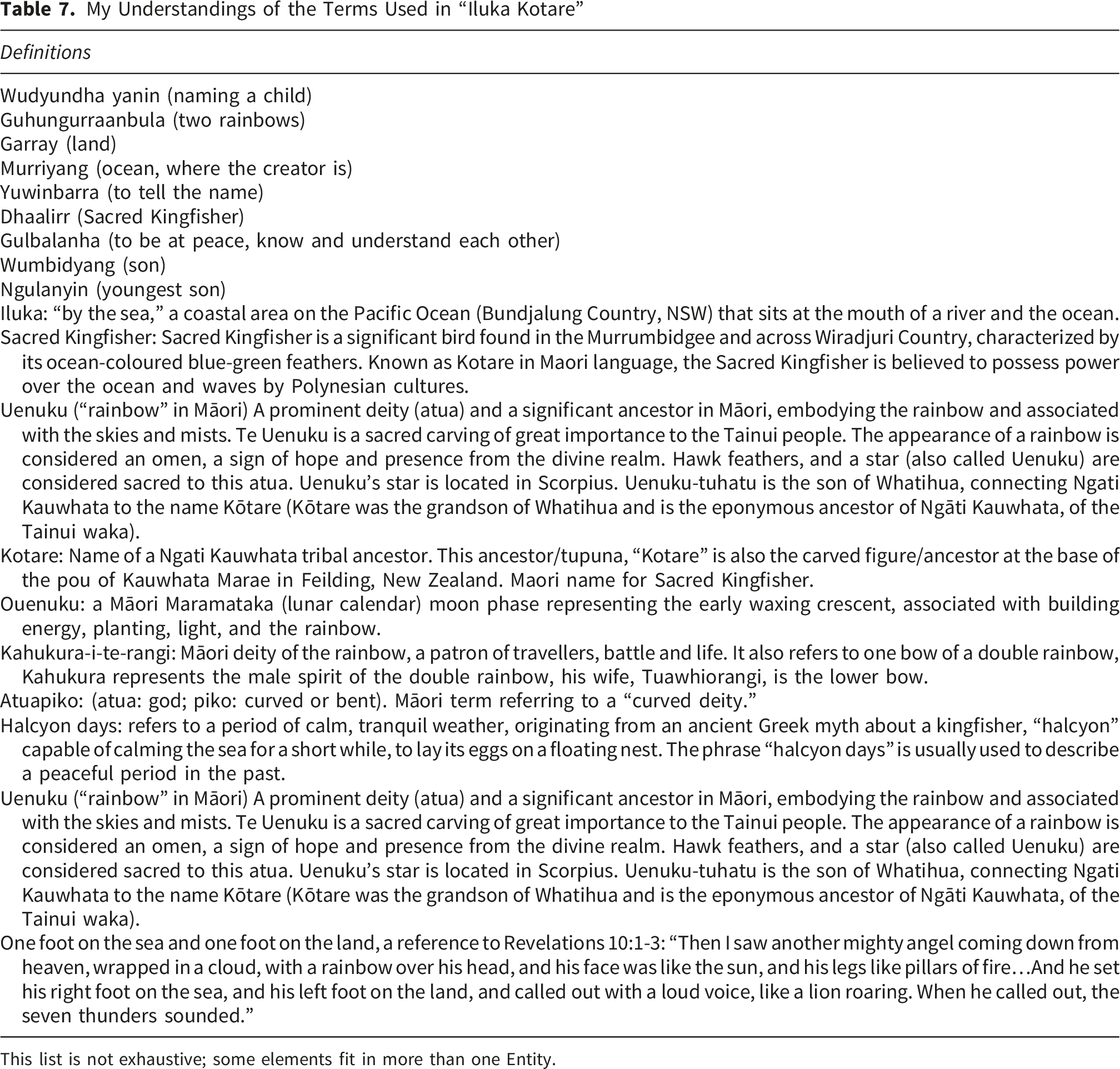
Image 3 presents this poetic inquiry, while Table 7 records the meanings of the terms used within it. These definitions are not supplementary, but form part of the analytic process. They show how language carries layered relations across Wiradjuri and Māori worlds, connecting naming, Country, kinship, ancestral beings, and cosmological systems. Terms such as Wudyundha yanin (naming a child), Guhungurraanbula (two rainbows), Yuwinbarra (to tell the name), and Dhaalirr/Kotare (Sacred Kingfisher) situate the poem within a relational network of language, place, and ancestral meaning.
Wayamiilbuwawanha “iluka kotare”
My Understandings of the Terms Used in “Iluka Kotare”
Definitions
Wudyundha yanin (naming a child)
Guhungurraanbula (two rainbows)
Garray (land)
Murriyang (ocean, where the creator is)
Yuwinbarra (to tell the name)
Dhaalirr (Sacred Kingfisher)
Gulbalanha (to be at peace, know and understand each other)
Wumbidyang (son)
Ngulanyin (youngest son)
Iluka: “by the sea,” a coastal area on the Pacific Ocean (Bundjalung Country, NSW) that sits at the mouth of a river and the ocean.
Sacred Kingfisher: Sacred Kingfisher is a significant bird found in the Murrumbidgee and across Wiradjuri Country, characterized by its ocean-coloured blue-green feathers. Known as Kotare in Maori language, the Sacred Kingfisher is believed to possess power over the ocean and waves by Polynesian cultures.
Uenuku (“rainbow” in Māori) A prominent deity (atua) and a significant ancestor in Māori, embodying the rainbow and associated with the skies and mists. Te Uenuku is a sacred carving of great importance to the Tainui people. The appearance of a rainbow is considered an omen, a sign of hope and presence from the divine realm. Hawk feathers, and a star (also called Uenuku) are considered sacred to this atua. Uenuku’s star is located in Scorpius. Uenuku-tuhatu is the son of Whatihua, connecting Ngati Kauwhata to the name Kōtare (Kōtare was the grandson of Whatihua and is the eponymous ancestor of Ngāti Kauwhata, of the Tainui waka).
Kotare: Name of a Ngati Kauwhata tribal ancestor. This ancestor/tupuna, “Kotare” is also the carved figure/ancestor at the base of the pou of Kauwhata Marae in Feilding, New Zealand. Maori name for Sacred Kingfisher.
Ouenuku: a Māori Maramataka (lunar calendar) moon phase representing the early waxing crescent, associated with building energy, planting, light, and the rainbow.
Kahukura-i-te-rangi: Māori deity of the rainbow, a patron of travellers, battle and life. It also refers to one bow of a double rainbow, Kahukura represents the male spirit of the double rainbow, his wife, Tuawhiorangi, is the lower bow.
Atuapiko: (atua: god; piko: curved or bent). Māori term referring to a “curved deity.”
Halcyon days: refers to a period of calm, tranquil weather, originating from an ancient Greek myth about a kingfisher, “halcyon” capable of calming the sea for a short while, to lay its eggs on a floating nest. The phrase “halcyon days” is usually used to describe a peaceful period in the past.
Uenuku (“rainbow” in Māori) A prominent deity (atua) and a significant ancestor in Māori, embodying the rainbow and associated with the skies and mists. Te Uenuku is a sacred carving of great importance to the Tainui people. The appearance of a rainbow is considered an omen, a sign of hope and presence from the divine realm. Hawk feathers, and a star (also called Uenuku) are considered sacred to this atua. Uenuku’s star is located in Scorpius. Uenuku-tuhatu is the son of Whatihua, connecting Ngati Kauwhata to the name Kōtare (Kōtare was the grandson of Whatihua and is the eponymous ancestor of Ngāti Kauwhata, of the Tainui waka).
One foot on the sea and one foot on the land, a reference to Revelations 10:1-3: “Then I saw another mighty angel coming down from heaven, wrapped in a cloud, with a rainbow over his head, and his face was like the sun, and his legs like pillars of fire…And he set his right foot on the sea, and his left foot on the land, and called out with a loud voice, like a lion roaring. When he called out, the seven thunders sounded.”
This list is not exhaustive; some elements fit in more than one Entity.
Through this process, poetic inquiry operates as both analytic and generative method. The poem brings together Wiradjuri and Māori cosmologies, including Ouenuku and Kahukura as rainbow deities, and the Sacred Kingfisher as a figure of water, movement, and transformation. These are not symbolic additions, but active presences that shape how the story is understood and told. The recurring appearance of rainbows, the naming of Iluka, and the invocation of land and ocean form part of a relational methodology in which story emerges through embodied experience, ancestral guidance, and linguistic connection. In this sense, the poem enacts the principles of Waya Yindyamarra simultaneously. It carries story inside before bringing it into the world; it listens to signs across Country and sky; it speaks truth through naming and genealogy; and it returns knowledge to kin and future generations. Table 7 makes this process visible by grounding each term in its relational meaning, showing how language itself operates as a methodological device. The inclusion of Māori terms alongside Wiradjuri language reflects the lived reality of Iluka’s genealogy and the responsibilities that arise from it. The poem therefore becomes a site where multiple Indigenous knowledge systems meet through kinship, naming, and lived experience, demonstrating how Waya Yindyamarra can hold these relations without reducing them.
This poem spirals from lived experience through kinship and Country. Relationality, reflexivity, and methodological sovereignty are woven together through matrilineal threads of ontological caregiving and love. It demonstrates how Waya Yindyamarra can be used not only to analyse story, but to create it. The poem narrates my responsibilities as a Wiradjuri mother, showing how genealogical knowledge is carried and shared through story. Through Ouenuku (moon), Kahukura (rainbow), and Kotare (sacred kingfisher), we see how women ground children through Yuwinbarra, situating them within matrilineal descent, totem, Country, and kin. In Wiradjuri matrilineal ontology, it is through the mother, and the mother’s mother, that children are positioned and given the totem name that carries their relatedness to all other mayiny.
Through Dharra-waluny, I carried both my son and his genealogy within me. His story gestated alongside my body and my learning of te reo Māori. Writing the poem brought this knowledge into the world, his birth, his name, and the rainbow that appeared, as something that had been held within. The imagery of Ouenuku, Kahukura, and the kingfisher reflects how story emerges from the womb of both mother and Country. Through Balumbambal winhangadurinya, I recognised the rainbow and kingfisher as ancestral teachers. Kahukura, atua of the rainbow, has followed my son across his early years, appearing at moments of significance and travel. The kingfisher, as both Wiradjuri and Māori teacher, marks seasonal law and holds power over water. Including them in the poem acknowledges their role in shaping his life, showing how ancestral ways inform both naming and writing.
Through Wudhabarbidyabu gulbalaabu, I listened carefully to the rainbow sky that appeared on his naming day, to the stories shared by his Māori whānau, and to the law of birds and waters on Wiradjuri Country. Careful listening becomes a methodological practice, guiding how new story is created in accordance with Indigenous law. Through Gari yala dhuluyarra, I understood the need to speak truth about my son’s birth and naming, anchoring his genealogy in story. Truth-telling here affirms not only struggle, but also joy, responsibility, and continuity. Naming my son through poetry becomes a way of inscribing truth for him and for those who follow.
Through Duguwaybuwawanha, I returned this story as a gift to my son, to our family, and to community. Poetry functions here as a methodology of return, ensuring that the knowledge of his birth, his name, and the signs that accompanied him are remembered and shared. Through Guyabanha ngiyaginya, I understood the rainbow as a cycle of renewal. Its continued appearance reminds me that his story is always being renewed. Writing the poem became part of that cycle, a moment of rest and reflection, honouring my role as mother before moving forward again. In this way, Iluka’s conception, naming, birth, and spirit are engaged as living data: relational, embodied, and storied. The poem enacts the seven principles of Waya Yindyamarra, demonstrating how poetic inquiry generates both new knowledge and analytic possibility. What emerges is not only a method of interpretation, but a methodology of creation, a spiralling continuation of my embodied Wiradjuri matrilineal ontology.
Returning to Image 2, further themes emerge through visual practice. This collage layers photography, painting, and images of tattoos I have designed and inscribed on my body, including Wiradjuri wildflowers, Dhaalirr/Kotare, Wawi the Rainbow Snake, and Myee the Rainbow Moth. The Seven Sisters constellation rises into sky, transforming as they return to Sky Country. A yam stick placed within Gugaa’s termite mound recalls women’s labour in sustaining life. My ceremonial belt, woven by Wiradjuri women’s hands, signifies matrilineal custodianship of bloodline, totem, ceremony, and knowledge. A carved tree marked with geometric diamonds connects land and sky in a spiral of story carried across seen and unseen worlds. Together, the poem and collages demonstrate Waya Yindyamarra as both method and methodology: a living, relational, and generative practice grounded in Wiradjuri matrilineal ontology. Here, story is not data. It is method, relation, and continuation.
Conclusion
As Wiradjuri, we understand that every stage of life is a moment of transition, and that transformation is a constant (Grant, 2010). A songspiral methodology requires us to embrace this reality: to spiral backwards into our own prior work as well as into the work of others, and to spiral forwards into the future, carrying those teachings into new depths. Guided by Moreton-Robinson’s Indigenous Women’s Standpoint Theory (2013), I returned to this methodology to articulate and story my embodied position as a Wiradjuri woman, reinterpreting and expanding it through matrilineal responsibilities. In doing so, I honour the leadership of Wiradjuri women as carriers of law, story, and authority, and ensure that our matrilineal perspectives continue to shape and transform how we articulate research methodologies today. Yet I make sure to echo Jones’ (2018) words, when he describes of his own men’s Wiradjuri methodology Yindyamarra Winhanganha (Respectful Thinking), that Waya Yindyamarra, “does not speak for or represent all Wiradjuri. It is hoped, however, that it can contribute to a communal Wiradjuri methodology, or at least inspire other Wiradjuri and south-east methodologies to grow and develop” (p. 68).
In this article, I have brought Country, Mayiny (people), Garray (land), Galing (water), Balugan (animals), Dhabugarra (plants), Yirung (sky), and Marra (climate), into conversation with Waya Yindyamarra Songspiral Methodology (Rogers, 2025). Through this re-turn, and by working with the principles of standing in right relationship with Country, listening and hearing, carrying stories inside, following ancestral ways, speaking truth, returning and giving back, and resting and renewing, the methodology itself has been further deepened. These principles have not simply been applied to story, the connective thread that weaves all entities of Country together, but have been extended, expanded, and transformed through their use.
By returning to ancestral knowledges embodied in Wiradjuri stories, alongside stories told about Wiradjuri women, I have shown how Waya Yindyamarra can be lived in practice, not only described as theory. As a living methodology, it continues to spiral onwards, remaining grounded in Wiradjuri ontology and cosmology while being continually strengthened through its own principles. In this way, it offers a mode of Indigenous research that is relational, respectful, and life-giving.
Shaped by Indigenous Women’s Standpoint Theory (Moreton-Robinson, 2013), Waya Yindyamarra affirms that women’s experiences, responsibilities, and embodied knowledges produce a distinct standpoint. Through a Wiradjuri matrilineal lens, we see that women have always been life givers, caretakers, and transmitters of bloodline, totem, skills, knowledges, and stories. Centring this standpoint ensures that the framework honours women’s roles as law carriers, knowledge holders, and custodians of Country, demonstrating that a Wiradjuri methodology must begin from women’s ways of being, doing, and knowing. In this sense, Waya Yindyamarra is not only a methodological framework, but a matrilineal spiral.
Footnotes
ORCID iD
Jessa Rogers
Ethical Considerations
This project has HREC approval through the University of Melbourne Human Ethics Committee.
Funding
The authors disclosed receipt of the following financial support for the research, authorship, and/or publication of this article: This project receives Australian Research Council (ARC) through the Discovery Early Career Research Award (DECRA) (DE230100140)
Declaration of conflicting interests
The authors declared no potential conflicts of interest with respect to the research, authorship, and/or publication of this article.
HoodJ. (1843). Australia and the East: Being a journal narrative of a voyage to New South Wales in an emigrant ship, with a residence of some months in Sydney and the bush, and the route home by way of India and Egypt. In the years 1841 and 1842. John Murray.
JonesJ. (2018). Murruwaygu: following in the footsteps of our ancestors. [Doctoral dissertation, University of Technology Sydney]. OPUS at UTS. https://opus.lib.uts.edu.au/handle/10453/133196
5.
MartinK. (2008). Please knock before you enter: Aboriginal regulation of outsiders and the implications for researchers. Post Pressed.
MathewsR. H. (1897). The Burbung of the Wiradthuri tribes. Part II. The Journal of the Anthropological Institute of Great Britain and Ireland, 26, 272–285. https://www.jstor.org/stable/2842356?seq=12
9.
MathewsR. H. (1897b). The totemic divisions of Australian tribes. Journal and Proceedings of the Royal Society of New South Wales, 31, 154–176. https://zenodo.org/records/16245931
10.
Moreton-RobinsonA. (2000). Talkin’ Up to the White Woman: Indigenous Women and Feminism: University of Queensland Press.
11.
Moreton-RobinsonA. (2013). Towards an Australian Indigenous women’s standpoint theory. Australian Feminist Studies, 28(78), 331–347. https://doi.org/10.1080/08164649.2013.876664
ParkerK. L. (1898). In StowC. E. S. (Ed.), More Australian legendary talesDavid Nutt.
14.
RogersJ. (2025). Waya Yindyamarra: A Wiradjuri Songspiral Methodology for Indigenous Poetic Inquiry. International Journal of Qualitative Methods, 24, 16094069251379104. https://doi.org/10.1177/16094069251379104
15.
SpryC.ArmstrongB.IngramN.WilliamsA.WilliamsJ.IngramG.SutherlandI.Yarrawula Ngullubul Men’s CorporationHinesM.PottsT.ConyersL. (2023). Investigating Wiradjuri marara (carved trees or dendroglyphs) and dhabuganha (burials) in the Central Tablelands, southeastern Australia. Australian Archaeology, 89(3), 209–226. https://doi.org/10.1080/03122417.2023.2219378