




Abstract
[Programme] theory development is a central component of any realist study. However, there are few published examples that demonstrate how combining established realist approaches can enhance the development and elicitation of [programme] theory in complex healthcare settings. This paper aims to contribute to the growing realist literature by presenting a step-by-step process used in a realist study focused on refugee mental health services in Canada. The paper introduces the intentional and systematic integration of two established realist analytical techniques, linked coding and realist thematic analysis. This combination can enable a more robust and transparent elicitation of [programme] theory by capitalising on the complementary strengths of each approach. A worked example illustrates five interconnected phases: preparation, linked coding, realist thematic analysis, abductive synergy, and initial [programme] theory development. At each stage, the strengths of both approaches were intentionally leveraged to advance causal explanation and theory refinement. The paper concludes with practical recommendations and future directions, emphasising the importance of making deliberate methodological choices when combining realist techniques. It also highlights the need for transparent documentation of [programme] theory elicitation to support rigour and reproducibility in realist research. By offering a replicable framework for methodological synthesis, this paper provides a contribution to the advancement of realist research practice.
Keywords
Introduction
Eliciting a [programme] theory is a foundational step in realist inquiry (Smeets et al., 2021). As a theory-driven approach, realist inquiries (research, synthesis, and evaluation) begin and end with a theory that can be tested and refined through empirical data. Social programmes embody assumptions about how change is supposed to happen, for whom, and under what conditions. Realist approaches are increasingly adopted in health and social policy research due to their potential to unpack complex phenomena and interventions in open systems (Marchal et al., 2018; Mukumbang et al., 2024). As the field grows, questions persist regarding how best to develop [programme] theories in ways that are methodologically robust, transparent, and practically applicable (McEwan et al., 2023). There is growing recognition for the need to meaningfully engage with interest group holders to take up the findings of realist theorising. This means consistently engaging in dialogue to validate or refute working theories. Interest group holders are individuals with professional or lived experience relevant to the topic of study. It is a term derived from the MuSE consortium network, and advocates for inclusive and decolonial language and reflexivity around groups that are affected by colonization, thus we deliberatively do not use the term ‘stakeholder’ (Akl et al., 2024). This paper reports on the theory-elicitation from Phase 1 of a five-year participatory realist project focused on integrated mental health care for refugees, drawing on data generated through a realist workshop, six sector-specific deliberative dialogues (n = 24), and an in-person World Café event (n > 30) conducted in British Columbia between 2022 and 2024.
While there is broad agreement on the importance of [programme] theories in realist inquiries, there is no single agreed-upon method for constructing them. This lack of prescription is not a weakness. Indeed, it reflects a realist concern with adhering to ontological and epistemological principles rather than enforcing a fixed approach (Salter & Kothari, 2014). The RAMESES II reporting standards offer valuable guidance on good practice, such as making [programme] theories explicit, realist in form, and grounded in evidence, but deliberately avoid mandating a specific analytic pathway (Wong et al., 2016). As a result, researchers are exposed to a multiplicity of approaches, frameworks, and tools, often leading to confusion about where to begin (Renmans & Pleguezuelo, 2022; Shearn et al., 2017). In practice, a range of methods have emerged for identifying, structuring, and refining [programme] theories from interest group holder engagement and interviews to theory-driven realist reviews (Fick & Muhajarine, 2019; Peters, 2024). This pluralism is a strength and a challenge. Without clear exemplars, it can be difficult for researchers to navigate the early stages of realist inquiry with confidence and rigour.
To understand the importance of [programme] theory development within realist inquiries, it is essential to consider their philosophical and methodological groundings. Rooted in a realist philosophy of science, the realist approach assumes that reality exists independently of our perceptions, where unobservable generative mechanisms produce observable outcomes (Mingers & Standing, 2017; Sankey, 2021). It views causation as contingent and context-dependent, occurring through the interaction of mechanisms with enabling or constraining contextual conditions (Greenhalgh & Manzano, 2021). The aim of realist inquiries is to both describe what works, and to explain how and why it works (or does not), for whom, and in which contexts (Howe et al., 2025; Pawson et al., 2005). These explanations are commonly articulated through context–mechanism–outcome (CMO) configurations, which serve as building blocks for the development of realist [programme] theories (Dalkin et al., 2015; De Weger et al., 2020).
In realist inquiries, there are different types of theories, and developing the Initial [Programme] Theory (IPT) is the crucial first step. IPTs are a set of initial ideas and assumptions about how and why a programme is intended to work, and for whom, under what circumstances (Hounsou et al., 2025). All programmes, defined as structured resources and/or the facilitation of providing those resources, be it material or immaterial (e.g., knowledge), whether explicitly stated or not, possess an underlying theory that researchers are tasked with making explicit (Goodridge et al., 2015; Trevisan & Walser, 2015). The IPT functions as a central component of realist research, aiming to provide plausible explanations for an intervention’s success or failure in specific contexts. Realist research is theory-driven, shifting the evaluative focus from merely “does it work” to the more complex question of “what works, for whom, in what contexts, and how” (Greenhalgh et al., 2015). By sketching the terrain to be investigated, the IPT helps refine the scope of the realist inquiry and guides subsequent research design and data collection methods (Flynn et al., 2020). The IPT is then empirically tested and progressively refined throughout the research process with the help of key interest group holders through iterative consultations, ultimately contributing to the development of transferable middle-range theories (Mukumbang & Wong, 2025). IPTs are thus fundamental to generating insights into how outcomes are produced and are a crucial step in the ongoing process of explanation and theory development within realist research (Pawson, 2003).
This process of explanation requires reasoning strategies that move beyond description. Retroduction, the central realist-informed inference-making approach, allows researchers to work backward from observed outcomes to infer the mechanisms that could plausibly have produced them (Jagosh, 2020; Mukumbang, 2021). Similarly, realist analysis is guided by a depth ontology that distinguishes between the empirical (what is observed or reported in the data), the actual (what occurs in practice, whether observed or not), and the real (the underlying causal mechanisms or structures that generate these events) (Bhaskar, 1978). For example, in health services research, participants’ accounts of acting under pressure may be treated as empirical data, recurring patterns of practice interpreted at the actual level, and then explained at the real level by inferring underlying mechanisms such as professional obligation or fear of failure. Retroductive thinking supports realist inquiry and addresses the complexity and non-linearity typical of health and social interventions (Moore et al., 2018; Skivington et al., 2021).
It is this complexity that leads to the need for explicit analytical strategies in realist inquiries. For example, Nielsen and Lemire (2024) argue that realist analyses should be transparent, theory-led, and clearly aligned with the aims of the project from the outset. This means intentionally selecting which contexts, mechanisms, and outcomes will be investigated and why; articulating how reasoning strategies such as induction, abduction, and retroduction will be employed; and ensuring that theory construction remains visible and iterative throughout the analysis process. Some studies have already provided exemplar cases that offer methodological guidance at the IPT stage and beyond (Eastwood et al., 2022; Flynn et al., 2020; Hounsou et al., 2025; Smeets et al., 2021). While such calls and examples have improved the methodological clarity of later phases in realist research, there remains a relative lack of practical guidance showing how analytical techniques can be combined and applied specifically during the initial phase of [programme] theory elicitation (Shearn et al., 2017).
This paper responds to that gap by proposing and demonstrating a structured, phased approach to realist theory elicitation and analysis that combines two complementary methods: linked coding and realist thematic analysis. While the broader project is informed by Pawson and Tilley’s (1997) realist evaluation principles, the analytic approach deliberately draws on the strengths of both scientific and critical realism. Specifically, linked coding and the use of CMO heuristics support pragmatic, theory-driven analysis, while the depth ontology and explanatory focus of critical realism strengthen causal reasoning. Together, this integration advances methodological practice across both realist traditions (Mukumbang et al., 2023). Drawing on a recent study focused on developing a [programme] theory for integrated mental health care for refugees in Canada (Clark et al., 2026), we outline a five-phase analytical strategy: (1) preparation and team alignment; (2) linked dyad and triad coding; (3) realist thematic analysis across experiential, inferential, and dispositional themes; (4) Intervention-Context-Actor-Mechanism-Outcome (ICAMO) configuration development through abductive synergy; and (5) initial [programme] theory development via retroduction. The aim of this paper is to demonstrate that the strengths of established realist-informed approaches can be productively combined to develop a rigorous, transparent, and theory-led analytical strategy. We thus offer a replicable pathway for other researchers seeking to generate and refine [programme] theory from primary qualitative data, with a focus on conceptual clarity, collaborative reasoning, and analytic depth.
Project Background
This paper details the robust realist theory-building. Three interlinked knowledge translation activities were implemented between 2022 and 2024: a realist orientation workshop, sector-specific online deliberative dialogues, and an in-person World Café event for a participatory realist project titled Promoting Integrated Mental Health Care Services and Supports for Refugees in British Columbia. Participatory realist is the overall framework guiding the work which includes interest group holders’ identification of a policy and practice problem. In realist research, researchers must engage interest group holder perspectives on drivers of change, privileging their knowledge and enhancing rigor of findings. Interest group consultation throughout the processes is necessary for knowledge uptake (i.e., barriers and facilitators to uptake) of that knowledge (Jagosh et al., 2012). This project seeks to understand how integrated mental health care services for refugees operate across diverse services in British Columbia by identifying and analysing [programme] theories through the iterative creation and refinement of ICAMO configurations.
Overview of the Process
The first phase focused on eliciting an initial [programme] theory to explain how integrated mental health services for refugees might work, for whom, and under what conditions. Using a structured, multi-stage interest group holder engagement process grounded in community based participatory research (CBPR) principles (Collins et al., 2018) and integrated knowledge translation (IKT) (Jull et al., 2017), the aim was to collaboratively construct an early explanatory framework that could guide subsequent testing and theory refinement.
The process began with a realist workshop facilitated by experts in realist research. This session brought together diverse interest group holders, including refugee service users, mental health practitioners, settlement workers, and policymakers and introduced them to key realist concepts such as generative causation and the logic of programme theory development. We used purposive, criterion-based sampling, supplemented by snowball sampling, to recruit interest group participants with professional or lived experience of refugee and asylum seeker mental health services. Inclusion criterion were experience in service delivery, policy, advocacy, or lived experience of forced migration, and willingness to participate in realist dialogue. Participants with lived experience were deliberately included to address their common exclusion from research. Recruitment followed a community-based realist workshop, after which interested participants contacted the study lead (NC) to participate in individual or group deliberative dialogues conducted online or in person. Snowball sampling occurred through established immigrant and refugee health sector networks. No participants withdrew.
Following the workshop, six sector-specific online deliberative dialogues were conducted (N=24), segmented into interest group holder cohorts: refugee service users, settlement staff, mental health professionals, and policy actors. This sample size is typical for IPT elicitation, focusing on theoretical saturation of CMO configurations rather than statistical representativeness (Emmel, 2013; Malterud et al., 2015). Each 90-minute session explored participants lived experiences and perspectives on what works (or does not) for integrated refugee mental health care, for whom, and in which contexts. Insights were captured through collaborative digital tools such as evidence-informed ‘menu cards’ to guide the next phase.
Next, an in-person, multi-sector World Café event convened over 30 participants for a series of structured conversations. The event focused on bringing together multisector, multidisciplinary providers and people with living experience to exploring shared priorities and identifying future directions. The World Café event was graphically recorded to share knowledge across the services and participants.
This paper focuses on the analysis of the deliberative dialogues which inform the IPT development using linked coding, realist thematic analysis, and retroduction. This structured analytical strategy allowed for the systematic generation of early explanatory propositions. Future phases of the project will empirically test and refine these theories across multiple service sites and sectors using realist approaches.
Methods
This section outlines how we combined the strengths of Jackson and Kolla’s dyads and triads (2012), Wiltshire and Ronkainen’s (2021) realist approach to thematic analysis and Mukumbang et al.’s (2018) ICAMO configurations as part of a qualitative primary data collection and analysis strategy to reach a refined IPT. ICAMO was selected for its ability to explicitly articulate Intervention and Actor elements, which are critical in this refugee mental health services context. Steps of the analytical process are outlined below (see Figure 1). The examples presented are fictitious but preserve the real analytical logic of the study to protect participant confidentiality while demonstrating our methods. The study received ethics approval from the University of British Columbia and the University of Victoria, BC REB Number: H22-03195) and all participants provided informed consent. Clark et al. (2026) analysis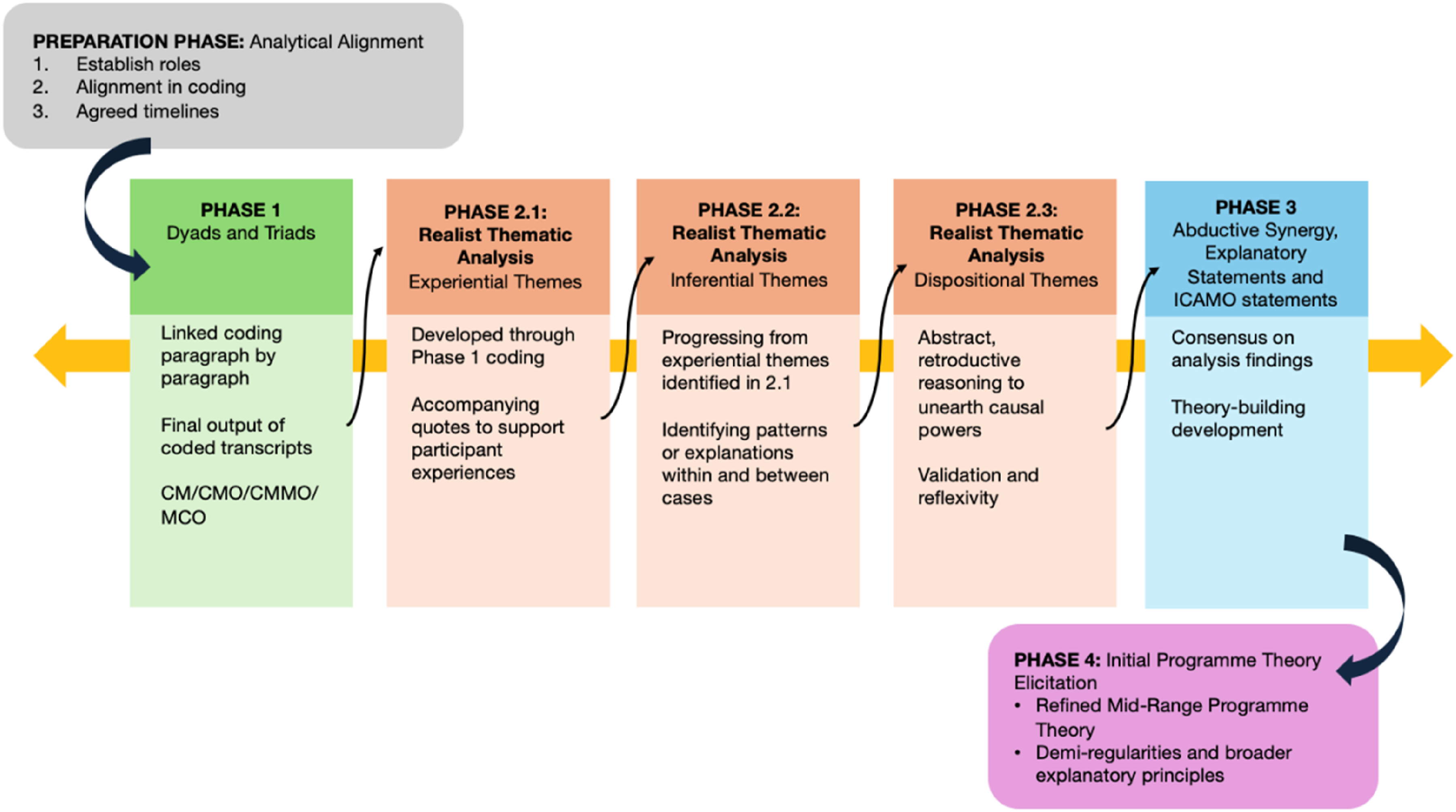
Preparation Phase: Analytical Alignment
Before initiating the first phase, the team (AAB, NC, MH and FCM) met twice via Microsoft Teams to code an extract from one of the deliberate dialogues together. Two key strategies guided this refinement (1) bi-weekly team meetings provided a space to discuss emerging findings in relation to their original context (e.g., specific dialogue sessions) and begin identifying generative mechanisms and (2) theory validation involved assessing the plausibility and explanatory power of emerging ICAMO configurations. These processes were informed by the team’s previous realist experience, (AAB has 3 years of realist research experience, including leading and contributing to several completed and ongoing realist projects and undertaking training and collaborations with realist researchers. MH has 2 years of realist research experience, informed by professional and lived motivations related to structural discrimination and health inequities), in situ practitioner knowledge (particularly that of NC, who brings 30 years’ experience in community mental health nursing, including 15 years working specifically in refugee mental health services and with refugee communities and participatory realist expertise), methodological guidance and supervision (FCM brings extensive realist methodological expertise to evaluate mental health services and policies), congruence with existing literature, and resonance with frontline experiences. A consensus document was used to assess and validate dispositional statements and refine the ICAMO logic. This allowed the team to clarify questions related to coding and extraction, and to ensure alignment in the realist process. It also helped establish roles, expectations, and timelines.
Preparation Phase Alignment Checklist

Phase 1: Jackson and Kolla (2012) Dyads and Triads
The deliberate dialogue transcripts were coded independently by two researchers (AAB and MH) using the dyad and triad method, a realist-informed approach to data analysis that focuses on identifying and refining causal explanations by examining dyads (two linked elements, such as context–mechanism or mechanism–outcome) and triads (full context–mechanism–outcome configurations). By iteratively analysing these relationships, researchers can build, test, and refine [programme] theories in a structured yet flexible way that accommodates complexity and partial data. A key strength of this approach is that it avoids “cataloguing” i.e., coding context, mechanism, and outcomes separately without configuration (Pawson & Manzano-Santaella, 2012). This phase enabled the team to think retroductively throughout the analysis and begin theory building and refinement from the outset.
Linked Coding Example From Fictitious Transcript

Note. The highlighted extract includes a CM dyad, in this case, the contextual conditions of lack of systemic resources and the personal responsibility activated despite the challenge.
Phase 2.1: Realist Thematic Analysis – Experiential Themes
Definition of Inductive, Deductive, Abductive and Retroductive Reasoning

Experiential themes were initially developed by AAB and MH using the dyads and triads identified in Phase 1, by collectively reading and discussing the data to identify themes that closely represented participants’ experiences. NC provided contextual knowledge to enhance understanding of service settings and policies. AAB and MH met weekly to discuss progress across each transcript, with all experiential themes included in a master list (and visual Miro board) to observe similarities and differences within and between cases (Pawson, 2024). Deductive reasoning was used to identify recurring themes and new data. At this stage, quotes were extracted as evidence of the experiential theme and dyads and triads were used to evidence the existence of the mechanism and context relationship.
Realist Thematic Analysis Experiential Theme Example

Phase 2.2: Realist Thematic Analysis – Inferential Themes
After experiential themes and quotes were developed and extracted, the analysis moved beyond surface-level accounts to develop inferential themes. These themes identify patterns or explanations that could plausibly apply beyond the dataset. AAB and MH worked independently on each transcript using inductive reasoning and abductive reasoning. This helped connect participants’ expressions to wider ideas, enabling deeper exploration and adjudication between potential explanations.
Realist Thematic Analysis Inferential Theme Example

Phase 2.3: Realist Thematic Analysis – Dispositional Themes
The final stage of the analysis aimed to arrive at dispositional themes. These explain the underlying causal powers or mechanisms that must exist for observed patterns to occur. This stage used retroductive reasoning, asking: What must be true about the world for this pattern to make sense? We distinguished inferential themes from dispositional themes using a simple decision rule. Inferential themes summarise what is happening in the data, whereas dispositional themes explain what makes those patterns possible. Inferential themes therefore involved conceptual explanations that remained close to participants’ accounts, while dispositional themes involved retroductive propositions about underlying causal powers, mechanisms, or structures that could generate the observed patterns and may not be directly evidenced in the data. AAB and MH worked independently to arrive at dispositional themes. Due to their more abstract nature, AAB and MH met weekly to validate and question the themes, linking them back to theory and the purpose of the work. This reflexivity between the analysts helped unearth, interpret and adjudicate between theories (Downey et al., 2024). This phase formed the core of the analysis by examining data across different ontological levels and explicitly articulating generative causation through retroductive reasoning.
Realist Thematic Analysis Dispositional Theme Example

Phase 3: Abductive Synergy, Explanatory Statements and ICAMO Statements
At this stage, AAB and MH came together to reach consensus on the analysis. The findings from each researcher were placed side by side, with themes and retroductive theorising maturing throughout. A whole-team consensus was then reached on the final themes and ICAMO/explanatory statements. ICAMO statements were developed by identifying the Interventions, Actors, Contexts, Mechanisms and Outcome apparent at each stage of the analysis. NC and FCM provided iterative feedback and refinements on all ICAMO statements through discussion, comments in Microsoft Word, and bi-weekly meetings. AAB and NC met frequently to collaboratively build the theory and co-design the dispositional themes, jointly refining the ICAMO statements over several meetings by drawing on NC’s contextual expertise. Phase 3 consolidated the final configurational propositions, which were then developed into the full visual IPT and validated with interest group holders.
Synergy Example

Explanatory Statement Example

ICAMO Statement Example

Phase 4: Initial [Programme] Theory Elicitation
All ICAMO statements were compiled into a separate Word document, with each component visually highlighted for clarity. This helped distinguish between the different elements and facilitated abstraction at the context and mechanism levels. The ICAMOs were analysed for patterns, including overarching contextual conditions for integrated mental health care and similarities and differences at the mechanism level. At this stage, triangulation was used to assess each ICAMO configuration by balancing interview data with the broader evidence-based literature and collective but diverse expertise of the analysists (AAB, NC, MH, FCM), relevant substantive theory, and analytic interpretation. Competing explanations were initially adjudicated by AAB and MH based on explanatory power, empirical adequacy, and plausibility in accounting for outcome variation, rather than theoretical preference. These judgements were then reviewed with NC and FCM, with team consensus reached when an ICAMO provided a coherent and evidence-based explanation suitable for interest group holder validation. Demi-regularities, or, semi-predictable patterns of behaviour, were identified within the scope of the project and re-described using abductive reasoning, drawing on theories from outside the scope of the project and retroductive reasoning to uncover causal powers (Lawson, 1997). Broader explanatory principles were then developed, synthesising the key [programme] theories to reach an IPT. Although retroduction is employed in these later stages, the entire analytical process explicitly leveraged retroductive reasoning at all stages. From the Preparation Phase and Phase 1’s initial linked coding, abduction, the inventive thinking to imagine hidden mechanisms, was employed to identify patterns and initial interpretations, laying the groundwork for deeper inquiry. Phase 2 directly embodied retroduction by progressing through the themes, which explicitly involved abstract, retroductive reasoning to unearth causal powers. This unearthing of mechanisms is central to retroduction’s aim of understanding why things are the way they are. Subsequently, Phase 3 and Phase 4, involving the development of ICAMO statements and eliciting the IPT, deepened this retroductive understanding by linking key components and continuously refining causal pathways, aiming for closer approximations of the truth about underlying generative processes. Thus, retroduction, in tandem with abductive thinking, was a continuous and fundamental mode of inference throughout the project, enabling the move from observed phenomena to understanding the deeper, unobservable mechanisms that produce them. This final phase produced the final IPT through systematic triangulation of data and theory.
ICAMO for Demi-Regularity and Initial [Programme] Theory Formation
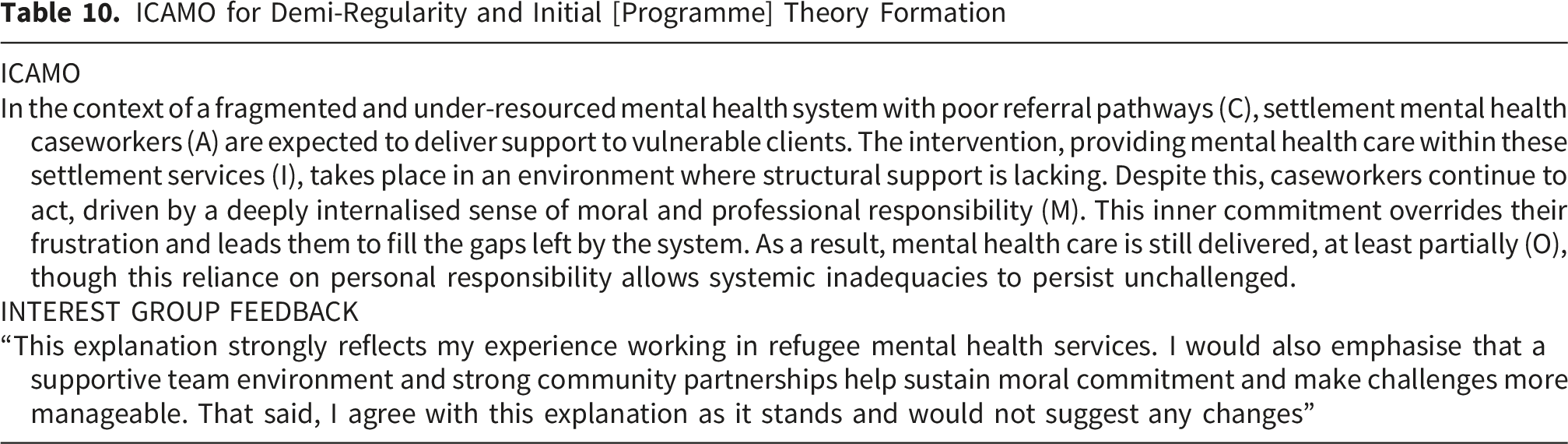
Figure 2 provides a visual representation of the IPT analysis process and Figure 3 provides the final IPT created from the analytical process. Initial [programme] theory process An initial [programme] theory diagram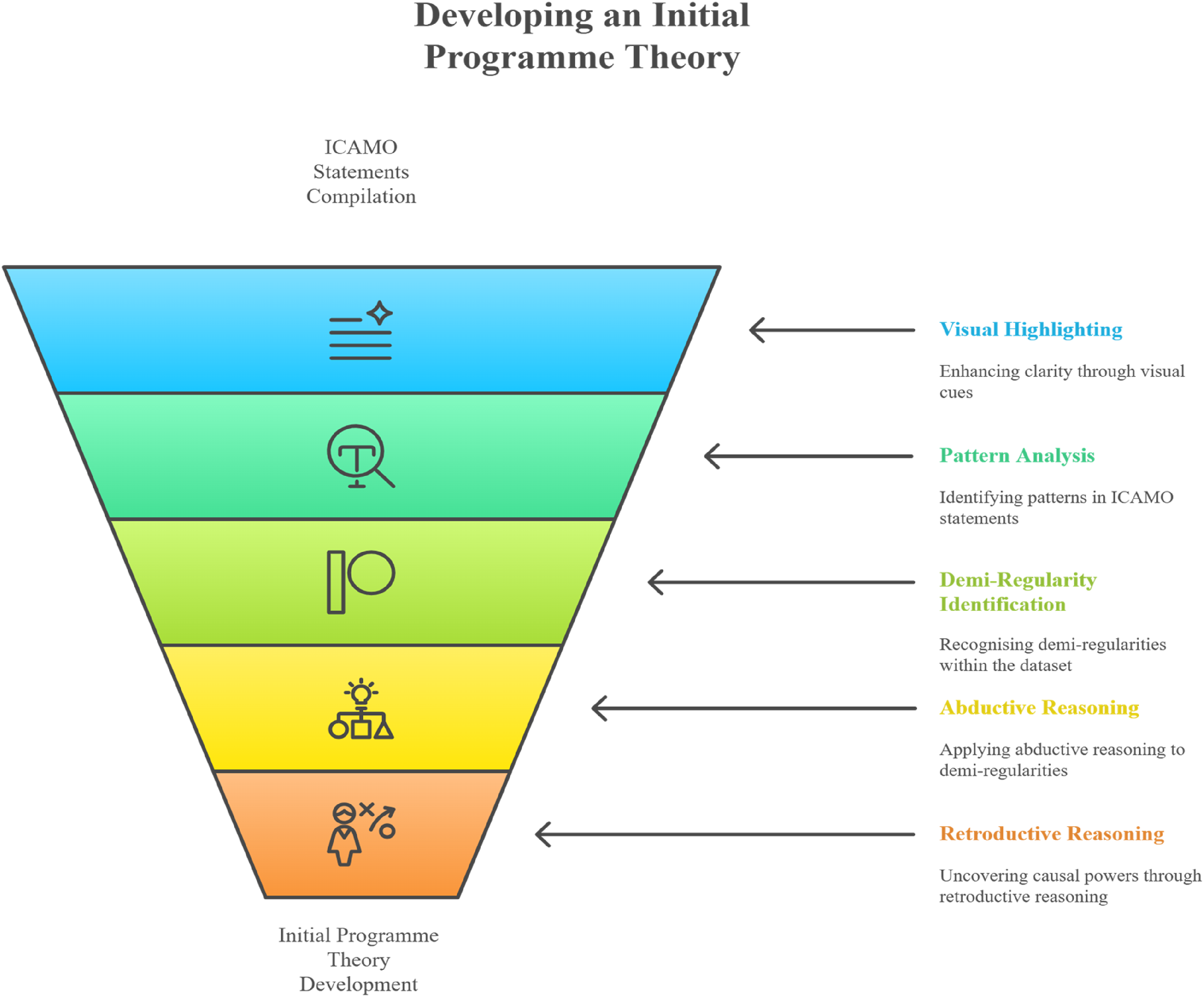

Discussion
Despite the central role of [programme] theory elicitation in realist inquiries, there are currently few examples that explicitly combine the strengths of two established realist analytical tools to demonstrate the reasoning behind [programme] theory development. This paper aims to address that gap by contributing to ongoing discussions about how [programme] theory is constructed in realist work. Specifically, it offers a step-by-step, replicable process that researchers can apply when working with qualitative primary data. This approach is intended to support transparency, rigour, and practical application in realist analysis.
This study adopted a novel approach by combining the strengths of linked coding techniques with realist thematic analysis. Dyad and triad coding have been widely used in realist research, with existing literature highlighting their value in CMO configurations from narrative data, exploring connections early in the analysis and supporting cross-case or cross-unit comparison (Caló et al., 2019; Steiner et al., 2021; Van Der Weide et al., 2025; Willis et al., 2018). Similarly, realist thematic analysis has been recognised for its contribution to producing causal explanations and uncovering underlying generative mechanisms, aligning well with a depth ontology (Fryer, 2022; Marsh et al., 2024). By integrating these two approaches, researchers can strengthen causal inquiry. Specifically, this combination enables the early identification of CMO patterns while also engaging with the deeper, often hidden structures that may not be readily accessed through standard thematic analysis alone. This dual approach supports a layered and theoretically rich understanding of how and why outcomes occur in particular contexts. However, combining methodological strengths does not eliminate the limitations of each individual approach. For example, this type of integration can be cognitively demanding and resource-intensive, particularly in settings with limited time or capacity. Additionally, there can be challenges in clearly distinguishing between thematic patterns and the inferential or dispositional elements associated with mechanisms, which may lead to some conceptual ambiguity. Despite these challenges, we argue that future realist research should explore and consider combining compatible or synergistic methods for [programme] theory elicitation. Doing so can expand the methodological repertoire available to the realist community. Such decisions should always be deliberate and guided by the ontological and epistemological underpinnings of the project, ensuring that any combination of methods remains coherent, purposeful, and aligned with the realist logic of inquiry.
Although the process presented above follows a sequence, as with all realist analysis, the phases were iterative and evolving. For instance, some dispositional themes were adapted based on evolving thinking on inferential themes at later stages of the project. This process presents both analytical and logistical challenges (Gilmore et al., 2019; Manzano, 2016). Analytically, the process of combining linked coding with realist thematic analysis required moving back and forth between coding structures and emerging realist themes. This iterative movement was valuable in identifying and refining underlying mechanisms, as our understanding of the data and emerging theories evolved throughout the project. However, the continuous nature of this development made transparent documentation essential. To manage this, document control and version tracking using Microsoft Teams played a critical role in maintaining consistency and clarity (Kanza & Knight, 2022). From a logistical perspective, employing a combined approach demands considerable time and resources. While this is not unique to realist research, it requires careful balancing of the day-to-day practicalities of project management with the need to preserve ontological and theoretical depth. Time pressures must not compromise the integrity of the analytical process. As such, maintaining an audit trail and ensuring transparency in the documentation of decisions and changes becomes especially important. Realist research must aim to make its processes visible and replicable.
The use of commonly available tools proved sufficient to conduct this project with rigour. This is a noteworthy observation, as it highlights that accessible and widely used software can effectively support the demands of realist analysis. At the outset of the project, the team agreed on a shared approach, and this decision proved beneficial throughout the research process. These tools supported the work in two key ways: first, by allowing collaborative annotation and tracking of analysis through shared working documents online; and second, by enabling visual mapping of codes and conceptual links using Miro. This demonstrates the value of combining different tools to support the analytical strategy, rather than relying on any one platform in isolation. Other researchers have also employed similar software in realist projects (Johansson et al., 2025; Jones et al., 2024), reinforcing the idea that methodological rigour does not necessarily require complex or specialised tools. In sum, accessibility, when paired with clarity and transparency, can be just as effective, if not more so, than adopting a multitude of sophisticated software options. In a research environment where numerous digital tools are readily available, it is important not to overcomplicate the process unnecessarily (Isangula et al., 2024). A practical, accessible, and rigorous approach is often more sustainable and effective.
While the worked example presented attempts to bring the analytical process to life, it has limitations that should be taken into account. First, the analysis was based on a relatively small primary dataset, specifically, six deliberate dialogues, each approximately 90 minutes in length. It is not yet clear whether the same analytical approach would be equally applicable or effective in the context of realist surveys or secondary data collection in a realist synthesis. Second, while the study focuses on the Canadian context, the identified ICAMO configurations have transferability potential; multi-site validation is planned for future phases initially through a realist review and then in various locations across Canada. Third, the research team involved in the example had prior experience in refugee mental health and expertise in realist approaches. This may have made the process smoother and more efficient than it might be for those attempting it for the first time. For this reason, we advise readers, particularly those new to realist research, to proceed with caution. Although we have tried to present the process in a simple and transparent way, it is essential that researchers clearly articulate their realist assumptions and reasoning throughout the process. Future research should consider RAMESES III standards (in development) for realist reporting. Fourth, this work was carried out within a collaborative research team, and the timings and processes described reflect that team-based setting. PhD students or independent researchers working primarily with their supervisor may need more time and support to adapt the process to a smaller-scale or more individualised research context. This analytical process required approximately 200 team hours over 6 months, highlighting its resource-intensive but valuable for robust theory-building. Finally, there was a high degree of alignment among team members in terms of how the analysis was approached and interpreted. This alignment helped the process flow more smoothly. We found that ensuring shared understanding from the onset was particularly helpful. However, in other cases, analysts may diverge more in their interpretations. If this happens, techniques such as data triangulation and interest group holder involvement can help resolve discrepancies. These strategies are consistent with realist principles through theory adjudication and support the rigour of the analytical process (Pawson, 2006; Rycroft-Malone et al., 2012).
Conclusion
In this article we have argued that combining established realist analytical methods to elicit [programme] theory can be a valuable and effective approach. By doing so, researchers can demonstrate how [programme] theory can be developed and refined throughout the research process. A key lesson emerging from this work is that integrating different approaches, when done transparently and with clear justification, can enhance the depth and flexibility of realist analysis. Importantly, the article emphasises the need for early alignment within the research team regarding the theoretical and analytical direction of the project. Establishing a clear and shared analytical strategy from the outset is essential for ensuring consistency and coherence throughout the study. This proposal is not intended to promote a single, standardised method or suggest a universal solution. Rather, it offers an additional option, another analytic process in the realist researcher’s toolkit, that may help in understanding complex social phenomena. The aim is to support methodological innovation while remaining grounded in the core principles of realist inquiry.
Footnotes
Acknowledgments
We wish to acknowledge our interest group holders for sharing their knowledge and time. We would like to thank Dr Suzanne Jackson for her comments.

Ethical Considerations
Research ethics approval was obtained by the University of British Columbia and the University of Victoria, BC.
Consent to Participate
All participants gave written consent to participate. REB Number: H22-03195.
Funding
The authors disclosed receipt of the following financial support for the research, authorship, and/or publication of this article: We sincerely thank Michael Smith Health Research BC for the Convening and Collaborating (C2) award that provided the funding for this research. Michael Smith Health Research BC; C2-2022-2929.
Declaration of Conflicting Interests
The authors declared no potential conflicts of interest with respect to the research, authorship, and/or publication of this article.
Data Availability Statement
The data that support the findings of this study are available from the corresponding author upon reasonable request.