




Abstract
Storytelling, deeply rooted in African diasporic oral traditions, serves as a vital methodology for cultural preservation, resistance, and healing. Grounded in the legacy of the West African Griot, this study explores how storytelling through the creation and engagement with the ‘Ancestral Journey Narrative’, a sound collage, can function as a decolonial and affirming methodology within Afro-Caribbean art therapy. Using an Arts-Based Research (ABR) framework, members of a PhD cohort were invited by the first author to engage with a sound collage narrating the imagined journey of an enslaved African to the Caribbean. Through creative responses in visual art, movement, and dialogue, participants reflected on historical trauma, resilience, and cultural identity. Thematic analysis revealed three interconnected themes: Visualizing the Journey, Embodying the Journey, and Linking the Past to the Present. These themes highlight how embodied storytelling can foster emotional connection, historical understanding, and cultural reclamation. Findings underscore the importance of integrating Afro-Caribbean cultural frameworks and ancestral narratives into therapeutic and educational settings to counter dominant historical erasures, address mental health stigma, and promote resilience through cultural pride. While this study was limited by its small, academically situated sample, it offers critical insights into the transformative potential of storytelling as a culturally affirming practice. Future research should broaden participation through community-based approaches and explore the long-term impacts of multi-modal arts-based storytelling interventions across diverse Afro-Caribbean contexts.
Keywords
Storytelling is celebrated as one of the most valuable traditions within African diasporic cultures (McNeil Young et al., 2023) and recognized as a cornerstone of qualitative research (Banks-Wallace, 2002). Rooted in the West African Griot tradition, where oral historians preserved culture and passed down values, storytelling maintains a powerful link between past and present. This tradition has played a vital role in sustaining Afro-Caribbean identities across generations of oppression and displacement (Banks-Wallace, 2002). Rooted in ancestral wisdom and collective memory, storytelling acts as a form of resistance that counters historical trauma and mental health stigma while affirming the lived realities of marginalized peoples (Banks-Wallace, 2002; Naidoo, 2020; Nakhid et al., 2022; Samuel & Ortiz, 2021). Lewis (2011) underscores the power of using stories in research to give voice to communities, describing storytelling as “a less exploitative method of inquiry that offers a more complex and complete picture of social life” (p. 215). Stories permeate cultural and social environments, transcending the constraints of time and space to empower individuals, bridge differences, build communities, and draw on personal and cultural wisdom (Lewis, 2011).
Caribbean people possess distinct worldviews shaped by the historical legacies of colonialism, slavery, and cultural syncretism (Beckles, 1997). Consequently, traditional Western research methodologies often fail to capture the nuances of their social realities and can perpetuate harmful stereotypes and erasures (Wilson et al., 2019). As Nakhid et al. (2022) argued, there is a critical need for culturally affirming research methodologies grounded in Caribbean perspectives, methodologies that celebrate, rather than marginalize, the unique epistemologies of the region.
Affirming methodologies are research approaches grounded in the worldviews and interactions of specific communities, particularly Caribbean peoples, focusing on validating local cultural practices and knowledge systems rather than Western perspectives (Nakhid et al., 2022). These methodologies seek to de-mythologize colonial knowledge systems and reconstruct meaning around rituals and practices by exploring the historical and cultural contexts of these communities (Nakhid et al., 2022). These approaches include utilizing practices like “liming” and “ole talk” (Nakhid-Chatoor et al., 2018), incorporating storytelling as a form of resistance and knowledge transmission, and acknowledging the syncretism inherent in Caribbean identity (Stewart & Ferguson, 2023).
Affirming methodologies prioritize relationality, community engagement, and embodied knowledge (McClinchey, 2024; Nettleford, 2004), moving away from detached, objective Western frameworks. This shift is essential for decolonizing research practices and fostering more accurate, respectful, and empowering understandings of Caribbean experiences (Samuel & Ortiz, 2024). As Stewart and Ferguson (2023) note, Caribbean Decolonial Research Methodologies are not merely intellectual exercises but an ‘epistemic imperative’, a corrective to reductionist narratives that have historically undermined Afro-Caribbean knowledge systems. Storytelling, as one of these methodologies, serves as both a research tool and a vital means of cultural preservation and affirmation.
Background and Context
The socio-historical landscape of the Caribbean is deeply marked by colonialism, the transatlantic slave trade, and subsequent cultural erasure (Beckles, 1997), leading to intergenerational trauma that continues to affect community dynamics and mental health (Naidoo, 2020; Saint Louis, 2021). Historically, storytelling has served as both a form of resistance and a survival strategy to combat the legacies of historical trauma (Banks-Wallace, 2002). Enslaved Africans preserved their histories and values through oral traditions, blending African, Indigenous, and European influences (Aljoe, 2004). Within the oral traditions, stories are passed down through generations (Shearer, 2022). Additionally, festivals like Junkanoo and Trinidad Carnival exemplify storytelling as cultural performance, reclaiming public spaces, and resisting colonial legacies (McClinchey, 2024).
However, colonial narratives transmitted through education systems, media, religious institutions, and legal structures have historically worked to silence, distort, or erase Afro-Caribbean experiences (Clarke & Mullings, 2022; Naidoo, 2020). Chimamanda Ngozi Adichie’s (2009) concept of “The Danger of a Single Story” highlights how the dominance of colonial perspectives shapes what is seen as legitimate knowledge, often marginalizing alternative histories and lived realities. In this context, storytelling becomes a powerful act of resistance and reclamation, offering counter-narratives that restore voice, agency, and cultural pride (Clarke & Mullings, 2022).
Beyond resisting dominant narratives, storytelling also reflects a fundamentally different approach to knowledge, one rooted in relationship, reciprocity, and communal accountability. Wilson (2008) describes this as relational accountability, a core principle of Indigenous research methodologies, emphasizing that knowledge creation is not just about generating information, but about honoring relationships with people, communities, land, and ancestors. This principle aligns closely with Afro-Caribbean storytelling practices, which are deeply rooted in intergenerational wisdom and communal responsibility. Naidoo (2020) frames lived experience and personal story as valid and valuable sources of knowledge that can challenge Western epistemologies.
Ultimately, storytelling disrupts hierarchical power dynamics, centering community voices over institutional narratives (McClinchey, 2024). In Afro-Caribbean contexts, storytelling is embodied through dance, music, ritual, and visual arts (Nettleford, 2004), reflecting a holistic epistemology where knowledge is lived, performed, and felt. Mental health stigma in these communities, often rooted in colonial ideologies and respectability politics, creates barriers to help-seeking (Edge, 2013; Gallimore et al., 2023; Ocho et al., 2022). Storytelling interventions help counter this stigma by normalizing conversations about mental health, reframing suffering within historical and communal contexts, and fostering resilience through cultural pride (Samuel & Ortiz, 2021).
ABR and Storytelling: A Tool for Exploring Historical Trauma
Arts-Based Research (ABR) offers a framework for exploring and understanding the experiences of traumatic migrations within Afro-Caribbean communities. ABR is a form of qualitative inquiry that uses artistic processes as both a method of inquiry and a mode of representation to generate, analyze, and communicate knowledge (Barone & Eisner, 2012). Barone and Eisner (2012) outline several criteria that make ABR socially transformative, including its potential to be incisive, concise, generative, socially significant, evocative, illuminative, and coherent. Furthermore, Sethi (2018) emphasizes the participatory nature of ABR, which adopts a “bottom-up” approach, providing space for facilitating advocacy and social change. By integrating storytelling and engagement with creative arts such as dance, drama, music, and visual art, ABR enhances self-expression and amplifies voices (Banks-Wallace, 2002; Fonseka et al., 2021; Lewis, 2011). ABR contributes to the generation of a sense of community and connection among participants, allowing for the sharing of insights and stories within wider community contexts (Banks-Wallace 1998).
Storytelling in ABR and Creative Arts Therapies (CATx)
Lewis (2011) emphasized that storytelling is not just a cognitive process but also a product of cognition, shaping our understanding of reality through recursive storytelling and noted that “our aesthetic understanding of reality is formed and informed through our embeddedness in the generative and creative process of story” (p. 507). The use of storytelling in research adds layers of complexity and completeness, offering a space for the storyteller to create and transform places into meaningful spaces of resistance against institutionalized power (Datta, 2018; Samuel & Ortiz, 2021). This sentiment is echoed by Banks-Wallace (1998, 2002) and McNeil-Young et al. (2023), who highlighted the unique opportunities provided by storytelling not only to contribute to the development and testing of theories or interventions but also to promote the health, spiritual growth, and liberation of participants while providing education that can support the development of interventions based on the realities of people’s lives. Therefore, storytelling is a powerful tool in ABR, enabling researchers to delve into complex issues and foster empathy and understanding across diverse communities. By embracing these methodologies, researchers can create a more inclusive and nuanced understanding of the world we live in.
Storytelling is also used in Creative arts therapies (CATx). The field of CATx offers a unique framework for integrating embodied, expressive, and culturally responsive approaches to mental health. However, mainstream CATx practices have often drawn heavily from Euro-American paradigms, with limited attention to Afro-Caribbean epistemologies, spiritualities, and communal ways of knowing (Valldejuli & Belnavis Elliott, 2023). As such, there is a growing need to explore how CATx can be reimagined through affirming methodologies that center on the lived experiences and cultural knowledge of diverse communities.
There is an urgent need for culturally affirming methodologies that counteract the erasure and misrepresentation of Afro-Caribbean histories within dominant therapeutic and academic frameworks. Storytelling, particularly when embedded in arts-based practices, offers a culturally resonant and emotionally accessible pathway for communities to explore historical trauma, reclaim identity, and foster resilience. This work is necessary not only to decolonize mental health practices but also to create restorative spaces where lived experience and ancestral memory are honored.
This qualitative descriptive inquiry explores storytelling as an affirming methodology and tool for cultural preservation in Indigenous and Afro-Caribbean contexts, highlighting its transformative potential for healing, empowerment, and resistance. This study was focused on an arts-based experiential workshop that used storytelling to explore the emotional and relational impact of narrating historical experiences. A sound collage was constructed by the first author, based on the imagined journey of an enslaved African to the Caribbean (See Box 1), using layered sounds, rhythms, and spoken word to embody the narrative. Participants in the workshop were invited to reflect deeply on the lived realities of historical trauma. The workshop examined how engaging in the telling and creative interpretation of such stories can enhance emotional connection, promote critical reflection on issues of oppression and resilience, and encourage participants to consider their positionality within these narratives.
The central research question guiding this inquiry was: How does engaging with the enslaved journey narrative enhance historical understanding? We present the research process, the thematic findings, and the broader implications of integrating storytelling as an affirming methodology in Afro-Caribbean art therapy research. In the discussion, there is exploration on how these practices challenge dominant narratives, and have the potential to address mental health stigma, and promote resilience through cultural pride and community engagement.
Purpose
The purpose of this study is to explore how engaging with narratives centered on the traumatic migrations of enslaved Africans can foster empathy, deepen cultural awareness, and promote culturally sensitive therapeutic practices among creative arts therapists. Utilizing an ABR framework, this study explored how a sound collage and creative expression can support the decolonization of art therapy practices and enhance therapists’ understanding of the historical traumas experienced by Afro-Caribbean communities. By promoting dialogue around historical trauma, the hope is that it can inform culturally responsive therapeutic models that address the complex legacies of colonialism within Afro-Caribbean populations.
Method
Situated within CATx, this workshop intentionally drew on core CATx principles, including embodied knowing, multimodal expression, and intersubjective meaning-making (Leavy, 2018). The use of sound, movement, visual art, and collective artmaking reflects CATx approaches that privilege pre-verbal, sensory, and relational pathways for exploring complex experiences that may not be readily accessible through verbal narration alone (Gerber et al., 2012). Consistent with ABR methods, artistic inquiry is understood as a primary mode of knowing through which meaning is generated, conveyed, and shared, bridging CATx and research traditions (Leavy, 2018). In this way, the methodological design aligns ABR with CATx, foregrounding relational engagement and artistic processes as epistemologically generative.
Building on this methodological and conceptual foundation, the experiential workshop explored how engaging with the Ancestral Journey Narrative invited participants into a deeply reflective and embodied experience of historical trauma, cultural resilience, and identity reconstruction. To address the question: “How does engaging with the enslaved journey narrative enhance historical understanding?”, the study employed a qualitative descriptive approach (Kim et al., 2017; Sandelowski, 2000) with a thematic analysis (Braun & Clarke, 2006) to understand participants’ experiences and identify key themes.
Guided by an ABR methodology (Barone & Eisner, 2012), grounded in storytelling and creative expression, the research process began with the development of an investigator-created Ancestral Journey Narrative, a poetic account of enslaved Africans during the Middle Passage. This narrative was transformed into a layered sound collage, integrating African drumming, nature sounds, other ambient sounds, and voices to evoke sensory and emotional engagement. This was utilized in a multi-phased ABR process, using initial art response, group discussion, group mural, and final discussion. All procedures followed the COREQ (Consolidated Criteria for Reporting Qualitative Research) guidelines to ensure rigor and transparency.
Participants and Procedures
This study was conducted as a 3-hour, in-person ABR experiential workshop within a doctoral-level art-based research course in the Creative Arts Therapies program. Designed as a pilot study, the workshop aimed to explore the emotional and cultural impact of storytelling on participants’ understanding of historical trauma and cultural identity. The workshop was situated within a broader vision to develop culturally responsive therapeutic methodologies.
There were four (n = 4) participants in the workshop. The first author, an art therapist, was the facilitator of the experiential workshop and participated in the creation of the group collage. In addition to the facilitator, there were two other Ph.D. students and a faculty member. The participants represented various cultural and racial backgrounds, including individuals from Asia, the Caribbean, and the United States. All participants were actively engaged in creative arts therapies research and practice, contributing to a reflective and scholarly environment for experiential inquiry. Before the session, participants were sent an email detailing the session’s objectives, structure, and schedule by the facilitator author. The communication included an invitation to bring additional materials, dress comfortably for potential movement, and provide advance or in-session consent for audio and visual documentation.
The workshop followed a structured, multi-phase format grounded in ABR methodology (Barone & Eisner, 2012). It began with a listening session featuring the Ancestral Journey Narrative sound collage (see Box 1), a facilitator-composed auditory piece designed to evoke the lived experiences of traumatic migrations of enslaved Africans arriving in the Caribbean. The sound collage was developed by the author and informed by feedback from two other Afro-Caribbean arts therapists. The initial poem was first shared with the Afro-Caribbean arts therapists, who offered feedback and suggestions on how it could be developed. Based on their input, various sound elements were added, and the evolving sound collage was circulated again for further review, leading to additional refinements in response to their insights.
Drawing inspiration from the Ancestral Journey Narrative poem, the collage layered pre-recorded drumming from a traditional Kalinda (stick fighting) group in Trinidad with excerpts from recorded African spirituals. Additional rhythmic elements were composed using drumming loops within GarageBand software, creating a textured percussive foundation. Ambient sounds such as wind, water, and birds were also integrated to enhance the sensory depth of the piece. Together, these elements were woven to reflect the emotional cadence of the poem.
Participants first engaged with the sound collage through a 10-minute guided listening session. Following the group listening, the ancestral narrative sound collage was shared with participants via email. Participants were encouraged to relisten to the sound collage as needed during their individual art responses. Participants then spent 30 minutes creating individual responses using visual art, movement, music, and writing, with some choosing to relisten to the sound collage using headphones. A variety of materials were available throughout the space to support multimodal engagement, including musical instruments, art supplies, fabrics, and movement props. Each participant was encouraged to respond in a way that resonated personally and culturally with the narrative. The author engaged in observation and reflective journaling during this time, observing and documenting through video recordings and photographs, participants’ reactions, and engagement with materials.
Following the individual responses, a brief 15-minute reflection period allowed participants to share immediate insights before taking a 15-minute comfort break. Participants then reconvened for a group response discussion for half an hour, during which the author facilitated open-ended conversation around emotional and interpretive responses to the sound collage. This discussion unfolded organically, with participants voluntarily building upon one another’s reflections. After the feedback, participants were invited to participate in a group art-making activity, which was a mural, that lasted for approximately 15 minutes. During this activity, participants gathered around a large sheet of paper and co-created a collective mural. Each person, including the first author, selected a space to contribute to, interacting spontaneously to layer, extend, and interpret each other’s imagery.
Then, following a short break, the second reflective session took place for approximately 20 minutes. Participants sat around the completed piece and discussed the collaborative process. This phase of the workshop was marked by embodied and iterative dialogue; participants moved freely through the space, using available instruments or materials to emphasize emotional points and amplify their verbal expressions. The immediacy of the in-person format allowed for rich, emotive exchanges and real-time processing, supporting the group’s engagement with core themes such as historical trauma, cultural resilience, and reclamation.
With the participant’s consent, the workshop was audio recorded, and the first author took photographs to document the discussions and creative responses for subsequent analysis. Participants’ written consent was gained to use the workshop as a study and publish the findings.
“Come take a journey with me across the lush blue seas, rough, exquisite, inviting yet despairing, rocking and swaying to the gentle breezes as we traverse the Atlantic. It is a strange place, it is a different place, the trees obscure the land, but as we get closer the darkness and the mustiness of our closed home, stink with the musk of bodies and death seems less scary. I can hear the shouts of the people above, movement, excitement. As I hear the sound of footsteps descending, descending. I can hear my heart beating in my ears … I can taste the bile of the seawater, mixed with fear mixed with decay; they come. shouting, laughing, demanding, pushing, prodding, angry pale faces. I do not understand what they say…. But they hit, they quarrel, they seem angry, and people start to move. Bodies creak; bones crack as we stretch and maneuver to stand from our cavernous prison. I hear a voice, and it says arise! I move as quickly as I can, my movements punctuated by pain. by the time and space, by the darkness… How long have I been in this darkness? There is only now a gentle swaying and the distant gentle sound of splashing. My body moves with the rocking. I rise with all the dignity I can muster ... pale faces peering and prodding. I look around at the other faces, the ones who are still here, and there is a quiet strength and determination. naked bodies ascend the stairs, and I can almost hear the hum of my ancestors, up up up we go and then my eyes burn. I close them quickly; nausea assails me at the changing scents; decay has been my home. I can feel the wetness falling down my face and I realize that I am crying. I cannot wipe these tears, I cannot protect my dignity, but I must continue. It smells and tastes salty and as my eyes adjust, I feel a calmness come over me; you will survive it says. The water looks a hundred shades of blue and the sand glistens like crushed pearls. The wind in the trees echoes like a call and I close my eyes and listen. I do not know where I am, but it feels like this is where I will call home. As we are forced to disembark one by one, the faces some I know, and some I do not, communicate a silent message; “we will survive, we will thrive, we will create, we will not forget, our ancestors are with us.” As we arrive at this new place, we are far, but we are near. We live in the past, but we are ready amidst our imprisonment to create. I feel this in my bones. I am here. I am arrived, I am creator, I am healer.”Box 1. The Ancestral Journey Narrative
The Storyteller as Researcher: Researcher Positionality
My position as first author is that of a storyteller, healer, and cultural witness. As an Afro-Caribbean woman shaped by a complex history of migration and colonial legacies, my body carries embedded stories and ancestral knowledge, it is both a site of lived experience and a vessel for generational memory. My Caribbean identity grounds my epistemology, guiding me to research what feels relevant, work that resonates deeply with my own experiences and those of the diaspora. Through the Ancestral Journey Narrative, I positioned myself not only as a researcher but as a co-creator and facilitator, engaging in reflexivity and honoring the embodied nature of historical trauma. This research is a living practice of respect, reciprocity, and relational accountability, affirming that our stories, held within our bodies and art, have the power to heal and transform.
Research Team
This pilot project was developed as a foundational step toward future research studies. As the primary researcher, PhD candidate, and first author, I designed and facilitated this qualitative inquiry, grounded in an arts-based experiential workshop, to explore and refine the Ancestral Journey Narrative sound collage. The project was supervised and supported by the second author, a faculty member and experienced qualitative researcher. As a white woman with deep expertise in qualitative methods, she collaborated during the analysis phase with intentional efforts to center my cultural context and voice, and to ensure ethical integrity and methodological rigor. Drawing on principles of reflexivity and cultural humility, she critically engaged with power dynamics and her own positionality to cultivate a respectful and inclusive research partnership. Throughout the study, she remained attentive to methodological rigor and made deliberate efforts to identify and address potential biases.
Data Collection
Data were collected through participants’ reflective discussions, creative art responses, inclusive of movement, visual art, music, and the author’s reflective notes, capturing verbal and nonverbal expressions of meaning-making during the workshop. Data was in the form of audio recordings, transcripts of the recordings, photographs of art work created in the session and response art and notes made by the first author.
Data Analysis
For this study, recorded group reflections were transcribed and uploaded into NVivo, a qualitative data management software. Following Braun and Clarke’s (2006) six-phase process of thematic analysis, the first author immersed herself in the data through transcription, video review, and examination of photographs of participants’ artwork. Initial codes were generated in NVivo and organized into a preliminary codebook. This was shared with the second author, and together they reviewed and refined the coding, resulting in an updated codebook. The final analysis identified three themes across visual artworks, group dialogues, and facilitator reflections, with recurring patterns related to historical trauma, empathy, cultural reclamation, and resilience.
Rigor and Credibility
This study ensured rigor and credibility through multiple validation strategies, including member checking and reflexivity via a researcher journal. The final codebook was shared with the participants of the workshop to review the themes to ensure any researcher bias may be addressed. Participants who responded agreed with the codebook and did not suggest any further changes. Triangulation of data sources, which included artworks, recorded discussions, and researcher notes, supported a comprehensive understanding.
Ethical Considerations
This pilot study was determined to be exempt from review by the Drexel University Institutional Review Board. Participants received detailed information about the study via email before the workshop. Informed consent was obtained for participation, audio-visual recording, and documentation of artwork. These measures ensured transparency, ethical integrity, and respect for participants’ autonomy.
Findings
Grounded in CATx, which emphasizes embodied, multimodal, and relational ways of knowing, the findings reflect how participants engaged through sensory, emotional, and imaginative processes central to CATx practice. In response to the central research question: How does engaging with the enslaved journey narrative enhance historical understanding? Figure 1(A) and (B), shows the collective mural created by participants, illustrating how the enslaved journey narrative was visually imagined and collaboratively interpreted through artmaking. This image anchors the findings in a multimodal CATx framework and informs the analysis and subsequent themes that follow. The analysis revealed that storytelling, when integrated into arts-based practices, helped participants connect emotionally and intellectually with the historical realities of traumatic migration. This process facilitated a deeper understanding of ancestral experiences while creating space for critical reflection, empathy, and cultural affirmation. A thematic analysis of participants’ responses illuminated three themes. The first theme, Visualizing the Journey, encompassed three subthemes: remembering and reconnecting with ancestral histories and traditions; experiencing displacement and seeking refuge, and the symbolism of water. The second theme, Embodying the Journey, included two subthemes: emotional or somatic responses and emotional and embodied empathy. The third theme, Linking the Past to the Present, represents three subthemes: experiences of belonging, displacement, and cultural negotiation; resilience and cultural survival, and envisioning new pathways of healing and empowerment. (A) and (B) Ancestral sound collage collaborative mural.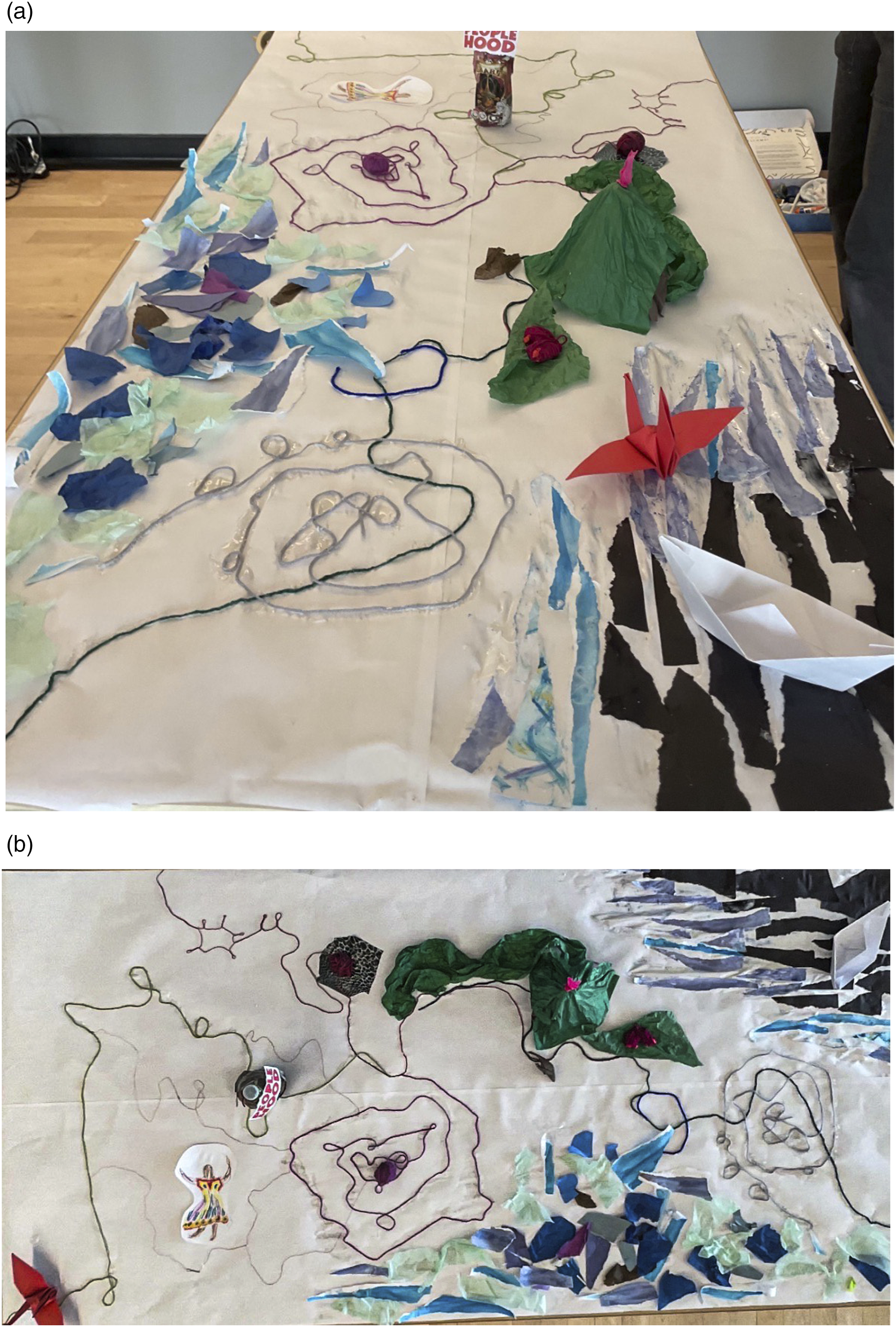
Each theme captured different dimensions of how participants engaged with the enslaved journey narrative by visually imagining the voyage, emotionally and somatically relating to the trauma, and drawing parallels between historical and contemporary experiences of displacement and resilience. Together, these themes underscore storytelling’s transformative potential as an affirming methodology that promotes historical understanding, community healing, and resilience through imagining new futures and possibilities.
Visualizing the Journey
Visualizing the journey captured how participants imagined and reflected on the transatlantic migration of enslaved Africans. This theme encompassed three subthemes. First, participants described remembering and reconnecting with ancestral histories and traditions, often linking these visualizations to personal and collective identity. Second, they expressed experiences of displacement and the search for refuge, highlighting the emotional impact of forced migration. Finally, the symbolism of water emerged prominently, representing both danger and survival, and serving as a metaphor for continuity, ancestral presence, and the enduring legacy of the journey.
Remembering and Reconnecting With Ancestral Histories and Traditions
Participants described how engaging with the narrative prompted personal reflections on their familial lineage, cultural roots, and experiences of migration. P2 stated, “Walking the steps of your ancestor... like whatever background you have, your ancestor came from somewhere,” referencing the broader context of ancestral movement. This participant also described visualizing the transatlantic slave trade during the initial reflection after listening to the sound collage, including scenes such as “imagery of the slave ship… people who are stacked like an object.” These reflections demonstrated how the narrative facilitated recollection of historical events and recognition of ancestral experiences through creative engagement.
Experiencing Displacement and Seeking Refuge
Through group discussions, participants drew connections between the enslaved journey and their own or their families’ migration histories. P2 noted, “We physically crossed the room, how your ancestor might have arrived here,” describing how a guided movement activity in a workshop that they had previously engaged in contributed to their engagement with the idea of arrival and displacement. In addition, P2 stated, “While putting this together [the artwork], I also thought about my own journey of acculturation,” referencing personal migration experiences during the creative process. Visual artworks included fragmented or layered imagery representing borders, fragmented landscapes, and paths or crossings, which were discussed by participants as symbolizing disrupted belonging or transitional states. These verbal and visual responses indicated how participants explored the intersections of historical forced migration and contemporary relocation or adaptation.
The Symbolism of Water
Water emerged as a recurring symbol in participants’ verbal and visual responses. Participants described water as representing the dangers of migration and the necessity of survival. P3 noted that “We need water along the way... it’s also that double meaning of water... something terrifying, like a tsunami, and something you need to survive,” referencing the contrasting qualities of water. In addition, P3 remarked, “Sound of ocean… sorrow and fear,” linking auditory elements of the sound collage to emotional responses. In the artwork, water was depicted through abstract waves, blue color palettes, and a collaged water bottle. Participants reflected on the symbolism of these elements, noting their relationship to the process of migration, movement, instability, and endurance. These verbal and visual elements demonstrated how water was used as a symbol to convey complex associations with the transatlantic journey, emotional vulnerability, and ongoing connection across generations.
Embodying the Journey
The overarching theme of embodying the journey captured how participants experienced the narrative through emotional and physical responses. It encompassed two key subthemes: (1) emotional or somatic responses to experiences of violence, displacement, and suffering, and (2) emotional and embodied empathy with the lived realities of enslaved ancestors. Participants’ reflections and artworks showed how the narrative evoked internal sensations, affective reactions, and a physical awareness of historical trauma, and a felt sense of connection to ancestral experiences.
Emotional or Somatic Responses
Participants experienced emotional and physical reactions as they engaged with the historical narrative, the “ancestral journey”. The combination of sound, imagery, and collective artmaking elicited multisensory reactions. Participants described emotions such as feeling overwhelmed, tearful, and sad. P2 described, “It [the sound collage] just gave me this imagery... the smell, all the waste, the sweat... very visceral reaction to this imagery,” indicating how auditory and visual stimuli evoked sensory memories. P3 noted that “It feels partly like the heartbeat, but it’s also the brokenness of the body… the heartbeat that kind of keeps the body going even through the brokenness,” describing a bodily awareness of suffering and survival, Additionally, P1 reflected on the sensations created by listening to the collage noting a “sensory kind of like expression of the heartbeat in your ears… really like just kind of the visceral piece of it” stating that “It was beautiful to listen to… it really did for me evoke… the emotion around like the violence and also the strength.” Additional reflections included the impact of specific sounds, such as the sound of a boot descending stairs, prompting them to consider the embodied legacy of violence and its presence within their ancestral heritage.
Emotional and Embodied Empathy
This subtheme describes participants’ emotional engagement with the ancestral narrative, including expressions of sadness, oppression, resilience, and hope. Participants described how the sound collage and related artwork created such as P1’s depiction of a slave ship, triggered emotional reactions and personal reflection with “white violence in my own body”. In the first reflection after the individual art making, P3 remarked that they were “Trying to kind of catch that arc... I’m going to cry,” referencing the emotional intensity of engaging with the sound collage. P1 stated that they were “responding to that arc of the image around dignity and wanting to protect dignity,” describing an awareness of the enslaved struggle with preserving their dignity and their will to survive. These responses reflected how participants used emotional and embodied experiences to connect with historical realities through both artmaking and dialogue. Through Embodying the Journey, participants expressed experiencing the profound interconnectedness of historical and contemporary struggles, recognizing how ancestral trauma lives within the body and how remembering these stories becomes both an act of mourning and an affirmation of dignity and survival.
Linking the Past to the Present
The final theme of linking the past to the present captures how participants connected ancestral histories with their present-day identities and experiences. Participants’ reflections revealed that engaging with the Ancestral Journey Narrative led them to examine the enduring impact of historical trauma, the complexities of migration, and the resilience embedded in cultural survival. This theme encompassed three subthemes: (1) experiences of belonging, displacement, and cultural negotiation, where participants described navigating their identities across multiple cultural contexts; (2) resilience and cultural survival as foundations for future identities, as participants recognized how ancestral endurance informed their sense of self; and (3) envisioning new pathways of healing and empowerment, where participants explored possibilities for transformation through reclaiming cultural knowledge and affirming collective strength. The collaborative creation of the final group mural served as a visual manifestation of this theme, blending ancestral pain, embodied resilience, and a vision for a future rooted in strength and unity. Key elements included a dancing figure, symbolizing joy, cultural vitality, and freedom, and a mountain of hope, which participants described as being “grounded in love.” Additional symbols included a bird, a boat, and threads, with participants describing the image of fire as a symbol of continuity and enduring strength. These elements together illustrate how the narrative facilitated a process of situating the self within a broader historical continuum.
Experiences of Belonging, Displacement, and Cultural Negotiation
Participants described ongoing tensions related to belonging and exclusion within diasporic contexts. These experiences were often discussed concerning cultural differences and feelings of being perceived as outsiders. P2 shared, “Even after 20 years, I still feel like a foreigner living in this land,” emphasizing the persistence of feeling culturally out of place despite long-term residence. In group discussions, participants also spoke about adapting their language or behavior in different settings. P2 referred to the complexity of maintaining cultural identity while navigating new environments. For some, these reflections included mention of internal conflict and the effort to remain connected to their cultural roots while engaging with dominant cultural norms.
Resilience and Cultural Survival
Participants’ reflections and artworks revealed a shared theme of resilience as a response to ancestral trauma and personal histories of cultural struggle. This resilience was expressed through metaphors of endurance, strength, and continuity that emerged in both verbal and visual data. Across reflections, participants described resilience not only as surviving hardship, but as holding onto cultural identity and inner strength in the face of historical and contemporary oppression.
P1 reflected on “the full arc of true horror and violence and also the resilience and beauty and strength,” highlighting the emotional complexity of engaging with ancestral memory. P2 described their artwork as embodying “that vigilance or the toughness… wrinkle or get crushed but still tough,” referencing a textured image printed on photo paper that resisted tearing, symbolizing the inability to be easily broken down. P3 focused on internal endurance, stating, “The heartbeat that keeps the body going even through the brokenness,” portraying survival as a steady, embodied force. These expressions of resilience were visually represented through central motifs such as the heartbeat, unbreakable materials, and water. The idea of being “grounded in the heart” was further emphasized by participants who incorporated elements like lava cooling into rich soil, symbolizing the transformation of suffering into generative strength. The fire beneath the surface, described by P2 as “the rich roots that will continue to feed,” served as another powerful metaphor for ancestral endurance. Taken together, these artistic and verbal expressions illustrated how participants externalized resilience through layered symbolism, positioning survival not just as endurance but as regeneration, connection, and creative strength.
Envisioning New Pathways of Healing and Empowerment
Participants articulated visions for healing and transformation that emerged from their lived experiences, discussing personal histories of migration and reflecting on historical knowledge of the migratory journey of enslaved Africans. These visions were rooted in hope, communal healing, and cultural regeneration. P1 described the capacity to cultivate growth even in adversity, stating, “It builds more and creates rich soil and even while you’re in the middle of the desert ...still celebrating this.” For them, the metaphor of creating “rich soil” in a barren environment symbolized the sustaining power of cultural pride and the importance of finding joy and meaning even amid hardship.
P3 reflected on an excerpt from a previous reading from another course on the program, which described the forced disembarkation of enslaved Africans in the Americas. From this, they imagined the “coming together of different tribes becoming something new,” describing a re-visioning of diasporic identity as a process of collective re-creation rather than loss. They spoke about the possibility of new cultural identities emerging from shared struggle and historical trauma, emphasizing transformation through solidarity and adaptation.
The final group mural, collaboratively created by participants, visually represented this subtheme. Participants integrated symbolic imagery that expressed transformation, renewal, and collective strength. A central dancing figure appeared prominently, representing joy, movement, and the reclaiming of cultural vitality after trauma. The “mountain of hope”, constructed using layers of warm, earthy tones, was described as “grounded in love,” symbolizing a strong foundation for imagining the future. Participants added underground fire, soil, and heart imagery to convey the idea of ancestral energy nourishing new growth. The layout of the mural also contributed to this theme. Participants observed that the composition moved from denser visual elements to more open spaces, suggesting a progression toward unknown but hopeful futures. This was described by P1 as an “invitation to look back at where we come from” while also looking forward. Participants discussed that the act of co-creating the artwork became an embodied way of envisioning new futures anchored in resilience, unity, and cultural continuity.
Discussion
This experiential workshop explored how engaging with the Ancestral Journey Narrative, an investigator reimagined story of an enslaved African arriving in the Caribbean, invited participants into a reflective and embodied exploration of historical trauma, cultural resilience, and identity reconstruction. Thematic analysis revealed three themes: Visualizing the Journey, Embodying the Journey, and Linking the Past to the Present. These themes align with African and Afro-Caribbean storytelling traditions where narrative serves as a vessel for collective memory and fosters cultural preservation and psychological healing (Datta, 2017; Osei-Tutu, 2022; Smart, 2019). Additionally, they reflect the oral and performative traditions within African and Afro-Caribbean storytelling, where narrative serves as resistance and a vessel of cultural continuity (Osei-Tutu, 2022; Smart, 2019; Vété-Congolo, 2007).
Participants vividly visualized the ancestral journey in response to the sound collage, which offered a multi-sensory experience that made historical trauma feel immediate and embodied. Through guided listening, many reported seeing images of ships, ocean crossings, and fragmented memories, reflecting Smart’s (2019) assertion that African oral traditions rely on sensory-rich storytelling to transmit cultural knowledge and resist erasure. Water emerged as a recurring symbol, both life-giving and destructive, capturing the dual nature of the Middle Passage and its enduring psychological impact (Nettleford, 2004; Thompson, 2023). These metaphoric visuals align with Afro-Caribbean epistemologies, where natural elements hold layered spiritual and historical meanings (Bernard & Fernandez, 2012).
Participants embodied the journey as they engaged somatically and emotionally with the narrative, often describing visceral reactions linked to intergenerational memory. Participants described survival amidst suffering, a theme echoed by Naidoo (2020), who highlights how Caribbean descendants often carry embodied memories of resilience and strength passed down intergenerationally. This process resonates with what Sonn et al. (2013) describe as critical psychosocial ‘mnemonics’, the use of storytelling to access and reconstruct historical memory, allowing for emotional release and identity affirmation.
Kinesthetic elements, such as the act of physically crossing the room, mirroring the journey of an enslaved ancestor, reinforced embodied empathy and connected participants to their genealogies through physical movement (Banks-Wallace, 2002; Barone & Eisner, 2012). This reflects Freeman’s (2018) emphasis on the narrative body as a source of meaning in arts-based and phenomenological research. Banks-Wallace (2002) and Barone and Eisner (2012) similarly note that such methods foster embodied knowledge that is not accessible through traditional verbal inquiry alone. Beyond personal insight, the narrative served as a tool to connect the past with the present. Participants reflected on inherited resilience, noting how cultural memory shapes contemporary Afro-Caribbean identity. This aligns with Smith’s (2021) argument that decolonizing methodologies must center lived experience and relationality to recover suppressed knowledge and reclaim Indigenous voice.
The collaborative mural created at the end of the session visually synthesized participants’ experiences, blending symbols of ancestral pain, resistance, and imagined futures. This act of collective creation is not only expressive but also political, reflecting what Carey (2016) describes as “performance as praxis,” where embodied creativity becomes a site of cultural affirmation and transformation. The final theme linking the past to the present mirrors the Afrocentric principle of Sankofa, which emphasizes returning to ancestral knowledge to inform future action (Wilson et al., 2019). Participants described transformation as rooted in community, cultural continuity, and ancestral presence.
Overall, the findings suggest that arts-based experiential workshops grounded in Afro-Caribbean and Indigenous storytelling traditions create transformative spaces for participants to engage with historical trauma, reflect on cultural narratives, and envision pathways toward healing and empowerment affirming calls for research frameworks that honor co-creation, spiritual knowledge, and embodied memory as legitimate ways of knowing in postcolonial contexts (Osei-Tutu, 2022; Sonn et al., 2013; Smart, 2019; Wilson et al., 2019).
Limitations
While this study offers valuable insights into using storytelling as an affirming methodology for exploring historical trauma, several limitations should be noted. First, the workshop took place in an academic setting with a cohort of PhD students and a professor, which may have influenced participants’ willingness to fully engage or express vulnerability due to existing academic relationships. The author’s familiarity with participants may also have affected their participation. Additionally, the sample consisted solely of CATx students and a professor who were researchers, limiting the diversity of perspectives and excluding practicing clinicians or broader community representation. Second, the small sample size and focus on doctoral-level CATx students may not reflect the cultural, educational, or experiential diversity of Afro-Caribbean communities. Participants’ advanced academic training may have also led to a level of reflexivity and critical engagement not typical in community-based contexts. Finally, the study relied on self-reported data from reflective discussions and art responses, which, while rich in qualitative insights, may be influenced by social desirability bias or participants’ limited ability to fully express complex emotions within a brief workshop setting.
Recommendations and Future Research
The findings from this experiential workshop highlight several key recommendations for advancing storytelling as an affirming methodology to address historical trauma and promote cultural resilience. Arts-based storytelling that incorporates soundscapes, movement, visual art, and ritual should be embraced to foster embodied historical understanding. These creative modalities enable participants to emotionally connect with the lived realities of enslavement, displacement, and cultural survival, thereby deepening empathy and critical reflection.
Training programs for CATx should intentionally center Afro-Caribbean lived experiences and knowledge systems to promote culturally affirming methodologies. Creating spaces to explore themes of migration, identity, and belonging can support participants in reconstructing identity narratives rooted in cultural pride and collective resilience. Intergenerational storytelling should also be encouraged to preserve ancestral knowledge and strengthen cultural memory. Community-based participatory approaches are recommended for future implementations, as they enable deeper relational engagement and empower Afro-Caribbean communities to co-create knowledge in culturally embedded environments. Collective artmaking and group storytelling can serve as powerful tools for transforming historical pain into shared visions of hope and unity.
Future research should expand beyond academic contexts to engage with diverse Afro-Caribbean populations, exploring the long-term impact of arts-based interventions on identity development, resilience, and mental health. Longitudinal and comparative studies could examine how storytelling functions as a decolonial and affirming methodology across various diasporic contexts. Additionally, integrating multi-modal creative expressions such as music, dance, and ritual can deepen the exploration of how embodied cultural practices foster healing across generations.
Conclusion
This study explored storytelling as a decolonial and relational method for confronting historical trauma, reclaiming cultural narratives, and fostering resilience in Afro-Caribbean contexts. Through an arts-based workshop grounded in an imagined ancestral narrative, participants engaged with an enslaved story of migration, displacement, and survival. These findings highlight the critical role of Indigenous and Afro-Caribbean wisdom in shaping culturally responsive therapies and research. Expanding this work with more diverse populations can further strengthen its impact in both community and clinical settings. Ultimately, this research advances the decolonization of therapeutic practices, offering creative, culturally affirming pathways and methodologies for healing historical wounds.
Footnotes
Acknowledgements
We would like to thank the participants who engaged in the experiential workshop.

Consent to Participate
Written consent was obtained from all participants.
Funding
The authors received no financial support for the research, authorship, and/or publication of this article.
Declaration of Conflicting Interests
The authors declared no potential conflicts of interest with respect to the research, authorship, and/or publication of this article.
Data Availability Statement
Due to the nature of the study, supporting data is not available.