




Abstract
Co-creation is increasingly used in public health to strengthen the relevance, feasibility, and sustainability of interventions, yet many approaches remain either too generic to guide implementation or too rigid for multi-country adaptation. This paper presents the application of the MapStakes-PH framework as a practical, step-by-step roadmap for organizing co-creation processes in preventive public health, using Project Sunrise, a Horizon Europe–funded initiative on adolescent cancer prevention implemented across eight European countries, as an illustrative use case. Grounded in stakeholder theory, co-creation is a participatory approach requiring meaningful collaboration among diverse actors (e.g., young people, families, educators, practitioners, researchers, community representatives, and policymakers) throughout design and implementation to design, develop, and improve systems, policies, or experiences, with attention to local context and equity. The MapStakes-PH Framework, originally developed for environmental and urban planning, offers a five-step process to (1) identify, (2) analyze, (3) engage, (4) coordinate, and (5) evaluate stakeholder contributions, the centerpiece of co-creation. We describe how the project team transferred this framework into a health promotion setting to structure stakeholder mapping, convene local co-creation councils, support co-design of context-specific actions, and maintain iterative learning through light-touch feedback cycles. The framework’s strengths for qualitative, practice-based co-creation include its usability, explicit decision points, adaptability across settings, and capacity to make stakeholder dynamics actionable, without oversimplifying complexity. We detail the five steps, the assumptions required for use, and practical considerations for adoption (e.g., participation/selection effects, facilitation intensity, and scalability). Consistent with the manuscript’s scope, we focus on the process architecture and implementation roadmap rather than reporting empirical outcomes.
1. Introduction
Co-creation has emerged as a crucial participatory approach in public health, particularly in the design of complex health interventions, gaining substantial recognition over recent years (Vargas et al., 2022). Stakeholder theory, originally introduced by Freeman, offers a robust framework for understanding the collaborative relationships needed in health promotion and disease prevention (Freeman, 1984). According to Longworth et al. (2024), the collaborative process of co-creation involves engaging researchers, practitioners, patients, community members, and policymakers in all stages of an intervention, from problem identification to solution development and implementation. Central to co-creation are the principles of power sharing, transparency, and mutual respect, which foster meaningful collaboration, shared decision-making, and tailored interventions to the specific needs and contexts of the target populations. These elements contribute to more relevant, effective, and sustainable health outcomes (Halvorsrud et al., 2021). For instance, within the field of public health, co-creation frequently involves collaborating on the design and implementation of health promotion strategies, ensuring that community perspectives shape the intervention, thus enhancing effectiveness, inclusivity, and social integration, particularly among vulnerable groups (Greenhalgh et al., 2016). Numerous public health initiatives have successfully applied co-creation approaches to address issues such as physical inactivity, poor nutrition, and mental health challenges (Elwan, 2024). For example, the promotion of physical activity in teenage girls illustrated the effectiveness of this approach in developing practical, context-sensitive solutions that resonate with participants’ needs and lived experiences (Camacho-Miñano et al., 2011).
These participatory principles also align with broader goals of fairness, inclusion, and shared responsibility, strengthening community ownership and the sustainability of public health interventions (Arumugam et al., 2023; Freeman et al., 2010; Hickey et al., 2022; Nutbeam, 2008).
In this context, the World Health Organization and other global health bodies emphasize co-creation as a core component of integrated, people-centered health services (WHO, 2017). By integrating the perspectives of stakeholders from various disciplines and cultural backgrounds, co-creation helps to create cancer prevention and treatment strategies that are adaptable, scalable, and culturally competent, making them more impactful across different healthcare systems and populations (WHO, 2017).
In this study, stakeholder theory (Freeman, 1984) is operationalized not as a market-driven model, but as a procedural logic for inclusive identification and engagement of actors whose lived experience, institutional authority, or contextual knowledge contribute to shape cancer prevention. WHO frameworks contribute a normative equity lens, emphasizing participation, inclusion, and social justice, while qualitative research traditions provide the epistemological grounding through which co-creation functions as a process of knowledge generation rather than consultation. In the Project Sunrise, planning and setting into action a co-creation initiative has been key to developing a comprehensive health promotion protocol –a structured yet flexible plan outlining the co-creation implementation and evaluation for cancer prevention in school-based settings in eight European countries.
Although various co-creation protocols exist in public health, many lack the methodological rigor and flexibility needed for real-world application (Vogelsang et al., 2025). In this direction, it was considered that the five steps in the MapStakes Framework offer a novel, structured approach suitable for real-life settings, applied for the first time as a co-creation protocol in health research to address the complexities of cancer prevention holistically (Figure 1) (Barquet et al., 2022). MapStakes framework (Barquet et al., 2022)
This paper outlines the methodological insights and lessons learned from building on the MapStakes-PH 1 framework and principles within the Sunrise Project, offering a practical co-creation roadmap for social workers, public health researchers, and practitioners. Through an illustrative application, it demonstrates how MapStakes-PH can be operationalized to organize and translate complex stakeholder dynamics into actionable public health planning considerations. The roadmap is intended for practitioners and implementation teams who are responsible for organizing, facilitating, or coordinating co-creation processes, rather than for conducting in-depth qualitative analysis of stakeholder interactions.
2. Methods
In the methods, we present the application of the MapStakes-PH framework as a guiding structure for a systematic approach to stakeholder engagement across diverse contexts, organizing the co-creation process within the Sunrise project (hereafter referred to as the case study). MapStakes, originally developed as a stakeholder management tool, has primarily been used in environmental management, urban planning, and business settings to map out stakeholder interests and influence (Barquet et al., 2022), but it has not, to our knowledge, been applied in public health prevention initiatives.
Within the project lifecycle, MapStakes-PH is intended for use at the transition from design to implementation after initial stakeholders are identified, but before priorities, activities, and delivery mechanisms are fixed, making it particularly relevant for practitioners responsible for translating participatory intent into operational plans. At this stage, it offers a structured way to support collective discussion, particularly in settings where participants differ in expertise, levels of influence, or experience with cancer prevention. By employing role-neutral criteria and facilitated scoring processes, MapStakes-PH is designed to address common challenges in stakeholder engagement, such as power asymmetries, uneven expertise, and institutional hierarchies, by supporting the balanced inclusion of experiential, professional, and policy-relevant knowledge in analytic decision-making.
MapStakes-PH is designed to emphasize user accessibility, aligning with frameworks that advocate for usability and inclusivity in co-creation processes (Arnstein, 1969; WHO, 2017). By offering a step-by-step guide, the framework ensures an intuitive experience that can be adapted to various project contexts, challenges, and requirements, reflecting principles of flexible design in public health tools. Incorporating feedback from stakeholders throughout the development and testing stages enhances the tool’s relevance and efficacy. This practice is supported by literature, suggesting that stakeholder-informed design increases user engagement and satisfaction by ensuring that tools address user-specific needs and preferences (Freeman, 1984). To support ongoing improvement, the framework is designed to incorporate monitoring and reflection components that facilitate learning, support iterative refinement of co-creation processes, and inform potential adjustments over time, in line with health promotion perspectives that emphasize evaluation as a developmental rather than outcome-focused function (Nutbeam, 2008). Regular updates based on user input contribute to an iterative development process, ensuring sustained effectiveness and relevance, in line with best practices for user-centered and adaptive design (WHO, 2017).
2.1. Case Study Background
The Project Sunrise, funded by the European Union’s Horizon Europe research and innovation program, embodies the necessity of adopting co-creation processes to design and implement school-based health promotion and cancer prevention initiatives. The case study involves a range of stakeholders, including students, parents, educators, public health experts, and policymakers, spanning across eight European pilot countries: Belgium, Greece, Switzerland, Slovenia, Spain, Cyprus, Italy, and Romania.
2.2. Roadmap Development
The methodological framework was developed through an iterative process informed by established co-creation principles and refined through expert consultation. Initial planning drew upon Freeman’s Stakeholder Theory (Freeman, 1984) and WHO’s framework on people-centered health services (WHO, 2017), as well as the MapStakes-PH framework to structure a participatory approach to data collection and analysis. These resources provided a foundation for identifying the relevant stakeholder groups and determining the appropriate methods for engaging them throughout the case study.
Further refinement of the approach was achieved through a pragmatic literature review and input from experts in co-creation and facilitation, including members of the case study team and academic collaborators with experience in community-based health promotion. This process ensured that both theoretical integrity and practical applicability guided the methodology. Emphasis was placed on ethical conduct, inclusive engagement, and cultural competence; principles that were embedded in the design of all research tools and procedures (Freeman, 1984).
2.3. Ethical Consideration
Ethical approval for the co-creation activities methodology was secured from the Ethical Committee of the Hellenic Mediterranean University. Informed consent was obtained from all participants, with confidentiality and data protection maintained throughout the participatory research process. Special consideration was given to the inclusion of vulnerable populations, especially youth, ensuring that power dynamics were addressed and equitable participation was promoted.
Throughout the case study, efforts were made to foster trust, encourage open dialogue, and reduce barriers to engagement. By incorporating the voices of students, parents, educators, health professionals, and policymakers, the methodology upheld the core values of stakeholder theory, mutual respect, inclusivity, and shared benefit.
2.4. Consortium as Facilitators of the Co-Creation Process
In Project Sunrise, members of the research consortium acted primarily as facilitators of the co-creation process rather than as content experts or decision-makers. Their role involved structuring the process, defining procedural boundaries (e.g., scope, sequencing, and timelines), moderating discussions, and ensuring balanced participation across stakeholder groups. While facilitation was designed to be as role-neutral as possible, using structured tools, predefined criteria, and transparent decision rules, the research team’s institutional position, methodological expertise, and control over process design may nonetheless have influenced group dynamics, including agenda setting, pacing of discussions, and perceptions of authority. To mitigate these effects, facilitation emphasized shared decision-making, explicit clarification of roles, and the use of standardized frameworks (MapStakes and RILEC) to anchor discussions in collectively agreed criteria rather than individual perspectives. This reflexive acknowledgement is intended to enhance the process’s transparency regarding potential sources of influence while remaining consistent with the paper’s focus on process architecture rather than interactional outcomes.
3. The Five-Step Co-Creation Roadmap: Applying the MapStakes-PH Framework
To support practical uptake, each step of the roadmap is accompanied by a brief “Tips for Use” box. These highlight common pitfalls, minimum requirements, and adaptation strategies, translating the framework into actionable guidance for practitioners working under real-world constraints.
3.1. Step 1: Defining System Boundaries
School systems are complex entities embedded within broader systems of district/community, state, regional, and national contexts (Schuelka & Engsig, 2020). Boundaries define the stakeholders that are identified as relevant to the process and hence represent the first criterion for inclusion and exclusion (Pluchinotta et al., 2022). The boundaries initially set by researchers can sometimes be interpreted differently by stakeholders (Mehrizi et al., 2009). In the context of health promotion and co-creation processes, “school boundaries” refer to the limitations, constraints, or parameters within which health promotion initiatives or programs are designed, implemented, and evaluated within school settings (Scheerens, 2014; WHO, 2013). These boundaries can encompass various aspects like physical, policy, resources and competencies, social, legal, ethical, and community links.
The physical spaces of a school, classrooms, gyms, shared areas, and outdoor settings shape where and how well-being activities unfold. When these environments are thoughtfully used, they can contribute to a school climate marked by safety, respect, and a sense of belonging (Uline & Tschannen-Moran, 2008). Alongside this, school policies and broader institutional priorities play an important role in guiding health promotion efforts, while the availability of staff, materials, and funding largely determines whether such initiatives can be sustained over time (Allen et al., 2021).
Just as critical are the social dimensions of school life. A culture that emphasizes care, inclusion, and mutual respect where relationships are nurtured and students’ identities are recognized, helps foster a genuine sense of belonging. When students feel accepted and are able and encouraged to be themselves, within clear and supportive boundaries, they are more likely to engage, thrive, and experience positive developmental and learning outcomes (AERO, 2023). Legal and ethical boundaries involve adherence to regulations such as confidentiality, informed consent, privacy rights, and the duty of care. Ensuring compliance with these legal requirements is essential to maintain trust and integrity throughout the co-creation process. As emphasized by Allen et al. (2021), the successful implementation of school policy must include clear protocols for stakeholder engagement, data protection, and training for staff to uphold legal responsibilities. Lastly, community links address the collaboration between schools and external stakeholders, including families, community organizations, local businesses, psychological services, and other health-related bodies. These collaborations extend the school’s capacity to promote student well-being and health by integrating broader social and professional support systems. Effective coordination ensures that school-based health initiatives are responsive to local needs, culturally competent, and sustainable. As highlighted by Venka and McNamara (2015), schools function best as “health-promoting settings” when they are embedded in a whole-community approach, where collaboration with external actors enables context-sensitive solutions and continuity of care beyond the school walls. These partnerships not only support individual students but also foster system-wide change, ensuring the co-creation of inclusive, equitable, and community-rooted interventions.
3.1.1. Tips for Use – Set Boundaries Transparently
Be explicit about what is “in” and “out” of scope and why. Boundary choices are rarely neutral and may differ across sites; document the rationale (e.g., feasibility, mandates, access) and revisit boundaries if new risks or key actors emerge. Avoid defining the system so narrowly that important community or policy influences are missed.
3.2. Step 2: Identifying Stakeholders
When identifying stakeholders, it is crucial to think beyond the obvious. Researchers’ networks are often the starting point in a co-creation process. However, there is a need to go beyond the researchers’ (or the person doing the mapping) networks. Groups and roles are defined according to the project’s objectives and area of focus. Stakeholders should represent either themselves or a segment of society. Maximum variation sampling was employed in this study to intentionally include stakeholders across diverse roles, ages, institutional positions, and intersecting social identities, allowing the framework to capture a wide range of perspectives relevant to school-based cancer prevention.
Identifying stakeholders requires thinking and looking beyond familiar networks. While existing researchers’ networks often serve as a starting point in the co-creation process, it is essential to deliberately expand outreach to ensure inclusivity and diversity. As emphasized in the Health Promotion Module, stakeholder identification should reflect the broader system in which the project is embedded. Stakeholders should be selected based on their relevance to the project’s objectives, potential influence on outcomes, and representation of diverse societal segments (Barquet & Cumiskey, 2018).
Stakeholders’ Inclusion Criteria

This multi-stakeholder collaboration aligns shared goals such as promoting adolescent health, enhancing well-being, and addressing risk behaviors within school settings. As Herlitz et al. (2020) emphasize, involving whole-school approaches and diverse stakeholders in all stages of intervention design tends to foster stronger relationships, greater ownership, and more sustainable behavior change. Interventions that are co-developed draw on both lived experiences and professional expertise of the stakeholders, ensuring real-world relevance, successful implementation, and collective responsibility, helping to ensure their long-term success.
3.2.1. Tips for Use – Guard Against Missing Voices
Do not assume that the most available actors represent the full system. Build in steps to reduce selection effects (e.g., multiple recruitment routes, alternative meeting times, trusted intermediaries) and actively check for under-represented groups, especially those facing barriers to participation. Treat “who is at the table” as a quality issue, not a given.
3.3. Step 3: Mapping Stakeholders
Different methodologies exist for mapping stakeholders, although no single method fits all contexts (Reed et al., 2009). To increase the accessibility of the approach, the MapStakes-PH methodology suggests two rather simple points: mapping according to representation roles (e.g., who stakeholders represent or what perspective they bring) 3 , and according to influence (e.g., their power or capacity to shape outcomes) 4 . This echoes Reed et al.’s recommendation that stakeholder analysis should consider both influence and interest when selecting methods (Reed et al., 2009).
Stakeholder Roles in Co-Creation Interventions

The second step in mapping stakeholder influence focuses on understanding both stakeholders’ level of influence and how much they are affected by the issue. This dual perspective enables a more accurate and ethical identification of relevant actors by recognizing both their power and their vulnerability. According to Walker, Bourne, & Shelley, this approach helps surface hidden dynamics and allows for a nuanced understanding of influence beyond formal authority (Walker et al., 2008). It is crucial to ensure balanced participation; over-representation of dominant groups can skew the process, while under-representation of marginalized voices may lead to incomplete or inequitable outcomes (Walker et al., 2008). Additionally, individual participants should ideally represent one stakeholder group to avoid conflicting roles and interests.
Figure 2 shows an example of how each stakeholder group affects or is affected by the initiatives of the case study. Considering the extent to which a stakeholder group affects or is affected, each pilot country mapped a balanced stakeholder representation and presented, according to their case, how each stakeholder group affects or is affected by the initiatives of the case study. Stakeholders influence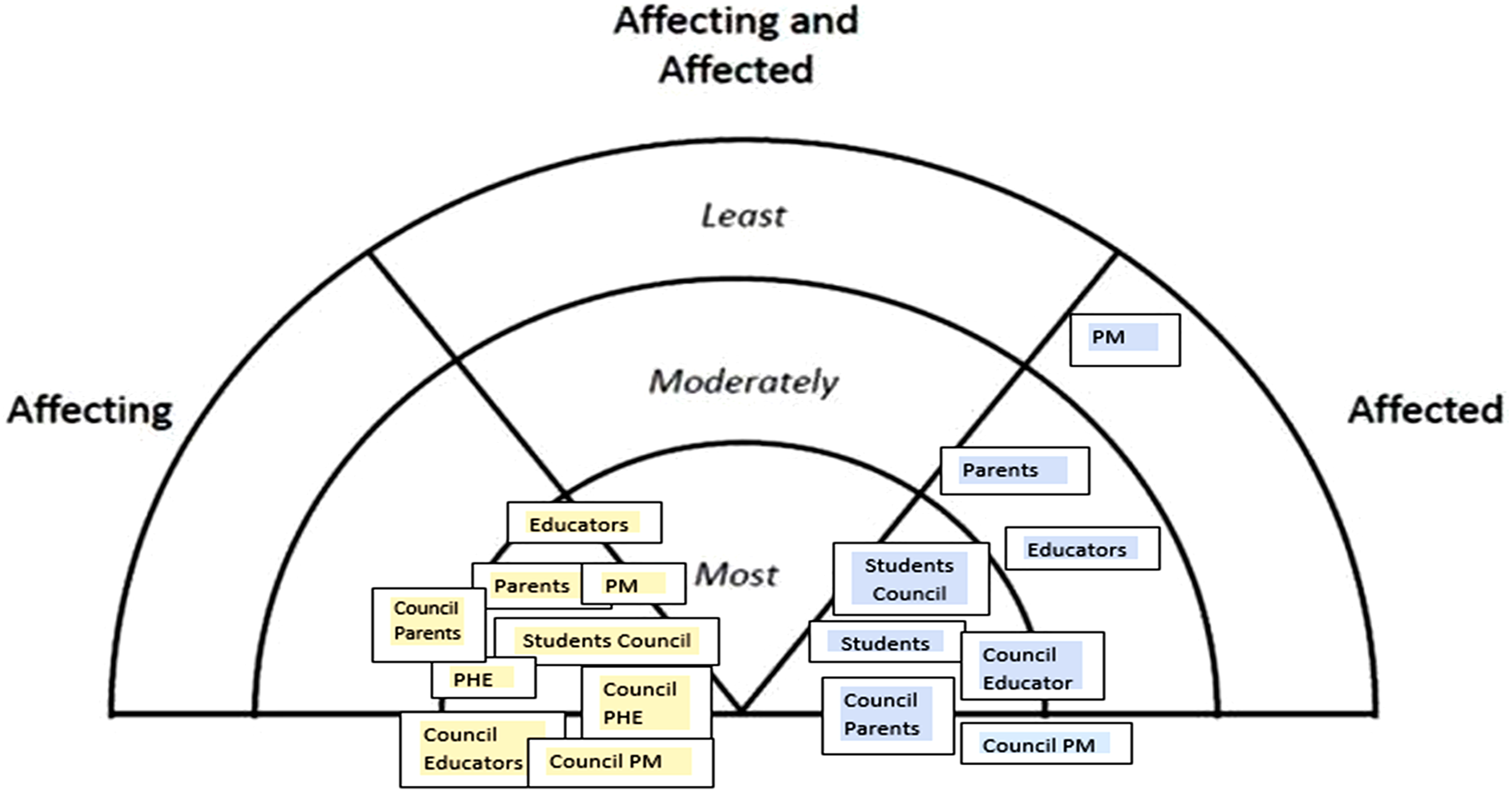
3.3.1. Tips for Use – Guard Against Missing Voices
Do not assume that the most available actors represent the full system. Build in steps to reduce selection effects (e.g., multiple recruitment routes, alternative meeting times, trusted intermediaries) and actively check for under-represented groups, especially those facing barriers to participation. Treat “who is at the table” as a quality issue, not a given.
3.4. Step 4: Involving Stakeholders
The fourth step focuses on assessing the level of involvement that is both required and desired for each stakeholder. Drawing on participation typologies first proposed by Arnstein (1969) and later refined by Basco-Carrera et al. (2017), this step recognizes participation as a continuum ranging from non-participation to low and high levels of engagement (see Figure 3). The extent to which stakeholders will be involved is dependent on the aim of the co-creation activity, considering two crucial questions: how much stakeholders should be involved and in which activities, according to experts. Participation typology description
Because engagement needs vary across project stages, it is important to be clear from the beginning about roles, expectations, and time commitments. Effective participation also requires attention to stakeholders’ interests, knowledge, and capacities, supported by transparent communication that helps build commitment and manage expectations throughout the process (Petkovic et al., 2023; WHO, 2017).
Throughout this process, feedback mechanisms play a central role, allowing the approach to be adjusted in response to stakeholder input and ensuring that a wide range of perspectives inform decision-making (Nutbeam, 2008). Finally, Petkovic et al. (2023) underscore that stakeholder engagement should not be treated as a one-off event but as a continuous and evolving process, requiring attention to roles, resources, and the context of participation.
Overview of Participant and Valid Monitoring Tool Responses per Co-Creation Activity

The process owners (our case study’s consortium) pre-decided the depth and the activities in which they wished to involve the different stakeholders during the co-creation process. Figure 4 illustrates the stakeholder involvement across the co-creation activities, showing how different groups (e.g., students, teachers, policymakers) engaged at varying levels (1 to 6) across the seven co-creation activities of the case study. Predefined levels of stakeholder involvement based on group type and co-creation activity
The case study’s participatory structure ensured both breadth, through inclusive involvement of various stakeholder types, and depth, by gradually intensifying participation levels. The early phases emphasized awareness and feedback, while later stages fostered shared ownership through co-design and joint decision-making. Matching stakeholder roles with appropriate levels of influence allowed students, parents, educators, experts, and policymakers to actively shape the intervention, enhancing its relevance, credibility, and long-term sustainability.
Importantly, MapStakes-PH does not require full implementation of all steps at equal intensity; practitioners can apply a “minimum effective dose” by prioritizing boundary setting, stakeholder mapping, and role clarification, while scaling involvement and monitoring to available resources.
3.4.1. Tips for Use – Match Involvement to Capacity and Scale
Structured co-creation requires time, facilitation, and coordination. Plan for the “minimum effective dose” (what must happen vs. what is optional), and anticipate that participation intensity will vary. Protect equity in the process by designing participation formats that work for people with limited time, resources, or trust in institutions.
3.5. Step 5: Monitoring Involvement
RILEC Criteria of the Co-Creation Process Monitoring

In this final step, the focus shifts to building and nurturing the relationships developed by the stakeholders and the co-creation process. Ultimately, effective monitoring supports the maximization of the intervention’s impact and the sustainability of its results.
For our case study, each of the five RILEC criteria were decomposed in a set of quantitative indicators, intended to easily capture the value of the co-creation process and its results, and take into consideration the context of the purpose of the co-creation process and its system boundaries, as defined in Step 1. It is also important to note that monitoring stakeholder involvement benefits significantly from the outputs of the previous step (Step 4-Involving stakeholders), which assisted the foundation of engagement. Mostly adjusting and adapting co-creation process elements, such as the content, the interactions, the execution of the process, and the accessibility, Step 4 highly influences the level of stakeholder participation in the co-creation process, from which relevant insights are derived to assess the stakeholders’ engagement throughout the co-creation process.
To perform the fifth and final step, monitoring stakeholder involvement, the case study’s consortium took full advantage of the many different co-creation activities of the case study, ranging from focus groups, sessions, workshops, interviews, and surveys. To the benefit of a comprehensive assessment of the co-creation process, an online, user-friendly, and self-reported questionnaire involving all participating stakeholders was created and delivered. The evaluation of the specific activities was conducted throughout the co-creation process as a whole and as a process result. The questionnaire was administered electronically via the on premises deployed Lime Survey platform. It was designed based on the RILEC criteria and corresponding indicators, and adapted to reflect the roles and perspectives of different stakeholder groups. To ensure accessibility and inclusivity, the questionnaire was translated into the seven languages of the study and pilot tested across the eight pilot countries and seven of the nine co-creation activities.
In Table 3, the number of participants per co-creation activity of our case study is reported along with the number of valid responses in the co-creation monitoring tool for the corresponding activity. Overall, 46,6% of the participants in the relevant co-creation activities responded to the optional and anonymous co-creation monitoring questionnaire, which was partially expected since the questionnaire was not part of the actual activity (i.e., no reserved time for providing answers) and it had to be answered after the completion of the activity without supervision. From the 204 responses of the participants to the co-creation monitoring tool, it is possible to devise an overview of the extent of the activities across different countries, stakeholder groups, and genders.
3.5.1. Tips for Use – Keep CQI Light and Consistent
Use simple, repeatable monitoring (e.g., a short mini-audit and a one-page quarterly snapshot) rather than complex systems. Indicators can mean different things across contexts; interpret trends locally and avoid rigid cross-site comparisons. Ensure monitoring leads to 1–2 concrete adjustments per cycle, not paperwork.
4. Discussion
This article presents MapStakes-PH as a structured yet adaptable roadmap for organizing co-creation processes in public health promotion, illustrated through a multi-country cancer prevention initiative. By making facilitation choices, participation levels, and monitoring criteria explicit, the framework supports transparency and practical application in complex stakeholder environments. This explicit procedural framing is intended to support reuse, adaptation, and dissemination of the approach beyond the original project context.
A central strength of MapStakes-PH is its holistic approach to stakeholder involvement, which brings together diverse perspectives and fosters shared ownership. By clearly defining roles and expectations across planning, implementation, and evaluation, the framework reduces uncertainty and supports more effective and legitimate outcomes (Barquet et al., 2022). By specifying their roles in phases such as planning, implementing, and evaluating, MapStakes enhances collaboration and ensures each participant contributes effectively (Reed et al., 2009), fully engaging them in the co-creation process. An additional key strength of MapStakes-PH lies in its capacity to reveal gaps in stakeholder representation. This strategic stakeholder mapping underscores the need for a balanced representation, allowing for prioritization of key stakeholders (Walker et al., 2008). Low involvement of policymakers, for example, would point to a missed opportunity for aligning interventions with systemic policy goals—an area that warrants strategic focus.
Additionally, MapStakes-PH provides valuable insights by revealing low-attended activities and engagement disparities and equips the study case’s research teams to investigate participation barriers and implement tailored outreach and engagement strategies. At the same time, it enables the recognition of high-performing activities that reflect meaningful stakeholder collaboration, serving as replicable models for future efforts. This strategic learning approach aligns with recommendations in stakeholder engagement literature, which emphasize the need for iterative feedback loops, tailored involvement strategies, and adaptive management to ensure inclusive and equitable engagement across diverse groups (Kujala et al., 2022; Morales-Garzón et al., 2023). Finally, the framework promotes social learning, as diverse stakeholders share knowledge and experiences throughout the process. This not only meets the immediate goals of the intervention but also builds capacity for future co-creation initiatives, contributing to long-term social change (Bos et al., 2013).
Another crucial feature brought about by MapStakes-PH is the enhanced collaboration and communication through continuous feedback loops, enabling real-time adjustments to interventions. This approach fosters adaptability and allows solutions to remain context-sensitive, improving the overall effectiveness of the co-creation process (Huang & Harvey, 2021). At the same time, this ongoing process engages stakeholders in all stages, from design to evaluation, making it more likely for the interventions to be tailored to the cultural and socio-economic context, increasing their long-term relevance and success (Wells et al., 2021). This ongoing process highlights sustainability as another central outcome of using MapStakes.
For practitioners, the primary value of MapStakes-PH lies in making facilitation choices explicit, who to involve, how, and when, thereby supporting transparent, repeatable, and context-sensitive co-creation, without requiring specialized methodological expertise. Figure 5 presents implementation-oriented recommendations for adapting MapStake-PH’s process components into an intervention-ready delivery model for public health practice. MapStake-PH (public health)
4.1. Limitations
While MapStakes offers a structured and adaptable roadmap for organizing co-creation processes, several limitations should be considered when assessing its transferability. First, selection bias is an inherent risk in participatory approaches. Despite efforts to ensure diversity, stakeholder participation was partly shaped by availability, access, and willingness to engage, which may have led to the under-representation of certain voices. Second, scalability poses practical challenges. The framework requires time, facilitation capacity, and coordination, which may limit full implementation in resource-constrained or time-limited settings. Adaptations in participation intensity or prioritization of core steps may therefore be necessary, and the framework accommodates it. Third, cross-country variation influences the enactment of the framework across pilot sites. Differences in institutional contexts, governance structures, and participatory cultures affected both the pace and depth of engagement. While MapStakes-PH is designed to be context-sensitive, such variation limits direct comparability and underscores the need for local adaptation. These considerations suggest that MapStakes-PH should be viewed as a flexible procedural guide rather than a standardized intervention, with successful transferability depending on context, resources, and stakeholder ecosystems.
4.2. Conclusion
In summary, MapStakes-PH stands out as a comprehensive and adaptive framework that fosters inclusive stakeholder engagement, strategic role clarity, and iterative learning. By highlighting participation gaps, promoting balanced representation, and supporting context-sensitive, sustainable interventions, MapStakes-PH not only strengthens the effectiveness of co-creation efforts but also builds long-term capacity for transformative public health initiatives.
Footnotes
Acknowledgments
We would like to thank Vasileios Liakopoulos (Ellinogermaniki Agogi), Stefanie Verdun (GEZOND), Teresa de Pablo Pardo (FISABIO), Loukas Sparos (HMU) and Polonca Pangrčič (AMEU) for their valuable contributions during the preparatory meetings of this task of the case study. Their insights and support were instrumental in shaping the development of this work.

Ethical Considerations
Ethical approval for the co-creation activities methodology was secured from the Ethical Committee of the Hellenic Mediterranean University (Νo 16935 05/07/2024).
Consent to Participate
Informed consent was obtained from all participants, with confidentiality and data protection maintained throughout the participatory research process. Special consideration was given to the inclusion of vulnerable populations, especially youth and parents, ensuring that power dynamics were addressed and equitable participation was promoted.
Funding
The authors disclosed receipt of the following financial support for the research, authorship, and/or publication of this article: This work was supported by the SUNRISE project that has received funding from the European Union’s Horizon Europe research and innovation programme under grant agreement No 101136829. The views expressed in this paper are the author’s views and do not necessarily reflect those of the funders.
Declaration of Conflicting Interests
The authors declared no potential conflicts of interest with respect to the research, authorship, and/or publication of this article.
Data Availability Statement
The data are available after request.