




Abstract
This article discusses the survival process of one Caribbean scholar working within academic systems shaped by colonial histories, offering insights that may resonate with others navigating similar institutional contexts. This work examines the daily labour of methodological endurance within universities where Euro-American performance metrics continue to shape legitimacy and knowledge production. These academic environments create ongoing colonial contradictions that scholars must navigate. Drawing on visual practice, poetic inquiry, and pedagogical engagement, this article explores how creative autoethnographic methods function as survival tools. It examines how these methods can maintain relational, spiritual, and intellectual integrity while meeting institutional demands. Creative approaches prove valuable when standard academic methods cannot adequately hold embodied knowledge and intergenerational memory. They become essential for scholars whose institutional frameworks require them to compromise or abandon spiritual ways of knowing. The work contributes to methodological literature by demonstrating survival practices in action rather than describing them theoretically. Three original paintings and six haikus serve as analytical methods, making visible the contradictions and quiet negotiations through which the author navigates the academy. The form mirrors the content, modelling how visual and poetic practices serve as methodological scaffolding for scholars seeking to maintain integrity within colonial academic frameworks. This paper honours ongoing contradictions and makes them knowable while preserving their complexity. The primary contribution lies in documenting how particular survival strategies inform broader conversations about methodological innovation in postcolonial academic contexts.
Keywords
Settle your shoulders, soften your jaw, draw one breath in and one breath out.
There are six poems in this paper. I invite you to let each greet you as a meditation. As brief, distilled images, each haiku is an invitation to read slowly, spaciously, and with an awareness of your own bodily presence in the moment. The first epistemology this paper invites you to inhabit is the epistemology of compression.
Like many academics, but especially those working in Global South contexts, Caribbean scholars work within institutions shaped by regional priorities and academic traditions structured by colonial inheritance. Under these conditions, I find myself navigating an ongoing tension between what I know through lived experience, ancestral memory, and embodied practice, and what is recognised as legitimate within prevailing models of academic rigour and research production. What does it mean to rumble with methodological contradictions? How do I create and write through them rather than seeking resolution? I have found a path to sit with these questions through visual autoethnography and poetic inquiry. They have become my methods of disruption and survival in the academy. They offer a way to remain in integrity with cultural, relational, and spiritual lineages, even as I meet the demands of formal assessment structures, publishing expectations, and institutional protocols.
There has always been tension in my approach to academic work. While social science methods have primarily informed my toolkit, I have consistently viewed my world and, by extension, research through an artist’s lens. This tension reflects a broader institutional challenge. As Emmison and Smith (2007) observe, visual methods have been “marginalized from the core concerns of the social sciences, even though our social world confronts us above all as a visual experience” (p. 1). I would extend this argument beyond visual methods to include methods of embodied experience. We experience the world through movement, image, and other forms of creative expression, yet we are instructed to separate ourselves from our ways of knowing when analysing the social world. For scholars like myself, working at the intersection of artistic and academic sensibilities, visual and poetic methodologies become necessary tools for maintaining both rigour and integrity. This paper explores how creative methodologies can open pathways between what the academy deems legitimate and the ways of knowing that feel most authentic to those of us shaped by subaltern, diasporic, and Caribbean traditions. I offer it as a meditation for scholars seeking to translate, reframe, and negotiate their knowledge practices without losing cultural or spiritual integrity.
Theoretical Frames: Creative Autoethnography, Feminisms, and Post-Coloniality
Visual autoethnography and poetic inquiry provide the methodological foundation for this paper, framing the self as both an archive and an analytic lens through which to interpret institutional, historical, and embodied experiences (Adams et al., 2015). Caribbean and Black feminist epistemologies guide the work toward forms of inquiry that honour the complexity of marginalised lives. Postcolonial and Caribbean intellectual traditions further frame creative expression as a response to the enduring logics of coloniality that shape academic institutions and their knowledge hierarchies. Three paintings (2018–2023), created across distinct moments of institutional encounter; six haiku distilled from embodied practice; and field notes gathered through teaching and research collectively form a layered visual-textual archive that refuses the separation of analysis from affect or theory from embodiment. Together, they offer an analytic framework that foregrounds creativity, reflexivity, and refusal as integral to understanding how scholars navigate and survive the epistemic and institutional violences of the academy.
The Self as History
Caribbean autoethnographic practice materialised from a distinct intellectual tradition where personal narrative has long operated as a theoretical method, predating the formalisation of autoethnography as a research method. In this lineage, James (1963) demonstrated how the intimate details of one’s life can illuminate wider histories of colonial domination, cultural formation, and political struggle, while Wynter (2021) advanced the view that embodied experience and memory are indispensable tools for challenging Eurocentric epistemologies and generating new conceptions of the human being. Hall’s (1990) analyses of cultural identity and diaspora, Brathwaite’s (1984) nation-language poetics, and Brodber’s (1980,1988) sociological fiction established early precedents for using the ‘Caribbean self’ as an analytical instrument for theorising collective experience. These foundational thinkers demonstrated how Caribbean identities were theorised from the specificity of racialised and colonially marked positions.
This Caribbean genealogy intersects with Black diaspora scholarship, which understands traditions of knowledge production as forged under conditions of ongoing coloniality. Hartman (2007, 2008) demonstrates that the afterlife of slavery endures in the continued devaluation of Black life and in the epistemic violence that renders certain forms of knowledge illegible to dominant institutions. Creative methods, including visual methods and poetry, become necessary modes of articulation when the archive rests upon what Hartman (2008, p. 10) terms a ‘founding violence’. These creative and embodied forms can gesture toward what the textual archive cannot hold: sensory, affective, and spiritual truths that exceed the limits of academic traditions built on dispossession.
Building on Collins’ (2000) work on Black feminist epistemology, my use of visual autoethnography responds to what Hartman identifies as the “non-event” of Black suffering in official archives, that is, the ways colonial violence continues to structure what can be known, and how. The visual and poetic register aligns with Hartman’s concept of critical fabulation, a methodological refusal of objectivity that insists on the truth of embodied experience. It is precisely because the textual archive is shaped by ‘founding violence’ that creative methods become powerful: the visual and poetic can interrupt, reimagine, and reassemble histories that were never meant to be told in full. Alexander’s (2005) Pedagogies of Crossing is another foundational anchor for my work, as my approach aligns with her argument that spiritual, creative, and embodied practices constitute “oppositional knowledges”(p. 5). These are forms of understanding that exceed, resist, and unsettle disciplinary capture. These lineages, Black feminist, diasporic, and specifically Caribbean, provide the epistemological and methodological grounding for my work.
The Self Unfolding in the Academy
The formalisation of autoethnography within Caribbean scholarship has intensified in spaces where embodied knowledge confronts institutional violence and epistemic silencing. Contemporary scholars are increasingly turning to autoethnographic methods when analysing experiences that resist conventional academic capture: diasporic memory and intergenerational trauma (Brand, 2001), ancestral memory and healing (Nixon, 2013), spiritual practices deemed “unscholarly” (Alexander, 2005), and decolonising psychological practice (Chambers & D'Souza, 2024), to name a few.
Counter-discursive autoethnographic practice has been vital for Black women academics. Through evocative narrative, Esnard (2025) interrogates the double-edged nature of voice and positionality, revealing how Caribbean women academics navigate institutional spaces through both resistance and constraint, shaped by the intersecting realities of gender, race, and social (in)justice. Stewart’s (2019) work on navigating academic spaces in the post-diaspora similarly uses autoethnographic reflection to illuminate how mobility, belonging, and racialised expectations contour Caribbean women’s scholarly trajectories across transnational contexts.
My scholarly work extends the autoethnographic lens by bringing trauma-responsive pedagogy, Caribbean feminist epistemology, and arts-based inquiry into a deliberate conversation with the body as archive. I treat visual art as epistemic text that makes visible the affective and spiritual labour of surviving academia, demonstrating how creative practice itself becomes a site of knowledge production, a return, perhaps, to the aesthetic-political fusion that characterised earlier Caribbean intellectual traditions.
When Language Fails, Images Hold
I sat in a university governance meeting where a colleague voiced pointed objections to a proposed gender policy. The colleague argued that a policy mandating affirming language for non-binary students infringed on faculty freedom and their right to speak truth as they know it. The framing echoed a familiar violence: the denial of recognition repackaged as academic neutrality, where harm is positioned as a principled stance. The silence that followed felt like complicity. My body registered what I could not immediately name. I will not recount the full encounter; what matters is that it triggered an accumulation of affect that had nowhere to go. That evening, I began painting the piece titled Rage (Figure 1). I did not sketch or map it. I reached for colour the way one reaches for breath. I poured onto that surface what I could not find words to express elsewhere; the tension of misrecognition, the ache of institutional complicity, the dissonance between what I felt and what I did not say. Rage Mixed media on aqua board, 16×20” – created in response to the embodied tension of misrecognition and the affective aftermath of institutional silence
The image is of a Black woman. Her lower right jaw and neck are intact, warm and dark-skinned. Her eyes fixed. The rest of her face is consumed in fire: reds, oranges, blues swirl in infernal heat. The background is engulfed in flames. The upper left section of her face is ablaze. Yet her gaze does not waver. She stares through the viewer, defiant, not destroyed. She is one with the burning but distinct from it, as though she is becoming the fire to fight it. This knowledge does not translate easily into text. The image carries what prose cannot. It conveys the simultaneity of containment and resistance. The painting seeks to make tangible the dignified violence of enduring institutions that do not see you and yet require your performance.
In Groundings with My Brothers (1969), Walter Rodney, the Guyanese historian and political activist whose work critiqued colonial education and neocolonial structures, used the term Babylonian captivity to name the tension that scholars must grapple with if they wish to resist complicity with oppressive structures. Babylon, for Rodney, is not only the colonial empire but the logic of containment itself; he is naming the logic that forces performance within oppressive structures that strip the academic of the means to transform them. Babylon does not simply exploit. It distorts. It teaches the scholar to question their knowing, to mistrust their instinct, to believe that evidence must look a certain way to count. It demands that Caribbean scholars teach Caribbean content in Western containers, framed by citation protocols and publication logics that rarely honour their contexts.
This struggle resonates with Watson’s (2009) observation about “struggling for/against the notion of ‘truth and its restitution within the ‘proper’ frame’” (p. 532). Her analysis reveals how academic frames simultaneously delimit and disclose truth while occupying “an ambiguous position in relation to this inside-outsideness” (p. 532). Watson’s analysis speaks to a broader academic struggle. Caribbean scholars similarly find themselves working within institutional frameworks that were designed to contain rather than recognise their ways of knowing.
Decades into this post-colonial era, the institutional architecture remains essentially unchanged. We teach Caribbean theory, but the structure of scholarly production, peer review processes, citation hierarchies, and validity frameworks persist. The contradiction is persistent, as academics are asked to speak from their context, but within frames that are not designed to recognise them.
After the meeting, I found myself spiralling not just from the encounter, but from my own silence. I questioned why I had not spoken up, why I had not challenged the objection, why I had let the moment pass. The voice of the inner critic often hovers over knowledge workers in the academy. It masquerades as accountability but is the internalised echo of colonial education. Evans-Winters (2019) names this as a form of epistemic violence; it is the hollowing that occurs when self-doubt becomes a survival strategy. It is both a psychological response and a political response. The shame spiral becomes part of the performance; it is self-policing to preempt external judgment.
Painting Rage disrupted this spiral. Not because it gave me clarity or absolution, but because it allowed the shame spiral to be held in colour and form rather than in thought alone. This aligns with Bhattacharya’s (2013) understanding of how arts-based methods can access “in-between spaces to identify how silence, secrets, and resistance worked” in ways that traditional analysis cannot reach (p. 622). The creative process itself became what Bhattacharya and Payne (2016) describe as a border crossing. Drawing on Gloria Anzaldúa’s theorisations of nepantlera, they describe this as a movement through “liminal, conflicting, contested spaces that characterize travel between worldviews” where “existing belief systems are interrogated and perhaps reframed” (p. 1101).
In making the fire visible in Rage, I recognised silence as a site of emotional complexity. The fixed stare in the image is endurance, a signal that silence can be defiance and an act of refusal, but it is also true that the aftermath of my silence carried shame. As Armah (2022) argues in her work on emotional justice, Black women often inherit patterns of emotional response shaped by histories of harm: the instinct to shrink, to second-guess, to protect ourselves through quietness when the room becomes dangerous. In retrospect, I recognise the presence of that emotional inheritance. My silence was not an absence of response, but neither was it purely resistance. It was a moment where shame, survival, and refusal converged, and an embodied response formed at the crossroads of personal history and structural violence.
What I also withheld in that moment was the expectation, explicit and implicit, that I would offer emotional labour, and perform a reassuring neutrality in a space where my perspective had already been marginalised. The afterlife of slavery (Hartman’s 2007) produces an affective inheritance through the ongoing conditions that shape, constrain, and discipline Black expressive life. Within such contexts, speech is never simply expression; it can be risky, costly, or foreclosed. My silence, then, was an embodied recognition of this terrain and an intentional withholding, even as I wrestled with the discomfort that rose within me. To hold both truths is to grant myself the grace that Armah’s (2022) Emotional Justice Framework presents as part of the reparative work for Black women. The silence was complex, layered, and imperfect, and mine. It was a moment of defiance shaped by both structural inheritance and my own embodied awareness of the harm unfolding in the room.
Visual autoethnography becomes more than a method; it becomes an epistemic intervention that enables what Anzaldúa and Keating (2015) describe as nepantlaric activity –a shifting between various modes of consciousness. The painting holds what the academic frame cannot. It contains the split between knowing and permission to name, even when this permission is self-imposed because of the felt danger in patriarchal and colonial academic spaces. Equally important, it captures the divide between embodiment and articulation, between knowledge that lives in the body and knowledge that can be translated into academic language. The painting offers no resolution, but it offers witnessing. In doing so, visual work created a space of epistemic safety from which I can re-approach academic demands. It does not replace academic demands. It interrupts them.
The Image Says
Settle your shoulders, soften your jaw, draw one breath in and one breath out.
Some knowledge resists linear exposition. It lives in data folded between breath and memory. The sharpness of a silence in a meeting, the sudden stillness in a classroom when a student touches something tender, the echo of a grandmother’s instruction inside a journal article on trauma. These knowings do not yield to neat definitions. They do not appear in the transcript, the fieldnote, or the checklist of validity criteria. But, they are felt, reverberating, refused by language.
Creative methods allow us to move beyond analytical tools that cannot contain the complexity of what we are asked to hold. Language fails, and sometimes it betrays. This challenge is precisely what Watson (2009) identifies when she argues that visual methods “destabilize text, preventing that closure that is the aim of analysis” and thereby challenging conventional notions of representation and validity (p. 530). Watson demonstrates how visual methods challenge the academic imperative toward analytical closure and definitive interpretation. Her approach recognises that some forms of knowledge require methodological approaches that resist the reductive tendencies of conventional analysis. For scholars navigating colonial academic frameworks, this destabilisation becomes not just methodologically useful but necessary for survival. Where traditional academic discourse demands resolution and clear categorisation, visual autoethnography allows for “the contaminating hybridity of intermediality” that can “provoke a rereading, as analysis of text” (Watson, 2009, p. 530). This methodological disruption becomes particularly necessary for scholars whose ways of knowing exceed the bounds of academic legibility as they carry knowledge that academic frameworks often render invisible or invalid.
The Epistemology of Compression
Across my academic practice of research, writing, and teaching, haiku functions as a deliberate epistemological intervention. It represents disciplined brevity in the form of three lines and seventeen syllables. It demands compression without loss of resonance. As Mullens et al. (2024) observe, haiku’s compressed form requires scholars to synthesise and articulate succinctly, making it particularly valuable for capturing complex insights in accessible formats. This constraint aligns with my survival in academic spaces that privilege exhaustive exposition, citation density, and linguistic over-elaboration as measures of legitimacy. Haiku offers an approach that distils insight to its essence, privileging precision, pause, and implication over accumulation.
This approach aligns with what Faulkner (2019) describes as poetry’s capacity to challenge “dominant, entrenched academic community and its claims to scientific ways of knowing” through “artful ways of knowing and being in the world” (p. 72). Prendergast et al. (2009) emphasises poetic inquiry’s relational and ethical nature, foregrounding how it taps into affective and embodied ways of knowing for social scientists. Rather than conforming to academic demands for extensive justification, haiku functions in my practice as what poetic inquiry scholars recognise as “a tool and method for presentation of research data, as a source of data, and as a source for data analysis” simultaneously (Faulkner, 2019, p. 38).
My use of haiku as method is informed by the Japanese aesthetic principle of ma, which Pilgrim (1986) describes as an active, charged interval where space and time converge and meaning is generated as much through absence as through presence. It is also rooted in Caribbean oral traditions in which brevity, repetition, and layered metaphor function as acts of memory and resistance (Brathwaite, 1984). In my methodological practice, ma is not a passive silence but a relational space in which conventional analytical frameworks give way to contemplative engagement. The pause after a haiku carries as much analytical weight as the words themselves, creating openings for interpretation and connection that conventional academic prose often forecloses. Similarly, in Caribbean poetics, the disciplined economy of language is not a constraint but, as Brathwaite shows, a form of abundance: what is unsaid remains charged, resonant, and vital, speaking alongside what is spoken.
Consider the haiku that opens this paper: “They ask for evidence./My mama’s hands are proof/But not their kind.” Here, eighteen syllables accomplish what a full paragraph of academic analysis might struggle to achieve, capturing the epistemological violence of institutional misrecognition while affirming alternative forms of evidence. The compression forces both author and reader into the tension without escape through elaboration.
Choosing haiku situates my methodology within non-Western knowledge systems that value evocation over explanation, resisting the colonial academy’s tendency to over-define, own, and over-write. Compression functions here as refusal. It is a refusal to be made endlessly legible to a gaze that demands translation on its own terms. In doing so, haiku affirms the right to opacity, aligning with Caribbean intellectual traditions that preserve complexity in the face of reductive interpretation.
This methodological choice renders haiku portable, memorable, and resistant to academic erasure. These are three essential qualities for knowledge that must travel across institutional boundaries while remaining intact. Haiku functions as a survival technology, a means of holding knowledge in a form that can endure the pressures of academic translation while preserving its essential complexity.
Clarifying the Methodological Turn
The Clean Version
Settle your shoulders, soften your jaw, draw one breath in and one breath out.
Several years ago, I interviewed an older woman whom I call Ms. J. I use the word interview loosely because what was supposed to be a 90-minute conversation continued for an entire day; I describe this interview experience in detail elsewhere (Rogers, 2025b). This fully grey-haired woman, beaming with the kind of wisdom that brings a hush over you and makes you question whether you have anything valid to say, pointedly asked me, “Who are you?” After I started listing my credentials, she interrupted with, “No, who are your people?” It took me many years to rumble with the duplicity of asking women who they were while still performing my identity through the academy’s idioms. My autoethnographic turn began there, with an ethical reckoning.
The questions “Who are you?” and “Who are your people?” continue to haunt my scholarship. Each attempt to frame participants’ stories within academic norms began to feel like betrayal, not only of them, but of myself. There are two demands: the demand for rigour and the demand for relational accountability. One required citation; the other required ancestral memory. Amid this tension, Uncontained was created (Figure 2). Uncontained 16” × 31.5” Mixed Media on Canvas – a dissected portrait of a woman with a layered composition using acrylics, tweed yarn, cowrie shells, Ankara fabric, and a discarded placemat
I made it one afternoon in my studio after trying and failing to write about the epistemic costs of “rigour.” Every time I attempted to translate my knowledge into academic writing, it came across as justification. The voice on the page was not mine; it was the voice of the social scientist trained to defend, to apologise, to prove.
The painting is of a dark-skinned woman. She is bald. Her face is split in two. One half is collaged with waxed Ankara fabric; the other side is a smooth, even-toned hue rendered in acrylic paint. Beside the right side of her face, thick woollen cord traces curved patterns, echoing both adornment and containment. Cowrie shells are fixed into the surface, symbols of protection, wealth, and femininity, while a few white feathers with gold-painted tips emerge like quiet declarations. The background beside the left side of her face is a field of pale, muted tones, smooth, subdued, contrasting with the textured, ornate complexity of the right side. I cut and glued fragments of a gold placemat, once elegant, now dulled with age and use, into the composition, refusing to discard what still holds meaning.
This painting is a fragile, uneven constellation of memory, place, and refusal. This is theory-in-process. It is knowledge that is being lived and assembled in real time, not retroactively justified to fit a framework. In that sense, the image is the method. It performs a form of epistemic integrity that the academy often cannot hold. Each material carries meaning that the text cannot fully translate. The Ankara fabric honours diasporic lineage. The feathers recall an ancestral ceremony. The gold placemat, once considered refined, now frayed and recontextualised, gestures toward the reclamation of what institutional knowledge might deem irrelevant. Together, they narrate an epistemic split between what is seen and what is recognised, between what I carry and what I am permitted to name. I gave myself permission.
In moments of institutional strain or when the classroom demands performance while my own grief is still raw, I turn to image-making as a form of epistemic reassembly. I give myself permission. The act of creating becomes a site of coherence. Artmaking makes room for ambiguity, for silence and for knowledge that cannot yet be said. This is not art as catharsis. This is theory being made in process, in body and in materials. A knowing that refuses to be cleaned up before it can be heard.
When I ask myself why I return to the canvas, why I resist translating certain truths into institutional prose, I hear Ms. J’s voice, “Who are your people?” Uncontained is one of my responses to her question. Not in words, but in texture, material, and refusal. A reply shaped through waxed fabric and feather, through cowrie shell and a broken placemat. I could not articulate to her then what I now understand in full. This painting holds that paradox of asking others about identity while hiding my own under the institution’s language. It does not neaten the contradiction between who I am and who I am expected to be. Here are some of the affordances I have discovered specific to the conditions of my own survival in the academy: • • •
Uncontained was born from the silence between what I knew and what I could say. It is the answer I give when I am asked to explain how I know what I know and refuse to explain.
Teaching Permission: Accountability, Risk and Pedagogy as Collective Holding
Teaching is not separate from survival. It is one of its central strategies. Both liberatory intent and institutional conservatism shape my academic discipline. Methodological survival often takes the form of pedagogical subversion. I cannot shift research metrics, but I can create moments of collective methodological release. These moments allow me, and sometimes my students, to momentarily resist the demand to translate our knowledge into colonial legibility.
My students are postgraduate, mostly women, often first-generation university graduates, who arrive with complex cultural inheritances and experiential insights. They already know things. However, their knowledge is intuitive, symbolic, spiritual, and affective and rarely granted legitimacy in formal research spaces. I do not give them permission. Instead, I try to hold space long enough for them to remember that they never needed it. Bringing poetic inquiry into the classroom was not an abstract pedagogical decision. It is an extension of my own survival practice. I needed a classroom where I could model methodological impurity without shame. The act of teaching became part of my own endurance.
We begin with self-mapping. I ask students: “Whose epistemology has shaped who you are?” One student was attempting to craft a research question while drawing from a series of reflexive journal entries. Together, we co-wrote this haiku using found poetry from her journal entries.
Inheritance
Settle your shoulders, soften your jaw, draw one breath in and one breath out.
I include this with her explicit consent. The poem is not presented as proof of the method’s success, but as one example of what becomes possible when methodological breadth is affirmed. It is important to name a critical distinction here. I am not treating their work as data in my own research. This is not research on them. It is a pedagogical field where I practice methodological survival through relational risk. Facilitating poetic inquiry for others helps me preserve my own integrity as a scholar. It allows me to model a way of being in the academy that refuses singular epistemic frames. That refusal, witnessed and shared, becomes less lonely and methodologically sustaining.
This pedagogical approach can present significant challenges and ethical considerations that require careful navigation. Students may experience vulnerability when engaging with visual methods, and some decline participation entirely, opting instead for conventional academic forms (Mullens et al., 2024). This resistance must be respected as a legitimate methodological choice. As an educator, I continue to develop practices for facilitating these spaces responsibly while avoiding both romanticisation of creative methods and dismissal of their limitations. Students also engage these approaches through a range of creative and community-centred outputs beyond the classroom. A detailed account of these practices is beyond the scope of this paper, but is noted here to acknowledge the wider pedagogical impact of the methods described.
I cannot escape colonial academic structures in the act of teaching. But I can stretch them. I push gently at their boundaries, sometimes with poetic inquiry, sometimes with silence. These moments matter. If my own visual autoethnography is a personal act of endurance, then my teaching becomes a communal act of methodological holding. It is a way of refusing erasure through cultivation.
The Ethics of Survival and Endurance
Who Do I Write For?
Settle your shoulders, soften your jaw, draw one breath in and one breath out.
The ethics of methodological survival are embodied and sometimes contradictory for those of us who live them. Working within colonial academic structures while trying to remain accountable to ancestral lineages, community relationships, and spiritual commitments requires daily negotiation. I am often calculating: What can be said here? What must be held back? Whose language will carry this? What will be lost in translation? Survival demands strategy. Sometimes that strategy looks like centring Caribbean feminist theory in citation practices. Sometimes it looks like embedding visual work into academic outputs. As Bhattacharya (2013) notes, this approach stems from “the need to subvert the structures of oppression in higher education by putting secrets out in published spaces as coded language” (p. 614). Endurance, in this context, refines the capacity to hold dual audiences at once, to speak in the tongue of the academy without betraying the rhythm of my own thought. It teaches the art of “double vision” (Du Bois, 1903), seeing the world through dominant epistemic frameworks and seeing yourself making visible the internal labour that academic legitimacy requires of Black scholars. This navigation requires “a delicate dance between silence, voice, and secrets” while maintaining accountability to both academic and community audiences (Bhattacharya, 2013, p. 614).
As Emmison and Smith (2007) observe, academic discourse has “developed in such a way as to privilege verbal forms of communication,” requiring scholars working with alternative methods to constantly negotiate between institutional expectations and their own ways of knowing (p. 12). The painting depicted in Figure 3 marked the first time I used Caribbean folklore as a research framework. I discuss the creation of this piece in Brushstrokes and footnotes: Encountering La Diablesse in liminal academic spaces (Rogers, 2025a). I have since begun building on the use of Caribbean Folklore as an analytical framework to understand methodological refusal. La Diablesse, a creature found in the folklore of the Southern and Eastern Caribbean, functions in my work not only as a mythological figure but as a methodological guide. In traditional Caribbean folklore, she seduces and misleads men with her beauty, concealing her cloven hoof beneath an elegant skirt. She is a figure of enchantment and deception, both feared and misunderstood. But in the painting Brushstrokes and Footnotes, La Diablesse is not the dangerous seductress of traditional interpretation. Brushstrokes and Footnotes, mixed media on canvas, 40 × 28 inches – visual autoethnographic work inspired by La Diablesse, a figure from Caribbean folklore, employed as an analytical framework for exploring identity fragmentation (Rogers, 2025a)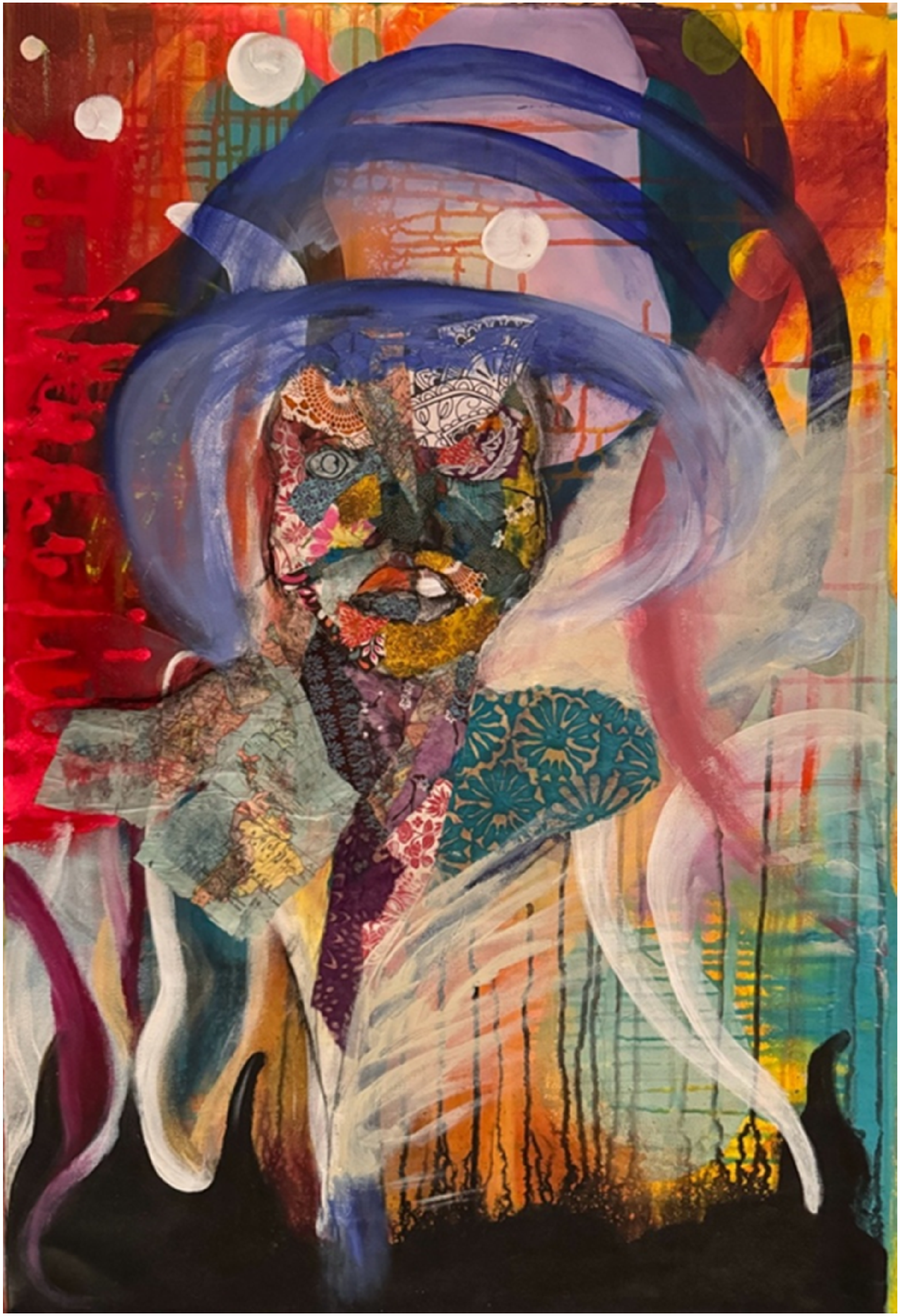
La Diablesse represented what the academy cannot fully hold: the dangerous woman, the masked scholar, the embodied contradiction. Her presence has given me a framework, albeit an unruly one, for thinking through several methodological themes:
The Danger of Being Seen Too Clearly
In the academy, visibility for Black women is often double-edged, both demanded and punished. La Diablesse hides her hoof, not out of shame, but as a strategy. What does it mean to withhold parts of ourselves not as deficit, but as resistance?
Seduction and Performance
Academic survival requires the performance of “rigour,” the seduction of citations, the careful choreography of being knowable without being devoured. La Diablesse’s performativity mirrors the performance required in methodological writing, especially when our knowledge comes from the body, land, and spirit. Her presence urged me to interrogate which parts of my method were meant to convince rather than convey.
Intergenerational Haunting
The figure in the painting does not belong solely to me. She is shaped by stories passed down through generations, remembering and voicing fears that they were never allowed to name. La Diablesse emerged not as an invention, but as a repository of collective memory, of ancestral knowledge that flickers through the body.
Unreadability as Method
The piece resists linear decoding. It asks the viewer to sit in discomfort, to accept partial knowing and to read without mastery. La Diablesse, too, is unreadable, her story changing depending on who tells it. That fluidity became part of the method itself, namely, to resist the academy’s demand for stable narrative closure and instead hold multiplicity as an analytic strength.
For those navigating colonial academic structures while maintaining accountability to ancestral lineages, community relationships, and spiritual commitments, methodological survival becomes a daily ethical negotiation which is embodied, lived, and often contradictory. As Bhattacharya (2013) observes, this positioning creates ongoing tensions about “to whom should I be loyal” when navigating between community accountability and institutional demands (p. 613).
The Ongoing Work
Tomorrow I Will
Settle your shoulders, soften your jaw, draw one breath in and one breath out.
There is no final synthesis. No stable endpoint. The contradictions remain. However, the practice of staying within the work and its inherent tensions has produced a significant methodological transformation. Challenges persist, and I continue to question the legitimacy of my methods and occasionally remove creative elements when anticipating reviewer skepticism. However, these responses have become less automatic. The impulse to self-censor requires more deliberate consideration, prompting reflection on whether such removals serve methodological necessity or habitual self-protection.
This work has fundamentally altered my institutional navigation strategies. My methodological compass no longer relies solely on traditional academic metrics but incorporates memory, community accountability, and epistemological coherence. The goal has become leaving methodological traces that others might find useful for adaptation, rather than creating replicable models.
Survival, I have learned, is not a static condition but a dynamic practice that adapts, experiences fatigue, and regenerates. It requires accompaniment through visual witness and the solidarity of those who understand that institutional persistence can constitute its own form of resistance. This article, therefore, functions as an invitation toward methodological adaptation. It encourages the development of approaches that can hold personal contradictions, cultural inheritances, and ethical commitments while recognising that the navigation process itself constitutes legitimate research.
This article offers a lived map of small, strategic, embodied refusals. It documents how I have learned to stay with less fragmentation, more discernment, and an increasingly quiet fidelity to truths that may not always be publishable but are always real. The coral builds not by resisting the tide but by learning to flourish within it. The work continues. This navigation is still becoming. Always becoming.
Conclusion
A colleague wrote to me after encountering Uncontained: I stood before Uncontained for twenty minutes. The gold placemat … I have one from my grandmother. When you said the academy wants our trauma cited and contained, I felt that in my chest. How do you know when to paint versus write?
Her question is not only about medium; it is about method, survival, and the negotiation of expression under conditions that police what knowledge should look like. It is also the question that sits at the heart of this paper. My response is both personal and methodological: I paint when language collapses under the weight of what it is asked to carry. I write when the visual needs a companion to translate its tremor into analysis. I do both when the academy requires containment, but the work requires refusal.
The contribution of this paper lies in its articulation of a distinct mode of creative autoethnography, routed, as Stuart Hall (1999) urges us to understand identity, through the paths I traverse as a Black Caribbean woman scholar. It is a practice that fuses visual artmaking, poetic compression, and embodied narration to theorise institutional life from within the afterlives of coloniality, guided by ancestral epistemologies that instruct attention to the body, the spirit, and the land. While foundational autoethnographers such as Ellis and Bochner (2000) have legitimised personal narrative as a scholarly method, the approach I advance is grounded in Caribbean aesthetic, spiritual, and historical traditions. In doing so, it offers scholars, particularly those in Global South, diasporic, and other minoritised contexts, a framework through which creative practice can function as representation and as an analytic force, counter-archive, and refusal. The integration of painting, haiku, and embodied field notes demonstrates how creative forms surface dimensions of epistemic violence and survival that remain inaccessible to textual analysis alone. I imagine others adapting this approach to interrogate the affective, spiritual, and political textures of academic life, to challenge disciplinary boundaries, and to craft methods capable of holding complexity, contradiction, and creativity.
Returning to my colleague’s question: How do you know when to paint versus write? I offer this: The work tells me. The body tells me. The moment tells me. Method becomes a listening practice.
By centring Caribbean intellectual genealogies and creative praxis, this paper extends existing autoethnographic scholarship. It opens space for methodological innovations grounded in the epistemologies of the oppressed. And if a reader can stand before a painting, or pause over a haiku, and feel something shift, feel something uncontained, then the method has done exactly what it came to do.
Footnotes
Acknowledgments
I am especially grateful to my students, whose questions, challenges, and insights keep my research grounded and my pedagogical practice honest. You remind me daily that knowledge is co-created and that academic integrity requires remaining accountable to the communities we claim to serve. I acknowledge Ms. J, a voice which appears in this work - thank you for your patience with my learning and the generosity of your teachings. Finally, I recognise that this work emerges from ancestral knowledge systems and community practices that long predate academic frameworks. I am honoured to be in conversation with these traditions.

Ethical Considerations
This study employed autoethnographic methodology, drawing primarily on the author’s personal experiences and reflections.
Funding
The authors received no financial support for the research, authorship, and/or publication of this article.
Declaration of Conflicting Interests
The authors declared no potential conflicts of interest with respect to the research, authorship, and/or publication of this article.
Data Availability Statement
As this research is autoethnographic in nature, the data primarily consist of personal reflections, artistic works, and experiences that cannot be shared publicly while maintaining participant confidentiality and the author’s privacy. One anonymised co-written poem with a student is included in the manuscript represent the extent of shareable data from this study.