




Abstract
Introduction
The level of salt intake among the Iranian population remains considerably above the recommended limits. This exploratory, qualitative, and applied study adopts a prospective policy analysis framework to develop an evidence-based policy package to reduce salt consumption.
Methods
Employing a multi-method research design within a policy analysis framework, this study is carried out in four phases. Initially, a thorough literature review is conducted to gather and evaluate policies, programs, and interventions from various countries targeting population-level salt reduction. Subsequently, qualitative analyses examine the obstacles, challenges, and enabling factors associated with existing and ongoing salt reduction efforts in Iran. This involves assessing the policy content, context, and formulation processes, alongside examining stakeholders’ roles within the policy triangle framework. Following this, a draft set of policy options is generated. An expert panel consisting of specialists, policymakers, and officials is then assembled to review and classify these options. The policy options are prioritized using the Delphi method, combined with the Centers for Disease Control and Prevention (CDC) framework, to ensure an accurate assessment of feasibility specific to Iran. Ultimately, the highest-ranked options will be refined and compiled into a comprehensive policy package ready for practical implementation.
Conclusions
The prospective policy analysis approach enables the identification and selection of potentially viable and effective policies to reduce salt intake. The findings of this research will be disseminated in formats such as policy briefs, technical reports, and scholarly articles to inform and guide policymakers.
Introduction
Non-communicable diseases (NCDs) represent the most significant and rapidly increasing threat to human health, especially in low and middle-income countries (LMICs) (Bakhtiari et al., 2020). NCDs account for 74% of worldwide fatalities, translating to 42 million deaths annually (Faso, 2019). In Iran, NCDs rank as the primary cause of mortality, accounting for 83% of premature deaths. Among various risk factors, an unhealthy diet is the most concerning. This unhealthy diet often involves a high intake of processed foods, which are typically high in salt, sugar, and trans fats, while lacking sufficient fruits, vegetables, seafood, whole grains, nuts, and legumes. Improving dietary habits could potentially prevent 20% of deaths worldwide (Afshin et al., 2019; Danaei et al., 2014; Hyseni et al., 2017). Diet-related risks are considered one of the most crucial primary risk factors for the occurrence of NCDs in Iran (“https://www.healthdata.org/research-analysis/health-by-location/profiles/iran,”).
Lowering salt consumption in communities is regarded as one of the most economically efficient strategies to alleviate the impact of NCDs (Cobiac et al., 2010; Webb et al., 2017). High consumption of salt is closely associated with elevated blood pressure (BP), which consequently heightens the chances of developing cardiovascular disease (CVD). It is also connected to kidney disease, gastric cancer, and osteoporosis, and is acknowledged as a worldwide health issue (Alonso et al., 2021). In 2013, the World Health Organization (WHO) recommended that all Member States reduce population-level salt intake by 30% as part of its nine global targets for a 25% reduction in premature mortality from NCDs by 2025 (Banatvala et al., 2023). A subsequent global review in 2014 reported that 75 countries had implemented national salt reduction initiatives—twice the number documented in 2010. These initiatives encompassed strategies such as reforming food products to decrease salt content, consumer education, adopting front-of-pack labeling, introducing salt taxation, and implementing interventions across various community and institutional settings (Trieu et al., 2015; Webster et al., 2011).
In 2016, the WHO released the SHAKE 1 Technical Package for Salt Reduction to assist member states in implementing salt reduction strategies across five main action areas: surveillance, collaborating with the industry, establishing labeling standards, enhancing knowledge, and improving the environment (WHO, 2016). This was issued with the expectation that countries would tailor, execute, and convert this information into effective policies and interventions.
The Political Declaration from the General Assembly was approved, committing all 193 member nations and states to tackle the prevention and management of NCDs (EB150, 2022). Later, during the 66th World Health Assembly, WHO Member States endorsed a global objective to achieve a 30% decrease in average population consumption of salt/sodium by 2025. This goal was one of nine voluntary global targets to realize a 25% reduction in premature deaths from cardiovascular diseases, cancer, diabetes, and chronic respiratory illnesses by 2025 (WHO, 2013). Following this, the WHO has assisted Member States by outlining effective methods for developing, implementing, and monitoring salt reduction initiatives (WHO, 2010), including ways to align salt reduction efforts with eliminating iodine deficiency programs. Various resources have been provided to support these efforts (Trieu et al., 2015; WHO, 2011).
Studies have shown that the Iranian population consumes more than 10 grams of salt daily, most of which comes from bread, cheese, and fast food (Esmaeili et al., 2025; Noushin et al., 2012). In 2015, Iran developed a National Action Plan to prevent and control NCDs. The plan is consistent with the global goals of the WHO, the country’s domestic priorities, and evidence from disease burden studies at the national and subnational levels (G. WHO, 2017).
Salt-Related Studies Conducted in Iran

Objectives
The main objective of this study is to analyze and review salt consumption reduction policies in Iranian society and to develop an efficient policy package. The analysis covers timely action and supportive policies, while the exploration will focus on proposing the needed policies. Therefore, the objectives are as follows: 1. To review and compare salt consumption reduction programs in Iran and other countries. 2. To analyze existing policies to reduce salt consumption in Iranian society. 3. To propose a comprehensive package of salt consumption reduction, prevention, and support policies for Iranian society.
1. What are the policies, strategies, and programs of other countries to reduce salt consumption, and how effective are they? 2. What are the effective contextual factors and content of salt consumption control policies in Iran? 3. What is the trend of salt intake in Iran? 4. What are the key stakeholders and what are their roles concerning salt consumption control policies in Iran? 5. What are the proposed policy options for reducing salt consumption in Iran? 6. What is the final policy package for salt consumption control in Iran?Box 1 Specified Research Questions
Methods/Design
The present study is a multi-method research study with a policy analysis approach, comprising four stages. The approach to this qualitative study is a case study, as we prospectively analyze policies, propose policy options, and formulate a policy package to reduce salt consumption in Iran, thereby gaining a deep understanding of these policies, programs, events, and related organizations. To achieve these objectives, this multi-method study will be conducted in 4 steps: 1. Conducting an initial literature review to identify successful policies and programs, strategies, and potential methods for reducing salt consumption in different countries around the world 2. Conducting a qualitative study to determine experts’ perspectives on effective factors and strategies for reducing salt consumption in Iranian society and the Iranian healthcare system 3. Extracting preventive methods through the first two objectives (literature review and qualitative study) and developing an initial draft of a policy package for reducing salt consumption in Iranian society. 4. Validating and finalizing the initial policy package through the Policy Delphi method (Figure 1).
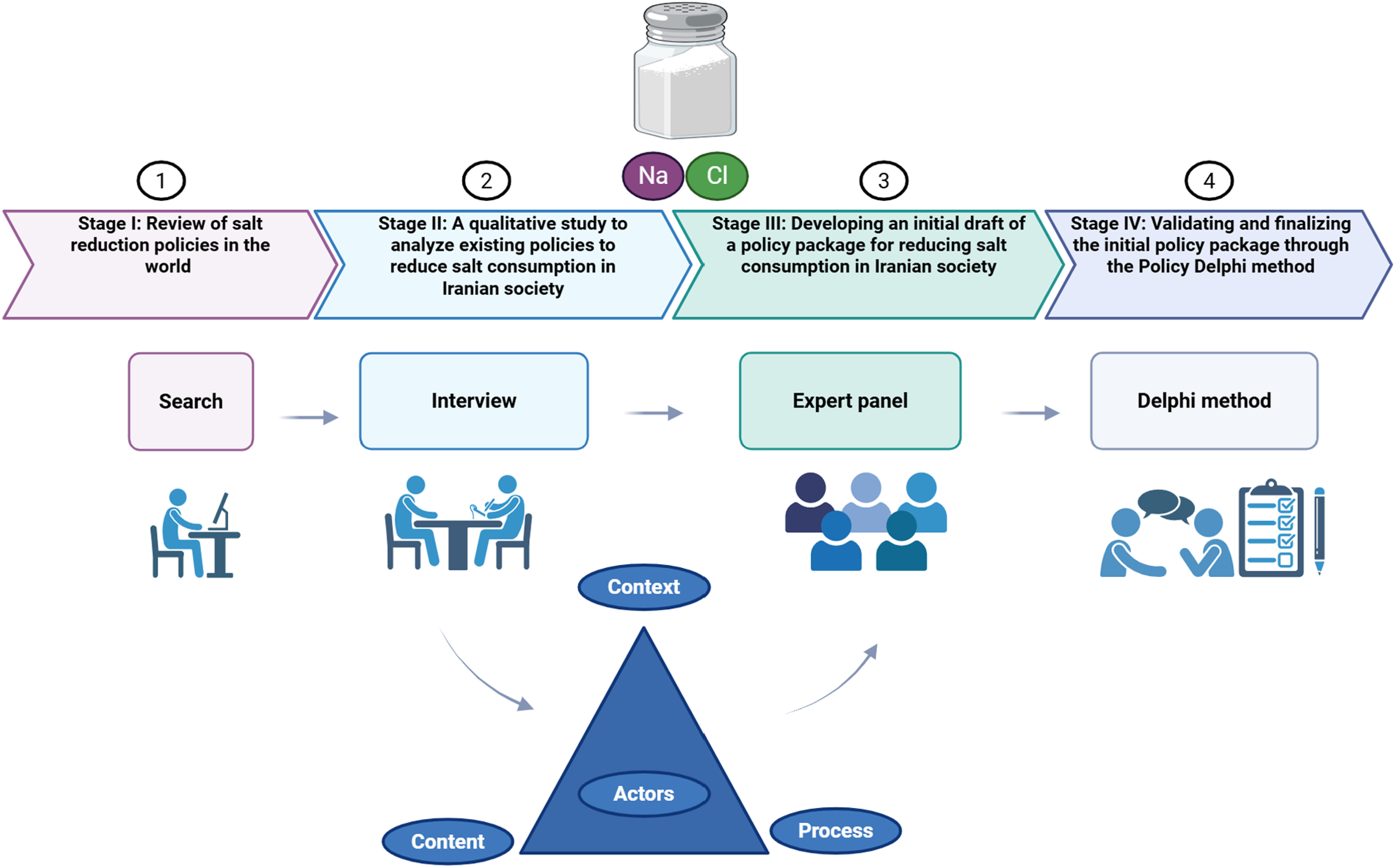
Four steps of the current multi-method study to develop a salt reduction policy package in the Iranian population
Stage I: Review of Salt Reduction Policies
All officially published and written documents and records of decisions, reports, plans, and actions, and statistics of national governments, national authorities and international organizations (such as the World Health Organization or the World Bank), national scientific societies and academic associations, world development indicators, and demographic and health surveys are defined as policy documents.
We will first conduct a literature review to identify policies that could inform the design of a transformative policy package. The results of this review will, in fact, form the basis for subsequent interviews with experts, help identify stakeholders, and help introduce policy options appropriate to the conditions of Iranian society. Reducing salt intake in line with international standards will be considered the principal indicator of policy effectiveness. Given the current research’s general target of formulating a policy package to reduce salt consumption in Iran, it is possible to use the content of effective international policies (as applicable in Iran) as input to develop policies for Iran. To obtain an overview of potentially relevant policies, we will conduct a literature review by September 2025. Search engines, including PubMed, ISI, Google Scholar, websites of health ministries, government records and guidelines, all public websites, grey papers, protocols, and clinical procedures will be reviewed. A manual search of the references of the included articles and reports will also be conducted. A data-collection checklist will be developed to review successful and effective salt programs against critical infrastructure criteria.
Search Strategy
The search strategy will include a combination of the keywords ‘salt’, NaCl, ‘sodium’, ‘reduction’, ‘salt intake’, ‘sodium intake’, ‘dietary salt’, ‘dietary sodium’, ‘salt consumption’, ‘policy’, ‘policy’, ‘public policy’, ‘health policy’, ‘regulation’, ‘legislation’, ‘guidelines’, ‘standards’, ‘strategy’.
Inclusion and Exclusion Criteria and Data Collection
Documents in English that address the operational model of salt reduction policies, rules, and programs will be included. Inclusion criteria included published studies on salt intake control worldwide and studies that described at least one salt control policy. Irrelevant documents, such as video clips, movie content, advertisements, newspapers, discussion papers, online advertising sites, and marketing channels, will be excluded.
Stage II: A Qualitative Study to Analyze Existing Policies to Reduce Salt Consumption in Iranian Society
The design of the study’s second phase is a qualitative study with a conventional content analysis approach (Hsieh & Shannon, 2005). In this phase, three specific objectives will be pursued, namely: 1- Analyzing the context and content of salt consumption control policies in Iran, 2- Analyzing the process of salt consumption control policies in Iran, and 3- Analyzing the stakeholders, their position, role, and their relationship with salt consumption control policies in Iran.
In this phase, a review of the policies and guidelines published in Iran will be conducted. Policy documents will be searched on the Ministry of Health and Medical Education website and reviewed and analyzed for the content of salt control policies in Iran. Based on a review of documents, reports, and policies, key stakeholders and experts, as well as relevant organizations and institutions, will be identified and interviewed. Policy documents, key informants, and stakeholders related to salt control policy in Iran will constitute the research community in this phase. The researcher will design and use a document review form to include information such as title, document description, name, publication time, publication location/organization, and document content. Snowball sampling method will be used to identify other stakeholders through informed persons, and additional stakeholders will be added to the study step by step (Hennink et al., 2017). Interviews will continue until data saturation, meaning that no new concepts or points emerge, and the researcher repeats the same sentences over and over again (Saunders et al., 2018).
Data Collection and Analysis
The primary data collection involves semi-structured interviews carried out by the first researcher and participating experts, guided by a research-developed interview protocol. Whenever feasible, interviews are conducted face-to-face at mutually agreed locations. Participants will be selected based on job roles, relevant knowledge, awareness, and willingness to contribute. Initial pilot interviews are undertaken to refine the interview guide, ensuring clarity and precision for subsequent discussions. Before each session, participants will receive a formal invitation letter and provide written informed consent. To enhance accuracy and prevent data loss, interviews will be audio-recorded with participant permission, alongside concurrent note-taking of key points. Each session will typically last 25 to 40 minutes, and interviews continued until no new insights emerged, indicating data saturation.
For analyzing the collected data, a descriptive content analysis method will be adopted, focusing on reaching saturation when repetitive concepts and statements are recognizable (Hennink & Kaiser, 2022; Keen, 2015). Researchers will progressively gather data, expanding topics and developing broad thematic categories. Transcriptions of interviews will be meticulously made and repeatedly reviewed. Codes were inductively generated from the data and subsequently grouped into categories based on their similarities and differences.
To assess policies, the study employed the policy triangle framework by Walt and Gilson, which includes four dimensions: context, content, process, and stakeholders (Walt et al., 2008). The analysis followed three phases: description (capturing essential points during interviews), analysis (organizing and classifying text and documents), and interpretation (coding and theme development) (Saint et al., 2008). MAXQDA 2020 software facilitated systematic coding and qualitative data analysis. Additionally, a stakeholder analysis will be conducted using a specially prepared checklist that captures each stakeholder’s role, activity, and influence in both policy formulation and implementation. Tools such as Policy Maker and MAXQDA software support this component of the investigation.
Stage III: Formulating a Preliminary Policy Package to Manage Salt Intake in Iran
At this phase, the research team consolidates findings from the literature review, interviews with key stakeholders, stakeholder assessments, and policy evaluations to identify both barriers and enablers influencing salt reduction efforts. The policy options derived by the researchers are then categorized and structured systematically to create an initial collection of proposals.
Following this, a preliminary policy package is developed by synthesizing the collected evidence through consultation with an expert panel. This panel comprises members of the research group and several field specialists. During the formulation process, various assessment criteria are considered, including the practicality of implementation, public acceptance, technical and organizational challenges, and performance factors such as costs, duration, feasibility, acceptability, and political backing.
The draft options are presented to an expert panel comprising relevant authorities and policymakers who provide their feedback, which is carefully documented. This iterative review continues with panel discussions until no new suggestions emerge, indicating consensus or saturation. Ultimately, the collective insights and recommendations are compiled, refined, and prepared for subsequent stages of validation and prioritization.
Stage IV: Validating and Finalizing the Initial Policy Package Through the Policy Delphi Method
The Policy Delphi method (Makhmutov, 2021; Niederberger & Deckert, 2022) is designed to achieve consensus by examining the most detailed and strongest opposing views on possible solutions to a significant policy problem. The method’s primary goal is to ensure that all potential options are considered, that the impact of each is carefully assessed, and that the degree of acceptability of each is determined (Rayens & Hahn, 2000). In the next stage, the Delphi technique and the Centers for Disease Control and Prevention (CDC) Policy Options Analysis Framework, which has three main criteria (the extent of the impact on public health, feasibility, and economic and budgetary effects), will be used to prioritize policy options and assess their feasibility in Iran (Koplan et al., 1999). The Delphi round will continue until consensus is reached. The final version of the policy package will be sent to each member present at the panel meetings. After prioritization, the selected options will finally be ranked to provide the most appropriate policy options in the package for Iran in the current circumstances. A final policy package will then be developed and reported.
Rigor and Quality Assurance
Ensuring the reliability of qualitative research hinges on meticulous attention to methodological rigor. This study addresses four key criteria: credibility, transferability, confirmability, and dependability (Flick, 2015; Mousavi et al., 2025). To enhance credibility, the researcher will engage deeply throughout all research phases, complemented by peer reviews to identify and correct potential errors. Preliminary codes will undergo continuous comparison and refinement against data summaries, with participant validation of the coding. To affirm dependability, feedback from external reviewers will be incorporated. Concurrent data collection and analysis aid in establishing transferability. Moreover, the researcher’s active involvement, along with diverse feedback and constructive critiques from other academics and study participants, further strengthens the study’s credibility.
Discussion
The present protocol provides a detailed, comprehensive description of strategies for implementing a salt-reduction intervention policy. This study also provides detailed, robust evidence that governments, policymakers, and other organizations can use to develop strategies to control salt intake.
Data from all stages will be triangulated, using policy analysis to produce a valuable, actionable set of data that provides a comprehensive view and ensures a systematic process for selecting the optimal options for the current situation in the study environment. A study of successful programs implemented in other communities to examine community-based self-management policies, as well as the perspectives of key stakeholders, policy makers, actors, senior managers, and informed workers, as well as the general public who are the primary consumers of salt, will be used to arrive at the most appropriate policy options to design a policy package. The package will then be presented to the country’s policymakers to promote evidence-based policymaking.
Focusing on the prerequisites and barriers to controlling and reducing salt consumption at each stage of the program implementation and change process will help us develop more appropriate and consistent policies for society. The results of this study provide a policy package and, therefore, policy options to address the challenges of reducing salt consumption in the country’s current situation at local and national levels. In addition, it can serve as a basis for broader national and international discourses to develop more practical strategies for preventing non-communicable diseases across all age groups of the population.
Strengths
This study will examine an important issue, given Iran’s high salt consumption and the numerous challenges the Iranian health system faces in implementing NCD prevention programs through salt-reduction interventions. Using a qualitative approach, the study will thoroughly identify and analyze all dimensions related to the salt reduction program. In the present study, various data collection and analysis methods will be used, adding to the work’s richness and validity.
Limitations
The first major limitation anticipated in this study will be the expected difficulty in accessing and interviewing key relevant individuals and policymakers at the national level due to their dispersion. To address this issue, our strategy will involve pre-arranged plans for conducting in-person interviews or virtual meetings. Another limitation of this study may be the lack of access to minutes and specific documents from related policy meetings.
Call to Action
This study highlights the significant health risks associated with high salt consumption in Iranian society and underscores all stakeholders’ urgent need for action. By addressing recognized barriers and implementing recommended measures, we can strengthen the healthcare system’s resilience and safeguard public health against NCDs for future generations. By providing a policy package to policymakers, health professionals, and community leaders, they will be called upon to prioritize policies related to the prevention of NCDs and to prioritize the control of salt consumption in society among their most important actions, and to commit to joint efforts that will preserve the health of our population.
Conclusion
The present study will identify scientific evidence and documentation of the obstacles to the production and implementation of salt consumption control policies in Iran by analyzing these policies using the policy triangle model, focusing on content, context, stakeholders, and process. It is hoped that Iranian health policymakers will consider the policy package when implementing salt consumption control programs in Iranian society. In addition, this study will reveal the challenges of the salt consumption control policy cycle and the obstacles to implementing existing policies in this field. Our study will present the existing literature on the available policy options and an appropriate policy package, based on the criteria of acceptability, feasibility, and effectiveness, for controlling salt consumption at the local and national levels. The findings will also provide a basis for a broader international discourse to develop strategies that are consistent with national and regional structures and practices, and their challenges, for reducing salt consumption.
Footnotes
Acknowledgments
We gratefully acknowledge all the experts and participants in this project.

Ethical Considerations
This study is part of the Postdoc thesis of the first investigator at the Micronutrient Research Center, Research Institute for Endocrine Disorders, Research Institute for Endocrine Sciences, Shahid Beheshti University of Medical Sciences, Tehran, Iran.The Ethics Committee of Shahid Beheshti University of Medical Sciences approved this study (Ethics Code: IR.SBMU.ENDOCRINE.REC.1404.064).
Consent to Participate
Written informed consent to participate and to be audio recorded will be obtained from the participants. Detailed information about the research, including purpose, procedures, associated risks and benefits, and confidentiality measures for privacy protection, will be given to participants before the interviews. Furthermore, participants will be clearly informed that participation was voluntary and they could withdraw at any time without consequences. All methods will be carried out in accordance with relevant guidelines and regulations.
Author Contributions
Contributors A.D., F.M.N., R.KH.Z., and Z.B. contributed to the study title, conception, and design. A.D. drafted the protocol with consultation from F.M.N.
R.KH.Z. and Z.B. assisted in developing the search strategy and protocol development.
A.D., Z.B., and F.M.N. developed and conducted the preliminary searches. All authors have proofread the protocol and provided final approval of the version to be published.
Funding
The authors disclosed receipt of the following financial support for the research, authorship, and/or publication of this article: This study was funded by the Micronutrient Research Center, Research Institute for Endocrine Disorders, Research Institute for Endocrine Sciences, Shahid Beheshti University of Medical Sciences, Tehran, Iran (Ethics Code: IR.SBMU.ENDOCRINE.REC.1404.064; Grant Number: 43016223).
Declaration of Conflicting Interests
The authors declared no potential conflicts of interest with respect to the research, authorship, and/or publication of this article.
Data Availability Statement
The data will be available on reasonable request from the corresponding author in due course.