




Abstract
The optimal constellation of focus groups is a prime concern of scholarship within qualitative methodology. Most focus group experts discourage strong heterogeneity among participants, as status differentials are considered a hazard for the social interaction that is the driving force of the method. This paper sets out to engage empirically with this widespread wariness. It does so by drawing on a focus group study involving Danish climate scientists, climate journalists and members of the public in both single-actor and mixed groups. To develop a refined appreciation of the power dynamics within the fifteen focus groups, they were examined with a combination of quantitative and qualitative measures. The quantitative analysis showed no obvious relationship between background characteristics and the number and length of speaking turns. Further, the assessment of the participants’ discursive positioning in the discussions also lends credence to the unpredictability of the power dynamics within the groups. For example, the members of the public in the mixed groups often managed to position themselves as equals to the professionals and sometimes even imposed their opinions on the group. Taken together, the results counter the common caution against high heterogeneity in focus groups. This inquiry concludes by highlighting key aspects to carefully consider when designing and executing highly heterogeneous focus groups, aiming to inspire others to mix people from different walks of life when the research question calls for it.
Keywords
Social interaction has an imperative function in focus group studies. For this reason, the question of how best to assemble focus groups is among the most touched upon subjects in the canon connected to this method. Recommendations on focus group composition nevertheless exhibit a striking uniformity. For decades, focus group scholars, with occasional exceptions (Clavering & McLaughlin, 2007; Femdal & Solbjør, 2018; Greenwood et al., 2014; Kitzinger, 1994), have advocated for homogeneity when organising groups (Caillaud et al., 2022, p. 10; Fallon & Brown, 2002, p. 198; Kamberelis & Dimitriadis, 2020, p. 489; Myers, 1998, p. 88; Peek & Fothergill, 2009, p. 53; Ruiz, 2017, pp. 286–287). Hughes and DuMont even included homogeneity in their definition of the method. They characterise focus groups as ‘in-depth group interviews employing relatively homogeneous groups to provide information around topics specified by the researchers’ (Hughes & DuMont, 1993, p. 776).
Homogeneity is usually conceptualised as a likeness in attributes such as gender, age, ethnicity, education level and occupation (Bloor et al., 2001, p. 21; Carey, 2015, p. 276; Côté‐Arsenault & Morrison‐Beedy, 2005, p. 174; Hennink, 2014, p. 39; Morgan, 1997, p. 60). The main argument against mixing participants across these traits is that diversity in backgrounds will hamper the interaction, as people might feel uncomfortable sharing their views with non-peers (Fallon & Brown, 2002, p. 198; Peek & Fothergill, 2009, p. 39). This problem is supposed to be more pronounced if the groups consist of individuals with obvious social disparities (Cyr, 2019, p. 45). In such cases, an internal hierarchy might form, potentially keeping ostensibly inferior participants from contributing to the conversation (Hennink, 2014, p. 39). The discussion about homogeneity and heterogeneity in focus group composition is therefore intimately tied to assumptions about how status differentials influence the relations among the participants.
Although the mechanism has not been thoroughly theorized in research on focus groups, the intricacy of the link between status and power in minor groups has been a long-standing preoccupation for social psychologists (Berger et al., 1972; Berger & Fişek, 2006). The gist of this body of work is that social and demographic differences are decisive in small, task-oriented groups because they dictate the performance expectations participants form for themselves and for one another. Empirical analyses within this tradition confirm that factors such as gender, age and socio-economic rank govern the power and prestige hierarchy in such groups (Dovidio et al., 1988; Fişek et al., 2005; Knottnerus & Greenstein, 1981; Mohr, 1986).
According to Morgan, heterogeneity may hold significant untapped potential (Morgan, 2017, p. 416). In keeping with this, heterogenous groups are well-suited for examining what Kitzinger calls ‘argumentative interactions,’ where researchers capitalise on participants’ differences as they misunderstand, question and attempt to persuade each other, or openly disagree, to gain a richer understanding of the matter at hand (Kitzinger, 1994, pp. 113–115). Beyond the insight related to the participants’ points of divergence, heterogenous groups can also highlight shared stances among disparate individuals. Morgan asserts that ‘the most serious barrier to doing more with heterogeneous groups is undoubtedly a lack of knowledge about implementing them’ (Morgan, 2017, p. 416).
This paper aims to inform future guidelines on focus group composition by presenting firsthand observations of the impact of participant heterogeneity. To this end, it analyses a focus group study involving Danish climate scientists, climate journalists and members of the public (hereafter referred to as citizens for simplicity). This data set combines the three participant types in the same focus groups, which offers an opportunity to explore power dynamics in a research design that runs counter to the conventional methodological wisdom by bringing together individuals of varying genders, ages, educational backgrounds and occupations. The analysis will operate on two scales: a macro level focusing on aggregated measures of participation volume and a micro level examining moments of interaction that reflect power dynamics between participants. Using a mixed-methods approach, the study uncovers both overarching patterns of power dynamics as well as manifestations in specific exchanges. The paper will be directed by the following research question:
In What Ways Do Participants’ Background Characteristics Shape the Power Dynamics Within Focus Groups?
The present article shows that the volume and frequency of turns are generally not determined by participants’ background characteristics in a straightforward manner. By the same token, the analysis of discursive positionings displayed that the power dynamics within the groups only partly relied on the background characteristics with considerable leeway for participants to make the most of their starting point. This evidence should if not encourage, then at least not discourage focus group researchers across fields from experimenting with research designs that include heterogeneous groups. Moreover, Ayrton holds that the available literature lacks ‘guidance on the analysis of power in focus group data’ (Ayrton, 2019, p. 324). As such, another major contribution of this paper is the introduction of an integrative analytic model for studying power dynamics in focus groups.
The Focus Group Study
The empirical foundation of this paper is fifteen focus groups with Danish climate scientists, climate journalists and citizens carried out in the autumn of 2021. Three of the groups included participants from all three segments, whereas the remaining 12 groups comprised representatives from only one category, with four groups for each actor type (See Figure 1).
1
26 climate scientists, 24 climate journalists and 26 citizens took part in the study, and the size of the focus groups ranged from 4 to 7 participants. The initial objective of the focus groups was to investigate how the three types of actors perceive the ideal configuration of the public climate debate (P. B. Nicolaisen, 2022, 2024). Illustration of focus group composition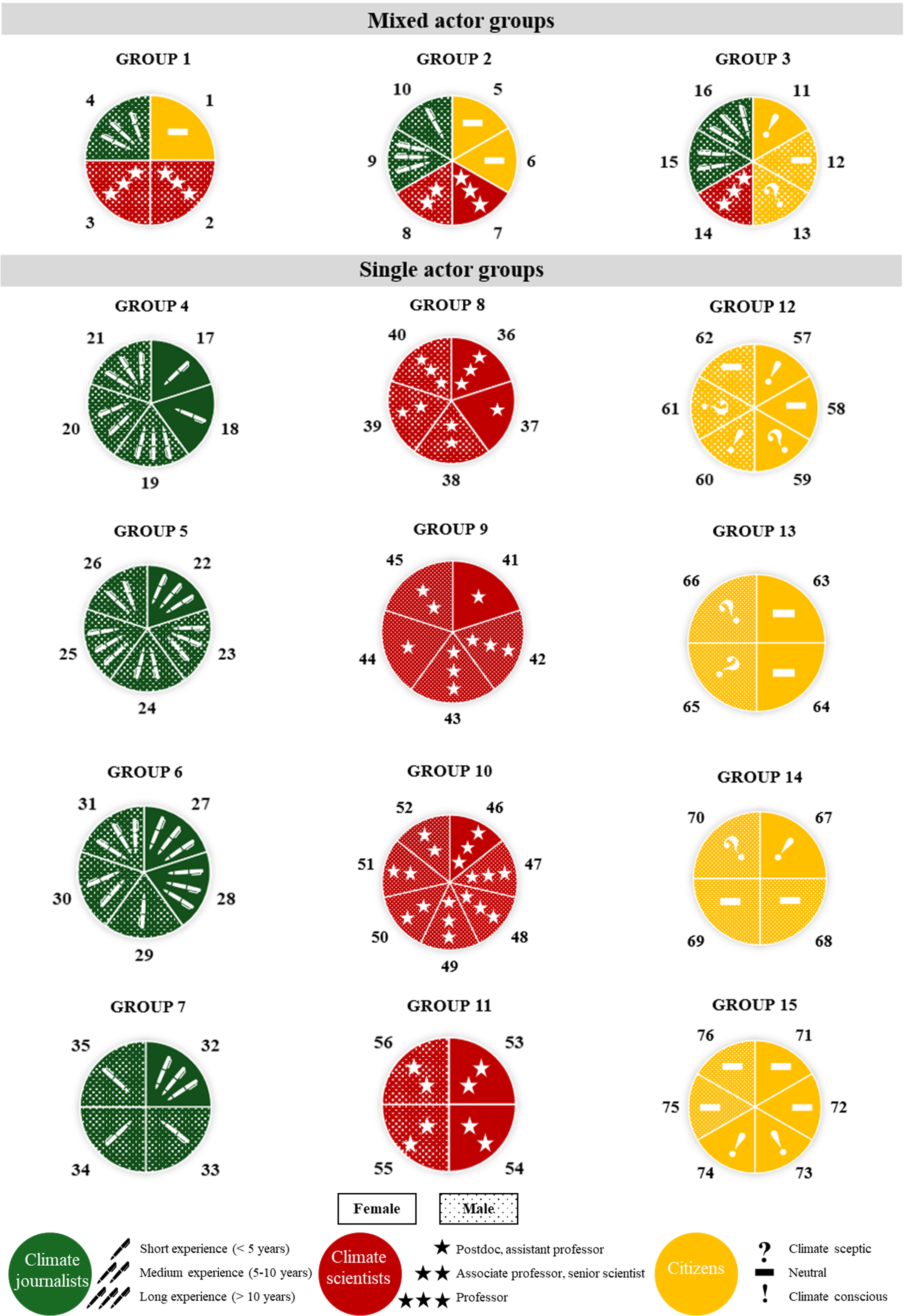
In this study, a climate scientist referred to a university researcher who investigates either the physical aspects of climate change or strategies for its mitigation and adaptation. A climate journalist was defined as an individual who had produced a substantial body of journalism on climate-related topics, even if climate coverage was not their sole focus. Lastly, a citizen was classified as an individual over the age of 18 with voting rights in Denmark, who did not qualify as either of the other two actor types.
Participants were selected using a maximum variation sampling strategy (Flyvbjerg, 2006, p. 230). As a result, the sample of climate scientists comprised scholars from several universities and research fields with varying seniority, whereas the climate journalists hailed from a wide spectrum of the Danish media landscape and had differing amounts of experience. In relation to the citizens, the goal was to have a diverse representation of individuals from separate age groups with different educational and occupational backgrounds and attitudes towards climate change (sceptical, concerned, neutral). It would have been preferable to have an equal number of men and women in the sample with respect to all three actor types; however, this was particularly difficult to attain for the climate journalists, as the Danish population of reporters within this beat is male dominated. The three groups encompassing both scientists, journalists and citizens inherently exhibited a high degree of heterogeneity, but the single-actor groups could also be classified as relatively heterogeneous. In these groups, participants from each actor type were mixed in terms of the properties that guided the sampling strategy: instead of forming groups with only inexperienced male journalists, female professors or climate sceptics, efforts were made to have as much diversity as possible within the groups in which the three actor types featured separately. The rationale for employing a research design with both single-actor and mixed-actor groups was that the former allowed me to probe the intra-segment consensus on the topics discussed, whereas the latter facilitated the observation of inter-segment negotiation. I believed that the advantages of creating a more multifarious discussion environment through the mixed-actor groups outweighed the risks of merging the three segments of participants. Hence, some groups included participants with markedly dissimilar background characteristics.
The focus group discussions were audio-recorded and subsequently transcribed, primarily by student assistants, and they were all conducted in Danish. Before the data collection began, the study received ethical approval from the Research Ethics Committee at Aarhus University (approval number 2021-81).
A Comprehensive Approach to Understanding Intergroup Power Dynamics
This section will introduce the eclectic analytic framework that was used to study the power dynamics of the focus groups.
Evaluating Participation Volume
In the first part of the analysis, I assessed the power dynamics quantitatively. For this purpose, I operationalised speaker power as the number of speaking turns and the total spoken words for each participant. This aligns with Shelly and Troyer’s argument that a higher frequency and length of speaking turns attest to a privileged standing in a group’s hierarchy: ‘When an actor is advantaged in the group status structure, the actor is easily able to assert claims for chances to speak and to speak at length’ (Shelly & Troyer, 2001, p. 420). I utilised an inclusive notion of a speaking turn, as each utterance was counted as a turn (c.f. (Duncan, 1972, p. 288). Estimating the rate and duration of discussants’ involvement in the focus groups will serve to probe potential patterns of participation connected to their background characteristics. I also tallied the number of turns taken by the moderator in each group, as a high amount of moderation might indicate dysfunctional group dynamics, which require frequent probing and conflict management. My intention was to gauge the need for moderation in the interaction among participants, and therefore I disregarded the introductory statement and the standardised presentation of each exercise when determining the sum of moderator turns.
The statistical breakdown of the focus group data was performed manually using the basic affordances of MS Word. To arrive at the number of turns taken by each participant and the moderator, I searched the transcripts and counted how often the name of every participant and the moderator featured in the speaker column. The number of spoken words was computed by pasting the contribution of each participant and the moderator into a separate document and running the word count function after deleting the speaker column and cleansing the transcript for contextual notes.
Analysing Power Dynamics in Interaction
I will draw on Aronsson’s social choreographic approach in the qualitative analysis of the focus group discussions (Aronsson, 1998; Aronsson & Rindstedt, 2011). The choreography metaphor suggests that social orders are fluid. A social choreographic analysis therefore focuses on mapping how interactions expand or reduce the social distance between agents within a conversation (Aronsson, 1998, p. 77). While individuals’ background characteristics have a bearing on the initial gap between them, a key principle for Aronsson is that this divide is flexible and constantly modified through interaction: ‘social space is seen neither as completely preformed nor as completely open’ (Aronsson, 1998, p. 76).
In understanding how individuals occupy social space, the concepts of position and positioning are principal (Aronsson, 1998, p. 78). Similar to the notion of a social role, a position revolves around rights and duties. But whereas a role is usually perceived as stable across contexts, a position is situation-specific and up for constant negotiation and possibly contestation (Harre & Langenhove, 1991; Harré & Slocum, 2003, p. 104). What precedes agents’ taking up certain positions is positioning: “the discursive processes by which rights and duties are ascribed, taken on, rejected, refused, contested, and so on” (Harré, 2015, p. 269). In my analysis, I will investigate the discursive processes embedded in the sequences of turns in the conversations, as participants react to previous turns and simultaneously condition prospective ones.
Positions can generate disputes due to their relational nature. When one agent assumes a position, other actors are positioned according to that position (Harre & Slocum, 2003, p. 108). When someone positions themselves as a teacher, others are naturally positioned as pupils. Similarly, if a person adopts the position of a victim, it invites others to become sympathisers. Hence, actors may oppose being dealt unwanted positions by their interlocutors. Since positions determine agents’ manoeuvring room in a social setting, they are closely linked with power dynamics within groups. Successfully claiming desired positions and avoiding unfavourable ones are exercises of power, and individuals vary in their capacity to perform these moves (Harre & Langenhove, 1991, p. 406). In the second phase of analysing the focus group data, I applied a social choreographic lens to explore how the participants’ background characteristics enabled and constrained their positioning efforts.
Analysis
In this section, I will outline the findings from the two approaches used to evaluate the power dynamics in the focus groups. First, I will report the results from the assessment of participation volume across the groups. Next, I will present a micro-level analysis of selected instances of interaction to illustrate how participants’ background characteristics intersected with their positioning.
Number of Turns and Spoken Words
This analysis integrates two measures of participation volume: the percentual distribution of speaking turns among participants, along with the extent of moderator involvement in each group (as shown in Figure 2); and the total word count for each participant (as displayed in Figure 3). Percentual turn-taking for each participant Percentual words spoken by each participant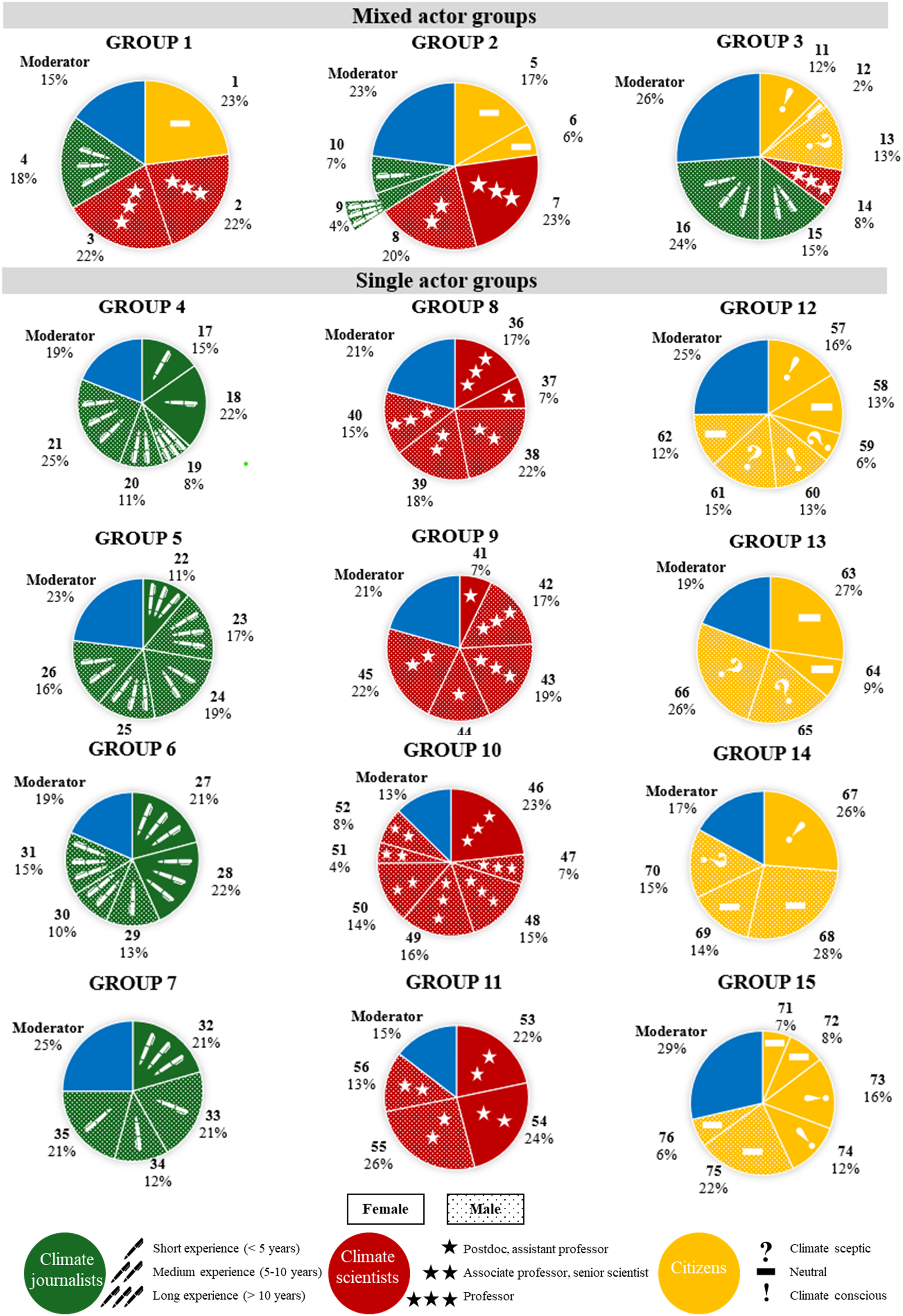

The participation metrics of the three mixed-actor groups show that the climate scientists and climate journalists generally dominated the conversations from a quantitative perspective. Group 1, which featured two climate scientists, one journalist and one citizen, had a somewhat equal division of turns with the most frequent turn-taker being the female citizen. Her turns were nevertheless notably shorter than those of the other group members. With respect to the volume of words, she therefore constituted the tail end of the group. The two climate scientists in Group 2 led the discussion in terms of both the number of turns and words spoken, whereas the third-highest number of turns were taken by a citizen. However, like the citizen in Group 1, her contributions had a moderate length, which meant that one of the climate journalists surpassed her in total words spoken during the session. In Group 3, one climate journalist participated to an exceptionally high extent, accounting for around a quarter of the turns and a third of the words. Whereas the meagre engagement of the climate-neutral citizen in this group stood out, the other two citizens were fairly immersed in the conversation, both taking more turns than the attendant climate scientist. Overall, the climate scientists and climate journalists in the mixed-actor groups were represented across the entire spectrum of participation, whereas citizens ranged from scarce to modest involvement. Meanwhile, in terms of turn-taking, the citizens were largely on par with the other actor types.
In the focus groups composed exclusively of climate reporters, it was difficult to spot trends in the participation rates, as the distribution of turns seemed unconnected to the journalists’ experience levels. The most consistent and prolific speaker in Group 5 was a journalist with medium experience although he was matched up with three veteran colleagues. Likewise, novice journalists exceeded more experienced peers in word output in Group 4 and Group 7. The picture looked more orderly in the single-actor groups with climate scientists. In the two groups in which junior researchers were present, they took the fewest turns and said the least. Nonetheless, it is important to note that the female assistant professor in Group 9, who seemed to participate minimally, had to leave the group about halfway through the session. There was no crosscutting tendency as to the significance of being a full professor versus an associate professor in relation to the number of turns taken and words spoken. The scenario is equally unclear in the groups composed of citizens only. It appeared probable that the citizens with marked attitudes towards climate change would be the most vocal in these groups. Yet, in two of the four groups with this composition, the most productive and regular speaker was someone without a deep-felt conviction concerning climate change.
The average woman took slightly more turns (16%) than the average man (15%). In fact, in seven group a woman took the most turns—including Group 7, where it was tied between three participants: a woman and two men. This is noteworthy, as merely 35% of the participants were women due to the difficulty of locating female climate journalists and, to some extent, climate scientists. On the contrary, women were the rarest turn takers on only five occasions, and one of these instances was the assistant professor who had to leave early. In terms of the amount of speech performed, on average women uttered almost 20% fewer words in the discussions than men. Consequently, the data does not suggest that women struggle to take the floor when featuring alongside men in focus groups; however, it does substantiate that women’s turns are, as a rule, shorter than men’s. Finally, the level of moderator involvement fluctuated in a somewhat irregular fashion across the different types of groups. The average moderator participation was stable across the single-actor groups with climate journalists and citizens as well as the mixed groups, whereas it was slightly lower in the single-actor groups with climate scientists. Although there is a weak positive correlation between the degree of moderator presence and group size, Group 10 complicates this finding by being both the largest group and the one least influenced by the moderator.
A Social Choreographic Take on Power Dynamics
Summing up the number of turns and words sheds light on the overall functioning of the power dynamics; however, it does not provide deep insight into how they are manifested in the interplay among group members. To offer a more well-rounded account of the phenomenon, the final part of the analysis will explore micro-level interaction by examining participants’ positioning practices. It will mainly concentrate on the mixed-actor groups, as they appear to be the most critical sites for studying power dynamics. These groups seem more at risk of developing unproductive social hierarchies due to their internal differences, which may affect the power relations.
A Fine Line Between Inferiority and Superiority
One interesting instance of positioning occurred in the supposedly most skewed focus group, namely Group 1 in which a female early retiree was paired with two highly esteemed climate scientists and a renowned climate journalist, all males. The composition became more asymmetrical than intended due to a late cancellation from another citizen.
During the discussion, the early retiree managed to walk a fine line of superordinate and subordinate positionings. The balancing act started already during the introductory round. Responding to a lengthy description by one of the climate scientists of his academic merits and media experience, she replied with a lightly sarcastic comment: ‘We had only really needed you then.’ This interaction appeared to be pivotal in shaping the power dynamics of the remainder of the discussion. Not only was it the first joke of the session, but it could also be seen as controversial, as if she mocked the climate scientist’s presentation of his achievements. By means of the quip, the citizen positioned herself as a joker and the climate scientist as fair game. Crucially, the jest was well-received by all the other group members, who laughed loudly.
Later, the early retiree assumed a subordinate position when the participants debated the elements of good climate reporting. As part of a turn which primarily concerned her preferences regarding climate journalism, she positioned herself as “a totally ordinary citizen” that “doesn’t know much more than totally average people do about the climate.”
In line with this position, the citizen sometimes asked the others to clarify implicit points. One example of this occurred in connection with an exercise in which the participants were asked to reflect on climate scientists’ mandate in public discourse based on a vignette featuring a fictional glaciologist. Here, the early retiree found it difficult to understand why the others opposed that the glaciologist endorsed higher taxes on meat and air travel, as proposed by one of the option cards. But who should then provide the solutions to this problem, if it isn’t the ones … if it isn’t the climate scientists? (Citizen, neutral, female, 60s, early retiree) Yes, but that’s another climate scientist. It’s a bit like when you have knee pain and go to the doctor, and you need to have surgery. (Climate scientist, male, professor (A)
2
) Okay. (Citizen, neutral, female, 60s, early retiree) Then it’s not the same doctor that’s looking at your knee. It’s another doctor, and that’s where the wheels often fall off. (Climate scientist, male, professor (A)) Ahh! That’s what it’s about. (Citizen, neutral, female, 60s, early retiree)
However, at times the early retiree took a more authoritative stance with the approval of the other group members. Prompted by a card in an exercise in which the participants were asked to reflect on normative statements about climate journalism, the climate journalist and the two climate scientists entered into extensive deliberations on whether climate reporters should take on an expert role. Arguments were weighed among the three participants for a couple of minutes without them reaching a definitive conclusion, although they seemed to lean towards granting journalists some authority to make independent scientific assertions. At this point, the early retiree stepped in with a firm rejection of the idea that journalists should function as experts. She explained that she felt more comfortable if the journalists refrained from making expert statements, using her citizen background to support her view—a tactic that she used repeatedly. Moreover, she based her opinion on the formulation of the quote that had sparked the debate, which read ‘It is not my job to act as an expert. If I do that, I am committing a journalistic sin’: […] ‘act.’ That’s like when you jump out of your journalist role and pretend like you’re an expert, and you might not even introduce yourself to the ones you’re speaking to. (Citizen, neutral, female, 60s, early retiree) Yes. (Climate journalist, male, long experience) […] You’ve just convinced me. (Climate journalist, male, long experience) […] I agree. I hadn’t thought about the word ‘act.’ You’re completely right. (Climate journalist, male, long experience) Yes, that’s to take on an attitude, to act. (Climate scientist, male, professor (B))
Following this exchange, the discussion moved on, and the early retiree thus succeeded in positioning herself as an arbiter.
On the whole, she positioned herself in a way that was transparent about the limitations of her citizen status while also emphasising the unique point of view that she brought to the group. Correspondingly, the other members positioned her as an asset, and the climate journalist even invited her for coffee to discuss her thoughts on new formats in more depth. Tellingly, she was also the most active participant, as shown earlier in the analysis, which evinced her standing within the group.
The Battle for Expert Standing
To put the early retiree’s nimble navigation between superordinate and subordinate positionings into perspective, it contrasts with the approach of a climate-sceptic citizen in another mixed-actor group. In addition to the climate-sceptic citizen, this group contained two other citizens, one climate-conscious and one neutral, two climate journalists and one climate scientist. Throughout the discussion, the climate sceptic often voiced his critical take on both climate science and climate journalism. He partly attributed this wary mindset to his professional background as a biomedical researcher, which had provided him with considerable first-hand experience with the fallibility of scientific prognoses and naive questions from journalists, particularly during the COVID-19 pandemic. His doubts about climate science and the media’s reporting on the subject triggered positioning battles, as vividly illustrated in the following: […] the problem here, I believe, is that journalism has already chosen a side […] You’ve already said: This is the truth. It’s predictions about something in the future. I mean, 100,000 things can happen here. So, you’ve decided what is true. (Citizen, climate sceptic, male, 40s, biomedical researcher) No. I think you misunderstand what I’m telling you because … (Climate journalist, male, long experience) The scientists have done so… (simultaneously) (Citizen, female, 40s, climate conscious, nature interpreter) They’ve proposed a good speculation … (Citizen, male, 40s, climate sceptic, biomedical researcher) (Interrupting) Not at all. (Climate scientist, male, professor) … about what will happen in the future (Citizen, climate sceptic, male, 40s, biomedical researcher) It’s not speculation. (Climate scientist, male, professor) That’s not how science works. (Climate journalist, male, long experience) No. That’s rubbish. (Climate scientist, male, professor)
Here, the climate sceptic implicitly positions the climate journalists as zealots through his scathing evaluation of climate journalism, while portraying the climate scientist as a producer of speculation rather than knowledge. Consequently, he also positions himself as an expert on the workings of both enterprises. The climate scientist strongly rejected this interpretation of his profession, reinforced by one of the climate journalists. Shortly after, the other climate journalist pointed out that the climate sceptic had likewise misunderstood the dynamics of journalism, arguing that credible evidence disproving the human component in climate change would be regarded a major journalistic scoop. This further undermined the climate sceptic’s bid to position himself as an expert.
The wrestle for expertise was constant in the climate sceptic’s interplay with the other group members, especially the climate journalists, as exemplified below: […] Laypeople don’t understand science. You criticized me earlier for not understanding science even though I am a researcher, and you’re not, uh, and that’s fair enough. (Citizen, male, 40s, climate sceptic, biomedical researcher) Well, science is many things. This is about climate science. (Climate journalist, male, long experience)
In this fragment, the climate sceptic addressed the pushback he received previously when he tried to position himself as an expert by flagging his status as a scientist. By stressing that scientific legitimacy is domain-specific, the climate journalist once again refuted his claim to authority. This illustrates how participants’ positioning space was bounded by their background characteristics. The other group members were triggered by the perceived inconsistency between the citizen’s competence and the way in which he sought to position himself.
Increasing the Social Distance Through Positioning
An analogous pattern of interaction emerged in one of the single-actor groups with citizens, namely Group 13, which consisted of four participants and had an equal gender balance. The men were climate sceptics, whereas the women perceived themselves to be neither dismissive nor distinctly concerned about anthropogenic climate change. During the session, one of the climate sceptics, a geological consultant, consistently employed superordinate positionings. When asked to introduce himself with his name, age and profession, he used the opportunity to accentuate the ways in which his professional experience as a geologist had provided him with superior knowledge about the climate: […] I know a lot about how the development of the Earth and the changes in climate and therefore I don’t have much sympathy for the people who want the climate to be constant, because that would be totally abnormal. (Climate sceptic, male, 60s, geological consultant)
The other climate sceptic, a carpenter in his 40s, also conveyed his disbelief in human-induced climate change when the participants were asked to reflect on how climate change should be prioritised among other topics on the public agenda. According to him “no one really knows anything about that.”
As dictated by the moderator guide, the discussion proceeded to consider the role of climate journalism. When reflecting on this subject, the climate sceptic carpenter admitted to being unable to grasp the complexity of climate change along the same lines as the two female participants.
So, whereas the two climate sceptics were aligned in their distrust of the scientific consensus on climate change, they diverged in how they positioned themselves in the group. . The geological consultant claimed authority through his profession, whereas the carpenter did not present himself as more knowledgeable than the others. As the discussion progressed, it was evident that the difference between their orientations was deeper, as it contained an epistemological aspect as well. The geological consultant was convinced that climate change was a knowable phenomenon; the carpenter repeatedly doubted whether anyone could know anything certain about it.
This distinction between the two created a disconnect between them despite their similar climate attitude, in particular after the geological consultant presented a printed collection of allegedly essential climate-related graphs, which he insisted on handing out to the other group members half an hour into the session. The neutral participants were also unimpressed with the compendium, and the following dialogue happened right around the moment when the geological consultant introduced it without asking for permission: […] I don’t really care if those journalists present all sorts of graphs and diagrams and pies and everything and can explain this and that. I need to get knowledge that I can take in and understand […] (Neutral, female, 60s, childcare worker) I’ll give you an example because it’s just data... (Climate sceptic, male, 60s, geological consultant) […] But try to listen. (Neutral, female, 60s, childcare worker) It’s pure data and it’s something I did … (Climate sceptic, male, 60s, geological consultant) Well, I shouldn’t have to sit and interpret this. (Neutral, female, 60s, childcare worker) No, you shouldn’t interpret it. You just need to see it. (Climate sceptic, male, 60s geological consultant) No. I need someone to have read this. Made it. And I believe what they say when they come and tell me […]. I don’t give a damn about these. (Neutral, female, 60s, childcare worker)
This interaction exhibits how the geological consultant’s endeavour to assert his authority through data alienated the other group members. The childcare worker expressed a need for journalistic assistance in terms of filtering the abundant stream of climate information and admitted that she needed others to digest the raw science, which the geological consultant seemingly did not need. It provoked her that he tried to make her look at the graphs after she had just admitted her limited scientific proficiency. The geological consultant’s appropriation of a position as teacher invoked a gulf between him and the other group members, not least with respect to the group’s other climate sceptic as shown in the following example which stems from the end of the discussion. […] Well, there is not only one who is right and one who is … and everybody else is wrong. (Neutral, female, 40s, clerk) It’s obviously Karsten
3
who is right. (Climate sceptic, male, 40s, carpenter) Have I given the impression that I … (Climate sceptic, male, 60s geological consultant) (Interrupts) Hell yes! It says so here (hammers finger on compendium). Everyone can see that. (Climate sceptic, male, 40s, carpenter) […] No. It’s just data. (Climate sceptic, male, 60s geological consultant) No, this is damn well the answer, this is the answer, Karsten, it’s damn right! (Climate sceptic, male, 40s, carpenter)
Here, the carpenter satirises the geological consultant’s claim to certain knowledge about the climate. It stands as an apt illustration of how their divergent positionings drove them further apart as the session progressed. The main analytical point that can be derived from this is that antagonistic positionings may overrule the effect of commonalities in terms of intra-group alliances. At the outset, it appeared likely that the two climate-sceptic men would stand united during the discussion. Although they sometimes did, this turned out to be the exception rather than the rule. Instead, the carpenter was often allied with the two neutral women in their opposition to the geological consultant’s attempt to position himself as an expert.
Turning Citizen Status Into an Edge
Another surprising alliance emerged in Group 2, a mixed-actor group encompassing two representatives of each actor type. The interaction among the participants in this group was marked by a high degree of agreement on the various topics discussed. Nevertheless, friction occurred when citizens’ obligation to seek out new climate change information was brought up: […] I would like to ask you whether the individual citizen should try to keep updated on the climate situation. (Moderator) I don’t think you can, I don’t think you should require that from yourself or others that you ought to. But uh, the primary school. There are some institutions that have it as a duty anyway to make sure that it happens, but I don’t think we can say, ehm … (Climate scientist, female, professor) (Interrupting) Well, both as a citizen and as a teacher I actually think that you are obliged to or that you ought to. (Citizen, neutral, female, 50s, schoolteacher) Can’t you say ‘I can’t manage it. It is too difficult’? My old mother … (Climate scientist, female, professor) (Interrupting) You can always manage a little part of it. Again, it depends on how much. […] Well, I maybe would not have said so two years ago, but I just think, that it has become even more acute and relevant in some way. (Citizen, neutral, female, 50s, schoolteacher) I would also say that it is indeed important for the political decisions that the citizens […] that when they go in and vote they do it on an informed basis. So, ehm, in that sense I would say that … It does not mean that they must follow it day-to-day. (Climate scientist, male, associate professor) Right. (Citizen, neutral, female, 50s, schoolteacher) But that you understand the general picture is important (Climate scientist, male, associate professor)
This excerpt depicts how the female climate scientist’s rejection of placing a responsibility for keeping abreast of climate change with citizens is disputed by the schoolteacher. Notably, she presents herself as someone who knows what she is talking about. This move also serves to position the climate scientist as out of touch with the wider citizenry. Remarkably, the schoolteacher was supported by the other climate scientist in the group, which effectively closed the argument. To put this exchange into perspective, it should be mentioned that the viewpoint of the schoolteacher was very uncommon across the focus groups and was often contested when articulated.
As an illustration, a junior climate scientist in Group 8—the only early-career member among senior peers—expressed an outlook resembling that of the schoolteacher. The four other group members had agreed that it was unfair to pose any demands regarding citizens’ information-seeking efforts and that climate change was just one among many weighty issues on the public agenda when the postdoc intervened: But in some sense, you also need to have a duty. I mean, for example, we were talking about politics, uh, you have a duty to figure out who you want to vote for. I mean, otherwise, you won’t go into the ballot box. (Postdoc, female) Yes. That is right. (Associate professor, male (A)
4
) And when you do that, then well, one of the fundamentals at the moment is to know a bit about the climate. (Postdoc, female) Yes. (Associate professor, male (A)) Uh, in that way, I actually think that there’s a duty to know something about the climate, especially right now. Maybe not 30 years ago, I mean, because it wasn’t a topic that was politically … (Postdoc, female) (Interrupting) But, but, but a duty? (Associate professor, male (B)) Yes, duty is wrong. (Postdoc, female) It’s kind of a very ethical concept, right? […] (Associate professor, male (B))
This passage displays that the postdoc struggled to maintain the minority opinion, as she ended up abandoning her original standpoint. Although the associate professor appeared to subscribe to her proposition his confirmation seemed superficial, since he had just emphatically posited that imposing obligations on citizens in a democratic society is unsuitable. In fact, he continued with this line of reasoning half a minute on from the above dialogue: This is exactly what it is, isn’t it [referring to ascribing an information duty to citizens]—picking on people who are far less privileged than those of us sitting here in terms of education level and everything else, right? And that, that, that I absolutely don’t buy into. (Associate professor, male) […] […] I don’t think you can talk about citizens having a duty to follow climate matters or topics or other … (Professor, female) I just think that duty might be the wrong word in this regard. You see it as something you must do. I think … (Postdoc, female) [Interrupting] I rather think that it’s the other way around that someone has a duty to inform kids, youth and so on about these things, right? So, it’s more the educational element and that is important … (Professor, female) […] Well, I actually agree […] with what you say. That it is of course not the duty of the individual to know about it, but that it is the duty of others to inform about it. But how should they know if they don’t open a newspaper, or? […] How do they then decide where to put the mark on the ballot as a voter for example? Don’t they have a duty to find that out, then? (Postdoc, female)
At this juncture, the associate professor positions the postdoc as elitist because she promoted citizens’ duty to stay current with the climate issue. This is remarkable when compared to the dissent in Group 2, during which the schoolteacher managed to win support for a similar viewpoint and presented the climate scientist as a cynic due to her lack of faith in citizens’ ability to follow the climate situation. The diametrically different outcomes bear witness to the forcefulness of the schoolteacher’s use of her citizen status in positioning herself as a credible figure on the matter. This juxtaposition also demonstrates that internal differences within the participant segments—such as being a junior researcher among senior colleagues—may have a greater impact on participants’ positioning possibilities and the power dynamics at play than disparities between participant categories.
To sum up, this analysis has exhibited that participants’ background characteristics both enable them to and constrain them from taking up certain positions in the group. Despite having limited or moderate educational credentials, some citizens effectively established themselves as valued members of groups comprising high-profile climate scientists and journalists. They achieved this by leveraging their citizen status to signal authenticity and thereby gain authority. However, when citizens with university degrees aspired to position themselves as experts in varying group contexts, they were set straight by the other parties. Moreover, on several occasions the coalitions within the focus groups proved to be more dependent on the participants’ positioning than on their background characteristics.
Discussion
The evidence presented in this paper feeds into the scholarly debate about focus group composition. It demonstrates that vast heterogeneity in the background characteristics of participants does not necessarily lead to the non-constructive power dynamics typically predicted in the literature.
The assessment of participation volume revealed that climate scientists and climate journalists did most of the talking in the mixed-actor groups, whereas citizens took almost equally frequent but shorter turns compared to the climate reporters. In the single-actor groups with climate journalists and citizens, the participation volume and regularity seemed unassociated with professional experience as well as with climate attitude and educational level. Further, across the fifteen groups, women and men chimed in at the same rate, whereas the male group members spoke more during each turn. In the groups consisting of climate scientists, however, junior researchers, took a backseat when coupled with senior peers. Furthermore, the analysis of micro-interaction testified to the unpredictable nature of the power dynamics among the participants. Although the participants’ background characteristics meant they had already been dealt certain cards at the start of the discussion, the resulting power dynamics largely hinged on how these were played. Utilised in the right manner, participants’ citizen status could for example be turned into an ace that trumped the authority of a scientist. Conversely, citizens who tried to discursively position themselves as experts faced unwavering rejection.
When reflecting on the transferability of the results outlined here, it is critical to keep the context in which they were produced in mind. A key trait of Danish culture is its emphasis on egalitarianism (Bendixsen et al., 2018; Bruun et al., 2011), which makes Denmark a most-likely case for the beneficial mixing of individuals across the echelons of society (Flyvbjerg, 2006, pp. 231–232). On that account, it could be interesting for future research to explore how focus group heterogeneity fares in less egalitarian national settings. In addition, it is worth considering the nature of the subject in this regard. Climate change stands out as a highly salient issue, not least in Denmark where it has received heavy attention from the media for a prolonged period (Eskjær, 2019, p. 14; Weldingh, 2023, p. 175) and has also been demonstrated to be a top concern for the public (European Commission, 2021). The heightened awareness of climate change among the populace probably helped level the playing field between the citizens and the scientific experts and specialized journalists. Most Danes are regularly confronted with climate journalism and the public presentation of climate science, so it is likely that they had pre-existing attitudes towards the matters discussed. Had the focus groups centred on less relatable topics instead, such as genetically modified organisms or multidrug-resistant bacteria, it might have been more difficult for citizens to match the professionals in the conversations.
Exposing qualitative data to quantitative analytical tools, as I have done in this paper, is notoriously controversial (Hannah & Lautsch, 2011, p. 15; Morgan, 1993, pp. 112–113; Sandelowski, 2001). Specifically, Wilkinson has contended that focus group data are “ill-suited to quantification” (Wilkinson, 1998, p. 123), a view echoed by others (Barbour, 2005, p. 747; Sim, 1998, p. 349). This reservation is rarely explained (Vicsek, 2010, p. 129), but it presumably arises from the belief that simply counting the frequency of certain occurrences will not do justice to the complexity of this type of evidence. Still, one of the central arguments against heterogeneity in focus groups - that it silences lower status participants (Fallon & Brown, 2002, p. 198; Hennink, 2014, p. 39; Smithson, 2000, p. 108) —invited quantitative inspection. Given my aim to critically engage with this methodological custom, it therefore seemed sensible to gauge the participation rates of group members.
One notable drawback of the present study is the reliance on audio recordings of the focus groups instead of video footage, which prevented the capture of potentially relevant nonverbal interactions among the participants (Frank et al., 2008, pp. 449–450). Nonverbal behaviour has been categorised as ‘relationship language,’ the primary indicator of the state of an ongoing interpersonal relation (Ekman & Friesen, 1968, p. 180). Although facial expressions, head movements and gestures usually correspond to what is said, this is not a given, and in the case of incongruence, nonverbal communication is generally perceived to be most authentic (Burgoon et al., 2021, p. 10). Indeed, gestures have proven to be valuable signifiers of power dynamics within focus groups (Stewart et al., 2007, pp. 13–14). Another means of adding to the sophistication of the analysis would have been to supplement or replace the quantification of verbal frequency and volume with a method that systematically took account of the nature of the participants’ interactions across the focus groups. Bales’ interaction process analysis could be a well-suited tool for this purpose (Bales, 1951). Interaction process analysis entails that all interactional behaviour in a group session must be coded according to a scheme consisting of twelve categories (e.g., ‘Shows solidarity,’ ‘Asks for opinion,’ ‘Shows antagonism’). Even though such an approach would have greatly strengthened the depth of the macro-level analysis, it would also have been immensely work-intensive and would have required either ample resources or a more modest dataset. To guarantee the reliability and validity of the coding, several researchers would need to take part, and where the verbal output was equivocal, audiovisual recordings would be necessary to qualify the judgements (Ekman, 1957, p. 145; Ekman & Friesen, 1968, p. 181).
In addition to the apprehensions that heterogeneous focus groups may be scientifically unproductive due to dysfunctional group dynamics, they may also pose an ethical challenge. They are perceived as increasing the possibility of conflicts which can lead to psychological distress for participants, particularly in relation to sensitive topics (Sim & Waterfield, 2019, p. 3011). Since the subject of the focus groups was not sensitive, I deemed that the risk of severe clashes was not acute in my case. This proved rather accurate, as disagreements were mostly handled respectfully and remained focused on the subject. Even so, the profound disparities in participants’ attitudes to climate change sparked heated debates on a few occasions, where I contemplated stepping in. Some of these took place in the group in which the climate sceptic biomedical researcher was in opposition to all the other members on several occasions, chiefly the two climate journalists. However, it did not get to a point where I considered it necessary to intervene, and during the coffee break midway through the session the researcher engaged in a friendly conversation with the journalists, which made it obvious that neither side was fazed by their previous disputes.
The core takeaway from this analysis is not that heterogeneity in focus group composition will automatically bring about a fertile forum in which participants feel safe to express their opinions. Rather, the crux is that group dynamics are difficult to forecast based only on the participants’ background characteristics and, moreover, that there is a lot to gain if you succeed with composing significantly heterogeneous focus groups. As opposed to rigid dogmas regarding group composition, my findings support the idea that the degree of heterogeneity among participants should be contingent on the research question. In the focus group study reported here, the key line of inquiry was built around the societal communication of climate science and hence the interrelation among science, journalism and the public. Accordingly, the mixed-actor groups mimicked this network and showcased what happens when different types of knowledge come face-to-face in arguments and how they hold up against deep-seated beliefs. In line with Kitzinger’s notion of argumentative interactions (Kitzinger, 1994, pp. 113–115), the diversity among the participants often worked as a catalyst that forced them to express their views clearly as in the example with the biomedical researcher and the climate scientist. At other times, it served to underline the universality of certain outlooks when these were shared by all members of a mixed group.
Designing, Executing, Analysing and Reporting Highly Heterogeneous Focus Groups
Conducting focus groups with substantial intra-group heterogeneity can bring to light otherwise overlooked perspectives, but it also comes with focal considerations and practical implications at different stages of the research process. Below, I will outline the cardinal aspects that researchers should consider when designing, executing, analysing and reporting focus groups with much internal heterogeneity.
Designing the Focus Groups
As noted earlier, the decision about the proper amount of group heterogeneity should be based on the research question and particularly whether it lends itself to argumentative testing or shared sensemaking. If a medical sociologist, for example, was to examine some facet of the doctor-patient relationship in hospitals, it would presumably be rewarding to bring together these actors in the same focus groups, potentially along with nurses or next of kin, depending on the specifics of the research topic. In such a situation, the heterogeneous focus groups would function as sites of argumentative interactions between the parties (Kitzinger, 1994, pp. 113–115). If, instead, they were interested in how patients with a named disease make sense of the diagnosis, this would naturally call for less heterogeneity. However, even such a case could conceivably benefit from maximising the variation among the participants regarding characteristics that might influence their perceptions of the illness. Still, there are undeniably cases in which heterogeneity should be minimised for reasons of ethics and group dynamics. It would, for instance, be questionable to assemble immigrants and right-wing nationalists in the same groups; and if you are studying children’s experiences with bullying, a high degree of homogeneity in background characteristics would be essential to create a safe discussion environment.
The next step is to designate the parameters that should vary across the sample of participants. This is a matter of pinpointing the factors that may impact how participants relate to the subject of the focus groups. This is not always a straightforward exercise, since it may be difficult to decide which characteristics to give precedence to. Nonetheless, you should be mindful of how many parameters you include, because this affects the number of groups that must be organised.
Executing the Focus Groups
When moderating focus groups with pronounced heterogeneity, it is particularly important to emphasise during the introduction that all participants are equally legitimate contributors to the discussion and that there are no right or wrong answers. This can help mitigate feelings of inferiority that some participants might have. In very diverse focus groups, it is also especially advisable to begin with general questions that everyone, regardless of their different backgrounds, can answer. This promotes all participants to contribute from the outset. This point might also have been placed in the section about preparing the focus groups, as it has to do with the moderator guide.
After making sure that all participants feel welcome and included in the discussion, the researcher should carefully ponder their investment in balancing out potential asymmetries. If the effects of participant heterogeneity are of interest for the study, it is essential to let these dynamics unfold as naturally as possible. At the same time, it is important to prevent disagreements from escalating into feuds and to protect participants from being ridiculed. Since the margin between appropriate and inappropriate confrontation can be narrow (Demant, 2014), it is desirable to instruct the assistant supporting the focus group to keep an eye out for the well-being of the participants. This helps keep the moderator’s judgement in check. Steering a focus group is cognitively taxing, and when the moderator is occupied with processing the participants’ input and guiding the discussion, they may miss subtle signs of discomfort. As implied earlier in the discussion, valuable information about the participants’ mental states and their attitudes towards other group members can likewise be gleaned from their behaviour during breaks.
Analysing and Reporting the Focus Groups
Although the bulk of the considerations linked to focus group heterogeneity lies in the earlier stages of the research process, there are also a few elements of interest when analysing the data and communicating the results. If heterogeneity was a priority in the composition of the groups, it’s effect on the discussion is probable to be of relevance. In this regard, the matrix coding function in NVivo is particularly useful, as it enables the researcher to discover patterns between certain codes and factors, such as participants’ background characteristics or the group composition (Feng & Behar-Horenstein, 2019, pp. 568–569; Mortelmans, 2019, pp. 446–447).
Finally, it is worth considering how to engage with the heterogeneity in the presentation of the analysis. Focus group researchers often reveal very little or no information about the participants when they display examples of interaction. To help readers better understand the context, it is reasonable to disclose principal characteristics of the participants who are quoted, particularly in highly heterogeneous groups. For example, I considered it valuable to indicate the seniority of the climate scientists, the experience level of the journalists, and the gender and age of the citizens. Such information makes it easier to interpret the dynamics in the focus groups that underpin this paper. This practice ties back to the preparation of the focus groups, since the participants must be informed in advance about which details will be shared publicly.
Although there are various issues to be aware of throughout the research process when you conduct focus groups with marked heterogeneity, achieving positive outcomes is not as difficult as the existing literature often suggests. I hope the above pointers will be of use for researchers who grapple with puzzles that could be better illuminated by incorporating extensive focus group heterogeneity into their research designs - and inspire them to go against the methodological flow.
Supplemental Material
Supplemental Material - Dynamic Diversity or Malfunctional Mixing? Challenging the Conventions of Focus Group Composition
Supplemental Material for Dynamic Diversity or Malfunctional Mixing? Challenging the Conventions of Focus Group Composition by Peter Busch Nicolaisen in International Journal of Qualitative Methods
Footnotes

Ethical Considerations
The study received ethical approval from the Research Ethics Committee at Aarhus University (approval number 2021-81).
Consent to Participate
All participants provided written informed consent before participating in the focus groups.
Funding
The author disclosed receipt of the following financial support for the research, authorship, and/or publication of this article: This work was supported by the PhD programme at the School of Business and Social Sciences at Aarhus University and Velux Foundation (grant: VEL 57285).
Declaration of Conflicting Interests
The author declared no potential conflicts of interest with respect to the research, authorship, and/or publication of this article.
Data Availability Statement
The focus group transcripts cannot be shared, as doing so would compromise the confidentiality of the participants.
Supplemental Material
Supplemental material for this article is available online.
Notes
References
Supplementary Material
Please find the following supplemental material available below.
For Open Access articles published under a Creative Commons License, all supplemental material carries the same license as the article it is associated with.
For non-Open Access articles published, all supplemental material carries a non-exclusive license, and permission requests for re-use of supplemental material or any part of supplemental material shall be sent directly to the copyright owner as specified in the copyright notice associated with the article.
