




Abstract
In this epistolary paper, two landscape architects identify and analyse different roles that correspondence has played in their academia-industry collaboration. Their e-mail-correspondence has functioned as (1) process catalyst, (2) tool for data collection, (3) a method to co-create understanding of the subject matter, (4) a medium to level out differences in the project participants’ background (correspondence as ‘the great equalizer’), and (5) a medium to get to know each other and one-self. This paper, which performs what it writes about by taking the form of correspondence, is inserting itself in a steadily growing body of methodological literature on letter-writing and correspondence with a a dual aim. First, it intends to introduce correspondence to the palette of research methods in fields such as the authors’ home discipline that do not, or at least rarely, work with correspondence, but could fruitfully do so. Second, it aims at inspiring researchers from disciplines in which correspondence is readily used and accepted as a research method to employ it in new contexts and with new purposes, primarily for fostering collaboration in research projects with complex (multi-, inter- or transdisciplinary) constellations and demanding dynamics.
Keywords
Introduction
This epistolary paper identifies and analyses different roles that correspondence has played in an academia-industry collaboration. It reconfirms the findings of previous methodological studies on letter writing and correspondence, namely that these approaches are well-suited as a tool for data collection and to co-create understanding on the respective issues at hand. Our study further suggests that correspondence could also be useful beyond these more established roles, and in new contexts, such as transdisciplinary collaborations.
The context for our correspondence has been a collaborative project that was titled “Sending concepts on a journey—to increase social justice within the city’s green commons”. It was a one-year long collaboration between landscape architecture researchers at a Swedish university, and a private, Stockholm-based landscape architecture studio (referred to hereafter as Studio). Initially, it had a dual aim. A thematic focus was on social justice in the urban commons, while a methodological aim was to explore methods for collaboration between academia and industry. Inspired by Said (1983) and Bal (2002, 2009), our research design envisaged to make theories and concepts travel between the academy and the industry to identify, articulate and ultimately address social justice issues in urban green spaces. We had planned to make ideas travel through various activities: reading seminars organised by the researchers for the industry practitioners; field trips, prepared by the practitioners for the researchers; meetings with the project’s core group (K., L. and M. from Studio, and C. and V., that is we, from the university); and meetings with a reference group, consisting of researchers from other universities and other disciplines as well as civil servants in the urban planning sector. Since the project took place under COVID-19-restrictions, we were also exchanging many e-mails. Early in the project, these messages became important beyond discussing organisational issues. They took on the character of ‘proper’ letters—and they became crucial at a moment when we felt stuck in our study. We were thus taking recourse to a method that we consider to be part of the family of arts-based research methods (Barone & Eisner, 2011; Cole et al., 2004; Knowles & Cole, 2007; Leavy, 2020; Ward & Shortt, 2021) at a point in the project when more traditional research methods and ways of collaborating (the above mentioned project meetings, the field trip and a literature seminar) did not work as the lever we had hoped for. Methodological awareness and discussion of alternative, explorative and artistic, arts-based or arts-informed research methods have been growing over the past two decades or so, both within landscape architecture (Hughes & Armstrong, 2021; Rust, 2007; Wingren, 2018) and beyond (e.g. Barone & Eisner, 2011; Cole et al., 2004; Knowles & Cole, 2007; Leavy, 2020). Within our field, approaches for ideation and knowledge production tend to include more complex methodologies involving visual approaches and different kinds of storytelling or narratives. In our project, we turned to two arts-based methods when we had reached an impasse on two occasions (see Figure 1): In both an early and a later phase, we used correspondence, while we experimented with visual communication through cartoon drawing in collaboration with a well-known Swedish cartoonist in between those phases. The cartoons that we developed during two workshops were useful and resulted in interesting complementary material. However, the lack of earlier experience with this method for most of the participants as well as the limited budget made us abandon this approach. In contrast, the letter writing developed more easily and enabled us to move forward in the project, producing a rich body of material suitable for further analysis. Timeline of the university-industry explorative project between the landscape architecture studio and the university. The collaboration started during the joint application writing, with the official starting date being in spring 2020. However, the work in the project gained traction only after the summer of 2020. The funding period lasted one year, but the project has continued long after the spring of 2021. Correspondence was used during two different periods in the project: First, the weeks between October and December 2020 were characterised by an intense exchange of letters between the industry partners (K., L. and M. from Studio) and the partners from the university (C. and V.). The correspondence complemented numerous other activities in the project, but was experienced as both crucial for the project and worthwhile on a personal level. Second, during a period of some six months between September 2022 and March 2023, C. and V. decided to carry the project further (without K., L. and M. from Studio) and analysed the empirical material generated during the first period of correspondence through an exchange of letters to each other in order to identify and analyse different roles correspondence had played in the collaborative project
Letters and correspondence may not be that unusual in a range of fields, including e.g. caring, nursing or other health research, pedagogy, and criminology. They are, however, not among the standard methods in landscape architecture, nor in cognate fields such as urban design or architecture. Indeed, seminal methodological literature in landscape architecture (Brink et al., 2017; Deming & Swaffield, 2011; Swaffield & Deming, 2011) does not mention letters or correspondence at all. So, our first aim with this paper is to introduce letter writing and correspondence to the palette of research methods in landscape architecture and neighbouring disciplines and, more widely, in fields that do not already work with these methods. Answering a recent call in this journal for more research into this method (Charlton, 2024), a second aim is to inspire researchers from disciplines that are already familiar with letters and correspondence as a research method to use these approaches in new contexts and with new purposes. We are thinking here in particular of considering correspondence as contributing to and facilitating collaboration in larger, complex research teams, notably in inter- or even transdisciplinary projects. In such contexts, correspondence could complement formats such as workshops, which tend to be treated as the default mode of inter- and transdisciplinary collaboration (cf. Daniel et al., 2022).
Based on the positive experience with correspondence in the early phase of our project, we (C. and V.) decided to analyse our empirical material—the “recontextualised” (Barton & Hall, 2000, p. 9) letters K., L., M. exchanged with C. and V.—in and through correspondence with each other (see Figure 1). In other words, of the five letter writers who have corresponded in the original study, only two (we, the university-based authors of this paper) without our three (industry-based) colleagues from Studio have carried the project further into a meta-reflection of the joint process by writing this paper.
We decided to present our results through a series of letters. This decision has had several consequences for the writing process and the article’s outline: First, our article does not present its literature review, its theory and methods, its analysis and discussion neatly packaged in their respective sections. Instead, we blend, reiterate and successively deepen engagement with existing literature, theoretical perspectives and methodical remarks, analysis and discussion, mimicking the process of knowledge production throughout our correspondence. This also implies that section headings do not correspond to the confines of one letter; instead, headings may cut letters in half. Furthermore, the correspondence featured in this article does not display the original letters in their entirety, but condensed collages of originally seven letters into five. With this decision, we seem to fall in the middle of a methodological and stylistic spectrum of previous research on letter writing and correspondence written in an epistolary format, with one end featuring contributions that incorporate more or less unedited letters or e-mails (Guyotte & Sochacka, 2016), and the other extreme being fictive letters by fictive personas, carefully crafted by the researcher for the presentation and broad dissemination of research results (Carroll, 2015). In this middle ground, we are in good company: Several authors have played with the conventions of the genre, making use of its flexible and “porous” (Stanley, 2004, p. 218) nature. We’ve done this primarily since performing what we write about helps us to convey our message effectively. Given that one of the primary purposes of letters is to reach out to and touch the addressee, this involves not only presenting dry facts, but also illustrating how letter writing involves sharing emotions (Carroll, 2015; Charlton, 2024; Pithouse-Morgan et al., 2012) and addressing the recipient as a whole human being, not only a brain.
The decision to present our research by making condensed collages of the original correspondence between C. and V. has had methodological consequences. It made us consider carefully which observations, arguments and comments could credibly have been made by either C. or V. This deepened our understanding of our respective position—and maybe positionality. So, while our practice of blending and blurring authorship and letter content aligns with our ethos of joint authorship—the thinking-together that is unfolding in correspondence (which also implies that even if we write “I” in our letters, it means that both authors of this article identify with all of its ideas or arguments)—, we did not divide the content between us at random. Not only did it feel important to us to stay true to our personas (cf. Stanley, 2004, p. 203). It was also easier to keep our voices somewhat more consistent throughout the correspondence, which we assumed was important to mimic how insights emerge through correspondence. Finally, to write this paper in letters, exploring and pushing the boundaries of what an academic article can be, was both enjoyable and challenging. It represents an, albeit admittedly still rather fumbling, step in the authors’ journey towards daring to “write dangerously” (Badley, 2021, p. 716).
The following main part of the article presents our findings in an epistolary format, with the letters by V. to C. written in italics, and the letters by C. written to V. as regular text.
Correspondence as a Research Tool
29 September 2022
Dear C.,
What a rush of energy went through me after our last meeting! It felt good to decide to write our paper focusing on methodological aspects of our collaboration with Studio, and to do so by writing letters to each other. One of the first things I did though (I cannot help myself!) was a literature search on letters in academic writing. And, of course, there’s loads on that out there. Still, let’s start by having a look at our empirical material: the correspondence between Studio and us.
Trying to understand when and why we started to write letters, I see there is no clear-cut starting point of our correspondence. We hadn’t planned to use letters to send concepts or ideas travel. Rather, this practice emerged spontaneously and incrementally, and we made up the unspoken and playful rules of our correspondence as we wrote along. During the first weeks of the project, in August 2020, we exchanged several e-mails per day with Studio. On September 22, 2020, you jokingly started a very brief email with “Dear penfriends”, inspired by the radio programme Kära Annika (Dear Annika) hosted by journalist Annika Lantz, who corresponds with different people about topical societal themes in a simultaneously serious and humorous way. However, neither Studio nor I took the bait immediately. Only after several more ordinary e-mails, the style and character of the messages transformed into digital letters, marking the beginning of an intense period of correspondence between mid-October and early December 2020 (see Figure 1).
What makes it difficult to capture our shift from e-mails to letters is that we were using the same medium as for our regular messaging: e-mails. (I’ll use ‘letter’ in the following as a shorthand for the e-mails that had the character of letters as opposed to ‘email’ as messages of a more mundane nature.) While some authors point out the advantages of hand-written letters over digitally written ones (Stamper, 2020; Travis & Hood, 2023), I’d say e-mails worked quite well for us—as it has done for other researchers (Fritz & Vandermause, 2018; McCoyd & Kerson, 2006). To be honest, I’m not sure I would have written as much and as often as I did, had I needed to set a fountain pen to paper. Anyhow, not only were we using the same medium, but both our e-mails and what we’ve come to think of as ‘letters’ clearly showcase “epistolary intent” and “letterness”. The former involves “the intention to communicate, in writing or a cognate representational medium, to another person who is ‘not there’ because removed in time/space from the writer, and doing so with the hope or expectation of a response” (Stanley, 2015, p. 242), while the latter means “the porous character of the letter and its ability to morph into other forms” (Stanley, 2015, p. 243). Yet despite these similarities, some characteristics distinguish our e-mails from our letters. First, there is the salutation. Instead of simply writing “Hi!” (Hej!), as we would do in e-mails, we started the letters with “Dear researchers” and “Dear G. 1 ” respectively. Second, and more importantly, the letters had a different content and style than the e-mails. They did not merely deal with organizational matters, for example when to meet and what to put on the agenda. They had a different quality and function for the project. I think it is worthwhile that we look more closely into this!
Role 1: Correspondence as Process Catalyst
Overview over the correspondence between Studio (K., L. and M.) and University (C. and V.). During early October to early December 2020, Studio and University corresponded intensely. The correspondence commenced when we were stuck in our academia-industry collaboration and ended when we felt that we had found a way forward in the project. Both parties contributed approximately in equal measure to the correspondence, with Studio writing a total of 6,227 words, and university a total of 7,617 words, distributed over six letters each, which varied in length from 336 words to 2770 words.

I’m curious to learn what you think about all this, C.! (Sorry for the abrupt ending, I’m getting really hungry here; not a good state to be in when writing.)
With all best wishes,
V., curious and enthused again
3 October 2022
Dear V.,
Thank you so much for starting this written conversation. Something that we should have done long ago, of course, but life is claiming both our time: own research, teaching, collegial work at university, family matters, kids (mine grown up and yours still so young… all take our time—a time that we do not want to miss of course).
I like your initial observations on how and why we started to write letters and I think you’re right. The correspondence started because we were stuck, and writing letters helped us in finding a way forward. When looking at our correspondence retroactively, I think we can read it as a story, or a drama, in three acts.
In the first act, the exposition, we explain to the other project partner who we are and what we’re interested in regarding the joint project—just as you described. It seems to me as if we understood intuitively that we had hopped over the phase of getting to know each other, which is always important when starting to collaborate in new constellations. I’d like to emphasize that this phase was extra important due to the project’s character as a university-industry collaboration. Corresponding allowed us to understand our similarities and differences.
Industry and academia are like two different countries or cultures, both interested in landscape architecture and design, but exploring it with different aims, from different perspectives, and with different methods. This also implies a need for a qualified discussion within the field about the assets of these different forms for approaching the profession of (landscape) architecture and about how to understand it and its knowledge production (Lawson, 2002). Being a landscape architect practitioner who has crossed the border from private practice to academia and with a similarly long career in both, I know that from own experience (Wingren, 2009). Moving to the “other side” is like being in a new country where you are neither familiar with the language nor the culture. One difference is the respective main way of communication where one side (academia) principally writes texts while the other (practice outside academia) principally draws images. Another is academia’s interest for “royal” knowledge production compared to a more “nomadic” approach in practice/industry (Nilsson, 2007). In our joint project, the correspondence allowed us to develop an understanding of ‘the others’ (and maybe we even found out new things about ourselves. We should get back to this.).
From what I recall, the Studio-circle, our joint reading seminar, marked a turning point—in particular for you and K. That was the first time you both experienced the other, conversing about content in a focused yet informal atmosphere (as far as this is actually possible via Zoom…). I thought I could clearly see how you both got to know each other and were impressed by the other as ‘exploring and thinking creatures’. I’d say this experience marks the end of the first act. It opened up for a new depth in our correspondence—and for the second act.
The second phase is a crisis building up, culminating in what we came to call the concept-cartographical field trip (see Figure 2), a couple of weeks after the Studio circle, and its aftermath. While it was wonderful to finally meet IRL after many weeks of e-mailing and video conferencing, the field trip revealed that it was still far from clear where we wanted to go with the project. This was partly due to differing expectations on our respective roles within the project, and partly—if not primarily—due to an overt, careful politeness both parties demonstrated towards ‘the other’. While this was born out of a desire to show respect and commitment, it made us tiptoe around each other and prevented us from directly addressing challenges in the project’s aims and work plan, including the differing expectations. Studio certainly looked at us as a source of inspiration, and maybe even for research-based advice and reflection on their way of practicing landscape architecture. We, on the other hand, wanted to learn from Studio by articulating and conceptualizing their practice. To this end, we intended to play concepts into Studio’s camp and observe how they could translate them into their more visualised language and methodological world. K. and L., however, did not feel particularly comfortable in this Guinea-pig-role, discomforted by their assumption that we withheld answers we didn’t think we possessed. A comment by K. in a letter to us after the field (K.’s letter, 2020-10-30) trip reveals tension—a tension between trust in the process and the project team on the one hand, and confusion in the face of the openness and implied uncertainty of the project’s future focus on the other: It was cathartic to be finally able to meet. […] I firmly believe that we will be doing something good in the end. However, with many new impressions and input, I currently feel quite at a loss regarding the direction the project should take (master thesis flashbacks). The concept cartographical field trip. During this excursion, the project participants were asked to map certain concepts that had been circulating in the project group. The field trip was the first occasion where all members of the project’s core group, that is K., M. and L. from Studio as well as C. and V. from University met in real life. (Note the distance the project members keep from each other, following the rules for social distancing during the COVID-19 pandemic.) It also marked a turning point in the project: during the field trip, it became obvious that we were stuck in the project. In this situation, our correspondence served as a process catalyst. It allowed us to jointly work towards a common understanding of how to move forward in the project.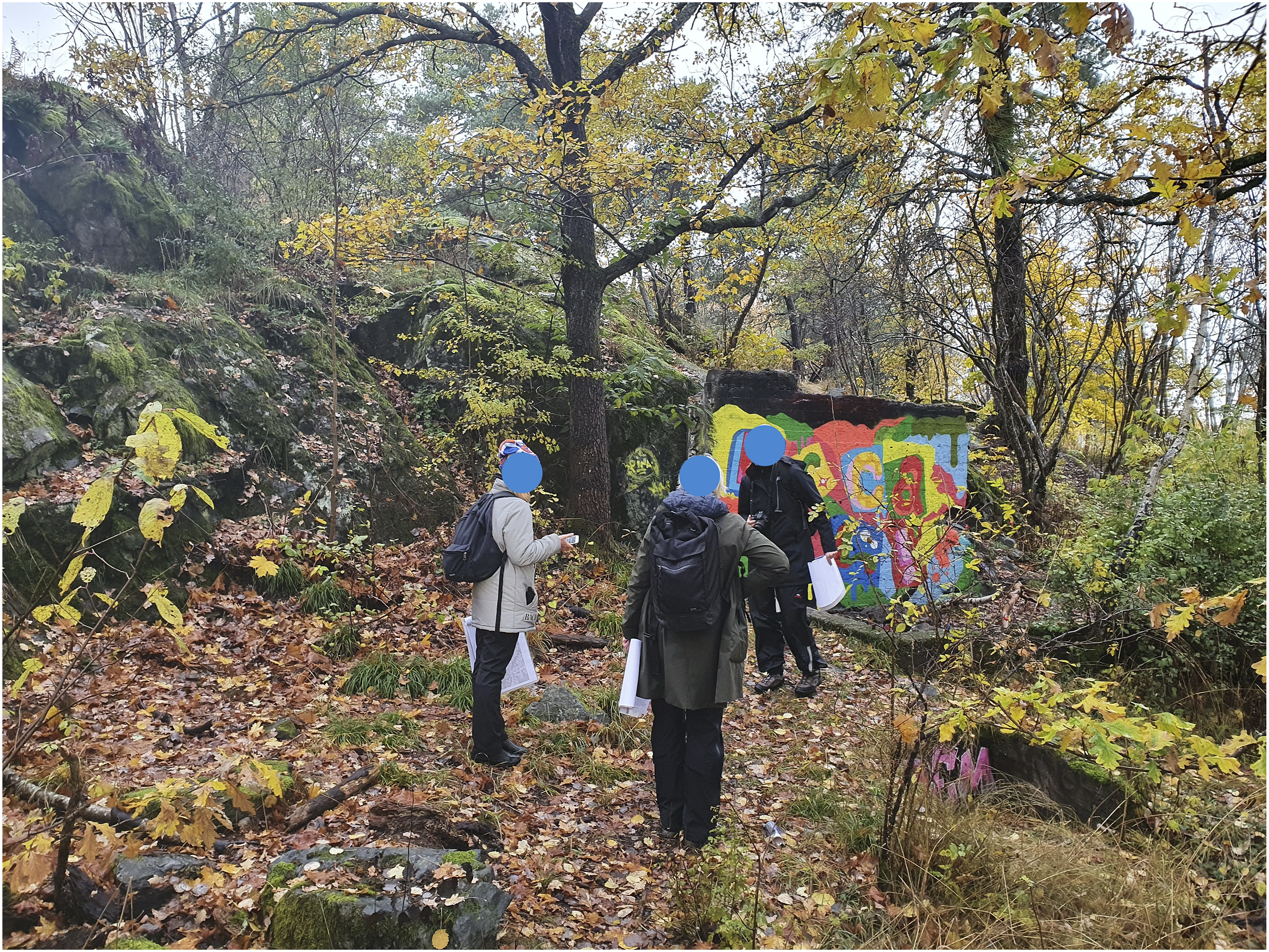
You, too, V., expressed ambivalent feelings after the field trip (V.’s letter, 2020-10-30). On the way back, I felt thoroughly inspired, but I also had a tingling feeling that we had come to a crucial point in the project. There was a lot of talk about that we [us researchers] had to ‘take a stand’, and that the ball was in our court now. I did what I always do when in doubt: I started to read ☺. It may take us until Monday before we get back to you regarding what kind of stand to take. […] It demands some thought.
Not unlike K., you acknowledge that it was helpful to meet in our project site. While K. uses the notion of catharsis, you describe the joint field trip as inspiring. Just like K., you articulate a feeling that decisions need to be taken. Unlike K, however, who feels insecure in the face of the wide and open-ended challenge that we have created for ourselves, you (probably more familiar with the feeling of staying with openness and not-having-the-answers) describe this feeling as “tingling”. What you seem to be uncomfortable with, however, is Studio’s explicit expectation that we are to come up with a solution.
The last act, then, is characterized by the slow emergence of a way forward in the project. You recall the ‘lasagne’? K.’s sketch that illustrated how we at the time assumed we could move forward in our search for socially just green space in the city by using different ‘perception filters’ at different scales (see Figure 3). Sure, the lasagne wasn’t the last word on the subject, but it still marked a turning point in the initial phase in our project: We were now jointly discussing how to move forward together. The “lasagne”, a sketch by K. from Studio, attached to her letter to C. and V. (University) from 12 November 2020. This figure visualises the ideas, jointly developed, about the relation between different “perception filters”, scales and how they could, if superimposed on each other, result in different tactics or actions in and for the urban realm. It marks the turning point from a phase of ‘crisis’ to what we, at the time, perceived of as the beginnings of a ‘resolution’. The figure shows a double page in K.’s professional diary, reminding us that the digital letters we were exchanging were only one way of communicating and thinking, as well as only one of many project-related activities
The end of my letter comes equally abrupt as that of your last one. I hadn’t noticed it has become so late. It’s Friday evening and I am invited at a friend’s house for dinner. Have a nice evening, V.! Do you eat as much tacos as we did on Fridays when the children were small?
Bests, your friend and colleague C.
10 October 2022
Dear C.,
The new week has started, and I’m still in a food coma after an overload of pizza. Could have been Tacos—they are still very much en vogue and popular with the kids.
It’s insightful how you re-tell the story of our project. Much of what you’re writing echoes with what I’ve read in the literature on correspondence. However, I haven’t (yet) encountered anything on the role of letters as process catalysts. Explicitly describing correspondence as having this role in more complex, inter- or even transdisciplinary projects seems to be novel! Cool! I’ve found, however, a lot about correspondence as a pedagogical tool (e.g. Prendergast, 2001; Samaras & Sell, 2013; White et al., 2007). Not all of this has a direct bearing for our questions. Much more relevant, it would seem to me, is what has been written in the literature on correspondence as a tool for data collection and as a method of analysis or reflection.
Role 2: Correspondence as a Tool for Data Collection
Some 25 years ago, correspondence started to be discussed more intensely as a method for the collection of data in qualitative inquiry (Harris, 2002; Kralik et al., 2000; Letherby & Zdrodowski, 1995). As late as 2009, Pauliina Rautio (2009, p. 16) could make the then still original methodological claim that “correspondence is a valid and distinct method in researching subjectively experienced phenomena unfolding in time”. Since then, an increasing number of studies have used and explored letters or correspondence in different ways as a method for the collection of data (e.g. Charlton, 2024; Erasmus, 2021; Flemming, 2020; Pithouse-Morgan et al., 2012; Stamper, 2020).
So, while we did gather data through correspondence in our study just as the methodological literature is suggesting, one thing distinguishes our project from many other studies: We had not planned from the outset to use correspondence as a form of data collection. Hence, we didn’t wittingly shape the rules of our epistolary (fancy word, eh?) communication, i.e. who would write when, how often, what, how, and to whom. Instead, we made our ‘research design’ up as we wrote along (as is not unusual for design-driven research, is it?). Its rules emerged incrementally, informally and playfully. But what were the ‘rules’ of our correspondence?
First, we did not follow what Stamper (2020, p. 182) calls a “one-off’ approach”. This would imply that the researcher elicits one letter only from study participants. Rather, we upheld what the author refers to as an “on-going correspondence” (ibid.). Compared with other research projects, in which correspondence takes place for the duration of several months up until one year, the timespan during which we were exchanging letters between academia and practice was brief (some six weeks), but intense (see Table 1).
Second, it is important to recall that our letters were addressed to and read by all five members of the project’s core group. When reading the methodological literature on letter writing, I get the sense that this is rather unusual. The default setup of most corresponding methods seems to be that one individual researcher exchanges letters with individual study participants (with the usual exceptions, of course, e.g. Rautio, 2009).
This leads me to a third, related point. Not only were our letters meant to be read by everyone—some of the letters were even written collectively. While it is true that K. has sent, signed and written most of the letters we received from Studio, the Studio-people told us that they often had met to discuss what to write in their letters. We wrote most of our letters individually (since we deemed it important to keep our separate voices). However, at crucial points of the project, even we met beforehand to think through together what to write (C. & V’s letter, 2020-11-13).
A fourth characteristic is the “invisibility” (Rautio, 2009, p. 21) inherent in all letter writing. In many studies that use letters, the researcher and the participants who correspond do not ever meet in person. Rautio, however, observes that “[d]ifferent research setups produce different extents and variations of invisibility suitable for different purposes (Rautio, 2009, p. 22). Indeed, K., L., M. and we did meet face to face, during the project’s core phase often via Zoom or Teams, but also in real life. Despite this, Rautio (ibid.) is right when she states that the medium of the letter implies some final invisibility: [T]here is still a considerable degree of invisibility present due to the nature of correspondence: Everyone is alone when writing and when reading. Because of this final invisibility the writer has no way of knowing or controlling when and where or in what mood or circumstances the recipients will read his or her words. […] Because of invisibility, the resulting data are carefully constructed.
Indeed, the invisibility and the time lag made it possible to reflect on and re- think how to phrase observations and insights or how to describe emotions. However, our letters were still informal enough that we dared to test ideas and articulate arguments we had only half thought through. In retrospect, I’d say it was the unpolished and unfinished character of the writing that invited the others to pick up and develop thoughts further in their respective replies, contributing thus to a joint understanding.
Role 3: Correspondence as a Method to Co-create Understanding
That letters facilitate reflection and enable understanding is a point the literature emphasises. I’ve come across one text that discusses this aspect in some depth. Linda Nyholm et al. (2018) have used correspondence as a tool to gain deeper understanding of a phenomenon, in their case the world of caring. Basing their methodology on Hans-Georg Gadamer’s hermeneutics, they describe understanding as “an expansion of the horizon, or as an opening of a new world” ( Nyholm et al., 2018 , p. 161). Understanding is reached when the “merging of the horizons” (ibid.) of the involved letter writers has taken place, i.e. when through the back and forth of letters a joint understanding of the phenomenon has been built. What I find crucial is that correspondence is an iterative process during which the “participants co-create together around the thing that is explored” (ibid.). What is co-created is an understanding of the subject matter. I think that our correspondence exemplifies quite well such a process towards a common understanding.
From the literature on letter writing and correspondence, it becomes clear that there are, to put it in a Kantian way, certain conditions for the possibility of hermeneutic co-creation. To make these moments of knowledge co-production possible, the involved letter writers need a certain mind-set, a mental disposition. This is quite beautifully described in another text (
Rhoades & Daiello, 2019
, p. 73):
Taking the time to attend to another person’s way of engaging with the worlds, to witness and linger with the intricate ways in which another makes sense of the world, is to cultivate an “ethos of openness” and “presumptive generosity” (McCormack, 2008, p. 8).
The merging of the horizons, the co-creation of knowledge, requires curiosity and an openness of the mind, as well as an attitude of intellectual generosity and a care-full respect for the involved correspondents. This definitely resonates with our correspondence with Studio, wouldn’t you say?
Yours, V.
3 March 2023
Dear V.,
I think you’re up to something important. Especially with your last point. I could so clearly see that with K. and you! You were both genuinely curious about the other’s perspectives and insights, you wanted to understand how you respectively thought, reasoned and worked. The letters were the perfect medium for this: the time one needs to invest in sustained correspondence served as the assurance of mutual interest, and the invisibility and distance allowed for some deep thinking to happen. So, when thinking back on and analysing our correspondence, I’d say we can confirm the results that Nyholm and colleagues (2018) have offered. But I think there are further reasons why the letters advanced joint insights in our project—reasons that are more specific to landscape architecture on the one hand, and to the transdisciplinary dimension of our university-industry collaboration on the other.
Role 4: Correspondence as Common Ground/The Great Equalizer
One reason the letters worked well in our collaboration is because they showed similarities with the way practitioners work within the landscape architecture industry, where work seems to be undertaken in a rather intuitive and iterative way, while still involving a high level of design expertise. (With ‘design’ understood here as both the noun and the verb.) Design work involves, as you know, the whole process from approaching a landscape to understand it to the end of a process, which often implies a speculative transformation of it through studio work (Armstrong, 1999; Oles & Horrigan, 2022). This is the way I used to work (as you know, I spent my first 15 years of practice ‘out there’ and came late into academia), the way I teach, and to some extent even the way I start to write papers. I’m pretty sure K. and L. are working like that in their studio practice. That a similarly ad-hoc method turned out to be crucial was thus maybe more surprising for you, V., who is used to carefully selecting research methods before starting a project. My way of approaching any task, also within research, is somewhat more iterative, exploratory and starting from my individual preunderstanding of the problem. Another similarity between our correspondence and the working methods of landscape architecture practitioners is that the letters were read, and some even written, by several people. This corresponds well with the collaborative way in which practitioners sketch and develop ideas in professional practice.
The other reason why the letters worked so well in our academy-industry collaboration is that it is such a low-stakes approach. Everyone intuitively knows how to write letters—or at least “some understanding of letter writing may […] appear instinctive” (Barton & Hall, 2000, p. 8). Being an academic is no advantage when it comes to letter writing. The medium of the letter levelled the playing field, as it were. It ensured that we could meet at eye level. I think the fact that both parties, i.e. us academics and the Studio practitioners, sent six letters each, and that each side wrote approximately the same number of words in these six letters (see Tab. 1), testifies to the fact that both parties were on equal footing.
Role 5: Correspondence as a Medium to get to Know Each Other and Oneself
There’s still much I’d like to take up, V., but I’m running out of time. So, allow me a rather abrupt switch of topic. I’ve been wondering about one aspect that Nyholm and colleagues (I’ve now read their paper) emphasise—namely that the goal of “hermeneutic letter writing is not to get to know the other letterwriter(s)”, “but rather to allow the subject matter to emerge with various aspects in its own right” (Nyholm et al., 2018, p. 161). I find that strange and wonder: Why couldn’t it be both? Reflecting on our letters, I’d say that correspondence can be simultaneously about the subject matter and about getting to know the other letter writers. Other studies on correspondence have come to the same conclusion—I recall that beautiful quote by Rhoades and Daiello (2019) that you mentioned in an earlier letter (cf. Flemming, 2020).
However, I’d even go one step further and argue that corresponding can also be about getting to know oneself! Reflecting on the correspondence in our project, I was reminded of the work I did in my doctoral project. Did you know that my thesis (Wingren, 2009) was written as a diary on my landscape architectural artistic practice? Even if the medium of the diary differs from corresponding in that there is no other with whom to exchange thoughts, I see similarities in the intensity of self-reflection in both forms of writing, very much connected to the research field of autoethnography (e.g. Adams et al., 2015). I’m thinking here for example of what you write in your first letter to Studio, V., in which you, by way of an introduction of yourself to K., L. and M., reflect on your career paths, intellectual life, and sense of (professional) self: I am really a pure theoretician. Yes, I did study landscape architecture, but my practical experience of professional life as a consultant or civil servant in a municipality is limited to a total of 26 weeks of internship while being a student. I realised fairly quickly that I enjoy reading, thinking, and writing a lot, being able to have the time to think things through thoroughly. However, I sometimes wonder whether my research is moving too far away from our field’s core, and how it is relevant in practice. […] It’s virtually an existential question: it puts me into question as a researcher. (V.’s letter, 2020-10-05).
When I was working on my thesis, I adopted a kind of autoethnographic approach and framed my method by using Bakhtin (1990) to discuss the inherent problematic of subjectivity with this method.
Now I feel I have gone astray a bit because, V., I think we should really get this paper finished. We’ve been at it for a long time already and come a long way. It’s about time we got our thoughts out there. What do you say?
Your pragmatic friend,
C.
9 March 2023
Dear C.,
It is incredibly genial to have a pragmatic friend! I can so easily get lost in theory and, indeed, did get a bit lost in thinking about your last letter. So, while I agree with you that we should stop writing letters and start transforming them into a publication proper, I hope you’ll allow me one last digression. You’re right, of course, when you suggest that corresponding can lead to insights about a (research) topic as much as to insights about the other letter writer and oneself. However, I had to think a lot about self-reflexivity in autoethnography (i.e. your diary) compared to “the collective reflection” (as L. put it during our meeting in January, see Figure 1) in our letters.
I would argue that it is the dialogical nature of correspondence that (potentially, at least) opens for a far, or rather: deep-reaching self-reflection, including a reflection of one’s positionality. It is very hard, if not impossible, to fully grasp one’s own positionality by oneself (see e.g. Savolainen et al., 2023; Takacs, 2002). David Takacs’ (2002) solution to this problem is to learn to listen to others. He argues that to get a more truthful understanding of the world, including one’s own perspective of and on it, we have to listen to as many people as possible, piecing together as many perspectives as possible. The point that I’m trying to make here is that since one individual (researcher) cannot look upon herself from outside herself (see the problem of subjectivity, Bakhtin, 1990; Vicenzotti, 2025), corresponding with others is one way to learn about one’s positionality. And indeed, the dialogical nature of correspondence meant we were doing “duoethnography” (Kinnear & Ruggunan, 2019; Sawyer & Norris, 2013), “collaborative autoethnography” (Chang et al., 2016; Guyotte & Sochacka, 2016) or “collective autoethnography” (Karalis Noel et al., 2023). We would need to discuss further, and at some length, C., how the autoethnographic approach you employed in your doctoral project relates to the duoethnographic stance in our correspondence vis-à-vis questions of subjectivity and positionality. But I’ll reign myself in here, be pragmatic, and leave this to be explored at some point in the future.
It seems much ‘safer’ to state that correspondence can be one great way to learn about oneself and one’s positionality. When thinking back to our project, however, I don’t want to suggest that we’ve actually come that far. At most, we’ve reached some embryonic pre-stage of starting to sense some aspects of our positionality… I’m thinking here again of the insights both K. and I’ve gained, how useful and appreciated our respective ideas were for the other. I’m also thinking of what K. and L. took away from the collaboration (
Fredriksson & Andersson Teleman, 2025
). I think the possibility for these insights emerged since our letters revealed both our intellectual perspectives on research, social justice, and the urban commons, as well as more personal reflections, for example this one by K.:
The ensuing discussions […] after the concept-cartographic field trip with the researchers have focused on whether the concept of social justice can sound a bit presumptuous. We should be humble in the face of what we can actually do, and our entire approach should be about sowing small seeds for others to develop further. (K.’s letter, 2020-10-30, 14:30).
This intertwining of the personal with larger theoretical concerns has been conceptualized with the term autotheory. Lauren Fournier (2021, p. 7) describes “autotheory” as a concept that “emerged in the early part of the twenty-first century to describe works of literature, writing, and criticism that integrate autobiography with theory and philosophy in ways that are direct and self-aware”. While the tenet of an earlier wave of feminism was that “the personal is political”, this has now turned into the conviction that “the personal is also theoretical: the personal is part of theory’s material” (Nancy K. Miller, cited in Fournier, 2021, p. 12). Desirée Henderson (2022, p. 4) has given a useful explanation of what this may mean, suggesting that “the autobiographical is necessary to deepen or complicate an engagement with theory, or vice versa”. I think we can say that autotheory has been the (unwitting?) theoretical frame for our analysis of our correspondence. By looking at what we’d written in our letters, we could understand the theoretical and methodological literature on correspondence, subjectivity and positionality on a deeper level—just as we (hopefully!) have contributed to methodological development by reporting on the different roles correspondence has had in our university-industry collaboration.
Now I feel (almost) as if I can let our correspondence go, and get ready for the next step, the nitty-gritty work of working on the article.
Yours,
V.
Conclusion
Performing what we talk about, the correspondence featured above mimics the dynamics of knowledge production in letter writing and discusses methodological aspects of our university-industry collaboration in general, focusing in particular on identifying five partly overlapping roles that correspondence has played in our project. (1) Process catalyst, (2) Tool for data collection, (3) Method to co-create understanding, (4) Common ground, or ‘the great equalizer’, (5) Medium to get to know each other and oneself.
The roles’ order roughly follows a gradient from instrumental and pragmatic to less instrumental and enabling transformative learning of the project members. The list is not comprehensive; it reflects, however, the dual aim of this paper:
Our first aim was to introduce letter writing and correspondence to fields in which this method is not yet widely known or used. Scholars in these fields (such as our home discipline landscape architecture) may be interested to learn that letters could, in certain cases, be a method to gather empirical data (role 2), and as such are an alternative to, for example, interviews. While working on the paper, we became acutely aware of the fact that letter writing and corresponding have been the subject of advanced methodological discussions. In the light of this insight, we’ve come to understand our role (and the contribution of this paper to ongoing methodological discussions) as being that of knowledge brokers, with knowledge flowing from methodologically savvy fields to disciplines such as landscape architecture. Furthermore, we have contributed to nuancing and enriching discussions in health sciences such as the one by Nyholm et al. (2018). In pursuing our second aim, however, we hope that our study has contributed to the methodological literature in disciplines that have been using and studying correspondence more thoroughly by identifying and describing instances in which it can be effectively used in contexts and for purposes far less thoroughly researched. We are thinking here of describing correspondence as a process catalyst (role 1), as providing common ground/the great equalizer (role 4), and as a medium to get to know project partners and oneself (role 5). These roles may be useful for fostering collaboration in research projects with complex (multi-, inter- or transdisciplinary) constellations and demanding dynamics.
In describing these roles, our paper should not be misunderstood as claiming to provide an evidence-based methodological guide. Critique that centres transferability of our results misses the point of this paper. We merely hope our study may inspire scholars to use letters or correspondence in fields that have previously not used them, or to try and test them in new contexts and with new purposes. In this context, it may be worth to recall that letters can be used to complement other, more tried-and-tested methods (e.g. focus groups, interviews, or workshops).
From our (limited) experience, we can say that it is a rewarding method. However, some points are likely to limit its applicability, the most important of which is that it is time-intensive. Not only does it take time to write letters, especially when you’re corresponding with someone for a long time. What’s more, for correspondence to unfold its full potential, it is likely that it needs to be upheld for a more extended period. Another point to consider before relying on correspondence as a research method is that it requires an open, curious, respectful and caring disposition. We experienced corresponding as blurring the boundaries between learning about the object of our study and about ourselves. The medium invites reflection of the world and the letter writer in it. This, together with the fact that letter writing is a skill that researchers from different fields as well as practitioners from the industry (or even ‘lay’ people) can possess in equal measure, makes it ideal for collaborations in which all involved correspondents are open for transformative joint learning.
Footnotes
Acknowledgements
Our heartfelt gratitude goes to Topia landskapsarkitekter, above all Katja, Linus, and Malin, but also the other partners and employees involved in the project at some point, for their letters, thoughts, time, energy, and for believing enough in the collaborative project to invest money in it. We would also like to thank Movium partnerskap, SLU for funding the project. A further thank goes to the members of the Design Theory Group at our Department for their constructive and encouraging comments on earlier versions of the paper. Crucial for the project and our turn to write a methodological paper have further been Swedish cartoonist and satirist Sara Granér, who held a cartoon-drawing workshop in our project, as well as the participants at a workshop dedicated to exploring correspondence as a research tool in landscape architecture that we’ve organised with Topia at the ECLAS conference in Brno in September 2023. Thank you for your interest in our ideas.

Funding
The authors disclosed receipt of the following financial support for the research, authorship, and/or publication of this article: This work was supported by the Movium partnerskap [grant number 222 20].
Declaration of Conflicting Interests
The authors declared no potential conflicts of interest with respect to the research, authorship, and/or publication of this article.