




Abstract
Phenomenology remains a central yet often misunderstood approach in qualitative inquiry, valued for its ability to reveal the meanings of lived experience. Despite its influence, researchers continue to face uncertainty in applying phenomenological principles consistently. Two areas frequently present challenges: determining when to adopt descriptive or interpretive phenomenology, and understanding how to operationalise bracketing within empirical descriptive phenomenological research. Furthermore, this paper offers a critical discussion addressing these concerns. It introduces a reflexive decision-making process to guide methodological choice, linking the selection of descriptive or interpretive phenomenology to the researcher’s prior knowledge and the existing body of phenomenological evidence. Bracketing is clarified as an iterative and reflexive practice, distinct from but related to reduction, and is described as a disciplined attitude that can be sustained throughout a study. Together, these contributions offer practical and accessible frameworks that enhance clarity, coherence, and reflexivity in phenomenological research. They also support more transparent methodological reporting and strengthen the credibility and pedagogical value of phenomenology across disciplines.
Keywords
Introduction
Phenomenology is a central philosophy and methodology of qualitative inquiry, particularly in health, psychology, and education. Its appeal lies in its capacity to explore lived experiences and to reveal their meanings (Giorgi, 2014; Sundler et al., 2019). Despite this appeal, phenomenology remains one of the most debated and inconsistently applied methodologies due to its evolving nature, making it complex for many researchers (van Manen, 2017). Researchers frequently encounter uncertainty when attempting to apply phenomenological principles in empirical studies, which has led to widespread inconsistency and sustained criticism (Al-Sheikh Hassan, 2023; Paley, 2016; Zahavi, 2021). The challenging aspect of learning and using phenomenology as a philosophy-based methodology has been ongoing for decades across fields (Quay, 2016).
Two methodological challenges have been especially persistent. The first is the selection between descriptive and interpretive phenomenology. Although many texts distinguish Husserl’s descriptive approach from Heidegger’s interpretive approach, few offer explicit guidance on how researchers should decide between them in relation to their own study (Matua & Van Der Wal, 2015; Reiners, 2012; Watson, 2024). The second challenge is the concept of bracketing, central to Husserl’s descriptive phenomenology but widely criticised as ambiguous or impractical (Beck, 2013; Finlay, 2011; Zahavi, 2021). Bracketing is often presented in abstract philosophical terms, leaving researchers uncertain about its practical application in phenomenological research (Bytautas, 2025; Thomas & Sohn, 2023). As a result, phenomenological studies frequently lack transparency in their methodological positioning, which undermines credibility and rigour (Al-Sheikh Hassan, 2023; Dowling, 2007).
This paper addresses these two areas of difficulty. It introduces a decision-making process to guide researchers in selecting between descriptive and interpretive phenomenology, based on their prior knowledge and experience of the phenomenon under study. It also offers a simplified and accessible account of bracketing to support its practical application in descriptive phenomenology. Consequently, these contributions provide methodological clarity and practical tools that can enhance the rigour and transparency of phenomenological research. Nevertheless, these contributions are designed to be flexible and reflexive in terms of use, where researchers are required to engage in ongoing and reflexive revising of methodological decisions throughout their studies to ensure the guiding nature of these frameworks, rather than being totally prescriptive.
Phenomenology and its Traditions
Phenomenology is simultaneously a philosophy, and a research methodology concerned with exploring lived experience. It seeks to reveal how phenomena present themselves to consciousness and to describe the structures of meaning that constitute experience (van Manen, 2023; Zahavi, 2018). Unlike other qualitative approaches, phenomenology is inseparable from its philosophical foundations, which continue to influence how it is interpreted and applied in empirical research (Dowling & Cooney, 2012; Sinfield et al., 2023). Husserl (1925/1977) connected phenomenology to the human sciences, offering guidance on how phenomenology could inform empirical disciplines such as psychology, health, and education.
The historical development of phenomenology is often described as a 'movement' (Spiegelberg, 1994), shaped by successive generations of philosophers. Nevertheless, most contemporary phenomenological research draws primarily on two traditions: Husserl’s descriptive phenomenology and Heidegger’s interpretive (hermeneutic) phenomenology (Al-Sheikh Hassan, 2023; Reiners, 2012). These traditions mark a significant division in phenomenological thought that continues to frame methodological debates.
Husserl, regarded as the founder of phenomenology, laid the foundation for phenomenology as a descriptive science of consciousness, established its methodological orientation before the later introduction of epoché and reduction (Husserl, 1900–1901/2001). He advocated returning 'to the things themselves or to go from words and opinions back to the things themselves, to consult them in their self-givenness and to set aside all prejudices alien to them', in which this occurs by describing the essences of experience as they appear to consciousness (Husserl, 1913/1983, p. 35). His approach is characterised by concepts such as intentionality, essences, and phenomenological reduction, with bracketing (epoché) as a central process to set aside preconceptions and allow phenomena to be described in their pure form (Cudjoe, 2023; Giorgi, 2009). Husserl’s phenomenology is epistemological in orientation, seeking reliable knowledge about lived experience through description (Zahavi, 2021).
Heidegger, a student of Husserl, rejected the possibility of presupposition-free description, arguing that all understanding is interpretive. His hermeneutic phenomenology shifted the focus from epistemology to ontology by asking what it means 'to be' in the world. He sates: 'The question of being attains true concreteness only when carry out the destruction of the ontological tradition. By so doing we can prove the inescapability of the question of the meaning of being and thus demonstrate what it means to talk about ‘retrieval’ of this question.' (Heidegger 1927/2010, p. 25)
Heidegger’s ontological concern with being contrasts Husserl’s epistemological focus on knowing. Therefore, Heidegger described human beings as always already embedded in cultural, historical, and linguistic contexts, making interpretation an inevitable and necessary part of phenomenological inquiry (Horrigan-Kelly et al., 2016; Suddick et al., 2020). This ontological shift laid the foundation for interpretive phenomenology as a distinct methodological tradition, providing phenomenological researchers with a unique understanding of notions introduced by Husserl, including the structure of the human being and the meanings of experiences (Johnson, 2000).
Subsequent thinkers elaborated and diversified phenomenology further. Merleau-Ponty highlighted the primacy of perception and embodiment (Merleau-Ponty, 1945/2013). Gadamer extended hermeneutics into a philosophical method of understanding shaped by dialogue and tradition (Gadamer, 1960/2013). Van Manen combined descriptive and interpretive insights in a practical methodology for studying lived experience (van Manen, 1990, 2023). More recently, scholars in psychology and nursing have debated how these traditions can be faithfully translated into applied research (Finlay, 2014; Munhall, 2013; Smith et al., 2009). Despite this diversity, the distinction between descriptive and interpretive phenomenology remains central, shaping both philosophical debates and the practical decisions researchers must make when designing phenomenological studies.
Descriptive and Interpretive Phenomenology
Applied researchers often encounter difficulty in distinguishing between descriptive and interpretive phenomenology. Both traditions share an interest in lived experience, yet their philosophical assumptions and methodological implications diverge in important ways (McConnell-Henry et al., 2009; Reiners, 2012). Differentiating between these traditions requires clear recognition of their differences and an understanding of their philosophical underpinnings. Researchers should also remain aware that these differences do not make one approach inherently superior to the other (Munhall, 2013). The distinctions are most clearly articulated in terms of ontology, epistemology, and the role of the researcher.
Descriptive phenomenology, following Husserl, is grounded in an epistemological basis, seeking knowledge of lived experience by returning to the phenomenon itself (Giorgi, 2009; Husserl, 1983). Husserl first systematically articulated the concepts of epoché and phenomenological reduction, framing bracketing as a methodological attitude that suspends presuppositions to attend to lived experience as it appears to consciousness (Husserl, 1983). The underlying assumption is that essences of experience can be revealed through careful description while the researcher brackets prior assumptions. Husserl (1931/1960) expanded on the methodological significance of reduction, emphasising the move from the natural attitude to the transcendental stance as essential for accessing the structures of experience. Initially, Husserl (1910-1911/2006) states the natural attitude as ‘…we all live and from which we thus start when we bring about the philosophical transformation of our viewpoint. We do this by describing in a general fashion what this attitude finds before itself pre-given things.’ (p. 2). Consequently, knowledge is accessed through description of phenomena as they appear to consciousness, uncontaminated by presuppositions (Finlay, 2011; Giorgi, 2009).
In contrast, Heidegger’s interpretive phenomenology is ontological in orientation. It asks not only what is experienced, but what it means 'to be' in the world (Heidegger, 2010). Here, lived experience is always situated within cultural, historical, and linguistic contexts that shape meaning. Interpretive phenomenology is therefore concerned with describing, understanding, and interpreting meanings of lived experience (Horrigan-Kelly et al., 2016), through an iterative movement around the phenomenon that integrates the context, participants, and the researcher (Benner, 1994). This process can correct or modify preconceptions by generating new understandings of meaning (Matua & Van Der Wal, 2015; Munhall, 2013). Pre-understandings are thus not set aside but actively engaged. The hermeneutic circle describes this process, in which interpretation moves between parts and whole, continually revising understanding in light of fore-structures of knowledge (Suddick et al., 2020). Knowledge is thereby co-constituted through dialogue between researcher, participants, and context.
The position of the researcher further illustrates this divergence. In descriptive phenomenology, the researcher seeks to minimise their influence by bracketing preconceptions and attending closely to participants’ accounts (Beck, 2013; Giorgi, 2009). The goal is to produce a faithful description of the essence of the experience as lived by participants. In interpretive phenomenology, the researcher is an active co-interpreter. Their background, experience, and prior understanding are not treated as biases to eliminate but as resources for interpretation (Suddick et al., 2020). Findings emerge from a fusion of horizons between the researcher’s and participants’ worlds (Frechette et al., 2020). Benner (1994, p. 99) illustrates the nature of interpretive phenomenology: 'The interpreter moves back and forth between the foreground and background, between situations and between the practical worlds of participants.'
Both traditions have been widely applied in health and social science research. Descriptive phenomenology is often employed when the aim is to capture the essence of experiences about which little is known, or to inform the development of practice interventions (Sundler et al., 2019). Interpretive phenomenology is more often chosen when the focus is on understanding meanings in depth, particularly in relation to cultural, professional, or existential contexts (Matua & Van Der Wal, 2015; Smith et al., 2009). Importantly, neither approach is inherently superior; rather, the choice depends on the research question, aim(s), and the researcher’s relationship to the phenomenon. Nevertheless, the boundary between descriptive and interpretive phenomenology is frequently blurred in practice. Studies often cite both traditions without clearly justifying their choice, which undermines methodological coherence and contributes to inconsistency (McConnell-Henry et al., 2009; Reiners, 2012; Shorey & Ng, 2022). This methodological uncertainty highlights two persistent challenges: first, how researchers can systematically decide between descriptive and interpretive phenomenology, and second, how bracketing can be understood and operationalised. These are the issues to which this paper now turns.
A Decision-Making Process for Selecting Descriptive or Interpretive Phenomenology
A persistent challenge in phenomenological research concerns how researchers decide between descriptive and interpretive traditions. While the philosophical differences between Husserl and Heidegger are well established (Giorgi, 2007; McConnell-Henry et al., 2009; Patton, 2020; Watson, 2024; Wojnar & Swanson; 2007), little guidance has been offered on how these differences should inform methodological decisions in empirical work. As a result, some studies cite both traditions without a clear rationale, creating ambiguity in design, analysis, and reporting (Reiners, 2012; Shorey & Ng, 2022). This lack of clarity, and the difficulty of applying philosophical notions in practice, has been identified as a barrier to rigour and credibility in phenomenological studies (Crowther & Thomson, 2020).
The issue of methodological choice is more than theoretical. It shapes the formulation of research questions, the role of the researcher, and the strategies of data analysis (Giorgi, 2009; Smith et al., 2009; van Manen, 2017). Without a transparent rationale, inconsistencies can arise; for example, claiming adherence to Husserl while employing interpretive analysis (Shorey & Ng, 2022). Such inconsistencies undermine methodological coherence and contribute to scepticism about phenomenology’s robustness as a research approach (Al-Sheikh Hassan, 2023).
This paper proposes a decision-making process that links methodological choice to two considerations: the researcher’s prior knowledge and experience of the phenomenon, and the extent to which the phenomenon has been addressed in existing phenomenological research within the same or similar contexts. However, the paper does not aim to comprehensively revisit the long-standing philosophical debates surrounding descriptive and interpretive phenomenology. Instead, it offers a flexible, iterative, and reflexive framework that researchers can use to justify their methodological choices in phenomenology.
The decision-making process can be summarised in four steps (Figure 1): Decision-Making Process for Selecting Descriptive or Interpretive Phenomenology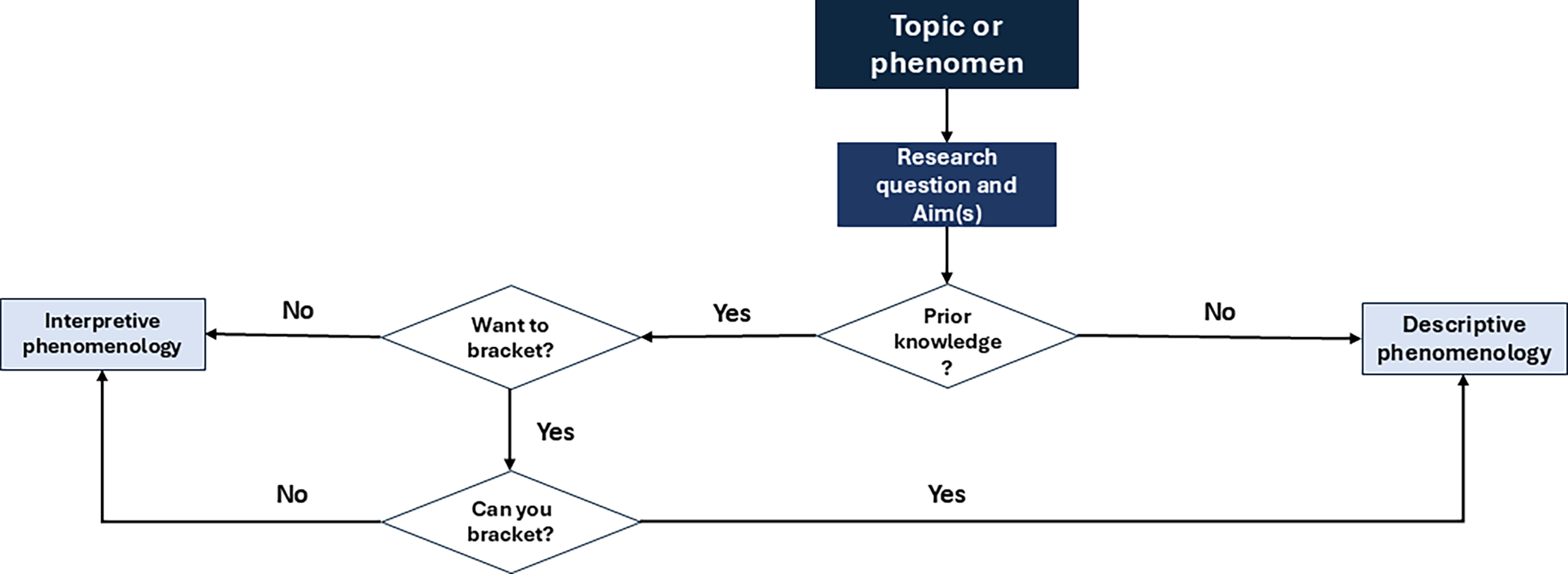
Step 1: Identify the Phenomenon and Clarify the Research Aim
The first step is to clarify what the study seeks to uncover. Descriptive phenomenology is most appropriate when the research aim is to capture the essences of lived experience and the structures of a phenomenon as it appears to consciousness (Giorgi, 2009; Husserl, 1983). This is particularly useful when the topic is underexplored or novel, and where establishing foundational description is the priority (Sundler et al., 2019). In contrast, interpretive phenomenology is oriented towards contextual meaning and existence, addressing questions about how experiences are understood within cultural, professional, or historical contexts (Heidegger, 2010; Smith et al., 2009). Careful formulation of the research aim is critical, since mismatches between aim and method are a recurring source of incoherence in phenomenological studies (Reiners, 2012).
Step 2: Evaluate Prior Knowledge and Experience
Researchers should then reflect on their positioning in relation to the phenomenon. This includes whether they approach the topic as outsiders with minimal familiarity or as insiders with substantial professional or experiential knowledge. In descriptive phenomenology, limited prior knowledge aligns with Husserl’s call for openness, as bracketing becomes more feasible (Ataro, 2020; Lopez & Willis, 2004; Willis et al., 2016). In interpretive phenomenology, by contrast, extensive prior knowledge is not seen as a threat but as a resource that can deepen interpretation (Heidegger, 2010; Munhall, 2013). Prior knowledge may also include engagement with existing literature. Some argue that early and extensive literature review risks creating preconceptions that compromise openness in descriptive studies (Dunne, 2011; Finlay, 2011; Fry et al., 2017). Others contend that literature can be drawn upon reflexively to justify and enrich interpretive analysis (Wolcott, 2008). Thus, the researcher’s stance towards both personal experience and literature informs whether a descriptive or interpretive approach is most coherent.
Step 3: Assess the State of Existing Phenomenological Evidence
The third step is to consider the existing body of phenomenological research. Nevertheless, considering this step in the process, it must be acknowledged that qualitative research is context-bound, and each study produces unique insights irrespective of how frequently a phenomenon has been studied elsewhere (Carminati, 2018; Polit & Beck, 2010). If a phenomenon is under-researched within a particular context, descriptive phenomenology can provide essential starting points (Ataro, 2020; Fry et al., 2017). If a substantial body of work already exists, interpretive phenomenology may be more suitable, since accumulated evidence can be reflexively engaged to situate participants’ accounts within wider debates (Tuffour, 2017; Larkin et al., 2006). Consequently, the state of existing evidence should not be treated as a prescriptive criterion, but rather as a reflexive consideration. Researchers may reasonably ask whether another descriptive study will add significantly to knowledge within the same context, or whether an interpretive approach could extend understanding by embedding participants’ accounts within broader cultural, historical, or professional contexts.
Step 4: Select the Approach
The final step is to align the chosen approach with the preceding considerations. Descriptive phenomenology is recommended when both prior knowledge and available evidence are limited, as it allows the researcher to establish essences without the weight of accumulated assumptions. Interpretive phenomenology is recommended when either prior knowledge is substantial or when a significant body of literature already exists, since both conditions favour interpretive engagement (Horrigan-Kelly et al., 2016; Matua & Van Der Wal, 2015). This decision should be reported explicitly in the methodology of any study, as transparency strengthens rigour and allows readers to evaluate coherence (Tuval-Mashiach, 2017). The choice should also be treated reflexively rather than rigidly; researchers may need to revisit their stance as the study progresses (Dodgson, 2019). For example, in health research, a novice investigating experiences of a newly introduced clinical technology may adopt descriptive phenomenology to capture foundational insights, while the same researcher studying patient care in an already well-researched field such as chronic pain may select interpretive phenomenology to generate richer, more situated interpretations.
This framework is not intended as a rigid algorithm but as a reflexive tool to guide decision-making and enhance transparency in phenomenological research. By explicitly linking methodological choice to both the researcher’s position and the knowledge context of the phenomenon, it provides a defensible rationale that strengthens methodological coherence, enhances the credibility of findings, and contributes to the cumulative development of phenomenological traditions.
Clarifying Bracketing in Descriptive Phenomenology
Bracketing, or epoché, is central to Husserl’s descriptive phenomenology but remains one of its most contested and misunderstood concepts (Morley, 2010). Husserl (1983, p. 61) writers: ‘I exclude all sciences relating to this natural world no matter how firmly they stand there for me, no matter how much I admire them, no matter how little I think of making even the least objection to them; I make absolutely no use of the things posited in them. Nor do I make my own a single one of the propositions belonging to ‘those sciences’, even though it be perfectly evident; none is accepted by me; none gives me foundation.'
This initially conceptualised bracketing, a philosophical stance, as a methodological move suspending presuppositions of the natural attitude. Husserl distinguished between bracketing and reduction: bracketing refers to the suspension of preconceptions, while reduction redirects attention from the object itself to the way it appears in consciousness. In this paper I call it 'reduction action' to showcase the required effort to redirect attention on how objects appear and emphasise its active methodological engagement (Husserl, 1977; Lewis & Staehler, 2010). Nevertheless, in much applied research these terms have been treated as interchangeable (Beck, 2013; Bytautas, 2025), obscuring their distinct roles. In empirical research, bracketing is best understood as a philosophy-based methodological discipline, a conscious and repeated effort to hold assumptions in abeyance to remain open to participants’ accounts (Fischer, 2009; Tufford & Newman, 2012). Reduction, though related, involves the redirection of attention to how phenomena appear in lived experience. The constant return to epoché throughout the research process allows for renewed openness and deeper insights into the phenomenon (Moja-Strasser, 2016).
Critics have questioned whether bracketing is possible at all, arguing that researchers cannot fully free themselves from prior knowledge and pre-understanding (Gadamer, 2013; Heidegger, 2010), and whether it remains pertinent to the non-philosophical application of phenomenology (Zahavi, 2021). Others have highlighted that bracketing is often invoked in empirical studies without sufficient explanation of how it was enacted (Al-Sheikh Hassan, 2023), or that it has been excessively and unnecessarily applied, leading some to suggest alternative approaches (Stilwell & Harman, 2021). Consequently, such challenges have contributed to a perception that descriptive phenomenology is methodologically naïve or impractical, opening the door to unjustified criticism of the approach (Giorgi, 2017; Paley, 2016). However, rather than continuing the long-standing debate over whether bracketing is possible or to what extent it can be achieved, some scholars argue that attention should be directed to the prerequisites that make bracketing meaningful in practice (Emiliussen et al., 2021), while others describe it as a transformative practice through which novice researchers can build methodological discipline and research expertise (Thomas & Sohn, 2023).
Building on this reframing, this paper clarifies bracketing not as a final achievement, but as an ongoing and iterative practice of reflexivity. Therefore, a simplified process of bracketing is presented to support researchers in applying the concept more rigorously in empirical work (Figure 2). The Phenomenological Bracketing Process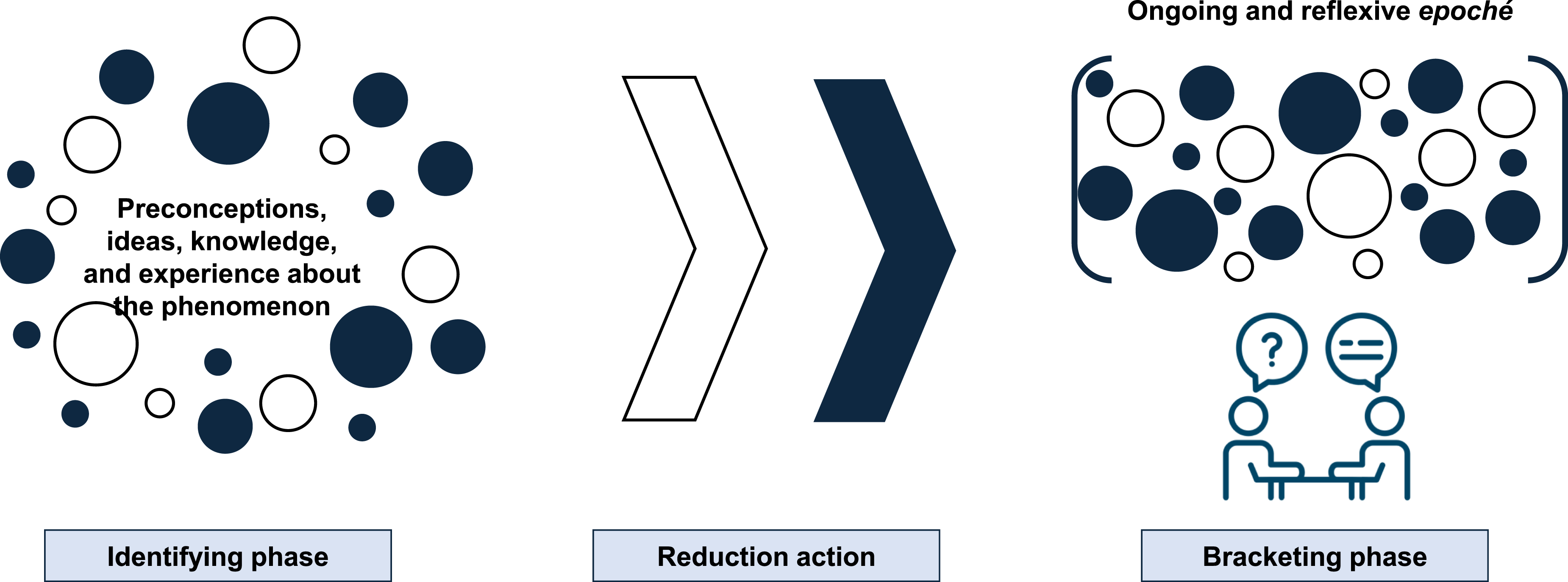
The bracketing process in empirical research can be summarised in four steps:
Step 1: Recognise Assumptions and Perspectives
Researchers begin by explicitly identifying prior assumptions, professional knowledge, theoretical commitments, and personal experiences that may shape their engagement with the phenomenon. Techniques such as reflexive journaling, memoing, and peer debriefing can support this recognition (Fischer, 2009; Tufford & Newman, 2012). By articulating these assumptions at the outset, researchers create the conditions for bracketing to operate as a conscious methodological discipline.
Step 2: Redirect Attention Through the Reduction
The reduction action involves turning from the taken-for-granted world to how the phenomenon appears to consciousness. This redirection of attention is what makes phenomenological description possible (Giorgi, 2010; Husserl, 1983). By shifting focus in this way, researchers open a space in which assumptions can be consciously bracketed.
Step 3: Suspend Assumptions in Bracketing
Bracketing is then enacted as a deliberate effort to hold recognised assumptions in abeyance, so that participants’ accounts can be encountered on their own terms. This discipline is sustained through epoché, understood as an intentional attitude that the researcher adopts and continually revisits throughout data collection and analysis (Finlay, 2008; Husserl, 1983). Maintaining epoché requires ongoing self-monitoring and reflexivity to ensure that prior knowledge, professional experience, or theoretical commitments do not intrude prematurely into the description of lived experience. In this way, bracketing is not a single act but a continuing methodological stance that supports openness to participants’ descriptions.
Step 4: Revisit Assumptions Reflexively at Later Stages
Finally, assumptions are revisited reflexively to evaluate how they may have influenced interpretation and to refine the researcher’s methodological awareness (Finlay, 2014; Thomas & Sohn, 2023). This iterative cycle ensures that bracketing functions not as a one-off achievement but as an ongoing methodological discipline.
To illustrate, consider a researcher investigating the lived experience of chronic pain. Clinical knowledge may lead to preconceptions about what patients ‘should' feel. Bracketing involves recognising these assumptions, suspending them during interviews, and focusing instead on participants’ descriptions of their embodied pain. The reduction action then redirects attention to how pain appears in consciousness, rather than to its medical explanations. By revisiting these assumptions reflexively at later stages, the researcher can critically evaluate how their professional background may have influenced understanding and refine their approach for future studies. Consequently, by emphasising bracketing as an iterative and reflexive stance, and by clarifying its relationship to reduction, this paper contributes a practical and accessible framework that preserves Husserl’s philosophical rigour while addressing concerns about feasibility and application in empirical research.
Implications for Qualitative Researchers
The introduction of a decision-making process for selecting between descriptive and interpretive phenomenology and the clarification of bracketing carry several implications for qualitative researchers. Both contributions respond to recurrent sources of confusion in applied phenomenological research and offer practical strategies to address them.
First, the decision-making process outlined here provides a transparent rationale for methodological choice without oversimplifying phenomenology as a rigorous philosophy. By linking the decision to both the researcher’s prior knowledge and the existing body of phenomenological evidence, the process addresses a gap in the literature where studies often invoke phenomenology without justifying their choice of tradition (Dowling, 2007; Reiners, 2012). The framework presented does not prescribe a single path but encourages reflexive consideration of whether descriptive or interpretive approaches are most coherent. Such transparency enhances the credibility of phenomenological research and allows readers to assess methodological coherence more critically (Tuval-Mashiach, 2017).
Second, by distinguishing between bracketing and reduction, and by framing bracketing as an iterative process of reflexivity, this paper provides researchers with a more workable understanding of one of Husserl’s most contested concepts. Instead of treating bracketing as an absolute suspension of all assumptions, an ideal that has been widely criticised as unachievable (Heidegger, 2010; Zahavi, 2021), researchers are encouraged to view epoché as a constant and disciplined effort that can be revisited throughout the study. This perspective makes bracketing methodologically feasible without abandoning Husserl’s central emphasis on openness to experience. It also emphasises the importance of reflexive practices, such as journaling, memoing, or peer dialogue, as tools to operationalise bracketing in empirical research (Fischer, 2009; Tufford & Newman, 2012; Olmos-Vega et al., 2023).
Third, these contributions have value for novice researchers and postgraduate research students embarking on their research careers. The process of deciding between descriptive and interpretive phenomenology, and the clarification of bracketing as a sustained reflexive stance, provide accessible entry points into what is often seen as a dense and philosophically challenging field. Clearer guidance on methodological choice can reduce the uncertainty associated with navigating complex philosophical debates (Normann, 2017; Saxena, 2017), making phenomenological concepts less daunting for novice researchers (Mitchell, 2021). A practical framework for bracketing also supports the development of reflective research habits that build methodological discipline over time (Thomas & Sohn, 2023).
Finally, these frameworks have implications for teaching phenomenology. Lecturers in qualitative research methods often face the challenge of introducing phenomenology in ways that are both philosophically grounded and practically usable (Adams & van Manen, 2017). Teaching phenomenology to postgraduate research students and established researchers from other disciplines often requires scaffolding to help them understand what constitutes phenomenology and how it can be relevant to their research endeavours (Gallagher & Francesconi, 2012; Quay, 2016). A structured decision-making process for methodological choice and a clarified account of bracketing can serve as pedagogical tools to help students grasp the basics of phenomenology more effectively. In this sense, the contributions made here support practising researchers while also strengthening the teaching and learning of qualitative methods in higher education.
As phenomenology continues to be applied across health, education, and social science disciplines, methodological inconsistencies risk undermining its credibility. Offering a structured process for methodological choice and clarifying bracketing strengthens the foundations on which phenomenological studies are built. In doing so, they help ensure that phenomenology remains philosophically rich, practically rigorous, and accessible for applied research.
Conclusion
Phenomenological research requires clarity in both philosophical understanding and methodological application. This paper highlights two key priorities for researchers. First, the selection of descriptive or interpretive phenomenology should be made through a transparent rationale that considers both the researcher’s prior knowledge and the existing body of phenomenological evidence. Second, bracketing remains essential within descriptive phenomenology and should be approached as an ongoing reflexive practice, revisited throughout the study to sustain openness and achieve deeper insight into lived experience.
Researchers who find it challenging or conceptually inconsistent to engage with bracketing when undertaking descriptive phenomenological research might consider whether an alternative qualitative tradition would better align with their aims and philosophical stance. These priorities emphasise that phenomenology is not only a philosophical tradition but also a methodological discipline that invites careful reflection and transparency. Researchers who justify their methodological choices explicitly and engage with bracketing reflexively strengthen the rigour, transparency, and credibility of phenomenological inquiry. In doing so, they contribute to a more coherent and practically accessible application of phenomenology across disciplines, ensuring its continuing relevance in qualitative research.
Footnotes

Ethical Approval and Informed Consent
Not applicable. This article is a methodological paper and does not report on new empirical research involving human participants.
Funding
The authors received no financial support for the research, authorship, and/or publication of this article.
Declaration of Conflicting Interests
The authors declared no potential conflicts of interest with respect to the research, authorship, and/or publication of this article.
Data Availability Statement
Not applicable. No datasets were generated or analysed for this article.