




Abstract
Composite narratives are derived from a synthesis of research findings and present key themes in a storied format. The story incorporates the researcher’s critical reflections and data interpretation. This method uses individual voices to illustrate themes and experiences while protecting the anonymity of participants. The aim of this paper is to provide a worked example of a composite narrative and explore its utility for presenting qualitative findings at interdisciplinary health research conferences. Conference presentations are crucial to a researcher’s professional development and research dissemination. The short time allotted to such presentations can make it difficult to share the context and richness of qualitative data adequately. A storied approach may offer a more relatable format that effectively engages not only researchers but consumers, practitioners, and policymakers. The composite narrative method provides an engrossing, context-rich, and anonymous method for privileging participant voices including those from marginalised groups. The composite narrative presented in this paper draws from a qualitative descriptive study of chronically ill older people’s social connections. This paper seeks to contribute to the discourse by providing a worked example of the process undertaken to create the conference presentation and outlining key considerations in the formation of a composite narrative, the process of development and the benefits and risks of this approach. We propose that this method humanises research findings and emotionally resonates with interdisciplinary audiences. While composite narratives have been used in manuscript presentation, the application of this method to oral presentation of qualitative findings has not been widely discussed in the health research literature. As such, this paper provides a valuable contribution to the field. Bringing qualitative data to life through a storied approach, particularly in time-limited conference presentations, may increase research impact and dissemination.
Keywords
What is Already Known?
⁃ Health researchers strive to demonstrate the real-world application of their findings to practice. ⁃ Composite narrative is an underutilised method for orally sharing insights from health research. ⁃ Disciplines, including education, sociology, psychology, management, and medical education, have demonstrated the usefulness of composite narratives, which can inform other researchers.
What Does This Paper Contribute to the Wider Global Community?
⁃ Using composite narratives in oral presentations can improve the dissemination of findings among researchers, practitioners, policymakers, and the public. ⁃ This paper outlines considerations in robustly producing a composite narrative for a conference presentation that emotionally resonates with interdisciplinary audiences through humanising research findings. ⁃ Future research is needed to evaluate audience engagement with composite narratives and the corresponding impact when this method is used to orally present qualitative research findings.
Introduction
Health researchers use qualitative methods to investigate the lived experience of patients and carers. They share their findings through conference presentations to create awareness of new knowledge, influence policy, and shape health care practice. The more effective the communication of these findings is, the greater the likelihood of research impact. Constructing conference presentations is a fundamental academic skill and essential to the effective dissemination of research findings (Asadnia & Atai, 2022). However, there is not much science behind how researchers craft engaging presentations, with most learning through trial and error (Freiermuth, 2023). Presenting qualitative findings can be challenging for PhD candidates and early career researchers, as the depth and complexity of findings are not easily communicated within the short timeframe of conference presentations. Time constraints can result in fragmentation of research findings, with researchers presenting parts of their work rather than the whole. This leaves the context and richness of qualitative data potentially lost as themes and sub-themes are superficially discussed. Creative approaches to presenting qualitative findings have been explored in the social sciences for some time (Richardson, 2000) with the use of stories now an accepted data source and representational form (Smith & Sparkes, 2009).
In conference presentations, unlike published papers, the audience receive a large volume of information quickly with limited opportunity to absorb and critically review the information. Using creative techniques to make the data accessible to the audience is key to promoting engagement with the content and uptake of findings (Asadnia & Atai, 2022). Composite narratives provide a novel means of orally delivering qualitative research findings. They aim to coherently summarise and synthesise findings through a story that draws from the words of multiple research participants. Composite narratives have the potential to emotionally resonate with audiences, which can create empathy towards the participant group and foreground voices from marginal groups, such as older people. Another benefit of composite narratives is their ability to engage audience members, such as policymakers, who may not be experts in the research area. A storied approach can make the conference presentation a memorable experience. As storytelling is a common way of sharing information among many cultures, the composite narrative approach may also appeal to diverse audiences, including healthcare consumers and practitioners. A brief explanation of how stories have become an accepted and legitimate part of qualitative research follows to explain where composite narratives fit within broader qualitative research and story-telling approaches.
Traditionally, stories and oral histories have been used across ages and cultures to share information, communicate values, create emotional connections and evoke action. This information can be disseminated in many forms for example, textually, visually, and orally through enactments (Richardson, 2000). Qualitative research that uses narrative analytic methods has an established history in social science fields including sociology, anthropology, philosophy, psychology, and education. In narrative inquiry “stories are used to describe human action” (Polkinghorne, 1995, p. 5). Social science researchers have situated stories within their broader “cultural, social and institutional narratives” (Clandinin & Caine, 2008, p. 542). There are variations in ways of understanding and differing contexts that influence how narrative inquiry is conducted within disciplines (Clandinin & Caine, 2008; Gelman & Basbøll, 2014; Smith & Sparkes, 2009). However, what is common is the focus on understanding peoples’ experiences, eliciting their meaning, and the application of narrative inquiry as a methodology (Clandinin & Caine, 2008). The use of stories in research and narrative inquiry was spurred by the crisis of representation arising in the mid-1980s which arose from criticisms of traditional approaches to qualitative writing (Richardson, 2000). This crisis called into question the ability of researchers to authentically represent the lived experience of research participants, highlighting the distinction between reality and representation (Sandelowski, 2006). Scepticism about the truthfulness or authenticity of researchers’ interpretations of peoples’ stories and the situational limitations of what researchers can know, resulted in greater attention to both reflexivity and representational forms (Richardson, 2000; Sandelowski, 2006). Richardson (2000) advocates for qualitative research, using the example of creative ethnography, to adopt creative analytical and writing practices. When considering validity, the metaphor of the crystal is proposed as a postmodernist contrast to the more traditional or positivist research method of triangulation noting “there are far more than three sides by which to approach the world” (Richardson, 2000, p. 13).
Health research has traditionally been dominated by medical research, with a preference for quantitative approaches that focus on disease and outcomes, rather than patient experience (Morse, 2011). In the 1990s, health researchers demonstrated some reluctance to embrace qualitative approaches (Morse, 2011). While progress has been made narrative inquiry in health research, unlike the social sciences, is relatively new. Narrative inquiry gained traction in health promotion (Riley & Hawe, 2005), clinical education (Bleakley, 2005) and nursing (Wang & Geale, 2015) in the early 2000s. Health researchers adopting the narrative approach generate rich understandings of how patients, carers and health practitioners experience events and the meaning they attribute to these events through a storied telling of these experiences. Through sharing these stories in more creative forms researchers found they could bring their findings to wider audiences, foreground the voices of those who are usually unheard and address misrepresentation (Sandelowski, 2006; Wang & Geale, 2015). Developments in neuroscientific research provide a rationale for presenting research findings through storytelling, that may appeal to the positivist inclination of some health and medical audiences. For example, Grall et al. (2021) conducted a neuroimaging study with 33 university students to assess the impact on their brains from listening to personal narratives and non-narrative messages. The study found that the audience was most engaged by personal narratives, according to the neural processes observed.
Researchers traditionally disseminate qualitative findings in published manuscripts. Qualitative studies that use thematic analysis are usually presented with a summary of key themes explained with narrative text and illustrated with participant quotes. This presentation approach can also be supported by tables linking data to themes and sub-themes as a way of demonstrating analytical rigor (Gioia et al., 2013). Manuscripts provide space for researchers to present the depth of their findings and allow the reader to move back and forth through the work to absorb the detail and thick description. In recent years, composite narratives have been used successfully to present text-based qualitative findings in diverse fields, including the social sciences (Arjomand, 2022; Li, 2023; Willis, 2018), education (Högman et al., 2024; Johnston et al., 2023) and organisational management (Van der Schaft et al., 2024). In the health field, composite narratives have appeared recently in medical education research (Allen et al., 2024; Apramian et al., 2023; McElhinney & Kennedy, 2022), primary care studies (McElhinney & Kennedy, 2021), research relating to first responders (Tetzlaff et al., 2024) and, to a lesser extent, in nursing research (Saleh et al., 2023).
Despite the popularity of this method in social science disciplines (Arjomand, 2022; Li, 2023; Willis, 2018) composite narratives are underutilised by health researchers to communicate qualitative findings in conference presentations. The absence of more creative forms of representing research findings at health and medical conferences may reflect the long disciplinary history of positivist research and doubts about the rigour of qualitative approaches more generally. For example, in the 1990s both Australian and British medical research institutions were reluctant to fund and/or publish studies based on qualitative methods as this form of inquiry was not recognised as rigorous (Merlin et al., 2009; Morse, 2011). While the importance of qualitative methods in health and medical research has grown since this time, higher value continues to be ascribed to systematic reviews and meta-analyses followed by randomised controlled trials (Merlin et al., 2009). Health researchers have adopted creative approaches to analysis and presentation of qualitative narrative data through storytelling (Feo et al., 2024) and arts-based methods (Jay et al., 2021), however, there are few examples of the integration of findings into composite narratives. Health researchers can, therefore, benefit from guidance about the use of composite narratives as the methodological process is not well understood. While significant progress has been made in developing textual composite narratives in social science (Johnston, 2024; Willis, 2019) and medical education research (McElhinney & Kennedy, 2022), this work does not extend to composite narratives in broader health research conference presentations.
The aim of this paper is to provide a worked example of a composite narrative and explore its utility for presenting qualitative findings at interdisciplinary health research conferences. This paper begins with background and context to composite narratives to locate this approach within the broader fields of qualitative research and storytelling. We then outline the development process of a composite narrative drawing on findings from a published qualitative descriptive study of chronically ill older peoples’ social connections (Thompson et al., 2024). We explain our positioning as researchers in the context of the narrative’s construction and conclude by discussing the benefits and risks of this approach, and the opportunities for future research.
Composite Narratives
Composite narratives are derived from a synthesis of key findings and present themes in a storied format (Willis, 2019). Within this paper, the terms composite narrative and story are used interchangeably. Johnston (2024, p. 2) describes composite narratives as “the many bits of data that are put together to compose a story.” The structure of the story can be thematic, episodic, or holistic and the narrative may represent a particular theme or element of the research findings (Johnston et al., 2023). This method uses individual voices to highlight shared experiences while protecting the anonymity of participants. As the story also incorporates the researcher’s reflections and interpretations of the data, reflexivity is a crucial aspect of the method as the researcher’s prior knowledge and exposure to participants’ views will influence analysis (Wertz et al., 2011).
A composite narrative can be used in several ways. For example, it may be used to re-present data or findings that are drawn from narrative analysis (Wertz et al., 2011), or to explain the development of theory (Johnston et al., 2021, 2023). In our example, we constructed the composite narrative to present a concise summary of our overarching findings from a published qualitative descriptive study of chronically ill older peoples’ social connections (Thompson et al., 2024). As the intention was to use this composite narrative during a 15-minute conference presentation, we chose to summarise key findings with an emphasis on participants’ direct speech. This was felt to be important as older people are often marginalised in society and we wanted to centre their voices. In this approach we sought to depict participants’ everyday reality of ageing with chronic conditions and convey their feelings through their own words. We sought to develop a composite narrative to increase engagement by presenting the findings in an evocative form that would resonate emotionally with the audience. This decision was, in part, because conference attendees were a mix of researchers, practitioners, policymakers and consumers. We also felt that this method would help with research dissemination and impact, as the presentation format provided a memorable point of difference to other papers.
Exemplar Study
In our example, two fictional characters “Arthur and Olive” were constructed from multiple participant accounts. Direct participant quotes were used to convey their experiences and to provide an overview of key findings. Initially, we used reflexive thematic analysis (Braun & Clarke, 2022) to analyse 19 interviews with older participants. Findings were reported in narrative text format within a peer-reviewed paper (Thompson et al., 2024). However, we felt that a storied approach would more effectively communicate the emotions and feelings associated with the issues expressed by participants in the interviews within a conference presentation. This led us to use a three-phase process to transform our analysed data into a composite narrative for oral presentation (Figure 1). Phases of Composite Narrative Development
Phase 1 Context and Positioning
As researchers will have made ontological and epistemological decisions prior to data collection, an awareness of this theoretical positioning is important and will inform the nature of the composite narrative. The composite narrative method is often associated with narrative inquiry (Chen et al., 2023) and phenomenological approaches (McElhinney & Kennedy, 2022), as these are suited to exploring lived experience. This storied approach has also been used effectively in grounded theory studies (Johnston, 2024). However, composite narratives can be used with most qualitative methodologies where the intent is to gain a deeper understanding of participants’ experiences. The study upon which the example is drawn was a qualitative descriptive study to inform a mixed methods project based on the pragmatic paradigm. Researchers influenced by pragmatism are driven to choose research methods that have the most utility for responding to the research question (Mayan, 2023). Key pragmatic tenets, for example, pluralism, the provisional nature of truth and the subjectivity/objectivity spectrum, are suited to health and nursing research that explores diverse human experiences and contexts with a focus on action to solve problems (Deering et al., 2021; Dolan et al., 2022). The pluralist approach to knowledge, through accepting different ways of knowing, provides space for the experiential knowledge of researchers, health practitioners and consumers/patients (Dolan et al., 2022). The studies that generate composite narratives must consequently demonstrate methodological coherence, explained as “congruence between your research paradigm; your ontological, epistemological, and axiological commitments; the theoretical orientation (or meta-theory) you choose; your methodology; data collection and analysis strategies, and so on” (Mayan, 2023, p. 67).
Several considerations informed the development of our composite narrative, including the original study’s context, status of the available data, theoretical positioning and aim. We began by reviewing the context of our qualitative descriptive study, which informed the understanding of a general practice nurse-led intervention to improve the social connections of older people. Authors of composite narratives may work with qualitative data that has already been transcribed and analytically coded (Willis, 2019). We do note, however, that this is not the only methodological approach. Smith and Sparkes (2009) provide a useful typology of narrative analyses that distinguishes between story analysts and storytellers noting that researchers can move along this continuum according to the purpose of their research. They describe story analysts as writers of “realist tales” whereas storytellers favour creative analytic practices more commonly associated with “written, oral, theatrical performances” (Smith & Sparkes, 2009, p. 282). In our case, the data had already undergone thematic analysis. Therefore, the data collection and analysis processes were reviewed to ensure that the true intent of the original data was understood (Pushkarenko et al., 2023; Willis, 2019). This included re-reading interview transcripts and a review of coding and themes. This process is important, as peer reviewers need to understand data analysis processes and that alignment is evident between the original data and the derivation of the composite narrative (Willis, 2019).
The sources of the data used to develop the composite narrative must be clearly stated (Tetzlaff et al., 2024). Developing a summary table of the themes and quotations to be included in the composite narrative was a valuable step in ensuring key points were captured (Supplemental File 1). Participant demographic information was also gathered in a table. While findings from all participants contributed to the narrative, direct quotes were drawn from 11 participants (5 males and 6 females). Our composite characters, Arthur and Olive, reflected the speech of their respective genders.
Finally, a brief description of the phenomena of interest, including the aim of the composite narrative, is essential. Close familiarity with the data will ensure that the aim of the composite narrative aligns with the data collected and analysed. Other authors who have constructed composite narratives refer to the “narrative thread” (Johnston, 2024; Johnston et al., 2023). The narrative thread is the backbone of the story and guides the writer to ensure the story stays on topic and presents a coherent yet concise summary. Our composite narrative sought to capture the phenomena of social participation of community-dwelling older people with chronic conditions and identify barriers and facilitators to social engagement.
Phase 2 Structure
Decisions need to be made about the structure of the composite narrative prior to any writing, such as deciding on a title, the length and format, whether the first- or third-person voice will be used, and if a single theme or multiple themes are included (Johnston, 2024; Pushkarenko et al., 2023; Wertz et al., 2011; Willis, 2019). The title for the composite narrative should convey to the audience “what is significant in the story” (Johnston et al., 2023, p. 118). Our title, “Getting older with chronic health issues is depressing”, captured the overarching view of participants about the impact of chronic conditions on older persons’ ability to remain socially connected. It used the words of participants to maintain meaning (Johnston, 2024). As our composite narrative was constructed specifically for a conference presentation, we summarised key findings in less than 1,000 words. The story can vary from a short vignette of 200–300 words to longer multi-chapter stories of more than 2,000 words (Pushkarenko et al., 2023). The text may be written as a composite first-person narrative (Johnston et al., 2023; Wertz et al., 2011), or alternatively as a third-person account (Pushkarenko et al., 2023; Willis, 2018). In our example, we used a third-person approach to preserve anonymity but simultaneously give voice to participants by using their direct speech, with all quotations drawn from the interview transcripts. The preservation of anonymity is illustrated effectively by composite narratives investigating United Kingdom politicians’ navigation of life and work (Willis, 2018). The participation of these politicians was conditional on anonymity, so Willis (2018) drew from multiple interview transcripts to create several composite narratives. Different personas were reflected in each composite narrative. For example, one story explored findings from experienced politicians while another reflected the views of participants who were new to parliament (Willis, 2018, 2019).
The themes included in a composite narrative also require careful consideration (Wertz et al., 2011; Willis, 2019). Authors must decide whether the story captures a single theme or multiple themes. For example, Johnston et al. (2023) produced 24 composite narratives from their grounded theory study which explored the experiences of secondary school students’ classroom interactions with their teachers and how these interactions communicated teacher expectations of students. Each composite narrative focused on a theme that was synthesised from multiple student transcripts, such as the theme “feeling smart” which depicted the research finding that “students respond to teachers with high expectations by becoming more confident in their academic ability” (Johnston et al., 2023, pp. 110–111). Johnston et al. (2023) make the important observations that there is no one method for the presentation of findings through a composite narrative, and researchers rarely describe how the story was constructed. Another example of the variability in the production of composite narratives comes from a study of hospital doctors’ well-being during the initial phase of the COVID-19 pandemic, with five personas generated from interviews with 48 hospital doctors working in Ireland (Creese et al., 2021). Each composite narrative aimed to capture the diverse issues that influenced doctors’ wellbeing (Creese et al., 2021). These studies illustrate that different structures can include the use of direct quotes from multiple participants to produce one complete story about the entirety of experiences; or multiple stories that focus on different elements of the data (commonalities and divergences; positive and negative cases) (Creese et al., 2021; Johnston et al., 2023). Given the context and time constraints, we chose to produce one composite narrative that summarised the key themes holistically.
Phase 3 Writing, Reviewing and Reflecting
Examples - Mapping of Composite Narrative Text to Key Qualitative Data Findings
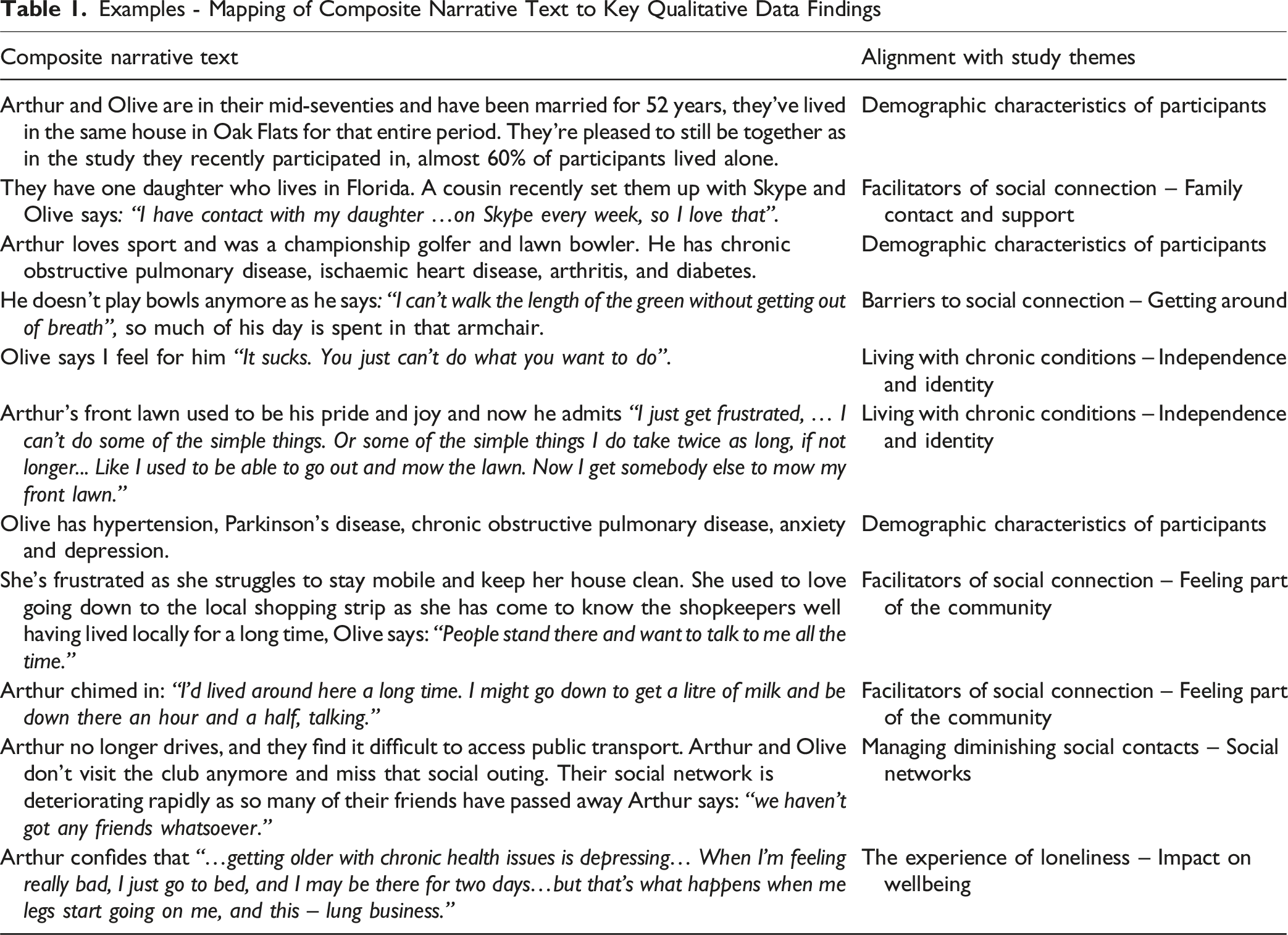
When the composite narrative is completed, it should be read aloud to check that the story flows, is within the time allowed for oral presentation and, most importantly, truthfully conveys the findings in a usable form. This process also provides an opportunity to ascertain if the composite narrative emotionally resonates with audiences. Researchers have many techniques and choices to help stories resonate. Richardson (2000) discusses the differing use of literary devices by disciplines and how writers may blend scientific and literary writing styles. Creative non-fiction with its mantra of “show rather than tell” (Smith et al., 2016, p. 66) uses rich description to generate an emotional response. Evocative representations of research, such as creative non-fiction, can increase the accessibility of complex ideas to broader audiences through arousing people’s imagination, activating memories and stimulating emotions with attention to style, plot and pace (Cavallerio, 2022). Researchers deploy various writing techniques including character development, imagery, using concrete details, dialogue, active voice and interior monologue, tone shifts, metaphors and similes (Caulley, 2008; Richardson, 2000). Evocative representations of research employ more vivid forms of expression and present findings from different perspectives. In the case of our example, through the characters and dialogue of Arthur and Olive we sought to recreate aspects of the lived experience of older people ageing with chronic conditions to evoke an emotional response, engage the audience on a deeper level and incite action (Smith et al., 2016). We reviewed our composite narrative with diverse audiences. Initially, it was presented to academics and peers, before subsequently being presented to audiences of practitioners, policymakers and consumers, particularly older people. Refinements to phrasing and oral delivery were made after every presentation.
Researcher reflexivity influences all forms of qualitative data analysis (Olmos-Vega et al., 2023). It is no different in composite narratives, which integrate the knowledge and interpretation of the researcher with participant voices (Wertz et al., 2011). Quality and trustworthiness were reviewed by diligently considering authenticity and transparency. Authenticity refers to our crafting of the story, the researcher must represent the data authentically and remain true to the sources’ perspectives (Wertz et al., 2011). For example, this includes how the composite narrative draws from the data (Apramian et al., 2023; Johnston et al., 2023; Willis, 2019), such as specifying “the number of sources referenced to construct each narrative” (Tetzlaff et al., 2024, p. 449). In the composite narrative presented, if views were gendered in the data, then this was reflected in the narrative. We demonstrated transparency by recording an audit trail (Johnston, 2024) and ensuring the study addressed the four dimensions of trustworthiness, credibility, dependability, confirmability and transferability (Lincoln & Guba, 1985). We recognise that more recent work demonstrates how this position on trustworthiness has evolved (Lincoln et al., 2011; Morse, 2015), particularly in the social sciences (Sparkes & Smith, 2009). What is crucial is to avoid “non-reflective adherence” to criteria without due consideration of the context and purposes of the research (Sparkes & Smith, 2009, p. 493). Our final composite narrative is provided in Figure 2. Getting Older With Chronic Health Issues is Depressing
Discussion
This paper seeks to contribute to the discourse around composite narratives by providing a worked example of the process undertaken to create an oral conference presentation. While composite narratives have been used in manuscript presentation (Creese et al., 2021; Johnston et al., 2023; McElhinney & Kennedy, 2022; Pushkarenko et al., 2023; Tetzlaff et al., 2024; Wertz et al., 2011; Willis, 2018), the application of this method to oral presentations of qualitative findings has not been widely discussed. As such, this paper provides a valuable contribution to the debate about effective research dissemination within the field of health research, where composite narrative is underutilised.
Qualitative research provides in-depth insights into the experiences and behaviour of patients and their carers, as well as health practitioners, through person-centred and humanistic approaches (Renjith et al., 2021). Such research helps researchers and practitioners to understand complex human behaviour (Renjith et al., 2021). The dissemination of qualitative research primarily occurs through journal articles, and while this form of scholarship is important, it may best serve the academic community and not be meaningful for the people who are the focus of the research (Keen & Todres, 2007). Composite narratives used in conference presentations may extend the dissemination and impact of qualitative research as the storied approach can be tailored to a lay audience or policy makers and facilitate their discussion of research findings (Keen & Todres, 2007). Evaluation of the impact of alternative methods of disseminating qualitative findings has predominantly relied on researchers’ self-reflection (Keen & Todres, 2007). Consequently, increased use of composite narratives should be accompanied by participatory evaluation strategies to assess the impact on researchers, practitioners, policymakers and consumers.
The three phases outlined to produce a composite narrative for oral delivery, including context, positioning, and structure, as well as writing, reviewing, and reflecting, are applicable to interdisciplinary health researchers. The phases are not intended to be prescriptive but provide guidelines for researchers unfamiliar with this form of composition. The provision of guidelines to support qualitative researchers is not new, with Polkinghorne (1995) adapting Dollard’s seven criteria for judging life history to produce guidelines for developing a narrative. Johnston (2024) has recently published a guide for researchers in the social sciences that includes six steps for constructing composite narratives. These steps are more detailed and presented in greater depth than the phases we describe and provide a comprehensive example of the use of composite narratives in the development and presentation of grounded theory. However, there is a broad alignment between the issues identified in this paper and those raised by Johnston (2024).
Benefits
A major rationale for featuring a composite narrative in conference presentations is that it humanises research. Wertz et al. (2011) argues that composite narratives can increase the visibility of the human qualities of phenomena, such as in her depiction of female adolescents and their experience of being overweight. This is important in health research as better health care may be facilitated by providing health practitioners with an embodied understanding of a condition or issue. Wertz et al. (2011) explains that using a composite narrative allows the reader to be closer to the phenomenon of interest. This ability to engage the reader personally offers a more humanising experience. Sanders et al. (2024) argue that narrative as a research methodology contributes to the formation of new knowledge by using storytelling to improve understanding of people’s human experiences.
Another benefit of using composite narratives to report qualitative findings is the ability to provide “complex situated accounts” of the phenomenon under study (Olson et al., 2023, p. 254). In conference presentations, there is rarely time to provide this detail. However, a composite narrative can illustrate aspects of real life, such as, in the example provided relating to Arthur and Olive (Figure 2), a sense of where they live. This detail can be provided, yet anonymity is still preserved as information that may be identifying has been removed through the synthesis of findings. In our study, many older participants were living with multiple chronic conditions which influenced their ability to engage socially. Previous research has identified how the lives of older people with impairments are negatively influenced by stigma as they are perceived to be at fault for failing to stay healthy (Raymond, 2019). Using a composite narrative to present findings protected participant anonymity by appropriately combining information that might be identifying, such as the details of participants’ chronic conditions.
Composite narratives provide an opportunity to amplify participant voices in conference presentations. In this paper’s example, we sought to champion the voices of older people with chronic conditions to understand their experiences of social connection. Johnston et al. (2023) also demonstrated this by using student voices to project key findings from their research in education. Interestingly, these student participants contributed to the generation of the research findings and construction of theory through for example, constant verification (Johnston et al., 2023). Another benefit of composite narratives is their potential to engage marginalised groups in the research process (Keen & Todres, 2007). Many cultures, including First Nations and culturally and linguistically diverse groups, have long histories of storytelling as a way of communicating cultural traditions and mores with successive generations (Weststrate et al., 2024). In Australia, Aboriginal peoples use yarning as a method of storytelling, and this has been adopted as a research practice (Bessarab & Ng’Andu, 2010). Marginalised groups may feel more engaged when research findings are presented to them through a composite narrative, particularly if Indigenous voices are privileged (Rieger et al., 2023).
We have argued that composite narratives provide an underutilised method for communicating qualitative research findings in an accessible format (Johnston et al., 2023). There is a capacity to generate empathy within diverse audiences of health academics, practitioners, policymakers and consumers (Wertz et al., 2011), which may increase engagement with findings. The complexity of research has been reported as a barrier to research-policy translation, and policymakers may not relate to the technical language of researchers (Ashcraft et al., 2020). Composite narratives provide a means of presenting findings so that they emotionally resonate with the audience, and this can enhance the transferability of research findings (Johnston et al., 2023). Another advantage is their use in interdisciplinary research, as the composite narrative can increase understanding of findings among academics and practitioners from different disciplines (Johnston et al., 2023). The interdisciplinary origins of composite narratives and their flexible format enhances their usefulness across qualitative methodologies (Sanders et al., 2024).
Risks
There are, of course, limitations and risks in the use of composite narratives. A key risk is the oversimplification of complex findings. Willis (2019, p. 478) urges researchers to avoid a situation where “the narratives become simplistic or caricatured”. This is a risk if findings are selectively presented to create a stereotype of a group of people. Robust attention to demonstrating the link between the composite narrative and findings (Johnston, 2024), in addition to researcher reflexivity, are ways to mitigate this. Findings may also be oversimplified when the composite narrative is primarily descriptive and limited interpretation is included. Additionally, composite narratives may be criticised if it is perceived that there is a lack of theory to guide analysis. It should be remembered that the composite narrative weaves together findings that draw directly from varying processes of qualitative analysis.
One of the most frequently identified risks of the composite narrative method relates to the skills of the researcher (Olson et al., 2023; Willis, 2019). Willis (2019) refers to researcher burden and reflects on the pressure on the researcher to create an accurate and meaningful story that remains true to the data. In their composite narrative about racism on a university campus, Olson et al. (2023) echo this need for accuracy and meaningfulness and discuss the responsibilities of researchers to protect the anonymity of their participants. This risk was managed through transparently recording details of each team member, demonstrating their familiarity with the data and documenting how they move from the data to the anonymised narrative (Olson et al., 2023). The story that the composite narrative portrays will be inauthentic if the views of participants are not given primacy, so care must be taken when blending the voices of researchers and participants.
Conclusion
Bringing qualitative data to life through a storied approach, particularly in time-limited oral conference presentations, may increase research impact and dissemination. There is clearly scope for wider use of composite narratives in health research. This paper outlines the three phases that we worked through to produce a composite narrative for a conference presentation.
Future research is needed to evaluate audience engagement with composite narratives when orally presenting qualitative research findings. Case studies that longitudinally track research dissemination and impact would also provide useful insights into whether composite narratives can influence policymakers and practitioners through presenting research findings in a more accessible format.
Supplemental Material
Supplemental Material - Using Composite Narratives in Oral Presentations: A Novel Method to Humanise and Disseminate Qualitative Research
Supplemental Material for Using Composite Narratives in Oral Presentations: A Novel Method to Humanise and Disseminate Qualitative Research by Cristina Thompson, Amy Montgomery, Kath Peters, and Elizabeth Halcomb in International Journal of Qualitative Methods
Footnotes
Acknowledgements
Our thanks to participants at the 2023 Australian Association of Gerontology Annual Conference and the 2023 University of Wollongong School of Nursing Research Conference, who provided feedback on the oral presentation of an earlier version of the composite narrative included in this paper. We also wish to acknowledge the erudite and constructive comments provided by the reviewers of this manuscript.

Author Contributions
Funding
Declaration of conflicting interests
The authors declared no potential conflicts of interest with respect to the research, authorship, and/or publication of this article.
Supplemental Material
Supplemental material for this article is available online.
References
Supplementary Material
Please find the following supplemental material available below.
For Open Access articles published under a Creative Commons License, all supplemental material carries the same license as the article it is associated with.
For non-Open Access articles published, all supplemental material carries a non-exclusive license, and permission requests for re-use of supplemental material or any part of supplemental material shall be sent directly to the copyright owner as specified in the copyright notice associated with the article.
