




Abstract
Drawing on the history of ideas, the use of knowledge, and what is known about research links, linkages, and interactivity, this ‘fishing for topics’ article focuses on how funded narrative inquiries move from fieldwork to contribute to the literature and what is known about teaching and the teaching profession. This fluid inquiry addresses the following research questions: (1) How are patterns/themes identified in data pools? (2) How are exemplars created that become published research stories? and (3) How does one manuscript relate to other manuscripts in the same and different data pools? Initially, the featured scholarship was produced using narrative inquiry’s interpretive tools of broadening, burrowing, and storying/restorying. Then, serial interpretation was undertaken to elucidate how research ideas materialized within/across the Korea-U.S. and the U.S.- China data pools. This innovative approach involved organizing the two studies into two metalevel story serials. Through this layered narrative inquiry approach, the overarching themes of fluid inquiry, flow of topics, and links/linkages/interactivity across data pools were identified. Two new narrative conceptualizations were named: meta-level story serials and meta-level serial interpretation. The insights arising from this “fishing for topics” article reflect the never-ending ebb and flow of waves splashing up to shore.
What is the original [idea]?…I suppose it is the source, the deep sea where ideas swim, and one catches them in nets of words and swings them shining into the boat… (Le Guin, 1989, p. 114)
While interdisciplinary research teams collaborate in funded research projects and co-publish articles and chapters, more needs to be known about how team members interact with one another than what has already been revealed (Cheong et al., 2023; Chung-Lee & Lapum, 2024; Foxall et al., 2021). This inquiry adds to the knowledge base of how funded research becomes enacted and instantiated. It illuminates how researchers arrive at topics to write about, how they transition field texts to narrative exemplars, and how collaborative research decisions are made. Ultimately, how one manuscript relates to another in the same or different data pools is also addressed. Other researchers, curious about the inner workings of research teams, often inquire: (1) “How are patterns/themes identified in data pools?” (2) “How are exemplars created that become published research stories?” (3) “How does one manuscript relate to other manuscripts in the same and different data pools?” These qualitative research queries fascinate us too. While our two teams of narrative inquirers have been productive, each has not previously reflected backward on its collective body of scholarship and questioned how ideas for articles and chapters in the international field of teaching and teacher education came to be. In this article, we jointly take up these important research puzzles.
When we began this shared work, the metaphor, ‘trolling for topics,’ organically emerged as we visualized narrative inquirers engaging in flexible inquiries. It allowed their sense of possibilities to be pulled along with the flow of participants’ stories, moving their reflections into, out of, and through participants’ narratives, to become full-blown exemplars. These exemplars were then brought in like waves to shore for reflection, analysis, and connection with past and present scholarship. Our metaphor necessarily shifted to ‘fishing for topics,’ because we needed to disassociate ourselves from the unscrupulous activities of internet trolls. 1 Our revised “fishing for topics” work demonstrates how research baits researchers’ imaginations, raises questions, and leads to new data pools or returns researchers to previously ‘fished’ areas. Having completed two major research projects—one funded by the Korea Research Foundation (KRF), another by the Asian-American Studies Center (AASC)—we retrospectively decided to investigate how we cast our lines into these two large data pools to find research worthy of sharing and to trace how our different pieces of scholarship relate to one other. Our intent is to reach a wide audience of qualitative/mixed-methods researchers who themselves are attempting to identify publishable works from their data collected, reflected upon, and analysed over time.
We begin by surveying three literatures that form the theoretical base for our multi-layered narrative inquiry. Then we describe how each team dove into its respective data to illuminate how we trawled the surface and the depths of our accumulated data pools to find topics around which to write Social Science Citation Index (SSCI) articles and chapters. We end by identifying themes that spanned both investigations and name loose research ends still needing to be knotted.
Literature Review
Three strands of literature form this article’s theoretical frame: (1) history of ideas; (2) use of knowledge in education; and (3) links, linkages, and interactivity.
History of Ideas
The ability to find research topics and to craft convincing exemplars from them traces to the history of ideas. According to Lovejoy (1940), “…ideas are the most migratory things in the world” (p. 4). An idea is “a preconception, category, postulate, dialectical motive, pregnant metaphor, or analogy, ‘sacred word’, mode of thought, or explicit doctrine, which makes its first appearance upon the scene in one [area]…and may…cross over into a dozen others.” Such ideas are “potent”—with each having a “particular go” (Lovejoy, 1940, p. 4) which reinforces “what their story is about…” (Le Guin, 2004, p. 264). Lovejoy’s (1940) categories include the histories of philosophy, science, folklore, education, and ethnography. Concerned with the development of educational ideas, this article also broadly addresses qualitative research (i.e., the ethnographic research theme).
Twelve categories exist in the study of cultural and intellectual ideas (Kelly, 1990, pp. 11–12). Included in Lovejoy’s (1940) groupings are the histories of philosophy, science, folklore, education, and ethnography. This article is primarily concerned with how ideas develop in education, specifically within two international teaching and teacher education projects. It also peripherally involves ethnography since ethnographic research falls under the banner of fluid inquiry, an approach we elaborate later.
To Reid (1993), educational ideas confirm, disconfirm, or advance fields of study. He and others (i.e., Ben-Peretz & Craig, 2018; Craig & Flores, 2020; Craig et al., 2022) stress the importance of differentiating between research continuities and discontinuities (Dewey, 1938) and evolution and revolution (Kuhn, 1962/1970) in educational research. A prime example of this phenomena is Clandinin and Husu’s (2017) chapter in the Sage Handbook of Research on Teacher Education. It evidenced how the international research amassed in their edited volume corresponds both with research about continuities in teacher education and research about teacher education’s disruptions. It is important that we emphasize that both approaches do much to expand what is known about teaching and teacher education.
Use of Knowledge in Education
The use of research knowledge in education (i.e., Fuhrman, 1994; Hemsley-Brown & Oplatka, 2005) is the second theoretical underpinning of this article. Lauglo (1996) distinguished between ‘internal’ and ‘external’ dissemination and use of research knowledge. He raised an important question: “What are the patterns of dissemination of research among researchers?” (p. 1). Internal dissemination and use typically occur in networks of researchers—even among members on the same and different research teams as is the case in this work.
With respect to educational research’s external use, Lauglo (1990) emphasized that it does not necessarily have to shape educational practices, although it most certainly can. He explained that “…research has other very important uses… [For instance], it trickles into the cognitive maps of what is problematic and what can be taken-for-granted as well as the kinds of questions that are recognized as important” (p. 3). These cognitive maps “[do] not just chart…[they] unlock and formulate meaning…[they] form bridges…between disparate ideas…not previously connected” (Larsen, 2010, p. 138). Over the long haul, knowledge accrued from research studies affect the field by becoming part of the language used to define issues and justify policy (Lauglo, 1990). This article strengthens what is known about narrative inquiry research by mapping how publications emerged and how they relate to other manuscripts emerging from the same and different data pools.
Links, Linkages, and Interactivity
Links, linkages, and interactivity constitute the article’s third theoretical pillar. In this section, we dialectically shift Huberman’s (1990, 1999) conceptualizations to inform our meta-level analysis of our narrative inquiries. Huberman’s overall scholarship focused on mismatches between theory and practice, and out-of-synch relationships between researchers and practitioners. While our original studies addressed somewhat similar themes to his, our multi-layered inquiry pertained to a whole new realm of relationships: (1) interactions between research team members, and (2) cross-study communications. Links (Huberman, 1990) denote interactions and collaborations between, in our case, researchers in single studies, while linkages signify relationships between different units (i.e., teams) in academia. Interactivity (Huberman, 1999) recognizes that different micro-worlds exist (i.e., different contexts, cultures, disciplines, and so forth) and how knowledge flows interchangeably between them. Concurrently, opportunities and barriers affording and constraining micro-world interactions are brought to the surface. Focusing on interactions between team members adds a critically important unit of analysis to our separate projects and subsequent multi-level analysis across the two featured research studies. This new methodological orientation centres attention on “jointly constructing knowledge through shared activity” (Huberman, 1999, p. 291). In our meta-level analysis, first author Craig, was the only member of both research teams. She served as a critical link between the studies and across the researchers as she was positioned in the middle of both shared knowledge constructions. Huberman’s (1990) illustrations, however, further challenged us to follow the course he mapped, to adapt his sample exemplars, and to culminate this article with our own graphic capturing knowledge flows, relationships, and interactivity. Our adoption and subsequent adaptation of Huberman’s scholarship further illuminates how the migration of educational ideas occurs and contributes to the generative nature of research dissemination as demonstrated in our discussion of the two fine-grained research pools.
Narrative Inquiry as a Fluid Form of Inquiry
We preface our introduction to the narrative inquiry research method with an overview of fluid inquiry and its subsidiary parts. We specifically discuss: (1) situating studies, (2) research exemplars, (3) trustworthiness of findings, (4) research stories worth telling, and (5) data pools.
Overview of Fluid Inquiry
According to Schwab’s (1962) practical vernacular, two broad research categories exist: stable inquiries and fluid inquiries. In Kuhn’s (1962) paradigm shift 2 language the categories are identified as normal science and revolutionary science. Stable inquiries ask specific questions that “fill a particular blank in a growing body of knowledge” (Schwab, 1962, pp. 15–16). They result in declarative knowledge statements communicating “empirical, literal, and irrevocable truths” (Schwab, 1962, p. 24).
However, a great deal of science and most teaching and teacher education investigations demand fluid inquiry. Fluid research methods do not address predetermined gaps in the literature. They do not produce knowledge that can be “tested, packaged, imparted and sent like bricks across countr[ies] to build knowledge structures that are said to accumulate” (Eisner, 1997, p. 7). Fluid inquiries take up persistent puzzles, leaving it up to readers to determine their actions rather than providing solutions to problems (Kuhn, 1962/1970). Fluid inquiries unfurl in situations where stable inquiries “have yielded as much knowledge…as they are capable of yielding” (Schwab, 1962, p. 16). Fluid inquiries are appropriate for studies whose backdrops are “puzzling, intractable, [and] no longer amenable to existing theoretical frameworks and social discourse” (Connelly et al., 2003, p. 366). Such situations call for a holistic approach that holds everything up for scrutiny (Schwab, 1960). This enables fluid inquirers to instantiate new knowledge and conceptualizations within dynamically shifting contexts where “stalemates, doubts, and failures...cannot be hidden” (Schwab, 1962, p. 21). Metaphorically speaking, fluid inquirers fish open seas, not pre-emptively knowing what they will find in deep or shallow waters. Contrastingly, stable inquirers know the species of fish they will reel in because they control the waters by virtue of their previous angling.
As presaged, this article’s intent is to communicate with researchers wanting to identify topics to turn into publishable research and to relate different manuscripts to one another, regardless of whether they are from the same or different studies’ research pools. Narrative inquiry is our chosen fluid research approach, as we have previously indicated.
Narrative Inquiry
Narrative inquiry uses stories as method to study human experience as research phenomena because: We live in stories the way fish live in water, breathing them in and out, buoyed up by them, taking from them our sustenance, but rarely conscious of this element in which we exist ...Stories make it possible for us to be human. (Taylor, 1989, pp. 5–6)
As such, narrative inquiries unfurl in a three-dimensional inquiry space involving temporality (past-present-future), sociality (interaction), and place (context) (Connelly & Clandinin, 1990; Dewey, 1938; Connelly & Clandinin, 1999) as illustrated in Figure 1. Narrative Inquiry’s three-dimensional inquiry space.
Research Tools
Grants, Puzzles and Research Tools.

Serial Interpretation
Serial Interpretation.


Story Serials
In previous narrative inquiries, story serials were used to link stories with the same overarching theme that occurred over a long period of time within the same research investigation. For example, Craig (2020) studied organized school reform in one middle school context over a period of twenty years. In that inquiry, she presented her research in six chronologically occurring narrative exemplars. Craig (2020) explained that: the story serial…graphically animated how each story told [over time] by the teachers folded into the next…, with all of their storied accounts winding both backward and forward to reveal …narrative threads already visible and yet to come. (p. 11)
We are doing the same thing in this investigation; however, we are working at a meta-level, which is a leading-edge adaptation for narrative inquirers. In this “fishing for topics” research, we do not have stories folding into each other as in the Data is [G]od paper, but we do have the unfolding of articles and chapters in the same data pool and how they relate to one another—and ultimately, to other articles and chapters in a second data pool. In short, we do not have story serials this time around, but meta-level story serials because we are discussing relationships between the articles and chapters in the data pools.
Situating Our Studies
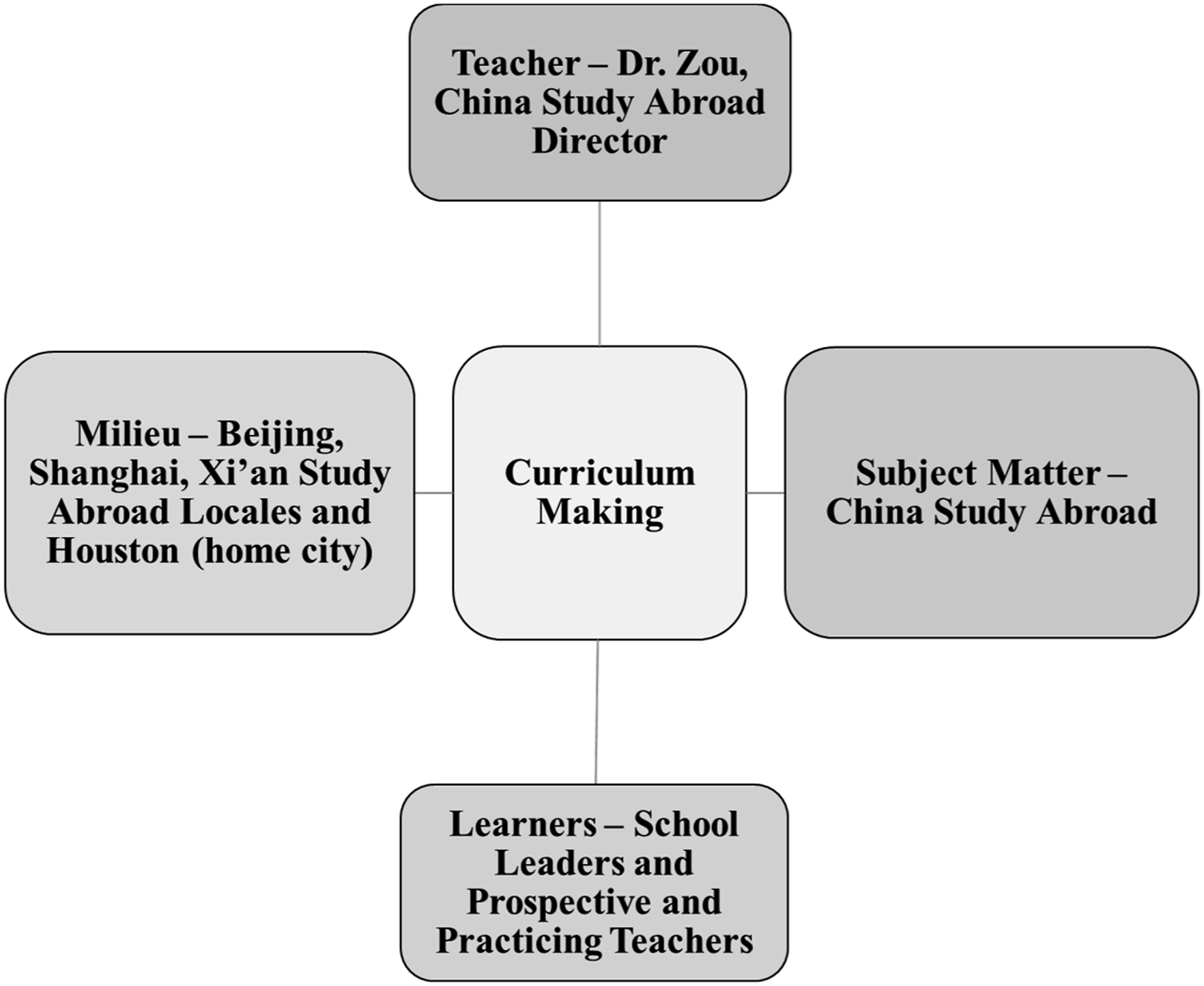
Researchers typically situate their studies in the teaching and teacher education field and in its literature. Goodson (1990) contends that teacher and teacher education researchers knowingly and unknowingly anchor their work in Schwab’s (1969) curriculum commonplaces. To him, the commonplaces are non-debatable and universal—as basic to educational inquiry as water is to all species of fish. In Schwabian terms, both of our featured research studies position educators in the teacher commonplace and prospective/practicing teachers, principals, and/or grade-school youth in the student commonplace. The subject matter was Physical Education (PE) where the KRF project was concerned as shown in Figure 2, and travel study abroad in the AASC-sponsored work as illustrated in Figure 3. The milieu commonplace in the KRF study was mainly one urban middle school in the U.S. and one middle school campus in Seoul, Korea. The milieu commonplaces in the AASC study were our home city of Houston and four metropolises in China (Beijing, Shanghai, Tianjin, Xi’an). Schwab’s curriculum commonplaces in the KRF research. Schwab’s curriculum commonplaces in the AASC research.
Research Exemplars
As readers are aware, research studies do not simply report what happened, they provide fully elaborated interpretations (Clandinin & Connelly, 2000)—or what alternatively are called exemplars—of experience (Barkhuizen & Consoli, 2021; Denzin, 1994; Foxall et al., 2021; Kelley et al., 2022). These rich examples link what is already known in one’s repertoire of experience with new thinking in the field (Schön, 1983). They facilitate linkages to others favouring similar approaches. Exemplars, in Lyons and LaBoskey’s (2002) view, are “concrete examples… elaborated so that members of a relevant research community can judge for themselves their ‘trustworthiness’ and the validity of observations, interpretations, etc.” (p. 20, italics in original). The validation of exemplars relies on believability, on one hand, and actionability, on the other hand (Mishler, 1990). Teaching and teacher education exemplars in the narrative inquiry vein typically: • Capture human actions that tell a story and convey developing knowledge, • Are lodged in socially/contextually embedded situations, • Draw other people into the mix when they are unpacked, • Implicate people’s identities, • Focus on interpretation, offering different viewpoints. (Lyons & LaBoskey, 2002)
Combined, these characteristics explain why Willis and Trondman (2002) recommend that creating fine-grained interpretations (exemplars) should be the “manifesto” of all qualitative researchers (fluid inquirers). Society urgently needs multiperspectival versions of experience for humans to better understand one another and one another’s approaches to conducting research, particularly from a fluid inquiry perspective.
In this work, we shine the spotlight on narrative inquiry research produced by two funded projects conducted a few years ago. Each research initiative, in our view, elucidates nuanced qualities of human knowing. Overall, both research studies promote better and more informed understandings of how and what humans know and the in-situ issues they experience as they articulate the narrative truths (Spence, 1982) of their lives, while remaining within the boundaries of what is socially acceptable.
Trustworthiness
Kuhn’s (1962/1996) concept of a paradigm shift, along with Schwab’s ‘practical’ scholarship, fuelled the “meteoric rise” (Lyons, 2006) of narrative inquiry research methods in teaching and teacher education. Kuhn asserted that new paradigm (fluid inquiry) researchers “think with exemplars” (Schön, 1983, pp. 183–184) rather than communicate certainties as “rhetoric of conclusions” (Schwab, 1961/1978). These exemplars, in Kuhn’s (1962/1970) words, are “the concrete problem-solutions” encountered “in laboratories [of practice], …that…show…by example how the job is to be done” (Schwab, 1962/1970, p. 187). To Schwab, such exemplars communicate tentative formulations—not facts, but interpretations of facts” (p. 242; italics in original). These interpretations “end in doubt or in alternative views of what the evidence shows” (p. 270). This is because researchers do not prove truths as the dominant paradigm purports. Rather, they tell “likely stories” (Schwab, 1967, pp. 14–15) until such time new discoveries are made. In contrast to capital ‘T’ Truth, such studies have a “true for now” (Bruner, 1986) ring to them. They mirror life—and are inevitably “unfinished and unfinishable business” (Elbaz-Luwisch, 2006), which once again speaks to the generative nature of fluid inquiry (i.e., narrative inquiry) and its research pools.
Research Stories Worth Telling
To Bruner (1986), statistical accounts produced by quantitative research studies (stable inquiries) are insufficient on their own because they have no moral push to them. Bruner, therefore, favoured storied accounts about real people facing real challenges because stories spur people to action. Carr (1986) similarly noted that the research stories of most value are those conveying the most narrative meaning. Bateson (2004), however, warned against the potential sharing of smooth Hollywood plotlines. Her belief is that narratives capturing the “zigzags” (the ups and downs) of experience are more likely to resonate with readers in instructive, potentially life-changing ways. Such research features the storying-restorying processes people engage in to improve their unwieldy situations. To Clandinin and Connelly (2000) and others (i.e., Clandinin et al., 2007; Ford, 2020; Kelley et al., 2023), stories worth telling are personally, socially, and practically justifiable—all at the same time. First, researchers need to personally identify with the research puzzles framing their inquiries as we are doing in this article. Second, their studies should champion changes in practice and/or actively cause individuals to think differently about themselves and others as we are also striving to do with this work. Third, topics of inquiry address social and educational relevance and respond to questions of ‘so what?’ and ‘who cares?’ (Clandinin, 2022; see also Chung-Lee & Lapum, 2024; Ford, 2020), which hopefully is the case with all rigorous teaching and teacher education research.
Data Pool
The well-known term, data pool (Cheong et al., 2023), resonated with our fishing metaphor and the pooling of data that subsequently occurred across team members (links) and research teams (linkages) presented next in this article. In this work, a data pool is a research record that often aligns with the data management plans of funded research grants. It includes interview data, researcher notes, observation notes, lesson plans, historical documents, and so forth. Each data pool entry is typically itemized, sequenced, and dated by researcher and location. Each entry can be interwoven with other texts to become exemplars featured in published research articles and chapters. However, despite our data pools’ systematic organizations, the entries in both instances are ions away from being publishable narrative inquiry research. As novelist Margaret Atwood explained, “it is only afterwards that [data] [becomes]…a story…when you are telling it to yourself or to someone else” (2011, p. 298).
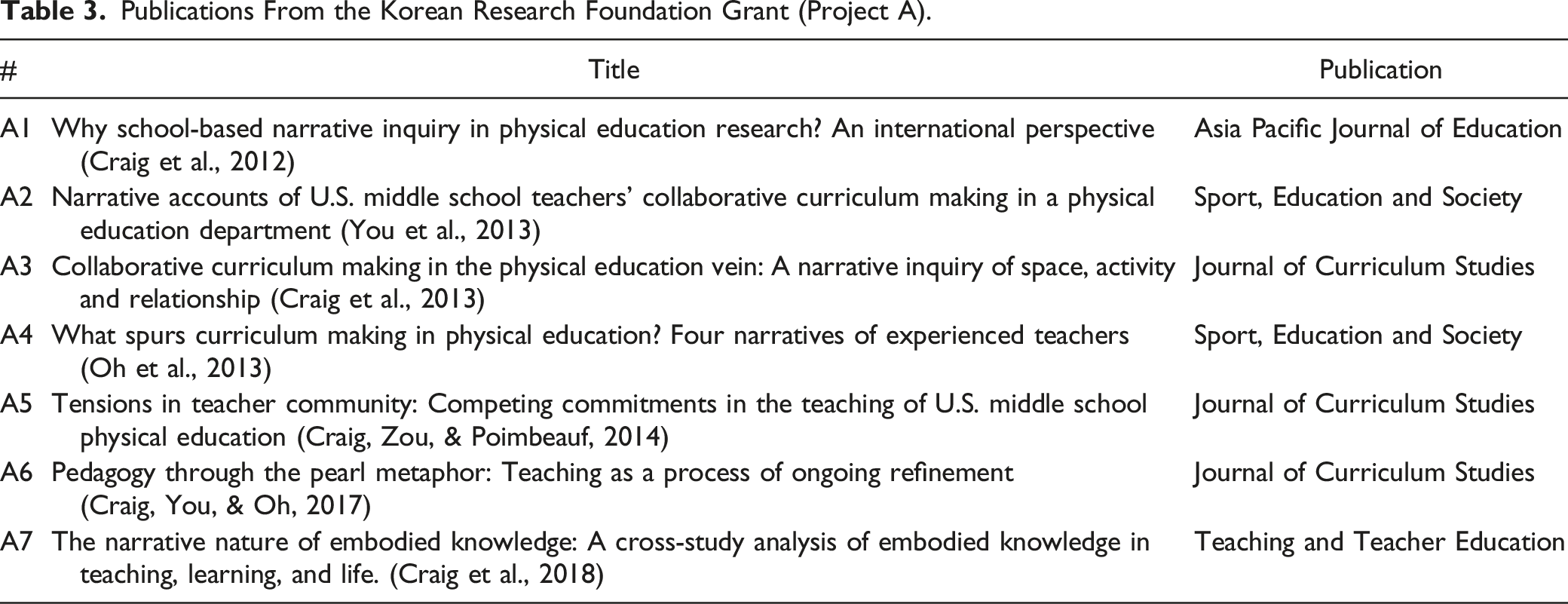
Publications From the Korean Research Foundation Grant (Project A).
Publications From the Asian American Study Center Grant (Project B).

Reflective Analysis on the Data Pools
Comparison is the most significant way that researchers identify and refine categories and analytic patterns or themes in their studies, regardless of research method (Tesch, 1990). Tesch explained, “Comparing and contrasting is used for practically all intellectual tasks during analysis: forming categories, establishing the boundaries of the categories, assigning the segments to categories, summarizing the content of each category, finding negative evidence, etc. The goal is to discern conceptual similarities, to refine the discriminative power of categories, and to discover patterns” (p. 96).
In this narrative inquiry research, topics for comparison were landed upon using meta-level serial interpretation and iterative dialogic collaborative processes (Paulus et al., 2008). This meant that KRF and AASC researchers individually and collaboratively analyzed data (participant stories from the field) to seek emergent patterns or themes within their respective data pools. In interpreting these patterns, they identified narrative threads in participants’ stories that could be used as research texts in exemplars that could most ably convey meaning and significance. In a nutshell, this is the way we “breathed life” into our meta-analysis (Chung-Lee & Lapum, 2024).
What initially became revealed in our meta-level serial interpretation of our two teaching and teacher education data pools was the flow of topics. Narrative threads related to these topics led to the development of multiple project publications as linkages became channeled between articles and across studies. Metaphorically speaking, some topics from our two data pools were “easy catches” in that they floated just below the surface and readily captured our attention. But that does not mean that these “easy catches” were less complex or less rigorous than other topics found deeper in the data pools that required more time and effort to name.
Our meta-level serial interpretation also revealed contrasting pathways to publication. Some publishing routes were fair-weather sailing; other times, stormy seas characterized our publishing experiences. The latter theme was certainly the case with this article, which fell between the cracks because of our desire to emphasize methodology. But it also was somewhat the case for other manuscripts as we later discuss.
Korea Research Foundation-Funded Work (Project A)
The meta-level story serial from the Korea Research Foundation (KRF) data pool addressed topics that quickly leapt out of the data pools. Because the first study dealt with Physical Education (PE) as lived in secondary schools and a narrative methods paper in PE had not yet been published, the first article we authored (A1) (Craig et al., 2012) focused on the use of narrative inquiry as a research method in PE. This choice helped us to capture how we methodologically conducted the study and filled a void in the literature and in practice. It also made sense to disseminate the article in the Asia Pacific Journal of Education. Part of narrative inquiry’s ‘meteoric rise’ as a methodology is attributable to its spread in Asia (Xu et al., 2024). This is due to the method’s Dewey (1938) roots and its Schwabian connections, given that Schwab was a constructivist and Deweyan in his teaching and research orientations. As the first American philosopher to travel to Asia and the only person outside China to receive the Order of the Jade, John Dewey, whose focus was on the continuity of knowing (past-present-future), resonated beautifully with the Confucian concept of the continuity of being (Craig, Zou, et al., 2014; Han & Feng, 2013).
The second (A2) (You et al., 2013) and third (A3) (Craig et al., 2013) articles chronologically produced from the KRF-funded project shared the same starting point but ended up in different yet not contradictory places. Let us explain. Having observed PE classes in two American secondary schools, author You was desirous of co-authoring a paper about how younger and older teachers collaboratively taught in U.S. schools in a different manner from what she had observed in Korean secondary schools where the hierarchy of age shaped who taught with whom (A2) (You et al., 2013). Craig, being North American, understood collaboration as typically occurring in schools, regardless of teachers’ age and seniority. Hence, she focused on what commonplaces of experience (Lane, 1988) prompted teachers to plan and teach collaboratively (A3) (Craig et al., 2013). Our team discovered that different members dipped our plumb lines into the data pool in distinctively different ways and snagged different field texts. Authors You and Oh subsequently were the lead authors of the manuscript dealing with age and seniority-related forms of teacher collaboration (A2) (You et al., 2013), choosing School, Sports, and Society as the publishing outlet. Meanwhile, Craig became the lead author of the third manuscript (A3) (Craig et al., 2013) having to do with the topics and narrative threads around which teachers collaborate. She, along with You and Oh, chose Journal of Curriculum Studies as the manuscript’s publishing venue.
Subsequent manuscripts associated with the KRF serial took up topics that had previously caught our attention but required deeper delving into the data pool. An organic follow-up to the previous papers was a discussion of the motivating factors related to teacher curriculum-making in PE. This was a topic which floated to the surface previously but required re-analysis to uncover finer points. The resultant fourth article (A4) (Oh et al., 2013) was subsequently published in Sport, Education, and Society as this was a fitting publication outlet, given its topic of inquiry and our previous success with that journal.
The writing of KRF manuscripts three (A3) (Craig et al., 2013) and four (A4) (Oh et al., 2013) set the context for our authorship of manuscripts five (A5) (Craig, Zou, et al., 2014) and six (A6) (Craig et al., 2017a), which unfurled at T. P. Yaeger Middle School in the US. The research team was present at Yaeger when a heated debate erupted around the PE Department’s rainy-day policy. As narrative inquirers, we wondered what lay at the root of the divisiveness that emerged that rainy day among typically collegial faculty members. This fifth paper (A5) (Craig, Zou, et al., 2014) caused us to revisit our research participants as they storied-restoried their experiences around the contested topic of what to do when rain prohibits outdoor PE classes and forces 180 students into a gymnasium meant to accommodate 60. This tension-filled inquiry indirectly affected change because the teachers shared their concerns with administration, spurring a faculty-supported policy shift. Since the manuscript we co-authored had to do with teaching, curriculum, and policy, it (A5) (Craig, Zou, et al., 2014) was also published in the Journal of Curriculum Studies. Readers can see that this article—of all the publications we highlight—directly affected both practice and policy, while keeping Schwab central to the work.
Our sixth manuscript (A6) (Craig et al., 2017a) arose from one participant’s ongoing use of the pearl metaphor and her image of ‘teaching as a strand of pearls’ as told to You and Craig in a series of interviews. Out of curiosity, both researchers felt inclined to follow the string of pearls trail of evidence in the data pool. Also, both privately worried about the idea being fleeting. However, when third author Oh reinforced the significance and universal value of pearls across all cultures, the research team became convinced that the strand of pearls metaphor was worth unpacking. At You’s suggestion, we returned to our storied data pool, extracting narratives we sub-titled Pearl 1, Pearl 2, Pearl 3, and Pearl 4. Because this paper (A6) (Craig et al., 2017a) was about the collaborative curriculum making of two teachers (one novice, the other experienced—one African American, the other White—one young, the other near retirement age—one male, the other female), it also was submitted to and accepted by the Journal of Curriculum Studies.
An additional paper (A7/B9) (Craig et al., 2018) was also authored from the KRF-sponsored data pool. Because the article involved serial interpretation across both data pools, it will be fully elaborated at the end of the discussion that follows. Finally, we know that the KRF data pool remains stocked with fertile ideas that could still yield additional articles/chapters, which again speaks to the generativity of qualitative research and narrative inquiry in particular.
Asian-American Studies Center-Supported Work (Project B)
The development of topics from the Asian American Studies Center (AASC) data pool also began with ideas laying just beneath the surface. The journey to publication in this data pool also highlights some of the challenges in finding publishing outlets for scholarship traversing multiple fields, due to the composition of our multidisciplinary research teams.
As with the KRF-funded research, we began the AASC inquiry with a methodology paper (B1) (Craig, You, et al., 2014). This time around, a paper having to do with narrative inquiry and travel study abroad had already been authored by others. Thus, we took a different tact to sharing how we used narrative inquiry, differentiating our scholarship by illuminating the method’s affordances, and constraints. This decision allowed us to share our approach to narrative inquiry through placing one foot in the practicalities of teaching and teacher education field work in a foreign country, while our other foot was focused on the China Study Abroad experience of American principals and teachers. After considering the growth of narrative inquiry in China, Korea, and other Asian countries in recent years, we submitted this article (B1) (Craig, You, et al., 2014) to the Asia Pacific Journal of Education.
This was followed by a manuscript that has not yet found a journal home (unlisted). Hence, it is not included in our annotated data pool. For that work, we used a wide-angle lens to capture Western learnings about Chinese culture. However, our inclusion of food subjected our manuscript to perilous seas. Article reviewers interpreted food as a shallow understanding of culture. Consequently, this research was disconfirmed by reviewers. We were aware of this potential risk in penning the manuscript, however, we could not deny that food, a basic human need, ranked very high among our Study Abroad participants’ experiences. Unfortunately, the link was present in our study’s data pool, but the linkage to available literature in the academy and to active scholars reviewing our submitted manuscript could not be made. In the final analysis, we simply were not willing to compromise our research participants’ experiences, given that respect for human experience sits at the heart of the narrative inquiry research method. Hence, our paper remains unpublished, thus constituting a research issue as we move forward.
This unaccounted-for manuscript taught us a critically important lesson about publication and dissemination: the need to have razor-sharp topics for each manuscript. We therefore directed our focus to journal writing and what our participants (teachers, principals, graduate students, school leaders) were learning about culture through reflecting in their individual China Study Abroad journals. This became another published manuscript (B2) (Craig et al., 2016) that was subsequently carried by Teachers and Teaching: Theory and Practice. The work allowed us to spotlight a handful of students’ narratives of experience, which we backed up with the remainder of the students’ journal entries. Later, when we were invited to author a chapter (B5) (Craig & Zou, 2016) for the book, Quality and Change in Teacher Education: Western and Chinese Perspectives (Lee & Day, 2016), we repeated this strategy, basing the chapter on what preservice teachers learned about culture through journal writing, using different participants and different evidence. Readers hopefully can see that this possibility always exists in large teaching and teacher education data pools because there is near-endless documentation on which to base future papers.
Our third manuscript (B3) (Zou et al., 2016), which was also published by Teachers and Teaching: Theory and Practice, somewhat resembled our ‘homeless’ manuscript discussed earlier, but we were more strategic in how we presented our evidence this time around. The article pinpointed four things the West could learn from the East. We also purposely resisted the status quo view of the East learning from the West, which is the globally accepted meganarrative (Olson & Craig, 2009) that we strategically side-stepped.
Continuing to fish for topics, we intensified our analysis, casting our lines deeper into the data pool for topics that evaded us. Our fourth paper (B4) (Craig et al., 2015) embellished one aspect of our third manuscript (B3) (Zou et al., 2016) and revolved around a thorough discussion of the images held and expressed by an Asian principal we observed. The notion of excavating the principal’s images of leadership resonated with Craig’s curriculum background whereas ideas associated with Asian-American worldviews reflected Zou’s home culture and area of expertise. Furthermore, fourth author Poimbeauf’s strong leadership background connected with the responsibilities and workload the Chinese principal carried. This work appeared in the Journal of Curriculum Studies.
Because the fifth manuscript (B5) (Craig & Zou, 2016) has already been discussed, we turn our attention to the sixth research article (B6) (Craig & Zou, 2015) which revolved around Lugones’s notions of ‘world traveling’ and ‘arrogant perception versus loving acceptance’ and how these conceptualizations surfaced in our participant’s experiential narratives. These concepts were well-known to Craig in the narrative literature and resonated both with the topic of study abroad and Zou’s cultural studies and global leadership expertise. The work additionally strengthened her conceptualization of ‘cultural therapy.’ However, this article’s unique topic did not fit squarely with any SSCI journal discussed thus far. Hence, we consulted journal lists and found a publication about which we had previously been unaware: International Journal of Diverse Identities. We were doubly pleased when we received high-quality feedback that helped us to improve our manuscript in ways that made it acceptable for publication in that outlet.
For the seventh AASC manuscript (B7) (Craig et al., 2017b), we re-examined the data pool, this time focusing on Shi Tan, a Chinese American teacher, as she revisited China, her ancestral home, in the company of mostly White educators, many of whom were principals and superintendents. As Shi Tan reflected on family, culture, and the role she had taken up as the only Chinese-speaking person among her American colleagues/participants, she experienced identity shifts in these areas, ultimately empowering her in new ways both personally and professionally. As it turned out, writing this seventh work was easier for us than finding a suitable journal home for it, which is the case readers will find with some of their own manuscripts. In our first two attempts to publish it, the manuscript was returned without review because it did not ‘fit’ the scope of the journals. After almost two years of searching for an appropriate publication outlet, this article landed in the much-respected journal, Learning, Culture and Social Interaction, a publication about which we had been previously unaware.
The eighth article (B8) (Craig et al., 2019), which was disseminated in Pedagogies: An International Journal, followed a similar train of thought to the sixth (B6) (Craig & Zou, 2015) paper. However, it combined Lugones’s scholarship with Buber’s (1970) concepts of I/It and I/Thou relationships and Turner’s notion of liminal spaces. This manuscript began as a conference paper presentation which we then transitioned into a publication. As with the previous article (B6) (Craig & Zou, 2015), this paper (B8) (Craig et al., 2019) connected fruitfully with Zou’s cultural studies and global leadership specialty areas while emphasizing narrative conceptualizations frequently used in Craig’s and Curtis’s teaching and teacher education research.
An additional article remains to be authored from the AASC-funded data pool. That publication will focus solely on travel study abroad and liminal spaces. In fishing our data pool for the eighth manuscript (B8) (Craig et al., 2019), we found far more examples of liminal space than we initially imagined. This convinced us that there is another article begging to be written in the future.
Finally, we direct attention to the article, A7/B9 (Craig et al., 2018), which pulled on our teaching and teacher education field work from both data pools. This serial interpretation manuscript addressed the embodied nature of knowledge and the convergence of the corporeal and narrative turns. This A7/B9 (Craig et al., 2018) paper possibility only became known to us as we comprehensively reflected backward on our collected texts in the preparation and process of writing this article. This instantiates Lovejoy’s research on how ideas migrate from paper-to-paper and researcher-to-researcher. Consequently, our attention was diverted from preparing this methodological article to writing the embodied knowledge manuscript, which was published in Teaching and Teacher Education 3 Interestingly, the latter A7/B9 (Craig et al., 2018) publication found its publishing home before this one, which ironically is the source of its key idea.
Serially Interpreted Narrative Inquiry
We now present overarching insights related to our meta-level story serials. This meta-level serial interpretation more deeply discusses the “fishing for topics” metaphor and more tightly connects it with the literature that kicked off this article.
Shallow-Water Fishing
As hinted, shallow-water fishing focuses on topics worthy of sharing that float just beneath the surface of teaching and teacher education data pools and are easy to spot. This does not mean that the articles/chapters spawned from them lack precision where rigor is concerned or are watered down where evidence is concerned. They simply are more accessible, identifiable, and easier to name because of less-dense waters. Associated with shallow-water fishing, two additional terms need explanation: easy catches and landing the catch.
Easy Catches
“Easy catches” are readily identifiable topics/themes in data analysis. In both data pools, methodological papers were obvious first choices since the research processes of gathering/analysing/interpreting the data were fresh in our minds. These articles illustrate how fluid inquirers adapt research plans as they go along, never following charted methodological routes in predictable ways as stable inquirers (mostly quantitative researchers) do. Concurrently, both of our methodology papers advanced the field of teaching/teacher education. Furthermore, strong linkages were made between and among research-theory-practice through their fluid inquiry approaches. Additionally, the articles from both studies have an identifiable linkage, which specifically addresses our second research puzzle introduced at the beginning of this article.
Landing the Catch
If searching for topics in a research data pool is akin to ‘fishing for topics,’ then publication is all about ‘landing the catch.’ As all fishermen attest, much can happen between catching a fish on the line (selecting/writing around a topic) and landing the fish in the boat (publishing an SSCI article). An example of this is the unlisted manuscript drawn from the AASC-sponsored research which centred on four strong data themes—one being the questionable topic of food as a manifestation of culture. Despite the paper being what we considered an “easy catch,” to date, it still has not “landed.” This manuscript demonstrates how researchers can successfully develop critical articles with themes representing participants’ truths yet fail to connect with reviewers who gate-keep the boundaries of acceptable research in teaching and teacher education. The exemplars in our reflective analysis demonstrate the need for researchers to investigate journals before submission to determine the best fit for their scholarship. From a publishing standpoint, a powerful lesson was learned about submitting papers to different journals and receiving different (i.e., more positive, more instructive) feedback. The lesson also includes not being put off by rejection; one must simply continue to refine manuscripts’ core ideas, polish their words, and seek to land catches elsewhere, which is the case with this methodological article as we have already mentioned.
Deep Sea Fishing
As Le Guin (2004) noted at the beginning of this article, the deep sea is probably the best—but most difficult—place where ideas swim. This is a major understanding that the history of ideas teaches us. The challenge for researchers is how to catch and communicate big ideas in ways that both secure and distinguish their scholarship. Lovejoy (1940) listed synonyms characterizing the sources of ideas in our literature review, as readers will recall. We will now elucidate how Lovejoy’s (1940) creative history of ideas language characterizing sources of ideas helped us to further frame our analysis, reminding us of the shiny fish we have yet to catch and the interpretive words in which we will wrap them. We particularly discuss Lovejoy’s notions of ideas as pregnant metaphors and analogies, ideas as a category of thinking, ideas as a mode of thought, and ideas as a dialectical move.
Ideas as Pregnant Metaphors/Analogies
Deep sea fishing yielded two metaphor and analogy papers, one in each data pool (A6) ([Craig et al., 2017a]) and B4 [Craig & Zou, 2015]), together with this all-encompassing, culminating “fishing for topics… in large data pools” article. Research in both instances advanced the field through presenting new interpretations of metaphors and analogies conveying educators’ experiences. In both instances, culture played a key role.
Idea as a Category
Examples of ideas that fell into a category are the paper and chapter that had to do with reflective journaling about culture (B2 [Craig & Zou, 2016]) and B5 [Craig et al., 2016]) and the two articles on collaboration (A2 [You et al., 2013] and A3 [Craig et al., 2013]). In the AASC-sponsored work (B2 [Craig & Zou, 2016] and B5 [Craig et al., 2016]) on journaling, the paper focused on principals whereas the chapter centred on novice teachers. A third article could feature teachers’ reflective journaling about culture. Both publications, B2 (Craig & Zou, 2016) and B5 (Craig & Zou, 2016), contributed to the advancement of the teaching and teacher education field because they showed fine-grained ways that study abroad novice teachers’ and principals’ attitudes/identities shifted in the throes of intercultural experiences.
The second example of ideas arising from a category came from the KRF study. In this instance, the category was collaboration (A2 [You et al., 2013] and A3 [Craig et al., 2013]). Readers will recall that You and Craig as co-researchers held different culturally imbued notions of collaboration, which gave rise to two published papers carried in two different publishing outlets. Advances in knowledge and practice were made through both articles: one illuminated the less-hierarchical way North American teachers are organized, pinpointing specific collaborations between and among American teachers—even when they are on the athletic field where classrooms have no concrete boundaries. On the other hand, the Asian view of collaboration was bounded by age.
Idea as a Mode of Thought
Lugones’ scholarship provided a mode of thought about how people perceive one another. Her work set the context (and informed the title) for the “Arrogant perceptions’ paper (B8) (Craig et al., 2019) in the AASC investigation. The term, arrogant perception—viewing the world solely from one’s own perspective—proved itself to be a potent way to trace how the teachers and principals transformed their arrogant perceptions of the Chinese into ‘loving acceptance.’ The work further showed people thinking of others as Is rather than Its, reflecting Buber’s (1970) scholarship. The paper advanced research in the teaching and teacher education field by demonstrating how contentious issues can be addressed and confirms the veracity and usefulness of Lugones’ conceptual terms.
Idea as a Dialectical Move
In the KRF A5 (Craig, Zou, et al., 2014) paper, we focused on a school policy that became rancorously disputed when a sudden rainstorm hit the campus. We showed the difficulties that resulted when the policy became lived by a department of teachers who characteristically worked well together, a policy which became immediately altered through the teachers’ deliberations. The work advanced the field because their absolute fidelity to policy shifted in the school context to reflective fidelity to policy through intuitively and dialectically using the practical logic outlined in Cohen and Schwab’s (1965) scholarship which directly links with the origins of narrative inquiry, the fluid inquiry method we adopted from the outset.
Linkages and Interactivity
Introduced in our literature review, Huberman’s linkages and interactivities were invaluable to our meta-level analysis. Rich examples of both follow.
Linkages
The awarded embodied knowledge article (A7/B9) (Craig et al., 2018) was produced through the merging of our two data pools with the data pools of two other funded studies on which Craig also worked. Solid linkages related to deep-sea fishing were established between the four data pools and the research programs. The interdisciplinary research teams subsequently produced robust exemplars of embodied knowing in PE, physics education, cyber technology education, and intercultural education. The resultant article provided new real-life examples that backed up the literature. These real-time exemplars became unique, interdisciplinary additions. The embodied knowledge article made a strong contribution to the teaching and teacher education literature as its citation record in the Web of Science, Scopus and Google Scholar continues to attest.
Interactivity
Interactions between research team members—that is, on-going communication, sharing of ideas, critical dialogue, insightful feedback, etc.—was foundational to productive ‘fishing for topics’ in the two funded projects. Having multiple researchers was helpful in bringing topics to the surface, as each researcher carried his/her own biography and disciplinary lenses to the work. For example, this article also would not have been authored without continuing single-study and cross-study communications among us. The “fishing for topics” theme simply would not have been experientially known by us.
Fish Yet to Catch
Our return to the two data pools and the literature while writing this article generated new ideas for future manuscripts which link in various ways to manuscripts already discussed. As mentioned earlier, a third paper on reflective journaling could feature experienced teachers. Other potential manuscripts include an article cutting across both data pools addressing the value of fluid/narrative inquiry in the two areas of study, and a further article focusing on links established inwardly between research team members and outwardly with the research community, more fully instantiating Lauglo’s ideas about research use and dissemination, which threads back to our literature review.
Fluid Inquiry
Although the data pool publications are presented in meta-level story serial forms, that was not how the scholarship appeared in press. Some topics developed into articles simultaneously. Other topics of investigation were interrupted to focus on a paper or chapter that unexpectedly emerged. This meta-level analysis highlights the fluid inquiry we engaged in during the gathering and analysis of the data. Figure 4 (Curtis, 2021, p. 53) which comes next, shows the fluidity of our researcher paths in this meta-level analysis as we moved back-and-forth and between data pools, repeatedly taking account of ideas/stories/contexts/interpretations/knowledge bridges, links, linkages, and interactivity. Our complex analysis of our ‘meta-level story behind the stories’ serials resulted in this article prepared and presented from an insider perspective. Fluid inquiry into the two data pool.
Concluding Thoughts
This article began with three purposes: (1) to illustrate how researchers identify patterns or themes within and across data pools, (2) to speak to researchers engaged in qualitative and mixed-method investigations as they attempt to identify topics from accumulated data pools that will subsequently become publishable teaching and teacher education research, and (3) to show how articles within and across data pools relate to one another. Employing the generative ‘fishing for topics’ metaphor provided our interdisciplinary research teams with the rare opportunity to situate, discuss, interpret, and ultimately share the processes through which we fluidly ‘found’ worthy topics and stories and how we linked them to each other within and across our two large teaching and teacher education data pools. The distinctions between ‘shallow-water fishing’ and ‘deep sea fishing’ revealed that some topics are captured only after the data collection has been completed and when you tell its stories “to yourself or to someone else” (Atwood, 2011, p. 298). Others, though, could be discerned below the surface and were easier “to swing shiny into boats…” as Le Guin (2004) suggested in the opening to this article.
In bringing this work to a close, we know that the publications arising from these two international data pools are not complete—and never will be complete—because narrative inquiry research is always open to further interpretation and analysis and most especially serial interpretation of its meta-level story serials. We additionally understand that we will live different experiences in the future and/or encounter different conceptualizations in the literature that will return us to our respective data pools with fresh lenses through which to identify more stories of personal, social, and practical significance. This new material will then be deliberated, arranged in new story serials, and serially interpreted, yielding new idea-seeds to “grow new stor[ies]” (Le Guin, 1989, p. 194) in ways uncannily like how this article in the narrative inquiry vein took shape and became publishable.
Footnotes
Declaration of Conflicting Interests
The author(s) declared no potential conflicts of interest with respect to the research, authorship, and/or publication of this article.
Funding
The author(s) disclosed receipt of the following financial support for the research, authorship, and/or publication of this article: This work was supported by the National Research Foundation of Korea and Asian American Study Center--University of Houston.
