




Abstract
‘Unwelcome truths’ are central to the empowerment and transformation aims of Participatory Action Research (PAR). They confront dominant narratives, challenge power relations, and reveal hidden structures of influence. At the same time, creating communicative spaces in which unwelcome truths can surface is rarely straightforward. Researchers play a key role in creating these spaces and face several challenges. These include ethical responsibilities, power imbalances, emotional and psychological barriers, and external pressures such as time limits and institutional demands. Researchers’ responses to these challenges are shaped by their methodological choices and positionality. These two factors directly influence how communicative spaces are created and sustained. Nevertheless, reflexive accounts of researchers’ methodological choices and positionality in PAR remain scarce in the literature. This scarcity limits accountability, transparency, and learning, which are principles integral to PAR. In this article we therefore present a behind-the-scenes account of a Dutch PAR project on resilience and experiences of loss. We draw on Goffman’s frontstage/backstage metaphor to examine the tension between public accounts of PAR and unpublished realities that are often personal, complex, and morally challenging. On the frontstage, we analyse how communicative spaces were created in meetings with co-researchers and the difficulties this process entailed. Backstage, we examine methodological challenges and the complex positionality of researchers. We explore these issues in greater depth using the validity claims from Habermas’s theory of communicative action. This provides a useful lens for analysing how unifying factors can emerge in communicative spaces despite the challenges faced. Finally, we conclude by considering the value of PAR for resilience research and how insights from this project may inform future studies.
Introduction
‘At times, drinking a few glasses of whiskey each day, ‘numbing’, forms a big part of my resilience, I do not think there is anything wrong with that… Sometimes, you just need to survive, sometimes you just have to hit rock bottom before reaching a turning point.’
This quote comes from a participant in a Dutch Participatory Action Research (PAR) study (2023–2025) on experiences of resilience in the context of loss. It is an example of an ‘unwelcome truth’ within the project. As described by Abma et al. (2019b), unwelcome truths confront dominant narratives, unsettle power relations, and expose hidden structures of power. For these reasons, they are described as uncomfortable. Paradoxically, the features that make them uncomfortable also make them welcomed and actively pursued in PAR. Their confronting nature is integral to advancing PAR’s aims of empowerment and transformation (Abma et al., 2019b; Kemmis, 2006). Nevertheless, unwelcome truths are often suppressed by PAR participants, as discussing them can cause discomfort and disrupt stability (Boyle et al., 2022). For instance, using alcohol to ‘survive’ hardship through numbing is rarely discussed openly due to societal norms and concerns about consequences within one’s family or workplace.
Supporting participants in surfacing unwelcome truths requires what is known as ‘communicative freedom’ (Davidson & Edwards-Groves, 2020; Habermas, 1984, 1987; Kemmis, 2006). According to Habermas’s theory of communicative action, communicative freedom means that all participants in a dialogue can share understandings, reflections, experiences, and questions openly and on equal terms. The resulting dialogue aims to achieve intersubjective agreement, mutual understanding, and consensus across four domains known as validity claims: comprehensibility, truth, rightness, and sincerity (Habermas, 1984, 1987; Kemmis, 2006). To support this, what is known as a ‘communicative space’ must be deliberately structured so individuals can contribute, exchange ideas, and challenge one another, while still feeling safe when beliefs and practices differ (Habermas, 1984, 1987; Kemmis, 2006). However, creating such a space is rarely straightforward. Confronting ‘unwelcome truths’ places significant psychological and emotional demands on all involved.
Although demanding, Kemmis (2006) argues that action researchers who avoid unwelcome truths are not engaging critically in PAR. Yet we question whether this is always realistic. Are there ethical limits to surfacing unwelcome truths? For example, when participants disclose potentially harmful coping strategies such as excessive alcohol use? What responsibilities do researchers carry when sensitive information is shared in group settings? These dilemmas from our research project on resilience and loss illustrate what several authors have emphasised: PAR presents distinct ethical challenges in practice (Aussems et al., 2022; Groot et al., 2018). Such challenges can complicate efforts to create power-free dialogue and, in turn, hinder the surfacing of unwelcome truths.
Furthermore, the tension between the ideal of a ‘power-free’ communicative space, where participants can share their perspectives equally, and the reality of structural inequality raises critical questions about PAR ideals of empowerment, equality, and justice (Abma et al., 2019a). Can genuine communicative space exist in institutional contexts where researchers retain control over methodology, interpretation, and publication? And can such power be examined critically without undermining the PAR project itself?
Published accounts of how researchers navigate these issues in PAR are rare (Boyle et al., 2022). Goffman’s metaphor of ‘frontstage’ and ‘backstage’ performances provides a useful lens for understanding why such accounts may remain unarticulated. Specifically, publications in the social sciences can be seen as ‘frontstage’ performances, where researchers uphold disciplinary conventions and language that is recognised by the scientific community (Goffman, 2022, p. 107). This usually involves justifying the relevance of their work, the rigour of their methodology, and the theoretical and societal implications of their findings.
By contrast, the ‘backstage’ can be understood as the place where details that rarely reach scientific publications are found. These may include struggles, negotiations, and doubts that also shape the research process. As Goffman (2022, p. 113) notes, it is ‘backstage’ where the ‘vital secrets’ of a performance become visible. Revealing the backstage opens up opportunities for observation and reflection. It enables, for example, the examination of how backstage discussions influence the frontstage, how researchers move between the two spaces, what happens when they ‘step out of character’, and what this implies for the integrity of their work (Goffman, 2022, p. 121). When observations and reflections are limited by an obscured ‘backstage’ in PAR projects, important opportunities for knowledge transfer on implementing PAR are lost.
In this article we therefore draw on Goffman’s ‘frontstage/backstage’ metaphor to present a behind-the-scenes account of our project. We examine typical frontstage practices by illustrating how communicative spaces were created during meetings with co-researchers. We also make backstage dynamics visible, including detailed discussions of methodological challenges and the complex positionality of the researchers.
By making backstage dynamics visible, we aim to explore how they influenced the communicative spaces created in this project. We also aim to highlight tensions between public accounts of the research process and what remains unarticulated because it is personal, complex, or morally difficult. It is important to emphasise here that in PAR, discussions of methodological challenges and positionality require joint decision-making with co-researchers. Our use of ‘backstage’ does not imply concealment from co-researchers. It refers specifically to reflections often omitted from published work, despite their importance for accountability, transparency, and learning in PAR.
Before applying the frontstage/backstage metaphor, we outline the study context and the value of PAR in resilience research in the following sections.
Context
This paper is part of a Dutch research project (2023–2025) that explores everyday experiences of resilience in the context of various forms of loss among adults (18+). The project aims to inform methodologies and guidelines for timely and appropriate resilience-enhancing interventions. Conducted in close collaboration with participants and professionals in social welfare and healthcare, the research combines Interpretative Phenomenological Analysis (IPA) and PAR. Using both approaches highlights complementary epistemological differences that deepen reflection and strengthen dialogue with co-researchers. IPA, for example, centres on detailed accounts of how individuals make sense of their experiences (Beeris et al., 2025; Smith et al., 2022), while PAR focuses on co-constructing meaning through dialogue and social transformation (Abma et al., 2019c, 2019d). Despite these different emphases, both approaches share core values of idiosyncrasy and reflexivity. This overlap helps us remain closely attuned to personal narratives and support meaningful collaborative action with co-researchers.
This paper focuses on the PAR component, carried out by 45 volunteers referred to as ‘co-researchers’ and a facilitating researcher. The first author is identified as the facilitating researcher in this paper because she helped secure project funding, oversaw implementation, and reported to the funding body. Co-researchers were recruited by the facilitating researcher through local social welfare and healthcare platforms in three small-to medium-sized Dutch municipalities. The co-researchers conducted interviews with 160 residents across the three municipalities. Together, the co-researchers and facilitating researcher held several group meetings to prepare for the interviews and analyse the findings.
PAR & Research on Resilience in Social Sciences
Resilience is increasingly understood as a dynamic process of navigating adversity, one that varies across individuals and shifts over time (Angevaare et al., 2020; Beeris et al., 2025; Fisher et al., 2019; Wiles et al., 2012; Wilson et al., 2020). PAR offers a valuable approach to resilience research because it places lived experience at the centre of inquiry. It makes it possible to address the complexity of resilience by focusing on how people themselves interpret and enact it over time, in their own contexts (Abma et al., 2019b; Kralik et al., 2006). Moreover, rooted in values of empowerment and transformation, PAR supports co-researchers in taking ownership of resilience-strengthening processes while contributing to shared understandings.
Frontstage/Backstage Metaphor
Preparation for Meetings
Frontstage
All co-researcher applicants met individually with the facilitating researcher to discuss expectations, roles, time commitments, and their motivation for applying. The facilitating researcher aimed for diverse groups, applying only minimal exclusion criteria to support diversity and reduce selection bias. A small number of applications were excluded because their motives did not align with the project’s participatory nature or due to concerns about participant safety. These decisions reflected methodological and ethical considerations, not a judgment on the value of applicants’ experiences.
The facilitating researcher endeavoured to make the start of each group meeting as comfortable as possible. She chose spacious, well-lit venues such as modern community or multifunctional centres where available. When unavailable, she consulted co-researchers about meeting at their homes, and some volunteered to host (see Figures 1 and 2). To build anticipation, she created WhatsApp groups, sent reminders, and shared detailed agendas by email. Attention was also given to atmosphere: high-quality notebooks, fresh cake or cookies, fruit, and unlimited coffee, tea, and water were provided. As co-researchers arrived, she greeted them by name, served drinks, and offered name tags to support personal recognition. The preparation was thought through in detail, down to the material used for the name tags, to create a sense of safety as the foundation of communicative spaces. Meeting on a Co-Researcher’s Property Meeting on a Co-Researcher’s Property

Backstage
The positioning of the facilitating researcher in relation to the co-researchers was established during the individual meetings. At this stage, she found the exclusion of applicants particularly difficult and experienced considerable doubt about whether her assessments were correct. Each applicant had a compelling story and a sincere motivation in their search for meaningful volunteer work. She became aware of her tendency to want to ‘care’ for all applicants and began reflecting on where this drive originated. This reflection involved extensive and personal conversations with the authors of this paper, with collaborating social welfare professionals, and later with co-researchers. All unanimously shared her view that the excluded applicants were not the right fit. Even so, she remained concerned about their situations.
Additionally, the careful and detailed ‘backstage’ preparation of the facilitating researcher highlights further issues regarding positionality. On the one hand, this thorough planning created a comfortable and ‘safe’ environment, helping co-researchers feel at ease at the start of the project. On the other hand, it could be viewed as top-down, overly controlled, or rigid. Such an approach may hinder spontaneity and disrupt the organic development of group dynamics.
‘Unwelcome truths,’ integral to the PAR process, were not intentionally avoided. Yet in retrospect, we recognise that the facilitating researcher’s approach may have limited opportunities for learning and co-creation in this initial phase. For example, a more flexible approach might have allowed ‘unwelcome truths’ to emerge naturally during the first group meeting. These could have included issues regarding expectations of the project, the roles of co-researchers and the facilitating researcher, and the extent of co-ownership. Exploring these collectively could have supported early co-creation and helped build trust within the group. In this case, however, such issues were addressed individually before the first meetings, and both the programme and setting had already been determined.
An intriguing exception to the facilitating researcher’s positionality emerged during meetings held at a co-researcher’s home. In these instances, the host co-researcher took an active role in facilitating the session. For example, they offered homemade apple pie and made suggestions to support the planned activities. The group expressed gratitude and respect to the host, acknowledging their willingness to open their home to the project. Practical questions were addressed by both the facilitator and the host, which relieved some of the pressure experienced by the facilitating researcher. At the same time, this positioned certain co-researchers differently, potentially contributing to power imbalances within the project. A possible way to mitigate this is to introduce a rotating ‘facilitator’ or ‘host’ role. Rotating these roles across sessions can distribute responsibility more evenly without singling out individuals.
Furthermore, there are several aspects of the preparation phase we would now approach differently. For example, using PowerPoint slides in multifunctional centres with professional catering created a formal atmosphere at the start of meetings. Co-researchers noted that this setting felt elaborate and unlike the projects they usually joined. In contrast, meeting in co-researchers’ homes fostered familiarity and co-ownership. The absence of a screen reduced the sense of separation between the facilitating researcher and the group, creating a more relaxed environment. Meeting in a local community centre had a similar effect, with co-researchers expressing pride in the venue and appreciation for the volunteers who prepared the room and arranged catering.
We also recognise that meeting in spacious homes may have felt unfamiliar or less comfortable for those with different living situations. In hindsight, we would place greater emphasis on varying locations and involving all group members in choosing spaces where they feel at ease. Alternatives could include local cafés, libraries, or cultural centres. More frequent use of different co-researchers’ homes, even if smaller, could also strengthen familiarity. We would further experiment with avoiding PowerPoint slides where possible to reduce the sense of separation from co-researchers.
Meeting 1: What is Resilience? What Do We Need to Learn About It?
Frontstage
During the first four-hour meeting, the group got to know one another, discussed ground rules, and explored the concept of resilience. The facilitating researcher suggested ground rules from Abma et al. (2019e), which the group then refined. They agreed on key values: personal integrity (honesty and transparency in expressing differing views), respect (active listening and mutual learning), and trust and confidentiality (personal matters remain within the group unless safety is at risk). The facilitating researcher also clarified communication guidelines, including how to raise concerns and expectations for interactions beyond formal meetings.
At this stage, differences in co-researchers’ backgrounds became visible. Some, drawing on professional experience, were comfortable with ground rules. Others questioned their purpose and felt uneasy. This introduced subtle strain into the communicative space, as some co-researchers felt less experienced or insecure. Verbal dynamics also varied: some spoke easily, while others remained quiet. In response, the facilitating researcher aimed to support group formation and reduce reliance on herself and on dominant voices. She posed open-ended questions, allowed silences, and encouraged peer-to-peer responses. Furthermore, she often guided the group’s attention from one person to the next, ensuring everyone had a chance to speak.
Once ground rules were in place, co-researchers explored the meaning of resilience through a ‘resilience postcard’ exercise. For this exercise, 200 postcards with diverse images were spread around the room. In silence, co-researchers selected any number of cards that, for them, represented resilience or aspects of it. This created space for individual reflection. The facilitating researcher then grouped the co-researchers into pairs and trios. She asked each pair to agree on three cards and each trio on four, drawn from their combined individual choices. This ensured that at least one card reflected a shared choice. Negotiating these group selections sparked rich dialogue, as co-researchers explained their choices, listened to one another, and reflected together on the meaning of resilience.
Each group then presented their selection to the wider group. First, other co-researchers viewed the chosen cards and wrote down why they thought these images had been selected. Afterwards, the presenting group explained their choices. The exercise fostered sharing, listening, and reflection on assumptions. Figure 3 shows the results from two groups. Visual Representations of Resilience
The facilitating researcher then presented current scientific insights on resilience and invited the group to reflect on them. The previously selected postcards were used to illustrate key ideas. For example, images of people together were used to highlight the role of social networks in resilience. This encouraged co-researchers to engage with theory through their own experiences, as expressed in the resilience postcard exercise.
Finally, co-researchers discussed how to approach interviewing others about resilience and considerable time was spent to co-develop the interview approach. To support this process, the facilitating researcher guided a ‘life event’ game, in which co-researchers shared their own resilience stories and listened to those of others. The game began with the facilitating researcher introducing the idea of how life events can be linked to the concept of resilience using dominos (see Figure 4). The central idea is that strengthened resilience can buffer the impact of a challenging life event (represented by the red domino), thereby preventing a cascade of negative effects. Life events were also explained as temporal markers for tracing how resilience is experienced over time (Beeris et al., 2025). Life Event Dominos
Each co-researcher then used life event cards to silently trace key events in their lives. They shared their life event timelines in the same pairs or trios as in the resilience postcard exercise. The facilitating researcher kept these groupings in place for efficiency. Within these groups, co-researchers alternated between speaker and listener, deciding among themselves who would begin in each role. In trios, the third member observed. Speakers had 10–15 minutes to share personal life events, focusing on what helped and what did not during difficult times. The facilitating researcher encouraged listeners to speak as little as possible and practise active listening. Drawing on her qualitative research background, she offered guidance on noticing non-verbal cues, managing time, recognising assumptions, and closing conversations thoughtfully. In trios, the observer role was also rotated. An additional round ensured that all members took part in all three roles. A plenary discussion followed, where co-researchers reflected on the exercise.
The ‘life event’ game gave co-researchers the chance to share their own resilience stories and to listen to those of others. Insights from this exercise informed the final interview design. Specifically, detailed guidelines for opening, conducting, and closing interviews were developed from their reflections. The facilitating researcher compiled these guidelines during the life event game, circulated them by email for feedback, and incorporated suggestions. Co-researchers continued refining these guidelines over two and a half years.
The facilitating researcher co-developed the interactive exercises (resilience postcards, dominos, and the life event game) with Erwelzijn (2025), a key partner in translating scientific insights into practice. These exercises created a communicative space where all co-researchers could share their perspectives, and dialogue frequently involved personal and sensitive experiences. Discussing each other’s stories often meant confronting ‘unwelcome truths,’ which sometimes led to heated and emotional exchanges.
Ensuring equal space for expression required time and care. This involved moving attention systematically from person to person so that difficult experiences were not dismissed and positive ones did not receive disproportionate emphasis. The facilitating researcher normalised discomfort by acknowledging it openly and created pauses in plenary conversations to allow time for processing emotions. She also checked in regularly with quieter co-researchers. Although conversations in these sessions did not always lead to consensus, they consistently ended in mutual respect. This did not eliminate all residual tension, as the discussions were often personal and emotionally charged.
Backstage
Firstly, regarding the facilitating researcher’s positionality, she felt strong internal pressure to act as a ‘helpful’ facilitator, focused on fostering engagement, safety, and inclusivity. This role, combined with detailed planning of meetings, may have unintentionally reinforced her position of control within the communicative space. From the outset, she was therefore grappling with the challenge of embracing common personhood and loosening her sense of control. In retrospect, some aspects could have been approached differently. For example, conversations about ground rules remained relatively impersonal and unemotional. Rather than working from a predefined list, the facilitating researcher could have invited the group to co-create the rules, which might have fostered a sense of shared responsibility from the start. Rotating the facilitator role among co-researchers could also have supported stronger joint ownership.
We are less concerned with whether the facilitating researcher’s positioning created a power imbalance during the resilience postcard exercise and the life event game. Unlike in discussions about ground rules, her facilitation here felt both necessary and appropriate. Her role was especially important in helping the group navigate the emotions and tensions that arose when co-researchers shared personal experiences. When conversations became more personal or emotional, she not only felt responsible for stepping in but was also expected to do so. This was evident when co-researchers directed questions to her, seeking ‘answers’ from her as facilitator. She was aware that giving direct answers could position her as an authority with ‘exclusive knowledge’. To avoid this, she framed her input as contextual and redirected it back to the group for reflection. Her approach did not force difficult conversations but instead created conditions in which co-researchers felt safe to explore them at their own pace.
For some co-researchers this was difficult, as they expected her to ‘know’ the answers and assume stronger authority. Remarks such as, “At the end of the day, this is your project, right!? What do you want?” reflected this view. The facilitating researcher responded by clarifying that, while she could share insights from her expertise, the project was participatory in nature. She encouraged the group to discuss her input critically, making it clear that agreement was not required and differences of opinion were welcome. Holding this position was challenging, given her tendency to take the lead and her strong internal sense of responsibility for the group. It required sustained reflection with co-researchers, co-authors and core team professionals to understand why this was difficult for her and how it might influence the communicative space.
Secondly, based on individual preparatory meetings, the facilitating researcher pre-assigned co-researchers to subgroups by matching backgrounds and interests. In retrospect, we would take a different approach. Although pre-assignment saved time, it may have limited the surfacing of unwelcome truths and reduced opportunities for learning. A similar limitation can arise when members select their own groups, guided by positive first impressions. In hindsight, we would therefore form subgroups randomly during the meeting. The facilitating researcher also observed that the original pairs and trios had grown comfortable after the resilience exercise, evident in their ease of conversation. She therefore chose not to reassign them for the life event exercise, aiming for efficiency. This decision, based on her assumption, may again have limited dialogue across differing perspectives. Looking back, we would mix the groups randomly to encourage broader interaction.
Thirdly, we question the added value of introducing theoretical knowledge on resilience into the communicative space. This was done deliberately after the resilience exercise, to allow space for personal reflection first. The facilitating researcher’s presentation sparked meaningful discussion but may also have disrupted the group’s emerging understanding of resilience. Put simply, introducing scientific knowledge at this stage may have steered prior experiences into a predefined framework and shifted focus away from co-researchers’ perspectives. An alternative would be to offer diverse sources of information outside the sessions. These could be scientific or non-scientific sources, qualitative or quantitative. Co-researchers could then select material that resonates with them for discussion and be encouraged to contribute their own additional sources.
In addition to the challenges mentioned above, the facilitating researcher was confronted with her own experiences of resilience during the ‘resilience postcard’ exercise. Some images held personal meaning for her, while others did not. As facilitator, she wanted to give equal space to all contributions and therefore chose not to share these reflections with the group. She experienced this as insincere, given the openness expected in communicative spaces. During one meeting, however, when co-researchers asked which card she would choose, she explained her choice and reasoning. She was surprised that the exchange felt natural and that the conversation flowed as easily as it did among the co-researchers.
In retrospect, it might have been beneficial for the facilitating researcher to join the activities. She had refrained, feeling responsible for facilitating the session and managing practical matters such as timing, refreshments, and clarity of instructions. This choice may have unintentionally reinforced distance from the co-researchers and limited opportunities to build trust, embrace common personhood, and foster collective responsibility. By participating and sharing facilitation with co-researchers, she could have shifted from a detached observer to an active group member and collaborator in knowledge development. This, in turn, might have strengthened both group cohesion and the participatory dynamic.
Meeting 2: Expectations and Practical Preparations
Frontstage
In the second two-hour meeting, the co-researchers gathered to discuss practical aspects of the interviews before starting them. The facilitating researcher used the card set ‘Collaborating like a forest’ (Age Friendly Community, 2025) to explore collaboration through the metaphor of a forest ecosystem. The cards prompted discussion of the following forest elements, each representing different aspects of the project: • Ground: How is our foundation? What nutrients keep the project healthy? • Roots: What are the roles of, and connection between partner organisations and co-researchers? • Trees: How strong or vulnerable do we feel? What helps us stand stronger? • Seeds: What research questions are we planting? How can we help them grow? • Fruits: What are our hopes and expected outcomes? • Animals: Who else belongs in this forest? Who benefits from it? • Diversity: Do we have variety of experiences in the project? • Climate: Are the societal/policy conditions around our project supportive? • Ownership: Who owns this forest?
This exercise addressed practical aspects of the research project, including the roles of partner social welfare and healthcare organisations, the facilitating researcher and co-researchers, interview questions, confidentiality, risk management, safety, insurance, and financing. Each co-researcher also wrote their expectations on forest-themed postcards (see ‘fruits’). They then shared their expectations and received feedback from the facilitating researcher and fellow co-researchers. To encourage a sense of connection, the postcards were photographed together as ‘a forest’ (see Figure 5). These postcards were revisited at the end of the project to reflect on whether expectations had been met. Collaboration as a Forest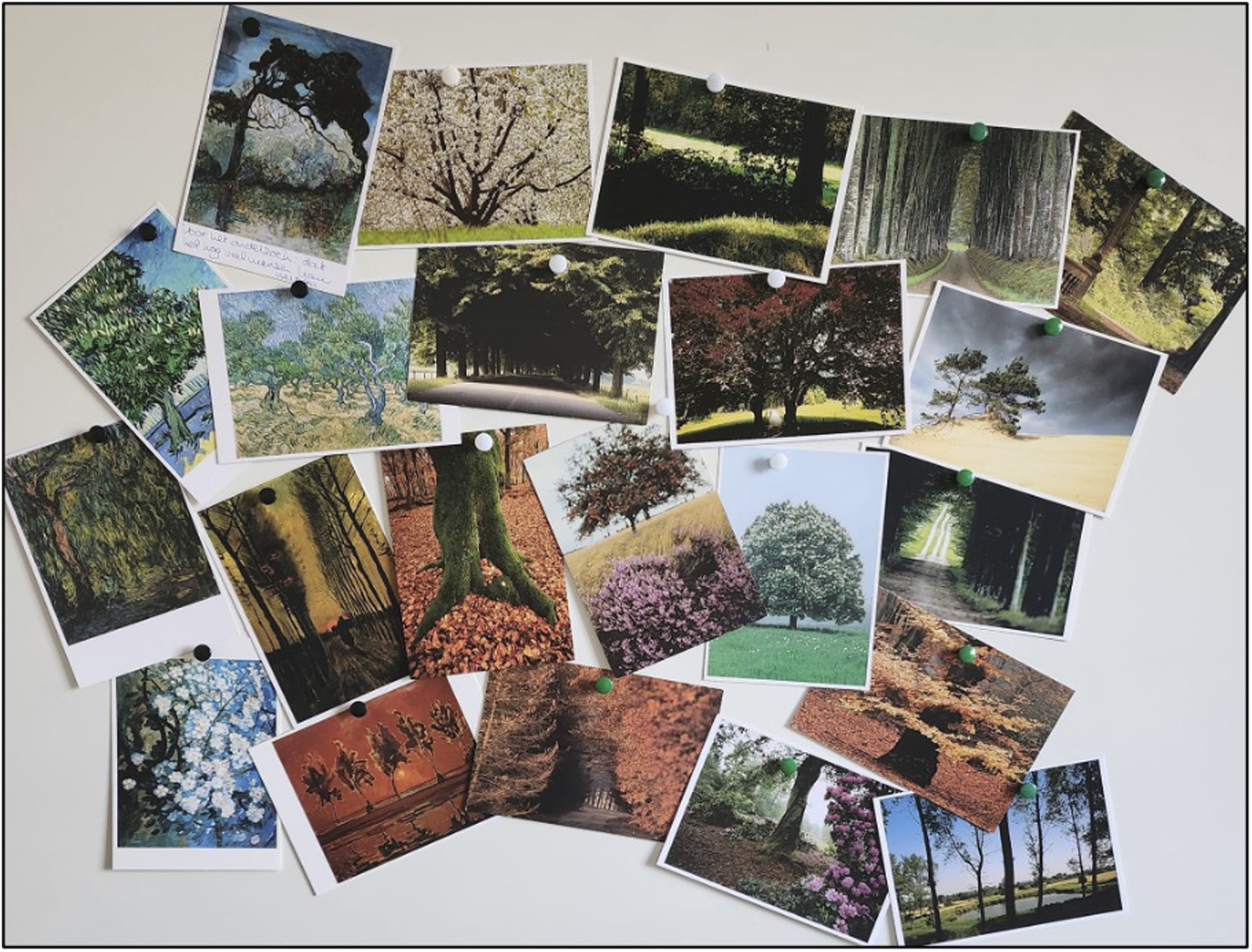
Backstage
This meeting was relatively straightforward due to its practical focus. There is little to report from backstage apart from two main reflections. First, the facilitating researcher had selected the metaphorical approach in advance to creatively address practical aspects of the PAR project. The aim was to support open discussion while ‘walking through the forest,’ using cards to aid reflection and memory. Building on earlier positive exercises with the resilience postcards and the life event game, co-researchers were invited to reflect on the forest metaphor before the session. Some engaged enthusiastically, while others expressed fatigue with metaphors. This created an imbalance in group dynamics, since not everyone found the exercise accessible. The facilitating researcher acknowledged these differences and made space for them to be voiced. She also observed that discussion of the metaphor’s usefulness shifted attention away from the core project themes.
One striking element was the use of forest-themed postcards to capture expectations. Co-researchers wrote down both personal hopes and project-related expectations. For those who did not connect with the forest metaphor, this exercise offered another way to express their views. This highlights the importance of providing varied methods to accommodate different preferences. In retrospect, we could have placed more emphasis on asking co-researchers what they found helpful and on offering a wider range of work methods.
Secondly, the meeting’s structured and full agenda left little room for spontaneity. Yet unpredictable behaviour, whether from individuals or the group, can surface lingering doubts, questions, or concerns. More flexible formats create space for co-researchers to speak openly, highlight what matters to them, and shape the research to reflect their experiences. In retrospect, it would have been better to ask the group in the first meeting how they wished to approach the second and then adjust the format accordingly.
Meeting 3 (& 4)
Frontstage
After completing their interviews, the co-researchers met again to share experiences and insights. The original plan included two meetings per municipality: the first with a group of 3–4 co-researchers for in-depth discussion, followed by a larger group of 10–12 to build on these discussions and evaluate the project. Both were to be organised by the facilitating researcher. After piloting this two-meeting format in two municipalities and receiving feedback from co-researchers, she decided to replace it with a single three-hour, large-group meeting in each municipality.
To reflect on the interviews, co-researchers examined participants’ stories in three phases: past events, present circumstances, and the development of resilience over time. This structure was suggested by the facilitating researcher and agreed upon collectively in Meeting 2 (see Seeds). Co-researchers were also invited to reflect on their own experiences of conducting the interviews and participating in the project. Reflections on all of these topics were exchanged in randomly formed pairs or trios, written down on sticky notes, and placed on coloured A3 sheets for plenary discussion (see Figures 6 and 7). Co-Researchers Discussing Findings Sticky Notes From a Co-Research Analysis Session
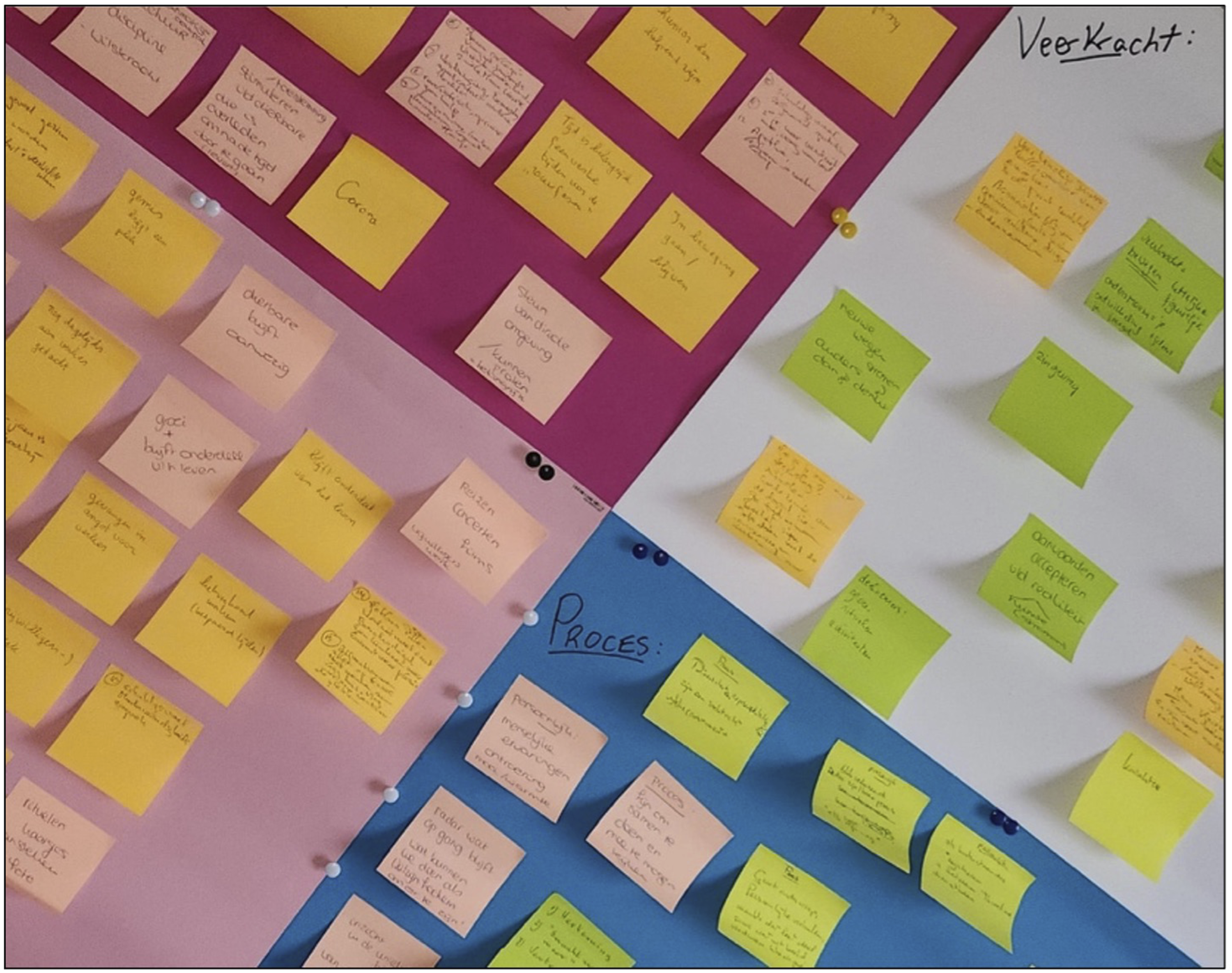
As in earlier meetings, the facilitating researcher guided the process but did not participate in the exercises herself. Unlike the previous, more structured sessions, this meeting was open-ended, allowing co-researchers to reflect freely on their experiences. She mainly kept track of time, ensuring that both reflections on the interviews and the project were addressed.
The facilitating researcher observed a sense of co-ownership in the group, as contributions came from everyone, not just a few dominant voices. She felt less pressure to intervene because the group engaged in thoughtful and respectful conversations grounded in their interview experiences. To close, the group reflected on what they had gained from the project and whether it had met the expectations recorded on their postcards in Meeting 2. Their reflections included unexpected insights and moments of personal growth, as illustrated in the following quotes. “The most remarkable experience for me was that my deep fear of losing my husband, who has been my rock for over 40 years, has significantly lessened. I’ve carried that fear for a long time. Hearing the resilience of the widows I spoke with gave me the courage to trust more in myself, should he pass away before I do.” – C “By participating in the project, feeling a sense of recognition and being affirmed in that, I also felt strengthened.” – M
Backstage
The facilitating researcher had designed the two-meeting format based on her qualitative research experience, assuming that starting in smaller groups would foster deeper reflection and analysis. When the meetings were later combined into one, it marked a turning point. The pre-set plan did not limit group input, as co-researchers proactively shared feedback and suggested changes.
During the larger group meetings, the facilitating researcher experienced stress. She maintained a calm presence and occasionally stepped back to check in with herself while the co-researchers worked together. She assumed the stress came from the open structure of the session. By contrast, the earlier, more structured and time-intensive meetings had felt less stressful. She worried that this meeting might feel less meaningful or even boring for co-researchers. In retrospect, however, we recognise that the opposite may have been the case.
Having conducted interviews and heard residents’ stories across the three municipalities, co-researchers had gained personal experience with the topic. They began to share these experiences independently and reflect on what this revealed about the meaning and functioning of resilience. Whereas the group had previously waited to see what would unfold, they now proactively shared insights from their interviews. The flexible format gave them space to reflect more spontaneously and freely. Additionally, the facilitating researcher observed that the co-researchers had strengthened their skills in managing these conversations. They shared and listened respectfully, even when disagreements emerged. She no longer felt the need to step in, as the dialogue unfolded naturally.
In these final meetings, the facilitating researcher was confronted with personal ‘unwelcome truths’ about her positionality, most notably an ongoing struggle with letting go of control. While some research methods require tightly managed protocols, PAR relies on an open and flexible approach. Although she was committed to this approach both intellectually and intuitively, applying it proved psychologically and emotionally demanding. Accustomed to her own approach to ensuring rigour in data collection, she had to find new ways to engage with material presented freely and spontaneously by the co-researchers.
She recognised that in PAR, equality among participants also depends on the facilitating researcher’s ability to release control and embrace a sense of common personhood. Yet significant personal life events had given ‘releasing control’ a subconsciously negative connotation. As a result, adopting a flexible approach with reduced control felt less natural than anticipated and brought feelings of responsibility and personal strain to the surface. This insight began a shift in the facilitating researcher’s positioning within the project and on a personal level. She became aware of deep-rooted associations between control and responsibility. She gradually recognised how rigidly managing complexity can be counterproductive. Loosening control proved not only possible but also valuable for her development as a researcher and for the project as a whole.
Furthermore, these challenging insights were openly discussed with co-researchers, co-authors, and professional peers throughout the project. In final meetings, the co-researchers reflected on mutual sharing of struggles and concerns and described its impact as follows: “The open and equal communication in the project was a breath of fresh air for me. Equality and safety make it possible to show vulnerability, to ask questions freely, to express and work through uncertainty, to voice doubts, to develop ideas, to exchange impressions, experiences, and insights, and to compare and adjust views. In my view, this creates a fertile ground for scientific inquiry.” – C “A surprising development for me as a co-researcher was that my understanding of my own resilience deepened, and the thorough evaluations contributed to this.” – T “I experienced the conversations [with the facilitating researcher] as open and equal, which gave me an inquisitive mindset that I was able to maintain. The exchanges added more depth to my understanding of the different layers of resilience. I carried this into the interviews I conducted. This not only led to meaningful conversations but also provided richer information about resilience.” – M “I appreciated that, during our first conversation [the facilitating researcher] shared something about her own life. She had just come back from her grandmother’s funeral […] and she talked about that. We also spoke about caregiving and even laughed about how it can sometimes become overwhelming. I enjoyed exchanging such personal stories. It added a sense of lightness to heavy topics and made me feel more open about my own background. I carried this openness into my conversations with the interviewees. I think it helps when participants see someone in front of them who is also simply a person with life experience.” – M
Discussion
This article examines a Dutch PAR project on resilience and loss using Goffman’s metaphor of frontstage and backstage performances. The frontstage represents the communicative spaces created by the facilitating researcher and co-researchers, where ‘unwelcome truths’ could surface. The backstage captures reflections on methodological choices and researcher positionality. Making such reflections visible is more than a matter of personal reflection. It deepens understanding of how PAR is implemented in practice. Yet such reflexive accounts are seldom included in published studies. Their absence increases the risk that researchers fall into the same pitfalls without recognising them as shared challenges. Providing such accounts is therefore essential for advancing accountability, transparency, and learning in PAR.
As illustrated, methodological challenges involved the practical work of creating communicative spaces, including selecting locations, facilitating dialogue, and addressing ethical dilemmas. Positionality issues arose from the emotional and psychological demands placed on both co-researchers and the facilitating researcher. At times, this strain led the facilitating researcher to seek control, while co-researchers expected her to ‘know’ the answers and adopt a more authoritative role. As the project progressed, the facilitating researcher learned to work more flexibly and the co-researchers assumed greater responsibility, sharing more authority in the research process. These dynamics demonstrate that personal responses and methodological choices are intertwined and need to be acknowledged to understand how PAR unfolds in practice.
This highlights that a felt understanding of implementing PAR may only emerge through practice and by confronting ‘unwelcome truths’ (Boyle et al., 2022; Dedding et al., 2023). These truths include not only those surfaced in dialogue with co-researchers, but also those uncovered within oneself as a facilitating researcher. Such work demands a high level of reflexivity, both in engaging with difficult conversations and in facing uncomfortable truths about one’s own positionality (Boyle et al., 2022). Failing to exercise such reflexivity can create psychological barriers that hinder group empowerment. This is particularly the case in institutional PAR settings where facilitating researchers retain some control over funding and methodological choices (Arieli et al., 2009).
Revealing typically unpublished ‘backstage’ dynamics of this PAR project exposed inherent messiness and personal confrontations. Messiness is often perceived as a weakness in research, something best kept out of view. Yet, as Cook (2009, p. 289) argues, “for rigorous PAR research to take place, researchers need to actually create and dive into the messy area.” Documenting such honest accounts is essential, as it is often the learning that emerges from this ‘mess that enables transformational processes (Boyle et al., 2022; Cook, 2009).
At the beginning of this article, we asked whether the positionality of the facilitating researcher can be questioned without undermining the integrity of a PAR project. The experiences outlined here suggest that this is not only possible but also critically important. Facilitating researchers often have ‘built-in advantages’ (Arieli et al., 2009) through their role in managing resources, overseeing implementation, and meeting responsibilities to funding bodies. Sharing reflections on positionality enables an informed evaluation of the facilitating researcher’s integrity. Rather than undermining the project, such reflexivity provides deeper insight and fosters learning.
At the same time, we recognise that reflexive writing risks foregrounding a single voice. Reflexivity in PAR is relational, shared, and iterative, as evidenced by discussions of backstage issues with co-researchers, co-authors, and professional peers. We maintain however that rigorous individual reflexivity can coexist with collective praxis. For those in positions of structural privilege, it may even be essential for strengthening accountability and transparency.
Furthermore, this article addresses issues of control in relation to the facilitating researcher’s positioning. It does not suggest, however, that PAR facilitators in resilience research should relinquish their responsibilities for supporting co-researchers. The unique ethical responsibilities of PAR make this neither feasible nor advisable (Aussems et al., 2022; Banks & Brydon-Miller, 2019; Banks et al., 2013). We recommend acknowledging that effective facilitation in a communicative space involves knowing when to step in and when to step back. At times, an active role may be necessary, even if it risks limiting shared responsibility. For example, the facilitating researcher intervened in the initial meetings to foster mutual understanding during emotional conversations that involved personal disclosures. If the project were repeated, we would not alter this approach, as it reflects an ethical responsibility for the group’s safety. In later meetings, the co-researchers had developed skills to manage these conversations, and the facilitating researcher was naturally able to step back.
In future projects, we may take a more experimental approach by loosening control and structure earlier in the process where it appears unnecessary. This could apply, for instance, to the formation of ground rules or to discussions of practical matters. Guidance for finding this balance can be drawn from an ‘ethics of care’ lens (Groot et al., 2018) and from studies that highlight the value of sharing ‘practical insights’ with co-researchers (Aussems et al., 2022).
Additionally, no excessively dangerous or illegal responses to adversity were disclosed. Had such disclosures occurred, the facilitating researcher was prepared to respond. At the outset, it was explained in the ground rules that any information posing a risk to oneself, or others could breach confidentiality and would need to be reported. This condition may restrict the sharing of certain unwelcome truths and limit full communicative freedom. However, we would not alter this approach, as it reflects an ethical responsibility to participants safety.
This aligns with Carr and Kemmis’s (1986) observation that the ideal of communicative freedom described by Habermas (1984, 1987) is not always achievable. There are limits. Nevertheless, striving for communicative freedom remains valuable, particularly because it promotes critical reflection across the four validity claims of comprehensibility, truth, rightness, and sincerity. In principle, all participants should have equal opportunity to challenge ideas on the basis of each of these claims within a communicative space. Unforced consensus across the validity claims fosters solidarity within the group, which in turn lends legitimacy to agreements and resulting collaborative actions. (Habermas, 1984, 1987; Kemmis, 2006).
In this project, meetings with co-researchers were designed as communicative spaces where ‘unwelcome truths’ could surface. Habermas’s validity claims provide a valuable lens for reflecting on communicative freedom within these spaces: • Comprehensibility refers to whether ideas on resilience were expressed in ways all participants could understand. The resilience postcard exercise addressed this by supporting co-researchers in developing shared and individual understandings of resilience. • Truth concerns whether what was shared in the meetings was considered accurate. Co-researchers recognised that what is ‘true’ for one person may differ for another. This insight emerged through discussions of unwelcome truths and reflection on the importance of respecting differing experiences of resilience. Even without full agreement, mutual understanding grew through open reasoning and active listening. • Rightness relates to whether the project’s ideas aligned with accepted social norms and ethical standards. In meeting 2, co-researchers reflected on the project’s relevance for interview participants and for society, affirming both its responsible structure and its potential for positive impact. • Sincerity focuses on whether participants spoke genuinely and meant what they said. Space for open and honest expression enabled authentic emotional exchange, and the group’s shared value of transparency fostered both trust and authenticity.
Despite the restrictions faced, the validity claims help illustrate how unforced consensus and collaborative action emerged in the communicative spaces of this project. These outcomes were evident in the interviews and the final group sessions. For PAR more generally, the validity claims offer a valuable guide for fostering communicative freedom, even when it cannot be fully achieved. Our project illustrates how striving toward such an ideal can, in itself, strengthen the research process. At the same time, a note of caution is necessary. For co-researchers to feel safe enough to speak openly in this project, ample opportunities for reflection and discussion were needed. Creating this space helped normalise discomfort and build mutual understanding. Rushed timelines, by contrast, risk producing pressured and superficial forms of consensus. Additionally, the topic of resilience is a flexible concept that allows room for subjectivity. This further complements the application of the validity claims by enabling the expression of multiple personal ‘truths’. Researchers must therefore carefully consider whether applying the validity claims is realistic within their timeframe and consistent with their aims. As Dedding et al. (2020) observe, pursuing ideal PAR practices can be difficult in practice, and the notion of ‘good enough’ PAR may at times be more appropriate.
Regarding the value of PAR in resilience research, this article emphasises how co-researchers developed a stronger sense of ownership and demonstrated greater skill in navigating complex or sensitive conversations. PAR offered the co-researchers a layered experience: they reflected on their personal understanding of resilience while also directly experiencing how collective understandings are shaped through interaction and dialogue. This was especially evident when confronting unwelcome truths that led to tension, conflict, or frustration. In essence, the co-researchers investigated the ‘reality of resilience’ in order to transform it, by turning that reality into a communicative space for joint exploration (Borda, 1979; Kemmis, 2006). Such an approach is particularly valuable in resilience research, as it mirrors the relational and often uncomfortable conditions under which resilience is formed (Angevaare et al., 2020; Beeris et al., 2025; Glas et al., 2023; Kralik et al., 2006). By utilising PAR, co-researchers and the facilitating researcher did not merely study resilience but enacted it, creating conditions in which resilience can be observed, questioned, and collectively redefined. This deepened both individual and collective insight into how resilience is strengthened or hindered in everyday life.
Conclusion and Invitation
Frontstage
This article has illustrated the often-overlooked realities of creating communicative spaces in PAR on resilience and loss, where unwelcome truths can be surfaced and confronted. We share these insights to support other researchers and advance the use of PAR in resilience research. Habermas’s theory of communicative action provided a valuable lens on striving toward communicative freedom in PAR, even in the face of restrictions. Our reflections also show that stronger PAR practice arises through experience and openness about difficulties. We therefore invite both new and experienced PAR researchers to view PAR as a continuous learning process. Sharing backstage practices can deepen understanding of resilience in real-life conditions and strengthen communicative spaces. Without such reflexive work, the core PAR principles of accountability, transparency, and learning risk remaining aspirational rather than realised in practice. Additionally, our findings underline the positive potential of PAR for resilience research.
Backstage
The title of this paper is a direct quote from a co-researcher, capturing how, after experiences of loss, both co-researchers and participants sought to ‘find themselves again’ in terms of resilience. It also reflects how connection within communicative spaces was described as transformational, extending beyond the individual and at times disrupting a previous sense of ego. Writing this paper brought a similar experience for us as authors: setting ego aside allowed deeper engagement. Although such reflexivity is often uncomfortable and unconventional in scientific writing, it proved transformative for our learning and for future PAR projects. We therefore encourage fellow researchers to set ego aside, reflect on their own backstage practices, and share their insights. Openly engaging with discomfort, rather than avoiding it, can foster resilience both in individual practice and within the research community.
Footnotes
Acknowledgements
The authors wish to extend their gratitude to the co-researchers and collaborating partner organisations, without whom this project would not be possible.

Ethical Considerations
Ethical approval for this study was obtained from the Ethics Committee of the University of Humanistic Studies, Utrecht, the Netherlands, file 2023-06.
Consent for Publication
All co-researchers depicted in images provided verbal consent for the use of these photos in publications.
Funding
The authors disclosed receipt of the following financial support for the research, authorship, and/or publication of this article: This research was supported by ZonMw, the Netherlands Organisation for Health Research and Development under Grant ‘Complexiteit omarmen en veerkracht versterken’ Project number: 05550032110010.
Declaration of Conflicting Interests
The authors declared no potential conflicts of interest with respect to the research, authorship, and/or publication of this article.
Data Availability Statement
The data package for this paper includes reports and materials from the co-researcher work sessions, as well as anonymised summaries of approximately 150 interviews conducted at the time of writing. Given the sensitive nature and volume of the data, all materials are securely stored on a protected drive at the University of Humanistic Studies in the Netherlands. Access may be granted upon reasonable request by contacting the corresponding author, subject to ethical and confidentiality considerations.