




Abstract
Ethnography has increasingly gained prestige in the forest arena, challenging various assumptions about people-nature relations. The importance of participant observation in navigating turbulent forest environments is often overlooked, as demonstrated in the lead author’s dissertation, “Knowledge Integration in Co-management,” a 6-year study with the People of the Mount Cameroon National Park (MCNP) published in 2022. We argue that revisiting behind-the-scenes encounters during fieldwork is crucial for addressing criticism of ethnography’s inadequacy in capturing the material and moral conditions that explain human behavior. These insights can enhance the depth and validity of ethnographic research, providing a more comprehensive understanding of the complex dynamics at play. This paper reflects on behind-the-scenes experiences, contextualized by identity and representation, conservation cluster variances, and research ethics. We describe the dynamic nature of events and obstacles of travelling during field work and how forest ethnography behind the scenes was pivotal to navigating them. It concludes by discussing why these components in the use of forest ethnography matter in counteracting fieldwork challenges and what they imply for studying complex co-management settings.
Keywords
Introduction
Forest ethnography examines how ecological and social processes interact over time, influencing environments and shaping human experiences within them (Ogden, 2011; Ogden et al., 2019). It is a qualitative approach that combines multiple methods to examine how contemporary settings are shaped in ways that question assumptions about the relations between people and nature (Ogden, 2011). Since its inception in the 19th century, within a positivist and imperialist context, forest ethnography has faced growing criticism for its inability to adequately capture the material conditions (which determine people’s quality of life) and moral conditions (principles that govern a person’s behavior) that explain human behavior (Shore, 2006). Particularly, since the 1980s, postcolonial scholarship has aimed to critique and deconstruct ethnography to reveal ‘truths’ about people and cultures (Elolia, 2024). Hence, extending ethnography to applied settings like forests is crucial for understanding human behavior and its impact on forest governance (Brockington et al., 2008; Brockington & Duffy, 2010; Brockington & Wilkie, 2015).
Within the forest scope of applying ethnography, an impeding challenge is how to balance between state resource management of forests, meeting the diverse needs of the growing human population, and promoting biodiversity conservation. While this question has been explored in an anthropological study among people of the Mount Cameroon National Park (MCNP) (Nebasifu, 2022), it sheds very little knowledge on the encounters behind the scenes during fieldwork, and their methodological implications for addressing existing criticisms of ethnography. This paper examines the “behind the scenes” concept with attention to tacit data and its methodological significance, i.e., passive occurrences during fieldwork including the related nuances of gathering empirical data, using two objectives: (a) To examine experiences underlying the behind-the-scenes events at the MCNP and the capacity of forest ethnography to navigate challenges encountered during fieldwork. (b) To explore, alongside the deconstructive influence of postcolonial studies, the methodological implications of these experiences, specifically the lessons they offer for researching complex forest environments under co-management.
The MCNP case represents a good example for addressing the above questions and the potential embedded in applying forest ethnography within unstable settings of co-managing forests with people. We revisit the lead author’s dissertation on “Knowledge Integration in Co-management” (Nebasifu, 2022), an anthropological study conducted based on a 6-year ethnography with the people of the MCNP. The study examined the nature of power relations between local communities and park authorities involved in the co-management (collaborative management) of the MCNP; the agency people display to boost their resilience within the system; and the relationships between biodiversity and local knowledge. In line with this study, we draw from behind-the-scenes data to examine the capacity of forest ethnography to navigate the complexities of conducting fieldwork in turbulent forest environments.
Behind the Scenes in Research
The “behind the scenes” can be defined as a composition of the material and moral conditions, and undisclosed experiences that display as “tacit data” during interviews or other forms of inquiry. The practice of using behind-the-scenes knowledge to inform ethnography is not new in anthropological inquiry and other social sciences. It often serves as a reflection on lived experiences that justify the researcher’s interactions with participants, various expectations, and emotions fundamental to drawing supplementary lessons from a study. For instance, Rios’ (2009) work explores the constructs of fatherhood and masculinity in Mexico. Rios discusses behind-the-scenes encounters, enabling her to reveal the mixed emotions and dilemmas of in-depth interviews that clarify the boundaries between data collection and interpretation. Based on this clarification, she argues that elements such as personal history, identity, and the insights enacted affect the dynamics of interviews, the accounts provided, and the meanings produced. Similarly, Macdonald’s (2006) retrospective analysis, based on an ethnographic study conducted between 1988 and 1990 at the Science Museum in London, demonstrates how behind-the-scenes material was useful in uncovering blind spots that hindered data analysis from revealing categories in the initial study.
The MCNP Case
Nonetheless, the MCNP provides examples that contextualize the researcher’s interaction with participants behind the scenes, situating identity, representation, and ethics with place and the meanings this situatedness produces for the research process. In this scenario, the researcher’s identity occasionally asserted itself, and the qualities attributed by participants contributed to what Dervin (2012) describes as “grasping sociality and the world.” This concept involves the production of assumptions and activities in and about the world through socially shared beliefs and knowledge among individuals. Such interactions highlight the dynamic interplay between the researcher and participants, shaping the understanding and interpretation of cultural practices and social realities. The MCNP is a site centred on Mount Cameroon, a large natural elevation that stands at 4,070 meters above sea level with rich vegetation, including a mix of tropical rainforests, mangrove forests, montane forests, and savannah grasslands. Categorized as an IUCN category II protected area in the Gulf of Guinea Forests in Sub-Saharan West Africa, Mount Cameroon has over 2000 plant species, some 46 of which are endemic to the mountain (Nebasifu, 2022, p. 50). Following its establishment in 2009, its land area of approximately 58,178 hectares was subdivided into four conservation cluster zones (the West Coast, Buea, Muyuka, and Bomboko) administered by cluster facilitators (appointed individuals) that ensure information-flow between park authorities, local communities, and other stakeholders (Charlotte, 2014). Each zone has structural variances in their biodiversity, livelihoods, administrative setups, and proximity to towns and markets that tend to influence human behavior and how people react to forestry laws.
People, Settlement, and Forest Legalities
The Bakweri, a hunter-gatherer and agriculturalist group that long ago settled on the slopes of Mount Cameroon (Ardener, 1970; Neh, 1989) have for many years been at the edge of seeking recognition of their customary rights to land use since the coming of the nation-state. The Bakweri underwent land displacements and other forms of land conflicts following German conquests in the 1890s, colonialism (1884–1960), and the introduction of plantation agriculture (1907–1960) (see also, Ngoh, 1996). State laws have also played a role in governing land use and access, including “the 1974 Land Tenure Decree, the 1994 Forestry and Wildlife Act, and the 2009 Presidential Decree creating the Mount Cameroon National Park” (Nebasifu, 2022, p. 27). Furthermore, a ministerial decision in 2014 introduced a co-management plan for the MCNP (Charlotte, 2014). These legalities have shaped the basis for land use and access among local communities, and the power relations between actors involved in MCNP management. These include the agency and cultural resilience local communities display in response to park management. Often, the persistence of state-induced laws for forests do not match the immediate needs and local knowledge systems of the Bakweri which brings about hostilities among land users (Nebasifu & Atong, 2020a; 2020b). Thus, by tapping into experiences underlying the scenes at the MCNP, we determine the capacity for forest ethnography to navigating various hostilities during fieldwork.
The MCNP site will be explored as a unique example, grounded on the lead author’s fieldwork experiences. It has been observed that the human population is increasingly heterogenous, including 41 villages located in remote and nearby locations, with differences in land use. For instance, some villages practice sea fishing as their predominant source of livelihood, while others focus on subsistence farming and trading non-timber forest products. Moreover, incomers from groups elsewhere in the country have settled in the area. These include, the Bali, Wum, Bafut, Kom, Bamileke, Essimbi, all in Cameroon, and others from neighboring Nigeria. The Bakweri refer to these incomers as wajili in their Mokpwe language. That is, to indicate “foreign settlers who have no blood ties to Bakweri ancestors but have adopted traditional Bakweri customs and ways of using the land to the extent that they can be accepted as members of the Bakweri community” (Nebasifu, 2022, p. 50). Following decentralization laws (Republic of Cameroon, 2004a, 2004b), both state agencies and NGOs participate in forest activities through community development initiatives.
Contingent to this uniqueness of a study site there is a need to understand the barriers and promising experiences of gathering ethnographic data. We use the related concepts of identity and representation, conservation cluster variances, and ethical principles. Such concepts are found useful in capturing, analyzing, and contextualizing passive experiences in complex environments of co-managing forests. By using this conceptualization, we contribute to postcolonial thinking, acknowledging the prevailing criticisms of ethnography whilst arguing for a forest ethnography that is essential to navigating turbulent co-management settings by counteracting fieldwork challenges. Often, such settings can be those impacted by colonial legacies, inequalities, and various forms of instabilities that present diverse challenges for data collection or the general conduct of one’s field work. It is also important to consider what lessons we can learn from this case, and how other researchers could adapt our experiences to improve their own research. We particular revisit the dynamic nature of events and difficulties of travelling at the study site and how forest ethnography was focal to navigating these obstacles.
Conceptual Framework
The following paragraphs highlight relevant developments in ethnography and forest ethnography between the 19th and 20th centuries, with an overview of its concepts of representation, cultural identity, and ethics.
Developments of Forest Ethnography
The term “ethnography” originates from the Greek words “ethnos,” meaning people or tribe, and “graphia,” meaning writing. It refers to the detailed description and study of cultures and peoples (Jones & Watt, 2010). Ethnography has historically been used to create detailed accounts of cultures, which were often employed to ideologically justify imperialist ambitions and colonization. These accounts emphasized “otherness,” studying groups different from the observer. This approach, rooted in colonial history, affects contemporary ethnographic analysis of places and peoples (Simpson, 2025). In the 19th century, European powers expanded by colonizing regions, such as parts of Africa, labeling them as “others.” They sought empirical data from these areas to develop new laws and theories about society (Jones & Watt, 2010). Forestry within these colonized regions was particularly crucial, providing essential raw materials like timber and agricultural products that were vital for sustaining modern European society. For instance, in Cameroon, following its annexation, German colonial authorities expanded their imperialist efforts by developing plantation agriculture. This approach was heavily criticized for its harsh conditions, particularly the use of forced labor (Mfum-Mensah, 2025).
In the late 20th century, postcolonial studies began to critique and deconstruct the foundations of ethnography, which traditionally focused on non-Western cultures. These critiques aimed to uncover deeper “truths” about people and cultures (Elolia, 2024). As a result, ethnography began to be used more extensively in applied settings, such as the forestry sector. Researchers explored the roles of non-governmental organizations (NGOs), state systems for resource management, parks, and natural areas (Brockington et al., 2008; Brockington & Duffy, 2010; Brockington & Wilkie, 2015; Günel & Watanabe, 2023). Within this scope of literature, forest ethnography was further refined to exploring the multi-scaled political and economic processes that shape access, control, and conflict in the forest arena. For example, West’s (2006) ethnographic study reveals why a biodiversity conservation project instigated between 1994 and 1999 at the Crater Mountain Wildlife Management Area in Papua New Guinea was unsuccessful due to the conservation goals of NGO workers not aligning with needs of the Gimi people.
Other postcolonial studies accounting for forest ethnography developments manifest in the local literature noting resource management, control mechanisms, and conflicts in forest landscapes (Awung & Marchant, 2018; Carson et al., 2018; Nchanji, 2024; Pyhälä et al., 2016; Usongo, 2024). This has been useful in informing the multifaceted ways people and nature are constituted (Akem & Savage, 2019; Kiik, 2018). In anthropology, for instance, researchers have investigated how people adapt to their environment and build social connections. Some notable studies on these topics are by Berkes and Armitage (2010), Moran (2022), Mikkonen (2025), and Nadasdy (2007). They further recognize traditional knowledge and practices as essential for the sustainable use of natural resources and for developing robust socio-ecological policies (Mikkonen, 2025). This has helped to uncover newer understandings about forest ethnography and its wider uses in contemporary contexts.
Representation, Cultural Identity, and Ethics
To understand how behind-the-scenes experiences influence the capacity of forest ethnography to address various challenges during fieldwork, we must adopt relevant concepts as an overarching framework. This framework helps us identify justifications and explanations of human behavior, thereby enhancing the depth and validity of ethnographic research. In the case study of the MCNP, utilizing these concepts allows for a more comprehensive interpretation of the researcher’s proactive behavior, his interactions with local people and park officials. Consequently, we focused on three key concepts: ethics, cultural identity, and representation.
We need ethical considerations to better understand the cultural demands specific to sustaining the everyday life of individuals and groups. This is particularly useful to clarify the purpose of credibility and integrity in the research. How understandings of representation and cultural identity develop from a study would therefore depend on Brightman and Grotti’s (2020) notions of conforming with good scientific practice and the principles applicable to consent and treatment of data, including various meanings produced about the researcher’s identity among informants in fieldwork. Identity may as well include the heteromorphic ways in which self-esteem, values, and realistic assessments of behavior integrate when relating the “self” and institutional structures (Patton, 2008) –that embed in the social and cultural environment.
Within this environment, cultural identity involves both objectively recognizable features and subjective feelings that arise through interactions with other people. According to Baker (1999), by the latter 20th century, identity and representation were regarded as related terms applicable to the construction of knowledge and the circulation of power. To Dervin (2012), cultural identity is a contested concept that presents itself as an analytical category attributed to qualities in a population and experienced by individuals. Dervin further notes that in the late 18th century, nation-states in Europe and elsewhere made efforts to develop a localized national culture, promoting a sense of cultural identity to prevent communitarian divisions and enable people to identify with each other. Cultural identity particularly refers to an individual’s sense of belonging to a particular culture or group, usually formed through shared features as beliefs, language, values, and norms that are passed down from generation to generation. Cultural identity shapes how people view themselves and the world around them and preserving such identity is crucial in fostering a more inclusive, equitable, and resilient environments (Ubaid, 2024).
Nonetheless, representation and cultural identity continue to face a challenging question of definition. An example found in the 18th century ‘crisis of representation’ wherein anthropology, in applying ethnography to grasp objective accounts of the ‘human’, questioned the effectiveness of knowing the ‘other’ through ‘knowing the culture’ (Dervin, 2012). Later in the 1980s, a time when postcolonial thought became influential, meanings were questioned in the anthropological use of ethnography, asking for instance how people represent their meanings, who interprets them, and how (Dervin, 2012). Because of this problematic nature of representation and cultural identity, some studies have proposed that knowledge/experience (Wikan, 2002) should be used in studies about a culture. In this paper, we however focus on our experiences and interpretations to contextualize settings behind the scenes in the MCNP case.
Considering this framework, this paper attempts a contribution to the deconstruction of postcolonial studies. It challenges prevailing assumptions about people-nature relations using the MCNP study. We reflect on what methodological implications field experiences with places and people in the background produce about the ethics and politics of the research process.
Data and Methods
This section briefly describes the MCNP, its adjacent communities, livelihoods, the system of co-management, and the rationale for the use of descriptive analysis.
Study Area
Established in 2009, the MCNP is a protected area on the Atlantic littoral that stretches 50 km west of the park. Its land area includes approximately 58,178 hectares with four conservation clusters: the West Coast, Buea, Muyuka, and Bomboko, each with distinct variations in biodiversity, and proximity between residential area and park boundary. The MCNP is located on Mount Cameroon, the highest mountain in West and Central Africa. Other than the variety of plant species, the park is host to wildlife species labeled as endangered, such as drills, forest elephants, antelopes, chimpanzees, Preuss’s monkey, and several bird species. The climate, characterized by a wet season with up to 10,000 millimeters of annual rainfall and a dry season with abundant sunshine, along with annual temperatures ranging from 4°C to 32°C, contributes significantly to the region’s rich biodiversity. This diverse climate supports a wide variety of ecosystems and species, making it an area of ecological importance and interest for research.
The Bakweri are a major group that settled around Mount Cameroon for several generations before the 16th century (Ardener, 1970), credited to their connection with an ancestor Eye Njie, who is believed to have led the group’s settlement in present-day Buea. Bakweri belief systems and cosmologies are crucial to custodianship over the land. For instance, their dualism of ‘being’ between the living and the dead influences their ways of looking after the land and its resources to sustain good relations with the dead. Today, the people of the MCNP engage in fishing, farming, and hunting livelihoods, some being harvesters of non-timber forest products such as the prunus africana, within the Mount Cameroon Prunus Management Common Initiative Group (MOCAP). Other individuals have found livelihoods in tourism and various businesses (Figure 1). Visit to a Village in Bomboko, MCNP. Source: Authors’ Field Data (2017)
Threats facing biodiversity on Mount Cameroon, such as bushfires, plantation agriculture, and illegal hunting provoked the state to adopt various measures for protected area management. Such as, creating the MCNP, utilizing the 1974 Land Tenure Decree, the 1994 Forestry and Wildlife Act and 2004 decentralization legalities, and establishing a co-management plan in 2014 (Nebasifu, 2022). These provisions have been crucial to strengthening environmental protection in partnership with organizations and local communities. The initial co-management plan for MCNP was designed for five years (2014–2019), renewable following revision. Co-management aims at promoting the sustenance of ecosystems and fulfilling local community needs implemented through management programs (e.g., park protection and surveillance, ecotourism development, research, and monitoring, among other things) (Charlotte, 2014).
Central to co-management are provisions for “community mobilization and participation” that ensure periodic meetings between village chiefs (village leaders) and park officials in platforms such as the Village Forest Management Committees (VFMC). These meetings devise new strategies for conserving biodiversity and promoting community development. Along with these arrangements are cluster facilitators (park officials) appointed to promote the effective flow of information between park authorities, adjacent villages, and partner organizations. The system also uses conservation development agreements (CDAs) as a basis for assessing people’s compliance with forestry laws, implementing conservation incentives, and issuing credits and bonuses (remuneration to support livelihoods). The dissertation, however, illustrates some of the criticism of this system with divergent views that question whether the state plans for conservation incorporates local opinions in the management of the park (Nebasifu, 2022). We have explored instances of this criticism in the agency people express to continue their culture and negotiate their customary rights to land use, have been observed. (Nebasifu & Atong, 2020a).
Descriptive Analysis
This study is based on a descriptive analysis of experiences behind the situations of working with people and various officials involved in the co-management of the MCNP, in a 6-year dissertation completed in 2022 (Nebasifu, 2022). In this paper, we present insights from the initial study that utilized field-based participant observation, as defined by Roque et al. (2024). This method enables researchers to immerse themselves in real-world environments, fostering connections with participants by observing their cultural practices, beliefs, and behaviors. Through this approach, we uncover previously undisclosed experiences that enrich our understanding of the study context. Descriptive analysis aims at describing past and present data, for better understanding and interpretation. In descriptive analysis, data presentation uses different forms of visualization such as tables and graphics, among other things. According to Loeb et al. (2017), descriptive analysis helps to reveal patterns in a dataset and inform decision-making. It enables the detection of participants’ behavioral trends in data. Descriptive analysis may however fall short of accurate representation of a study group when generalizing to cases elsewhere.
This dissertation used a multimethod ethnography (see: Nebasifu, 2022, p. 60), which shows the combination of different methods for data collection and analysis to derive comprehensive knowledge about the MCNP co-management setting. The study employed a range of methods, including purposive sampling, focus group discussions, field observations, face-to-face interviews, and discourse and narrative analysis. These approaches were carefully adapted to address the unpredictable nature of fieldwork and the practical requirements of article-based dissertations. By utilizing this diverse methodological toolkit, the research was able to capture a comprehensive understanding of the subject matter, accommodating the complexities and dynamics encountered in the field. Political instabilities in the study area also impacted the nature of the interviews. For example, the Ambazonian war intensified in September 2017, a period in which separatists in the Northwest and Southwest regions of Cameroon began a conflict against the Cameroon Government in a quest for the independence of southern Cameroon.
Given that ethnography has been criticized for not capturing the material and moral conditions that justify human behavior sufficiently (Shore, 2006), the current research paper builds upon Andersen and Risør’s (2014) descriptive analysis that draws attention to the importance of contextualization. Moral conditions include principles that govern human behavior such as empathy, inclusivity, to even the normal and values that guide the everyday beliefs and livelihood interactions of people. Material conditions pertain to those aspects that shape people quality of living including wellbeing, access to essential livelihood sources such as forests and farmlands, among others. This helps to: (a) uncover blind spots missed in initial data analysis, (b) provide insight into the sociocultural and political context influencing methodological choices, and (c) highlight the nature of verbal statements and the context of interviews. This creates a comprehensive view that informs the research process, highlighting emerging patterns crucial for achieving the research objectives. Figure 2 illustrates our focal points in the use of descriptive analysis. Applying the Descriptive Analysis. Source: Authors’ Own Illustration (2023)
Results
In examining the “behind the scenes” events, we consider three aspects that constitute promising and rigorous experiences at fieldwork including identity and representation, conservation cluster variances, and ethical principles in the research process. Many of these experiences, we claim, are observed as shaped by the locals’ and officials’ view of the researcher’s background as a ‘son of the soil’, meaning one who belonged to the community. In this case, the researcher was understood as one who had lived and acquired educational skills in the Mount Cameroon area over a decade ago, having previous knowledge of the study site, and who returned for fieldwork after several years of being a student overseas. This enabled the researcher to enjoy the benefits of an ‘insider’, although on other occasions, the locals perceived him as an ‘outsider’. We however interpret these experiences as good practice, one of partnership between the researcher and informants as we shall discuss in the paragraphs below.
Constructs of Identity and Representation
The researcher’s identity in a study site may include attributed qualities constructed in contact with other people. Representation allows individuals to position themselves, assert identities, and defend themselves on various occasions of attributing qualities. Both concepts, identity, and representation, in cultural settings, enable the individual to grasp the social world and interact with other people (Dervin, 2012). Relevant to identity and representation is the researcher’s previous acquaintance with the study site and informants. To the researcher, having earlier knowledge of the people, their culture, and place on Mount Cameroon came about many years ago in acquiring primary and higher education as a student in Buea. This showed in two instances of conducting interviews. The first, when the researcher met with a hunter, who happened to have been a primary school teacher of the researcher years ago, describing the hunting methods among the Bakweri (Movawu to mean hunting using dogs, and Makolokoto describing the practice of hunting at night) (Nebasifu, 2022, pp. 114-115). The other instance concerns a local, who had equally served as an informant to a relative of the researcher years back. Both cases were welcoming to some degree to the researcher, which eased the process of gathering data. Thus, with the researcher’s identity and representation being that of an ‘insider’, this further enhanced the support and trust from informants.
Another example involves situations of the researcher’s first entry to a study village in a meeting with the VFMCs. We recall some of the words of a local and member to the VFMC in welcoming the researcher: Sir, welcome! Most of our people went to their farms. You can wait here, have a seat. We heard that you would be visiting us. Finally, you arrived. Soon, the others will return from their farms. There is a community hall where meetings like this take place. But today, we can sit outside, and you can join the rest of the people in the matango house (a small wooden house where the locals gather to drink palm wine) when they arrive ... So, tell us about yourself, where you come from, your work, and why you are here, before the others join us…
In this scenario, the researcher’s conduct is primary to the interest and commitment participants display in sharing thoughts about the co-management system, such as the researcher’s ability to schedule interviews and notify people of his visit in advance through cluster facilitators.
Other procedures like using a language the locals understand and being a good listener are some of the significant qualities of the researcher’s engagement with participants. This also necessitates exercising a sense of humbleness or respect for the locals. An example concerns an instance of using pidgin English –a language spoken locally by most residents around the MCNP. During a morning of having attempted several phone calls to schedule an interview with a park official to no avail, the lead author decides to visit the official’s office in person. On that morning, we recall that after waiting patiently at the office door, upon being called up by a Secretary at the office, we exchanged greeting in pidgin and got a pleasant response (translated from pidgin to English language): Good morning... Sorry for keeping you waiting all this while. How can I help you Sir? Will you like to have the interview today? From what time of the day? So, you are coming from abroad. But you are from this vicinity? How long will you be staying in the country for your research? I can help you with more information if you need. We are always happy to receive guests like you…
Although the history of pidgin is intricately tied up with British and European colonialism (Mair, 2025), it has become a widely spoken language across several local groups in Cameroon and serves as an important language for trading between the locals and incoming traders from areas elsewhere such as the neighboring Nigeria. Speaking the language fosters a sense of belonging. For example, besides interviewing the official, we received extra time for discussions and access to reading materials, including reports on forest management in the southwest region, details on active organizations in the MCNP area, and official reports on biodiversity conservation initiatives in state and community forests. We engaged more amicably with the official and the Secretary, which led them to discuss various challenges of the MCNP co-management system. It also allowed them to learn more about the researcher’s background.
In other instances, assisting in a village task and exercising great patience upon arriving for a village meeting played a critical role in the engagement of informants. These were crucial to building trust and acceptance among the research subjects. In these situations, the locals approve the researcher’s position with rewards. Figure 3 shows an example in which the researcher entered a remote village in the Buea conservation cluster for a focus group discussion. After an hour of patiently waiting, the locals reward the researcher with a friendly welcome of delight, offering palm wine (a traditional drink made of extract from the palm tree) before beginning interviews. Locals Welcome the Researcher at a Village in Buea. Source: Authors’ Own Field Data (2017)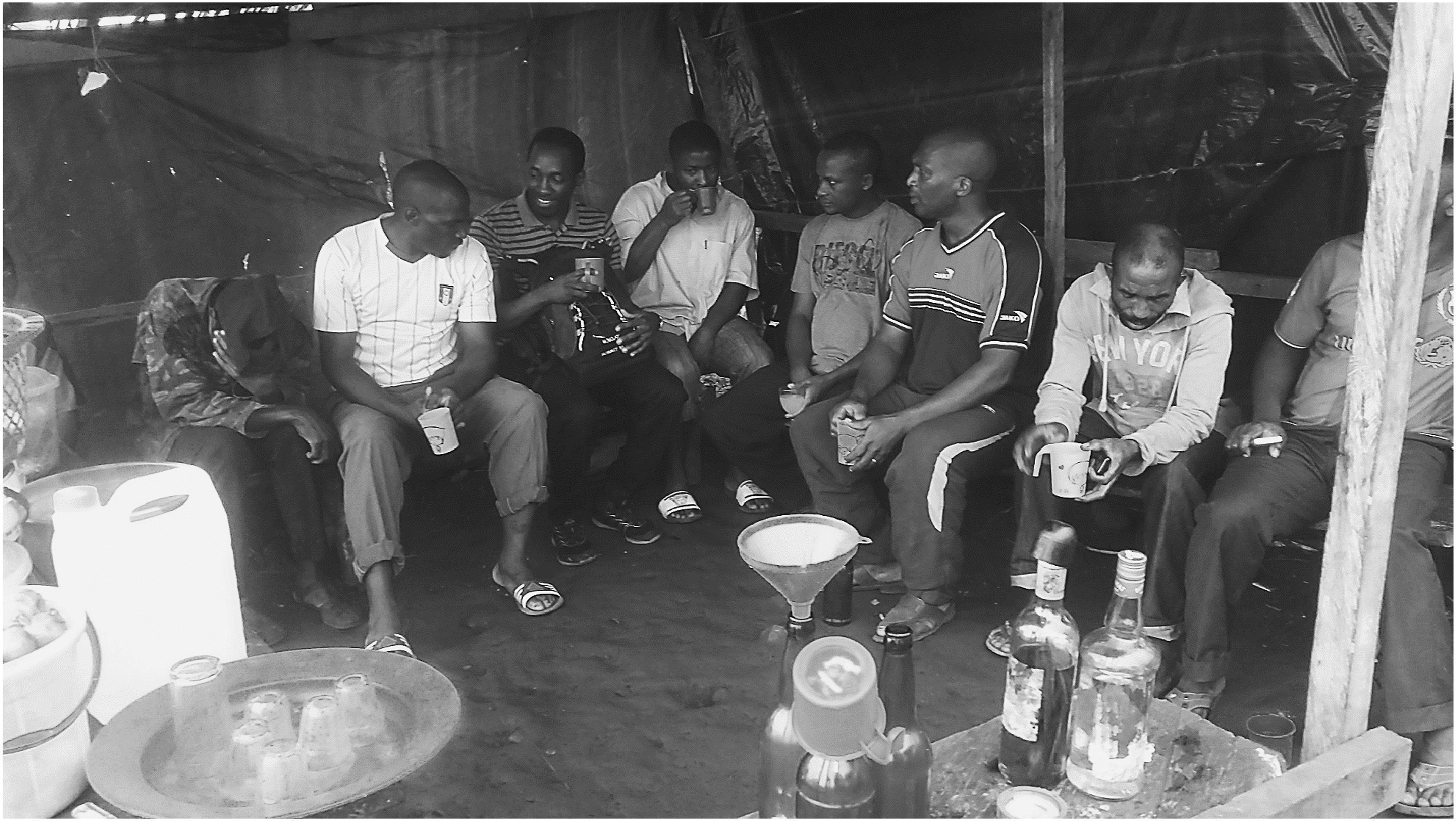
Other than village meetings, the study also included face-to-face interviews with park officials and representatives of state and non-state agencies that partner in the co-management system. In this instance, the researcher’s representation mattered for the interview process. Here, presenting oneself, using a surname, gave a sense of what cultural group the researcher belonged to and the language in which the official could respond to interviews. We do recount an instance of having met with another official during one of his busy schedules. Upon the lead author presenting his first name to the security guard who then informed the official of our presence, the waiting time prolonged for hours. When finally called up to meet with the official, the lead author then presented his family name and got the following reply (translated from French to English): Sorry Mr [lead author’s name] …. Are you related to … [name of a relative mentioned]. I am sorry for keeping you waiting. I knew your relative for so many years when we worked together, and it is wonderful to see that you are following his footsteps as a researcher. Again, sorry for keeping you waiting…My assistant will provide to you all the documents you need. Do not hesitate to get back to me if you need further help for your research…
In this example, the official recognizes the researcher by the family name. Among the study group we worked with, family names are very important and do shape what kind of favors an individual may receive depending on what impression people have about the relative bearing the family name.
Aspects such as dressing decently, arriving at the official’s office ahead of the scheduled interview, and having all the necessary permits for research in paper form, were all vital to the interview process. French language skills were essential to steering the in-depth nature of interviews with some officials. One factor to note here concerns the political instabilities brought by the Ambazonian war with road blockades reinstated and military personnel patrolling major streets to reinforce security. It was understood and evident that the course of the war did induce an impression of fear and caution among some of the informants we worked with.
Differences Between Conservation Clusters
The establishment of the MCNP led to the creation of four zones known as conservation clusters, each having distinct biophysical and socio-economic characteristics, even though all are governed under the co-management system. For instance, the West Coast in the southwestern flank of the park comprises villages close to the urban district of Limbe. The major roads are tarred, making transportation of agricultural products to nearby markets more accessible. Here, many of the locals practice fishing on the 50 km Atlantic seashore that extends along the southwestern flank of Mount Cameroon. Similarly, the study villages in Buea are close to urban and semi-urban areas with ease of access to markets, although subsistence agriculture is quite common. We were told during interviews that this proximity to urban areas and the presence of drivable roads did shape the recurrent visits park authorities organize to monitor forest activities. Because urban areas constitute markets that attract traders and tourists from far away in search of agricultural produce, many of the village residents were accustomed to visitors from elsewhere. It was also easier to travel for village interviews using motor transport, when compared to Muyuka (to the northeast) and Bomboko (to the northwest).
Unlike the clusters above, Muyuka and Bomboko present several challenges. For example, the remoteness of the study villages requires several hours of travel for interviews. The terrain is much more rigorous and rockier, consisting of valleys and hills, tropical rainforests, streams, rivers, and wooden bridges that made travel challenging. As a result, the researcher did swap the research vehicle to use a motorbike for reasons of poor road conditions, giving him additional time (unanticipated) to take photos while traveling through the tropical rainforest (Nebasifu, 2022, p. 61). In some of the villages, upon arrival with a Toyota Hilux (Figure 4), the locals mistook the researcher for a park official, and on other visits are mistaken for some wealthy individual. We recount some of the questions and concerns from a local farmer: Are you here today on park duty? How long will you be in the village? I am not sure if there will be many people present for meeting today. Does the chief know about your visit? … There have been some incidents of encroachment in the farms close to park boundaries, because the animals feed on our crops and we don’t know what to do about it… The Use of a Toyota Hilux at Fieldwork. Source: Authors’ Field Data (2017)
On some occasions of arriving at a village with a motorbike, the locals warmly welcome the researcher. However, with many of the locals cultivating cocoa on farms, usually long distances away, it is usually difficult to transport harvests to market as one local farmer from the VFMC in a village within the Bomboko cluster stated: Bomboko is the most remote cluster of all the others and so we must trek for several kilometers from our farms to take the harvests to markets in Limbe. The roads are so bad that we cannot get a taxi or any other means of transport to go to sell our crops but for those who can afford motorbikes. Because this place is so remote, the park authorities come here once a while to monitor activities in the village, but not regularly when compared to the other conservation clusters. The movement of people and vehicles here can be difficult especially in the rainy season…
Thus, due to the remoteness and unfavorable road distances, some farmers jump onto the back of the vehicle during a day of driving to or from a village interview, a practice many residents welcomed. We observed this practice as facilitating our access to the villages and at the same time strengthening our relationship with the locals. In a way, this also made it easier for us to build trust with the locals, who began considering the researcher as a friend and member to their community.
Ethics in Research Practice
Research ethics involves seeking credibility and integrity in the research process through good scientific practice, principles of consent, data protection and ownership, and the handling of research results (Brightman & Grotti, 2020). A typical way of going about ethical needs would include complying with the existing standards relevant to the researcher’s educational institution or board of ethics that specify what kind of requirements attribute to certain types of studies before visiting a research site. In the MCNP case, the researcher followed the Finnish National Board on Research Integrity (TENK) guidelines with attention to the Personal Data Act (523/1999). This takes into consideration informants’ consent to data storage, the usage of data, and guaranteeing their anonymity.
However, it can be argued that ethics in research go beyond the host institution to local procedures at the research site. Thus, in the MCNP case, the researcher sought official authorization from the Cameroon Ministry of Forestry and Wildlife, the state agency responsible for governing protected areas in Cameroon. There are also sub-levels to the local procedure, for instance, seeking an authorization letter from the MCNP conservator specifying the research objectives and the researcher’s request to conduct interviews with partners in the co-management system. This authorization seeking procedure includes holding bilateral meetings at which the researcher presents the initial research plan, subject to feedback from experts with long work experience at the study site.
Feedback was particularly useful in gaining better knowledge of the research site, circumventing various fieldwork obstacles, and streamlining the research methods in response to realities in the study society. For instance, following the feedback from experts as park officials, this enabled the researcher to access and review existing data from archives at the MCNP head office in Buea to further plan the interviews. Realizing just how much villages around the MCNP differ in several respects led to adopting a purposeful sampling to filter and select villages directly involved in park activities. Tacit authorization from local community governance mechanisms (usually letters issued with the signature of village heads locally referred to as chiefs) further enhanced the fieldwork, enabling entry to remote communities. Authorization letters were useful for going through security checks conducted by the military on major roads connecting urban and rural areas on the days when the movement of people was particularly limited because of the war. In one of the early mornings of driving through the West Coast conservation cluster, we recall our research vehicle being stopped and searched by persons from the Cameroon Rapid Intervention Brigade as part of a daily duty on patrol in his words (translated from French to English language): Where are you coming from Sir, and where are you driving to? We are conducting a routine patrol and will like to search your car. Can I see your ID card, the books of your car and an authorization letter from the Minister? …Be sure to drive safely and return in time…
This was part of a daily patrol given circumstances of the ongoing Ambazonian conflict in the region. But the Minister’s own authorization letter seemed to be the most recognized in this instance, without which the researcher would have been issued a fine despite having letters from other sources including a research permit.
Another observation concerns expectations for codes of conduct (do’s and don’ts) when interacting with local communities. The dissertation (Nebasifu, 2022, p. 72) targeted 17 villages for data collection from all four conservation clusters by the criteria of their involvement in park activities and their proximity to the park boundary. Considering the distinct nature of livelihoods that characterize each cluster, the expectations of one’s conduct seem to differ accordingly. For instance, locals in a typical village with subsistence farming tend to visit their farms in the early morning hours. As such, the researcher might only be welcome for interviews in the hours close to midday. In other villages with fishing activities, the residents tend to go fishing in the evenings, with expectations of participating in interviews rather early in the day. Caution is also taken to avoid taking photographs upon visiting a village unless the locals grant permission. We understood these examples as risking the trust participants share with the researcher if breached. Other expectations include the researcher’s use of symbolic gifts (such as, an elegant bottle of costly wine) presented to show gratitude to participants before beginning interviews; an introductory talk specifying the researcher’s background and purpose of the visit; and a ‘thank you’ message upon completing an interview session.
Discussion
Forest ethnography has faced criticism for not fully capturing the material and moral aspects of human behavior (Shore, 2006). Additionally, there are calls for better contextualization in descriptive analysis (Andersen & Risør, 2014) to avoid oversimplified causality that limits reflexivity regarding the context of interview encounters. Following the postcolonial stance that seeks newer understandings of the relations between people and nature using a typically applied co-management setting, derived from events underlying the fieldwork activity in the MCNP case. As we observed, this case presents many challenges for the researcher. For instance, when we consider for instance the difficulties of gathering data in the face of tensions between village residents and park authorities when co-management procedures do not meet the local needs of people (Nebasifu & Atong, 2020a); obstacles of traveling in remote areas and in war-torn zones; the unanticipated nature of events that emerge during field work; and how this impacts research identity and representation. However, being able to uncover these narratives produces some strength about the research process when performing in complex environments of co-managing forests with people. Particularly, what lessons could other researchers adopt from our study when applying forest ethnography in various contexts? We reflect on three fundamental implications.
Benefit of Previous Acquaintance with a Study Site
The first lesson concerns the benefits of having previous knowledge about a study site and the informants. This provides an added value of comprehending research identity and representation. For instance, among researchers sharing ethnographic interests in studying co-management systems within turbulent forest environments, there are varied ways of dealing with the dynamic challenges that emerge during fieldwork. Especially, when working with diverse groups of people, their cultures, actors, constituent legalities, historical processes, and socio-economic factors shaping day-to-day events as seen in the MCNP case.
For a researcher positioned as an ‘outsider’ with limited knowledge of the study site, prior exposure can be highly beneficial. This approach allows the researcher to become acquainted with the site’s culture, prevailing issues, historical context, and ethical considerations before collecting data, enhancing the depth and accuracy of their ethnographic work. A key lesson from applying forest ethnography in unexpected situations is the importance of flexibility and proactivity in adapting to uncertainties during fieldwork. In the MCNP case, the researcher successfully adjusted data collection methods in response to site insecurities and gained informants’ trust through goodwill, patience, and respect for local culture. This approach highlights the value of adaptability and cultural sensitivity in ethnographic research. These efforts significantly strengthened the researcher’s relationship with the locals, who became more willing and eager to assist in the research process. Building trust and demonstrating cultural sensitivity fostered collaboration and enriched the ethnographic study.
Calls for Proactive Methods in Forest Ethnography
The second lesson calls for proactiveness in the use of multiple methods (multimethod) in forest ethnography. This is critical to circumventing various obstacles that arise in adverse settings of co-management. According to Hesse-Biber (2015), multimethod design enables flexibility in examining complex analytical and interpretative topics in situations using varied kinds of data to answer multifaceted questions. Similarly, this mirrors the MCNP case, where the researcher incorporated new methods in response to different obstacles at the study site. For instance, swapping the research vehicle to use a motorbike for reasons of poor road conditions which allowed additional time to take photos while traveling through the tropical rainforest (Nebasifu, 2022, p. 61). Also, prior to doing fieldwork, by reviewing existing data from archives at the MCNP head office in Buea, we were able to adopt a purposeful sampling to select the most relevant study villages. This was useful in putting together a diverse set of interdisciplinary relationships in the study while pursuing new avenues for interdisciplinary research.
Positionality and Effectiveness Behind-The-Scenes
Lastly, a third lesson concerns the researcher position of engaging with happenings behind the scenes and its potential to inform results not initially observed through formal or conventional situations of data inquiry. Here, positionality distinguishes between insider and outsider experiences with regards to the researcher’s role in the community within which the study is conducted. Such experiences do not only complement important sources of tacit data that provide a plus in producing knowledge of the moral and material conditions that justify the ways people react to formalities of the co-management system. It can be learned from the MCNP case that by applying the conceptual framework (identity, representation, and ethics) to disclose the researcher’s experiences of interacting with informants in situations behind-the-scenes, we were able to capture valuable insights that justify the study’s results. Including various (non)relations between the researcher, locals, and park officials, and how this played into ethical decisions of doing research. This shows the capacity for forest ethnography to effectively navigate fieldwork challenges despite uncertainties in the MCNP’s co-management system.
Conclusion
Despite the rising use of ethnographic studies in the forest arena to challenge assumptions about the interactions between people and nature, not enough studies emphasize its potential in navigating complex environments of forestry. Since taking note of criticisms that ethnography alone does not sufficiently capture the material and moral conditions that justify human behavior, we followed the postcolonial lines of deconstruction, investigating the relevance of forest ethnography grounded on behind-the-scenes experiences of doing fieldwork.
We used an applied setting, the MCNP case, to determine the capacity for forest ethnography to counteract challenges in fieldwork, and the implications behind-the-scenes experiences have for researching complex co-management environments. The findings suggest that in forest environments with co-management settings, the complexity of researching these environments may be attributed to the heterogeneous nature of the human population, diverse actors and interests, and the nature of forestry regulations that govern the connections between people and nature.
Although such findings might produce lessons relevant to cases elsewhere with similar co-management scenarios, the MCNP case however shows that forest ethnography can be better placed to grasp these settings if adopted into the research process through prior knowledge of the research problem, the study site, and informants, a proactive use of multiple methods, whilst paying attention to researcher positionality. These, we further observed, were displayed in various contexts produced behind-the-scenes such as asserting identity and representation, differentiating conservation cluster zones, and coping with ethical expectations in the research process.
Footnotes
Acknowledgements
The authors acknowledge contributions from the Sociology and Anthropology Department at the University of Buea. We are grateful to the local communities and park management authorities at the Mount Cameroon National Park, and to the staffs at Environment and Rural Development Foundation (ERUDEF) for their support during fieldwork. Special thanks to the Arctic Anthropology team at the Arctic Centre in Rovaniemi, from which we received supervision during field work in Cameroon. We acknowledge peer support from the International Forest Policy team at the Department of Forest Science, University of Helsinki. Also, gratitude to the Reviewers and Editors for their comments.
