




Abstract
This protocol discusses a qualitative study about gay men’s memories and experiences of HIV/AIDS, and COVID-19. The study aims to understand the various ways in which younger and older gay men drew on their memories of HIV and AIDS to navigate COVID-19 and how, in turn, their experiences of COVID-19 re-shaped their memories of HIV and AIDS. To generate this knowledge, fifty semi-structured online interviews were conducted with gay men aged 23–82 years old living in the UK. This protocol details the context for the research, how it was conducted and some key methodological and ethical considerations when researching memory and COVID-19 experience.
Introduction
On 11th March 2020, the World Health Organisation declared COVID-19 a public health emergency of international concern, which lasted until 5th May 2023 (WHO, 2025). COVID-19, and the measures put in place to halt the spread of the virus, have become a critical historic moment because of its health risks and how it has disrupted social connectedness (Jones, 2020). To this end, thinker Paul B. Preciado argued that COVID-19 was a crisis so profound as to compel us to consider “under what conditions and in which ways is life worth living?” (Preciado, 2020). For some, COVID-19 generated a sense of disconnection that negatively affected mental health, wellbeing, and might have led to increased viral risk (Hyndman et al., 2021). Emerging variants of COVID-19, challenges to global vaccine delivery, and the long-term social and emotional consequences of the pandemic imply a need for ongoing public health measures of some kind (Iftekhar et al., 2021). Crucially, it is also worth noting that it has been groups underserved and disadvantaged that have been disproportionally negatively affected by COVID-19 (Bowleg, 2020).
In an attempt to make sense of the rapidly evolving situation of COVID-19, media narratives at the time and afterwards have often established the 1918 influenza pandemic as an antecedent to COVID-19, as well as SARS and MERS (Milman, 2021). In doing so, another, more recent (in fact, still ongoing for some communities) global epidemic was ignored: HIV, the human immunodeficiency virus which, if left untreated, causes AIDS (acquired immune deficiency syndrome). By 2023, it was estimated that 30.7 million people were receiving treatment for HIV, and 1.3 million acquired HIV in 2023 (UNAIDS, 2024b).
In the face of portrayals of COVID-19 as an unprecedented crisis (Gates, 2020; Guterres, 2020), this project explores how gay men—who have been historically disproportionally affected by HIV and been culturally associated with it through homophobic discourses—have understood and navigated COVID-19 based on their memories and experiences of HIV and AIDS. We use the term ‘navigate’ to refer, broadly, to perceptions and understandings, behaviours, social interactions, and affects. This is pertinent because, just as COVID-19 did in 2020, HIV has transformed how people approach health and sociality (including intimacy and sex), particularly during its early decades in the 1980s and 1990s (Garcia-Iglesias et al., 2024). This project is the first substantive empirical study of how COVID-19 has elicited memories of HIV and AIDS among gay men, how those memories and experiences have influenced everyday navigations of COVID-19, and how COVID-19 frames HIV and AIDS memories themselves (Garcia-Iglesias et al., 2024).
In this protocol, we use the term AIDS (or AIDS crisis) to refer specifically to the early days of the HIV epidemic, prior to the availability of effective treatment (highly active antiretroviral therapy, HAART). In this period, which in the United States is often described as spanning 1981–1996, serious illness and death were commonplace (Schulman, 2012). Elsewhere, and particularly in reference to more modern times, we use the term HIV.
The Context of HIV and AIDS
In recent decades, the HIV global epidemic has evolved significantly from its early days of an “AIDS crisis” (Schulman, 2021; Treichler, 1999). Thanks to effective treatment and prevention methods, HIV has become a manageable, chronic condition for many of those living in high income countries (UNAIDS, 2024a). This has generated a sense of HIV and AIDS being a ‘post-crisis’ (Kagan, 2018) or ‘post-aids’ (McInnes & Dowsett, 1996), despite stigma remaining prevalent (European Centre for Disease Prevention and Control, 2024). However, for some communities living in high income countries and many living in lower and middle-income countries, HIV and AIDS remain a crisis due to lack of access to prevention and treatment (UNAIDS, 2024a). In the UK, where our research is set and where treatment is widely available as part of the National Health System (NHS), HIV remains a public health concern: it is estimated that over 100,000 people are living with HIV and 6,402 new transmissions in England, Wales and Scotland were reported in 2023 (UKHSA, 2024).
Historically, gay men—and more broadly, gay, bisexual, and other men who have sex with men (GBMSM)—have been closely associated with HIV and AIDS. This is partly because they were among the first groups reported as being affected by the virus and have been—in higher income countries—disproportionately impacted by it over time. Furthermore, HIV and AIDS have often been used to amplify and mobilise pre-existing homophobic discourses (Sontag, 1989): Jeffrey Weeks states that “a slippage took place between the idea that homosexuals caused the plague [HIV] […] to the idea that homosexuality itself was a plague” (Weeks, 1986, p. 115). HIV and AIDS therefore remain a key element of gay men’s cultural memories and present realities, generating unique practices of intimacy, health and risk (Crimp, 1987; Dean, 2009; García-Iglesias, 2022).
HIV and COVID-19
HIV and COVID-19 are distinct phenomena virologically, in terms of their transmission and make-up, and socially in terms of stigmatisation, media portrayals and speed of government responses translating to public health initiatives (Braksmajer & London, 2021; Garcia-Iglesias & Ledin, 2021; Handlovsky et al., 2023; Logie, 2020; Quinn et al., 2021). Connections have been seen between HIV and COVID-19 on multiple levels (Garcia-Iglesias & Ledin, 2021; Handlovsky et al., 2023; Logie, 2020; Quinn et al., 2021; Santo, 2021). Garth Greenwell has written that the early COVID-19 pandemic generated, for him, a sense of “affective familiarity” to the AIDS crisis: in [his] anger at governmental failings and in the uncertainty […] felt in the face of contradictory information about who is at risk at to what degree, about where risk lies and how we should protect ourselves, about how many are likely to die. (Greenwell, 2020)
Greenwell points to the fact that different communities rely on their previous experiences to navigate emerging threats. In particular, research has suggested that sexuality has an important impact on how people navigate viral risk and how communities develop distinctive social practices situated in their sexuality and social contexts to respond to viral threats (Dean, 2009; Heaphy & Carol, 2013). There is evidence to suggest that HIV and AIDS remain closely associated with LGBT communities, most notably gay men (Institute of Medicine, 2011; Race, 2018; Weeks, 1989). It is also worth noting that the spread of COVID-19 coincided, in time, with a renewed cultural interest in the AIDS epidemic with numerous books, movies and TV series being produced (Kagan, 2018), most notably It’s a Sin (Collinson, 2021) in the UK.
Because of this, memories and experiences of HIV and AIDS have played a crucial role in how gay men navigate COVID-19 (Braksmajer & London, 2021; Daroya et al., 2022; Garcia-Iglesias & Ledin, 2021; Handlovsky et al., 2023; Quinn et al., 2021). This is not to say that gay men’s experiences of HIV, AIDS, and COVID-19 are homogeneous: within gay communities, there coexists different experiences of HIV, AIDS, and COVID-19 based on unique positionalities: for example, age, socio-economic status, disability, ethnicity, etc. (Bowleg, 2020).
Memories and Experiences
Key scholars have pointed to memories of the AIDS crisis (either experienced first-hand or transmitted culturally) as a key element in the daily experiences of gay men (Dean, 2011; Schulman, 2012) that have gained significant cultural and social relevance in recent years (Kagan, 2018). This research does not aim to document gay men’s memories of HIV and AIDS as objective narration of individual gay men’s pasts. Rather, we draw on the sociology of memory to understand memory as something that refers to the past but is constructed and reconstructed in the present (Conway, 2010; Garcia-Iglesias et al., 2024; Jedlowski, 2001; Zerubavel, 1996). We also understand memory as collective, rather than individual: stories of the past that make up the very fabrics of a particular culture in which we live (Conway, 2010; Halbwachs, 1992; Sturken, 1997).
Study Aims and Research Questions
This protocol outlines the methods and methodology developed for the project “Viral Memories: from HIV to COVID-19 and beyond” (from now on, “Viral Memories”) funded by the Economic and Social Research Council (ES/X003604/1) between May 2023 and August 2025.
This project explores the role of gay men’s memories and experiences of HIV and AIDS in their experiences of COVID-19. First, it seeks to understand how and what kinds of memories of HIV and AIDS are elicited by COVID-19 among gay men. Second, it aims to comprehend how those memories have been mobilised to navigate COVID-19. Third, it explores how COVID-19 frames memories of HIV and AIDS through remembrance and forgetting.
These aims are delivered through four research questions: 1. What memories of HIV and AIDS does COVID-19 elicit for gay men? 2. How do gay men, particularly those who lived through the AIDS crisis and those who did not, mobilize their memories, experiences of, and responses to HIV and AIDS to navigate risk and wellbeing during COVID-19? 3. How does COVID-19 frame gay men’s memories and experiences of HIV and AIDS in the UK? 4. How can people’s experiences of a past crisis be harnessed to support wellbeing in contexts of viral risk?
Overall, this project provides sociological insights into the role that HIV and AIDS play in gay men’s everyday experiences, advances theories of risk as intersectional, and develops guidelines for supporting gay men’s wellbeing. This project has implications for health promotion by providing a richer understanding of the complex roles that memories can play during global health crises such as COVID-19 and beyond.
Design and Methods
The research design and methods used reflects the interpretivist epistemology and constructivist ontology that underpins this research. This project has produced qualitative empirical data through semi-structured interviews (n = 50) with gay men with diverse memories and experiences of HIV and AIDS. Interviews provide a ‘site’ for gay men to articulate in their own words their meanings of their memories of HIV and AIDS, and how they shaped their experiences of COVID-19, on a cultural, personal and relational level (Heaphy, 2007). The interviews focus on gay men’s memories and experiences of HIV and AIDS and their role in negotiating wellbeing and risk during COVID-19. Data on socio-demographic characteristics was collected in line with a theoretical sampling (see further discussion) and to understand participants’ responses in their socio-cultural context. Emphasis is placed on framing participants’ responses in their socio-cultural positions.
Community Involvement
Central to the research design is the involvement of community groups and stakeholders/invested parties supporting gay men’s sexual health and wellbeing. The team has established an Academic Advisory Board (with senior academics and stakeholders/invested parties) and a Community Advisory Board (with representatives from community organisations relevant to the project). The Community Advisory Board ensures that the research reflects the needs of gay men living in the UK. We have held workshops with these groups at several stages of the research process: the first workshop was held before recruitment to discuss the research design and advertisements (September 2023) and the second took place when data collection was complete (November 2024). A third workshop will be held in 2025 to discuss outputs from the project to ensure that guidelines and reports that are created are accessible and useful to the community partners and the gay men who they support.
Sampling and Recruitment
Our sampling reflects the understanding that HIV and AIDS mediates gay men’s lives, regardless of HIV status. For example, gay men are often the target of specific HIV prevention, testing and other kinds of public health messaging (Keogh, 2008; Spieldenner, 2016). We also sought to recognise that there exists, today in the UK, a wide variety of memories and experiences of HIV and AIDS. These vary along multiple axes, including a person’s personal or lived experience of HIV and AIDS (whether they have first-hand experiences of the AIDS crisis or not), HIV status (whether they are living with HIV or not), and race and ethnicity, among others. We expected that the memories and experiences of HIV and AIDS that these men mobilised during COVID-19 would be equally different and therefore developed a recruitment and sampling framework that allowed us to capture these differences. Overarching eligibility criteria were: being 18 years old or older, identifying as a gay man 1 , and be currently living in the UK.
Originally, the project sought to broadly divide men in two groups: those over 45 years old, who were expected to have lived through the ‘AIDS crisis’ of the late 80s and 90s as adults, and those aged 18 years-old to 25, whose memories might be ‘second hand’ or ‘inherited’ (that is, acquired through cultural products, historical texts, or community membership). However, this proved inadequate as participants’ memories and experiences of HIV (and how they acquired them) relied much more on when they were involved with ‘gay communities’ or activist organisations than on age per se. Thus, this criteria was removed and participants of any age over 18 were invited to participate. For purposes of reporting in this protocol, we have divided them between ‘younger’ (18– 44 years old) and ‘older’ (45 and older).
Drawing on recruitment strategies that the researchers had successfully employed in previous sexual health and sexuality research (García-Iglesias, 2020, 2022), recruitment took place across several channels. Initially, community partners were invited to distribute written calls for participants among their service users, volunteers and staff (through internal mailing lists, sharing on internal webpages, or sharing in meetings and events). Once these channels had been exhausted, advertisements were then posted on social media, specifically the researcher’s personal Twitter and Instagram accounts, which were then shared by several large community organizations. A sample of the advertisements shared on social media can be seen in Supplemental File 1.
Prospective participants were asked to complete an online form to express their interest in being involved in the project (see Supplemental File 2). This form contained the Participant Information Sheet (detailing the aim of the project, participants’ expected involvement, data protection, etc.), Consent Form, and also requested demographic information about their age and background, including ethnicity and HIV status, as well as contact information. This information allowed the team to select participants based on their socio-demographic characteristics to ensure as diverse sample as possible. The form was hosted in the University of Edinburgh Online Surveys tool, provided under license from Jisc. After potential participants completed the form, the research team would get in touch to arrange a suitable time for the interview. Recruitment was encouraged through a gift in the form of a £20 voucher to thank participants for their time, as well as an additional opportunity to be entered into a raffle for an £80 voucher for having registered interest in taking part. Recruitment was opened on 2nd October 2023 and ended on 22nd August 2024.
Non-anonymous Cohort
As we developed the research, we identified some participants who had long and public histories of HIV and AIDS activism. The team felt that anonymising their accounts would require as level of erasure that much of the relevance of these transcripts would be lost (Moore, 2012; Mukungu, 2017; Naidu, 2018). Thus, the team developed an alternative pathway where these participants would be part of a non-anonymous cohort. These participants had different Participant Information Sheets and Consent Forms (see Supplemental File 3) which explained that their interview transcript would not be anonymous. Non-anonymous participants were asked to review their full transcript: at this time they had the option of choosing to be fully anonymized, anonymizing only certain parts of their accounts (e.g. names of other people), or remaining non-anonymous. In the end, a total of five participants were included non-anonymous cohort.
Semi-structured Interviews
We conducted semi-structured interviews between 20th October 2023 and 21st August 2024. Semi-structured interviews are a one-to-one verbal conversation with “a flexible and fluid structure” that is “organised around an aide memoire or interview guide [which] contains topics, themes, or areas to be covered” and “ensure[s] flexibility” (Lewis-Beck et al., 2004). This was a particularly useful method for this project as it ensured that key topics were covered (HIV, AIDS, and COVID-19) whilst allowing participants the opportunity to elaborate or focus on any memories and experiences that they thought were significant to them and their lives.
We developed three interview guides which were slightly different in focus: one for non-anonymous interviews (see Supplemental File 4), and two for anonymous interviews (one for gay men without lived experiences of the AIDS crisis, and one for gay men with lived experiences of the AIDS crisis) (see Supplemental File 5). The initial interview schedule was constructed by the researchers in line with the aims of the study.
At the start of all interviews, we asked participants to tell us a little bit about themselves in order to ease them in (Mason, 2018). All three interview guides covered five broad themes: a) HIV and AIDS: knowledge and experience of HIV and AIDS now and in the past, including PEP and PrEP
2
, and how connected participants feel to this history. b) COVID-19: knowledge and experience of COVID-19 and the various public health measures, the impact that COVID-19 had on their life at the time and if any changes remain now. c) HIV/AIDS and COVID-19: reflections on the comparisons between HIV/AIDS and COVID-19, how their memories of HIV and AIDS may have played a role in their experiences of COVID-19 and whether their memories of HIV and AIDS have changed in light of COVID-19. d) Identity as a gay man: how their identity as ‘gay men’ intersected with their memories and experiences of HIV/AIDS and COVID-19 e) Closing section: summarising the key take away messages from the interview in terms of the relationship between HIV, AIDS and COVID-19
After 30 interviews were performed, preliminary analysis was conducted to identify emerging themes and areas of improvement in the interviews. In light of this, and also considering feedback from meetings with the Academic and Community Advisory Boards, we added add further sections to the interview guides to capture arising themes. These were related to what sex education they might have received at school, their views and opinions on Mpox and the response to it, and more general questions about well-being in relation to HIV, AIDS, and COVID-19. Interviews were conducted online using the video-conferencing platform Zoom and ranged in length from 39 minutes to 1 hour and 45 minutes.
Conducting the interviews online removed many of the practical limitations of arranging face-to-face interviews by allowing for flexibility (for both the researchers and the participants), and broadened the sample by allowing those who lived in remote areas or did not feel comfortable meeting face-to-face to take part (Deakin & Wakefield, 2014; Oliffe et al., 2021; Seitz, 2016). It was felt that these advantages outweighed potential issues related to the use of online interviews, such as imposter participants or the exclusion of participants unable to use an electronic device (Garcia-Iglesias et al., 2025; Merchant et al., 2024).
Interviews were audio-recorded, and most were transcribed by a third-party transcription service (a small subset were transcribed manually by the team). Interviews were anonymised by removing identifiable information, such as: names (using pseudonyms), locations (instead providing general geographic areas), age (providing age bracket), and other details which were equally modified (e.g. specific places of employment were changed to broad sectors, etc.).
Analysis
Preliminary analysis involved both researchers analysing a sample of four to six transcripts individually, noting key themes within and across the transcripts which they then discussed collectively. During the discussion, a coding frame was devised which captured the key themes: codes included ‘biomedicine’, ‘knowledge and awareness’, ‘community, activism and support’, ‘similarities and differences’ and ‘changing memories’. Transcripts were uploaded to Nvivo and were coded according to the coding frame by SA.
The approach to analysis is based on narrative analysis, where data is understood as ‘stories’ told about everyday negotiations of memories, experiences and risk (Plummer, 1995). We take a social constructivist approach to analysis: we consider interviewees’ narratives to be a ‘site’ for exploring how people’s memories and experience of HIV and AIDS were recalled during COVID-19 at a cultural level (cultural scripts); how they influenced their everyday risk negotiations and wellbeing practices (personal scripts); and how their negotiations of risk and wellbeing emerge through interaction in relationships and with support services (relating scripts) (cf. (Heaphy, 2007). In addition, emphasis is placed on identifying intersectionality in participants’ accounts, such as access to healthcare, disability, housing, etc.
Archiving and Storage
Currently, the team is exploring options to make the data arising from the interviews available through depositing it in an open-access research repository. This is being considered alongside the need to ensure the privacy of participants.
Ethical Considerations and Declarations
Ethical approval was awarded by the University of Edinburgh Medical School (23-EMREC-036), and the researchers followed the British Sociological Association’s ethical guidelines (BSA, 2017). Informed consent was sought in the online form (see above). Although participants were not invited for interview unless informed consent had been obtained via the online form, the interviewer took time at the start of the interview to summarise key points from the participant information sheet, reminding participants of what would happen to their data, their right to withdraw at any time, and provided participants with the opportunity to ask any questions that they may have had.
Both researchers drew on their experience of conducting research on HIV, sexuality, and illness (García-Iglesias, 2020, 2022) and with young people on topics of gender and sexuality (Atherton, 2024) to manage the ethical issues that arose throughout the study. One key ethical issue that was managed throughout the interviews was the possibility that discussing HIV, AIDS and COVID-19 may raise past or recent trauma. In such cases, the researcher referred to the Incident and Safeguarding Protocol that was produced for the project (see Supplemental File 6). In cases where, during the interview, participants had expressed emotion, had discussed aspects of their experience that could be deemed to be sensitive, or had asked a question that the researcher was unable to answer, the researcher sent the participant a document that referred to resources and services for urgent and non-urgent support (see Supplemental File 7).
Preliminary Results
In total, fifty interviews were conducted. 27 participants were aged between 18 and 44 years old and 23 were aged over 45 years old (the youngest participant was 23 years old and the oldest was 82 years old). 27 participants were living with HIV and 23 participants were HIV negative and/or on PrEP, or had never had a test. 31 participants were white and 19 identified as belonging to an ethnic minority group including Black, Asian and mixed or multiple ethnic groups.
Participants by Age, Ethnicity and HIV Status
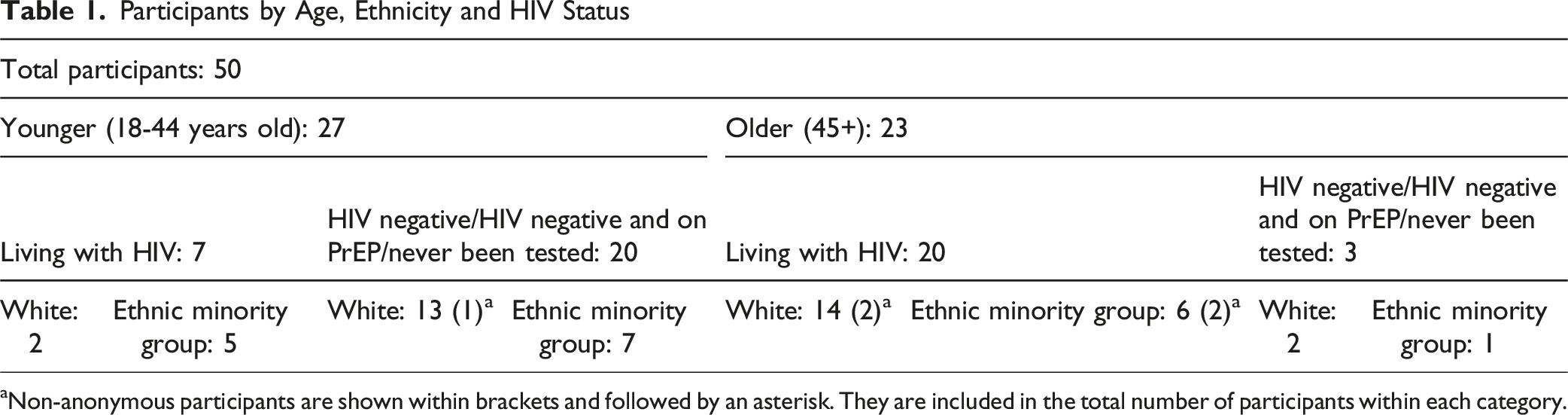
aNon-anonymous participants are shown within brackets and followed by an asterisk. They are included in the total number of participants within each category.
Data collection was completed in August 2024 and analysis is underway at the time of writing (late 2024). Data analysis is expected to be completed early 2025 followed by a period of writing and dissemination of findings.
Discussion
This project investigates how gay men living in the UK drew on their memories and experiences of HIV and AIDS to navigate COVID-19. We expect that the project will provide clarity on how gay men mobilised (or did not mobilise) their memories and experiences of HIV and AIDS during COVID-19, how these might have contributed to their navigation of COVID-19, and how COVID-19 might have framed their experiences and memories of HIV and AIDS.
The findings of this project will add to the growing body of knowledge about the complexity of COVID-19 experience. Whilst this project specifically focusses on HIV/AIDS and COVID-19, its findings and theorisations have wider implications: understanding how memories shape, and can be shaped by, another pandemic contributes to understanding pandemic events as inherently social, not simply virological.
Specific areas of interest also include wellbeing, risk and service provision by providing evidence for how experiences of HIV and AIDS among diverse gay men influence perceptions of viral risk and wellbeing during COVID-19. We hope that this will inform non-academic audiences and service providers of HIV prevention, treatment and care of new approaches to supporting wellbeing. The project will have several academic outputs for academic and non-academic audience: a monograph, and several peer-reviewed journal articles.
Supplemental Material
Supplemental Material - Viral Memories: A Qualitative Study Protocol for Exploring Gay Men’s Memories and Experiences of AIDS, HIV, and COVID-19 in the UK (ES/X003604/1)
Supplemental Material for A Qualitative Study Protocol for Exploring Gay Men’s Memories and Experiences of AIDS, HIV, and COVID-19 in the UK (ES/X003604/1) by Jaime Garcia-Iglesias and Sophie Atherton in International Journal of Qualitative Methods
Supplemental Material
Supplemental Material - Viral Memories: A Qualitative Study Protocol for Exploring Gay Men’s Memories and Experiences of AIDS, HIV, and COVID-19 in the UK (ES/X003604/1)
Supplemental Material for A Qualitative Study Protocol for Exploring Gay Men’s Memories and Experiences of AIDS, HIV, and COVID-19 in the UK (ES/X003604/1) by Jaime Garcia-Iglesias and Sophie Atherton in International Journal of Qualitative Methods
Supplemental Material
Supplemental Material - Viral Memories: A Qualitative Study Protocol for Exploring Gay Men’s Memories and Experiences of AIDS, HIV, and COVID-19 in the UK (ES/X003604/1)
Supplemental Material for A Qualitative Study Protocol for Exploring Gay Men’s Memories and Experiences of AIDS, HIV, and COVID-19 in the UK (ES/X003604/1) by Jaime Garcia-Iglesias and Sophie Atherton in International Journal of Qualitative Methods
Supplemental Material
Supplemental Material - Viral Memories: A Qualitative Study Protocol for Exploring Gay Men’s Memories and Experiences of AIDS, HIV, and COVID-19 in the UK (ES/X003604/1)
Supplemental Material for A Qualitative Study Protocol for Exploring Gay Men’s Memories and Experiences of AIDS, HIV, and COVID-19 in the UK (ES/X003604/1) by Jaime Garcia-Iglesias and Sophie Atherton in International Journal of Qualitative Methods
Supplemental Material
Supplemental Material - Viral Memories: A Qualitative Study Protocol for Exploring Gay Men’s Memories and Experiences of AIDS, HIV, and COVID-19 in the UK (ES/X003604/1)
Supplemental Material for A Qualitative Study Protocol for Exploring Gay Men’s Memories and Experiences of AIDS, HIV, and COVID-19 in the UK (ES/X003604/1) by Jaime Garcia-Iglesias and Sophie Atherton in International Journal of Qualitative Methods
Supplemental Material
Supplemental Material - Viral Memories: A Qualitative Study Protocol for Exploring Gay Men’s Memories and Experiences of AIDS, HIV, and COVID-19 in the UK (ES/X003604/1)
Supplemental Material for A Qualitative Study Protocol for Exploring Gay Men’s Memories and Experiences of AIDS, HIV, and COVID-19 in the UK (ES/X003604/1) by Jaime Garcia-Iglesias and Sophie Atherton in International Journal of Qualitative Methods
Supplemental Material
Supplemental Material - Viral Memories: A Qualitative Study Protocol for Exploring Gay Men’s Memories and Experiences of AIDS, HIV, and COVID-19 in the UK (ES/X003604/1)
Supplemental Material for A Qualitative Study Protocol for Exploring Gay Men’s Memories and Experiences of AIDS, HIV, and COVID-19 in the UK (ES/X003604/1) by Jaime Garcia-Iglesias and Sophie Atherton in International Journal of Qualitative Methods
Footnotes
Acknowledgments
We thank the participants, members of the Academic Advisory Board and Community Advisory Board for their contributions and support with this project.

Ethical Consideration
Ethical approval was awarded by the University of Edinburgh Medical School (23-EMREC-036).
Funding
The authors disclosed receipt of the following financial support for the research, authorship, and/or publication of this article: This project was funded by the Economic and Social Research Council ES/X003604/1.
Declaration of Conflicting Interests
The authors declared no potential conflicts of interest with respect to the research, authorship, and/or publication of this article.
Supplemental Material
Supplemental material for this article is available online.
Notes
References
Supplementary Material
Please find the following supplemental material available below.
For Open Access articles published under a Creative Commons License, all supplemental material carries the same license as the article it is associated with.
For non-Open Access articles published, all supplemental material carries a non-exclusive license, and permission requests for re-use of supplemental material or any part of supplemental material shall be sent directly to the copyright owner as specified in the copyright notice associated with the article.
