




Abstract
Ethical considerations in qualitative research have increasingly been framed as an ongoing and reflective process, challenging the traditional view of ethics as a rigid set of prescriptive regulations. Nonetheless, challenges in ethical thinking and interactions with formal mechanisms are often still viewed as bureaucratic hurdles. Drawing on our research experience in both the Global North and South, we examine how ethical challenges arise throughout research, particularly in relation to our work and fieldwork within domestic abuse-related deaths and perpetrator studies. Using the Bakhtinian notion of dialogues as a heuristic device, we explore how ethical issues are not only addressed in formal review processes but also in the iterative decision-making that occurs throughout research. We identify five archetypal types of dialogues – silenced, unspoken, backstage, unidirectional, and incomplete – that shape ethical decision-making and reflect the complexities of researching violence and abuse. Ethics should not be treated as a one-time procedural requirement, but rather as a dynamic and evolving process embedded throughout all stages of research, shaped by context, relationships, and experience. Ethical decisions often emerge outside formal mechanisms, especially in research involving violence and abuse, where access, power dynamics, and vulnerability complicate ethical concerns. We offer several broad recommendations for more robust ethical practices: fostering ethical dialogue by creating frank and non-judgemental spaces for discussing ethical dilemmas; reconfiguring the role of research ethics committees; embracing ethics as a relational and iterative process; foregrounding positionality and power; fostering interdisciplinary and cross-cultural dialogue; and recognising emotional labour. Our discussion emphasises the importance of vulnerability, context, and power asymmetries in shaping ethical research practices, particularly in violent or marginalised settings. Ultimately, we advocate for a more adaptive, responsive, and collaborative approach to research ethics – one that acknowledges the imperfect nature of ethical dialogue while fostering integrity in real-world research environments.
Keywords
Introduction
Marilys Guillemin and Lynn Gillam eloquently stated, “ethical tensions are part of the everyday practice of doing research–all kinds of research” (2004, p. 1). Following this logic, ethics are best understood as a practical, ongoing, and reflexive process, rather than a set of normative, prescriptive regulations. This approach, while central in certain fields, remains less familiar in others, signalling a fragmented landscape in terms of how ethical and methodological dilemmas are evaluated across the social sciences. In this context, an additional concern arises regarding the steps that are necessary when researching topics considered sensitive, whether in terms of the subject matter itself or the potential impact on research participants and/or the researcher (Liamputtong, 2025). In this paper, to explore these issues, we reflect on our research with men’s fatal violence practices. Drawing on our experiences, we argue that ethics should not be treated as a one-time procedural requirement, but rather as a dynamic and evolving process – shaped by context, relationships, and experience must be embedded throughout all stages of research.
Scholarly debates about ethics have led to ethics forming a distinct field of inquiry within the social sciences, shaping methodological approaches, research governance, and reflexive practices. This formation is also connected with the institutionalisation of ethical reviews with, for example, Research Ethics Committees (RECs) becoming a routine feature of social science research whereby an independent committee assessing research proposals relating to human subjects (Hunter, 2018). At the same time, criticism of the normative understanding of ethics has emerged, including within specific disciplines (like anthropological research, see Bourgois, 1990; Boyden, 2004; Campbell, 2010; Lambek et al., 2015) but also with respect to specific areas of study (such as gender-based violence, see Peterman et al., 2023; Sikweyiya & Jewkes, 2011). For example, one integrative review looked at 42 articles with respect to research ethics, identifying some common themes in ethical conflicts in qualitative research, including with respect to confidentiality/anonymity; participant autonomy; the risk to participants/researchers/research; mistaking the roles of researcher/therapist/friend; and project evaluation by RECs (Taquette & Borges Da Matta Souza, 2022). Notably, in the last theme, the authors noted that “disagreements may result from the lack of dialogue between researchers and members of RECs” (p. 10). Given this range of issues, Giraud et al. describe the importance of space “where questions of ethics may be addressed in a frank, open and non-judgmental manner” (2018, p. 14). What was perhaps left unexplored by Giraud et al. was how this space might operate, including the nature of the dialogic encounter between those involved in the research process, both at the level of the individual researcher or research team and/or in terms of RECs. Nonetheless, a concern with dialogue has structured other reflections on ethics too, including in the context of relational ethics and the relationship between researchers and RECs “about the nature and value of… research” (Larkin et al., 2008, p. 240).
Thus, drawing on our respective experiences of research into men’s fatal violence in Argentina, Chile, and Mexico [MHDM] and the England and Wales [JR], we frame this paper around dialogues related to and dealing with ethics. Rather than solely focusing on researcher–participant interactions, which have received greater attention historically, we foreground exchanges with institutional actors (notably RECs but also others like departments, academic communities, supervisors) and, to a lesser extent, participants. We interrogate the presence and effect of ethical dialogues in the field of domestic abuse-related deaths – including homicides in an intimate partner or family context, but in some jurisdictions also other connected deaths such as deaths by suicide – and perpetrator studies across two continents. Using dialogue as both an instrumental and heuristic device, we consider how conversations are held, avoided, shaped or redirected about ethical issues in the field. As we explore further below, we identified five archetypal types of dialogues – silenced, unspoken, backstage, unidirectional, and incomplete – that shape ethical decision-making and reflect the complexities of researching violence and abuse. This typology expands existing debates on ‘ethically important moments’ and relational ethics by offering a framework for analysing how ethical negotiations unfold not only between researchers and participants, but also within research teams, institutional environments, and formal review processes. We aim to challenge the linearity often implied in procedural ethics by demonstrating how ethical dialogue can be fragmented, constrained, or silenced – thus demanding new modes of reflexivity and institutional engagement.
Ethical Challenges and Research on Gender-Based Violence
Ethics in qualitative research within the social sciences has increasingly been framed as a dynamic, situated, and dialogical process – rather than a fixed set of normative prescriptions. As Guillemin and Gillam (2004) assert, ethically significant moments should be viewed as woven into the everyday practice of research, requiring ongoing reflexivity rather than mere compliance with formal regulations. This stance reflects a broader shift in the literature from procedural ethics towards an ethics-in-practice perspective that emphasises uncertainty, context, and relational judgement (Hunter, 2018; Taquette & Borges Da Matta Souza, 2022).
Despite this shift, there remains a marked fragmentation in how ethical and methodological dilemmas are addressed across the social sciences. Anthropology, for instance, has long critiqued the rigidity of formalised ethics systems, particularly in high-risk or politically sensitive contexts. Bourgois (1990) and Boyden (2004) underscore how strict ethical guidelines can obscure or sanitise the violence inherent to certain field sites, distancing researchers from the moral and political entanglements of their work. These critiques are echoed in feminist and applied anthropology, where ethics are increasingly recognised as embodied, emotional, and vulnerable (Campbell, 2010; Manderson, 2023).
Research on sensitive topics, such as domestic violence, homicide, or even war, further complicates ethical decision-making. Researchers in these fields often navigate blurred roles – between observer, confidant, and advocate – raising questions about anonymity, emotional risk, and the shifting dynamics of power (Dheensa et al., 2022; Silverio et al., 2022). The emotional labour and risk associated with such work frequently remain backstage, rarely captured in formal research protocols. The notion of the “ethical kitchen” (Di Marco, 2022) highlights these behind-the-scenes negotiations, which are often invisible to ethics review processes yet crucial to the integrity of the research.
At the institutional level, relationships with RECs are frequently marked by misalignment (Di Marco & Santi, 2025; Santi, 2015, 2016). Larkin et al. (2008) and Wynn (2011) observe the tensions between the bureaucratic framing of risk and researchers’ situated, embodied experiences in the field. Dialogues with committees can become performative rather than reflective, reinforcing the need for “relational ethical dialogue” and for spaces that support open, non-judgemental discussion about ethical dilemmas (Giraud et al., 2018).
This fragmentation and tension are particularly salient in areas such as research into domestic abuse and other forms of gender-based violence, usually concerning issues such as participant safety and recruitment, but also wider questions as to how research is conducted and any findings disseminated (e.g. see Bender, 2016 for a discussion around intimate partner violence). There has also been an extensive debate about the efficacy of RECs, including the extent to which they might hinder research, including with victim/survivors (Green & Morton, 2021).
In the context of systems that review domestic abuse-related deaths, it is recognised that ethical concerns often extend well beyond informed consent to encompass broader issues of justice, accountability, and survivor voice (Dale et al., 2017; Rowlands, 2020, 2025). However, discussions about ethics are usually bound up with this more general literature and the application of research practices into domestic abuse or gender-based violence more generally (e.g. see Cook et al., 2023). Thus, while ethical considerations are frequently noted, often concerning how data is used and the production of knowledge or a concern with the impact on families of those killed, the ethics of researching domestic homicide and femicide is not necessarily directly considered (e.g. see Dawson & Mobayed, 2023).
Recent work has also questioned who owns research data in criminological and carceral settings, further challenging normative assumptions about participation, knowledge production, and voice (Jarman, 2025). In sum, an expanding body of scholarship calls for a situated ethics approach – one that recognises the relational, affective, and political dimensions of research, particularly when dealing with violence and abuse. While institutional frameworks remain vital to safeguarding participants, they must be complemented by a culture of ethical enquiry that is adaptive, responsive, and collaborative.
Our Approach
This paper has emerged from an ongoing dialogue between the two authors of this paper about the complexities and tensions in our research and where our interests converge around (primarily men’s) fatal violence. MHDM works on femicide perpetration and masculinities, and has conducted fieldwork in Latin American countries (primarily Argentina, Chile, and Mexico) with the common factor of conducting open-ended interviews with intimate partner femicide perpetrators in prisons. JR works on domestic homicide, domestic abuse-related deaths, and femicide, with a focus on domestic violence fatality review systems, globally but also specifically Domestic Abuse-Related Death Reviews (DARDRs) – originally known as Domestic Homicide Reviews (DHRs) - in England and Wales.
As researchers, our positionality both converges and diverges. In terms of convergence, we are both white gay men and, as our work is concerned largely with men’s violence, our experiences and perspectives have personal, practical, and methodological implications (Hearn, 1998). Not least, we have both had to recognise and engage with the gendered social order and our own position within it, including in terms of privilege (e.g., we both benefit, whether we wish it or not, from a patriarchal dividend, despite our work to challenge its basis and consequences) and oppression (e.g., in the context of heteronormative assumptions that are tied to ways of being men, we have both experienced discrimination because of our sexuality). In terms of divergence, MHDM is from the Global South and JR the Global North, with these being imperfect but nonetheless useful categories for making sense of global hierarchies and power relations. Our experience of living and working in different regions also has implications, including the contexts within which we work and our relationships with other actors. Funding varies between regions, as does trust in institutions (e.g., in the criminal justice system), thereby shaping the way we think, plan, and develop our research. These differences can have significant implications for our research including, as we explore below, with respect to ethics.
In our experience, contrasting research settings – in Latin America and the UK – offer distinct configurations of how ethics are conceptualised, enacted, and negotiated. In Latin America, enduring legacies of state violence, social inequality, and administrative opacity often mean that researchers must navigate ethics through informal channels, building trust and accountability in relational rather than procedural ways. This can place greater emphasis on discretion and adaptive strategies. Conversely, the UK context is characterised by more standardised ethical governance, with a strong emphasis on compliance and documentation. While this may provide clearer procedural safeguards, it can also constrain flexibility and reflexivity in navigating ethical dilemmas. These divergent landscapes underscore the importance of context-sensitive ethical approaches – those that are responsive to local conditions, but also informed by a shared commitment to integrity, care, and accountability in research.
In a previous project (Di Marco & Rowlands, 2025), we considered the challenges, dilemmas, and opportunities that can arise when conducting qualitative interviews with intimate partner femicide perpetrators. Our reflections were broad and engaged with the epistemological, methodological, and ethical issues that arise in fieldwork with perpetrators, and we made recommendations in this context. In contrast, in this paper we take a narrower approach, turning instead to questions of ethical research practices per se and particularly the role of RECs. However, in developing this paper, we have undertaken the same process of critical reflection (Brookfield, 2009). Our critical reflection was undertaken over three phases and nine collaborative sessions, with a first phase when we shared and discussed examples of ethical tensions across our research experience and developed a conceptualisation of ethical dialogues. In the second phase, we interrogated examples we identified from our research experiences as a way to identify and test five archetypal types of dialogues. In the final phase, we developed our analysis as reflected in this paper. Underpinning these phases was a recursive writing process, whereby we co-wrote during our meetings to capture our thoughts and reflections and develop the paper, while we also individually wrote and responded to the other between meetings.
During our shared reflection, we identified how the form or outcome of the dialogue affected in some way ethical considerations. Conceptually, we drew on Bakhtin’s notion of dialogism. For Bakhtin (1981), dialogue is more than an exchange of words; it is a dynamic process shaped by social, historical, and ideological forces. It resists closure and involves multiple, often conflicting voices. In our context, this view of dialogue helps make sense of how ethical reasoning unfolds, not only with RECs but also other stakeholders, including other actors within our institutions and disciplines, as well as participants, and also within ourselves as researchers. Dialogue is not merely instrumental but constitutive, shaping ethical decisions through ongoing negotiation. This understanding underpins our typology, which captures not just whether dialogue occurs, but its texture, directionality, and power dynamics.
From these discussions, we identified five archetypal types of dialogues – silenced, unspoken, backstage, unidirectional, and incomplete – that shape ethical decision-making and reflect the complexities of researching violence and abuse. To illustrate the dialogues, we introduce example(s) from either MHDM and JR’s respective research experience to illustrate the discussion.
Dialogues
Archetypal Dialogues About Ethics
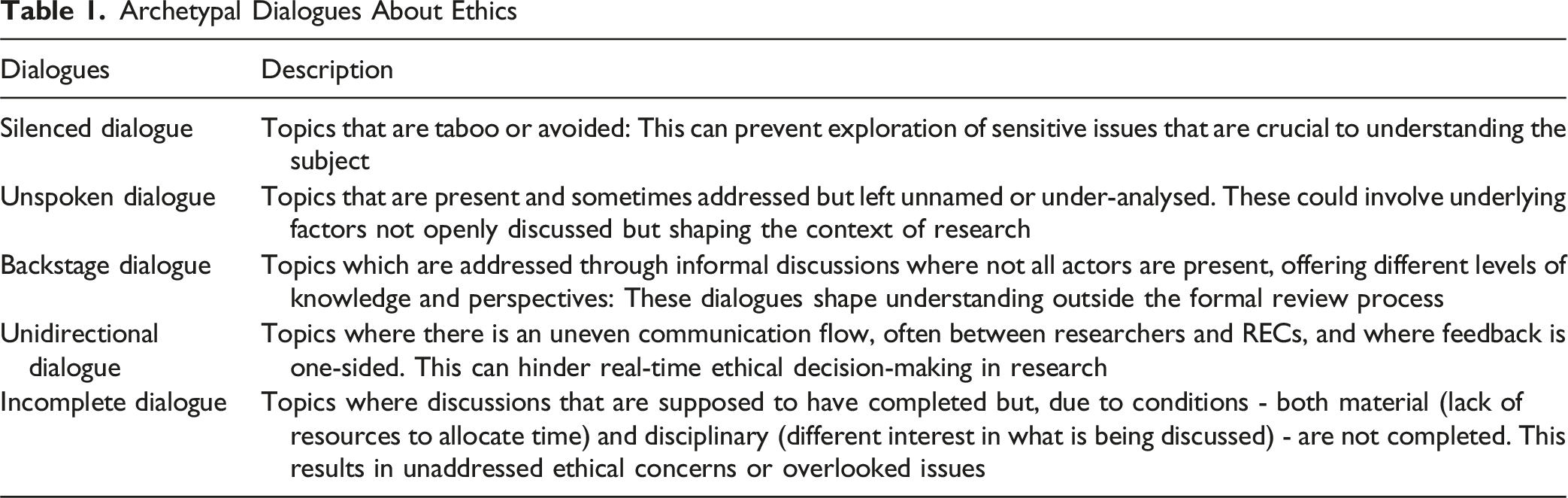
Silenced Dialogue
Silenced dialogues refer to topics that are often regarded as taboo or avoided within a specific field. The avoidance of addressing these topics, and the discussions they provoke, frequently solidifies into established practices. In any field, including domestic abuse-related deaths and perpetrator studies research, this can hinder the exploration of sensitive issues that are essential for gaining a deeper understanding of the subject.
A specific example of silenced dialogues is the ongoing debate over whether domestic abuse is asymmetric or symmetric, which has created a significant divide in research. This divide often reflects researchers’ differing perspectives, whether feminist or family violence-oriented. In the case of fatal domestic abuse, the asymmetric nature of deaths – where the majority of victims are women, typically killed by men (UNODC, 2024) – makes it more difficult to sustain this divide. However, research on fatal violence can still reflect these conflicting viewpoints. For example, Hope (2021) analysed 22 Domestic Homicide Reviews (DHRs) concerning domestic abuse-related deaths of men and reported significant findings, including insights into the experiences of men and the ways gender can shape these experiences (Huntley et al., 2019). Notably, however, Hope et al. did not address the evidence that many of the men killed had been abusive, or at the very least, that there was a lack of clarity about the antecedents to these deaths. Such omissions are significant, given the evidence that men killed by female partners often have a history of previous abuse (CWJ, 2021). While such a history neither justifies the killing nor diminishes the importance of attending to these deaths, it does require a nuanced engagement with the complex circumstances surrounding them.
In response to this, JR wrote a commentary, partly motivated by his personal experience of having led two of the DHRs included in the study (Rowlands, 2022). While this may appear at first glance to be an attempt at fostering dialogue, it is ultimately a point of convergence between two perspectives that, in reality, often operate in isolation from one another. These “discussions,” however, rarely transcend internal conversations within academic circles or professional communities. Instead, they remain confined to a limited space where they fail to engage more broadly with the full complexity of the issues at hand, leaving the voices of those most affected by the violence and abuse, as well as the broader societal dynamics, often unaddressed.
Unspoken Dialogue
Oftentimes, while topics may be present, they may be left unnamed or under-analysed. Yet, these topics can involve underlying factors which, while not openly discussed, can shape the conduct of research, including by concealing complexities and dilemmas.
For example, in navigating ethics, researchers frequently follow specific guidelines, either as provided by the relevant membership body or more specifically by an REC itself. These guidelines necessarily frame what can be spoken about, with a focus on specific aspects of research practice like anonymity and confidentiality (Deakin-Smith et al., 2024). However, some topics are not discussed because they are unspoken. In the case of DHR/DARDRs in England and Wales, an example of this arises because - in line with the statutory guidance governing the DHR/DARDR process - the reports of these reviews are usually published and placed in the public sphere (albeit this approach is markedly different to other forms of Domestic Violence Fatality Review (DVFR) globally see: Websdale, 2022). For researchers, the publication of these reports means that data-rich accounts of the circumstances of domestic abuse-related deaths are available for study.
Notably, however, in reporting on their work, oftentimes researchers state that ethical review was not required because published DHR/DARDRs are publicly available documents. This may reflect the narrowness of REC concerns because, as the subject of a domestic homicide/abuse-related death review is dead, such a concern is removed. Thus, necessarily the formal requirements of ethical governance to occlude any other considerations (Guillemin & Gillam, 2004; Pascoe Leahy, 2021). Yet, arguably, an ethical concern relates to both the memory of the victim, but also secondary victims and those who knew them - such as family members and others - and questions as to how the findings of any research will be used (Cook et al., 2023). In JR’s research, a concern about this question has led to an emphasis on recognising both the centrality of the victim but also their absence. This has included attempts to bear witness to the death but also engaging not only with the review report itself but attending to the system which generated it, and a criticality to the same (Rowlands, 2025).
In this example, an unspoken dialogue reflects what is considered in scope of an REC which, in turn, shapes what is considered in terms of research practices. In this case, ironically, one reading may be a demand for more REC oversight. However, while part of the response may be to ensure that the ethics of work on publicly available documents should be considered, it also serves as a reminder that researchers can go above and beyond these requirements.
Backstage Dialogue
Not all ethical dialogues are silenced or unspoken. In some cases, they occur prolifically, but in the backstage of the research process: parallel meetings, unilateral projects, and conversations, etc. Backstage dialogues involve discussions which are informal and/or where not all actors are present, creating a fragmented scenario of conversation and offering different access to knowledge or perspective about a case and may also reflect power dynamics. These backstage conversations, which revolve around front stage situations (i.e., ethical evaluations, formal consultations with university institutions), revealed the ‘kitchen’ of how we navigate ethical dilemmas and processes.
Behind closed doors, in conference hallways, or informal meetings, researchers sometimes grapple with topics that are difficult to discuss openly. In the midst of a formal research review process, it is not uncommon for ethical discussions to spill into informal settings. One of MHDM’s example comes from a coffee break at a conference, which researchers from our project attended along with a member of the REC who had evaluated our project. During a conversation with an REC member about concerns that did not fully come up during the formal review, the REC member suggested practical adjustments, such as emphasising the importance of follow-up care for participants or tweaking language around “vulnerable populations” to make the project more palatable to the REC. The member also shared how these ethical decisions are often not as straightforward as the official guidelines suggest, revealing that REC’s sometimes struggle with balancing risk minimisation with the real-world needs of the research.
This ‘backstage interaction’ could very well be framed as a way in which researchers navigate ethical ambiguity (Giraud et al., 2018): informal discussions provide researchers with an opportunity to address ethical dilemmas not fully addressed by formal guidelines, offering more adaptable and pragmatic solutions to complex situations. This example also shows that conversations about ethics are not necessarily silenced or unspoken, but can move to the backstage, revealing nuances and struggles not visible in the frontstage setting of formal meetings. It also highlights that the navigation of ethical problems might depend on accessing the same events and being able to interact with other researchers, which also raises questions of capital, both in terms of being able to fund attendance at conferences but also in terms of social capital. Such backstage dialogues reflect the complexity of navigating ethics when not all stakeholders are involved or the resources at hand by researchers vary, offering different access to knowledge and a framing of ethical issues.
In another example, the MHDM’s research team faced a decision regarding which REC to submit their project to, knowing that the choice would significantly shape how ethical dilemmas were conceptualised, negotiated, and written into the research design. The choice between two RECs - one known to be conservative, the other more flexible - became a crucial discussion among the researchers, as they recognised that one board was known for its strict adherence to biomedical protocols, while the other was more context-driven and better attuned to social sciences methods. This distinction in approach would shape the ethical frameworks the researchers would need to navigate - especially when it came to issues such as evaluating consent and portraying sensitive topics like intimate partner violence.
As the team deliberated on which REC to approach, they acknowledged the trade-offs involved in each choice. Submitting to the conservative REC could impose stricter guidelines, limiting the project’s scope, while the more flexible REC might allow for a more nuanced approach but risk greater scrutiny in the approval process. This backstage conversation revealed how researchers’ ethical decisions were not purely driven by formal guidelines but were also influenced by strategic choices based on institutional priorities, familiarity with boards, and the kinds of ethical dilemmas they were prepared to face. The discussion highlighted how decisions about which REC to approach reflected broader tensions between institutional power, ethical ideals, and the realities of conducting research on complex social issues.
Unidirectional Dialogue
In contrast to what we have discussed thus far, dialogue may be ‘front stage’ and also be evident in a way that silenced or unspoken dialogue is not. However, there may be an uneven communication flow, often between researchers and RECs, including where feedback is one-sided. This can hinder real-time ethical decision-making in research, reflecting instead a monological approach.
Consider, as an example of this, the feedback and requests made by RECs during the review processes. These requests may take various forms, including meetings, discussions, or formal reports. More often than not, these processes involve researchers receiving requests to modify their protocols to ensure that studies are conducted safely and ethically. Nonetheless, within the social sciences – which have historically resisted ethical evaluation procedures (Giraud et al., 2018; Santi, 2016) – these processes often concluded after this initial review. Typically, beyond a requirement to return to the REC for a substantive change, there is no monitoring during fieldwork or research, nor any final reporting once the project has ended. As a result, a unidirectional and temporally limited dialogue emerges, occurring primarily when researchers seek advice following the initial evaluation stage.
The following two fieldwork-derived examples from MHDM highlight experiences with post-approved research projects: one involving interviews with perpetrators of domestic homicide in prison, and the other focusing on batterer intervention programmes.
Seven months after fieldwork began in a multi-centre project, a participant disclosed suicidal thoughts. At the time, he was serving a sentence for the femicide of his ex-wife and had faced severe informal punishments from other inmates – a common practice for certain stigmatised gender-related crimes. His mention of suicidal ideation led to a halt in the interview and an offer of assistance, including the possibility of connecting him with practitioners from a higher-level authority to avoid conflicts of interest. Consequently, the research team reached out to the REC to request further guidance on how to proceed, as penal authorities were unresponsive. The response from the REC took three weeks, during which no institutional intervention was possible. Ultimately, the participant was transferred to another unit but did not receive any psychological support. The REC intervention, while procedurally correct, proved of limited practical use in addressing the urgency of the situation. This delay underscored the rigidity of the review system, where ethical considerations often need to be addressed dynamically but can only be formally processed through predefined bureaucratic channels.
In a separate one-year research project – designed to facilitate short-term knowledge transfer with a public institute – the research team sought to amend the research protocol after encountering unexpected ethical dilemmas during interviews with survivors of domestic violence, having realised that questions in the approved interview guide were causing significant distress to participants. As a result, changes were proposed to allow for a more flexible and trauma-sensitive approach. However, the REC process only permitted formal amendment requests, despite the immediate ethical concerns present in the field. On contacting the REC to confirm the proposed change, the research team received the following response: “Thank you for your email. We will respond to emails after our next board meeting on 21 August.” Ultimately, the reply came three months after our initial contact.
Both examples bring to the foreground the unidirectional nature of the relationship between ethical boards and research. Feedback and requests from RECs are typically directed at researchers, as their capacity to engage in two-way discussions is often limited. Many RECs operate with insufficient staffing and resources, restricting their ability to provide ongoing support beyond the initial approval stage. Additionally, their timelines and operational priorities often differ from those of researchers conducting fieldwork, making real-time consultation difficult. As a result, researchers may struggle to seek clarification or request guidance outside of the formal review process – reinforcing the unidirectional nature of ethical oversight. These dynamics underscore a structural power asymmetry between researchers and RECs, shaped by available resources, where researchers are expected to comply with ethical standards without having equal opportunities to influence how those standards are interpreted or applied in practice.
Incomplete Dialogue
Sometimes, dialogues can be left incomplete. This may mean that there are topics where discussions were expected to reach closure but – due to various conditions – both material (such as a lack of time or resources) and disciplinary (such as differing interests in the topic) – they do not. As a result, ethical concerns may become overlooked or oversimplified – flattening the dilemmas faced and the actions taken.
When undertaking research for his PhD, JR interviewed 40 stakeholders involved in DHRs/DARDRs [Rowlands, 2023]. As part of the data collection process – and reflecting what has become a routinised research practice (Deakin-Smith et al., 2024) – JR’s then-institutional ethical review process (at Sussex University) assumed that participants’ identities would be anonymised. For instance, ethics applications included questions such as: “Will all data related to this study be retained and shared in a form that is fully anonymised?” To address the complexity of pseudonymisation, JR offered participants the option to choose or agree a pseudonym. Of the 40 participants, 33 (82.5%) chose to have a pseudonym assigned by JR, while 7 (17.5%) self-selected their pseudonyms. However, one participant wished to use their real name and asked: “Is it ethical for the ethics committee to override my personal choice on waiving anonymity?” Not having encountered this situation before – and aware of another doctoral student who had faced considerable challenges in securing REC approval to use real names – JR sought advice from his supervisors. He explained to the participant that ethical approval would be required to honour their request and managed their expectations by clarifying that such approval might not be granted. Nonetheless, he committed to keeping the participant informed and to exploring further steps if needed – e.g. the participant writing directly to the ethics committee chair.
Ultimately, the participant decided to select a pseudonym, saying: “This would put you to a lot of trouble which I don’t want to do.” Ironically, the institutional norms around participant protection led the participant to protect JR as a researcher. This example illustrates the tensions around pseudonymisation, and the competing ethical claims involved (Berkhout, 2013). For the participant, the enforced pseudonym felt like a unilateral exercise of power that denied them the opportunity to be associated with their own work and ideas. For JR, pseudonymisation was a means of ensuring anonymity – in line with institutional assumptions. However, the open dialogue between researcher and participant allowed for some levelling of these power dynamics through reciprocity and transparency – including a commitment to reflect on the experience and to discuss and agree the summary here with the participant.
While the outcome was perhaps unsatisfactory, JR sought to navigate this ethically important moment through reciprocity and transparency, committing to reflecting on the experience and discussing this summary with the participant. However, in terms of dialogue, ironically, then, the application of institutional norms around research participant protection ended with a participant protecting JR as a researcher because of their concern about this process. Thus, this is an example of an incomplete dialogue which, if not otherwise reported, would have rendered the complexity of pseudonymisation invisible. Yet, as Deakin-Smith et al. (2024) have argued, having an open dialogue about these debates and decisions about naming practices might enrich both theory and research practice.
Discussion
Thus far, we have considered ethical research practices in terms of dialogues – be they silenced, unspoken, backstage, unidirectional, or incomplete. As a heuristic device, thinking through dialogue foregrounds the situated, contingent, and lived nature of ethical decision-making. These “ethically important moments”, as Guillemin and Gillam (2004, p. 265) put it, often occur outside the purview of RECs and demand reflexive judgment shaped by context, relationships, and experience. Drawing on Bakhtin (1981) notion of dialogue as inherently relational and multivocal, we understand these ethical moments as sites where multiple voices and power dynamics intersect, complicating what might otherwise be taken as straightforward ethical reasoning. By default, this challenges the dominant tendency to treat ethics as a matter of universal, standardised, and depersonalised procedures – an impulse still often rooted in managerial logics rather than in situated ethical practice.
Our typology builds on and moves beyond existing frameworks by offering a practical lens to examine how ethics is negotiated or foreclosed in everyday research practice. Grounded in experiences from both the Global North and South, we aim to highlight how different forms of dialogue reflect structural power, institutional constraints, and disciplinary norms – offering a comparative and diagnostic tool for advancing qualitative ethics. Acknowledging the heteroglossia in positions about ethics – the coexistence of diverse voices and discourses (Bakhtin, 1981) – enables us to grasp how decisions emerge from tensions between these often competing perspectives within institutional and cultural contexts. Importantly, fostering direct and situated processes of ethical reflection not only helps ground research in local realities, but may also enhance the originality and contextual richness of contributions, increasing their relevance – and even appeal – for scholarly publication.
Too often, research ethics is viewed merely as a bureaucratic hurdle, a one-off moment of approval that fails to account for the dynamic, messy, and complex realities encountered throughout the research process (Mertens, 2024). This reductionist view is reinforced not only in institutional practices, but also in teaching and training, where ethical review is frequently treated as an administrative checkbox rather than as a substantive part of scholarly formation. As Mertens and Ginsberg (2009) note, ethics should be central to all stages of the research process – not simply confined to the beginning. However, achieving this requires a paradigmatic shift, both institutionally and culturally. Research institutions often assume that research can be planned in a predictable, rational way, with ethical decisions reduced to linear processes – a view reflected in the minimal time allocated for contingencies and ethical discussions. This mirrors the classic critique of bureaucratic thinking, where rigid rules obscure the complexities of human action and reduce decision-making to impersonal procedures (Held, 1987).
Given this, how can we move beyond a procedural, static approach to ethics, and instead foster a more substantive and evolving process that addresses the continuous ethical challenges throughout the research journey?
One way forward is to explicitly recognise that ethical reflection is not a straightforward or linear endeavour. Researchers working on violence and abuse often face ethical questions that are not easily resolved by formal procedures. Institutional pathways may be opaque or inflexible; previous relationships with communities or gatekeepers may constrain how issues can be approached; and dominant discourses may influence what is considered acceptable to research and how. These dynamics are particularly pronounced when working across different sociopolitical contexts, as our comparative experience between the Global North and South illustrates.
Moreover, the perceived authority of RECs can sometimes inhibit rather than enable ethical reflection. As Taquette and Borges Da Matta Souza (2022, p. 12) argue, these mechanisms “should be educative and not disciplinary.” Yet, the asymmetry in power and knowledge between researchers and committees often stifles open exchange – especially when committee members are unfamiliar with the epistemological or methodological underpinnings of sensitive qualitative research. This is where the notion of relational ethics becomes crucial – not only in the field, but also within the institutional infrastructure that governs research (Larkin et al., 2008). While most critical dialogic theories do not prescribe an idealised model of ‘true’ dialogue – including Bakhtin’s – they foreground the importance of responsiveness and multivocality in meaning-making. From this perspective, institutional power imbalances may hinder the emergence of genuine ethical dialogue, as they limit the capacity for reciprocal engagement and the acknowledgement of diverse voices.
A relational approach to ethics acknowledges that research is a human endeavour – embedded in emotional labour, uncertainty, and moral ambiguity. It also opens up possibilities for mutual learning: “The governance of a research project may be enhanced by shared ownership and willingness to engage in mutual dialogue” (Larkin et al., 2008, p. 239). This perspective resonates strongly with our own experiences, in which ethical reflection emerged through iterative conversations – between ourselves, within our teams, and in response to institutional structures.
Returning to Giraud et al.’s (2018) call for spaces of “frank, open and non-judgmental” discussion about ethics (p. 14), we suggest that these spaces must be created rather than assumed. In practice, this could involve regular team reflections, peer debriefing sessions, or institutional forums where ethical dilemmas can be unpacked without fear of reproach. It also means foregrounding vulnerability as part of the research process – not as weakness, but as a site of ethical engagement.
Furthermore, using dialogue not only as a heuristic but as a method helps reveal what remains unsaid in formal ethical narratives. For example, the emotional toll of interviews with perpetrators, or the ethical uncertainty in negotiating access to carceral settings, rarely appear in REC applications but are central to the integrity of our research. As the metaphor of the “ethical kitchen” (Di Marco, 2022) implies, much of what sustains ethical research happens behind the scenes – through informal yet vital negotiations.
Finally, situated ethics also requires attention to voice and positionality. As scholars working in different regions with differing relationships to institutional power, we bring divergent assumptions, risks, and modes of accountability to our research. We also recognise that, although our identities as gay men do not position us as entirely abject within our social contexts, they nevertheless sharpen our awareness of institutional closures, discomforts, and the complexities involved in negotiating gendered violence and masculinity in research settings. These lived experiences sensitise us to power dynamics and silences that might otherwise be overlooked, enriching our reflexive engagement with ethical challenges. The question is not just “What are the risks?” but whose risks are recognised, and who gets to define ethical priorities. This is especially pertinent when researching marginalised or criminalised populations, where the balance between protection and silencing can be precarious.
Our aim in identifying and typifying these dialogues is not to present them as comprehensive or universal. Rather, they serve as a starting point for reflecting on how research on domestic abuse-related deaths and perpetrators is conducted, its ethical implications, and – following Bourdieu’s lemma of reflexive sociology (1992) – how we as researchers are implicated in the very structures we seek to analyse. The configuration of this field – including its silences, tensions, and methodological constraints – is itself illustrative of how fieldwork operates: as a space shaped not only by access and positionality, but also by affect, ambiguity, and power.
Ultimately, we advocate for a more candid and reflective conversation about ethics, without succumbing to the often-encouraged impulse to standardise or adopt a normative plan. Ethical discussions are inherently context-dependent, shaped by the institutions and countries in which they occur. They are also influenced by the resources that both institutions and individuals have at their disposal to consider and address these issues, as discussed, for example, under unidirectional dialogues. In this way, centring dialogue aligns with Hunter’s (2018) suggestion of the importance of a working relationship with RECs, rather than an adversarial one. The challenge then becomes how RECs, which are necessarily bureaucratic, can be designed to enable dialogic interaction rather than inhibit it. Ethics is a practice, but with this propositional statement, Hunter encapsulated a broad approach to how the social sciences conduct research and navigate ethical considerations.
This approach has also been framed as “dynamic ethics” (Hammett et al., 2022), where ethical reasoning is iterative, context-responsive, and unfolding in real time. Second, being mindful of different dialogues does not imply homogenising them into the same type of conversation. Normative planning is not realistic, as it reflects a biomedical model of ethical review that struggles to accommodate the uncertainty and contextual nuance of qualitative and field-based research. Ethics is a dynamic process.
Our best bet is to incorporate ethics into our methodological frameworks and reflexive practices, rather than calling for more institutional surveillance. As others have noted, normative planning does not work either as a methodological lens nor as a strategy for addressing ethical tensions. Research in contexts of violence – including conflict zones or carceral spaces – is fraught with practical and ethical dilemmas, many of which resist procedural resolution.
The lack of integration between disciplines has jeopardised the expansion of ethical dialogues. Anthropological research on trust, for instance, has long dealt with the ethical complexity of studying war-affected populations, yet this body of work is often siloed from broader ethical debates in violence research (see Boyden, 2004). By centring ethical dialogue as both method and practice, we move toward a more inclusive, adaptive, and contextually responsive understanding of research ethics – one that is grounded in vulnerability, collaboration, and the recognition of power asymmetries.
Recommendations and Conclusion
In light of the previous discussion, we propose the following recommendations to foster open ethical dialogue by promoting a more reflexive and context-sensitive approach to research ethics, especially in studies involving sensitive research (not least violence and abuse but also, for example, marginalised groups):
Create Institutional Spaces for Ethical Reflection
Create open, frank, and non-judgmental spaces for discussing ethical dilemmas. These spaces could include peer debriefing sessions, interdisciplinary ethics salons, or “ethical kitchens” – informal yet crucial settings for sharing and exploring dilemmas, uncertainties, and practice-based insights.
Reconfigure the role of RECs
Ensure RECs engage with diverse epistemologies and methodologies, particularly those grounded in qualitative and participatory approaches. Training for board members should encompass the complexities of sensitive qualitative research, with mechanisms for ongoing ethical reflection throughout the research process, both within these mechanisms and with researchers.
Embrace Ethics as A Relational and Iterative Process
Weave ethics throughout the research cycle, not just being addressed at the outset. This involves revisiting consent and other procedures and recalibrating researcher-participant relationships.
Foreground Positionality and Power
Foreground reflexivity, including how researchers’ identities and institutional affiliations shape the research process, both in terms of their positionality but also their experience and exercise of power. This is especially important in transnational and comparative research, where assumptions about harm, vulnerability, and accountability may vary significantly.
Foster Interdisciplinary and Cross-Cultural Dialogue
Engage with ethical perspectives from diverse disciplinary fields like anthropology, feminist theory, and participatory action. Promoting dialogue across disciplines and cultures helps challenge narrow, universalist frameworks and can enrich our understanding of situated ethical complexities.
Recognise Emotional Labour
Given the emotional challenges researchers face when working on violence and abuse, it is vital to create ethical support structures that allow researchers to process the emotional impact of their work. This support should be seen not only in terms of personal well-being but also as a vital part of epistemic responsibility.
In conclusion, we argue that research ethics cannot be reduced to a procedural check-box. Instead, ethics must be understood as an ongoing, negotiated process that unfolds within human relationships, institutional contexts, and the emotional realities of fieldwork. Dialogue, in this sense, is not an optional extra, but a fundamental condition for ethical research practice. Engaging with the silences, tensions, and ambiguities in the field signals an ethics that is responsive, accountable, and deeply connected to the lived experiences of researchers, participants, and the communities involved. An ethics that listens as much as it speaks is essential to advancing responsible and meaningful research.
Footnotes

Funding
The authors received no financial support for the research, authorship, and/or publication of this article.
Correction (September 2025):
The paragraph starting with “Having not faced…” and ending “…want to do” has been mistakenly included twice in the article and now it has been removed from page 7, second column, lines 5‐20, since original publication of the article.
Declaration of Conflicting Interests
The authors declared no potential conflicts of interest with respect to the research, authorship, and/or publication of this article.