




Abstract
The majority of chronic diseases are attributable to modifiable lifestyle behaviors. Healthcare practitioners, policymakers, and researchers desiring to help individuals and communities change behavior must understand the factors influencing the behavior of interest, including social and cultural context. Qualitative research addressing culture and context can give decision-makers a rich understanding of people’s experiences, attitudes, and beliefs to help people adopt and maintain healthy behaviors. Integrating a theoretically-driven conceptual framework in qualitative investigations of complex health behavior-related phenomena can provide a structure from which to investigate and analyze the findings. This structure can support future quantitative research by identifying saturated concepts within a theory. Few resources are available for independent researchers or small teams desiring to conduct robust, trustworthy, and meaningful research. In this article, we describe a process for integrating a conceptual framework and updating the framework using the findings from a focused ethnography study of eating behavior influences among emerging adults in the U.S. military as an exemplar. We provide recommendations for collecting and analyzing multiple qualitative data sources and interpreting findings within a compressed timeline despite COVID-19 public health restrictions. These recommendations may benefit doctoral students aiming to complete an impactful qualitative dissertation or novice researchers looking for ways to scope a complex health behavior study.
Introduction
Approximately 80% of chronic diseases are attributable to modifiable lifestyle behaviors (Katz et al., 2018). Numerous factors influence people’s behaviors, including personal values and beliefs, social influences, health equity, and social determinants of health. Healthcare practitioners, policymakers, and researchers desiring to help individuals and communities change behavior, must be knowledgeable of the myriad factors influencing the behavior of interest, including social and cultural context. Overgeneralization or reductionist views of a group’s behaviors and reasons for their behaviors may lead to flawed assumptions that subsequently inform ineffective policies and initiatives.
Qualitative research, particularly when addressing complex health behavior-related issues within specific cultural contexts, provides a rich understanding of individuals’ experiences, attitudes, and beliefs, which is crucial for developing effective, targeted policies and initiatives that promote healthy behaviors. Our approach, integrating a conceptual framework—the social ecological model—to help focus the research and explain the main points of interest, with focused ethnography, demonstrates that robust, trustworthy, and meaningful research can be conducted even with constrained resources and within a defined timeline. A conceptual framework serves as a foundation for qualitative research into complex health behavior phenomena, offering a structured lens through which findings can be interpreted (Macfarlane & O'Reilly-de Brun, 2012). This framework can also guide subsequent quantitative studies by highlighting well-developed theoretical concepts that are primed for hypothesis testing in subsequent studies. Unlike traditional ethnography, which requires extensive fieldwork and broad observations, we chose focused ethnography to explore a specific behavior within a subculture, primarily using interviews for data collection (Higginbottom et al., 2013). This allowed us to manage the project effectively and disseminate timely results without compromising the depth, rigor, or trustworthiness of the research.
There is limited practical guidance on integrating a conceptual framework in qualitative research, specifically focused ethnography. Few resources are available for independent researchers or small teams desiring to conduct robust, trustworthy, and meaningful research with constrained resources. In this article, we describe a process for integrating a conceptual framework with focused ethnography to explore the influences of eating behaviors within a cultural context. We use the first author’s dissertation research that explored influences of eating behaviors among emerging adults in the U.S. Navy as an exemplar and provide step-by-step guidance for collecting and analyzing multiple qualitative data sources and interpreting findings within a compressed timeline (Troncoso, 2021).
Our study, used here as an exemplar, involved an in-depth and rigorous process that required significant time and effort from the research team. This included extensive time dedicated to engaging with the data, critical reflection, detailed writing and memoing, and substantive discussions with the mentor and other dissertation team members. The use of a compressed timeline in this context refers to an efficient and focused approach to data collection and analysis, rather than a superficial one. By carefully scoping the study with clear objectives and research questions, and employing iterative and recursive data collection and analysis strategies, we were able to delve deeply into the areas of interest, achieve data saturation, and generate meaningful findings effectively. We aim to present a helpful process for doctoral students (and their mentors) desiring to conduct rigorous qualitative research in the health sciences.
The Exemplar Study: Context and Scoping
In the following section, we provide a guide for scoping a qualitative exploration of health behaviors among a cultural group by discussing the process we used to complete a focused ethnography of factors influencing eating behaviors among emerging adults in the U.S. Navy. The first author conducted the study for her dissertation, and the second author served as the methodology expert on the committee. The Uniformed Services University of the Health Sciences Human Research Protection Program (HRPP) Office approved the study as exempt human subject research under Category 2 as defined by 32 CFR 219.104(d)(2). All of the study participants provided verbal consent. We conducted the study during the height of the COVID-19 pandemic and faced several challenges related to the public health restrictions and competing priorities of the research population. Despite these unexpected obstacles, we collected rich data for analysis and interpretation, providing researchers, healthcare providers, and military decision-makers with foundational information for improving military personnel’s eating behaviors and health. The results of this study have been published elsewhere (Troncoso et al., 2023, 2024).
Defining the Culture and the Problem
The first step in our process was to determine the cultural group of interest, beginning with the broad culture of the U.S. military (hereafter military) and narrowing to the subcultural of early career enlisted Navy Sailors in the period of emerging adulthood (i.e., 18-25 years). The military is a culture with shared values, norms, behaviors, language, customs, and rituals distinct from the general U.S. civilian population (Meyer, 2015). The military has various subcultures, such as service (e.g., Navy and Army) and rank (e.g., officer and enlisted). Junior enlisted (early career) emerging adults in the Navy represent a unique subculture. They experience a critical period of transformation from adolescence to adulthood and are part of a culture that demands high levels of responsibility and self-sacrifice but with limited autonomy and agency. Unlike emerging adults who are full-time college students or slowly transitioning to increased responsibility, young service members are thrust into demanding jobs that may require leading others and working long hours in austere environments and unpleasant conditions.
Most young, early-career enlisted service members live in a controlled environment (i.e., barracks) with disproportionate access to unhealthy foods and a lack of access to cooking and food storage. Despite the need for active duty service members to have eating habits that promote optimal health and physical and mental performance, many enlisted service members have unhealthy eating behaviors ranging from not eating enough nutrient-dense foods, overeating processed foods, to disordered eating (Barlas et al., 2013; Chukwura et al., 2019; Gaviria & Ammerman, 2022). After a systematic review of the military and civilian literature, we identified a gap in research and a critical need to focus on the eating behaviors of junior enlisted Sailors in emerging adulthood.
Identifying the Research Questions and Conceptual Framework
The study explored factors influencing the eating behaviors of junior enlisted Sailors in non-deployed settings within the context of Navy and military culture. To better understand this phenomenon, the study had three specific aims with six corresponding research questions:
Specific Aim 1. Identify the intrapersonal, social, environmental (physical and macro-level), and cultural factors that influence eating behaviors among junior enlisted Sailors in non-deployed settings.
What are the prominent eating behaviors among junior enlisted Sailors?
What intrapersonal, social, environmental (physical and macro-level), and cultural (military and Navy) factors influence eating behaviors among junior enlisted Sailors? Specific Aim 2. Investigate the influence of cyclic physical readiness testing (PRT) on eating behaviors among junior enlisted Sailors in non-deployed settings.
In what ways do eating behaviors change during PRT season? Specific Aim 3: Identify perceived barriers and facilitators to healthy eating behaviors among junior enlisted Sailors in non-deployed settings.
How do junior enlisted Sailors define healthy eating behaviors?
What individual characteristics hinder or facilitate healthy eating behaviors among junior enlisted Sailors?
What aspects of the social, physical, macro-level, and cultural environment hinder or facilitate healthy eating behaviors among junior enlisted Sailors? Eating behaviors are complex actions influenced by multiple interconnected individual, social, environmental, and cultural factors. To comprehensively understand these multi-level influences, we employed the social ecological model for eating behaviors developed by Story et al. (2008) as our guiding conceptual framework. This model provided a systematic structure to describe the various levels impacting food choices and eating behaviors, from individual factors to broader societal and policy approaches. It identified specific factors within four levels (i.e., individual [intrapersonal], social environment [interpersonal], physical environment [community settings], and macro-level environment [societal and policy]) that impact food choice and eating behaviors. Using this model from the outset allowed us to systematically explore the diverse influences on eating behaviors and provided a valuable framework for organizing our findings and developing a comprehensive understanding of the phenomenon within the specific cultural context of this study. From Story and colleagues’ (2008) initial work and the literature review, we developed a preliminary conceptual framework to serve as an evolving roadmap, highlighting potentially relevant factors for exploration (see Figure 1.) This preliminary conceptual framework served as an evolving roadmap that we actively referenced throughout the data collection and analysis processes. It guided our inquiry by highlighting potential areas of influence on eating behaviors across individual, social, physical, and macro-environmental levels, thereby ensuring focus and managing the scope of our exploration. Staying focused on our original objectives helped us to go deep into the areas of interest without getting lost or being sidetracked by interesting but irrelevant data. To honor participants’ contributions and have peace about putting explorations aside, we kept memos of our reflections and data to explore in future studies.

Preliminary Conceptual Framework
Methodological Approach and Process
This section details the “how-to” of our integrated approach, illustrating each part with examples from our exemplar study. The study spanned approximately 17 months, from initial stakeholder engagement and site approvals (January-March 2020) through data collection (March-October 2020 for interviews, extending to February 2021 for policy documents) and parallel analysis (concluding March 2021) to final report synthesis and dissemination (May 2021). This timeframe included navigating the significant disruptions of the COVID-19 pandemic, which necessitated adapting recruitment strategies and led to an unforeseen site change. Despite these challenges and the defined timeline, our process proved feasible and applicable, allowing for the collection and analysis of rich, meaningful data under real-world constraints.
Design
The philosophical assumptions undergirding this study were that there may be multiple realities of a phenomenon and that knowledge is constructed with subjective evidence, requiring the researcher to “get as close as possible to participants being studied” (Creswell & Poth, 2018, p. 21). Focused ethnography provided a systematic way to examine the contextual influences of eating behaviors from the participants’ perspectives. In contrast to the extensive fieldwork and global observations required in traditional ethnography, focused ethnography allowed us to focus on a specific phenomenon within a subculture, using interviews as our primary data collection method (Higginbottom et al., 2013). In addition to semi-structured interviews with participants, we conducted informal interviews and included focused observations, artifacts, and photo elicitation. We triangulated data sources and methods to understand the influences of junior enlisted Sailors’ eating behaviors in multiple contexts. Doing so helped us create an adequate cultural description, including explicit and tacit cultural knowledge (Spradley, 1979). For example, we could learn about influences within the physical environment by interviewing participants and their leaders, observing food availability and accessibility, identifying printed information and marketing, and reviewing policies related to the military nutrition environment.
Researcher Positionality and Emic and Etic Perspectives
As the first author and an active duty Navy Nurse Corps officer, I brought both an insider (emic) and outsider (etic) perspective to this study. My experiences working with the research population were invaluable for gaining rapport and understanding the cultural context. However, I recognized my insider status could introduce bias. To address subjectivity and strengthen trustworthiness, I engaged in ongoing self-critique, maintained reflective journals and memos, and held regular dialogues with the second author and other dissertation committee members. The second author, as the methodology expert, provided crucial oversight and challenges to my interpretations, further enhancing the study’s credibility. We actively worked together to examine potential biases and ensure the accuracy of our findings throughout the data collection and analysis processes.
Data Collection Process
We collected and analyzed data iteratively and recursively to allow for constant comparison, member checking, and triangulation of the data. What follows is a brief description of the data collection methods and analysis.
Semi-Structured Interviews
We developed an interview guide based on the literature review, conceptual framework, and research questions. We then piloted the initial guide with four Sailors and refined it with the expertise of an anthropologist with military knowledge and the second author. The interviews followed the method described by Spradley (1979), beginning with broad questions and ending with more focused questions. All interviews were audio recorded and transcribed verbatim using NVivo transcription software and were verified by the first author. The second author provided accuracy checks on random transcripts. For every interview, I (first author) recorded field notes and memos to capture reflections, analytical hunches, and inquiries for further explorations. Because analysis occurred in parallel, subsequent interview questions were more focused and served to examine and clarify assumptions.
Informal Interviews
Informal interviews are conversations with experts about the culture that further help to discover categories and meanings, identify values, and confirm or elucidate data gathered from semi-structured interviews, observations, or artifacts (Fetterman, 2010). I (first author) conducted informal interviews with commanding officers and senior leaders, middle managers, health promotion professionals, dieticians, and food services employees with knowledge and expertise in the military food environment.
Observations
As the first author, I conducted observations at varying levels of involvement, ranging from observer-as-participant to observer (Roper & Shapira, 2000) using methods described by Spradley (1980). The core purpose of these observations was to gain a deeper understanding of the food environment within the military context, specifically assessing the access to and availability of food options and identifying facilitators and barriers to healthy eating behaviors. I also focused on observing participants’ interactions with the food environment and documenting social situations involving food and eating behaviors. This observational data was critical for triangulating information gathered through interviews, documents, and policies, providing a more comprehensive picture.
The observation process involved moving from broad descriptive observations to more focused and selective observations, guided by Spradley’s (1980) dimensions of social situations. Regarding participant awareness of my role, this varied by setting. In small group settings like military office breakrooms or workspaces, where I was present in civilian attire, participants were aware of my dual role as both researcher and observer. However, in less formal public spaces such as military dining facilities, during walks around the bases, or while in on-base eating establishments or grocery stores, I did not overtly make it evident that I was conducting research. I maintained a presence as a patron in these settings to capture more natural interactions with the food environment and social dynamics.
In the beginning of the study, observations were global and descriptive and guided by a priori themes derived from the conceptual framework and nine major dimensions of social situations: (a) space (the physical place or places), (b) actor (the people involved), (c) activity (a set of related acts people do), (d) object (the physical things that are present), (e) act (single actions that people do), (f) event (a set of related activities that people carry out), (g) time (the sequencing that takes place over time), (h) goal (the things people are trying to accomplish), and (i) feeling (the emotions felt and expressed) (Spradley, 1980). During later observations, I examined social situations with knowledge gained from previous observations and ongoing interviews by using emerging themes and the nine dimensions previously mentioned to refine and clarify assumptions. For example, during observations, I asked and answered questions such as, “Who is involved in organizing and patronizing command potlucks?” and “What are the differences between Sailors who bring their lunch to work and Sailors who order food for lunch during work?”
Artifacts
Artifacts include different data sources, such as objects or documents (Creswell & Poth, 2018) and can assist in understanding explicit and tacit knowledge and provide context to data gathered from observations and interviews (Munhall, 2012). Artifacts in this study included signs or flyers related to food and eating at military bases, military and/or command policies and procedures, information on public and social media channels associated with the eating behaviors of junior enlisted Sailors, and data from the Healthy Eating Score-7 questionnaire (Shams-White et al., 2019).
Photo Elicitation
Photo elicitation involves the use of photographs—taken by participants or selected by the researcher—during the interview process to elicit deep and meaningful talk, provide visible data that otherwise may be invisible to the researcher, or reduce areas of misunderstandings (Harper, 2002; Lapenta, 2011). We used photo elicitation to supplement gaps in observations and gain insider information on places where participants eat and prepare food.
We asked participants to voluntarily provide photographs of places where they eat, elements that depicted barriers or facilitators to healthy eating behaviors, or food preparation and storage areas in their living or workspaces. Photographs did not include people. Photographs were discussed at the end of the interview using questions or statements such as, “Tell me about this photo.” Photographs were uploaded to NVivo and linked to the participant interview for analysis. Figures 2 and 3 are photographs provided by a participant and discussed during the interview. Participant Photograph of Food Storage in Barracks Participant Photograph of Condiments and Beverage Storage in Barracks

Integration and Triangulation
We used multiple data sources and methods in conjunction to build a comprehensive understanding of the influences of Sailors’ eating behaviors. We then employed triangulation throughout the data collection and analysis phases by comparing and cross-referencing these diverse data streams. Specifically, we triangulated by data source (e.g., comparing perspectives from participants, leaders, and food service personnel), by method (e.g., examining how interview accounts aligned with or differed from observed behaviors), and by data type (e.g., integrating insights from interview transcripts, observational field notes, and policy documents). For instance, participants might discuss challenges accessing healthy food options in interviews; we would then compare this with observations of food availability in dining facilities and stores, and review relevant military policies. Photo elicitation provided visual data that either confirmed or added new dimensions to what was discussed in interviews and observed in the environment. This constant comparison across different forms of data allowed us to verify emerging themes, confirm or challenge initial assertions, and develop a more robust and accurate understanding of the multi-faceted influences on eating behaviors within the military subculture. This layered approach significantly enhanced the credibility and depth of our findings, ensuring they were well-grounded in the diverse realities of the study participants and their environment.
Data Analysis Process
Ethnographic data analysis is a continuous and iterative process, beginning with the first iteration of data collection (Spradley, 1979). We worked closely, meeting weekly or biweekly, during data collection and data analysis to ensure accuracy in the methodology, examined our potential biases, and evaluated the credibility of our findings. We followed the iterative and cyclic qualitative data analysis process described by Miles et al. (2020), which includes four concurrent processes for data analysis: data collection (discussed above), data condensation, data display, and drawing and verifying conclusions. We also used ethnographic analysis methods (i.e., domain analysis, taxonomic analysis, and componential analysis) to ensure cultural analysis and interpretation of the data (Spradley, 1979, 1980). These two methods were complementary and consistent with basic paradigms and assumptions of qualitative research methodology and ethnography.
Data Condensation
We organized the data according to data type (e.g., transcripts and field notes) and reviewed them several times to gain familiarity and a general sense of the data before organizing them into codes, categories, or themes. All interview transcripts and field notes were coded; we also coded artifacts (e.g., policy documents and photographs) where appropriate.
We conducted first and second cycle coding, which involves the initial process of labeling the data (first cycle) and then recoding, reorganizing, and reanalyzing data coded during the first cycle (second cycle) (Saldaña, 2016). During the first coding cycle, an eclectic combination of descriptive, a priori, in vivo, process, and value codes were applied to the qualitative data. We applied definitions to codes, wrote reflections of the codes, reviewed pertinent literature, kept an audit trail of code revisions and deletions, discussed emerging thoughts and ideas with members of the dissertation committee, and created a codebook.
Second cycle coding involved finalizing the codebook and making domain and taxonomic analyses (Spradley, 1979, 1980). Following Spradley’s methods, we conducted domain and taxonomic analyses to identify cover terms for potential domains and taxonomies. Cover terms are names for cultural categories, derived from either folk terms (participants’ own language) or analytical terms (researcher-defined terms when folk terms were not available). Domains are symbolic categories that encompass other categories referred to as taxonomies.
Domains for Factors Influencing Eating Behaviors Among Junior Enlisted Sailors in Non-deployed Settings

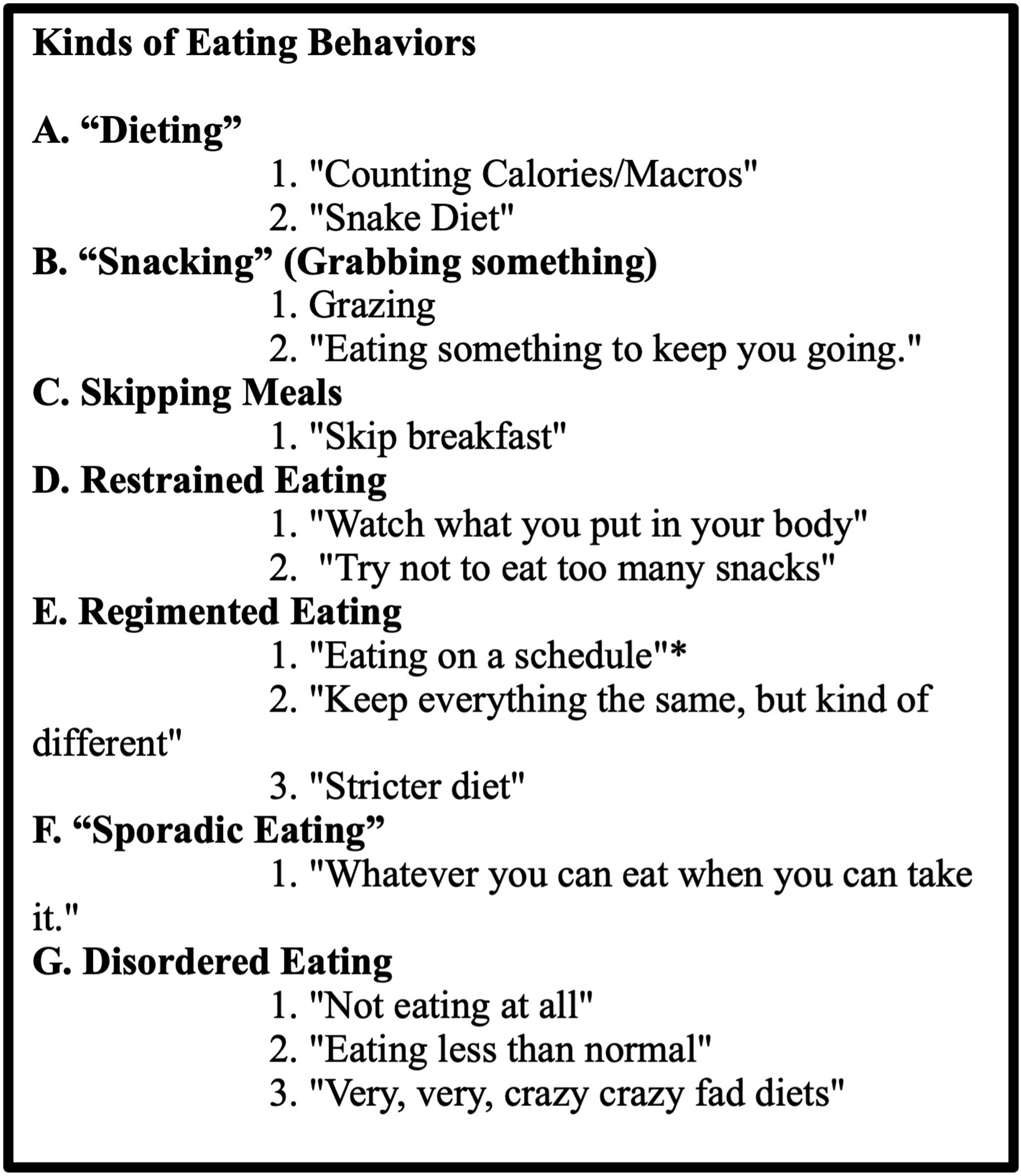
Excerpt Illustration of the “Kinds of Eating Behaviors” Domain
The codebook contained: (a) the code; (b) the definition of the code based on the researcher’s analysis of the data and/or the literature; (c) an exemplary quote; (d) an indicator if it was an a priori (“P”) or In vivo (“Inv”) code; and (e) a classification label related to the presumed level of influence within the social ecological framework (e.g., individual factor or physical environment). An excerpt of the codebook is shown in Figure 5. Excerpt of Codebook
Data Display
Data display involves organizing and assembling the data to provide analytic reflection and action and may include extended text, matrices, networks, and graphs (Miles et al., 2020). We used various types of data displays, including tables, matrixes, and visual models, to explore, describe, explain, and make predictions with the data. For example, we created matrixes to explore variations in eating behaviors and influences among groups, and visual models helped to make connections from sequence domains (e.g., stages in acculturating to military life/food environments). We also used displays when making componential analysis—“the systematic search for the attributes associated with cultural categories” (Spradley, 1980). We identified dimensions of contrasts between categories (e.g., Kinds of Sailors) and plotted these data into simple tables to identify nuances quickly and comprehensively within the culture related to eating behaviors.
Drawing and Verifying Conclusions
We employed various tactics to minimize bias, test or confirm meaning, and draw conclusions (Miles et al., 2020). These tactics included: (a) noting patterns and themes, (b) seeing plausibility, (c) clustering, (d) counting, (e) making contrasts and comparisons, (f) partitioning variables, and (g) subsuming particulars into the general. These tactics were employed in concert with, or as part of, the data condensation and display processes described above and during meetings. For example, noting patterns and themes and clustering occurred while reading and reflecting on the data, during first and second cycle coding, and identifying overarching themes. We employed counting when exploring how frequently specific issues were reported or the number of participants who mentioned a particular concept. Counting is not quantitative analysis but is important when making generalizations about the data, such as estimates on a particular recurrence or “significance” (Miles et al., 2020).
The final stages of drawing and verifying conclusions resulted in identifying cultural themes related to the specific aims and conceptual framework. As described in the section on data condensation, data were initially condensed into codes, domains, and categories. We identified themes while making contrasts and data comparisons, identifying stages in processes, and recognizing generalities of particulars. Data saturation, defined as reaching a point where no new salient information emerged from subsequent data collection or an intuitive feeling of learning nothing new, guided the decision to conclude recruitment. While an initial target number of participants was considered based on other qualitative studies of a similar nature, the final sample size was ultimately based on achieving this saturation, a determination made by the first author in consultation with the dissertation committee.
Ensuring Rigor and Trustworthiness
Establishing trustworthiness—the quality or goodness of qualitative research—is important for ensuring credibility, plausibility, and integrity of research findings (Ryan et al., 2007). To ensure credibility of findings, we engaged with the data extensively by reading and rereading transcripts, field notes, and artifacts to have an intimate understanding of the data and stay close to the data with descriptions and interpretations. Triangulation among methods and data sources produced confirming conclusions, and the research findings linked to the initial conceptual framework and other social and behavioral theories. I (first author) journaled, wrote memos, and discussed my perceptions, thoughts, and biases related to the study with the second author and dissertation committee members. Factual reporting and auditability of the research process and findings were important for ensuring dependability. The recursive and iterative processes of parallel data collection and analysis allowed for constant evaluation and comparison of emerging findings. We maintained an audit trail of all data collected, analytical reflections of the data, and the analysis process and meeting notes. Transferability—the fit of findings to other similar contexts and larger import (Miles et al., 2020)—rather than generalizability was the goal of this study. We presented findings that included detailed descriptions for readers to examine similarities and differences within their settings. Throughout the research process, a variety of readers—including researchers and service members from the Navy, Army, and Air Force— remarked on how consistent the findings were with their own experiences with junior enlisted personnel. Confirmability establishes that the conclusions and interpretations reached are coherent and supported by the data (Miles et al., 2020; Ryan et al., 2007). Confirmability is achieved when the other three criteria above are met or through the publication and dissemination of results. We invited participants and people familiar with the culture (e.g., Sailors not included in the study) to read drafts of written reports and provide feedback before presenting the findings in presentations, reports, and publications.
Presenting Meaningful and Culturally Relevant Findings
The findings from this focused ethnographic study are best represented in an adapted social ecological model, presented in Figure 6. Building upon the preliminary framework that guided our research design and data collection, this final model visually organizes the key influences on junior enlisted Sailors’ eating behaviors according to five levels: intrapersonal, social environment, physical environment, and macro-level environment, and cultural environment. Final Adapted Social Ecological Model of Influences of Eating Behaviors Among Junior Enlisted Sailors
The model’s purpose is to provide a comprehensive and culturally relevant summary of key factors across interconnected levels interact that shape eating behaviors within the specific military subculture of interest. Its application demonstrates how a foundational conceptual framework can be refined and populated with a nuanced representation of influences of complex health behaviors within a cultural group. Though the goal of the study was not solely to create a model, we found that presenting the results within this updated framework effectively conveyed the multi-level factors at play and provided a foundation for nuanced discussion.
The constructivist paradigm allowed us to integrate the participants’ and the researchers’ understanding of influences of junior enlisted Sailors’ eating behaviors. We also used different images to communicate findings to key stakeholders. Figure 7 is an example of an image used to communicate findings related to the research question, “What are the prominent eating behaviors among junior enlisted Sailors?” Participant language and emoji faces ensured the interpretation was culturally relevant and easy to understand. Prominent Eating Behaviors Among Junior Enlisted Sailors
Research is completed when pertinent findings have been published and disseminated to appropriate audiences for knowledge and action. Participants volunteered their time to contribute to a study they believed was necessary. Thus, it was imperative for us to present their narratives and comprehensive synthesis of the findings. First, we provided feedback and findings to junior enlisted Sailors, military leaders, health professionals, and researchers. Presentation to leaders provided timely and actionable information and also gave us credibility with follow-through. Next, we communicated our findings through posters and conference presentations to researchers, military healthcare professionals, and policymakers. These presentations opened doors for future work and participation in military nutrition policy and practice committees. Lastly, we published the work in peer reviewed journals to have a lasting impact and foundation for future research and collaboration.
Reflections and Recommendations
Reflecting on our experience applying this integrated methodological process, a primary lesson learned was the critical importance of clearly defining the research problem and rigorously scoping the study from the outset. Focused ethnography yields rich and nuanced data. Staying focused on the predefined research questions and utilizing the conceptual framework as a guide was essential to managing the project within our timeline and resources. It required making deliberate decisions about which avenues to pursue in depth and which to acknowledge but set aside for future inquiry, a process facilitated by continuously referring back to our core aims and the first author heeding the advice of committee members.
Effective communication and the cultivation of strong rapport were also paramount throughout this process. Frequent and focused dialogue among the dissertation committee members was critical for timely progress. My (first author’s) regular interactions with gatekeepers were vital for accessing the population and navigating the complexities of conducting research during the COVID-19 pandemic. Building trust involved maintaining respectful curiosity, a teachable attitude, and flexibility. Furthermore, given my insider positionality, reflexive journaling and memoing were invaluable tools. These practices allowed me to record not only observations and analytical hunches but also my own perceptions, thoughts, and potential biases. Regularly discussing these reflections and emerging ideas with my mentor and other team members provided essential external checks, challenging my assumptions and helping to ensure the trustworthiness and credibility of our interpretations. This iterative process of ‘trusting but verifying’ through triangulation, reflexivity, and team discussion was fundamental to managing subjectivity.
For researchers undertaking similar ambitious qualitative projects, especially those working independently or with limited team members, carefully considering the scope is crucial. Based on our experience, limiting the study to one or two primary aims with a focused set of research questions, rather than three aims, may be more manageable. Using visual tools throughout the analysis process also proved highly beneficial. Tools like sticky notes for initial coding and concept mapping features within qualitative data analysis software helped us to visualize connections between ideas, organize complex relationships between domains and themes, and avoid getting overwhelmed by the volume of data. These practical strategies, combined with rigorous scoping and consistent reflexivity, were key to conducting in-depth qualitative research effectively and efficiently.
Conclusion
Research focused on understanding the influences of health behaviors is critical for reducing the burden of preventable lifestyle-related diseases. However, generating meaningful findings for stakeholders can require extensive time and resources. As highlighted in the introduction, we aimed to present a methodological process that enables rigorous, trustworthy, and meaningful qualitative research even with constrained resources and within a defined timeline. Conducting focused ethnographic research and integrating a comprehensive conceptual framework throughout the study provides a structured yet flexible approach that facilitated obtaining culturally relevant and meaningful data efficiently and within a condensed timeline, demonstrating that a focused and time-sensitive approach does not necessitate a compromise on the depth or quality of the research. This process offers a valuable roadmap for researchers seeking to conduct robust qualitative inquiries under practical constraints.
Footnotes
Acknowledgments
We gratefully acknowledge Dr. Patricia Deuster, Dr. Diane Seibert, Dr. Patrick DeLeon, and Dr. Judd Allen for their contribution to the design of this study and mentorship to Dr. Melissa Troncoso We appreciate the participants, leaders, and gatekeepers who contributed their time to make this study possible.

Ethical Considerations
The Uniformed Services University of the Health Sciences (USU) Human Research Protection Program Office (HRPP) approved this study as exempt human subject research under Category 2 as defined by 32 CFR 219.104 (d) and therefore did not require Institutional Review Board review. The HRRP waived written consent and required oral consent to participate. The approval reference number is 922474.
Funding
The author(s) disclosed receipt of the following financial support for the research, authorship, and/or publication of this article: This work was supported by the Tri-Service Nursing Research Program [Grant: 11052-N20-C04GR]; the Uniformed Services University of the Health Sciences [Grant: R0611110320], and the Jonas-Geneva Nursing and Veterans Healthcare Scholars Program. The information or content and conclusions do not represent the official position or policy of, nor should any official endorsement be inferred by the TriService Nursing Research Program, the Uniformed Services University of the Health Sciences, the Department of Defense, or the U.S. Government. The funders did not play a role in study design, in the collection, analysis, and interpretation of data in the writing of the report, nor in the decision to submit the article for publication.
Declaration of conflicting interests
The author(s) declared no potential conflicts of interest with respect to the research, authorship, and/or publication of this article.
Disclaimer
The opinions and assertions expressed herein are those of the authors and do not reflect the official policy or position of the Uniformed Services University, the Department of the Navy, the Department of the Army, the Department of the Air Force, the Defense Health Agency, the Department of Defense, or the United States Government.
Copyright Statement
This work was prepared by a military or civilian employee of the US Government as part of the individual’s official duties and therefore is in the public domain and does not possess copyright protection. Title 17 U.S.C. 105 provides that ‘copyright protection under this title is not available for any work of the United States Government’ Title 17 U.S.C. 101 defines a U.S. Government work as work prepared by a military service member or employee of the U.S. Government as part of that person’s official duties. (Public domain information may be freely distributed and copied; however, as a courtesy it is requested that the Uniformed Services University and the authors be given an appropriate acknowledgement).
Data Availability Statement
Data may be available upon request, pending military ethical and legal review.