




Abstract
This scholarly article provides a new four-phase, thirteen-step CR-based method applicable to organizational research that responds to the serious lack of systematic and accessible frameworks aimed at revealing hidden underlying processes behind intricate workplace phenomena. CR’s stratified ontology—defining the empirical, actual, and real domains—provides a robust analytical framework to peer under salient trends. Despite the increasing familiarity of CR with organizational and management research, contemporary scholarship still too frequently suffers from the lack of reproducible methodology and thus limits empirical quality and makes accessibility problematic for newcomers. Our suggested methodology overcomes this shortcoming by informatively guiding researchers through problem description, mixed-methods approach, data gathering, and abductive-retroductive analysis ultimately providing actionable results relevant to organizational enigmas. By the combination of qualitative and quantitative approaches, it brings theory and hard facts together in a cohesive way and therefore becomes an instrument with multiple sides that can be applied in various fields, from public sector institutions to small and medium enterprises. This approach considerably contributes to CR scholarship through being open about methodology so making it highly accessible to novice scholars, and facilitating evidence-based policymaking. It unleashes the transformational power of CR, exposing causal mechanisms that work in modern organizations, and thereby spurring rigorous and effective research that informs scholarly discourse as well as actionable recommendations for urgent organizational concerns.
Keywords
Introduction
CR has become a dominant scholastic philosophical thought in the social scientific studies, especially organizational studies, due to its integrative nature that goes beyond the flaws of positivism and interpretivism with an ontology of stratified layers that differentiate the empirical (observable), actual (events), and real (generative mechanisms) levels (Bhaskar, 1975; Sayer, 2000; Fletcher, 2017). This hierarchical conception allows scholars to look beyond surface trends, literally connecting what is seen in the day-to-day routines of organizations—inefficiencies or procrastination—to those mechanisms and structures behind them which enable them (Easton, 2010; Hoddy, 2019a, 2019b). The penetration of CR cuts across all walks of life from education (Kouam, 2025), information systems (Elsehrawy et al., 2024; Wynn & Williams, 2020), entrepreneurship (Hu, 2018), public administration (Ongaro & Yang, 2024), public policy (Archer, 2024), psychology (Willis, 2023), to organizational and management studies (Gumbi & Twinomurinzi, 2025; Khaddour, 2024; Kringelum & Brix, 2020; Pimentel, 2024). Yet, while it has the potential in philosophy, the operational usability of CR in organizational research is being hindered by a lack of methodological distinctness and systematic guidance that limits its replicability and usability (Fletcher, 2017; Hu, 2018; Oliver, 2012).
Recent studies utilizing CR in organizational research, such as Khaddour (2024) and Pimentel (2024), provide information on the strengths as well as weaknesses of the paradigm. Khaddour (2024) mentions CR in organizational culture in utilizing a stratified ontology to apply Schein’s model in cultural mechanism analysis; but it does not depict a procedural framework in details, rather falling back on conceptual analyses that are imprecise rather than providing much explicit information for empirical application. Similarly, Pimentel (2024) condemns organizational phenomena from a CR point of view but does not provide sufficient procedural description and hence restricts replication of findings by subsequent researchers. Gumbi and Twinomurinzi (2025) examine the use of technology in small, medium, and micro enterprises (SMMEs) using the perspective of CR; yet their approach has been criticized on the basis of ad hoc selection of mechanisms, noting absence of a systematic procedure. These academic works resonate with Oliver’s (2012) contention that CR’s “lack of association with a known research methodology” places it at the level of philosophical speculation or overall support of blurring of methods without definite procedural measures (Frederiksen & Kringelum, 2021; Yeung, 1997). This methodological shortfall is most evident in organizational research, where the interlinking of agency (e.g., employees’ behavior), structure (e.g., bureaucracy), and culture (e.g., risk aversion) requires a formal but flexible approach to showing causal processes step by step, e.g., those showing public agency procrastination (Ackroyd & Karlsson, 2014; Hastings et al., 2025).
This article attempts to correct these methodological flaws by offering an inaugural 4-stage, 13-step approach specifically tailored to the conduct of CR research in organizational studies. This process addresses the current lack of systematic and reproducible steps by offering researchers a clearly defined sequence of procedures, starting from problem identification (Stage 1) to research design (Stage 2), data collection (Stage 3), and data analysis (Stage 4), concluding with solid recommendations. In contrast to prior work, e.g., Fleetwood (2005) or Newman (2020), theoretically rooted but non-operational in scope, our method is step-by-step, empirical, and bridges quantitative and qualitative methods to examine quantifiable dynamics (e.g., late deadlines) and tacit mechanisms (e.g., bureaucratic inertia) concurrently and thus being in line with CR’s goal of “connecting the inner world of ideas to the outer world of observable events” (Ackroyd & Karlsson, 2014, pp. 21–22).
The ease of use of this approach to early-career researchers is assisted considerably by procedural steps with form, i.e., posing questions in alignment with Critical Realism (Step 4) and mapping structures and contexts in a systematic manner (Step 9), thus eliminating the complexity highlighted by Bogna et al. (2020) and Ellison and Langhout (2025). Through effective combination of theoretical knowledge with real-world application, the framework responds to academic demands for utilitarian CR applications within organizational research (Hu, 2018; McAvoy & Butler, 2018), thereby as a flexible tool for studying a variety of phenomena, from employee procrastination to adoption of technology (Danermark & Morgan, 2023; Dwayi, 2024).
The theoretical contributions of the method are threefold. The first is that it provides a reproducible methodology based on CR, thus answering the vagueness addressed by Oliver (2012) and Fletcher (2017) by posing CR questions in a definite, phased procedural format. Second, it effectively synthesizes theory and practice to real life such that researchers are able to form actionable conclusions, e.g., policy reforms aimed at curbing procrastination, as examples of Wynn and Williams (2020) and Mäkipelkola (2025) studies. Third, it profoundly improves access for early scholars by making the complicated ontology of CR helpful in an orderly sequence of steps, thereby remedying the inaccessibility posed by Labas (2024) and Fuchs and Robinson (2023). These efforts address the deficiency in methodology in organizational research whereby a dearth of clear guidance hinders CR from elaborating organizational outcomes’ rich causal mechanisms.
The article’s structure is as below. First, we elaborate on the philosophical foundations of CR, contrasting them with other paradigms like constructivism and interpretivism. Second, we discuss the possible application of CR in organizational and management research. Third, we present the 4-stage, 13-step methodology, augmented with elucidatory examples, like the example of procrastination, to illustrate its applicability. Last, we explicate the differences isolating this framework from other methodologies and delineate its potential to advance CR research and organizational practice. By offering a formalized yet malleable methodology, this framework optimizes CR’s potential to investigate the internal mechanisms that explain organizational phenomena, thus advancing rigorous and efficacious research inquiry.
Philosophical Perspectives in Organizational and Management Research
Positivism, Interpretivism and Critical Realism
Comparison of Positivism, Interpretivism, and CR Realism

Therefore, CR’s capacity to penetrate superficial observation to find the underlying causes renders it superior to positivism’s focus on empirical and interpretivism’s focus on description (Fletcher, 2017). CR’s capacity to accommodate a wide variety of observations of reality is such that an inquiry that penetrates beyond superficial examination to uncover the underlying forces that drive events’ course is possible. First introduced by Roy Bhaskar in the 1970s and later advanced by various scholars (Alderson, 2023), CR has been used extensively in various research areas. It is important to be well-versed with the philosophical underpinnings of this paradigm while developing a methodology for its use in organizational as well as management research. We will now cover this topic in greater detail in the next section.
The Concept of Causality in CR
Stratified Ontology in CR

Ontologically Robust, Epistemologically Prudent
The CR’s stratified ontology makes it distinct from empiricism and subjectivism of positivism and interpretivism on the basis that generative mechanisms (such as organizational culture) are causally efficacious independently of observation (Ackroyd & Fleetwood, 2005; Bhaskar, 1978). In organizational research, such reasoning enables inquiry into implicit structures, e.g., rigid hierarchies, to impact outputs like resistance to change (Archer, 2024; Hu, 2018; Pimentel, 2024). Fallibilist epistemology embraced by CR accepts knowledge as temporary and subject to improvement through iterative questioning, in contrast with the positivist dogma of some definite truths and the relativistic approach of interpretivism (Lawani, 2021; Mukumbang, 2023). For instance, our leadership effectiveness theory changes as fresh empirical evidence input flows into prevailing hypotheses of mechanisms engaged (Kringelum & Brix, 2020). This tension between ontological firmness and epistemological caution aligns with organizational study requirements for theoretically informed but adaptively contextualized understanding (Danermark & Morgan, 2023; Ellison & Langhout, 2025).
Methodological Versatility for Causal Investigation
CR’s strategy integrates mixed methods of examining the richness of reality by integrating quantitative pattern analysis and qualitative mechanism study (Danermark et al., 2019; Fuchs & Robinson, 2023).
Abduction infers mechanisms from unusual observations (e.g., turnover and governance), and retroduction works backward from effects to their causes (e.g., bureaucratic inertia inducing delays) (Eriksson & Engström, 2021; Glynos & Howarth, 2019). For example, employee engagement could be measured by surveys (empirical), while interviews guess cultural norms as mechanisms (real) by way of triangulation (Dwayi, 2024; Hastings, 2021). Critics argue CR flexibility comes at the cost of ambiguity (Stutchbury, 2022), but its proponents claim its ability to change methods to suit phenomena and enhance reliability by triangulation (Archer, 2024; Fletcher, 2017). Organizational researchers can take on causal complexity through this malleability, blending theory and practice (Mukumbang & van Wyk, 2020).
Abduction and Retroduction in Organizational Studies
In organizational studies, abduction and retroduction complement one another in specifying generative mechanisms. Abduction interpretively formulates the evidence, for example, presuming that positive cultures drive innovation (Ackroyd & Fleetwood, 2005; Amabile, 1996). Retroduction then goes on to formulate conditions, for example, empowering leadership reducing hierarchical constraints (Bass, 1985; Fleetwood, 2005). This strategy, based on CR’s stratified ontology, yields operative knowledge of organizational phenomena, including cultural resistance to change.
Briefly, CR’s stratified ontology, fallibilist epistemology, and mechanism-based methodology yield a solid organizational research paradigm, more solid than positivism’s reductionism and interpretivism’s relativism (Archer, 1995; Bhaskar, 1975). By studying generative mechanisms using abduction and retroduction, CR reveals the dynamic interplay of agency, structure, and context (Fleetwood & Ackroyd, 2004). Applying it to organizational research, full of promise as it is, it is constrained by methodological inconsistency (Gumbi & Twinomurinzi, 2025; Khaddour, 2024). Our suggested method bridges those shortcomings by recommending a systematic way of making CR more useful and rigorous for organizational research.
Embracing the Philosophy of Realism in Organizational and Management Studies
Critical Realism (CR), as situated in the organizational studies tradition, provides scholars with a coherent analytical tool through which they can transcend shallow observation and to expound on the intricate processes and causal dependencies that underlie organizational existence. Drawing on the foundational work of Roy Bhaskar, A Realist Theory of Science (1975), this philosophical school offers a robust structure that moves beyond positivism’s reductionist empiricism and interpretivism’s subjectivism. It is Sayer (2000), Fleetwood (2005), and Ackroyd (2004), to name a few theorists, who have been able to translate these theoretical frameworks across into the social sciences to account for how CR reveals the underlying structures—power relations, discourses of culture, and institutional contexts—tacitly but powerfully influencing individual and collective agency in organizations (Ackroyd & Fleetwood, 2004; Sayer, 2000). Foundational texts such as Ackroyd and Fleetwood’s *Realist Perspectives on Management and Organisations (2000) have done much of the groundwork by using this methodology to analyze organizational structure, role, and relational relationship. Their issues raise causal mechanisms behind such features as motivation, successful leadership, and working culture, a solid foundation for further work examining structural forces shaping organizational action (Ackroyd & Fleetwood, 2005; Archer, 1995). Paralleling this, Danermark et al.'s Explaining Society: CR Realism in the Social Sciences (2019) also proved the versatility of the paradigm in explaining complex workplace dynamics and processes of change. By virtue of an argument for a mixed-methods paradigm, they were able to effectively blend empirical observations with the underlying generative forces, thereby reasserting the role of CR realism as an essential intellectual resource for organizational scholarship.
Such preliminary work is representative of the paradigm’s potential for synergy between structure and agency, a dialectical tension emphasized by Bhaskar himself (Bhaskar, 1979). Expanding upon this theoretical foundation, more recent research has borrowed CR’s applicability to numerous organizational contexts. Fleetwood (2005) examined the manner in which power relations quietly erode or confirm team cohesion and morale, revealing insights which are lost to mainstream empirical methods’ focus on surface level correlations instead of more fundamental causal explanations (Fleetwood, 2005). Easton (2010) utilized the paradigm to explain decision-making processes, demonstrating how taken-for-granted norms and hierarchical arrangements affect strategic outcomes—a contribution later built upon by his calls for methodological precision in case study research design (Ackroyd & Karlsson, 2014; Easton, 2010). In the meantime, Mutch (2013) summarized CR’s ability to explain organizational change, mapping the effects of historical legacies, cultural inclinations, and variables like trust and leadership on change processes (Mutch, 2013). This type of research is reflective of the success of the paradigm in being able to identify concrete outcomes with concealed causal processes and also supported by Sayer’s (1992) call for a general contextual understanding (Sayer, 1992). Pimentel (2024) presented a CR realist model of organizational sociology which focuses on the dialectical relationship between structure, agency, and context in building organizational social systems (Pimentel, 2024). Similarly, Khaddour (2024) re-worked Schein’s organizational culture model from a CR realist ontology, arguing that cultural values and artefacts are understood as mechanisms orchestrating behavior in multiple dimensions (Khaddour, 2024). Together, these contributions consolidate CR as a developing methodology for constructing sophisticated and multi-dimensional explanations of organizational phenomena.
But while the philosophical depth, early CR research faltered because it was unclear in methodology, so therefore it was less student and newcomer-friendly. While Easton (2010) and Ackroyd and Karlsson (2014) efforts were very much conceptual in nature, they left little in terms of practical guidance, and researchers had to work out the intricacies of the paradigm for themselves (Ackroyd & Karlsson, 2014; Easton, 2010). This lacuna precipitated the need for greater methodological systematicity, and proponents like Fletcher (2017) argued for methods combining CR with qualitative care for rigor to increase empirical precision (Fletcher, 2017). Bridging this gap, our methodology offers a distinct four-stage, thirteen-step approach, which is methodically constructed to take researchers step by step through problem formulation to data synthesis, thereby ensuring CR values are applied with pragmatism as well as effectiveness in organizational research.
An Innovative Methodology for Organizational Studies
Proposed Methodological Framework: Four Phases and 13 Steps
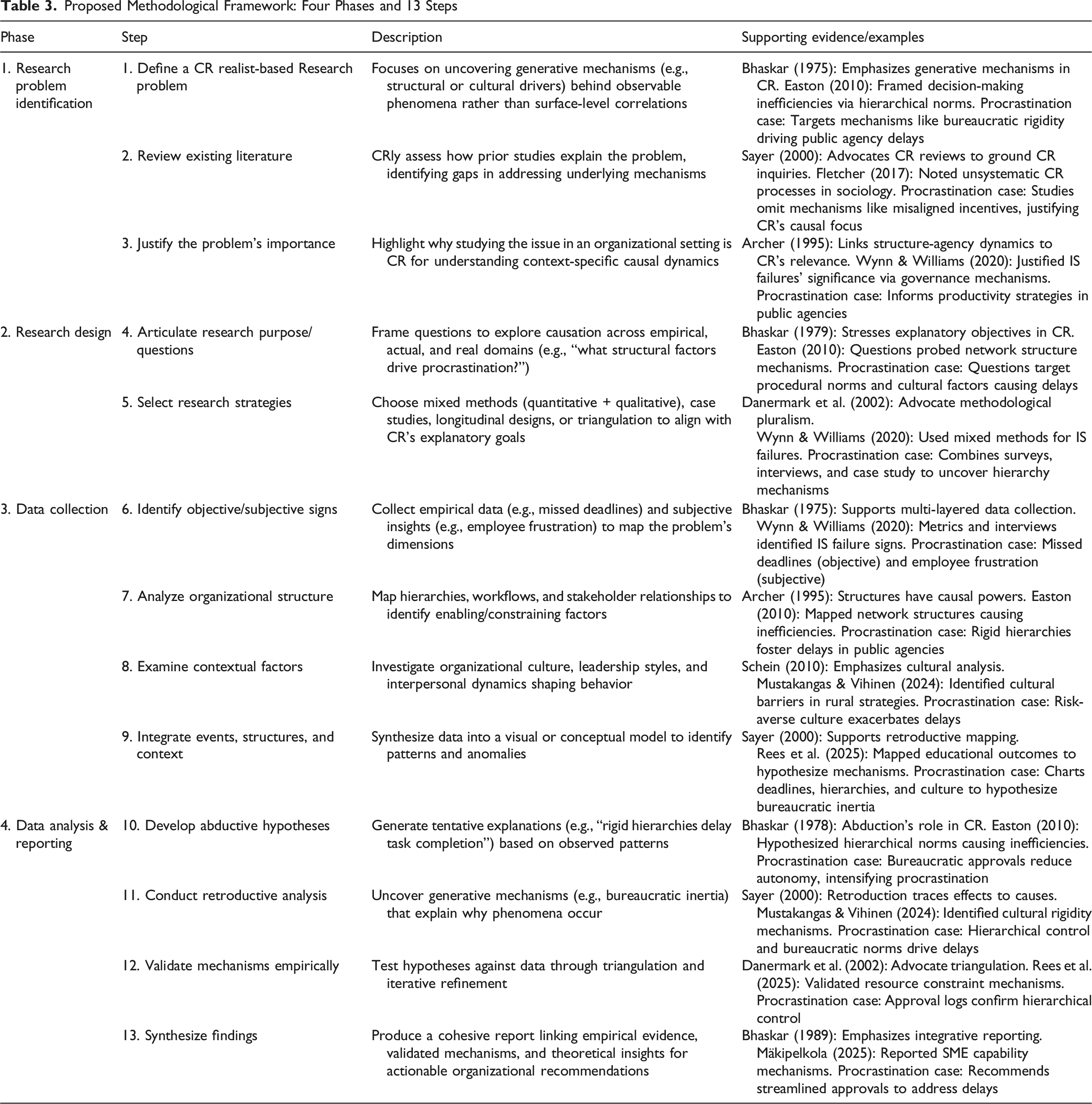

The Theorizing of the Methodology for Conducting of Organizational Studies Based on the Critical Realism
Phase 1: Establishing a Rationale for Using Critical Realism Methodology
Phase 1 lays the foundation for a CR investigation by determining that CR methodology is to be used and setting the research problem in the philosophical context. Spanning three steps—problems suitable for CR identification, literature review, and organizational relevance testing—phase 1 ensures adherence of research to CR’s goal of discovering generative mechanisms which exist above observable events (Bhaskar, 1975; Sayer, 2000). By basing research in CR’s stratified ontology, researchers are able to focus on deep structures and processes of organizational phenomena, like resistance to change or procrastination, rather than shallow correlations or unique stories (Fletcher, 2017). This stage allows researchers to deal with complex organizational problems with theoretical and practical acumen, based on prevalent literature and local applicability (Archer, 2024; Danermark et al., 2019). This phase empowers scholars to focus on issues necessitating an examination of deeper structures and mechanisms rather than mere surface observations. Subsequently, we shall elucidate this phase.
Step 1. The Philosophy of Critical Realism Is Suitable for Solving what Kind of Research Problem?
In research practice, the first step is formulating the research problem (Creswell & Plano Clark, 2011; Yin, 2018).? Problems in positivistic research paradigms tend to be focused on problems that are measurable, with variables, relationships, and statistical correlations to determine measurable patterns (Babbie, 2020; Creswell, 2014). This kind of methodology position is particularly appropriate for questions whose goal is to define causality by reference to empirical measurements. In contrast, qualitative studies aim to make stated the latent processes that drive phenomena, focusing on interpretation within specialized contextual structures (Plano Clark & Creswell, 2014). CR offers a different paradigm, moving away from observation to investigation of the causal structures that structure events. It aims to explain not only what happens but why it happens, revealing the normally hidden mechanisms and structures that shape events (Bhaskar, 1975; Danermark et al., 2019). It works from the premise of a multi-dimensional reality that includes the empirical (experiences), the actual (events regardless of observation), and the real (structures behind) (Sayer, 2000). Through the analysis of such strata, CR research yields explanations that relate observed events to their causal causes in a manner beyond empirical correlations. This is a step towards accommodating CR’s stratified ontology, which distinguishes empirical (observed events), actual (events), and real (generative mechanisms) spheres to accord more importance to causal explanations than descriptive explanations (Sayer, 2000). That is, research questions within a Critical Realism (CR) framework are distinguished by their complexity. They differ from positivist research in that they inquire about causation, not just correlation.
This approach fosters an open, multi-dimensioned conception of reality, linking empirical facts to the structural arrangements on which they depend (Bhaskar, 1998; Sayer, 2000). This way, CR produces research results that are theoretically sound and pragmatically efficient, to facilitate interventions addressing complex social problems. For procrastination, research question is: “What organizational mechanisms catalyze employee procrastination in public agencies?”, highlighting deeper structural drivers like bureaucratic rigidity or perverse incentives over surface-level conduct. Bhaskar (1975) concurs with this view, focusing on generative mechanisms as the crux of CR research, and Easton (2010) demonstrates sound problem framing in organizational studies. Fletcher (2017) similarly affirms the applicability of CR to rich social phenomena, highlighting its promise for the revelation of causal mechanisms in intricate organizational contexts.”
Step 2. How does the Existing Literature Explain This Problem?
Literature review is one of the major contributions to social science research, as it forms the basic scaffolding for framing the research problem within the context of a wide body of work (Creswell, 2014; Creswell & Plano Clark, 2011). Literature reviews have several significant functions: they legitimize the research problem, record contemporary scholarship, allow for gaps, specify theoretical constructs, offer methodological templates, and facilitate interpretation (Babbie, 2020). These positions enhance research robustness, create a link between the outcomes and the academic culture, and map the line of inquiry (Yin, 2018). The utilization of literature is dissimilar across different paradigms in studies. Literature in quantitative studies acts as a basis for science for hypothesis formulation and the discovery of variables, in line with deductive reasoning. Such a methodology allows for hypothesis creation, empirical analysis, and comparison (Creswell & Plano Clark, 2011). Qualitative research makes loose use of literature and allows scope for an inductive process that incorporates observations during data analysis for improved understanding (Denzin & Lincoln, 2011).
Literature in CR research has a multi-faceted role, forming the foundation for investigating the stratified nature of reality, from empirical experience, actual events, to true causal mechanisms (Bhaskar, 1975; Danermark et al., 2002). Reading literature at this level helps in the determination of gaps in existing knowledge, specifically where earlier research might have underemphasized causal structures. Such a procedure aligns with CR fallibilist epistemology, which views knowledge as temporary and open to revision from interactions with earlier research to lay bare methodological defects, such as correlational or descriptive analyses, to warrant a CR approach (Fletcher, 2017). Such research-informed analysis allows researchers to return empirical findings through the discipline of CR, thus being in a position to lay bare tacit mechanisms underpinning observed patterns (Fleetwood & Ackroyd, 2005; Sayer, 2000). Therefore, in CR, here and now, literature is most essential to make sure that research pays attention to both observable things and the generative mechanisms underlying them in order to bring life to academic scholarship along with practical application. In procrastination, literature review may find that previous work (e.g., Khaddour, 2024) mentions cultural determinants of procrastination but fails to identify specific mechanisms like misplaced incentives or hierarchical pressure, and therefore the importance of CR’s causal emphasis to close such lacunas.
Sayer (2000) promotes critical literature reviews as a mooring for CR questions, whereas Fletcher (2017) and Gumbi and Twinomurinzi (2025) reveal persistent methodological differences in organizational studies, and therefore the importance of a strict CR methodology.
Step 3. Why is it Important to Study This Problem in an Organizational Setting?
Study of a research problem within a given context enables a proper probing of contextual conditions influencing phenomena (Yin, 2018). The framework of the context is essential in explaining processes underlying observed events, enabling scholars to comprehend causal connections underlying surface patterns (Sayer, 2000). By concentrating in a specific context, researchers are able to examine intricate relationships between structures, mechanisms, and events that frequently go unnoticed by more universal studies (Stake, 1995). Essentially, a bounded, organized organizational context also enables researchers to amass enormous, context-laden data, which can highlight the frequently ignored subtle factors affecting behavior and outcomes. This is a reflection of Critical Realism’s (CR) intent to balance theoretical insight with the reality of practice, analyzing the interplay between agency, structure, and context within organizational environments to substantiate the relevance of the problem to CR methodology (Archer, 2024).
Therefore, concentration in one organizational setting also encourages stakeholder-specific actionable results. The results are setting-specific and encourage the resolution of problems critically associated with the organization (Flyvbjerg, 2006). Additionally, it enhances the theoretical knowledge base through testing or invalidating current theory within the discipline (Stake, 1995). In line with CR’s emphasis on situational complexity, this approach appreciates that causal processes vary with varying settings with diverse situational determinants (Sayer, 1992). Hence, research into a problem of study in its real-life context is necessary for the identification and interpretation of the respective causal processes involved (Danermark et al., 2002). To illustrate, examining a research problem in an organizational setting matters for a number of reasons: A) It facilitates whole-complex understanding (Yin, 2018), B) Reveals context-bound relationships (Stake, 1995), C) Questions multi-dimensioned data (Piderit, 2000), D) Gives theory with practice link (Flyvbjerg, 2006), E) Enhances CR (Sayer, 1992), F) Fosters effective interventions (Pawson & Tilley, 1997). Through concentration on a given context, therefore, scholars utilize CR to produce outcomes that are theoretically relevant in addition to being pragmatically useful. For instance, in procrastination, examination of mechanisms like rigid hierarchies is important in the sense that it would guide intervention towards improving productivity in public agencies in order to redress theoretical gaps in the understanding of structural forces and practical imperatives for performance improvement. Archer (2024) identifies CR’s contribution to structure-agency relations studies, whereas Wynn and Williams (2020) and Hastings et al. (2025) demonstrate empirical evidence of organizational relevance, showing how CR questions provide utilizable knowledge.
In summary, phase 1 defines the research problem within CR’s philosophical framework strictly, with general processes instead of surface appearances (Bhaskar, 1975). Through the foundation of each step of CR principles and empirical illustrations, it transcends methodological shortcomings in previous organizational studies (Fletcher, 2017; Gumbi & Twinomurinzi, 2025). This stage provides the foundation for future stages so that there is a systematic investigation of organizational performance causes, such as procrastination, with significant implications for theory and practice (Danermark et al., 2019; Hastings et al., 2025).
Phase 2: Research Design
Phase 2 formulates the paradigm of method appropriate for a Critical Realism (CR) investigation through delimiting the research objectives, questions, and strategy and conforming to the philosophical underpinning of CR (Bhaskar, 1975; Sayer, 2000). This stage entails two distinct processes—research goal and question formulation, and research strategy selection—thereby giving a systemic framework to the observation of observable facts and generative processes in organizational settings (Fletcher, 2017). By placing design within CR’s stratified ontology, researchers ensure consistency across empirical (observed), actual (events), and real (mechanisms) spaces for conducting a subtle study of complex organizational phenomena, including procrastination or organizational change (Archer, 2024; Danermark et al., 2019). This phase provides a foundation for data collection representing both manifest outcomes and latent causative factors, thereby supporting well-crafted and informative results (Hastings et al., 2025; Wynn & Williams, 2020). Subsequently, this phase will be discussed.
Step 4. What are Research Purpose and Questions?
Research questions and aims in a CR investigation are framed to reveal the generative mechanisms and structures of observable organizational occurrences, hence bringing objective realities together with subjective experience (Bhaskar, 1979). Such action is in line with CR’s explanatory concern, as opposed to over identification of causal mechanisms vis-a-vis positivism’s predictive aspirations (Hempel, 1966) or subjective meaning in line with interpretivism (Sayer, 2000; Schwandt, 1994). Compared with positivist questions (e.g., “Is a new management strategy increasing productivity?”), which attempt to quantify associations, or interpretivist questions (e.g., “How do employees understand a new management strategy?”), which attempt to examine meanings, CR questions are designed especially towards underlying causal conditions, e.g., “What structural and cultural conditions underlie employee procrastination in public organizations?” (Sayer, 1992). For example, Easton (2010) constructed questions which were intended to examine how network designs produce decision-making inefficiencies, such as hierarchical norms. For our procrastination study, the aim here is to account for why organizational mechanisms (e.g., bureaucratic inflexibility) cause delays, such as: “How do cultural and procedural norms in public agencies affect procrastination behaviors? This is justified by Bhaskar (1979), who focuses on explanatory aims, and Sayer (2000), who defends questions reaching further causal structures. Fletcher (2017) similarly testifies to the effectiveness of CR in formulation of questions that expose mechanisms in intricate organizational settings and ensuring thus theoretical as well as empirical consistency.”
Step 5. What are the Research Strategies?
Critical Realism (CR) research methods combine diverse methods to explain generative mechanisms, structural relations, and causal structures at empirical, actual, and real levels (Bhaskar, 1978; Danermark et al., 2002). This step illustrates CR methodological pluralism by combining qualitative and quantitative methods to build patterns and investigate underlying causes, thus making possible an all-round organizational phenomenon analysis (Sayer, 2011; Zachariadis et al., 2013). Such a methodology is mainly mixed methods in character, where quantitative data outline patterns (e.g., a job satisfaction survey) and qualitative data explain mechanisms (e.g., an interview about leadership issues). This is well illustrated through Wynn and Williams’s (2020) study of information systems failures. Case studies, in their general methodological process, enable contextual analysis that is intensive, abductive and retroductive thinking being employed to uncover mechanisms, as illustrated by Gumbi and Twinomurinzi (2025) in the case study of SMME technology uptake, though without systematic direction (Bille & Hendriksen, 2023; Yin, 2018). Longitudinal studies meticulously track the evolution of mechanisms over time, exemplified by Easton’s (2010) examination of network dynamics, while triangulation serves to substantiate findings across diverse data sources, as seen in Dwayi’s (2024) investigation of burnout. In our research on procrastination, mixed methods can quite logically include surveys to measure trends of delay, interviews to analyze cultural norms, and a case study of a public agency to retroductively study mechanisms such as fixed hierarchies, supplemented with policy documents. This is supported by Danermark et al. (2002) and Sayer (2000), who advocate methodological flexibility, and Archer (1995) and Mukumbang (2023), who stress the significance of case studies and triangulation in discovering causal complexity in organizational settings.
In summary, phase 2 is a systematic approach that is in harmony with CR philosophical values, enabling researchers to study observable results together with concealed processes driving organizational occurrences (Bhaskar, 1975). Through the provision of each procedural activity with CR roots and empirical demonstration, phase 2 aims to improve on methodological flaws of previous studies (Fletcher, 2017; Gumbi & Twinomurinzi, 2025). It prepares researchers for data collection and analysis processes, thus ensuring systematic management of untangling processes that lead to problems like procrastination, with ripple effects on organizational theory and practice.
Phase 3: Collection of Data
Phase 3 is concerned with building empirical knowledge to examine patterns in observable organizational phenomena through abductive and retroductive reasoning to tie data to underlying generative mechanisms (Bhaskar, 1975; Sayer, 2000). This phase is comprised of four distinct steps—identification of object and subjective indicators, close scrutiny of organizational structure, contextual scrutiny, and mapping of event, structure, and context—ensuring data collection consonant with CR’s stratified ontology, thereby navigating empirical (observable), actual (events), and real (mechanisms) spaces (Danermark et al., 2002). By combining distant data sources and reasoning techniques, scholars structure evidence that not only captures phenomena like inefficiencies or procrastination but also points towards their causal causes, thus forming the foundation for mechanism identification (Archer, 2024; Fletcher, 2017). It is an important step towards developing a robust dataset that deserves more advanced organizational analysis (Hastings et al., 2025; Wynn & Williams, 2020). Finally, the procedural steps of this stage fall under close analysis.
Step 6. What are the Objective and Subjective Signs of the Problem in the Study Setting?
Researchers methodically collect objective (quantitative) and subjective (phenomenological) signs in a bid to obtain a general overview of the study problem within its organizational setting (Yin, 2018). This methodological answer to such a call by Critical Realism (CR) of balancing observation at a level empirical and more profound mechanisms, using objective data to measure quantifiable patterns observable while using subjective data in locating the everyday experiences, thus capturing the dynamic tension between agency and structure (Archer, 1995; Sayer, 2000). Objective measures, such as decreased productivity (Hackman & Oldham, 1976), turnover (Hom et al., 2017), or customer discontent (Tax et al., 1998), are grounded in performance ratings, organizational records, and observational studies (Bowen, 2009). Subjective measures, however, such as job dissatisfaction or burnout (Maslach & Leiter, 2008), rely on methods such as surveys, interviews, or focus groups (Brinkmann & Kvale, 2018; Spector, 1997). As an example, Wynn and Williams (2020) used quantitative measures (e.g., system downtime) in conjunction with qualitative interviewing to establish information systems failure measures. Objective measures in our research on procrastination are late deadlines documented in public agency records, whereas subjective measures, obtained through employee interviews, reflect bureaucratic process frustrations. This is supported by Bhaskar (1975), who emphasizes multi-dimensional data collection, and Creswell (2014), who advocates for the integration of qualitative and quantitative findings. Gumbi and Twinomurinzi (2025) also demonstrate this using the combination of survey data and interviews for exploring barriers to technology adoption, although their method lacked systematic integration.
Step 7. What is the Structure of the Study Setting?
Substantive, immersive understanding of organizational structure—hierarchies, technology systems, stakeholder relations, and informal networks—is needed in order to comprehend causal propensities and capacities that influence things (Archer, 1995; Mintzberg, 1979). Such analysis is in line with CR’s focus on the actual world and charting structural factors capable of opening up or blocking mechanisms, for example, centralized hierarchies to exclude autonomy (Bhaskar, 1975; Sayer, 2000). Methodological techniques include qualitative interviewing to reveal informal processes, quantitative surveys to assess independence in decision-making, and observational studies to reveal policy-practice mismatch (Krackhardt & Hanson, 1993; Yin, 2018). For instance, Easton (2010) explored network structures to reveal mechanisms like hierarchical norms that lead to inefficiencies. In our research on procrastination, tracing the structural dynamics of a public agency can entail charting inflexible hierarchies and bureaucratic procedures in organizational charts and interviews and hence illuminate why centralized control leads to delay. Such an observation is supported by Archer (1995), who proposes causal powers of structures, and Miles and Huberman (1994), who prefer systematic mapping. Similarly, Mäkipelkola (2025) used similar approaches to explore capability formation in SMEs, conforming to structural forces but requiring more articulation of mechanisms.
Step 8. What is the Context of the Study Setting?
The contextual setting—overall paradigms of culture, climatic factors, managerial behavior, and human relationships—a influences the functioning processes in institutional setups (Danermark et al., 2002; Schein, 2010). The third stage is where Critical Realism (CR) identifies context as an active factor that engages with structures and agents to produce events, thus requiring exploration of paradigms of culture, practices in leadership, and team relationships (Pawson & Tilley, 1997; Sayer, 2000). Methodological tools are interviewing, cultural study, ethnographic field research, and value surveys (Hofstede, 2001) to cast light on management factors (Yin, 2018). Mustakangas and Vihinen (2024), for example, conducted studies of rural development settings using field interviews and investigations to identify cultural obstacles to effective implementation. For procrastination, the culture of a public agency might be examined through employee survey-based analysis of an aversion to risk culture as well as viewing autocratic managerial styles, hence showing how such determinants in such an environment enhance procrastinations. This argument is supported by Schein (2010), who directs the attention towards the importance of analysis of culture, while Schneider et al. (2013) stress the importance of climate. In addition, Khaddour (2024) employed CR with organizational culture too but was not systematic in terms of contextual analysis, hence reaffirming the need for careful approaches.
Step 9. What is the Mapping of Events, Structure, and Context of the Study Setting?
The event-structure-context mapping combines observation data, interview data, survey data, and documents to develop a comprehensive picture of organizational dynamics (Sayer, 2000; Yin, 2018). This phase satisfies the retroductive thinking characteristic of CR through reverse reasoning from events to hypothesize basic mechanisms by relating empirical patterns with structure and context effects (Danermark et al., 2002; Easton, 2010). Data sources include qualitative findings from interviews, quantitative trends from questionnaires, observation data, and document analysis (Bowen, 2009; Creswell, 2014). For instance, Rees et al. (2025) mapped results of educational programs using mixed data to determine mechanisms like resource limitations. In procrastination, mapping can engage in distinguishing tardy dates (events), rigid organizational pyramids (structure), and risk-averse environments (context) by employing a schematic map, hypothesising mechanisms like bureaucratic sluggishness. Miles and Huberman (1994) repeat the same by proposing integrative mapping, and Sayer (2000) upholds the doctrine of retroduction. Gumbi and Twinomurinzi (2025) tried to undertake similar mapping but could not achieve systematic synthesis and hence highlighted the necessity for systematic CR approaches.
By way of conclusion, the third stage strives to marshal and synthesize evidence in an effort to analyze organizational phenomena and speculate on underlying mechanisms, thereby following the stratified ontology imagined by CR (Bhaskar, 1975). In responding to methodological shortcomings of previous studies (Fletcher, 2017; Gumbi & Twinomurinzi, 2025), it bases each procedural step on CR principles and example illustrations. This process provides researchers with the ability to build a strong dataset that is favorable to mechanism discovery, thus allowing for better comprehension of phenomena like procrastination with sound theoretical and practical implications.
Phase 4: Data Analysis
Stage four synthesizes the cumulated evidence and accepted mechanisms into a consistent analysis and thus completes the inquiry in CR by reconciling empirical knowledge and theoretical understanding (Bhaskar, 1975; Sayer, 2000). Involving a series of four steps—generate abductive hypotheses, develop retroductive mechanisms, test the mechanisms against evidence, and debate findings—this step employs both retroductive and abductive reasoning in the identification of organizational problem generative mechanisms such as procrastination or operational inefficiencies (Fletcher, 2017; Mukumbang, 2023). Through placing analysis in CR’s stratified ontology, researchers establish relations between the empirical (observed), actual (occurrences), and real (processes) domains, thereby developing insights both that inform organizational choices and contribute to theory (Danermark et al., 2019; Hastings et al., 2025).
It ensures outcomes are theoretically informed as well as pragmatically sensible, confronting methodological loopholes in existing research (Gumbi & Twinomurinzi, 2025; Wynn & Williams, 2020). Then, we will explain this phase.
Step 10. What are the Main Hypotheses Resulting from Abductive Analysis?
Process of Abductive Analysis

It is in line with CR’s mission of creating credible explanations, using Phase 3 data (e.g., objective measures, subjective narratives, structural mappings) to advance causal connections within layered reality (Fletcher, 2017; Sayer, 2000). Researchers by the protocols of acquaintanceship of data, coding, integration of theories, hypothesis formation, and constant sharpening hypothesize mechanisms behind observed phenomena (Eriksson & Engström, 2021). For example, Easton (2010) used abduction to form an assumption that hierarchical norms lead to industrial network decision inefficiencies. For our procrastination example, abductive reasoning of delayed work, disengagement of employees, and bureaucratic organization forms hypotheses: “Excessive bureaucratic approvals constrict autonomy, leading to procrastination” and “Faulty accountability frameworks reduce task urgency.” Such hypotheses are built on organizational behavior theories (Mintzberg, 1979) and backed by Bhaskar (1978), who identifies abduction’s contribution to and Mukumbang (2023), who emphasizes its rigorous approach. In addition to that, Rogers and Teehankee (2020) also establish the value of abduction in organizational research.
Step 11. What are the Generative Mechanisms Resulting from Retroductive Analysis?
Different methodological frameworks have been developed to explain causal mechanism explanations through the use of retroductive inference (Brönnimann, 2022, p. 5; Fletcher, 2020; Willis, 2019). Retroduction is a unique type of inference, or more specifically as Mukumbang (2023) outlined it, theoretical framework aiming to achieve the CR task of explanation through the discovery and validation of a cluster of mechanisms purported to have caused the phenomenon being investigated (Wynn & Williams, 2012, p. 799). While induction, deduction, and abduction are all variations of logical inference, retroduction is an integrated logical approach uniting abduction, deduction, and induction to operate at its maximum effectiveness (Chiasson, 2005). Retroductive analysis takes the ground already established by abduction and extends it, undermining the generative bases of CR research by disclosing generative mechanisms—causal powers residing in structures and contexts that generate observable events (Bhaskar, 1978; Sayer, 2000). After the over-coded abduction, the researcher proposes a “spontaneous” explanation or an “informed hunch” regarding possible underlying mechanisms and relevant structural and contextual circumstances that can account for the observed phenomenon. The researcher subsequently proceeds to test the proposed first theory. (Mukumbang, 2023, p. 102). This move tests constitutive conditions required for things to be the way they seem, tracing subsequent actions (e.g., procrastination) to their causative source (e.g., hierarchical control), thus mirroring Critical Realism’s (CR) desire for depth explanation (Danermark et al., 2019; Glynos & Howarth, 2019). With the benefit of the extensive mappings created during Phase 3 and the hypotheses formulated in Step 10, it employs iterative thinking in explaining mechanisms inherent in the actual world—those unseen forces that govern organizational life (Easton, 2010; Hastings, 2021). Analysis goes beyond phenomena on the surface, attempting to reveal underlying currents that make up observed realities. Glynos and Howarth (2019:9) theorize retroduction as a circular—an ever-extended ‘spiral'—process, in which movement from one ‘moment’ to another and vice versa necessitates reconstituting narrative points in light of changes taking place in other moments so that repetition of the same position is impossible. This is how CR shows its dedication to explanatory depth, using iterative thinking to ask “what must be the case” in order for events to happen, following back the effects to their causal origin (Danermark et al., 2019; Glynos & Howarth, 2019). By investigating abductive discoveries, anomalies identification, hypothesizing mechanisms, iterative testing, and model-building, researchers reveal mechanisms in the world (Wynn & Williams, 2012). As an example, Mustakangas and Vihinen (2024) retroductively concluded cultural rigidity as a constraining mechanism to rural development plans. In the example of procrastination in our case, retroduction reveals mechanisms like hierarchical control (rigid approvals that slow action), bureaucratic norms (inefficient processes), and accountability deficits (slack measures), reconstructed from evidence and organizational theory. This is reinforced by Easton (2010), who utilized retroduction to illustrate network mechanisms, and Mukumbang (2023), who outlines its iterative process. Hastings et al. (2025) also indicate the care used by retroduction, but Spicer and Alvesson (2025) speak of uneven usage of retroduction in management studies, highlighting the need for systematic methods such as our own.
Step 12. To what Extent Do the Empirical Data Confirm the Selected Mechanisms?
This process fixes the generative structures outlined by retroduction to empirical facts and thus ensures theoretic constructions adequately portray the dynamic nature of the real world (Bhaskar, 1978; Fleetwood, 2005). Empirical fact confirmation in CR research goes beyond procedural formalism; it is a strict test distinguishing good mechanisms from speculative fantasy through triangulation and iterative refinement. Empirical testing against evidence guarantees theoretical notions correctly capture organizational reality, separating good explanation from conjecture (Bhaskar, 1978; Fleetwood, 2005). It is the crux of CR’s empirical seriousness, employing triangulation and iterative refinement to verify mechanisms through repeated re-examination of patterns of data, cross-verifying sources, methodological revision, and explanatory power testing (Fletcher, 2017; Sayer, 2000). For instance, Rees et al. (2025) legitimized education program resource constraint mechanisms based on the triangulation of interview and survey data. In our example of procrastination, hierarchical control is supported by approval records and employee accounts of delays, bureaucratic norms are supported by policy reports, and accountability shortfalls are provided by slack measures, whereas motivational shortfalls are variable by team setting and require further specificity.
Concurring with Danermark et al. (2002), who support triangulation, and Miles and Huberman (1994), who stress data-derived verification. Ellison and Langhout (2025) also highlight the practical applicability function of validation, while Gumbi and Twinomurinzi (2025) note challenges in combining data consistently, thus accentuating our framework’s systematic character.
Step 13. What is Critical Realist Research Report?
The CR research report integrates theoretical accounts, empirical research, and known mechanisms into a narrative tale presenting the underlying architectures and causal factors within the research issue. This effort is consistent with CR’s goal of bridging theory and practice in offering findings in an introduction, theoretical background, methodology, findings, discussion, conclusion, and recommendations to satisfy both intellectual and practical interests. For instance, Mäkipelkola (2025) recorded capability mechanisms in SMEs by relating facts to theories of organizations which become action knowledge. In our study on procrastination, the report outlines the way bureaucratic rules and hierarchical power must be worried about the postponement and how to eradicate them by creating simple approval process and enhanced accountability practices, borrowed from the CR principles and utilizing mixed-methods evidence. This assertion is supported by Bhaskar (1989), who emphasizes the need for integrative reporting, and Fletcher (2017), who highlights its theoretical depth. Rogers and Teehankee (2020) and Hastings et al. (2025) are also significant in reinforcing the role of the report in bringing together academic and practical results, and so enriching CR’s contribution towards organizational research. A research report built from CR can be sequentially designed in accordance with the following components.
Introduction
The paper begins with a critical explanation of the study problem, its importance, and the critical realist approach utilized. The section sets the importance of the study and why the particular case was chosen, thus setting the baseline design for the subsequent findings.
Theoretical Framework
In this section, Theoretical Framework is employed to bridge the practice-theory gap and explain how CR is utilized to describe the role it plays in investigating the phenomena in question. This is where emphasis on mechanisms and structures in CR leads to a more insightful exploration of the issue at hand.
Methodology
The paper below describes the mixed-methods research method applied for data collection and cross-verification of data, laying out the justification for every methodology choice and compliance with the CR paradigm focus on iterative examination and multidimensional reality. It also describes the problems faced and changes made along the way during the research process.
Findings
Empirical phenomena are logically grouped and matched with the underlying processes. Multiple sources of data are merged in this section to provide detailed descriptions of each process and how it influences the outcome of interest.
Discussion
This section integrates findings with the theory framework to analyze how mechanisms explain the research problem. Unexpected findings are explained, adding to the theoretical explanation of the phenomena.
Conclusion
The conclusion states the contribution of the study, summarizes the CR approach, and emphasizes major findings and their theoretical debate and practical application implications.
Recommendations for Practice
Where appropriate, the report formulates action-specific recommendations from the empirically validated mechanisms. For instance, if particular management practices bear on motivation, policy changes or training course revisions might be recommended.
Last but not least, Phase 4 coalesces mechanisms and data into a combined analysis to achieve CR’s objective of explaining organizational phenomena in terms of theoretical and empirical strength (Bhaskar, 1975). By anchoring every stage on CR principles and empirical examples, it closes loopholes in methodology recorded in earlier research (Fletcher, 2017; Gumbi & Twinomurinzi, 2025). This stage offers prescriptive findings for problems like procrastination, thereby informing organizational policy and facilitating the development of CR scholarship (Danermark et al., 2019; Hastings et al., 2025).
Discussion and Conclusion
The four-stage, thirteen-step Critical Realism (CR) framework delineated in this treatise attempts to fill an essential void in organizational scholarship: the lack of an obvious, understandable platform on which to apply CR to elucidate the generative mechanisms behind intricate organizational processes (Fletcher, 2017; Gumbi & Twinomurinzi, 2025). In responding to Oliver’s (2012) methodological indeterminacy objection against the application of CR, the present approach offers a reproducible and systematic methodology that elevates the applicability of CR to organizational studies, thus opening up an explicit doorway for novice and experienced researchers alike to examine the complex interplay among structure, agency, and context (Bhaskar, 1989; Sayer, 2000). This conclusion synthesizes the inputs of the framework, places them in relation to past research issue and current gaps, considers implications for organizational practice and studies, and defines limits as well as future research directions to reaffirm CR’s revolutionary potential to generate both theoretical and practical knowledge of organizational processes.
The study problem underpinning this research is the necessity for a sound methodology to explore the fundamental causal factors shared by organizational contexts, like procrastination in public bureaucracies—a challenge typically neglected by dominant positivist and interpretivist paradigms because of their tendency to focus on surface-level correlations or meanings (Danermark et al., 2019; Easton, 2010). In spite of hope provided by recent CR applications, the latter are afflicted by haphazard approach and procedural obscurity, as explained by Fletcher (2017) and Gumbi and Twinomurinzi (2025), who underpin the prominence of ad hoc methods in organizational research. Our suggested framework addresses these limitations in an organized manner by offering a logical, staged methodology with four distinct stages—rationale development, research design, data collection, and data analysis—and thus easing researchers through problem formulation, mixed-method design, multi-layer data collection, and abductive-retroductive analysis (Mukumbang, 2023; Sayer, 2000). For example, for the specific issue of procrastination, the methodology differentiates mechanisms like bureaucratic inertia and deficits in accountability in a systematic way, an reproducible activity in direct contradistinction to Spicer and Alvesson’s (2025) fragmented approaches. Its innovative aspects are novice researchers’ accessibility, defined by step-by-step clearly enumerated instructions (e.g., designing CR-suitable questions in Step 4) and the incorporation of mixed methodologies (Step 5) to make CR’s overflowing ontology and epistemology executable by a wide range of researchers (Hastings et al., 2025).
The implications for organizational studies are considerable. The framework accommodates causal inquiry rigorously, extending even beyond correlational or descriptive analysis to reveal the contextual and structural processes that determine phenomena, such as how hierarchy exacerbates procrastination (Archer, 1995; Easton, 2010). By rendering CR’s stratified ontology empirically accessible—differentiating empirical, actual, and real realms—it provides a strong alternative to positivist models prioritizing prediction (Hempel, 1966) or interpretivist modes attentive to meaning-making subjectivity (Schwandt, 1994). For instance, Steps 10–12 (abduction, retroduction, validation) provide hypotheses with continuous development and support with empirical facts, as exemplified by Rees et al. (2025) in education and Mäkipelkola (2025) in small- and medium-sized business research. Such methodological specification would significantly increase the legitimacy of CR in organizational scholarship, thus responding to Kouam’s (2025) call for systematic epistemological architecture in the study of complex social phenomena. In practice, the model has implications for organizational interventions and policy reform. For procrastination, evidence-tested mechanisms (e.g., authoritarian hierarchies) provide actionable advice like de-bureaucraticization or enhanced accountability procedures, therefore equipping stakeholders with data-backed interventions to enhance overall productivity (Rogers & Teehankee, 2020; Wynn & Williams, 2020).
The adaptability of the framework-inclusive of an extensive range of contexts ranging from the public sector organizations to organizational settings-allows it to be more useful in practical terms, as contended by Ackroyd & Fleetwood (2000). Despite its merits, the framework carries some limitations. It provokes empirical testing across different organizational settings to make it applicable, as its current application is illustrated in the form of procrastination case study. While the flexibility of the framework itself is a boon, new researchers will find it challenging to go through abductive and retroductive processes unless they are given extensive training on the principles of critical realism (Hastings et al., 2025). Second, mixed methodologies may be resource limiting for smaller studies, as quoted by Mustakangas and Vihinen (2024) in circumstances where there is resource limitation in rural settings. These recognized limitations do not discredit the worth of the framework for practice but indicate avenues for possible improvement. Future research should focus on applying the framework in specific organizational environments, such as technology use in small and medium enterprises (Gumbi & Twinomurinzi, 2025) or leadership procedures in turbulent environments (Krauter, 2025) to test its effectiveness and improve its step-by-step procedure. Longitudinal analyses may explore mechanisms development across time, building on Mäkipelkola’s (2025) ability framework for SMEs. Moreover, the development of novice training material could render the framework more accessible, catering to the pressure Peter et al. (2025) put on the value of emancipatory research instruments to a wide array of researchers.
Finally, this thirteen-step, four-stage critical realism approach is a significant advancement of organizational research, offering a rigorous, systematic, and clear methodology for explanation of causal mechanisms of complex things (Bhaskar, 1989; Easton, 2010). Through the elimination of methodological weaknesses, such as vagueness criticized by Fletcher (2017) and Oliver (2012), it provides a reproducible format combining mixed methods, reasoning iteratively developed, and empirical verification, illustrated by the example of procrastination being studied (Danermark et al., 2002; Mukumbang, 2023). Its applicability is not merely confined to higher education but in organizational practice and policy, with its flexibility guaranteeing ongoing use in a wide range of contexts (Fleetwood & Ackroyd, 2005). In spite of the limitations in those domains requiring further confirmation and training, this model promises more in-depth and meaningful exploration of organizational dynamics, confirming once more the revolutionary potential of critical realism in bridging the disparity between theoretical models and actual environments in the quest to deal with tangible problems (Ellison & Langhout, 2025; Hastings et al., 2025).
Footnotes

Funding
The authors received no financial support for the research, authorship, and/or publication of this article.
Declaration of Conflicting Interests
The authors declared no potential conflicts of interest with respect to the research, authorship, and/or publication of this article.