




Abstract
This article proposes a new, critical methodological framework aiming to unearth hidden, forgotten or banished issues in research using feminist theory, such as criminology and sociology, synthesising feminist theory and hauntology. By developing a framework for “speaking with ghosts”, we provide concrete tools to theoretically interrogate feminist issues of the past, present and future using a lens of archetypical imagery in order to prompt ethical as well as political critique. The framework is illustrated by unearthing gendered and feminist spectres of three photographs taken by young women in a recent photovoice study exploring everyday violence among youth. By applying the framework on the photographs, drawing on conceptual metaphors of both the spectral and of fairytales, which are always and already important sites of feminism, the study unpacks how spectres relating to heteropatriarchy and gendered power orders still haunt the everyday lives of young people and how the use of a feminist hauntology can provide potential for ethical, social and political change. Unlike previous consolidations of feminism and hauntology, this methodological framework is designed to promote political, ethical and social change as well as critique by delineating concrete ways of teasing out the feminist spectral in late modern texts, thus going beyond previous engagements with the spectral.
Keywords
Introduction
All of late modernity is haunted; permeated by ghosts of the past as well as of the future. Described as a “generalized social phenomenon” (Gordon, 1997/2008, p. 7), haunting has become an integral part of late modern texts, as well as popular culture, revealing (in)visible traces of lingering power structures, traumas, processes or phenomena which may be present no longer, yet still remains, affecting both present and future. Experiences of such spectral presences (and absences) have led to feelings of “temporal dis-ease” (Fiddler et al., 2022, p. 4), where time, and space, seems disrupted; out of joint. The increased use of the spectral and ghostly as conceptual metaphors, often referred to as the “spectral turn” in the fields of social sciences, have harnessed this temporal disembeddedness, attempting to grasp the invisible. In this study, we will endeavour to explore the feminist dimensions of the spectral by exploring haunting as a social phenomenon within feminism and feminist theory. We aim to theoretically explore hauntology in relation to feminism, examining how feminist spectres in the past, present and future affect the temporal dis-ease haunting (late) modern texts. Our ambition is to develop a critical methodological framework suitable for exploring hidden, forgotten or banished issues in crime and criminal justice as well as in other areas of research, such as sociology and political science, synthesising feminist theory and hauntology, where this framework allows for different ways of teasing out such sensitive issues that might not otherwise be seen, felt or perceived. This will include both teasing out gendered spectres, where gendered or intersectional power orders may cause harm and linger, and spectres of feminism itself, where feminism is haunted by various spectres affecting the turn and perception of the movement.
The conception of the use of the spectral in social sciences is often traced back to Derrida’s notion of Hauntology, although in some ways, the figure of the ghost has haunted mankind for much longer than that (Del Pilar Blanco & Peeren, 2013). In Spectres of Marx, Derrida (1994) ”unpacks the ways in which the opening line of The Communist Manifesto – ‘[a] spectre is haunting Europe – the spectre of communism’ – pre-figured Marx’s on-going “haunting” of a post-1989 world” (Fiddler, 2019, p. 468). As such, hauntology explores how the present is disrupted and destabilized by the past, and the demands of change this entails for the future, where the concept of the ghost becomes symbolic of the ”ultimate disjointedness of ontology, history, inheritance, materiality and ideology” (Del Pilar Blanco & Peeren, 2013:7). Hauntology speaks of the ephemerality and impermanence of our past, where past, present and future collide and are experienced simultaneously.
We will begin by theoretically interrogating the notions of hauntology and the spectral as well as exploring how these concepts relate to other, interconnected concepts that have previously been used in feminist studies, such as the uncanny. Moving forward, we will then explore how spectrality and feminism have been explored in the past, examining the specific position of feminism within hauntology and the spectral. We will then proceed to delineate our critical, feminist hauntological framework, explaining how a feminist understanding of spectrality can help tease out the feminist spectres haunting late modern texts, providing a deeper understanding of temporal disjointedness in order to enable ethical, social and political critique. As such, we will propose a critical, methodological framework of how to speak with ghosts. The operationalisation of this framework entails the entwinement of feminist theory, hauntology and a psychoanalytical approach where archetypical images, symbolism and conceptual metaphors can be understood as symptomatic of spectres haunting the texts, sometimes relating to underlying trauma “distressing” the text (Rashkin, 1992). As such, this critical framework draws on the intertextual and multilayered imagery of archetypes, both as “images to think with” (Kindynis, 2019, p. 39) and as symptomatic of past (and future) trauma (Fiddler, 2019; Rashkin, 1992), using visual as well as conceptual analysis to tease out the feminist spectres haunting modern texts. It also resonates with previous operationalisations of feminist and queer temporal frameworks, such as Wilson (2018:1210), exploring how “haunting” can be used in different representations of research to challenge stigmatizing “social imaginaries” of marginalized groups, Freeman (2010), examining how temporal organization of human bodies towards maximum productivity or “chrononormativity”, can be regarded as discriminatory in relation to queer bodies and politics, and Thomson et al. (2024:1259), exploring how temporal displacement can be used as an analytical strategy to “feel” history. Building on how these previous studies have applied ideas of haunting and dislocated temporalities to provide ethical, social and political critique, the current framework will explore the coalescence of such ideas with feminist theory and archetypical imagery to gain a deeper, more holistic understanding of feminist issues of the past, present and future.
To illustrate how this framework may be utilised, we will apply this excavating method on empirical examples from a photovoice study exploring everyday violence among youth. Three photographs and related interview material will be analysed using the feminist hauntological framework in order to unpack how spectres relating to inequality and misogyny still haunts the everyday lives of young people and how the use of a feminist hauntology can provide potential for ethical, social and political change. To illustrate examples of such archetypical images, this paper will explore these visual images using the conceptual metaphors and symbolism of fairytales.
Hauntology in the past
In this paper we propose a critical hauntological framework building hauntological theoretical concepts in order to grapple with the feminist dimensions of the contemporary temporal dis-ease haunting late modern texts. This, which we refer to as ”speaking with ghosts” (Derrida, 1994; Kosmina, 2020) is a way to theoretically interrogate feminist issues of the past, present and future in order to prompt ethical as well as political critique.
Besides being able to evoke discourse and systems of producing knowledge by their comparative nature (Bal, 2010), conceptual metaphors “performs theoretical work […] do[ing] theory” (Del Pilar Blanco & Peeren, 2013:1). While engaging with the ghostly and the spectral opens up multifaceted and interdisciplinary avenues for critique, it is important to note that this does not concern the study of actual ghosts as a supernatural phenomenon. Instead, the use of the spectral and the ghostly as conceptual metaphors entails the study of the “cultural forces that fashion or reveal our wavering present” (Fiddler et al., 2022:3). It is a method to make visible the incorporeal spectres we can sense haunting us. As Kindynis (2019:39) notes; “such motifs furnish us with the theoretical language necessary to explicate how memory and trauma become inscribed literally, symbolically, affectively and atmospherically in space and place”. As such, the use of the spectral as theoretical motifs or conceptual metaphors allows for a new vocabulary to frame different phenomenon in a new, critical light.
A related notion of hauntology informed by psychoanalysis was developed by Abraham and Torok (1972). Building on the psychoanalytical concept of incorporation, where a lost object which is mourned is internalized, Abraham and Torok uses the concept of hauntology to explore the experiences of trauma. When a subject incorporates a lost object, which can be anything from a place, an individual, a community or even an ideal (Fiddler, 2019), the lost object is taken “into the structure of one’s own identity” (Clewell, 2004, p. 50). This involves the denial of the loss itself, and as a coping mechanism, the process of incorporation then results in the encryption of the object into the subject’s body. As such, the subject internalizes the object “as though it was alive” (Fiddler, 2019, p. 466, emphasis in original). This (un)dead object, referred to as the phantom, lingers subconsciously within the subject, haunting their behaviour, thought and speech, ventriloquizing the subject as well as being felt in the absence; the gaps, the in-between and the unsaid. The phantom is buried deep within the subject, entombed in a crypt, “doomed to endlessly repeat the trauma, the loss, for which it was originally incorporated” (Fiddler, 2019, p. 467). Extending the framework by Abraham and Torok, Rashkin (1992: 47-48) explored the encrypted phantoms in “text(s) in distress”, examining how past traumas, often emanating from previous generations, can be teased out in texts in order to illuminate discourses and social practices, giving them new, contextualized meaning. Exploring thematic as well as behavioural elements of the texts, Rashkin studied uncanniness, texts within texts, ghosts, and obsessive repetition to “unbury” the phantom haunting the main text. As such, the uncanny as well as the abject are important aspects in the reading of “haunted” texts. Originally defined by Freud (1919/2001) and therefore intrinsically linked to psychoanalysis, the uncanny has been defined as the unfamiliarization of the familiar, as the known rendered unknown. The concept of the uncanny has also been extended from its use on individual psychology to the structural level, including cultural experiences as well as the affliction of late modernity itself (cf. Fiddler, 2019; Fiddler, 2022; Linneman & Turner, 2022). The uncanny also represents the return of the repressed, and has also been associated with ghosts, as “the return of that which was once known” (Fiddler, 2019:284). As such, the uncanny is inherently also related to the concept of hauntology and the spectral. Not only is the figure of the ghost itself uncanny, as someone (or something) familiar returning in an unfamiliar form, but the disjointed kernel of hauntology; the dissolution of distinctions, the disruption and dislocation of time and space, rendering something familiar unfamiliar, also evokes the uncanny. Derrida himself connected the concept of spectres and hauntology to the uncanny, as he stated that an alternative title to Spectres of Marx could have been “Marx – das Unheimliche” (Derrida, 1994, p. 219).
Building on all these ghostly concepts, haunting, then, can be conceptualized as a way of understanding different forms of dispossession, oppression and traumatization, as well as the impact this has on the people most affected (Gordon, 1997/2008). As Gordon, 1997/2008: xvi) states; “[w]hat’s distinctive about haunting is that it is an animated state in which a repressed or unresolved social violence is making itself known, sometimes very directly, sometimes obliquely.” The way these spectres make themselves known also collapses our understanding of time, as ghosts of the past irrupt into the present. As Kosmina (2020:904, emphasis in original) argued, the spectres of the past “are a requirement for conceptualizing the present”. But the past also holds a promise; a promise of what may yet be, of the future; what Gordon (1997/2008: xvi) refers to as “something-to-be-done”. As Derrida (1994) argued, ghosts do not only haunt us, reminding us of some trauma or wrongdoing in the past, but they also have injunctions; demands upon what will become of our future. In this paper, we propose a feminist use of the theoretical approach as will be presented below.
Feminist Spectres: Gender, Feminism and Hauntology
The question of “feminist futures” cannot be asked without reference to the pasts and presents of different feminisms. (Ahmed, 2003, p. 236).
Spectrality as a conceptual metaphor has previously been used in relation to gender, sexuality and race. Here, the idea is to ”effect revisions of history and/or reimaginations of the future in order to expose and address the way certain subjectivities have been marginalised and disavowed in order to establish and uphold a particular norm, as well as the way such subjectivities can never be completely erased but insist to reappearing to trouble the norm” (Del Pilar Blanco & Peeren, 2013: 309-310). There is also an inherent spectrality to the power orders of gender, sexuality and race themselves. The boundaries between normative and non-normative behaviour may not always be clear, becoming uncannily blurred, and leading to a sense of anxiety. Additionally, as del Pilar Blanco and Peeren (2013: 310) argued; “the normative position (masculinity, heterosexuality, whiteness) is ghostly in that it remains un(re)marked, transparent in its self-evidentiality.” Furthermore, the performance of gender is also ghostly as the constant repetition and reiteration of certain behaviour, which are never quite identical and never “perfect”, in essence leads to self-haunting.
Developing this concept, Fisher (2012) defined hauntology as consisting of two interrelated strands; the no longer and the not yet. According to Fisher, the no longer refers to that which is no more, but still lingers, affecting the present; “the traumatic ‘compulsion to repeat,’ a structure that repeats, a fatal pattern” (Fisher, 2012, p. 19). This is where the past disrupts the present, and may also include instances of transgenerational and colonial trauma (Fiddler et al., 2022). The not yet, by contrast, refers to that which has not yet happened, yet still affects the present (Fisher, 2012). Here, it is the future rather than the past which haunts the present, as future possibilities bleed into current ones. Haunting, then, can be considered the (in)visible traces in the present of the no longer as well as the not yet. Another way of re-orienting and subverting the spectral for the people rendered ghostly is to use the aspects of spectrality to one’s own advantage. This spectral agency, as Peeren (2014) calls it, allows for a way to resist and revolt against the spectralising forces of state power by turning the force of haunting against itself. For instance, rather than suffering “invisibility-as-negation”, people may employ “invisibility-as-subterfuge” (Peeren, 2014, p. 62), using the aspects of invisibility to their advantage. As Peeren (2014:182) argues, the spectral metaphor’s power consists of a balance of two things; “dispossession, which may cause one to be overlooked and considered expandable, and empowerment, including the ability to see without being seen and provoke fear and fascination.” This balance of spectral agency is different for different ghostly groups, and is moderated by various power orders, including gender.
But there are also spectres inherent to feminism. Postfeminism, for instance, has uncannily been described both as a critical reaction to second- and third wave feminism, aligning with other “post” discourses such as postmodernism, critiquing the understanding of identity and gender; but has also been defined as the remains of feminism after the “death” of the movement (Genz & Brabon, 2017; McRobbie, 2004). As McRobbie (2004:254) describes; “Feminism is cast into the shadows, where at best it can expect to have some afterlife”. As such, feminism itself can be described as spectral, lingering as well as returning in different iterations in an afterlife characterised by ambiguity; both embraced and repelled, commended and displaced. As a concept relegated to the past, this “spectre of feminism” is invoked in the present only to be undone, proposing a restoration of tradition for men and for young women, a “movement beyond feminism, to a more comfortable zone where women are now free to choose for themselves” (McRobbie, 2004, p. 259).
Hauntology and Feminism in the Past
There has been some previous exploration of the interconnection between feminism and the spectral in the past. For instance, Hesford (2006) employed a method to “look for ghosts” in feminism in relation to the figure of the feminist-as-lesbian. Using the figure of the spectral, informed by Gordon, 1997/2008, Hesford (2006) explores how ghosts in the recent feminist past becomes meaningful as public memory or event. Exploring what from the past haunts feminism in the present, as well as what promises for the future this haunting would suggest, Hesford (2006, p. 245) argues that “what haunts feminism today are the unrealised possibilities inherent to those failed ambitions [of the past]”. Reading the ghostly figure of the feminist-as-lesbian as the “contested and contingent unsettledness of second wave feminism in the present” (Hesford, 2006, p. 245), Hesford considers this figure a sign of ”what has remained repressed, forgotten, yet still alive” about feminism in the past. As a way of exploring the disjointed nature of the feminist present, Hesford therefore calls us to look for and confront these ghosts.
Another feminist approach to using the spectral was employed by Kosmina (2020), where she draws on Derrida’s hauntology and future-oriented understandings of memory in order to explore how the feminist spectres of the past may re-materialise in the present, how the absences become inescapable presences and how transparency can become solid. As Kosmina argues, the past is constantly rewritten and revised by feminist scholars and activists as “[f]eminist historical work is underpinned by a recognition that prior narratives of the past have excluded marginalised identities, stories and agency, and must therefore be embellished, or even rewritten entirely, for those groups to access the past at all.” (Kosmina, 2020: 903). As such, the past and the present has more of a cyclical relationship than a linear one, where the past influences the present but where the present also conceptualises the past. Connecting the spectral with memory studies, conceptualising memory as “the imbrication of past and present temporalities”, Kosmina (2020: 906-907) argues that memory mirrors the ghostly power of collapsing the past and the present, as well as “their simultaneous and paradoxical immateriality and the nevertheless material repercussions of its arrival in the present moment, and their recurrent use as a motif of the transparency or absence of women’s pasts in both scholarly and fictional work”.
While these past explorations of haunting and feminism have proposed novel ways in thinking about feminism, temporalities and the spectral, our proposed methodological framework attempts to go beyond these previous theorisations by suggesting new ways of how to concretely “speak with ghosts”; how to tease out and identify feminist spectres in different texts in order to get a deeper understanding of the temporal dis-ease such hauntings may cause. As Kosmina (2020: 907) states, “to speak to and with the ghosts of the patriarchal past is simultaneously to bear witness to the haunting of the present and to imagine a more just future”. By theoretically interrogating the different concepts inherent in hauntology and the spectral, we will therefore propose ways of giving back these spectres their speech; to give them form once more, either to clearly see them revived, or to enable their exorcism.
Exorcising and Invoking Feminist Spectres: Learning to Speak with Ghosts
Drawing on Derrida’s (1994) call to speak with ghosts, we attempt to resituate hauntology within a feminist context, looking not only at how the patriarchal ghosts of the past may affect our present and future (Kosmina, 2020), but also attempting to conjure as well as exorcise feminist spectres in the present emanating from both the past and the future. While invisibility may appear a requisite of the ghost, Derrida (1994: 157) argued that the spectre in fact is always incorporated; always in possession of a body or with the appearance of flesh, “in a space of invisible visibility”. However, this body is not inscribed any rights; it is muted, rendered voiceless. As such, by speaking with ghosts – giving them back their speech – we also render them flesh once more, which enables us to either engage with their demands and their injunctions, working towards a more just future, or, reversely, allows us to see them more clearly as we exorcise them, hampering their impact on the future. The process of learning to speak with ghosts is in other words also a process of learning to identify the spectres that haunt our present in either text or space. But it is also about engaging with these ghosts, enabling ethical and political critique as these spectres are forced into the light. This engagement with the spectres can be achieved by theoretically interrogating the texts, informed by Fisher’s conceptualisation of the no longer and the not yet, as well as conducting visual and conceptual analysis of the archetypical imagery of a text.
Archetypes are usually understood as “universal, archaic patterns and images that derive from the collective unconscious and are the psychic counterpart of an instinct” (Petric, 2023) and connects back to the teachings of Jung. As Jung described; “an image can be considered archetypal when it can be shown to exist in the records of human history, in identical form and with the same meaning” (Jung, 1967, para. 352). Such archetypical images can for instance include Jungian archetypes like the Shadow, the Mother, the Hero and the Wise old man (Petric, 2023), or as characters and roles from fairytales, including the King, the Queen, the Princess and the Witch (Moxnes & Moxnes, 2016), and may be utilized as a coping mechanism for trauma (Petric, 2023) as well as useful tools when (re)constructing and (re)interpreting reality (Moxnes & Moxnes, 2016). Feminist Archetypical theory, developed by second-wave feminists, applied feminist ideas to a Jungian understanding of archetypes, where distinctly female concerns, persistent and universal throughout human history, where framed as images of a collective unconscious, repressed and oppressed by patriarchal forces (Downing, 2020 [1981]; Pickard, 2024). As such, “unconsciousness-raising” (Pratt, 1985), as a complementary process to consciousness-raising advocated by second-wave feminists, can not only function as a way to tease out important universal and structural issues for feminism, but also to challenge and subvert such patriarchal oppression. While the use of feminist archetypical theory has largely been abandoned, arguments for its “resurrection” has been made (Pickard, 2024, p. 133), stating it can be a powerful and empowering tool to both identify and convey “patterns of embodied female experience”. The cultural connotations of certain archetypes have however lent feminist archetypical theory to critique (Pickard, 2024), as the clear Western-centered frame of Jungian archetypes and fairytales risk homogenizing people’s experiences, premiering certain images as well as rendering others invisible. However, as noted by Nicolae (2023), such imagery can also be reclaimed and subverted in order to challenge oppressive social systems, making them potential powerful tools of critique in itself. The symbolism of such archetypes, while potentially both culturally conforming and destabilising, may therefore not only function as conceptual metaphors to help elucidate the cultural meaning of a text, but may also be understood as symptomatic of haunted or “distressed” (Rashkin, 1992) texts. Examining texts through the lens of such archetypical imagery might therefore help us to tease out such spectres, excavating the meaning as well as the impact of such hauntings.
As such, our methodological framework, drawing on hauntology, feminist theory and archetypical imagery, entails both visual as well as conceptual analyses of a text. This firstly includes the posing of a series of questions designed to invoke the feminist spectres haunting a text, emanating both from the no longer as well as the not yet; • What feminist or gendered spectres in the present, from the past, can we identify? • Which spectres do we wish to exorcise? • Which spectres do we wish to invoke? • What feminist or gendered spectral traces of the future can we detect in our present?
Secondly, the framework proposes reading the texts through archetypical imagery, exploring how different archetypical images reflect, resonate and distort the themes of the text, and how such imagery may help to elucidate feminist issues. Here, a range of different archetypes may be used. Rather than conceptually interrogating the text with questions, this visual analysis is conducted by mentally overlaying archetypical imagery with the imagery produced by the texts, comparing, contrasting and consolidating these images and reading them through one another (Campbell, 2022). This might entail exploring the entanglement of seemingly disparate parts, and examining how traces of the past, present and future may be read through one another in a bricolage of dislocated temporalities. While archetypes can be symptomatic of underlying trauma on the individual level (Petric, 2023), the current framework is not focused on an individual analysis of any one person’s subconscious; rather, the aim of the methodology proposed here is to gain a holistic understanding of embodied experience and everyday life, using archetypical imagery as a lens to frame violence not as individual problems but in terms of universal societal experiences (Pickard, 2024). As such, our proposed framework, while focused on texts “haunted” by previous collective trauma, loss, or injustice, does not attempt to tease out such spectres on an individual level, and is therefore to be regarded as a structurally conceptual tool emanating from the researcher’s perspective rather than a psychoanalytical method to uncover the subconscious.
In the current paper, we have utilised fairytales as archetypical imagery in order to tease out the feminist spectres haunting our chosen texts. Fairytales and folkloric stories are so ingrained in popular cultural contexts and the public imaginary that it is hard to ignore their lingering impact on late modern texts. Their significance and ephemeral adaptability have rendered fairytales a popular motif and framing device for an abundance of current cultural texts, including films, literature, video games and song lyrics 1 . Constantly reinvented for new eras, subverted and reimagined, fairytales are in themselves haunted by previous versions and iterations, possessing “textual afterlives” (Rigney, 1996), affecting any present and future readings. Fairytales also possess a specific position in relation to feminist studies, as popular fairytales and folktales have been examined from a modern, feminist perspective to illuminate the paradigms which still affect and confound modern women (Reynolds, 2014; Rowe, 1978). Traditionally, fairytales tend to endorse a patriarchal ideology using polarised imagery, reinforcing conventional features of femininity (Pentony, 1996). However, subversions and reiterations of classical fairytales may also be important sites of feminist activism, where a reframing of traditional, universal roles may provoke change as well as challenge current power structures, connecting the past, present and future. As such, there is a spectrality to fairytales that we aim to invoke by drawing on their conceptual metaphors when analysing our empirical material, allowing us to conjure the spectres haunting feminism.
Using this critical framework, we attempt to excavate the feminist spectres in three photographs emanating from a study about everyday violence among youth 2 . This photovoice study, including photographs as well as focus group interviews, was conducted in the north of Sweden with young people in upper secondary school, between 17 and 19 years old. Five of the focus groups consisted only of boys and six focus groups consisted only of girls, and young people from both theoretical and vocational programmes were interviewed. An attempt to create a focus group for youths who did not define themselves as either boys or girls were made, however no such participants were identified. The data collection took place in the fall of 2021 and in the spring of 2022. Three photovoice workshops were held with each group; each workshop lasted between 40 and 120 minutes and were digitally recorded and later transcribed. Within the context of the interviews, the youths were asked to discuss and explore how violence is defined, places associated with violence, consequences and causes of violence, and strategies of how to cope with violence in their everyday lives. They were also asked to take photographs that in different ways represented different themes explored in the workshops. These themes were decided by the participants and differed between the groups, but included themes such as What is violence? Violence online, Causes of violence, Places of violence and Consequences of violence. The participants took the photos using their own phones and were instructed to only take ethical photographs, which included pictures where no person could be identified.
The photographs were included in this study since photovoice, as a participatory action approach based in feminist theory, departs from the experiences of young people and endeavours to ensure empowerment and inclusion of the participants in order to gain a deeper understanding of potentially sensitive issues (Wang & Burris, 1994). The participatory nature of this methodology furthermore resonates with the methods used in previous studies exploring temporal displacement within the social sciences, such as Renold (2017), Wilson (2018) and Thomson et al. (2024). By examining three of the photographs taken by young women participating in this study using the proposed framework, we attempt to tease out the feminist spectres that haunt the everyday experiences of young people today. In doing this, we will also draw upon the conceptual metaphors of fairytales evident in the feminist spectral resonances in the photographs. These metaphors do not only resonate with the spectral, generating “images to think with” (Kindynis, 2019, p. 39) in relation to the ghostly, but as mentioned, there is also an inherent spectrality to fairytales, possessing “textual afterlives” (Rigney, 1996). As such, the coalescence of spectral and fairytale metaphors in relation to feminism can be considered an “echoic” (Baker, 2012, p. 284) if not “diffractive” (Barad, 2007, cited in Campbell, 2022: 167) approach to examining the material, where these metaphors are read through one another.
Photograph 1 – Into the Woods: Gendered Spectres of Female Victimhood and Self-Imposed Vigilance
It’s not that we need more wolf hunters. […] It’s that we need men to stop becoming wolves. (Arnold, 2020)
As can be seen in Figure 1, the first photograph depicts an unlit, desolate wooden path, taken at night, surrounded by gnarly trees. While this particular photograph was taken by one of the girls in a theoretical programme, it constituted only one of many photographs taken by all the girls illustrating dark or abandoned spaces, mostly in public places, including underpasses, tunnels and unlit footpaths. The girls expressed intense fear of these places as they represented spaces of potential violence against women, primarily sexual, and where thus permeated by inequality. While the girls were simultaneously aware that these places were imported and imposed on them from popular culture, and that they were statistically very unlikely to be victims of violence in such places, the fear remained as an ever-present shadow, affecting their strategies and everyday lives. As the girls discussed; A picture of a dark, unlit footpath in a woody area, representing the girls’ fear of sexual victimization and the spectre of inequality violence
As such, examining the feminist spectres of this photograph using our proposed critical framework, reveals gendered inequalities in such popular culture projections, haunting the everyday lives of young people, limiting them. While the boys claimed apprehension in relation to these places, only the girls’ lives were impeded on a daily basis by the fear conjured by these images, reinforced by structural as well as interpersonal narratives of vigilance and self-imposed restraint. As Bella, one of the young girls from the theoretical programmes stated; “No one is telling [the boys] to be careful. We are just kind of easier prey.” [Bella, theoretical programme, workshop 2].
This dichotomous division of preys and predators, reinforced while simultaneously critiqued by the girls, resonates with the well-known archetypical image of the folkloric tale of Little Red Riding Hood; where young girls are discouraged from straying from the clear path, lest they be attacked by a dark wolf, implicating their responsibility and blame for their own victimisation. Here, the spectre of old, patriarchal ideas in regards to feminine victimhood, as well as innocence (see Christie, 1986) still haunts the everyday lives of young women today, reinforcing stereotypical ideas of offending and victimhood, feeding into punitive, if not gothic (see Skott et al., 2021), crime policies, refusing to be exorcised. Despite the girls’ awareness and resistance of these spectral narratives, the haunting effect lingers, refusing to let go. Only by “speaking with” the ghost, drawing it into the light and holding it accountable can we banish this spectre and achieve change and progression. However, as insinuated by this photograph, the woods, as a transitional place were people “lose and find themselves. […] [where] they gain a sense of what is to be done” (Chinellato, 2020:128), is also intrinsic to the success of this change. Only by going into the woods, refusing the paved path, renouncing the projected popular culture narratives and reclaiming agency, not too differently from Little Red Riding Hood herself, can the gendered spectre of feminine victimhood be exorcised.
Similarly, there is a spectre of the “not yet” in relation to feminism that can be teased out using the methodological framework on this particular photograph. The darkness and unknowability of the obscure path ahead can also be understood as a fear of getting lost in the woods when departing from the path; a haunting sense of estrangement and alienation. This haunting sense of estrangement can be understood as a warning of the future marginalization or alienation of feminism, spectrally lingering in our present. In the wake of postfeminism, when young women feel distant to, or even disillusioned by feminism, where “utterances of forceful non-identity with feminism have consolidated into something closer to repudiation rather than ambivalence” (McRobbie, 257), this lingering sense of estrangement felt in the dark wood-like footpath depicted in the photograph reminds us of the work necessary within feminism in order to avoid becoming lost or estranged. This spectre of the not yet, seen when looking forward yet already perceptible in the present, heralds a future where feminism not only is regarded as out-of-date and distant, but where attempts to understand it are impeded by a growing generational divide, rendering people unable to ever find their way back again.
Photograph 2 - Mirror Mirror: Haunting Reflections of past and Future
Meanwhile, Snow White held court, rolling her china-blue doll eyes open and shut, and sometimes referring to her mirror, as women do. (Sexton, 1971)
The second photograph, seen in Figure 2, taken by one of the girls in a theoretical programme, represents the constant and ever-present violence young girls use against themselves. This violence could be manifested both as mean and malevolent thoughts, where the girls constantly measure and compare themselves against gendered, aged and raced norms and ideals, punishing themselves when not meeting them, but it could also be manifested as actual physical violence against themselves in the form of self-harm. As the girls discussed; A picture of a mirror, illustrating the haunting effects of heteropatriarchal norms of beauty
4

As such, using the framework developed to “speak with ghosts”, we can tease out a haunting legacy of heteropatriarchal beauty norms forced upon the girls represented by the mirror, where the past and present collide, causing them anxiety and distress.
Yet, the mirror also resonates with the spectres of the not yet; of the fear of failure, of the pressures and anxieties of the future for these youths, standing at the brink of adulthood. While the boys may suffer from this anxiousness too, this fear was predominantly expressed by the girls, where performance anxiety and fear of the future were intrinsically linked to gender norms. This resonates spectrally with the archetypical image of the fairytale of Snow White. As the magical object of the Evil Queen, the mirror is understood to represent female vanity, as well as arrogance and pride. The mirror occupies a very distinct position within folklore and fairytales overall, where it has been read to represent a hostility towards women, as well as a reflection of women’s fantasies, desires and transformation in the face of such hostility (Schanoes, 2009). In this photograph, we see the vanity and desires turned inwards, becoming restricting and confining as the mirror acts as the conduit of gendered, aged and raced norms of beauty. This confining ideal of female beauty, projected through the use of the magic mirror in Snow White, spectrally still lingers in our present, as the girls are constantly forced into and measured against gendered ideals of beauty and appearance in a way different from men, and dictated by gendered power orders. Indeed, while many modern-day iterations and adaptations of Snow White has been made, beauty remains the core feature of both Snow White herself as well as the Evil Queen 3 .
In fact, drawing upon Gilbert and Gubar’s (1979) feminist literary criticism of Snow White, the mirror is not only projecting heteropatriarchal norms; it is the very voice of patriarchy; “the voice of the looking glass [is] the patriarchal voice of judgement that rules the Queen’s/and every woman’s/self-evaluation” (1979, 38). It encourages female rivalry and hinders female bonding (Joosen, 2004). As such, there is also a spectral warning of the diffracting powers of patriarchy haunting feminism that can be excavated from this photograph, mirrored in the polemic writings of Angela Dworkin, where she defends the Evil Queen of Snow White, reframing her actions as ambitious rather than vain, recognizing that “beauty was coin in the male realm, that beauty translated directly into power” (Dworkin, 1974, p. 30).
Drawing on our proposed framework, using the symbolism of the mirror as an archetypical image to help ”envisage [the] ghostly power” (Mbembé, 2003:1) that lingers within these texts, can thus allow us to conjure both gendered spectres haunting young girls, and spectres haunting feminism, enabling us to attempt to exorcise them. By speaking with the gendered ghosts haunting young girls’ everyday lives, represented in this photograph, we are able to tease out spectral remains of violence of both past as well as the future, opening up avenues for change.
Photograph 3 – Sleeping Beauty, Awakening Fear
“I am free. I am haunted. But if nothing else, I am wide awake.” (Sheehan, 2011)
The third and final photograph (see Figure 3) depicts an unmade bed, taken by one of the girls enrolled in a theoretical programme. The bed has clearly been slept in, the covers tossed to the side, the sheets wrinkled, and it is positioned underneath printed pictures of famous album covers and pop singers. The image represents one of several images depicting beds, where the girls used the bed as a symbol for sexual violence and intimate partner violence, committed in the home, often hidden and out of sight. As the girls discussed; An unmade bed in one of the girls’ bedrooms, representing the haunting fear of sexual violence, rendering even safe spaces uncanny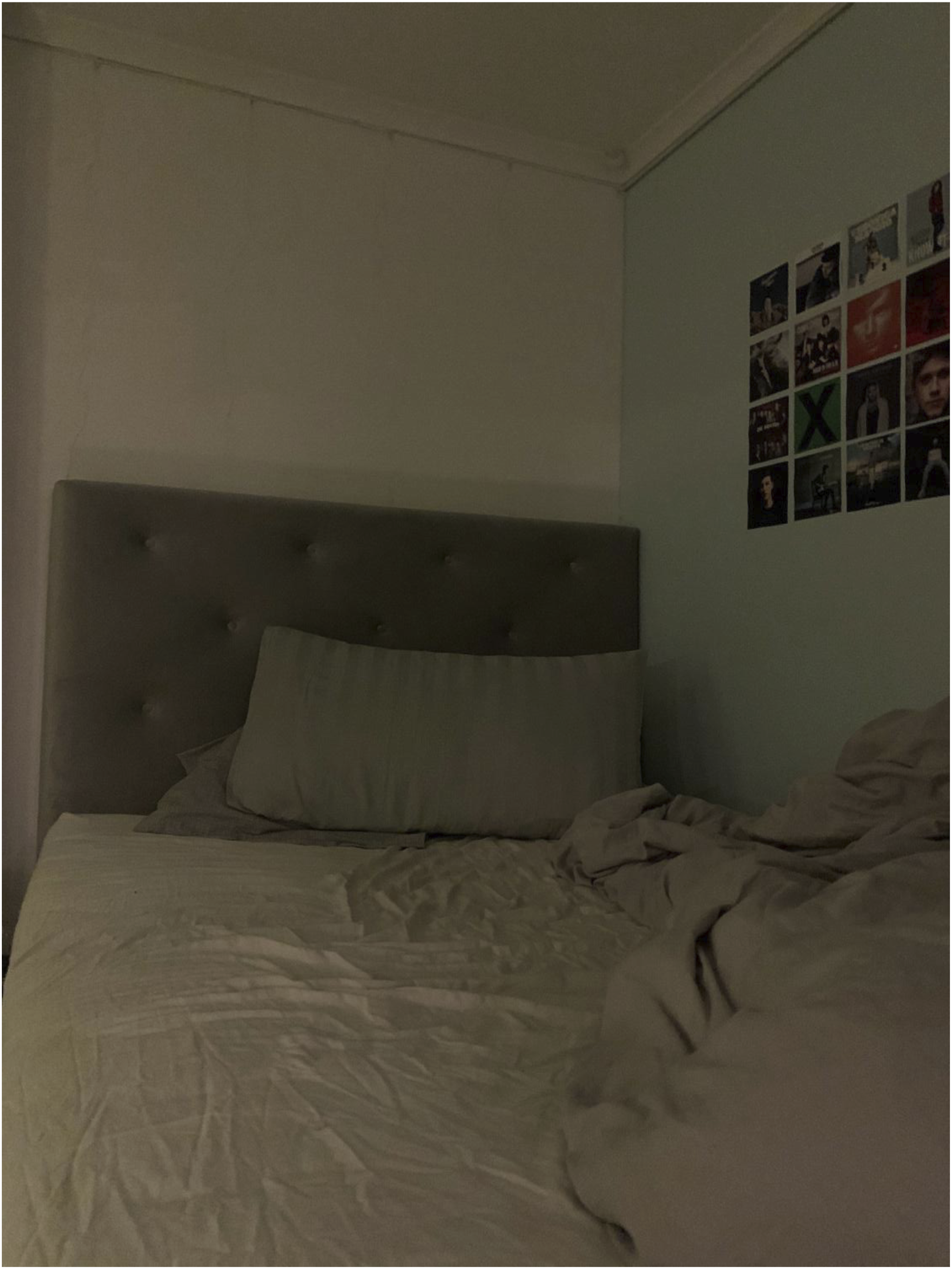
Here, using the proposed framework, we can tease out spectres of both the no longer and the not yet. The picture of the unmade bed represents gendered spectres of both previous and potential future violence against women, collapsing past and future and haunting the girls’ everyday lives, having real effects on their wellbeing. The photograph depicts the place where they should feel the safest; in their own rooms, in their own beds, yet this image is haunted, rendered unsafe and uncanny by the lingering presence of violence that is no longer yet remains, and violence that is yet to come. Here, there is also a haunting doubling with the fairytale of Sleeping Beauty, where the implied sexual violence inflicted on Sleeping Beauty while asleep works as a similar past spectral trauma (Petric, 2023), fuelling the need for political and ethical change moving forward.
The element of enforced sleep in Sleeping Beauty, symbolic of a lack of agency, can furthermore be read as the remnant spectre of a powerless, voiceless past for women, as well as feminism, across the globe, making itself felt in the presence through images such as Figure 3. By rendering Sleeping Beauty unconscious for a substantial amount of the story, she is not only made unable to dictate, rewrite or reform her own living conditions, but she is also rendered invisible in the narrative; absent in her presence, highlighting the dangers of sleep. As such, this photograph also represents a lingering warning, to women as well as to feminism, of what ”sleeping” and a lack of agency can entail. This spectre calls to women and feminism to wake up, to resist rest and slumber, for as Reynolds (2014:39) stated, ”women need to break through that barrier of the sleep of post-feminism, [since] feminism is vulnerable to attack in this dormant position”. ”Speaking with the ghosts” of the girls’ photograph has consequently unearthed spectres that needs to be exorcised, as well as ghosts that needs to be kept alive to continue to haunt.
Discussion: A Séance with the Spectres of Feminism
In this paper, we have attempted to delineate a new, methodological framework synthesising feminist theory with hauntology in order to exploring hidden, forgotten or banished issues in crime and criminal justice as well as in other areas of research, such as sociology and political sciences, or indeed, any study using feminist theory. The framework aims to grapple with the feminist dimensions of the contemporary temporal dis-ease haunting late modern texts by “speaking with ghosts”; using both visual and conceptual analysis to explore the feminist issues of the past, present and future in order to prompt ethical as well as political critique. Building on previous operationalisations of temporal displacement within the social sciences (Freeman, 2010; Thomson et al., 2024; Wilson, 2018), this was done by conceptually interrogating the text using a series of questions, as well as by examining the text through a lens of archetypical imagery, allowing the symbolism of fairytale archetypes to reflect, resonate and distort the themes of the text in order to explore how such imagery may not only help to elucidate feminist issues, but help to contextualise these within the everyday lives of young women. This “echoic” (Baker, 2012, p. 284) and potentially “diffractive” (Barad, 2007, cited in Campbell, 2022: 167) approach allows us to read symbolisms of fairytales and haunting through one another, encouraging both theoretical and visual analysis of feminist issues in order to gain a deeper, more holistic understanding of such issues, and to tease out voices that may previously have gone unheard. As such, this feminist hauntological framework proposes a visual and conceptual interrogation, or “séance”, with feminist spectres, allowing for a method to tease out voices and experiences that may have previously been ignored, or silenced. By interrogating texts in this way, unearthing the feminist spectral traces of both the no longer and the not yet (Fisher, 2012) using archetypical imagery, both gendered spectres, where gendered or intersectional power orders may cause harm and linger, and spectres of feminism itself, where feminism is haunted by various spectres affecting the turn and perception of the movement, may be exhumed and drawn into the light. This excavation of ghosts, mirroring other ghostly methods (Armstrong, 2010; Ferrell, 2022), will then allow either an exorcism, where the spectres are banished or put to rest, or an invocation, where the ghosts are “let live”, left to continue to haunt.
By examining feminist spectres and spectres of feminism in three different photographs taken by young women representing different aspects of violence in their everyday lives, we have demonstrated the constant and looming presence of inequality and violence in young peoples’ lives, as well as the usefulness of the proposed theoretical framework in order to tease out such violence. By “speaking with” the spectres that were excavated from these photographs in relation to the metaphoric symbolism of fairytale motifs, which are always and already important sites of feminism (Joosen, 2004; Reynolds, 2014; Rowe, 1978), we were able to draw out ghosts of past and future violence, still affecting the young girls’ in their everyday lives, to either be exorcised or invoked. This analysis has also revealed the power of popular culture motifs when understanding violence, and indeed, illuminated the reciprocal relationship between heteropatriarchal power orders and the popular imaginary when constructing violence. While this study specifically chose to focus on photographs taken by young women as a way to illustrate the proposed methodological framework, future studies should utilise this framework to examine similar photographs taken by boys or men, exploring whether similar archetypes can be read through such photographs, or if the fairytale dimensions of the archetypical imagery is predominately gendered.
As such, we have developed a hauntological methodology which will allow us to explore the spectral traces of the past and future in the present, “talking with ghosts”, in order to promote critique and to enable social, ethical and cultural change. Building on the feminist spectral methodologies that has been developed before, (Hesford, 2006; Kosmina, 2020; Pickard, 2024) our hauntological framework does not only draw out the feminist political spectres of the past, pulling them into the present to explore what futures this could entail, but, inspired by Fisher (2012), we also conjure the feminist spectres of the future as they relate to the present and past. The future is consequently not only imagined as the possible utopian echoes of the spectres from the past as they become (re)materialised in the present, but as deeply riddled with ghosts itself; ghost of what might be, of what might never be, and the (im)possible consequences of each that ripple through time. Unlike Kosmina, we therefore move away from an understanding of the ghost as only directed towards a utopian future, and instead read the spectre as an inherently temporally as well as spatially disjointed figure, which may be directed at the past as well as the future. The spectres of the future may caution as well as inspire, warn as well as welcome, frighten as well as appease. As such, unlike previous consolidations of feminism and hauntology, this methodological framework is designed to promote political, ethical and social change as well as critique by delineating concrete ways of teasing out the feminist spectral in late modern texts, and thus goes beyond previous engagements with the spectral.
The close relationship between the spectres of violence and symbolic fairytale motifs unearthed in the girls’ photographs (such as the patriarchal symbolism of the mirror, the fear of straying from the path in the dark woods, and the implied sexual violence of the unmade bed) further highlights the strong, lingering hold of heteropatriarchal narratives and demonstrates how these narratives continue to haunt the lives of new generations. While this seemingly unwavering grasp of heteropatriarchy may seem dispiriting, it also underlines the importance of the continual unearthing of its deep-reaching roots, and indeed, the relevance of the proposed framework when attempting to do so. Fairytale-motifs do not only resonate with feminist critique but, as demonstrated here, fairytales and feminism are also ”echoic” (Baker, 2012, p. 284) with the spectral as these metaphors can be read through one another (Campbell, 2022:167). By using the feminist hauntological framework proposed here, such spectral metaphors can therefore be used as a prism to unearth feminist issues from the past, present and future, drawing them into the light either to be exorcised or invoked, depending on how heteropatriarchy is to be challenged and resisted. As such, our proposed framework also demonstrates the potential power of archetypical imagery when exploring feminist issues, not only allowing for a more holistic understanding of embodied experience and everyday life, but also has empowering potential, framing violence and lived experience not as individual problems but in terms of universal societal experiences (Pickard, 2024). As mentioned previously, it is however important to use this imagery sensibly, acknowledging the homogenising risks of western-centred framings, as well as the potential to subvert such framings.
Drawing again on the coalescence of spectral and fairytale metaphors in relation to feminism, perhaps it is by subverting the rules; of purposefully straying from the path, of going deep into woods where we “gain a sense of what is to be done” (Chinellato, 2020, p. 128), that will allow us to truly see the spectral legacy of Gordon’s “something-to-be-done” (1997:202) and find ways to utilise this spectral or “ghostly power” (Mbembé, 2003) to enable political, social and ethical change in relation to women, gender and feminism.
Footnotes

Ethical Approval
Ethical approval was received by the Swedish Ethical Review Authority [2021-01391] before any data collection started an all respondents participated in the study has provided informed consent.
Funding
The authors disclosed receipt of the following financial support for the research, authorship, and/or publication of this article: This work was supported by the Swedish Research Council for Health, Working Life and Welfare (FORTE) [2020-01152].
Declaration of conflicting interests
The authors declared no potential conflicts of interest with respect to the research, authorship, and/or publication of this article.