




Abstract
Keywords
Introduction
The experience of dementia is individual and unique. As such, including the diverse voices of people living with dementia in research is important to gain a better understanding of their perspectives. While the experience of dementia may include some shared features across individuals, such as challenges with memory, hearing, vision, and communication, the extent to which each person is impacted varies. As such, methods used to facilitate the involvement of people living with dementia in research must also be varied and adaptable to individual needs. This study seeks to better understand how interviewing techniques might be utilized to engage more deeply with people with dementia in order to capture their lived experiences.
People living with dementia have been routinely excluded from research and activities in broader society due to assumptions about abilities, stigma, and discrimination (Alsawy et al., 2017; Cottrell & Schultz, 1993; Swaffer, 2014; Tyrrell et al., 2006). Understanding the lived experiences, preferences, and abilities of persons living with dementia is key to the development of adequate and relevant supports and services. However, the nature of dementia as a disease means that, for many, verbal communication of one’s experiences can be challenging. Qualitative methods that support communication and accommodate an individual’s needs can help to facilitate improved engagement in research activities and beyond. Further, actively involving people with dementia in research means acknowledging that they are the experts on their own lives (Clarke et al., 2018). This type of knowledge is vastly different than the empirical types of knowledge that are utilized by professionals in dementia care or derived through theory (Clarke et al., 2018).
Including people with dementia in research, policy, and practice is essential to supporting that their voices are heard in the development of supports, services, and care (Bethell et al., 2018; Gove et al., 2017; Innes et al., 2021). As well, the inclusion of people living with dementia in research is becoming more prominent in social and health research that seeks to explore their lived experiences and perspectives (Alsawy et al., 2017; Benbow & Kingston, 2014). Qualitative research is often thought to be best suited to investigations of lived experiences, of dementia as well as other conditions (Aldridge, 2014). However, qualitative research often requires participants to recall information about their experiences and express these experiences, most often in a verbal interview, which can be quite challenging for people with dementia (Phillipson & Hammond, 2018). Persons with dementia may also experience challenges with reporting and comprehension due to cognitive impairments or challenges with memory, vision, and hearing (Phillipson & Hammond, 2018). In a review by Alsawy et al. (2017), it was identified that effective communication for people living with dementia involves several factors, including not speaking for the person with dementia and adapting to changing conversational abilities. Purves and Perry (2009) highlight that it can be problematic when proxies speak for a person with dementia, as the person may be unable to share their agreement or disagreement with what is being communicated. Optimizing research for persons with dementia can include frequent consultations to ensure that the conversations are supportive of the person with dementia’s needs and views and allowing time to express disagreement if the understanding of their needs is incorrect (Alsawy et al., 2017; Phillipson & Hammond, 2018). It has also been identified that facilitating a positive relationship and video-recording conversations can help in interpreting nonverbal expressions (Alsawy et al., 2017). Wied et al. (2019) report that people with dementia should be encouraged to share their preferences and perspectives actively and suggest conversational interviewing styles as a potential mechanism for fostering participation in decision making.
Many researchers utilize accessibility modifications, novel or creative methods, or other adaptations to support the inclusion of people living with dementia in research projects. However, the extent to which adapted and modified methods impact the engagement of people with dementia in research, as well as data collected, is relatively unknown. Garnering a comprehensive understanding of which methods are supportive of the inclusion and engagement of people with dementia in research is necessary to inform selection of research methodology, ensure high quality evidence is produced, and maximize meaningful engagement during research participation (Phillipson & Hammond, 2018).
Several strategies for supporting participation have been identified, including using short sentences and closed-ended questions – as well as additional supports such as introducing objects, like photographs, that have meaning or value to the individual, changes to physical space such as lighting, and changes to social demands, including prompts and encouragement (The Alzheimer Society Canada, 2019; Trahan et al., 2014). When persons with dementia have further changes to their hearing, vision, and memory due to age, additional strategies may be necessary to optimize participation. Alternative means of supporting communication such as scrapbooks, biographical books, and reminiscence boxes can be helpful for people living with dementia who have additional age-related changes to their vision, hearing, and memory (Alsawy et al., 2017). Approaches to conversations in the form of storytelling are often helpful in promoting the expression of one’s experiences (Alsawy et al., 2017). As Phillipson and Hammond (2018) highlight, innovative and creative methods in dementia research provide insight into the abilities of persons living with dementia, emphasizing engagement in research projects where they can share their experiences. Further, conversational approaches like storytelling or life-story methods have been shown to support persons with dementia in expressing their experiences (Alsawy et al., 2017; Funnell et al., 2019; McKeown et al., 2013; Weid et al., 2019).
Rationale
This study sought to examine a combination of visual (photograph) prompting and storytelling strategies through the use of projective interviewing techniques. Projective techniques are based on the principle that, when presented with an ambiguous situation, participants will project their unconscious desires and feelings onto their answers (Mesías & Escribano, 2018). As a way to understand why people act in the ways they do, projective techniques are thought to uncover a person’s cognitive frames – implicit knowledge structures of assumptions, attitudes, and beliefs developed over the course of a lifetime (Regan & Liaschenko, 2008). In this study, the specific projective technique utilized was a construction technique – where the participant is asked to respond to a situation by creating a story or description (Mesías & Escribano, 2018). A classic example of construction techniques is the Thematic Apperception Test (Murray, 1943) which involves a set of ambiguous pictures which are shown to the participant to elicit a storyline, and the participant’s response is thought to be representative of their own attitudes or feelings (Mesías & Escribano, 2018). In this study, this involved a set of photos alongside ambiguous prompts.
Construction projective techniques, such as storytelling, alongside photograph prompts, can be employed to further support the participation of people with dementia in research by connecting relevant pictures to a discussion. Visual methods that incorporate images can help to promote communication when there are deficits in expression abilities (Phillipson & Hammond, 2018). The use of visual methods in qualitative data collection offer the opportunity to include groups that may typically be considered vulnerable by providing more accessible opportunities to participate.
Purpose
The purpose of this study is to examine the utility of visual construction projective techniques (for the purposes of this paper, referred to as photo-prompted storytelling) in dementia research. Specifically, this study seeks to examine whether photo-prompted storytelling techniques impact the data collected through improving research engagement for the purposes of understanding the lived experiences of people living with dementia. The examination of photo-prompted storytelling in this study centers on establishing whether these techniques can increase engagement for people with dementia compared to traditional semi-structured interviewing with direct questioning, and how the use of such techniques may impact the data collected.
Research Questions
This study sought to address the following research questions: (1) How does the use of photo-prompted storytelling techniques impact the data collected as compared to semi-structured interviewing techniques in interviews with people with dementia? (2) Does the use of photo-prompted storytelling techniques with people with dementia impact research engagement?
Methods
Design
This qualitative study was part of a broader research project that took place from May 2022 to February 2023, and which used a multimethod research design (Tashakkori & Teddie, 2010) that involved: (1) employing different interviewing techniques with people with dementia; and (2) video recording these interviews for the purposes of observational analysis. Multimethod research is characterised by the coexistence of methodologies – in this case, both interview and observational (Anguera et al., 2014). These two methods were integrated through the data analysis as described in the following sections. The research project collected data using different interviewing techniques: (1) traditional, semi-structured interviewing techniques, and (2) photo-prompted storytelling techniques where photographs were used alongside verbal prompts.
Sampling and Recruitment
Participants were invited to participate in this study if they identified as a person living with dementia who resided in the community (i.e., not living in a long-term care or other institutional care setting) in Canada and had access to a device with videoconferencing capability. Participants who could not provide informed consent and/or participate in virtual interviews due to significant communication challenges (e.g., hearing challenges, inability to converse comfortably in English) were excluded. Recruitment materials were distributed through community organizations in Southwestern Ontario, as well as via social media networks. A total of 17 participants were recruited as part of the project. Four participants were excluded at screening due to significant communication challenges (e.g., hearing challenges and/or vision challenges), and 1 participant died prior to the commencement of the interview phase of the study. Interviews were conducted with 12 people living with dementia. The age of participants ranged from 58 to 92 years (avg. 70), 7 participants identified as women, 5 identified as men, and all participants identified as being white.
The study was reviewed and received ethics clearance from the University of Waterloo (REB 44329). All data collection took place virtually due to the COVID-19 pandemic physical distancing requirements. Information about the study and the consent form were provided to participants by email in advance of the initial study screening interview. At the time of the screening interview, the interviewer reviewed the study information and consent form with the participant, asking questions to confirm their eligibility and understanding of what was involved in participating in the study. If the participant understood the nature of participation, verbal consent was obtained and demographic information such as the participant’s age and gender were collected. At the time of the first interview, and for each subsequent interview, verbal consent was again obtained. All participants were able to provide verbal consent to participate in this study.
Data Collection Procedure & Interviewing Techniques
The interview guides for each interviewing technique (traditional semi-structured and photo-prompted storytelling) were developed to be near-identical, varying only in the delivery of the questions. The interview guides were developed in parallel for each type of interview – for example, direct questions in the traditional semi-structured interview were translated into prompts for the photo-prompted storytelling interviews. The photographs were chosen in consultation with all authors and based on availability of open-source photographs fitting the interview guide. The two interviewing techniques are described below. (1) Traditional semi-structured interviewing techniques with direct questioning. Participants were interviewed about their experiences with community supports and services using a standard semi-structured interviewing technique and process. The interview was guided by a set of questions that explored tasks and activities in day-to-day life, their current and past support and/or service use, their experience accessing supports and/or services during the COVID-19 pandemic, as well as what services they might seek to access should their needs change in the future. This interviewing technique involved direct questioning. (2) Photo-prompted storytelling techniques. Participants were interviewed utilizing photo-prompted storytelling techniques, which involved the interviewer reading a series of prompts for the participant to respond to with the goal of having the participant create a story of the person living with dementia in the photos who is receiving supports or services in the community. In the story, participants were initially presented with a general description of the character, Frank, who was said to be living with dementia. As the interview progressed, participants were guided through a series of photographs and prompts where the experiences of Frank were explored in relation to community supports and services.
Upon expression of interest in the study, potential participants were contacted to schedule a time at their convenience to complete a screening interview and demographic questionnaire. During the screening interview, the purpose of the study was explained and informed consent was sought. All participants in this study were able to provide informed consent independently as determined through the use of the University of California San Diego Assessing Consent to Participate in Research protocol; however, a proxy-consent process was also prepared in the event that a participant could not provide informed consent. In this study, all participants were determined to be able to provide informed consent independently, and took part in the interviews independently (i.e., no care partners or family members attended the interviews with the participant). Once the participant consented to participate in the study, the 3 interviews were scheduled and a demographic questionnaire (age, sex, marital and living status, and racial, ethnic, or cultural origins) was completed. In total, as part of the larger project, participants took part in 3 interviews, 1 week apart, over a 3-week period. Interviews were scheduled at a time preferred by the participant and took place at the same time and day of the week where possible. The same interviewer (the first author) conducted all the interviews. All participants participated in all interviews, and all participants were shown the same photographs in interviews with photo-prompted storytelling techniques (see Appendix 1). Questions in the traditional semi-structured interviews were asked directly to participants, where questions in photo-prompted storytelling interviews were phrased as prompts about the character in the story instead of the participant themselves. For example, in interviews where direct questioning was used, the participants were asked “if your needs changed in the future, what types of supports or services do you think you might access?”, and in interviews with photo-prompted storytelling techniques, participants were asked “if Frank’s needs were to change in the future, what types of supports or services do you think would be helpful for Frank?” (See Appendix for photographs used). In the present study, interview data from 2 interviews in which the participants took part in are examined. The order in which the interviewing techniques were employed with each participant alternated according to a pre-defined and counter-balanced ordering to reduce ordering effects. To minimize carry over and memory effects, an interval of at least 1 week between interviews was maintained.
Data Analysis
Interviews were audio and video recorded. Two analyses were conducted to address the research questions. First, audio recordings were transcribed verbatim, cleaned, and anonymized prior to analysis. Following data preparation, the transcripts were analyzed using qualitative content analysis. Content analysis is an analytical approach typically used in qualitative descriptive studies (Miles et al., 2014). An inductive analysis was conducted with 2 coders, the first author and a trained research assistant, following an iterative process of data familiarization and generation of initial impressions, thoughts, and analysis, line-by-line coding, discussion with the broader research team, and meaningful categorization (Hsieh & Shannon, 2005). First, a content analysis for each set of interview data (traditional semi-structured and photo-prompted storytelling) was conducted. Then, responses across interviews were analyzed, and categories resulting from the primary content analysis were contrasted to support the identification of similarities and differences in the data. The content analysis categories from each analysis (i.e., traditional semi-structured interviews and photo-prompted storytelling techniques) were first compared to examine similarities or differences across interview types. From there, responses from each participant were compared with key focus on the identified similarities and differences across the two data sets. The focus of the analysis was to explore the ways in which participants engaged with the interview questions and prompts. The findings were reviewed iteratively by all authors to confirm categorical relevancy, organization, and interpretation. NVivo 12 was used to support data coding and analysis. Reflexivity journals were also kept by the interviewer and reviewed throughout the analysis in order to support with familiarization and gaining a sense of the whole of the dataset.
Video recordings were used to facilitate observation of the engagement of participants in the interviews. An observational scale, the Engagement of a Person with Dementia Scale (EPWDS) was modified and used to examine the engagement of participants in the interviews. The EPWDS has established content validity and psychometric properties for the assessment of behavioural and emotional expressions and responses of engagement by people with dementia across five areas: affective, visual, verbal, behavioural, and social engagement. The content validity of the EPWDS was supported by a panel of 15 experts in a Delphi study, resulting in an overall agreement of 81.4% (Jones et al., 2018). The internal consistency of the scale is reported to be α = 0.94, and overall inter-rater reliability scores as measured by intraclass correlations (ICC) ranged from 0.75 to 0.95, p < 0.001 (For complete psychometric properties of the scale, see Jones et al., 2018). The EPWDS was modified for use in virtual settings as in-person observations of engagement were not possible due to the COVID-19 pandemic. Due to the modifications made, we are unable to definitively confirm that the psychometric properties of the original scale were preserved in this study. As participants participated via videoconference, the observational items on the scale were applied to the video recordings of their interviews. As there are no physical materials associated with this study, the Behavioural Engagement items were not assessed (see Jones et al., 2018). Videos were scored across the subscales (dimensions) of the EPWDS and summed to produce a total score. As not all items (i.e., the Behavioural Engagement items were not assessed) across the five dimensions of the EPWDS were measured, the total score ranged from 10 to 40. The higher the total score, the higher the level of positive engagement exhibited by the person with dementia. The lower the total score, the higher the level of disengagement or negative engagement exhibited by the person with dementia. Each video recording was scored based on the coder’s interpretation of the participant’s level of engagement in the interview. Both the first author and the research assistant reviewed the coding framework and criteria in-depth prior to conducting the coding. The first author and the research assistant first coded a sample of videos independently, and then compared scores, discussing any substantial differences in coding. Once consensus was reached, the research assistant coded the remaining videos independently. To evaluate whether there were statistically significant differences in participants’ engagement scores obtained using the two different interview techniques, a repeated measures analysis of variance (ANOVA) was conducted.
Methods to Enhance Rigour
Several strategies were employed to enhance the rigour of the study, including the use of researcher reflexivity journaling and triangulation. Following each interview, the interviewer completed a reflexivity journal detailing any methodological decisions and the reasons for them, the logistics of the interview, and a reflection upon what happened during the interview. Throughout the data analysis, the journals were reviewed and noted to support the analysts in staying “close to the data” (Lincoln & Guba, 1985). Further, all researchers involved in the data analysis engaged in regular peer debriefing. To promote credibility, dependability, and transferability, a detailed overview of the study methods, analysis framework, procedure, and findings are included in this paper. With respect to confirmability, researcher triangulation took place throughout the project, and quotations are used to support the categorization of the analysis.
Findings
Content Analysis
Similarities and differences across interview techniques were identified through the cross-examination of the categories identified through two content analyses – one conducted on the traditional semi-structured interviewing techniques data set, and one conducted on the photo-prompted storytelling techniques data set. The results of these two content analyses were compared and contrasted to examine similarities and differences in the ways participants responded to and engaged with the interviewing techniques. Findings from the cross-analysis were then applied to the individual transcripts for each participant to support with the identification of similarities and differences across the data sets.
Summary of Impacts Identified Through Content Analysis Categories
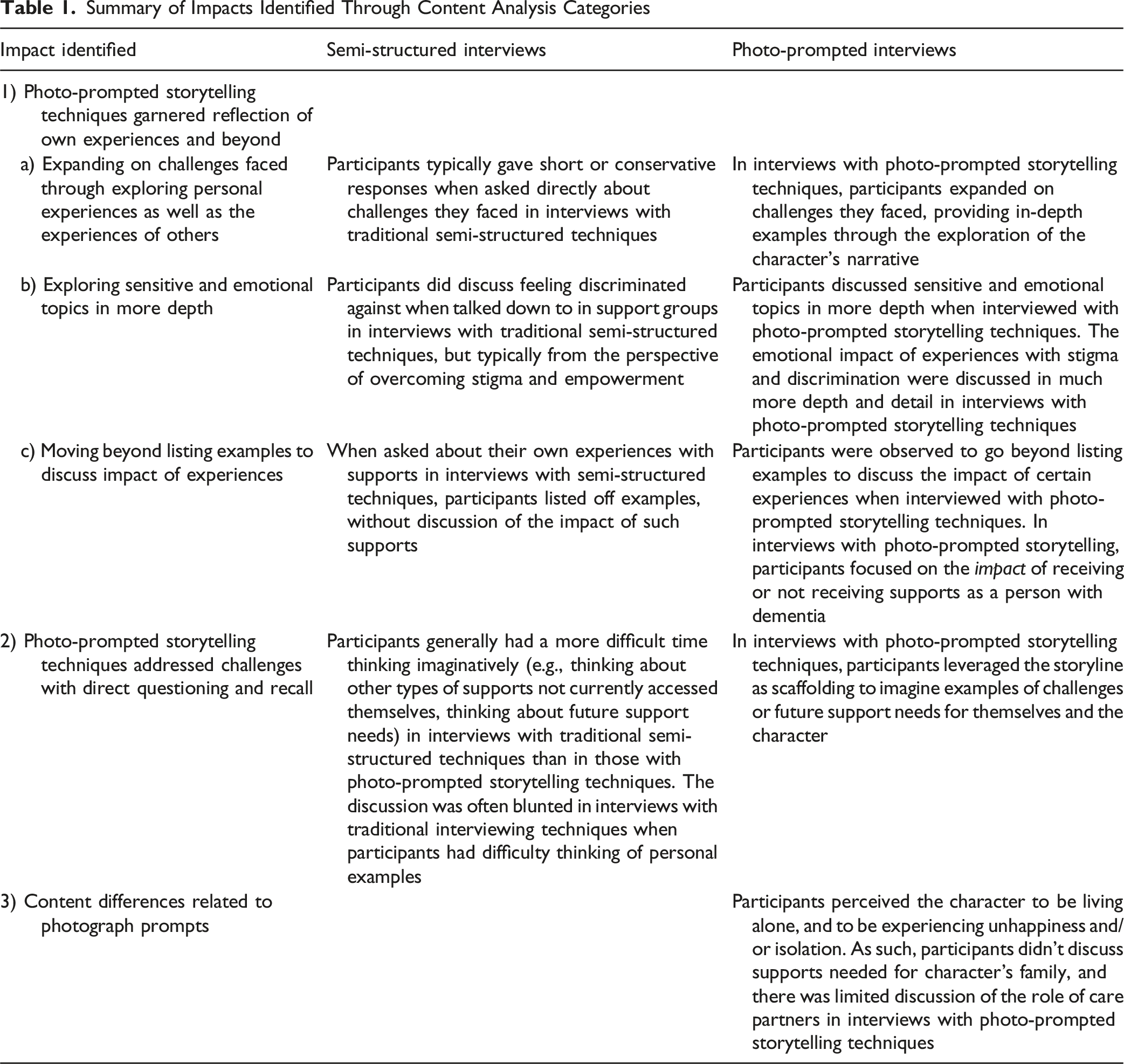
Photo-Prompted Storytelling Techniques Garnered Reflection of Own Experiences and Beyond
Interviews with photo-prompted storytelling techniques seemed to encourage participants to reflect on their own experiences in more detail than in interviews with semi-structured techniques. This was evident through discussions on challenges faced, and sensitive or emotional topics such as discrimination, depression, and isolation. As well, interviews with photo-prompted techniques also seemed to provide participants with an opportunity to go beyond simply listing examples of supports or services they had or hadn’t accessed (as occurred in interviews with semi-structured techniques) to explore the deeper impact of these experiences. In this category, areas demonstrating participants’ reflection of their own experiences and beyond are explored through three subcategories: expanding on challenges faced, exploring sensitive or emotional topics in more depth, and moving beyond listing to discuss impact of experiences.
Expanding on Challenges Faced
When interviewed with semi-structured techniques, many participants reported experiencing few challenges in their day-to-day life, and overall, considered themselves to be faring better than others or “doing fine”. This is demonstrated by one participant who explored how their own embodiment of “living well” inspired others, showcasing a focus on one’s perception of self as faring better than others, and a shift away from any challenges experienced. “I know a woman who, a number of years ago, she got the diagnosis and went home and basically shut the door…it was only when she read a little article in a newsletter from the Alzheimer’s Society that had a little item about something I had done and my picture and she thought, ‘you know what, he can do it, so can I’. So, she started coming to our support group.” P5, semi-structured interview
This concept was further demonstrated by a participant who shared about empowerment to address and overcome internalized stigma. This excerpt, like the one above, represents the focus or tone of the interview as positive, with a tendency to minimize any challenges one may have experienced and position oneself as faring better than others. As this participant explored, “The reason why I became [a dementia] advocate is there’s a lot of people who have stigma, they’re ashamed, they’re embarrassed. They don’t want people to know. They have trouble expressing what they need or want, simply because people don’t understand why they’re doing this. And I speak for those who can’t or won’t. I’m willing to tell my story. And I have helped a number of people get over the stigma and I enjoy it.” P3, semi-structured interview
However, when interviewed with photo-prompted storytelling techniques, participants did connect to concepts of struggle and strife, especially around coping with one’s diagnosis. This is interesting as it presents a departure from the positive tone of the semi-structured interviews. One participant articulated this concept, stating, “I think he [Frank] would more than likely try to empower somebody else, even though he’s feeling horrible. And he doesn’t have anything to do about his own situation. But he would never want anybody else to be in that situation. So, you know, he’d try to lift them up somehow…I still think even if he is giving good, uplifting advice, I think he’s really torn with himself that ‘why can’t I take my own advice?’” P13, photo-prompted interview
Further to this, some participants reflected on their own difficulties living with dementia and strategies they took to feel empowered through the construction of the character’s narrative in interviews with photo-prompted storytelling techniques. Markedly different from semi-structured interviews, in the photo-prompted interviews, participants connected to concepts of challenge and empowerment. As one participant reflected, “I say just don't be afraid. It's okay to ask for help. It's okay. Just remember to survive, and fight and have a smile on your face. And, on the other side of the coin, it's okay to have bad days. And you have to recognize that something good has come out of a horrible situation. And I wouldn't wish it on my worst enemies, but if you do it [try to live well] and keep on fighting, the rest is history.” P8, photo-prompted interview
Participants seemed to reflect more deeply on the concepts of resilience and living well in interviews with photo-prompted storytelling techniques – sharing perhaps a more realistic look into the struggles and daily challenges than in interviews with semi-structured techniques where participants tended to maintain an overall positive tone. This was evident when examining how participants discussed the pandemic. In interviews with semi-structured techniques, participants often reported coping fine with pandemic restrictions or stated that they weren’t greatly impacted. For example, one participant shared, “You know, I don’t think it affected me as deeply as it did some people.” P12, semi-structured interview
However, when the same participants were interviewed with photo-prompted storytelling techniques, they often expanded on the experiences of the character to share their own perspectives and circumstances during the pandemic with relation to isolation. This is significant as it showcases the additional depth produced in interviews where the photograph prompts were used. As one participant stated, “I imagine his social isolation would be amplified…the first part of the pandemic I really got along really quite well, because I’m the type of person who likes to be by myself. But after the first year, I started really feeling the effects of being isolated, not having people to talk to and, and all of that…so, I know when I went in first went into the COVID, I didn’t have a whole lot of hope, or any kind of a future to anticipate so…” P12, photo-prompted interview
Another area of contrast between interviewing techniques involved discussions of day-to-day challenges. When interviewed with semi-structured techniques, participants often did not report any challenges with daily living and would typically respond that they were doing fine or had nothing to complain about. Interestingly, when participants were asked about what they thought the character might have trouble with as a person living with dementia, this seemed to offer an opportunity to explore their own experiences through the construction of the character’s story. This concept is emphasized through the quotation below. “Counting money and change might definitely be a difficulty. Getting up and down stairs, to go into places, getting out of the bedroom, into the bed. And if he lives alone, being afraid of taking his medicine, I mean, of forgetting his medicines, more than likely. Or forgetting to brush his teeth, like I sometimes do.” P8, photo-prompted interview
This concept was also articulated by another participant in connecting the constructed storyline to their own experiences. “Yeah, he doesn't have to worry about leaving the stove on which can drain electricity. I've done that many times. I relate to Frank…If the meals have to be heated up either on the stove, or the microwave, he’d need related instructions. And the backend, depending on how far along he is, like me, I know myself, I have trouble following instructions. And he probably would have the same difficulty.”” P3, photo-prompted interview
In contrast, when interviewed with traditional semi-structured techniques, the same participant shared the following when asked about challenges they face, “The odd time shopping. I keep telling myself to make the list and then when I look, I don’t have a list. That’s basically it.” P3, semi-structured interview
Exploring Sensitive or Emotional Topics in More Depth
Interviews with photo-prompted storytelling techniques also tended to result in more in-depth discussions of sensitive or emotional topics. Participants discussed stigma and discrimination in both interviews, however, in interviews with semi-structured techniques, conversations tended to be focused on the participants’ experience overcoming stigma and developing resilience, and in interviews with photo-prompted storytelling techniques, participants explored the emotional impact of such experiences with stigma or discrimination in much more detail. The photo-prompted interviewing techniques, on some occasions, were often quite moving to participants, and several became overcome with emotional during discussions of topics like grief, isolation, and coping. As contrasted in the following excerpts, participants seemed encouraged by the co-constructed narrative of Frank to share their often emotionally challenging experiences with injustice, stigma, and discrimination. To demonstrate this concept, presented below is an excerpt from a participant interviewed with semi-structured techniques. When asked about challenges they face and supports or services they accessed, they stated, “The Alzheimer Society has something like a café or something like that, but that’s mainly for caregivers. The support groups for people living with dementia have disappeared. That’s wrong…” P3, semi-structured interview
Another participant explored this concept when reflecting on their own experiences in an interview with semi-structured techniques. They shared about their own experience with accessing supports and services, and how they had felt stigmatized. This participant stated, “Sometimes I feel like they talk down to us because of the dementias we have, and I don’t think that’s right.” P8, semi-structured interview
Another shared about challenges with the medical community, stating, “My doctor said, ‘well, it's common as you age’…but it took me eight years to find someone who would take me seriously… I couldn't find any kind of support any kind of anyone with any kind of understanding as to what I was going through” P12, semi-structured interview
The same participant demonstrates that the concept of stigma and discrimination was more deeply explored in interviews where photo-prompted storytelling techniques were used. This participant seemed to create storylines for Frank that related to their own experience with challenges and exploring their needs, sharing, “I find that as my dementia progresses, I’m a lot less aware of things that other people think and a lot more self centered - I have to really work at keeping things in my head, just the schedules and things like that. It’s really working overtime for me to remember everything that I have on my list for that day. And I don’t know that he [Frank] would necessarily have much of anything to advise to other people, he’s probably so consumed in his own thoughts and needs that he may not be in a position to be able to express exactly what it is that he needs.” P12, photo-prompted interview
Participants also seemed to scaffold off the constructed narrative, building on to the character’s storyline with their own experiences and perspectives. One participant demonstrated this notion through sharing, “Usually, I like to be as positive as I can but recently I had a very difficult situation arise, where stigma reared its ugly head…the person said, ‘but you have dementia’, and thought that I was unable to do anything by myself and so they followed me literally every step, and it was the most disconcerting couple of days I've ever had in my life…it hurts me to my core, and it caused me to rethink my abilities or disability. [Stigma] does a great deal of harm.” P1, photo-prompted interview
Moving Beyond Listing to Discuss Impact of Experiences
Participants often described their experiences by listing examples in interviews with traditional semi-structured techniques. When interviewed with photo-prompted techniques, participants moved beyond listing examples to exploring the impact of such examples and experiences, both on themselves and others. Participants tended to use the co-constructed narrative of the character as leverage to expand on their own experience, reflecting on the impact of experiences and the emotional connections to topics in much more depth. For example, while participants did share examples of experiences with discrimination in interviews with semi-structured techniques, they did not discuss the impact of this experience. This concept also extended to discussions of stigma and isolation above and beyond those in traditional semi-structured interviews. This was also evidenced through discussions of the COVID-19 pandemic. For example, several participants discussed their experiences with friends or acquaintances met through supports and services that had a very hard time when restrictions were in place, as shown through the below excerpt. “Well, when you talk about Covid-19 and people with dementia, I personally know three people who passed - they are people with dementia, who used to be in a support group, and I believe part of the fact that they passed so quickly, was that they had no support at all.” P1, photo-prompted interview
This is contrasted with the response from the same participant in the interview with traditional semi-structured techniques when asked about their experience with the COVID-19 pandemic, where they stated, “We pretty much carried on. We did the masks. We had all this sort of health things that you needed to do. We may have missed just a few sessions, but then we did online [support groups].” P1, semi-structured interview
When asked about whether the pandemic would have impacted the character, this participant stated, “Oh greatly, because so much of what was being done here like at the dementia cafe, all the programs...they just came to a very abrupt end and there were people who I know who have gone downhill rapidly, because of the lack of socialization.” P2, photo-prompted interview
In comparison, when asked about their experience with the pandemic in the interview with traditional semi-structured techniques, the same participant shared, “I’ve been fortunate I really have not had any, what I would consider to be bad experiences with this.” P2, semi-structured interview
The photo-prompted storytelling techniques also seemed to encourage participants to consider different perspectives – as one participant explores in the below excerpt, the storytelling exercise prompted them to reflect on how parallels could be drawn across both the characters and their own experiences of living with dementia. “This conversation makes me smile because in some ways all we're doing is making assumptions on the basis of one picture and as far as dementia and people's interactions with those with dementia, they all make assumptions…and they write you off. So, I just I just think this is quite funny, we're all making assumptions which is reflective of society.” P5, photo-prompted interview
The photo-prompted storytelling techniques seemed to give participants the opportunity to reflect on their own experience more deeply, especially with relation to grappling with difficult emotions after a diagnosis or experiencing isolation from friends and family after disclosure of a diagnosis of dementia. This idea is demonstrated through the below excerpts where participants were heard to reflect on their own experience through constructing the character’s story. “Frank looks really sad to me. Perhaps he's really thinking through his diagnosis and what life is going to be like for him in the years ahead. I think he's really wrestling with how best to get through. Yeah, that's really interesting, that was sort of what it was like when I was diagnosed. It took me rather a long time to get through that, I think it was nearly 18 months, but once I was finished feeling sorry for myself, then I could actually move on with a really positive attitude so yeah…there's truth to that.” P1, photo-prompted interview
Another participant shared the impact of experiencing stigma and isolation after sharing their diagnosis with friends, stating, “If I were in his shoes, I think I would be thinking [about] where all the people in my life have gone. I know once I came out of the closet, in regard to my dementia, I lost like all my friends, but one. And now when we run into people that we know, they talk to my husband, and they don’t talk to me, as if I can’t understand what they’re saying...So, I would think, perhaps he’s just pondering over his life, wondering where he went wrong as far as having somebody in his life when he needs them so badly.” P12, photo-prompted interview
While this participant didn’t discuss their experience with stigma or isolation when they were interviewed with traditional semi-structured techniques, they did share about their experience connecting with others living with dementia, stating, “When we got together, it was like we were all on an equal playing field. We all knew exactly what everybody else was going through.” P12, semi-structured interview
One participant articulated this concept by connecting their own experience to their perception of the character’s experience to explore the impact of isolation, stating, “Well, he’s totally on his own, right, in his house and he’s looking around and he’s thinking ‘what’s it all about’, like a lot of times I’m sitting there like that, right? And I’m just wondering is this gonna be me? I think about that all the time.” P4, photo-prompted interview
To contrast, when interviewed with traditional semi-structured techniques, this participant shared, “I can do that all of that stuff. Yeah, I get groceries and I lost my license because of yeah…so that was that was a killer, that was too bad.” P4, semi-structured interview
Further supporting the idea that the photo-prompted storytelling techniques helped to encourage imagination and explore one’s own experiences, some participants mentioned how they engaged with the storytelling technique from their perspective. As one participant shared, “I just think that was very, very interesting little thing to do, because it did make me think about things that I hadn’t thought about in a while. Some of the stuff that I was saying is stuff that I myself have actually had. It makes you more aware of your own situation. And think 'oh, yeah, I think I feel like he looks'. So, it triggers things. And I think that's a really good thing.” P15, photo-prompted interview
Photo-Prompted Storytelling Techniques Addressed Challenges with Direct Questioning and Recall
The second category of impact identified involved the notion that photo-prompted storytelling interviews tended to result in more imaginative responses, and in many cases, seemed to facilitate conversations when contrasted with interviews with traditional techniques. For example, participants were asked directly about the challenges they experienced in their day-to-day lives in traditional interviews, and what challenges they thought Frank experienced in his day-to-day life. In response to direct questioning, participants would often respond that they didn’t experience challenges, or that they couldn’t think of anything. However, when the same participants were interviewed with the photo-prompted storytelling techniques, they often scaffolded off the co-constructed narrative of Frank to share their own experiences with day-to-day challenges. This concept is demonstrated by one participant, who shared, “I think he can wash and dry his clothing, but I think putting it away is difficult. I think changing his bed is difficult for various reasons. I think deciding what to cook and eat is also difficult. He can have lots of groceries and his fridge, but it’s difficult for him to decide what to cook for himself. I think a lot of the daily chores like, well they’re not even daily, like washing our windows and ironing and things like that, I don’t think Frank gets around to doing.” P1, photo-prompted interview
In comparison, when interviewed with traditional semi-structured techniques, this participant shared, “My husband provides my transportation and I do have a cart. So, it’s the best of a poor situation, I would rather be hundred percent independent. We do have a housekeeper that comes once a month for maybe an hour. That’s about all I can think of.” P1, semi-structured interview
Another section of the interviews across techniques focused on thinking about what supports or services one might consider accessing now or that one might need to access in the future should their needs change. When interviewed with traditional semi-structured techniques, some participants either didn’t feel they needed to access supports and services or didn’t have them available to them. This seemed to hinder the conversation in terms of imagining about their future support and/or service needs, and what they might access in the future. When asked about supports or services they might access if their needs changed, some participants reported not being able to think of anything or gave general responses that they would seek out help as they needed it – but didn’t mention specific supports or services as seen in the interviews with photo-prompted storytelling techniques. This notion is demonstrated in the below excerpts from participants who shared, “No, I don’t do those sorts of things. So, I don’t have anything in my area that I would want to take part in. Besides, I’m comfortable with myself. I don’t need people around me.” P3, semi-structured interview
The challenges thinking of future support needs were further demonstrated as participants shared, “I’m trying not access anything, just trying to make it work.” P5, semi-structured interview
And, “I don’t even know.” P8, semi-structured interview
Participants were also asked about what supports or services they might access in the future if their needs were to change. Most participants seemed to find this a difficult question to conceptualize, and often had a hard time coming up with examples or envisioning how their own needs may change. This concept is demonstrated through the excerpt presented below. “I can't think it of...well it's hard just to guess what you would do until you realize what you can't do, you know.” P14, semi-structured interview
When interviewed with photo-prompted techniques, participants expanded on the character’s story to explore their own experiences. For example, one participant explored future supports or services the character might look to access, stating, “I think there may be an Alzheimer society, there will probably be some sort of a senior’s community. I think that’s where he could really benefit from by being with others his age and perhaps, they have dementia support within the senior’s community - in our town, we have that, and I do that, and it is just a chance for people to be with other people.” P1, photo-prompted interview
This concept of imaginative thinking is also demonstrated in the below excerpt from a participant who explores different examples of support in one’s community, sharing, “Maybe if he’s part of a church group, to have someone visiting for the church group, or faith group…get connected with the other people and with the services that are out there, figuring out how to get what you need, because that’s definitely a bit of a mission. Maybe he just wants to be in touch with people to say, ‘come to my place for a game of Euchre’.” P16, photo-prompted interview
Content Differences Related to Photograph Prompts
Impact of the photo-prompted techniques on the interview outcomes was also identified with relation to the content of the interviews and the photograph prompts chosen. Through examining how participants responded to the prompts in these interviews, it was identified that differences in discussions could have been influenced by the content of the photograph prompts used. For example, participants often perceived Frank to be isolated and feeling unhappy. One participant commented, “I’m not sure just looking at that picture he’s in a position to give advice to anybody. I think he’s the one who needs advice.” P2, photo-prompted interview
Further, participants discussed the importance of having supports in place for their family and friend care partners in interviews with semi-structured techniques. While discussed in interviews with photo-prompted storytelling techniques, these instances were often infrequent, potentially due to most participants constructing a narrative for the character where he was living alone, either due to being widowed, or otherwise socially isolated. That is to say, Frank’s story often didn’t include a spouse or other care partner that supported him in his home. In fact, participants often felt as though his wife must have died some time ago, and nearly all participants constructed his circumstances around him living alone. As one participant shared, “When I look at him, I see that his wife has already passed. He now has dementia. His family is not as attentive as what he’d always felt they would be. And he’s just sitting there in the morning having his coffee without his wife without his family without support. That’s what he looks like to me.” P13, photo-prompted interview
As many participants thought that Frank lived alone, they didn’t often discuss how family support impacted him, but rather, how the lack of support may have contributed to depression and isolation. Thus, it was more common for participants to discuss their own care partners and/or spouses in interviews where semi-structured techniques were used.
Observational Analysis
Descriptive Statistics of Overall Engagement Score

There was a statistically significant difference in engagement score between the two interview types, F (1, 11) = 4.94, p = 0.04. Therefore, it is suggested that there is a statistically significant difference in engagement scores when participants are interviewed using semi-structured techniques or photo-prompted storytelling techniques.
Discussion
This study makes an important contribution to the body of research related to involving people living with dementia in qualitative research that focuses on understanding lived experiences and perspectives. This study enhances our understanding of photo-prompted storytelling techniques as a mechanism of engaging people with dementia in interviews. Findings from this study reinforce the utility of photo-prompted storytelling techniques in supporting the participation of people living with dementia in qualitative interviews (Phillipson et al., 2023). Together, results from a qualitative content analysis and observational analysis support that these techniques may impact the types of data collected through interviews, as well as the engagement of people with dementia in interviews. Additionally, as this project was conducted during the COVID-19 pandemic, people with dementia may have been feeling additionally isolated.
Projective (storytelling) techniques are rooted in psychology with historical applications in consumer research and more recently, broader health research. While few studies have examined the application of projective (storytelling) techniques in research with persons with dementia, literature does exist to support its utility in disability and health research. As aligned with work by Porr et al. (2011), who reflect that the use of projective (storytelling) techniques enabled participants to give voice to their inner thoughts and emotions, this study supports that photo-prompted storytelling techniques have utility in supporting participation and the expression of one’s emotions. Further, a general goal of projective (storytelling) techniques is to overcome response barriers – including participants feeling uncomfortable discussing sensitive topics or the social pressure to answer in the ‘right’ way – barriers especially relevant to those living with dementia who may experience pressure to remember the ‘correct’ answer or report on events accurately. As discussed by Wiehagen et al. (2007), projective (storytelling) techniques are conceptualized as being instrumental in supporting participants in overcoming response barriers, including social and language obstacles in health research. This study supports that projective techniques, in this case, photo-prompted storytelling techniques, have potential in supporting the expression of people living with dementia on topics considered sensitive in nature – such as disclosing a diagnosis of dementia, experiencing mental health difficulties, and experiencing challenges with personal care. This concept is also supported by Clarke et al. (2019), who discuss storytelling techniques as a viable method of circumventing obstacles to self-report. Further, this study supports that photo-prompted storytelling techniques may impact the types of data collected through interviews. Participants in this study were observed to provide more rich and thorough responses when interviewed with photo-prompted storytelling techniques, as illustrated by Participant 1 in the above section on direct questioning and recall – when asked directly, they gave only 2 examples of challenges they face in their day to day life, but when asked about the character Frank, they gave three times as many examples of challenges.
Like results of a historical study by McGrath et al. (1993), the present study reports that when questioned directly, participants tended to respond with direct, neutral, or superficial answers. McGrath et al. (1993) also report that when interviewed with projective (storytelling) techniques, participants gave responses that were more complex, imaginative, and creative than when questioned directly. These findings are aligned with the results of the present study, which support that photo-prompted storytelling techniques tended to engage participants in more creative and imaginative expression through engaging with the photograph prompts and story character. For example, participants often positioned themselves as faring quite well during the pandemic in interviews with semi-structured techniques – but gave much more complex answers when asked about how the character, Frank, might have experienced the pandemic. This is evidenced through answers from a participant (participant identification code ‘P12’), who stated that the pandemic “[didn’t affect] me as deeply as it did some people” when interviewed with semi-structured techniques but responded with concrete examples and a rich description of their experience with social isolation during the pandemic when interviewed with the photo-prompted technique.
Further, results from a study by Phillipson et al. (2023) support that photo-prompted storytelling appear to lessen some of the demands of direct questioning for people living with dementia who are engaged in research by allowing for imaginative responses and offering additional conversational prompts. The present study reinforces that photo-prompted storytelling techniques offer an opportunity for participants to explore topics creatively, take different perspectives, and reflect on their own experience through the construction of a storyline and with the support of prompting photographs, similar to findings from Teachman and Gibson (2013), who explored the utility of storytelling through vignettes in applied research with children living with disabilities and found that such techniques facilitated more dynamic conversations. As demonstrated, participants provided rich, intimate descriptions of their experience with grief following a diagnosis, as well as the resilience developed (see quotes from participants 1 and 12 above) – all through exploring their experiences in the construction of the character’s story. While on the surface, general topics were explored in both types of interviews, responses in semi-structured interviews tended to be surface level descriptions or examples of experiences. This is in contrast to responses in interviews with photo-prompted storytelling techniques, where similar topics were discussed in much more detail, and where participants expanded on the character’s narrative by bringing in their own perspectives on the impact of such experiences, and reflecting on the interplay between living well and still experiencing challenges – above and beyond recalling lists of examples as observed in interviews with semi-structured techniques. This aligns with findings from a recent study by Phillipson et al. (2023), who reported that the use of photo-prompting techniques supported personal reflections in research with people living with dementia. Specifically, this study reported that the techniques promoted empathy and supported reflections on the needs and experiences of a hypothetical character (Phillipson et al., 2023).
Participants also discussed highly sensitive topics, including their experiences of stigma and discrimination in interviews with photo-prompted storytelling techniques. This occurrence confirms the supportive nature of photo-prompted storytelling techniques in enabling the discussion of such topics, such as in the exemplars presented above from participant 1. While participants may not have shared the exact circumstances of the character, Frank, they were able to engage with the narrative exercise and express how they connected to Frank’s potential experiences directly, or how they might have felt if they were in his shoes. This concept is also reported by researchers Gram et al. (2023), who examined the utility of storytelling techniques to examine lived experiences of sensitive health issues. The authors reported that when researching perspectives on prostate cancer, the use of projective (storytelling) techniques tended to encourage emotional openness amongst participants and facilitated the discussion of one’s emotions with respect to the topic (Gram et al., 2023). Results from the current study’s observational analysis also support that photo-prompted storytelling techniques may impact the engagement, in this case being defined as active participation, of people with dementia in interviews. While a secondary evidence source, the results of this analysis do suggest that on average, when interviewed with photo-prompted storytelling techniques, participants in this study were observed to show higher levels of positive engagement than when interviewed with semi-structured techniques.
Future Research
This study took place during a timeframe where institutional and community settings had pandemic-related restrictions. As such, the study was designed to be conducted completely online. Future research should seek to expand the application of photo-prompted storytelling techniques in different settings (e.g., in person) and with different populations (e.g., with participants at different staged of their dementia journey or experiencing dementia alongside multimorbidity impacting communication abilities) to examine the utility of the techniques across research projects. It will also be important to examine the extent to which the photographs chosen as prompts impact the results of the research – this study supports that aspects of the photographs chosen may influence the topics discussed. Responses in photo-prompted storytelling technique interviews often tended to cluster around perceptions of the character in the photos (e.g., in the case of this study, all participants perceived the character to be unhappy and living alone). As relatively recent research has observed, varying a key feature of the story in storytelling techniques has produced mixed evidence as to whether responses also vary – for example, when varying key features in a story completion exercise on body hair, responses were not observed to be markedly different between groups (Victoria et al., 2019; Jennings et al., 2018). While participants unanimously constructed the character as living alone, this still offered the opportunity for participants to contrast their own experience if they didn’t live alone, and to relate to their experience if they did. This concept is referenced by Clarke et al. (2019), who state that a benefit to storytelling techniques is that they allow for connections to topics even if the participant lacks personal experience.
Strengths and Limitations
The current study presents an in-depth account of the application of a photo-prompted storytelling technique in research with people with dementia. This research offers a unique contribution to the field of inclusive research methods and delivers results to support the extended use of such techniques in future research through a comprehensive analysis of similarities and differences across traditional, semi-structured interviewing techniques with direct questioning and photo-prompted storytelling techniques. The overall study was impacted by the pandemic, as recruitment and participation were shifted to be virtual/online. As such, the diversity of the study sample was likely impacted, as the nature of the inclusion criteria and the method of participation was not fully inclusive or accessible to all people living with dementia (for example, those living remotely or without internet access). Participants were also excluded if they were not able to partake in virtual interviews due to significant challenges with communication (e.g., hearing challenges, uncomfortable conversing in English). As physical distancing restrictions have been lifted and in-person research has resumed, future research should seek to explore the utility of these methods in in-person settings and examine ways to improve the accessibility of the method to engage a broader group of people living with dementia (e.g., people who may have challenges participating in virtual research).
As a potential mitigation strategy to the recruitment challenges this study faced, recruitment was open to individuals across Canada to include as many people living with dementia and as diverse a sample as possible. While inclusive and accessible recruitment for this study was challenging, the study procedures overall included several accessibility modifications to maximize the meaningful participation of participants who took part in the study. This included process consent procedures, modifications to study materials, flexible participation options, and ample time scheduled in to support rapport development. In this study, we did not require a diagnosis of dementia for participants to take part. This decision was made for several reasons, including due to pervasive stigma and lack of understanding of dementia, not everyone receives a diagnosis of dementia and for some, the diagnosis can be delayed. While this approach likely increased the opportunity to participate for some individuals, it does mean that some individuals with potentially subjective cognitive impairment could have participated in the study. However, in order to maximalize participation opportunities for people living with dementia, including any participant who identified as a person living with dementia was essential.
The sample size of this study is also relatively small – as 12 participants completed the interviews. Further, several participants in this study self-identified as activists in the dementia community and may have been more likely to agree to participate. As a qualitative-driven multi-methods study, the purpose of this study was not to produce statistical generalizable results. The rich and detailed description of the study and findings supports transferability and allows for readers to determine the relevance of the study’s conclusions for their own contexts (Firestone, 1993). A secondary goal of this study was to examine observational engagement scores across interview types. Thus, statistical analyses of observed engagement scores were conducted to quantify the observed difference in scores and serve to contextualize the results from the qualitative component of this study. Results should be interpreted with consideration of the strengths and limitations of this study, including the sample size.
Another potential limitation of this study was that the same photograph prompts were used for every participant. Because the photograph and character were described as a man, participants identifying as women may have connected differently to the prompts if the photographs used depicted a woman. Further research should seek to examine the impact of photograph prompts on the types of results generated, that is, changing the photographs to reflect each participants characteristics may have produced different results.
Conclusion
This study showcases how research can be adapted to better include and engage people living with dementia in research. This study was conducted during the COVID-19 pandemic, which presented difficulties and increased isolation for participants. This research provides insights into the experiences of people living with dementia during that time, but also provides evidence as to how people with dementia can be accomodated to participate in research that is conducted virtually. Including people living with dementia in research helps to ensure services and supports are developed and implemented in such a way that is relevant to the needs, desires, and abilities of persons with dementia. This can, in turn, improve wellbeing and enhance social connectedness, which has many other benefits for people living with dementia. Many of the symptoms associated with dementia including challenges with memory, language, and spatial recognition can make it very challenging for persons with dementia to become engaged in a variety of different activities including research (Trahan et al., 2014). These symptoms coupled with the health and sensory-related changes experienced by many individuals justify modifying research activities to enhance engagement for people living with dementia.
This study supports that qualitative research can be optimized for people living with dementia. Because qualitative research relies on the participant to communicate their experiences, researchers must consider how dementia impacts a person’s abilities on an individual basis. This study provides evidence for photo-prompted interviewing as a method to deepen engagement through allowing for more flexible participation that meets participants individual needs. Improving the accessibility of research methods for studies that involve people with dementia as participants is essential to supporting meaningful engagement in research. Further, understanding the impacts of adopting creative or modified approaches to research with people with dementia is important to our understanding of how adaptations or modifications may impact the data collected in these types of projects and any implications for the evidence produced. High quality evidence and results are essential to improving the quality of life and care of people living with dementia, especially from studies researching the lived experience and perspectives of people living with dementia themselves.
Supplemental Material
Supplemental Material - “If I Were in his Shoes”: Photo-Prompted Storytelling in Interviews With People Living With Dementia
Supplemental Material for “If I were in his Shoes”: Photo-Prompted Storytelling in Interviews with People Living with Dementia by Emma Conway, Ellen MacEachen, Laura Middleton, and Carrie McAiney in International Journal of Qualitative Methods
Footnotes
Acknowledgements
The authors would like to acknowledge the contributions of Research Assistants Katelyn Wheeldon and Savanna Cornfield who provided assistance with coding and analysis.

Funding
The authors received no financial support for the research, authorship, and/or publication of this article.
Declaration of Conflicting Interests
The authors declared no potential conflicts of interest with respect to the research, authorship, and/or publication of this article.
Supplemental Material
Supplemental material for this article is available online.
References
Supplementary Material
Please find the following supplemental material available below.
For Open Access articles published under a Creative Commons License, all supplemental material carries the same license as the article it is associated with.
For non-Open Access articles published, all supplemental material carries a non-exclusive license, and permission requests for re-use of supplemental material or any part of supplemental material shall be sent directly to the copyright owner as specified in the copyright notice associated with the article.
