




Abstract
Qualitative research necessitates the representation of, and engagement with, people who the research is designed to assist. Disability research not only seeks to explore populations where lived experience of disability is distinct, it is also a field where researchers themselves have lived experience. This paper reflects on the methodological innovations between the researcher, their supervisory team and the co-created opportunities to collect qualitative experiences from participants with disabilities, acknowledging the researcher’s own disability. The purpose of the paper was to provide scope to explore the multiple provisions required to be inclusive of accessibility needs as a way to bring unique consumer perspectives to the research table. The paper demonstrates, through a narrative lens, how the research space is altered for people and researchers when disability is present; requiring ways to ensure inclusive research practices are responded to. Recommendations for future co-creation of research with disability are identified.
Introduction
People living with Deafblindness want to be included in research (Roy, 2020) but this cannot happen without adjustments, accommodations, and immersive understandings of the individual’s unique needs. Research conducted by people with lived experience of disability also requires accommodations and adjustments. This includes technology and assistive devices, to allow for qualitative inquiry to be undertaken. The changes required to make qualitative research accessible may impact the choice of qualitative methodologies to conduct of the research. Participants, described later in this paper as being deafblind, are expert-knowers of their experiences and of their disability, with some only being able to voice (or sign) if given full and individual accessibility support. This has implications for researchers, supervisors, ethics committees and research funding bodies.
There are substantial gaps in the literature of inclusive qualitative research with deafblind participants and/or by a researcher with deafblindness. There are vast unknowns as to what the qualitative inquiry space looks like when lived experience researchers engage in data collection and translation of research findings. Deafblindness studies are in their infancy, meaning that complexities about the lives of those with deafblindness and the research ‘about’ them is rarely ‘with’ them (Watharow, 2021). There are barriers to building a body of emancipatory and socially-just research on the lived experiences of people who are deafblind. There are tensions around definition and terminology (Wittich et al., 2013; Jaiswal et al., 2020; Simcock 2017a, 2017b; Watharow, 2021). This paper engages a New Nordic definition: “Deafblindness is a combined vision and hearing impairment of such severity that it is hard for the impaired senses to compensate for each other. Thus, deafblindness is a distinct disability.” (Nordic Centre for Welfare and Social Issues, 2018)
The use of this definition was included and utilised given its capacity to offer explanatory notes that explore the complexities of life with dual sensory impairments; accessibility, communication, mobility, participation, inclusion, and information acquisition are all impacted. The seeking of a definition that sought to provide inclusivity from the early stages of the research development, given the vast heterogeneity of the potential participants to be recruited, necessitated its inclusion. Shakespeare (2014) noted that ‘many with dual sensory loss will not identify as such, especially older adults who may view ‘not seeing’ and/or ‘not hearing so well’ as normal accompaniments to ageing these individuals may at times be targeted or incidentally recruited into qualitative research studies. This paper examines the complexities of qualitative inquiry and details the innovative preparations, conduct and events within and around co-produced narrative spaces.
Background
Positioning of author one as expert-knower
Author 1 (AW) lives with Deafblindness because of Usher syndrome. The author has a profound hearing loss of 90 decibels and one degree of central vision in one eye only. Hearing loss has been present since birth, alongside the onset of vision loss beginning age 15 and degenerating over time requiring their career as a General Practitioner to end, and their research career to begin. Their research focus was prompted by their lived and learnt experience of healthcare communication. The following narrative reflection uses three lenses of research: researcher, participant, consumer to refract the experiences throughout the study.
In 2015, working at the end of a career as a medical practitioner in Sydney, Australia, a middle-aged man came to see me. He had suffered an adverse event after leaving hospital, the result of staff not accommodating his accessibility needs. Like me, he had a dual sensory impairment. He had misunderstood the diabetes education, misread the small-print instructions and given himself a near-lethal dose of insulin. Another month later, another patient. She was clutching a letter from a hospital doctor, requesting a dementia screen, an aged care assessment and prescription for antipsychotics. The patient is ‘seeing’ things that aren’t there, a little girl in a red coat who has lost her mother. “She may not be real,” the patient explains, “but the little girl seems to need her mother desperately”. She reveals this as a detailed and distressing vision. This phenomenon is not uncommon in people with low sight; it is called Charles Bonnet syndrome. She does not have dementia; she doesn’t need antipsychotics and she doesn’t need a nursing home. I call the specialist to explain our mutual patient is losing her sight, not her marbles. I am appalled when not long after, another older patient with sight and hearing loss needs lifelong dialysis after staff in hospital failed to notice he couldn’t see or hear food and drink arrive and depart. Dehydrated, both kidneys failed.
With my own sight and hearing diminishing, and my cherished clinical career soon ending, I can see a future in which a neglectful, over-busy, task-oriented hospital is a place where I, too, might come to harm. A year later this happens. I am quite sick. I am in hospital and oxygen is administered. I am told where the buzzer is and to “just buzz us if you have any problems”. I ask for a safety pin to anchor the red-button buzzer to the sheets, because I won’t be able to see it if it hangs down or falls. “No, I am afraid we can’t. That is an occupational health and safety issue” I am told. I know I need to remind the nurses each shift about my sensory losses and how I need help with many things. It is all in my notes, but I know nobody will read them. I also know staff handover is a precarious thing and important information often gets lost and forgotten. I can’t speak a full sentence without shortness of breath. My husband, not allowed to stay, does all he can and tells everyone he sees that I am deafblind. It doesn’t translate into practical help.
Very early in the morning I struggle for breath, but I can’t see or find the buzzer for the nurse. The buzzer is on the floor…somewhere. The oxygen saturation monitor on my finger shows plummeting blood oxygen levels, before it falls off. Air hunger is making me panicky. I am saved by the patient in the bed opposite me, who buzzes and shouts. This wakes the patient next door, who also shouts and buzzes. A procession arrives that includes nurses, intern, registrar, intensivist and husband. I don’t feel safe anymore. Almost as bad, one doctor tells my husband my cognition has been affected; I don’t answer any questions correctly. “Did she have her hearing aids in?” my husband, replies with acerbity.
Later that year, a university professor friend says “Do a PhD. Use your experiences to prove the existence of laissez-faire care for people like yourself and the patients, then think about ways to transform the status quo.”
So, I apply to undertake a study exploring the hospital experiences of people who are deafblind. I acquire supervisors (including Author 2). The journey begins.
Roy (2020) notes that research with deafblind participants identified increased trust, respect and value when the research is led by those from within the field. In identifying the lived experiences that led to the decision to undertake Doctoral studies, the commitment to participatory barrier removal in public health research for those with communication disability/ies was the foundation of the project and intertwined with awareness regarding the most appropriate qualitative methodology.
Method
Methodological Choices Using Accessibility as a Standpoint
The research was conducted as a consumer-academic-researcher. The approach was underpinned using a narrative inquiry methodology (Creswell & Poth, 2018) aiming to be sensitive to people and places in order to acquire new knowledge, whilst also seeking to capture stories that could be voiced, interpreted and acted upon. The Doctoral study included patient experiences from 18 individuals who all identified as living with a dual sensory impairment. They ranged from 25-71 years with 13 identifying as female, and 5 males. Four participants were non-verbal and used no spoken language, eight identified sign language as their chosen language and written English, or AUSLAN for the remaining.
Prior to deciding on a research methodology community consultation, to explore engagement with contemporaneous studies on better research practices with deafblind participants, was undertaken. Author 1 participated in a World Café (2018) event that explicitly examined attitudes of people who are deafblind to research and what promoted inclusion and what fostered exclusion, prior to beginning data collection and to immerse in research reflections. The key messages were that the Deafblind community wants to be included but require face-to-face options, accessible formats, unpacking of questions, and elimination of graphics and hierarchies such as Likert scales (Roy, 2020). These findings also support the use of semi-structured interviewing with communication support in place of survey. This method also allows for the management of limited participant energy, interpreter availability and time restraints to ensure momentum within the research process. The data collection method chosen for the research is the semi-structured interview (Kvale, 2006).
The methodological choices connected with the aim of the interview, being that the goal was to garner actions, feelings and events that occur in hospital, as well as information about lived realities to contextualise experiences for people who are deafblind. By centring on this topic, the researcher was able to engage in comprehensive and thorough questioning without straying into discursive territory, for the purposes of specific research questions (Bernard, 2013). The aim was to follow the semi-structured interview technique, alongside a commitment to full and individual accessibility, by enabling participants to tell their stories on their own terms—in their chosen language, location and pace—while keeping some common questions for comparison and as prompts. Obtaining the perspectives of participants with deaf blindness required pre-emptive thinking about the processes needed to ensure accessibility and inclusion. These innovations, gathered from supervisory observations, are identified across three areas in the combined results and discussions section of this paper. Identifying how, during reflexive analysis on the data collection period, key timepoints to better understand accessible qualitative research was enhanced. The next section explores the results of the observations of the action of doing research with deafblind research participants. The present research made a commitment to accessibility by only seeking two inclusion criteria—that participants be 18 years or over; and self-identify as deafblind, Deafblind or a person with dual sensory loss or impairment. The latter distinction was important because not all view hearing and vision loss as an impairment or disability.
Results: observations on how to apply accessibility to qualitative data collection methods with people with disability (Figure 1). Process map to identify strategies that enhance accessibility.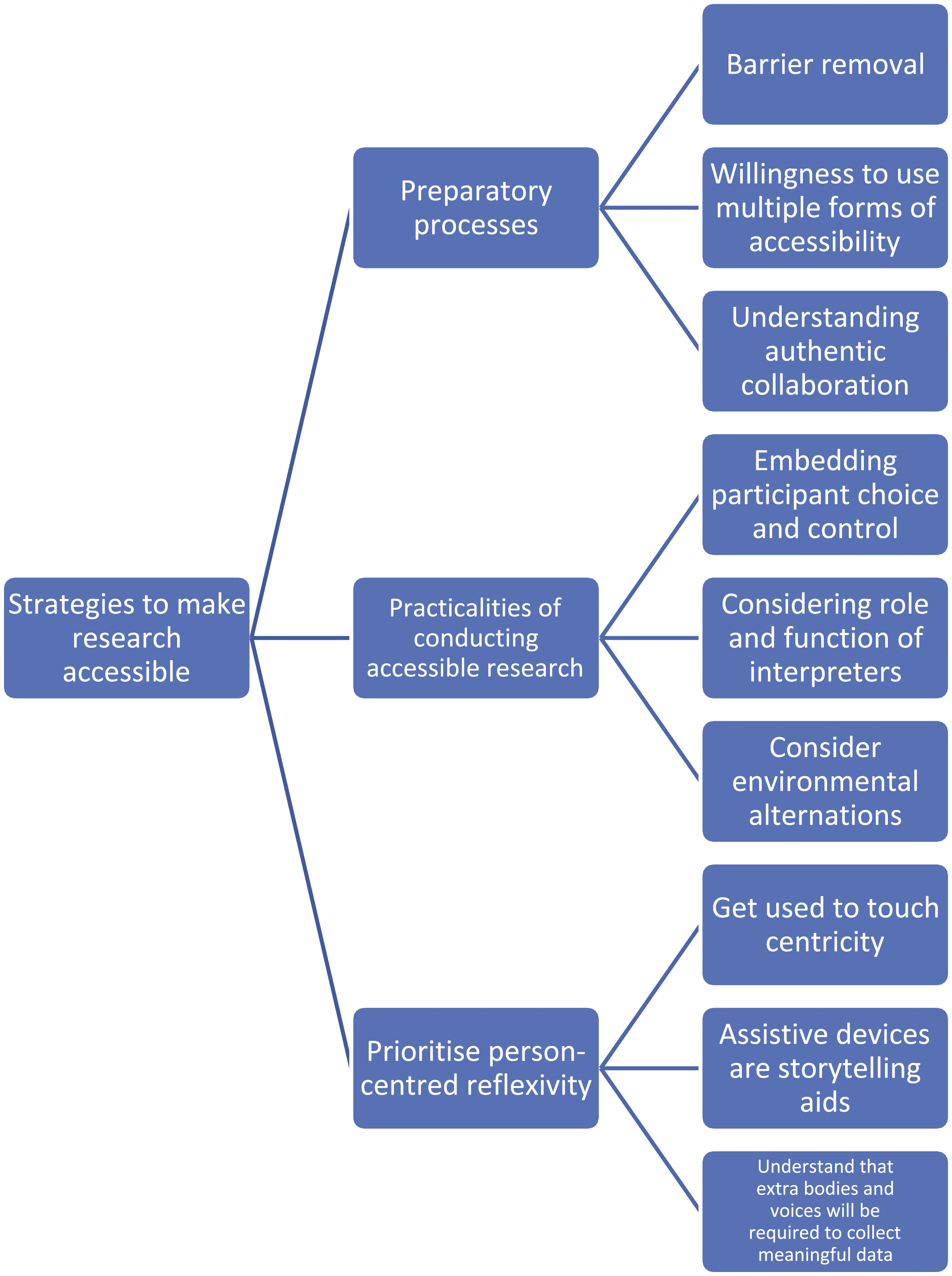
Preparatory Processes
Berghs et al. (2016) insist that public health researchers pay closer attention to the inclusion of people living with disability in all research by removing exclusionary barriers. Nothing in their review that very few researchers achieve this. Leech (2002) suggests that, in an ethnographic semi-structured interview, the researcher should approach the participants ‘appearing to know very little’ (p. 665), to enter their world more fully. Meaning that preparation is a necessary phase in the process of qualitative data collection.
Barrier Removal
In the field of Deafblindness, not immersing in the worlds of the participants is in fact to construct further barriers to inclusion and delimits the capture of truthful knowledge. The first imperative in working with people who are Deafblind, should be to understand their vast heterogeneity and complex living realities and how these impinge upon narrative inquiry research. This cannot be garnered simply with extensive reading, nor are lived experience researchers able to claim full prior knowledge. Own experiences are individual and not emblematic of the whole scope of diversities within the disparate communities and outliers.
Furthermore, barriers to research exist in social, institutional, and academic spheres because of these structures and individual complexities coalescing. These are at variance with the narrative spaces inhabited by sighted-hearing participants and researchers. Accessibility to information, communication, and safe environments for people with disabilities is paramount to increasing inclusion in research and wider society. The prevailing discourses, articles and books on qualitative inquiry methods and conduct are founded on sighted-hearingness. Meaning that the researcher may not always be well prepared.
Key to barrier removal is immersive co-creation, where all members of the research project can come to understand what hurdles need to be removed and what resources provided to enable the narrative conversations. Not only do preparatory processes empower participants to make informed choices and to tell their stories, in their own spaces, in their own way, they also affirm the subject of the study: hospital experiences as being a prevailing concern and source of anxiety for the community and individuals.
Accessibility provision follows from the information gained from co-creation and consultation. Ethics processes must include attention to true informed consent of participants with information in multiple formats, languages and across several occasions so that information may be imparted and absorbed. Deidentifying participants is crucial too for disseminating results. Honorariums should be meaningful to participants. Inclusivity then extends into the storytelling space where participants should have direct choices and control. Story telling aides need to be provided and the narrative physical environment altered to suit individual participant requirements. Debriefing needs to be planned so that interviews end on a positive note.
Understanding Collaboration
The narrative inquiry space requires a collaborative approach. The four elements of co-creation (co-ideation, co-design, co-implementation and co-evaluation [Pearce et al., 2020]) occupy immersive, physical and temporal dimensions. These elements are necessary to gain the participants’ trust and informed consent, and to attain their stories in socially just and participatory ways. Assumptive barriers (i.e. not deciding what is ‘best’ for participants) is assisted by a path of inclusion, by meeting the accessibility needs of all who wished to share stories.
Being Open to Multiple Forms of Accessibility
One participant in the research told us that they said to the doctor managing their care: “No interpreter. No conversation”. This sums up our approach to the many ‘conversations’ of the research space: information sessions and information sheets; answering questions and emails; obtaining informed consent; setting up interviews; booking interpreters if needed; the interviews themselves and, finally, thank you letters all need to be accessible – that without accessible information there should not be a research interview.
Different occasions, audiences and places required different communication methods, sometimes with different communication allies such as partners, support workers or interpreters. Often different technological aids and devices were used for different research activities. The design of the study was approached with community input regarding the accommodations needed in all the spaces of the research. This included measures for print disability, language/s, interpreters and creating a safe space for storytelling.
Learning the manual alphabet and hand-over-hand Auslan (Australian sign language) was undertaken by the researcher (author 1) and the accessibility assistants (AAs). This was much appreciated by participants and the source of humorous exchanges. It must be stressed that the beginner sign language in no way substituted for professional interpretation and was a way to access mutual social engagement only. For many participants, few in society make commitment to communicating with many people who are deafblind in their preferred tactile ways. Provision of accessibility imbues ethics and consent procedures, measures to ensure inclusion and promoting the use of storytelling aids and aides as discussed now.
Ethics approval was sought and obtained (No. HREC ETH17-1398) and was further amended one year later to allow for accessibility and coding assistants to help with interviewing and meet the researcher’s own accessibility needs when conducting the research. Participant consent requires special attention. Consent forms have evolved to become wordy, jargonistic documents. People with sensory impairment often find information sheets and consent forms unreadable or too long, confounding and potentially intimidating. They are usually in non-accessible formats.
There are participants who have had limited exposure to education or to the written structures of English language, such as AUSLAN native users. Traditional information and consent forms converted to extra-large fonts can be time and energy consuming. With approval from the Ethics Committee an abridged information sheets and consent form was developed focussing on plain English, with removal of jargon, complex terms and academic language. These were provided in multiple formats, which included regular, large print, extra-large print, electronic and braille. Video AUSLAN and audio versions were also planned for. All sheets, forms and interview guides were reviewed by a psychologist and researcher who works with the deafblind population to check for appropriateness and cultural-linguistic ease.
In the study conducted, 18 of the participants reflected on the information sheets required: one participant used a large print version; three participants used very large print; three used their screen readers to read electronic versions; eight used interpreters to sign the content; and three used braille forms produced by Vision Australia. These processes are time consuming and research project management plans need to factor this into budgets and schedules.
In addition to inclusive consent processes, pre-interview engagement with participants also requested if numbers or new names should be used as de-identifiers, given the small community of people living with deafblindness. Both (Maple & Edwards, 2009; Wayland, 2015) note the importance of pseudonyms due to the sensitive nature of the study, which includes hospital and health experience material and to limit re-identification.
Disability can be part of exclusion criteria, whether explicitly or not. This perpetuates data invisibility and seems to reinforce those hospitals make negligible efforts to include people living with disability in reviews of care.
Practicalities
Participant Choices and Control Within the Research Space
Participants identified the communication method/s and the spaces used for the research. The Deafblind population uses diverse communication methods and the research was required to ‘match’ their preferences using human or technical assistance. To arrange times, dates and interpreters (if needed): three participants provided their preferences via interpreters or support workers; an accessibility assistant contacted three participants via the phone, who had residual hearing or communication partners, to foster inclusion; five participants used texting; and the remaining seven used email.
The location chosen for interviews was also entirely participant driven as to where was most accessible for them. It is important for safety and security that people with mobility restrictions be free to choose the safest location for them. Most participants did not travel unaided and a few preferred to use a remote method, e.g., the National Relay Service (NRS) or email, so they could answer questions in their own home at a convenient time for them. Most wanted to be interviewed face-to-face at the support organisation offices, community hubs or in their home or workspace. The most popular venue was for the researcher to come to the home (eight participants). One participant noted that they needed to not be at home so that they could speak freely.
Interpreters
Research, utilising interpreters, notes that it is not always possible to know who is speaking, inferring interpreters are fabricating questions and responses. Temple (2002), in Simcock (2017a) states that, ‘interpreters are not neutral’ because they are ‘constructers of knowledge in the interpreting act’ (p. 1726).
Sheppard (2011) writes that using ‘carefully trained’, independent interpreters eliminate many problems in qualitative research with Deaf participants. In that research, unexpected issues arose, including examples of participants asking for ‘my interpreter’ instead of the interpreter supplied, or issues about the small communities from which clients come and interpreters work (Sheppard, 2011). Participants who used an interpreter provided the researcher with a list of preferred interpreters. Booking interpreters was then done through the Deaf Society and Tactile Terps, a private company. On no occasion did a participant receive an interpreter not on their list. The practice in hospitals, where staff book interpreters without participant approval, results in interpreters attending without the requisite skills. In many cases, participants described Auslan interpreters who were not as familiar with deafblind tactile methods or who were simply unknown and not trusted.
Utilising this knowledge awareness that, for people who are deafblind in Australia, their communities are very small means that independent interpreters may do harm. Given not all interpreters are literate in all forms of sign and tactile languages, and individual idiosyncrasies, the participants use of tactile methods, means that trust becomes paramount and personal. The use of known, trusted interpreters enhance inclusion, because interpreters have knowledge of idiosyncrasies, personal styles, preferences, and meanings, while also providing a safeguard against inappropriate touch and communication failure. In this research, two participants disclosed instances of an interpreter’s unwanted touch and unprofessional conduct. Both involved unknown, hospital-engaged interpreters, and both caused distress. To create a safe space for all participants, it was necessary to ensure choice and control.
In addition to accessibility, awareness of using interpreters and their capacity to change the traditional narrative inquiry space (in terms of adding members, increasing time needed for communication relaying, increased energy needed for kinaesthetic language, breaks are needed for both participant and interpreter) need to be addressed. Prior immersion in Deafblind culture helps researchers to understand these norms.
Another imperative for using trusted interpreters is that there may be diversity of language used within an interview as well as between participants and within interviews. Partway through one interview, a participant switched from hand-over-hand (Auslan tactile) to fingerspelling (English alphabet), explaining via interpreter, “I get more out of English than Auslan. It’s my preference now”. This is not unusual, as noted by Lahtinen and Ojala (2018), in order to produce a coherent end product in interpreting, one has to be able to combine different interpreting methods and change them when in need flexibly and creatively to accommodate the changing situations. Another participant and interpreter use a tactile table for some of the interview, reducing their kinaesthetic burden. These events reinforce the decision that participants should choose their interpreters to build trust and familiarity into the best-for-the-individual communication support.
Four interpreters were engaged in total, with one being engaged more often. This professional had high visibility within the small community and was trusted by the participants, appearing on the list of all except for interstate or rural dwelling participants. One participant required two interpreters: one for idiosyncratic language and one for Auslan (Berghs et al., 2016).
From a practical perspective, interpreters adhered to the Australian Sign Language Interpreters’ Association (ASLIA) Code of Ethics and Guidelines for Professional Conduct (ASLIA Australian Sign language interpreters association National Code of Ethics and Guidelines, 2007), and be adept at unpacking questions for each individual participant. In addition, interpreters are to be offered mandated rest breaks every 15 minutes, or two interpreters should be booked to continue interviews more seamlessly. Participants living with deafblindness who use interpreters are accustomed to these mandates and the consequent interruptions to flow were considered normal.
Environmental Alterations
When interviews took place in-person, the environment was altered to maximise accessibility, communication, and comfort. Storytelling aides and story-receiving aides mean that there are more people in these physical narrative spaces, meaning a larger room is needed for interviews to accommodate all parties. For some this included participant, guide dog, partner, interpreter, accessibility assistant and researcher. The hard reality of being deafblind is dependence on others for nearly all tasks (Moller, 2003). For a lived experience researcher with deafblindness, this means bringing others to be story receiving aides to the research spaces. Assistants act as research haptic signallers, voice interpreters, note takers, sighted guides, and live transcribers, depending on a situation’s requirements. In this study, they assisted by making notes and cross checking with the transcripts and the researchers notes for errors, homonyms and added contextual information—especially non-verbal, non-signed social cues. A common issue, for example, was the difference between “I have a problem with accents” and “I have a problem with access” as the researcher’s notes didn’t pick this up, and the recording presented a dilemma as to what was said, both versions being contextually correct, but only one being accurate. In these cases, the assistant had noted the correct word.
After ensuring that rooms were large enough to accommodate all attendees, the room itself was adjusted ton address seating, lighting, positioning of tables, positioning of a tactile table, water bottles, space for a service animal and adherence to guide dog etiquette, according to the NSW/ACT Guide Dogs’ website was also addressed. The face-to-face interviews all required some form of alteration to place.
Time
Time is protracted in this altered narrative inquiry space, both in the organisation and expression of stories. The action of time in interview preparation and conduct emulates that which is needed for hospital care and communication. Increased time is needed to organise storytelling aides and participants; rest breaks for interpreters; and relay via interpreters, the National Relay Service or communication partners; as well as to debrief with participants. Communication is prolonged when relaying stories through aids and aides, and when using tactile communication, such as the deafblind manual alphabet (Hersh, 2013).
Participants had full control over the location, timing and how the environment is arranged, to ensure their optimal communication and comfort. Face-to-face is the preferred mode of interview (78%), which reflects findings noted previously by Roy et al. (2018). Six participants conduct face-to-face interviews without an interpreter, while eight use an interpreter. The remaining four use email or the National Relay Service.
Choice and control over location is critical to aid barrier removal to participation, as mobility restrictions occur due to decreased environmental information because of reduced residuals of hearing and sight. Falls are more common (Berghs et al., 2016; Brennan & Bally, 2007; Moller, 2005). Researchers need to consider these issues as attendance at a focus group, for example, in an unknown location late at night may be a significantly riskier undertaking for a people who are deafblind than for a sighted-hearing participant.
Person-Centred Reflexivity
Touch-Centricity
For people who are deafblind, touch-centricity transcends cultural limits because, with co-occurring loss of hearing and vision, touch becomes a vital communication conduit, even for those who do not use a tactile language. They touch doors, doorways, tables, chairs, canes and guide dog harnesses to ascertain environmental information. They touch the arms of those guiding them and the hands of those communicating, and feel with their feet for tactiles, obstacles and danger.
Participants also touch chairs, tables and the researcher’s hand or arm to emphasise points. Additionally, participants touch interpreters when retelling events in hand-over-hand signing or using the deafblind manual alphabet. Participants touch parts of their own bodies to illustrate thoughts, such as touching the side of the temple to indicate the sign for ‘I am thinking’; one participant had idiosyncratic touch signals that only her support worker can understand. Hands were always moving through the air as signs, gestures and messages: there are clenched fists in the air for anger and on the table as vibro-tactile emphasis. I touch participants hesitantly at first, spelling out letters of the manual alphabet in palms and fingertips, getting faster as my confidence grows. This reciprocity fosters trust.
One participant liked to feel people’s hair and face to tell who is engaging with them. Many like a long goodbye hug—a Deafblind cultural custom from when gatherings were less frequent, and you did not know when you would see each other again. Four interviews ended with long goodbyes, both with researcher and the accompanying assistant. In this study, there were also things that we do not do, such as holding participants’ hands down (if they sign). For many, this harkens to past times when teachers and/or parents held children’s hands with force to stop them signing.
Touch and vibration, such as banging on the table for emphasis or turn-taking, were evidenced in two interviews. One participant banged on the table at several junctures to reinforce their point about feeling abandoned. By contrast, tactile performative elements were absent from the remote interviews via national relay service or email; perhaps those who need multiple sense communication choose face-to-face contact. There is also touch between researcher and assistant with a system of haptic signals being devised to signify turn taking, stop, keep going and what emotions are playing out in the narrative space—e.g., a signal for ‘they are laughing’, ‘sad or ‘happy’. These are important for the researcher, so as to receive cues and contextual information regarding how the participants are feeling and the interview progressing. All of this is normal when two people who are deafblind get together. They give each other tactile signals and signs that the sighted-hearing do not need. Working with participants with Deafblindness means upending ‘no touch’ norms of the sighted-hearing researchers, for without mutual touch there is no communication, reassurance, emphasis or narrative performance.
As a researcher, being ‘one of the tribe’ confers kinship, even if that tribe is somewhat scattered and not all from the same village. One participant shared a story of being thought of “as blind drunk when ‘only blind’”. The researcher reciprocates saying “I agree 150%,” to which they replied, “Thank you, I knew that you would understand”. Trust is also evident from the personal and, at times, traumatic experiences the participants disclosed, because they had the power to choose of what they speak. The participants trust me to ‘do right’ with these stories.
Assistive Devices as Storytelling aids
Assistive devices must be considered. For example, hearing aids, cochlear implants and accessibility software are required by almost all of the participants, as well as the researcher. The importance of appreciating the fallibility of technology cannot be overstated. For all the connectivity and benefits that modern communication and assistive technology bring, fails and breakdowns are a common occurrence (Moller, 2005; World Federation of the Deafblind, 2018). Technical glitches affected three interviews.
The iPad recorder failed in one interview, but a smartphone was used for the second half, after a few minutes of troubleshooting. In one internet relay chat interview, the call dropped out, but rapport was unaffected, with everyone laughing about ‘epic fails’.
Towards the end of the last interview, the researcher’s hearing aids ran out of battery unexpectedly. The assistants’ notes were used to corroborate the transcript and the researcher’s impressions. The interview guide kept the last two questions on track and demonstrated the importance, with multiple impairments on both sides of the research space, of having a script and sighted-hearing backup, both with the accessibility assistant’s notes and transcript.
Extra Bodies and Voices
In most interviews, extra bodies and voices as storytelling aides were physically present. With the exception of virtual interview via email, at least three people were physically present at each interview, with a maximum of five recorded. The relay conversations (3) had an operator, who is present virtually as the third or fourth body, as one participant used her partner as her “ears” during a call. Eight participants required an interpreter, partners were present in two interviews and support workers in four. Three guide dogs snoozed in corners or under tables while their owners were interviewed. An accessibility assistant was present at most (16) interviews, including two relay conversations. The role of those added voices is to corroborate, add contextual detail and support the participant in telling their experiences enhanced this qualitative study.
Discussion
This study sought to define a population of people who are Deafblind meaning they are without any vision and without any hearing. As with many communities of people with disability, there are varying levels of residual hearing and sight, therefore creating vast heterogeneity on. This study highlights that multiple methods and aids to communication may be needed to navigate social and personal life, covering speech, sign, and tactile languages, and/or braille. Centring this heterogeneity reminds researchers that these are wide parameters for a qualitative inquiry to navigate and chart and are important living realities that will impact the provision and cost of emancipatory qualitative research practices, as well as challenge the qualitative research inquiry space itself when disability is included. Further seeking to understand how co-creation can further be enhanced with a researcher with lived experience (as noted by Mellifont et al., 2019) requires awareness of how disability can be embedded in methodological choices using the following recommendations:
Accessibility is Key
Providing full accessibility on an individual needs basis results in better inclusive research practice and allows participants to both fully understand the research and be voiced and heard. Do not offer a couple of formats and label then as ‘fully accessible’ for they will not be to be to all. University ethics departments need to take heed and ensure that all research proposals have considered how to value, reach and capture all voices possible. Grant application budgets need to allow extra for the provision of face-to-face communication methods and interpreters alongside alternative formats. Considering accessibility and inclusion of people living with disability should be a normal part of any proposal or application. After all, disability is common and comes to nearly all of us one way or another, one time or another.
Lived Experience Researchers are Valuable
Participants gave unsolicited feedback that being “just like us” was a respected position for the researcher. Occupying this position enabled the researcher to predict and plan for removal of barriers to participation in research faced by this hard-to-reach group. The researcher’s own experiences of discrimination, microaggressions, disparate life opportunities and exclusion contributed to a determination that no adults living with Deafblindness should be excluded. Lived experience researchers should be included in all projects because of these valuable insights into barriers to inclusion, accessibility and their insider knowledge of many living realities that elude those without the experience of disability.
Immersion is Necessary
Immersion in the communities prior to research design enables researchers with and without lived experience to fully explore the prevailing community concerns so that research is driven by scholar activism for social justice and equity. Choose research inquiry methods that engage with the complexities of lives lived with disability and or marginalisation. Do not just count, look and listen to voices as well as counting data. Contextualise data with lived experiences. One thing we have found is that taking the time and creating the wider narrative spaces to engage with context also yields future directions for new research. This research uncovered common concerns of unemployment, appropriate housing, ageing into disability and ageing with disability, access to community health services, alongside experiences of microaggression, abuse and discrimination in all domains of life. Immersion also establishes the specific narrative space requirements needed to elicit that community’s stories.
Examine All Research Decisions Clearly
Collaborate with those with lived experience and interpreters to ensure that questions are unpacked as thoroughly as possible, that concepts are clear and that inaccessible formats are minimised. This means considering screen reader capabilities and finding alternatives to hierarchical tables and scales. In the post-Covid era when so much has moved to online-only formulations, if research involves disability or older participants, then sensory disability is common. Multiple disability is common. Research cannot claim to offer a comprehensive capture of phenomena under study if they are not offering individuals access.
Roy’s (2020) observations that face-to-face is the preferred format for researching dual sensory impaired populations is confirmed by the immersion and co-design with the attendees at support group meetings preferring face-to-face. This is in contrast to those not affiliated with impairment support organisations who preferred remote methods. This difference was not explored in the present research but bears exploring in future.
Allow More Time
There are manifold challenges to barrier removal, provision of genuine access and relaying stories. Preparation is needed, resources provided, and communication support set up. It takes more time to allow for Deafblind people to absorb the information, unpack the meaning and then relay their own opinions and experiences. This also means investment in the research by funding bodies and universities to accommodate the real-world costs of increased time and accessibility provisions for both participants and lived experience researchers.
Conclusion
Meeting the accessibility and support needs of research participants and lived experience researchers individually and explicitly resulted in this study generating a loud collective voice stating that the underbelly of medicine is a dark place, where urgent change is needed. People who are deafblind are entitled to but not often receiving equitable and safe care and communication when in hospital and they are similarly marginalised in research. This paper sets out to demonstrate what is needed in the narrative inquiry space to set up interviews, gain informed consent and hear the testimonies. By having a lived experience researcher, this study was able to bridge the community and individuals in the production of new insights and knowledge from the participants themselves, by making the research design accessible.
People who are deafblind are a hard to reach, frequently excluded and not consulted on the issues that matter to them. “We are in the too hard basket” notes Annie, a participant. This contributes to failures by clinicians, researchers and policy makers alike to provide safe, accessible narrative spaces to collect data and stories. This results in data invisibility, where the people and stories you don’t get to hear or see, don’t exist. To prepare the narrative space and participants for storytelling research, the researcher needs to spend time within the community, engage people who are deafblind in the research, provide individualised accessibility, allow increased time and fund communication support every step of the way.
While the researcher worried about rigour and contaminating the research space because of their disability, the participants themselves understand the fragility of adjustment to sensory loss/es and the at-times hostility of ‘normal’ society, with its many sensory hurdles. The insider knowledge from both lived experiences, clinical practice and community immersion imbues the researcher with both depth and breadth of understanding. This then informs the qualitative research to enable greater inclusions and participation of people who are deafblind to tell their stories in their chosen spaces with preferred language/s and storytelling supports as needed. As the research unfolds and concludes, we realise that in this research, the participants and lived experience researcher are co-creators of inclusive narrative inquiry spaces for and within this project.
Footnotes
Declaration of Conflicting Interests
The author(s) declared no potential conflicts of interest with respect to the research, authorship, and/or publication of this article.
Funding
The author(s) received no financial support for the research, authorship, and/or publication of this article.
