




Abstract
Both co-production methods and arts-based methods are now increasingly used in healthcare research, particularly to understand the experiences and views of people and communities marginalised or underserved in healthcare services. Healthcare staff and researchers often look to use these approaches when seeking to explore health inequalities in a public health context. Yet, both co-production and arts-based methods can lack structure and consistency of application and sometimes fail to maximise impact in the field. This paper presents the development of a cohesive five-stage methodology that integrates co-production and arts-based research methods into a broader approach which includes community engagement, inclusive research practice and education: - the C-CARE methodology. C-CARE was conceptualised through the development of an inclusive approach to Advance Care Planning (ACP) - the ‘No Barriers Here’ project, within a public health palliative care context. We describe how the evolution of ‘No Barriers Here’ as an ACP intervention supported the development of the C-CARE methodology, which now underpins our work. The methodology has potential for use outside a palliative care field to understand and address a wider range of health inequalities in a public health context.
Keywords
Introduction
Advance Care Planning (ACP) or planning for future care, as it is sometimes known, is the process of exploring and expressing a person’s wishes for their care in the lead up to, during and after their death. Existing data provided through the ‘Learning from lives and deaths – People with a learning disability and autistic people’ (LeDeR, 2021) process, has highlighted that people with learning disabilities and autistic people experience inequity in dying and often experience traumatic, non-care planned deaths, higher rates of emergency hospital admissions at the end of life and poor access to, and experience of, ACP.
This reality became more apparent in the early stages of the Covid-19 global pandemic, when emerging evidence showed that people with learning disabilities and autistic people were more negatively impacted by the virus (Kuper & Scherer, 2023; Public Health England, 2020). ‘No Barriers Here’ was developed in response to this reality.
‘No Barriers Here’ is a co-produced, arts-based approach to addressing inequalities in palliative care. It adopts a public health approach to palliative care and ACP, focusing on the importance of planning for future care for all people and communities, but particularly those underserved in healthcare and/or marginalised in society. The project resulted in the development of a cohesive five-stage methodological approach, C-CARE, which integrates co-production and arts-based methods to explore and improve the experiences of people marginalised and underserved in healthcare. The five elements of C-CARE are
Following the success of the first stage of ‘No Barriers Here’, subsequent funding was awarded to explore the transferability of the method with other groups and communities marginalised in palliative care and in healthcare more widely. This paper presents the development of the C-CARE methodology through the three stages of the ‘No Barriers Here’ project.
The thematic findings of the project are published elsewhere (Jerwood & Allen, 2023; Jerwood et al., 2025; NHS England, 2022; The Victoria and Stuart Project, 2024). This paper describes how the C-CARE method was developed and offers insights into how it might be used in other public health contexts to address inequalities in healthcare settings.
Background
Advance Care Planning and Access to Palliative Care
ACP is usually delivered in healthcare settings by healthcare professionals such as palliative care nurses and medical staff. Sudore et al. (2017) define ACP as: A process that supports adults at any age or stage of health in understanding and sharing their personal values, life goals, and preferences regarding future medical care. The goal of advance care planning is to help ensure that people receive medical care that is consistent with their values, goals and preferences during serious and chronic illness.
The experience of the interaction with healthcare professionals around ACP conversations and completion of documentation varies in quality and there is no standardised approach to ACP (Morrison et al., 2021; Zwakman et al., 2018). It nearly always involves completing a written form, often little more than a brief discussion regarding Do Not Attempt Resuscitation (DNAR) preferences. Sometimes a more comprehensive, multi-stage conversation is possible which can be very rewarding for the patient. However, this usually depends on the confidence and capacity of the healthcare professional conducting the conversation. In recent years, ACP has been positioned as an integral component to enhancing end-of-life provision and decreasing moral distress amongst healthcare providers (Yeun, 2021). There has also been an increased focus on addressing inequities and inequalities in access to palliative care. Research has demonstrated that equitable access to palliative care and ACP is not provided for many groups and communities (Allen, 2021; Care Quality Commission, 2016a, 2016b; Chidiac et al., 2020; Haviland et al., 2021; Hospice UK, 2023; Hussain et al., 2021; Jerwood & Allen, 2023; Jerwood et al., 2021, 2024; Knippenberg et al., 2020; Pallotta-Chiarolli & Sudarto, 2023; Rosa et al., 2023; Selman et al., 2022; Wagemans et al., 2010).
We were aware of the need for an innovative, inclusive approach to ACP, so our initial focus was on co-producing a process for working with people with learning disabilities in relation to ACP to design a healthcare intervention. Subsequently the potential of the approach as a research method has been recognised and we began to document its elements and impact.
This paper will explore the theoretical framework underpinning the C-CARE methodology, outlining how the delivery of the ‘No Barriers Here ’ research studies led to each stage of development of the approach. It proposes how C-CARE can be used when seeking to understand the experiences of people underserved in healthcare with the aim of addressing health inequalities and experience of care. Each element of the methodology is discussed and the potential for wider use in a public health context is presented.
Theoretical Framework
Epistemological Orientation
Traditional epistemologies value some forms of knowledge or knowing more highly than others. This is known as epistemic injustice and our methodology aims to disrupt the epistemic injustice inherent in research processes and clinical practice. There are two forms of epistemic injustice (Fricker, 2007). The first, testimonial injustice, is where prejudice or unconscious bias causes the audience to give less credibility to the speaker’s experiences. The second, hermeneutical injustice, is where a group or person is disadvantaged in making sense of their lived experience due to structural inequities. Our methodology seeks to develop a process that includes the experiences of those experiencing both forms of epistemic injustice. For example, many people with a learning disability will have had their views or symptoms dismissed by healthcare professionals because of the imagined challenges regarding understanding informed consent. If data is collected by interview or questionnaire and a participant cannot speak or write, their experiences would be excluded from research and their voices or knowledge not included. Using arts-based methods goes someway to mitigate this (the A in C-CARE). This will be discussed later in the paper.
Participatory and Equity-Oriented Theoretical Underpinnings
The theoretical underpinning for the development of the C-CARE methodology is in an equity-oriented, participatory paradigm (Allen W, 2024; Chambers, 2008; Fogg et al., 2022; Heron & Reason, 1997). Participatory research values inclusion of participants, collaboration between participants and researchers, and doing research with participants, not to them.
The C-CARE methodology evolved through three research studies which focused on participants with specific characteristics. Whilst focusing on specific groups and communities underserved in healthcare, an intersectional lens is critical to our approach. In an attempt to understand the needs and experiences of people who share particular characteristics, such as people with a learning disability, it is important not to homogenise everyone who shares that characteristic. Exploring identity through the arts-based workshops adopted within C-CARE allows intersecting aspects of identity to be highlighted and explored. Understanding that different intersects of identities can create greater inequities and experiences of prejudice is an fundamental principle of our theoretical approach.
Community Engagement and Co-Production
Co-production, supported by preparatory community engagement (the C-C in C-CARE), centres users’ voices and experiences and involves the giving up and sharing of power in the research relationship (Palmer et al., 2018; Robert et al., 2015).
The term co-production is often used interchangeably with co-design and co-creation (Needham & Carr, 2009). Our understanding of the distinction between these terms is informed by Vargas et al. (2022). Co-production refers to the engagement of stakeholders in the delivery of a solution to a previously agreed problem and co-design to the involvement of stakeholders in the development of the solution. Co-creation is often used as an overarching term and describes the engagement of a diverse range of stakeholders in the process of understanding complex problems, designing and evaluating solutions. We have used the term co-production throughout our work, despite it including co-design, for ease of understanding. This decision was informed by our first co-production group who felt the term co-production was clearest to them.
A central tenet of C-CARE is that the end users or beneficiaries of research should be involved in its development, design, conduct and dissemination. Our ontological position is that people have different lived experiences which are shaped by inequitable societal structures, privilege, discrimination and marginalisation. There is no one single reality or experience. Peoples lived experiences shape their views and attitudes towards healthcare (Guba & Lincoln, 1994).
Participatory research places the researcher within the research process and acknowledges the researcher is not objective or neutral in the research. Our position is that the researchers are part of the relationships and dynamics that the participants are navigating, and we are not neutral in this role. Our own lived experience also shapes our views and attitudes. To make this explicit we included positionality statements in our data collection and analysis processes which we discuss later in this paper.
Inclusive Research Methods
From the start of the project, we knew that any research methods we adopted needed to disrupt and challenge existing research and clinical cultures. Our thinking, given that the imperative was to work with groups and people who experience marginalisation in healthcare and to address inequity, was to co-produce with the people that were likely to be impacted. Our aim was to reduce the inherent power imbalances of the researcher/participant relationship. As project leads, neither author had a learning disability, so we could not bring lived experience to our roles. At the outset we formed a co-production group which included ourselves (researchers and practitioners), four adults with learning disabilities and/or autism, and an advocacy worker. Co-production methods centre the knowledge user or beneficiary and are a key tenet of action-based research (Bradley, 2015; Fisher & Fisher, 2016; Think Local Act Personal National Co-production Advisory Group, 2022). Our commitment was to work in co-production at all stages of the project from initial planning, design of intervention, data collection and analysis, to knowledge dissemination. The C-CARE methodology locates co-production methods as part of a structured methodological approach (Graham et al., 2019).
Arts-Based Methods
In health research, arts-based methods are largely used in two ways: to collect different forms of data or to enhance data or to creatively communicate or disseminate research findings. In addition, arts-based methods can also be used for gaining new ways of knowing beyond capturing a broader range of data or enhancing dissemination impact of research findings (Boydell et al., 2012). The production of images or objects provides an opportunity for participants to reveal or express more of themselves through engagement with making. The co-production group were clear that any approach needed to allow for more inclusive and accessible ways of expressing views and experiences as well as allowing time for the exploration of such views, as participants may never have had the time, opportunity or space to think about their wishes. Arts-based approaches can slow down processes and provide time for reflection, giving participants the opportunity to explore their own experiences and form views and opinions about their wishes (Boydell et al., 2012).
Bird (2022) describes how arts-based research supports the development of more inclusive research practices through making visible experiences and lives which have been silenced by structural inequities. Highlighting that arts-based research methods can challenge traditional hierarchies in both research and health care practice: The arts bring imaginative, intuitive and embodied experiences into the same space as reason and logic to create a space within which the marginalised becomes centred, and participants become the beneficiaries and co-producers of knowledge.
Our decision to adopt an arts-based approach is centred on the participatory potential of co-production, which is supported by a published evidence base. Majid and Kandasamy’s systematic review describe four reasons for adopting arts-based methods in healthcare which resonated with the aims of the project: (1) To capture aspects of a topic that may be overlooked, ignored or not conceptualised by other methods (i.e. quantitative and interview-based qualitative methods). (2) To allow participants to reflect on their own experiences. (3) To generate valuable community knowledge to inform intervention design and delivery. (4) To formulate research projects that are more participatory in nature (Majid & Kandasamy, 2021).
Developing the Methodology
As practitioner-researchers with experience of working with learning disability organisations, we were very aware of the inequalities that people with learning disabilities face. Building on an existing relationship with a local advocacy organisation, we formed a co-production group with a group of four adults with learning disabilities and/or autism and an advocacy worker. In the early stages of discussions and planning, our co-production group members with learning disabilities were clear that there needed to be creative ways of supporting conversations, acknowledging that for some people, verbal communication is not the preferred or most accessible means of communicating (Aldridge, 2007; Richards et al., 2019). In addition, arts-based methods have been shown to be successful in enabling the voices of marginalised people to be heard and accepted (Coad, 2007; Coad et al., 2009; Fenge, 2022; Huss & Bos, 2022; Mannay, 2015).
From the perspectives of the co-production group members with learning disabilities and autistic people, this was about ensuring that different ways to express views and feelings were embedded in any approach. For the art psychotherapist researcher member of the co-production group, it was important to consider how artmaking also slows down processes and allows time to think, feel and speak (Bird, 2022). Much of the criticism of existing ACP approaches is that they are viewed as a task, a form which has to be completed, and the focus is on completion not quality. Many people have not considered their own feelings about their end-of-life care/wishes for future care. This is particularly true for people who are not always asked their opinion or listened to in a healthcare setting or offered the opportunity to make or contribute to decision-making where there are choices.
Stage 1 – Developing the ‘No Barriers Here’ Approach and the Beginnings of the Methodology
The development of the approach centred around a series of arts-based workshops, each addressing a different aspect of ACP. The co-production group members felt that delivering the sessions as small group workshops would serve several functions. A workshop in a small group felt more accessible for attendees and less intense than an 1-2-1 conversation. Members with learning disabilities commented that they spent a lot of time in small groups and this didn’t feel intimidating. It would allow for group conversation and the sharing of ideas and experiences and support social connection.
Further description of the recruitment, ethical considerations, workshop delivery, data analysis and findings of the first stage of the project are reported elsewhere (Allen, G and Jerwood, 2022; Jerwood et al., 2025). Workshops were co-delivered by practitioner researchers and people with learning disabilities from the co-production group. One of the facilitators was a qualified psychotherapist and was able to provide support to any participants who became distressed and ensure appropriate follow-up support after the sessions.
The co-production group met several times and tried different art-making methods and explored the different topics which arise in ACP conversations. Local ACP documents were shared and discussed to identify key topics for inclusion. Collectively the following structure was developed:
Workshop 1 – Who Am I? Introducing Myself to the Group. What Would I like People to Know About Me?
The first workshop focuses on helping the group land in the space and gently introduces the use of a less-verbal method of exploring and expressing thoughts and feelings. The aim of the workshop is for participants to introduce themselves to each other and the facilitators in a more personal way than would happen in a traditional healthcare setting.
Participants are asked to draw around their own hand and then to use the art materials to add aspects of their identity which are important to them. This activity can be carried out to the depth the person feels comfortable with. On a simple level, this could be their name and using their favourite colours to decorate the paper.
It might be very pragmatic – favourite food, friendships, hobbies etc. - or it might be more values-based or identity-driven. For example, preferences about being warm or cold, needing to be quiet, preferring to be with lots of people, religious or cultural identity, sexuality and other aspects of the person’s identity they feel they want to share or would want healthcare professional to know. (Figure 1). Art Materials – paper, pens, pencils, crayons, collage. Participants Taking Part in Creative Workshops
Workshop 2 - My Wishes for my Care – People, Place, Care after Death, Most Important Things
Whilst workshop 1 enables the group to get to know each other and build connection, workshop 2 introduces the more expected aspects of ACP. Even where participants were known to each other, the nature of the exercise allows sharing of new information within the group. Participants are given a large square of fabric, divided into four sections and each section is used to explore different themes, which are introduced step-by-step during the session. Starting with important people, participants are asked to think about who the important people in their lives are, who might help them make decisions about their care, who might speak on their behalf if they couldn’t, and who they might like to have involved in their care if they were to become unwell. Participants are encouraged to think about professional and informal carers and also to think about anyone they would not like to be involved.
Next, place of care and place of death are explored. It quickly became apparent that the workshops also served as education sessions as participants were not aware of the choices and possibilities available to them. Discussions regarding resuscitation, life-sustaining treatment, organ donation and other associated topics are therefore included.
In the workshops participants were able to discuss past experiences of hospital admission, relationships with General Practitioners (GP) and other healthcare services and explore their own views about where they would like to be looked after. It allowed the hospice-based researcher to introduce the concept of hospice care and community palliative care to participants.
The third theme to be introduced is care immediately before and after death, ideas about funerals, choices about burial or cremation, organ donation, religious customs and practices are discussed.
The final theme is based on a discussion of the participants’ most important and underlying wishes and beliefs, and what would be most important if not everything they hoped for could happen. This offers a way of capturing the really important aspects and serve to bring the final workshop to a close. Participants are encouraged to think about what would be most important, if not everything they discussed could happen and to condense the content to capture the really important aspects. (Figure 2). Art Materials – fabric, fabric markers, buttons, fabric remnants, glue, oil pastels. Examples of Workshop 2 Creative Care Planning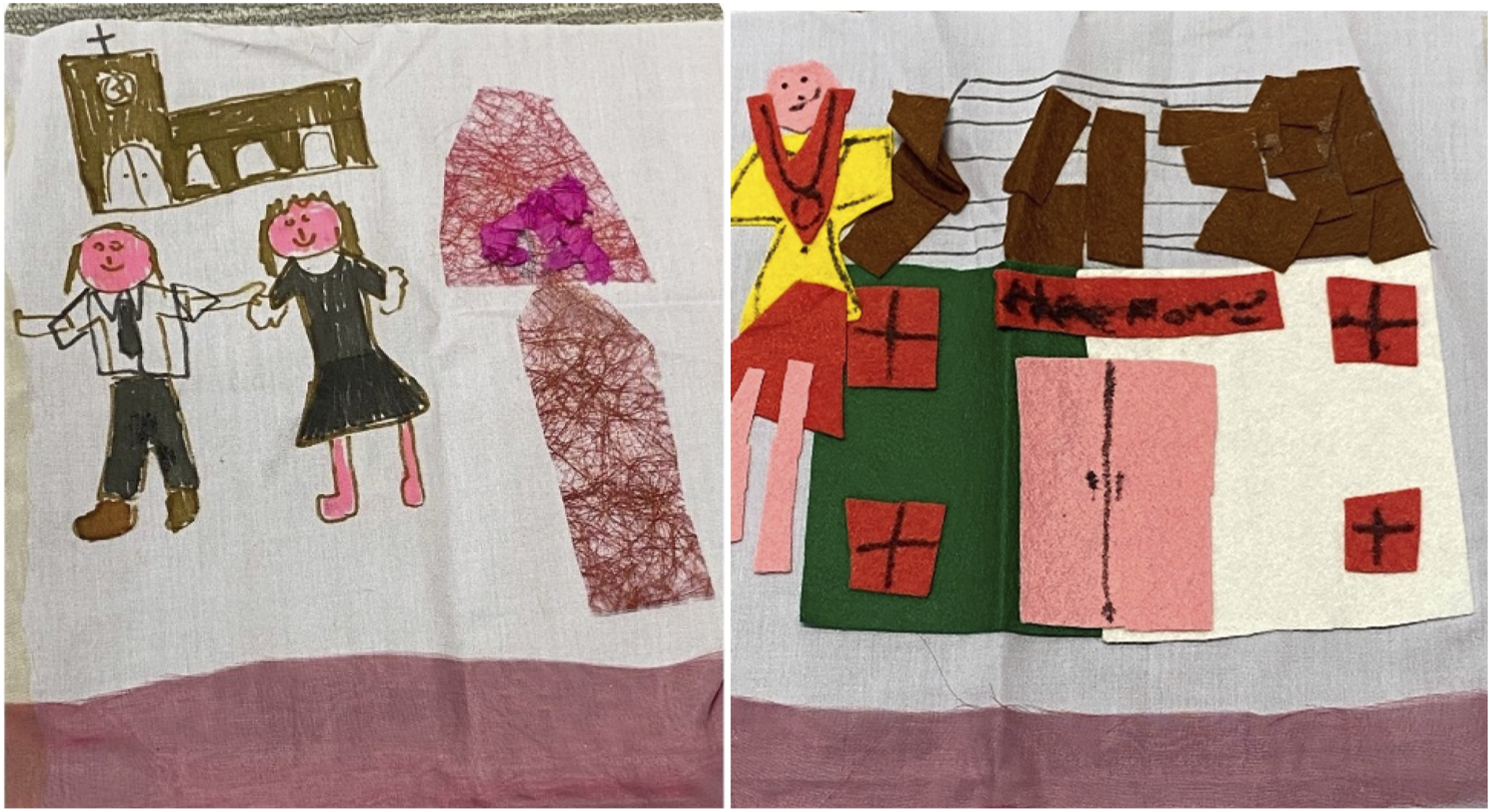
Workshop 3 – Legacy
The final workshop looks at legacy and uses weaving as a creative activity. Participants are encouraged to think about their own legacy, how they would like to be remembered and what they felt they had contributed or achieved. For people marginalised in health care and wider society this is particularly important and participants in the first stage of development were able to express their own achievements and challenge the perceptions of people with learning disabilities. Workshop 3 allows people to express themselves and share how they would like to be remembered after they die. Participants are asked to write down or discuss the different aspects of their own legacy, then decide what colours or materials to use to represent each element and to weave on the loom. Weaving offers a different way of creating an image and can be grounding as an activity allowing conversations to expand. During the process of weaving, participants were encouraged to share aspects of their own lives, the roles they had played and their own achievements. (Figure 3). Art Materials – weaving looms, yarns, wools, other fabric remnants, wooden tags and labels. Participants Taking Part in Workshop 3 Legacy Weaving Activity
Data analysis was also carried out by the co-production group using reflexive thematic analysis (Braun & Clarke, 2022). The authors carried out an initial analysis of the data. The other members of the co-production group undertook further analysis of the data and then the whole group contributed to the development and refining of final themes.
At the end of Stage 1, our methodological approach included 3 elements: co-production, arts-based methods and inclusive research design.
Stage 2 – Refining the Methodology
The second stage of development of the C-CARE methodology continued through a second funding award to adapt and explore the suitability of the methodological approach with people marginalised in palliative care by identity, culture, ethnicity or race (ICER). The core research team (JJ and GA) were approached to carry out this piece of work and spent time reflecting on how appropriate it would be for two White researchers to carry out a study focused on the experiences of people from racialised backgrounds. At the time, the health inequalities experienced by people from racialised backgrounds in the Covid-19 pandemic were being highlighted in mainstream media and racism in healthcare, and in palliative care specifically, had been highlighted (Hussain et al., 2021; Kapadia et al., 2022; Koffman et al., 2022). Returning to our own research position regarding a participatory, co-produced approach, we worked with racialised people and community-based organisations embedded in different ethnic minority communities in the locality. We considered how we could approach the study to uphold our ethical responsibilities and not to be paralysed by our own discomfort. Our community engagement and early stages of co-production work included challenge to us as researchers to find a way to use the approach, which appeared to have potential to disrupt some of the established research hierarchies, to hear the voices of people marginalised by identity, culture ethnicity or race differently. It was in this second stage of development of the methodology that the importance of community engagement was really highlighted in supporting authentic co-production. We formed a second co-production group with members of local communities who were racialised as black or brown, people from migrant communities, people with refugee status, unsettled asylum status and people from diverse backgrounds who were known to be under-represented in the local health system.
Again, the co-production group guided and challenged the study, advising on how to recruit, which groups or communities should be focused upon, where workshops should be held, how to identify safer spaces, interpreters and other issues of trust-building and accessibility.
The thematic findings from this stage are again reported elsewhere (Jerwood & Allen, 2023). The methodological developments and refinements to the method particularly focused on the role of community engagement as a link to meaningful co-production. Members of the co-production group supported the analysis of the data and development of the themes in the findings far more extensively in this stage. We engaged in deeper considerations on how traditional research hierarchies and power imbalances could be disrupted when approached through a de-colonising lens. Our own journeys of understanding our role as researchers and as healthcare providers in reinforcing and perpetuating these hierarchies were central to the analysis and also reflection on suitable dissemination methods. Developing our inclusive research practices was a key addition to the model in this stage. Challenging future funders on the inclusion of co-production costs from the start was an example of how we evolved from the first stage. For example, ensuring we could pay people properly for their time was established as a fundamental principle of the project.
Stage 3 – Making Mistakes, Further Refining and the Development of the C-CARE Methodology
The third stage of the development of C-CARE was carried out during a research study focusing on the experiences, barriers and expectations of LGBTQ + people in relation to palliative care and ACP (Jerwood et al., 2024). It was in this study that we conceptualised the current five-stage methodology presented in the next section, partly through making mistakes and taking shortcuts. The level of funding for this stage was significantly less (for reasons which will be discussed in a separate paper) than for the previous study focusing on identity, culture, ethnicity and race. Rather than reduce our expectations of the number of participants we could include, we focused less resource on community engagement. This decision was influenced by the fact that one of the research team was an ‘insider researcher’ (Brannick & Coghlan, 2007; Hewitt-Taylor, 2002) within this community. It was relatively easy to recruit a co-production group through personal and professional networks, however, the lack of community engagement prior to the forming of the co-production group had a detrimental effect on recruitment. As a research team, we made assumptions about the ability of ourselves and the other co-production group members to reach potential participants. We also made assumptions about the willingness of LGBTQ + people to want to engage in discussions about death, dying and wishes for future care. More effective community engagement with organisations working within the LGBTQ + communities locally and nationally might have mitigated this. From a methodological perspective, it reinforced the inclusion of
Participant Feedback
Each stage of development was shaped not only by the co-production group members but also by participant feedback. Participants in the arts-based workshops were asked to feedback not only on the process of participating in the ACP workshops, but also on the methods used within the workshops themselves. This was carried out as verbal discussion at the end of the workshops and re-visited when the educational resources were developed, which is discussed later in the paper.
Reflexivity Position Statements
As we ended the third stage and conceptualized the five elements of C-CARE, we revisited our own research practices. Reflecting on our own identities as researchers had become embedded in our inclusive research practice. In each workshop, co-production meeting or other shared space, we all reflected on our own positionalities.
An example of a positionality reflection: “I am an Asian, middle-aged woman. I was born in the UK to parents who had migrated here under a scheme for NHS professionals. I was from a middle-class family historically, but due to the poverty we lived in when I was a child in the UK, I feel my upbringing here was more working class. We didn’t own our own home. My life now is more privileged due to my, and my husband’s, education and employment status. However, I feel continually reminded of my difference, particularly in the last 10-15 years. I am heterosexual, married and the mother of three children, so I have a degree of privilege in these regards, however my ethnicity and race are a part of my identity where I am aware of my own inequality. I bring lived experience of racism and of privilege to this project, I can relate to some people’s experience of racism but in other ways, as an Asian woman born in the UK, I feel very different from many Asians who came to live here later in life.”
This process of reflection happened to varying degrees across the different stages of the project and the development of the C-CARE methodology. For example, prior to beginning data analysis, the researchers and co-production group members considered their own positionality and relationship to the data. This is an important part of participatory research and, in particular, to reflexive thematic analysis which acknowledges that we are not neutral beings but rather, we bring our own lens to data analysis influenced by our own identities and perspectives.
Acknowledging and foregrounding our own positionalities supported a levelling of the power imbalances in the group - for example, between those who were practitioner researchers, clinicians or lived-experience practitioners. Whilst the power imbalances may not be able to be fully eradicated, bringing them into consciousness allowed us all to acknowledge the lenses we may bring to the analysis of the data for example.
Impact and Dissemination – the Educational Element
Throughout each stage of our research, we have prioritised the dissemination of the knowledge we gained, including both thematic findings and methodological insights. Many minoritised people do not benefit from the research they take part in and experience participation or consultation fatigue (Applied Research Collaboration: Kent Surrey and Sussex, 2022; NHS England, 2023). Generally, much healthcare research is never implemented in practice or there are long delays between research being carried out and being implemented (Grant et al., 2016; NIHR Health Research Authority, 2023).
Following the initial stage working with people with learning disabilities, the findings were shared through a co-delivered lunchtime learning session. People with learning disabilities co-delivered the session, which presented the learning from the workshops and over 150 people attended, far more than was anticipated. In addition, we made a short film about the project using footage from the sessions (with consent) and interviews with the co-production group. The film served as an accessible way for other people with learning disabilities to access the research but also for healthcare staff to benefit from the learning. Far more people attended the online learning session and watched the film than have read the publications associated with the study. In addition, the approach was included in several best practice toolkits and won two awards for its co-production elements and inclusive practice (Allen, 2023; Tuffrey-Wijne et al., 2025).
Examples of education resources produced during the ‘No Barriers Here’ project include co-delivered ‘lunch and learn’ sessions; short films; written/visual resources; inclusion in best practice toolkits; conference presentations, journal papers and webinars; online learning modules and workshops. Examples can be found on the ‘No Barriers Here’ website (https://www.nobarriershere.org/). (Figure 4) The C-CARE Methodology
The C-CARE Methodology
Stage 1 Community Engagement: Making Relationships With Community Partners
Beginning with community engagement has become a crucially important stage in our methodology. Bypassing this stage led to much poorer quality co-production and poorer recruitment. Identifying who we need to engage with early on allows relationships and trust to be built. It means that it takes more time, additional resources and funding, but this upfront investment of resources yields valuable returns.
When thinking about community engagement, it is important not to default to ‘the usual suspects’. Many organisations have local partners who are the go-to for new projects or initiatives. Yet, inherent in equity-oriented work is the need to engage and build relationships with those who are not represented, not present, not visible and with whom existing relationships do not exist. Combined with making effective use of local population health data to understand locality-based health inequalities, it is possible to build connections with groups and communities who are underserved.
The groups and communities we work with have often experienced poor treatment in healthcare and in other societal spaces. It is important to understand the structural inequity which underserved communities experience and to educate ourselves alongside listening and bringing curiosity to these early conversations. For ‘No Barriers Here’, the community engagement stage led us to build relationships with individuals who acted as the bridge between the research study and the communities and groups. Russell describes these people as ‘border hounds’ (Russell, 2017). By building trust with individuals, we were able to work with groups who it would have been very difficult to engage with if these relationships did not exist.
Stage 2 Working in Co-Production: Working With and Alongside People to Understand Experiences, Inform and Drive Change Together
There are many definitions of co-production and many different understandings of what co-production is. In this context, we understand co-production to be the process of sharing power, relinquishing control and working with and alongside participants in research with an overall aim of developing and delivering services or initiatives which benefit the end user. Our community engagement often led to recruitment of members into our co-production groups. In addition to members with lived experience, the authors as researchers and healthcare professionals also formed part of the co-production group. In addition, other key stakeholders are often part of the groups. These range from members with professional interest, representatives of key organisations, community leaders, ‘border hounds’ and other partners. The co-production group meets regularly throughout the duration of the project and oversee the development, design, delivery and dissemination of the study. Examples of this have been decisions about room hire, design of posters, identification of the need for adjustments, involving interpreters and addressing other accessibility needs. As the project continued, this also included the recruitment of participants, co-delivery of workshops, analysis of the data, and writing up findings. Co-production extends to dissemination of findings through involvement in developing educational sessions and resources, presentation to conferences and in co-authoring journal papers and book chapters. Our co-production members have also educated the researcher members, challenged non-inclusive research and healthcare practices and supported the development of the C-CARE research method.
Stage 3 Arts-Based Methods of Data Collection: Offering a Less-Verbal Approach, Creating a More Equitable, Accessible way to Take Part
The use of arts-based approaches is central to the methodological approach. Offering a less-verbal means of taking part at every stage of the process, not just in participant workshops, is essential to enhance equity of participation. For many reasons, a solely verbal approach is not accessible for everyone. This may be due to language barriers, physical disabilities or health conditions. Less well understood, are the many other reasons why solely verbal communication might not be optimal for participants, which may be due to cognitive impairment, past trauma, neurodivergence, or personal preference. Arts-based approaches can offer a depth of opportunity for expression and, as discussed earlier, a space for greater exploration of feelings and preferences, which has been important for people who may not have had this space before.
In ‘No Barriers Here’ studies, we have used artmaking within participant workshops but also in co-production meetings, in data analysis and in research dissemination. The methodology does not prescribe what the art-based methods should be as this will differ by project, but there will always be an arts-based element of the study when using the C-CARE method. An understanding of the benefits and potential risks of using arts-based methods is required and considerations of resourcing, space and management of risk are essential in the planning stage.
Stage 4 Inclusive Research Practice: To Explore and Understand the Experiences of People and Communities who Experience Inequity, Disrupt and Challenge Inequitable Research Practices
C-CARE is a research methodology. There will always be a research aim and questions. We have not been prescriptive about the method of data collection or analysis as different research questions will require different forms. Data collection will always include an arts-based aspect. Equally, data analysis should always include analysis of the participant-created visual data (PCVD). Adapted forms of reflexive thematic analysis (Braun & Clarke, 2022) are commonly used for analysing visual data and have been used in the early phases of the ‘No Barriers Here’ project by the authors. Until recently there has not been adequate research exploring the development of specific data analysis methods for PCVD. Baart and Roos propose a specific method Baart and Roos (2022) which they call - Created-Image Data Analysis (CIDA), We have used CIDA as a method of analysis in our most recent ‘No Barriers Here’ study using the C-CARE method (which will be reported in a forthcoming paper later in 2025). Other examples exist and can be selected as appropriate for the research question.
A key principle of the methodology is that we try to disrupt traditional clinical and research hierarchies and power structures. Approaches to the collection and analysis of data, the development of research questions and the dissemination of research should be inclusive in the study design. Finding ways to weave patient and participant voices throughout the study is key to this stage. Challenging funding mechanisms which do not support authentic and meaningful co-production is essential. As researchers with privilege and platforms to challenge funders and publishers, we believe we should find ways to do so at every stage. Challenging publication culture is another example of where we have forced change. Including our co-production (non-academic) group members in the writing process as co-authors and ensuring book chapters and journal papers (research outputs) are accessible by including easy-read versions or QR codes to filmed summaries is one way we have disrupted established publishing regimes which favour writers in academic roles (Jerwood et al., 2025).
Stage 5 Education, Impact and Dissemination: Sharing our Learning and Knowledge to Improve Access to and Delivery of Care
The C-CARE methodology was, in part, developed to highlight the importance of maximising the impact of research in improving care. Too many research studies fail to translate into improvements in healthcare practice (Grant et al., 2016). Inherent in our methodology is consideration and planning for how the findings will be used to inform care improvements. Predominantly, this has been in relation to the education of healthcare staff, building confidence in working with difference, embracing uncertainty and sitting with not knowing, embracing professional curiosity alongside taking responsibility for one’s own learning and development. Examples from the project have included co-delivered ‘lunch and learn’ sessions, delivered by members of the co-production group with lived experience, and the creation of films as well as traditional journal outputs to signpost to published papers. Co-production group members with lived experience have presented findings at conferences and co-authored journal papers and book chapters alongside researcher and healthcare professional co-production team members.
In addition to data collection, the use of arts-based, less-verbal methods plays an important role in more accessible research outputs. Using the data collected not only to contribute to an academic evidence base, but to improve frontline care, is an important aim in our research and in the C-CARE methodology.
When working with people and communities who are marginalised in healthcare and in equity-oriented spaces, it is crucial to consider the benefits for participants. Many marginalised people are over-consulted with and never see any change as a result of their participation. It’s just TAKE, TAKE, TAKE. What do YOU [researchers] give back to US? [Quote from community engagement workshop]
In addition, considering how to manage the end of co-production relationships is important. Some of the first people involved with ‘No Barriers Here’ have worked with us for more than five years. Thinking about how to maintain meaningful relationships whilst not overburdening people is not always easy. Celebrating success and achievement has been an important part of ensuring endings are authentic and not harmful to participants. Gaining permission to contact people beyond the life of the project has been important, to share opportunities, to celebrate awards and to continue to write and present about the project and the methodology.
As a more inclusive approach, C-CARE includes as its final element the creation of education assets for both healthcare staff and communities themselves. The need to create resources, which are community as well as healthcare focused, emerged from our most recent study in response to a challenge regarding research and consultation fatigue participants experienced. Arts-based, visual resources such as films, zines and illustration are more accessible for many audiences and also allow for the feeling to remain within the data rather than it be reduced to purely the written academic word. (Figure 5) Illustrations by Cass Humphries-Massey From ‘It’s More than Rainbows in Receptions’ (Jerwood et al., 2024)
In addition, purposefully sharing resources resulting from our research with other researchers and policy teams has been an important part of the development of C-CARE.
Research using the C-CARE methodology as part of the ‘No Barriers Here’ project has been included in national best practice case studies on advance care planning for people with learning disabilities, in a dementia toolkit and in an equitable palliative care toolkit published by other researchers and policy teams. Inclusion in these publications and resources increases our reach and credibility amongst a wider audience in healthcare and with commissioners and funders of care innovation.
Limitations
The C-CARE method was developed through three research studies. The original aim was to develop an advance care planning intervention, which is what ‘No Barriers Here’ is. However, as we worked through the studies, it was impossible to ignore the need to think about the underlying methodological approach which distinguishes ‘No Barriers Here’ from other participatory, co-produced health inequalities interventions and research. As an ACP intervention, the efficacy and impact has been evaluated within the research studies themselves. However, further evaluation of the method as a more effective framework for meaningful co-production, more equitable participation and as a catalyst for behaviour change in clinicians is necessary. Further evaluation of the C-CARE method is required, particularly to explore its application in other areas of health and social care where quality of general care planning can be poor and where inequity exists for groups and communities.
Conclusions
C-CARE offers a more robust, structured approach to co-production and the use of arts-based methods in healthcare research, particularly in addressing health inequalities. It has potential impact beyond improving access to, and experience of, palliative care and advance care planning research.
C-CARE is a novel methodology which brings together tools which are popular in healthcare research – working in co-production, using arts-based research methods, addressing health inequalities, improving staff confidence and patient awareness of healthcare systems. Often attempts to work in co-production feel inauthentic or incomplete. Similarly, the use of arts-based methods has become popular in data collection in some areas, particularly with minoritised communities, but there is a lack of focus on how this type of visual data will be analysed, with researchers resorting to thematic analysis of transcripts and thus losing the additional rich less-verbal data. C-CARE highlights the importance of using appropriate data analysis methods for PCVD so that important themes are not lost.
Many healthcare professionals and researchers can see the benefit of these approaches and aims but lack guidance in how to use them effectively to develop more equitable research studies and healthcare innovations. C-CARE is a staged methodological approach which embeds authentic co-production throughout, supports and guides the researcher and participant through the use of arts-based, less-verbal methods of participation, analysis and dissemination. It prioritises both participant voices and experiences and visible improvement to care through creative dissemination.
We believe C-CARE has usefulness beyond ACP and palliative care, as a public health equity-oriented, co-produced research method for improvement more widely, particularly with people and communities marginalised and underserved in healthcare. This novel methodology has ensured inclusive and authentic co-production, with experiential approaches which emphasises the power and richness of less-verbal methods and visual data.
New methodological approaches for carrying out research which centre the voices and experiences of marginalised communities are needed to ensure the inclusion of those whose voices have not been included in health research historically. C-CARE is an iterative methodological approach, and we encourage other researchers to use C-CARE and feedback to inform future iterations as it evolves.
C-CARE supports the sharing of power with underserved people and communities, with researchers and healthcare professionals working alongside one another as equal partners. C-CARE offers an approach which supports this process and that will shift the future landscape of equity-informed research, ensuring that the voices of those most marginalised are heard. “
Footnotes
Acknowledgements
The authors would like to thank all the people who participated in the ‘No Barriers Here’ workshops, all the people who participated in our co-production groups and steering groups and our funders. We also thank Professor Caroline Bradbury-Jones, Professor Annie Topping, Dr. Simon Hackett and Dr. Jodi Hall for advice in developing this paper.

Ethical Considerations
Each stage of the project was subject to different ethical approvals. Phases 1-3 did not require NHS REC approval as we were not recruiting staff or patients from NHS sites. Stage1 was approved internally through the Hospice Research and Service Improvement Ethics approval process. For stage 2, HRA approval was sought and the study defined as research, however, due to the nature of recruitment and delivery intentionally taking place outside NHS settings, NHS REC approval was not required. The Dudley Group NHS Foundation Trust provided governance and approval for the study locally. For stage 3, which was a community-based study outside of NHS services, the study was approved through the Hospice Research and Service Improvement Governance process.
Funding
The C-CARE methodology was developed through the delivery of the ‘No Barriers Here’ project. ‘No Barriers Here’ was developed in a partnership between The Mary Stevens Hospice, Art Psychotherapist and Researcher Dr. Jed Jerwood, University of Birmingham and Dudley Voices for Choice. The different phases of ‘No Barriers Here’ have been funded by Masonic Charitable Foundation (GRW015422), NHS Charities Together and Marie Curie UK (RF22-598).
Declaration of Conflicting Interests
The authors declared no potential conflicts of interest with respect to the research, authorship, and/or publication of this article.