




Abstract
In the last decades, the Hispanic population in the United States has been growing rapidly bringing with it a variety of new languages, traditions, customs, and cultural influences (U.S. Census, 2021). With the incorporation of these influences to the community the necessity of a new and more cultural appropriate methodology emerged. This paper explores the methodology of pláticas, culturally relevant conversations used to engage Hispanic populations in research. It highlights the significance of pláticas in understanding shared cultural experiences and the importance of adapting research methods to fit the participants’ cultural contexts. The author draws on three distinct research projects where she used pláticas to collect data and provides practical guidelines and lessons learned for conducting them, emphasizing the need for researchers to build trust, choose appropriate settings, and utilize flexible protocols. Key considerations include understanding participants’ backgrounds, selecting the right timing and location for discussions, the necessity of preparing for unexpected shifts in conversation, and how to document the data depending on a different number of factors. Ultimately, pláticas emerge as a valuable methodology for qualitative research, fostering deeper engagement and more detailed data collection.
Introduction
The United States’ Hispanic population increased by 23% between 2010 and 2020, leading to the incorporation of new languages, traditions, customs, and cultures (U.S. Census Bureau, 2021). Generally, in the United States, the term Hispanic refers to people with ancestry from Spanish-speaking countries. However, as Becerra and Shaw (1984) acknowledge, the term Hispanic involves a complexity and diversity of cultural backgrounds, traditions, and histories that must be considered when researching this demographic. While it is essential to recognize that the Hispanic population is not monolithic, it is also true that many Hispanic populations share cultural commonalities (Rodriguez et al., 2014). One of those commonalities is the pláticas; I (as Hispanic) have always had pláticas with my family and friends since I was a child. We have pláticas in the kitchen and living room, or before bed—we have pláticas all the time, anywhere! These pláticas can be about memories, experiences, politics, religion, advice, science, and superstitions; the list is endless. Regardless of the topic, I always learn something new from pláticas with other people. In this article, I share practical guidelines for using this cultural practice as a methodology for collecting data from Hispanic populations.
Understanding Pláticas
Hispanics understand pláticas as our everyday conversations (plática – singular, pláticas – plural). Researchers and evaluators have also recognized these conversations as a culturally relevant methodology for Hispanic participants in the United States (Carmona et al., 2018; Fierros & Bernal, 2016; Flores & Morales, 2021). This methodology emerged from the concern that traditional research methodologies did not feel authentic to the Hispanic population in the United States and thus had cultural and general limitations when used with these participants (Becerra & Shaw, 1984).
What are Pláticas?
In 1978, Ramón Valle and Lydia Mendoza (1978) identified pláticas as a more engaging research approach for interacting with the Hispanic population in the United States. The key difference between this methodology and others is the active engagement of the researcher in the conversation. In pláticas, the researcher and the participants exchange knowledge, making the researcher not just a questioner but a co-collaborator and co-creator of the research process and the outcomes (Garcia & Mireles-Rios, 2019). Pláticas shifts the research focus to dialogues where the researcher not only asks questions but also actively engages in the conversation, sharing vulnerability, emotions, and reflections (Murillo et al., 2021). To truly engage in the conversation, the researcher must build trust and prepare to be vulnerable with the participant.
Pláticas originated from Chicana/Latina feminist epistemologies (Flores & Morales, 2021). According to Valle and Mendoza (1978), includes three main sections: la entrada, amistad interview, and la despedida. During la entrada, the researcher and the participant discuss how they know each other and the link between them. The researcher brings the study topics to the conversation in the Amistad interview. This section includes relevant information about the research but could also include sharing information about related topics irrelevant to the researcher. In the last section, la despedida, both parties express appreciation for the pláticas, which could be followed by an even more casual conversation (Fierros & Bernal, 2016).
Pláticas align closely with the principles outlined by Pasque and Alexander (2022) in their book Introduction to Advancing Culturally Responsive Research and Researchers. As an approach that prioritizes relationality, storytelling, and shared meaning-making, pláticas serves as a powerful tool in culturally responsive research. Pasque and Alexander (2022) argue that culturally responsive research must evolve to address the socio-political and ethical demands of our time. They highlight the need for research that challenges traditional notions of neutrality, objectivity, and detachment, which are features associated with dominant research paradigms historically. In contrast, pláticas intentionally center the researcher-participant relationship, fostering trust, reciprocity, and emotional connection. This method reflects the axio-onto-epistemological commitments described by the authors: ethical engagement (axiology), honoring lived experiences and embodied knowledge (ontology), and co-constructing ways of knowing (epistemology).
Culturally responsive research advocates for approaches that respond to systems of power, injustice, and inequity, arguing that traditional methods often perpetuate white supremacy and systemic violence through their epistemic assumptions. Pláticas resist these dominant frameworks by reclaiming and legitimizing oral, affective, and community-based knowledge practices that have long been devalued in academic spaces (Pasque & Alexander, 2022; Smith, 2012). In this way, pláticas align with a decolonizing agenda, fostering participatory, reciprocal, and trust-based research environments instead of those grounded in extraction (Smith, 2012).
Additionally, pláticas complement the dynamic model of researcher identity presented by CohenMiller and Boivin (2021), which challenges binary notions of “insider” and “outsider” in favor of conceptualizing positionality as fluid and context-dependent. Instead of assuming fixed identities, pláticas support reflexive engagement, allowing researchers to adapt their roles in response to evolving power dynamics and relationships. In doing so, pláticas shift the traditional hierarchical researcher-subject dynamic toward co-constructed meaning-making. By resisting the imposition of external frameworks, pláticas create conditions in which community members can speak in their own voices, on their own terms (Smith, 2012). In both frameworks, pláticas are not merely a method of data collection but a culturally responsive, socially conscious praxis—one that values relational knowledge, embraces the complexity of identity, and strives for justice through community-centered inquiry.
Methodology or Method?
The discussion of whether pláticas constitute a method or a methodology has been a subject of debate in the literature, with scholars presenting nuanced perspectives that reflect both practical and epistemological dimensions. Some researchers have employed pláticas strictly as a data collection tool—a method—while others argue that its deep roots in culturally relevant epistemologies render it a comprehensive methodology.
On one hand, studies in the United States, such as that by Peña and Salazar (2023), demonstrate that pláticas can be used as the primary data collection method. In such cases, pláticas are operationalized as a means of gathering narrative data in a structured way, akin to other qualitative methods such as interviews. Conversely, other scholars position pláticas as a methodology—a broader conceptual framework that is intrinsically connected to cultural epistemologies and practices. Some authors in the United States emphasize the use of pláticas as a methodological approach that not only collects data but also validates and builds upon the lived experiences and community cultural wealth of the participants, and inherently embodies a set of principles and practices reflective of Chicana/Latina feminist epistemologies. (Aviña & Morales, 2022; Jiménez-Silva & Lopez, 2024; Nuñez, 2023).
Moreover, when scholars articulate the dual nature of pláticas—both as method and methodology—they highlight that its power lies in its ability to integrate data collection with deep interpretative and epistemological commitments (Castillo et al., 2023). Therefore, the answer is not binary. Pláticas can be understood as a method when they are used as a data collection tool to answer specific research questions. However, they are more comprehensively conceptualized as a methodology when the research seeks to integrate culturally specific epistemological foundations, reflexivity, and the co-construction of knowledge. The choice of classification depends largely on the research design and the epistemic aims of the study.
While pláticas can be an effective method or methodology, it is important to recognize that, like most methodologies, they also have their limitations. Their narrative and co-constructed nature fosters rich data that can lack standardization and consistency, complicating cross-comparison and replicability (Carmona et al., 2021; Sanchez, 2025). Researcher’s positionality in conducting pláticas can enhance trust and openness but also blur boundaries and inadvertently introduce biases (Jiménez-Silva & Lopez, 2024; Ortiz & Çolak, 2024).
Additionally, pláticas are deeply rooted in Chicana/Latina context, potentially limiting broader applicability and generalizability (Bernal et al., 2023; Sanchez, 2025). Their open-ended format also challenges systematic analysis, the narratives produced are often complex, non-linear, and heavily context-dependent, which requires extensive interpretative effort to analyze them coherently (Carmona et al., 2021). This process may lead to difficulties in ensuring inter-coder reliability and might require additional methodological triangulation to strengthen the validity of the conclusions (Carmona et al., 2021; Castillo et al., 2023). Researchers must therefore remain critically aware of these limitations and consider complementary methods or rigorous analytical approaches.
This paper focus on pláticas as a methodology because through pláticas, I acknowledge, value and build on my participants’ experience and community cultural wealth.
Ethical Considerations
Researchers using pláticas must address ethical concerns tied to the method’s conversational and culturally rooted nature. First, as I mentioned before, the informal and relational approach of pláticas can blur traditional boundaries between researcher and participant. Researchers must remain vigilant in obtaining informed consent that is both ongoing and comprehensible within the participants’ cultural context (Haintz et al., 2015). This process must ensure that participants fully understand the research purpose, the voluntary nature of their involvement, and the handling of their contributions, thus protecting their autonomy and mitigating risks identified in broader cross-cultural research studies (Novoa-Heckel & Bernabe, 2019).
Second, since pláticas often involve sharing culturally and contextually specific personal narratives, safeguarding sensitive data becomes paramount. Researchers must develop strategies to anonymize data and protect participants, particularly when conversations may divulge identifiable community or family information (Vuban & Eta, 2018).
Researchers must be culturally competent, ensuring their methods do not inadvertently disrespect or misrepresent local traditions and social norms. This includes being reflexively aware of one’s positionality and the power imbalances that may exist during the data collection (Mertens, 2015). Building a collaborative relationship that fosters trust requires researchers to adapt ethical practices to the local context, which might not be adequately covered by generic ethics review frameworks (Haintz et al., 2015).
Finally, researchers must be mindful of the broader ethical implications of data interpretation and dissemination. The informal nature of pláticas, while a strength in yielding rich, context-specific data, also demands that interpretations remain sensitive to cultural meanings and are not decontextualized in the process of analysis (Tabatabaei, 2016).
Research Question
Pláticas have been used effectively in research with Hispanic communities to establish rapport, power-sharing, and cultural sensitivity. For example, in the United States, in understanding the cultural perspective of rural Hispanic high schoolers in their college decisions (Puente et al., 2023), in understanding the barriers of low-income Hispanic engineering students in a longitudinal study (Escobar et al., 2024), to understand the experience of Hispanic mothers of children with disabilities (Osieja, 2021), or to describe the based organization’s effort to support and sustain Hispanic teachers during COVID-19 (Unda et al., 2022).
Although pláticas have been the subject of several studies over time, there is no clear guide on how to conduct them. The systematic integration of pláticas as part of a broader qualitative strategy underscores the necessity for established guidelines; without them, variations in how these conversations are initiated and conducted may compromise the integrity and reproducibility of research findings. Thus, creating standardized guidelines could help mitigate interpretative discrepancies and ensure ethical engagement in research with marginalized populations.
The purpose is to provide practical guidelines, advice, and considerations for setting up and conducting pláticas in five relevant steps: (1) learn about the participants, (2) where to have a plática, (3) when to have a plática, (4) pláticas protocol, and (5) prepare to have a plática. These practical guidelines are based on lessons learned while implementing pláticas across three projects.
Research Projects and Use of Pláticas
My decision to conduct pláticas emerged from an initial search for existing interview protocols aimed at exploring higher education pathways among underrepresented communities. While I encountered general frameworks, many lacked questions that addressed the specific challenges these communities face. This gap led me to scholarly articles and theses that introduced pláticas as a more culturally relevant approach to information gathering, particularly within Hispanic communities. I chose to adopt pláticas not only for their methodological value, but also because they empower participants to share their stories in ways that are meaningful to them and rooted in their own cultural narratives.
The first two projects where I used pláticas were part of evaluations conducted by Catalyst Consulting Group. The third project was my Ph.D. dissertation at NC State University. In all three projects, I was responsible for developing and implementing pláticas.
Project 1. EAGER: Elevating and empowering Hispanic/Latinx voices through video: Reducing barriers in academia and building an ecosystem for success in the Earth system sciences
The first project is called “EAGER: Elevating and empowering Hispanic/Latinx voices through video: Reducing barriers in academia and building an ecosystem for success in the Earth system sciences” (Award Number (NSF): 2136256). This project funded by the National Science Foundation and led by the National Center for Atmospheric Research (NCAR) was designed to build a network of support in the Earth system sciences for Hispanic/Latinx undergraduate, graduate, and early-career scientists and their families. The project’s main goal was to empower Hispanic/Latinx community voices, broaden awareness of geoscience careers, and empower conversation between this community and the university system. This project organized pláticas between students and family members to learn more about their journey in higher education. The results from the pláticas were then used to lead listening sessions with representatives from six different universities to reflect on supports that are and are not available at their institutions currently to support Hispanic/Latinx students and families.
In this instance, the pláticas were conducted by the students in accordance with a protocol provided by Catalyst. The students determined the language (Spanish or English) to be used during the pláticas. Over a two-week period, the students held discussions with their families and recorded the sessions.
Project 2. Sparking Interest
The second project is “Sparking Interest in STEM Among Hispanic Learners Nationwide Through Meaningful Connections to NASA Explorations and Discoveries” (NASA Award #: 80NSSC22M0100). The project aimed to advance NASA’s vision for STEM education by disseminating resources to engage Hispanic communities in NASA science by leveraging national networks and working with local partners. In this case, the partnership was between the Museum of Life and Science, El Futuro, and El Centro Hispano in North Carolina. In the early stages of the project, the partners were interested in the science perception that the Hispanic families had. During a kermes (street party) organized by one of the partners pláticas were conducted to understand it. Later in the project, the partners organized travel to the NASA open house event with 14 Hispanic families. The pláticas were used to understand how and if this experience changed their perception of science.
In this case, the pláticas were led by researchers who identify as Hispanic and speak Spanish fluently. The researchers conducted one set of the pláticas during the kermes to understand the community’s perception of science, another on the way to the event, and another on the way back to compare the responses and explore how this experience changed their perception of science.
Project 3. Understanding Climate Change Learning and Behaviors of Mothers in Mexico and the United States: a Mixed-Method Multiple Case Study
The last project is my Ph.D. dissertation, “Understanding Climate Change Learning and Behaviors of Mothers in Mexico and the United States: A Mixed-Method Multiple Case Study.” The dissertation aimed to understand the factors that lead mothers to engage in climate change behaviors and how mothers influence their families’ behaviors. I recruited and had pláticas with 24 mothers—12 Mexican and 12 U.S. mothers—for the study. The 12 Mexican women identified as Hispanic-Mexican and the 12 U.S. mothers identified as White. The pláticas with the Mexican mothers were in Spanish, and the rest were in English. The pláticas were done online and audio recorded for later analysis.
Practical Guidelines and Lessons Learned
Choose the Right Protocol
As part of my work, I explored multiple ways to prepare for a plática. The first time I implemented pláticas was with the EAGER project. To support the project, I developed two protocols. I developed the protocols in English and Spanish to increase the availability to everybody, and I highly recommend doing the same (Hassey et al., 2016). Protocol 1 (Figure 1) included a checklist with topics for students to discuss with their family members. Protocol 2 (Figure 2) was a more formalized interview-style protocol that included questions and suggestions for how to start each part of the plática. Both protocols have in common la entrada and la despedida. In la entrada, the researcher introduces the idea of plática and the topic to be discussed. In la despedida, the researcher thanks the participants for their time. Example of Protocol 1 for Pláticas Developed for the EAGER Project Example of Protocol 2 for Pláticas Developed for the EAGER Project
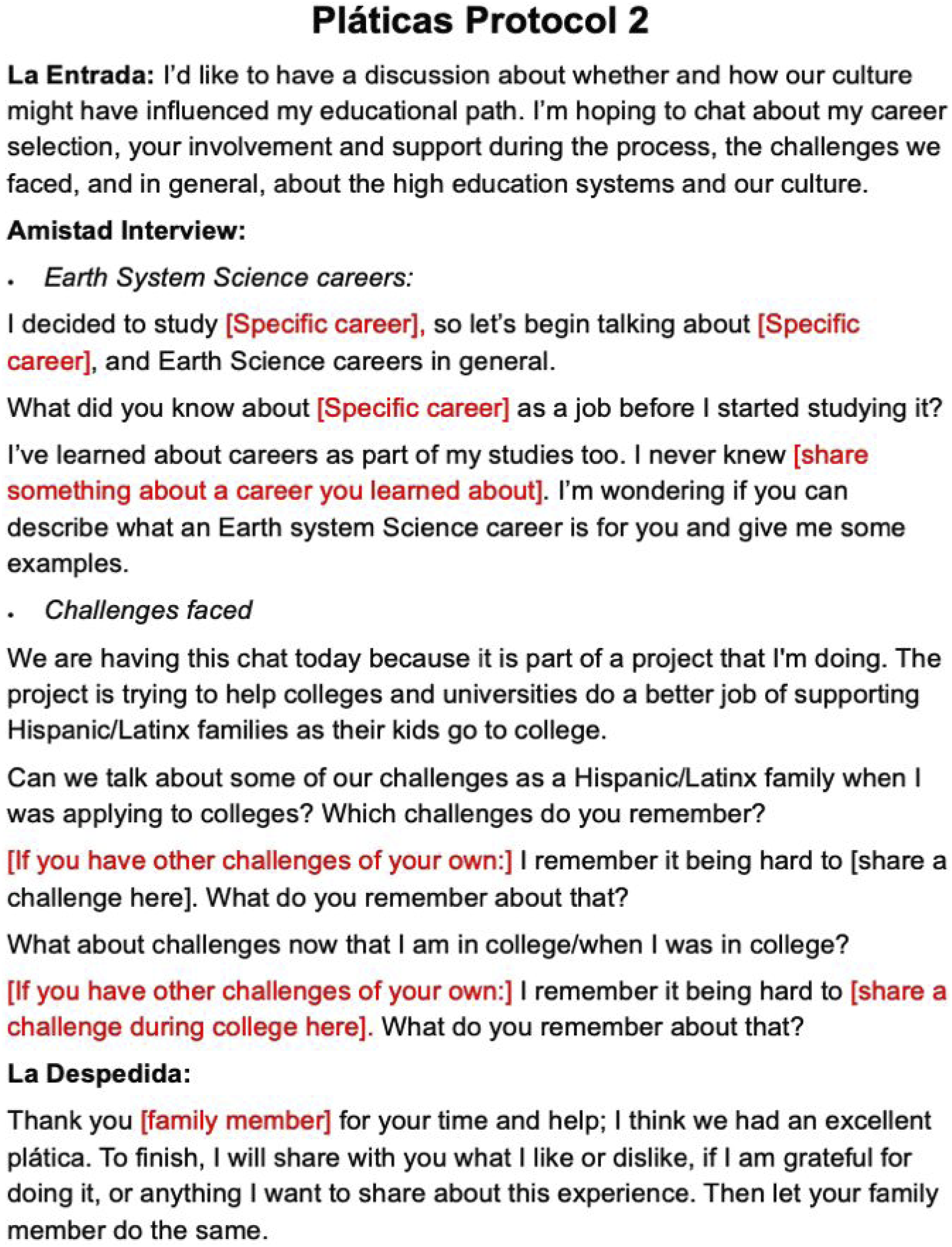
Protocols 1 and 2 were tested with two Hispanic students; we asked them to have a plática with their family members and audio record it. Afterward, both students had a discussion with me about their experience with the protocol. Both participants agreed that pláticas were more efficient, personal, and successful than the traditional interviews. I also asked them which protocol was easier for them, which one they felt more comfortable with, and which one they felt gathered more information from their family members. With the help of that conversation and by listening to the data they collected in each of their pláticas, we determined that Protocol 2 would give us better information and understanding of the problem we were studying. Protocol 2 was also the preferred format for the two students who tested it and it resulted in richer conversations. This patter is likely based on the fact that the students who led the pláticas were not part of a research group, and thus needed more guidance. Using Protocol 2, seven additional students held pláticas for this project with one or more family members. In total, eleven pláticas were analyzed. All the pláticas except one were conducted in Spanish, and the duration varied from 5 minutes to 2 hours. Protocol 1 was used for Sparking Interest to guide the pláticas because the researchers were familiar with pláticas, their methodology, and did not share the same experience with the participants.
In summary, the procedures in Protocol 1 appear to be better suited for people with more experience gathering information. This protocol might also appear to be appropriate for those with extroverted personalities. Because this protocol only includes a main question and then a checklist of the topics to discuss, the person who leads the plática should know exactly what information they want from the participants so they can integrate those topics into the plática casually.
Protocol 2, which includes questions and suggestions on how to start each part of the plática, appear to be more suited if any of the participants in the plática, both the researcher and/or the participant have few experience in gathering qualitative data collection. This protocol also appear to be more convenient if gathering information from both sides of the plática is desired. For example, during the EAGER project, we wanted to collect information about the experiences of students and their families in higher education. Protocol 2 was more appropriate because, with this one, we collected data from the students and their families simultaneously. The students led the plática by sharing their side of the story in a structured way, and asking their families about it and their experiences. Based on my experience, instances in which the data collection is focused equally on collecting information from both participants Protocol 2 appear to be a better fit.
Pláticas should not follow a strict protocol; it is a casual conversation that helps the researcher collect information about the desired topic (Fierros & Bernal, 2016). Even when a protocol has been developed for the pláticas, it might be better not to read it to the participants—it could be used as a guide or reference instead of reading it word for word. However, having a protocol in place helps to align the conversation with the research questions; because of that, the protocol is not static and can be changed depending on the plática and what the participant wants to share. Sometimes, the plática can take a shift that researchers do not expect but that could be relevant to their research. If this happens, researchers can ask follow-up questions, as long as these do not interfere with the flow of the plática. As mentioned above, to have a successful plática, researchers need to engage and connect with the participants (Murillo et al., 2021). Nonetheless, researchers need to be careful not to engage too much in the plática to make sure they do not monopolize it; researchers need to share their experiences, thoughts, and feelings, and remember that they are having the plática to gather information and, more importantly, to hear the stories of participants.
The Success of Pláticas Varies Based on Cultural Norms
According to the literature, pláticas are better for collecting data from Hispanic populations because of the “friendly, intimate and mutualist manner” to engage in a conversation and match the cultural formalities (Valle & Mendoza, 1978, p. 33). Pláticas may not work as well for other cultural groups, for example in cultures where directness and assertiveness are valued, the indirect nature of pláticas might be perceived as ambiguous or ineffective (Gopalkrishnan, 2019). I learned through my dissertation that this is true in practice. I had pláticas with both Mexican and U.S. mothers. The Mexican mothers did not need guidance; I just asked the question, and they talked for at least 1 hour. In contrast, U.S. mothers expected me to keep asking questions, like in a traditional interview. They would only speak for a few minutes, and then they waited for me to continue asking the next question, or they stopped to ask if that was what I was looking for because I remained silent, waiting for them to keep talking. Even when that happened, I got enough data from both groups to analyze. If this method is to be used with non-Hispanic participants—perhaps to compare responses or experiences—it may be necessary to include additional questions. A more detailed protocol can be helpful in guiding the conversation and making it easier for participants to engage meaningfully.
I also recommend that both participants on the pláticas have the same native language to get more detailed information and a deeper level of understanding. Even though 75% of Hispanics in the United States speak Spanish, not all individuals who identify as Hispanic do so (Mora & Lopez, 2023). It is important to avoid making assumptions about their language. Listening first or including a question at the beginning of the protocol about language preference for the plática can help ensure respectful and appropriate communication.
In all the projects I have worked on, all the Hispanic participants have chosen to speak Spanish. However, this is not a general rule. According to Ewens et al. (2016), participants provided more detailed information when they spoke in their native language compared to when using a non-native language or an interpreter. I witnessed this with the difference in the duration of my pláticas during my dissertation: the pláticas with Mexican mothers, with whom I share the same first language, were more extensive (between 60 and 90 minutes) than those pláticas with U.S. mothers (between 20 and 40 minutes).
Location May Influence the Outcome
Pláticas should be a safe space to relate with the participants and share things in common to establish connection (Fierros & Bernal, 2016). Dressing appropriately is a key aspect of creating this safe space. For instance, blending in rather than standing out as an academic may be helpful. When collecting data at a festival or public event, dressing in a way that reflects participation in the event—rather than formal work attire—can help build rapport and relatability with participants. This approach supports a professional yet approachable presence. Visiting participants in their own spaces, rather than asking them to come elsewhere, can also foster trust (Tang & Santos, 2017). Finding common topics to spark a plática—such as commenting on the event—can create a relaxed atmosphere and encourage people to engage more openly in conversation (Fierros & Bernal, 2016).
Before approaching a participant, it might be a good idea to make sure they are not near any authority figures or individuals in positions of power who could make them feel hesitant to speak openly. In the Sparking Interest project, people may not have been able to speak their minds fully because the leaders of the organizations were too close by, which may have affect what they shared (Ploran et al., 2018). Another consideration is to have one plática at a time and away from other participants; if the participants hear each other, peer pressure or the opportunity to provide fully independent and authentic responses could influence their answers and experiences (Lu & Brown, 2023; Padilla‐Walker & Bean, 2008). This last recommendation could be challenging when data collection is planned in small or confined spaces. For Sparking Interest, we needed to conduct pláticas on a bus, where even with our best efforts, the participants could hear one another, which we noticed in the results led to some participants sharing similar answers or experiences using the same words that had been used before. To minimize peer pressure, the researchers tried to approach people in random order and approached those who were awake. However, it might be helpful to try speaking with each participant individually, as this can allow to better understand their personal experiences and perspectives. Taking this focused approach can support the collection of more accurate and balanced data.
The pláticas can be done in-person or online depending on the availability of the participants. For the EAGER project, some participants’ families were not in the country, so they needed to have the plática over the phone or online. This did not change the interaction and engagement in the pláticas, because they knew and trusted each other (Zhang et al., 2023; Zhang & Jiang, 2018). For the Sparking Interest project, all the pláticas were in person, at the beginning and at the end of a shared experience. We traveled on the bus with them and had the same experience at the NASA open house event, which allowed us to establish a deeper connection with the participants than if we had only had the pláticas with them days after the event (Cheong et al., 2023). For my dissertation, I did the pláticas online. I did not know the mothers before the plática, but I had already found something we had in common: we were all mothers and cared about the environment. Using this information in la entrada, I started talking about motherhood, making jokes about it, and asking about their family. This allowed me to establish rapport and familiarity with the participants. Although I recommended doing the plática in person when possible, pláticas can be done in both formats (in-person and online). Establishing a connection online generally takes longer without the nonverbal cues provided by in-person contact, especially when there is no prior relationship (Mendonça, 2020).
The Timing of the Plática is Vital
Pláticas in Hispanic culture often occur spontaneously and in any setting. For this reason, it is important to be prepared to engage with participants at any moment” (Fierros & Bernal, 2016). For the Sparking Interest project, we attended a kermes (a street party) that one of the partners organized. The goal of that data collection was to learn more about the necessities and preferences of the community in participating in STEM activities. Whole families attended the kermes, most of them with small children, which made it hard for the parents to have a long plática with us. When we realized that, we decided to integrate ourselves into their activities instead of asking them to stop their activities and talk to us. We started to walk with them, making the pláticas longer and more profound (Tang & Santos, 2017). Based on experience, it is important to engage with participants at a moment when they are able to focus. For instance, if they are watching their children, it may be more effective to walk alongside them and integrate into their routine rather than seeking their full, undivided attention.
When doing the pláticas for my dissertation, I made a mistake in my first two pláticas; I booked them too close to each other. I booked the pláticas 1 hour apart, which I believed would give me enough time, but I did not anticipate that my first participant would be so passionate about it that we talked for 2 hours. I needed to interrupt the first participant to call the second one to see if we could reschedule the plática. Luckily, she was available later, so I could keep talking with the first one. This experience offered a valuable lesson: it is impossible to predict how much a participant will share, and it is best not to interrupt them. It may be helpful to keep the schedule open, allowing at least 2 hours before the next appointment or meeting.
Data Recording Will Vary Based in the Format of the Plática
One critical aspect of leading a plática is that the facilitator must understand what a plática is, why it was chosen as a method for data collection, and its specific purpose within the research context. These questions should be clearly answered before the plática begins. If data collection is being carried out by others, it is essential that the entire team has a thorough understanding of both the concept and the process.
It is important to plan in advance how data will be stored and determine what is appropriate for each occasion. For example, for the EAGER project, most participants were not in the same country as their families, so it was easy to ask them to record the online meeting so we could analyze it. For the Sparking Interest project, one data collection was done during a kermes, and after each plática, we moved away from the attendees and made voice notes. However, another data collection point was during a bus ride, and it did not feel appropriate to record our observations if the participants could hear us. In that case, we decided to take written notes after each plática. Each plática is unique, so considering all these aspects beforehand can help guide the conversations smoothly and naturally.
After following these steps, one should be well-prepared to begin. However, it is important to remember that each project and participant is unique. Therefore, remaining open to unexpected changes is crucial. Embracing these changes can guide the research in new and exciting directions that may not have been initially considered.
Conclusion
In my experience, pláticas are an excellent option for collecting information from Hispanic populations. Just as with all data collection methods, pláticas are not be suitable for every research project, evaluation, or participant (Flores Carmona et al., 2021). For example, if the researcher is not ready to share their own vulnerability, emotions, and reflections, then this method will not be a good fit. Similarly, based on my experience, this method is only likely to be successful when done with participants who have pláticas as a cultural norm. I suspect the method would work equally well with those from other cultures who have similar storytelling norms, though we did not test this assumption in our work. In the three projects I shared in this paper, pláticas were a good choice for research and evaluation projects that spanned different settings, different kinds of participants and pláticas collectors, and different research questions. Pláticas have been used in different studies, such as examining the cultural advantages of premedical Latinx students in their undergraduate years (García, 2024), understanding how math is not disconnected from everyday Latinx cultural knowledge and practices (Zuniga-Ruiz & Gutiérrez, 2023), or developing local economy (Ely-Ledesma, 2022).
Pláticas offer distinct advantages over traditional interviews for this specific population (Fierros & Bernal, 2016). They provide a non-academic environment, allow communication in the participants’ preferred language, and because they lack a strict protocol, participants can co-create and co-produce knowledge relevant to their research (Garcia & Mireles-Rios, 2019). The practical guidance shared here suggests that the success of pláticas varies based on cultural norms, the location may influence the outcome, the timing of the plática and the type of protocol are vital, and that the data recording will vary based in the format of the plática. If this methodology aligns with the research context, it is recommended to consider the insights and experiences shared here to guide the rewarding journey of pláticas.
Footnotes
Acknowledgements
I would like to express my heartfelt gratitude to the projects that supported my research, including the Sparking Interest and EAGER projects. I am especially thankful to my mentors, Dr. K. C. Busch and Dr. Karen Peterman, for their invaluable guidance and encouragement throughout this journey. I would also like to thank Max Cawley, Director of Climate Research and Engagement at the Museum of Life and Science for his trust in this project. Additionally, I extend my sincere thanks to the participants of the pláticas, whose openness and willingness to share their experiences made this research possible.
Ethical Approval
The N.C. State Institutional Review Board (IRB) approved a research protocol, which is 26158. However, this IRB only included the data collected for the dissertation. The second set of data were collected as part of a project evaluation. Project evaluation is not considered to be human subjects research and thus does not require an ethics committee review. The Catalyst Consulting Group team conducts a wide range of evaluation and social science research. All members of the Catalyst Consulting Group team are CITI certified and we follow the ethics and human subject requirements set forth in the social sciences certification courses for all of our work.
Funding
The authors disclosed receipt of the following financial support for the research, authorship, and/or publication of this article: This work was supported by the NASA Award #: 80NSSC22M0100.
Declaration of Conflicting Interests
The authors declared no potential conflicts of interest with respect to the research, authorship, and/or publication of this article.
Data Availability Statement
Data sharing is not applicable to this article as no new data were created or analyzed in this study.