




Abstract
In the field of tourism, where quantitative methods are widely preferred as an interdisciplinary science, it is common for qualitative research to be handled with quantitative research designs and approaches. This situation raises questions about the quality of the studies. This study aims to determine the level of attention paid to the points that should be considered in the reporting of qualitative research in the field of tourism. In this context, the systematic review approach, which enables the systematic evaluation of the information available in the literature on a subject, was adopted. Accordingly, the COREQ checklist, one of the reporting criteria for the evaluation of qualitative research, was used. Within the scope of the research, 75 studies published in journals indexed in the TR Index in 2023 in the field of tourism were evaluated. A Custom GPT based on GPT-4o was created for the evaluation of the studies according to the COREQ checklist. As a result of the study, it was determined that the information based on the COREQ criteria was not sufficient in the studies examined, and the studies were inadequate, especially in terms of method and theory.
Background
Qualitative research is defined as research in which qualitative methods such as observation, interview, and content analysis are adopted. It provides a qualitative approach to reveal the perceptions and situations of the participants in a realistic and comprehensive manner, without intervention (Yıldırım, 1999). Aspers and Corte (2019), on the other hand, define qualitative research as a repetitive process that leads to a clearer understanding of science by identifying new and meaningful differences compared to other phenomena.
The aim of qualitative research is to determine how a socio-cultural activity or reality is conducted. In other words, it can be described as an investigation into behaviors and phenomena. Qualitative researchers accept that human behavior is systematic, even in their daily movements. Researchers consider the functioning of people’s behaviors and try to analyze these behaviors. The main purpose of qualitative research is to understand how behaviors and events occur (Tetnowski & Damico, 2001).
Qualitative research, which has been used in the field of social sciences for many years (Tong et al., 2007), is seen as a unique (Denzin & Lincoln, 1994) and valuable field that does not privilege any method (Ertugay, 2019). Over time, qualitative research has increasingly been preferred over quantitative research. The preference for qualitative research over quantitative research is due to its ability to observe the phenomena and events that are the subject of the research in their natural environments and to examine the reactions of other people to these phenomena or events (Dey, 1993). Thus, qualitative research can provide real data, which can positively affect the reliability of the research. Another reason for the preference for qualitative research is the researcher’s ability to conduct in-depth investigations. During the research process, the researcher includes their subjectivity in the process and produces new information by revealing the information hidden under the truth (Storey, 2007). In addition, qualitative research can examine phenomena and events in their natural environment; that is, in qualitative research, researchers do not intervene in the research. This feature allows the researcher to examine the subject under study in a realistic way. While conducting qualitative research, the researcher can also act as a participant. In this respect, the researcher can reach a conclusion about the data obtained by looking through the eyes of the participants to whom qualitative research methods are applied (Ertugay, 2019).
The researcher adopts a comprehensive approach throughout the qualitative research process. This approach stems from the necessity to examine human behaviors holistically rather than in fragmented parts, as human behaviors cannot be considered in isolation (Tanyaş, 2014). An additional critical attribute of qualitative research is its inherent flexibility. This characteristic allows the initially determined research method to be adjusted by the researcher as the study progresses. Such flexibility, based on the trajectory of the research, can enhance the study’s reliability (Ertugay, 2019).
Within the qualitative research process, the methodology is established, data are collected, and the study is meticulously reported in its entirety (Burnard, 2004). To ensure rigorous and comprehensive reporting, various checklists have been developed (Özden Attepe et al., 2022). One prominent example is the Consolidated Criteria for Reporting Qualitative Research (COREQ) checklist. The COREQ checklist is an extensive tool that offers substantial benefits to qualitative researchers during the reporting phase (Buus & Perron, 2020).
Scientific journals, which feature contemporary studies pertinent to their respective fields, have become easily accessible due to advancements in technology. These journals play a pivotal role in the advancement of science. Analyzing the studies published within these journals is equally significant as the studies themselves (Demirkol & Kutluca, 2016). With the increasing use of qualitative methods in social science research since the early 1980s, the need to establish reporting standards for qualitative research has arisen (Godinho et al., 2019). Consequently, the COREQ checklist, consisting of 32 items, was developed to assess the quality of reporting in qualitative research (Tong et al., 2007).
In this study, qualitative studies published in tourism and using the interview method were examined. The aim is to determine the characteristics of the studies using the interview method according to the qualitative research criteria outlined in the COREQ checklist and to evaluate how appropriately these studies are reported in accordance with qualitative research methodologies. Upon reviewing the literature, while tools for analyzing qualitative research have been developed, no similar study has been found within the field of tourism. This study is significant in highlighting the extent to which studies in the tourism literature are designed in alignment with qualitative research methods.
Design in Qualitative Research
Qualitative research is often undertaken when there is limited information about a particular topic, when the scope of the research is not fully defined, when the limitations of the research are not well known, and when the topic under investigation is not at a measurable level (Morse, 2003). Researchers require clear information about the subject they are investigating. In qualitative research, the study does not progress based on a predetermined design; rather, it evolves as it progresses (Sandelowski & Barroso, 2003). Researchers utilizing quantitative methods typically conduct studies based on a known phenomenon, allowing them to predict the information they will obtain as a result. In contrast, qualitative researchers may not be able to foresee the outcomes of their research. They cannot identify the phenomenon that will drive their study forward without conducting the research itself. Qualitative researchers can only anticipate the general direction in which their research will proceed (Polit & Beck, 2004).
Qualitative research is characterized by seven prominent features: it is suitable for natural environments, the researcher can participate in the research process as a participant, a holistic approach is applied, participants’ perceptions are revealed, the research design can be flexible, the inductive method is used, and qualitative data are obtained as a result (Yıldırım & Şimşek, 2016). Qualitative research is sometimes deemed “easy” by some due to the small sample sizes typically employed. However, this is a misconception. By utilizing qualitative research methods, researchers can expand the sample size and, as a result, collect a substantial amount of data (Klopper, 2008).
When employing qualitative research methods, the first step is to identify the research problem, that is, to determine which problem the research aims to address. Subsequently, data sources should be defined. Following this, it is necessary to determine and create the tool to be used for data collection (Yıldırım & Şimşek, 2016). For instance, if the interview method is chosen, an interview form can be created. Data are then collected and reported using the specified tool. The data obtained from the sample are analyzed in depth. Finally, the collected data are interpreted, and the research is considered complete (Maxwell, 1996).
Four research designs can be employed in qualitative research: phenomenology, grounded theory, case study, and action research. Phenomenology is a technique that begins with the individual or the individual’s experiences, striving to set aside long-standing assumptions, prejudices, and facts (Wallace & Wolf, 2004). Phenomenology examines events as they are reported without questioning them. The aim of applying a phenomenological design is to understand the fundamental experiences of individuals who encounter the phenomenon and their reactions to it. In phenomenological research design, attention is focused on a specific concept or phenomenon. Studies utilizing this design generally employ the interview method (Creswell & Creswell, 2018).
Grounded theory, also known as theory building or “sub-theory,” was pioneered by Glaser and Strauss (1998). It is recognized as a technique for discovering new issues and facts based on systematically obtained and reported data. This design focuses primarily on identifying the main problem within a particular field. Secondly, it emphasizes the categorization and categorical characteristics of specific events (Wagner et al., 2010). Grounded theory is implemented in two stages: data collection and data analysis. Various data collection methods can be employed during the data collection stage, including the analysis of interviews and diaries. The data obtained in grounded theory are categorized into three types: “field notes,” data collected from interviews, and the researcher’s personal notes (Khan, 2014). Grounded theory encompasses two study methods: the systematic approach proposed by Strauss and Corbin and the constructivist approach proposed by Charmaz (Strauss, 1987). In the systematic approach, the researcher categorizes the interviews, with each category representing an accumulation of knowledge. The researcher observes and collects information during the interview process. Finally, the researcher combines observations with the data obtained from the interviews to establish a clear category (Ilgar & Ilgar, 2013). In the constructivist approach, in addition to the systematic approach, there is greater flexibility, and the researcher develops a theory based on their own observations. This approach employs a variety of information gathering and coding methods (Charmaz, 2006).
A case study, or case study research design, is commonly employed in the social sciences. It is defined as a study that aims to generalize findings to several units related to a person, community, or organization (Gerring, 2004). More precisely, a case study involves the researcher examining a complex topic or broad issue and narrowing it down to a manageable research question (Heale & Twycross, 2018). As inferred from these definitions, the most prominent feature of a case study is the detailed evaluation of one or more situations (Yıldırım & Şimşek, 2016). In conducting a case study, the researcher may utilize various sources of data, including documents, archival records, interviews, direct observation, participant observation, and physical artifacts (technological devices, artifacts, etc.) (Yin, 2003).
Action research is defined as a type of research undertaken to improve the fluency and accuracy of the participants’ own practices, their perceptions of these practices, and the contexts in which these practices are applied (Carr & Kemmis, 1986). The primary characteristic of action research is the sudden occurrence of a problem. In this method, the researcher needs to understand the problem and find a solution to it. Another key feature is the immediate implementation of the obtained data (Köklü, 2019). Action research necessitates problem diagnosis and action intervention (Avison et al., 1999). In action research, the individuals from whom the researcher collects data are considered partners in the research (Başarır, 2019).
In qualitative research, three data collection methods can be employed: interviews, observation (ethnography), and document analysis. The interview method involves collecting data through conversations to gather information from participants (Mack et al., 2005). This method is also referred to as the interview method. The key element in the interview method is the presence of at least two people. During the interview, the researcher can examine the participants’ perspectives and responses, including their facial expressions. To ensure that the interview method is effective, it is crucial for the researcher to have a pre-prepared interview form to prevent deviation from the research objectives (Patton, 1987). Several stages can be utilized when preparing the interview form and evaluating the data (Groves et al., 2011). In the process of creating an interview form, it is essential to first review the literature on the subject and consult experts to ensure that the interview questions align with the research objectives (Myers, 2013). Before administering the interview form to all participants, a pilot study should be conducted. A pilot study should be conducted before applying the interview form on all participants. In the piloting phase, deficiencies and problems related to the interview items can be eliminated (Dömbekci & Erişen, 2022).
By employing the observation method, the researcher can access data firsthand. This method is utilized to determine and analyze a behavior occurring in any environment in detail (Bailey, 1982). In the observation method, the researcher selects the environment in which the study will be conducted. By using this method, the researcher can observe people’s behaviors in their natural settings. In this context, the researcher refrains from intervening in any behavior while observing. Intervening in the research process may lead to the observation of artificial behaviors, which do not reflect reality, and therefore, the results of the research may be misleading. The researcher can prepare an observation form prior to conducting observations. This approach enables the researcher to examine human behavior more holistically rather than in isolation (Yıldırım & Şimşek, 2016).
Content analysis is defined as a technique that investigates a social phenomenon by making inferences about the characteristics of unwritten documents based on the characteristics of written documents of the phenomenon (Gökçe, 1994). According to another definition, content analysis is a methodological tool and method that aims to extract meaning from words, verbal or written documents according to predetermined, objective, systematic, and deductive criteria that investigate a social phenomenon (Tavşancıl & Aslan, 2001). By utilizing the content analysis technique, the contents of documents, records, and themes can be analyzed objectively (Metin & Ünal, 2022). In content analysis, it is essential to apply the principles of the method to derive consistent and generalizable results from the data, to make sense of, and to interpret the obtained information (Gökçe, 2006). These principles include objectivity, systematicity, and generality. Objectivity relates to the clear articulation of each stage of the research, ensuring that other researchers following the same process can reach the same conclusions. Systematicity involves applying specific rules for including or excluding analyzed content within certain categories (Holsti, 1969). Generality pertains to the association of categorized documents with a broader theory (Hepkul, 2002). When applying this method, the research problem is first identified, and the content is determined accordingly. In quantitative research, hypotheses are established, and the research question is defined (Creswell & Creswell, 2018).
Analysis and Reporting in Qualitative Research
Analyzing qualitative research involves the process of reviewing and interpreting data to describe the phenomena or cultures under study (Tesch, 2013). When analyzing qualitative data, it is essential to maintain rigor and transparency, regardless of the specific analysis method employed (Fossey et al., 2002). Inadequate design and reporting of studies can lead to misrepresentation of results in subsequent research (Tong et al., 2007).
The quality of qualitative studies is largely dependent on how the study is reported. Optimal reporting is crucial for the comprehensive evaluation and accurate presentation of qualitative studies. Such reporting aids editors, reviewers, and other researchers in critically assessing and synthesizing qualitative research findings (Özden Attepe et al., 2022). For more effective analysis, it is important to adhere to clear reporting criteria (O’Brien et al., 2014).
Reporting Standards and COREQ
In qualitative research, checklists have been developed to assist researchers in selecting appropriate data collection techniques and in accurately reporting their findings (von Elm et al., 2007). Most checklists used in qualitative research share four common objectives: to enable meticulous reporting by researchers, to facilitate comprehensive analysis, to aid those who access the research in evaluating the methodology employed, and to assist in assessing the comprehensiveness of the research (Buus & Perron, 2020).
One of the prominent checklists used in qualitative research is the COREQ (Consolidated Criteria for Reporting Qualitative Research) checklist, which was developed under the categories of research team and reflexivity, research design and analysis, and findings. The COREQ checklist was created in response to the lack of clear reporting standards in the analysis and reporting of qualitative research. It specifically focuses on the analysis of studies utilizing interview and focus group techniques. The COREQ checklist serves as a valuable tool for researchers in analyzing their studies (Tong et al., 2007). Moreover, it is designed to encourage clear and holistic analysis of interview and focus group research, thereby indirectly enhancing the rigor, integrity, and reliability of such studies (Buus & Perron, 2020). Subsequently, the ENTREQ (Enhancing Transparency in Reporting the Synthesis of Qualitative Research) checklist was developed with a similar approach to the COREQ checklist. This checklist comprises 21 items organized under the categories of introduction, methods and methodology, literature review, and the evaluation and synthesis of findings (Tong et al., 2012).
Another widely used checklist in the social sciences is the “Standards for Reporting Qualitative Research (SRQR)” created by O’Brien et al. (2014). The SRQR checklist contains 21 criteria and is a comprehensive tool that encompasses all techniques applicable to qualitative research (Tekindal et al., 2021).
All checklists in the literature show the importance of accurate reporting of research. Given the importance of accurate reporting, researchers have begun exploring advanced tools to assist in qualitative analysis. One such innovation is the use of Artificial Intelligence to enhance qualitative research rigor.
Using Artificial Intelligence in Qualitative Research
Intelligence, in its simplest definition, involves perceiving stimuli from the environment, translating them into information, and utilizing that information. Intelligence is not static and has the capacity for renewal and adaptation (Legg & Hutter, 2007). The concept of artificial intelligence (AI) was introduced by John McCarthy in 1956. Artificial intelligence is defined as the science and engineering of creating intelligent mechanisms, particularly intelligent computer programs, that mimic human-like behaviors (McCarthy, 2007). Based on this definition, AI can be understood as a computer’s ability to exhibit human-like behaviors, such as problem-solving or reasoning.
Due to its capacity for automated reasoning, many researchers have increasingly utilized artificial intelligence for scientific purposes (McCorduck, 2004). However, in the early years of AI’s development, it struggled to provide logical solutions to complex problems, leading to a decline in its popularity. In the 1980s, AI regained prominence as research institutions and universities developed a type of AI system that integrated the knowledge of experts. These systems, known as “expert systems,” marked a significant advancement in the field (McCarthy, 2007). In 2006, Hinton and Salakhutdinov (2006) advanced the field of AI by linking it to education.
Through its continuous development over the years, artificial intelligence has achieved significant milestones in various domains, including social sciences, medicine, and mathematics, and has continued to demonstrate its value in scientific research. Artificial intelligence aims to equip computers with the ability to interpret information, engage in cognitive processes, and make decisions. The underlying infrastructure of AI encompasses the abilities to perceive, store, and learn from data (Xu et al., 2021). Owing to these capabilities, AI plays a critical role at every stage of the scientific process. For instance, it aids scientists by saving time in hypothesis formulation, data collection, and rapid inference-making. AI’s ability to extract new insights from existing literature, produce clear scientific papers, and provide profound insights into AI itself can be invaluable to researchers (Ghosh, 2023). On the other hand, there is concern among scientists that AI might replace their roles. However, as human knowledge expands, curiosity and the quest for understanding continue to grow. Regardless of the results produced by AI, the human pursuit of knowledge remains relentless. From this perspective, AI should not be viewed as a competitor to scientists, but rather as an assistant that enhances their work (Ghosh et al., 2021). Artificial intelligence has found widespread application in science, particularly in supervised learning and anomaly detection. In supervised learning, AI is trained by being taught data patterns, enabling it to make predictions or inferences about data it has not previously encountered. In anomaly detection, AI is capable of identifying abnormal objects or patterns that deviate from the norm (Ghosh, 2023). AI is a highly preferred platform due to its ability to reach ethical conclusions, as it operates in an unbiased, fair, and impartial manner. It can be asserted that AI is a crucial supportive tool for researchers, as it helps to minimize researcher bias in scientific studies and enhances efficiency in data analysis (Jalali & Akhavan, 2024). Additionally, AI can integrate with the Internet of Things (IoT). Through this integration, AI-powered tools used in fields such as agriculture and environmental science can collect and analyze data via sensors, providing real-time results. Moreover, employing AI-powered tools in hazardous environments can help safeguard scientists from potential dangers (Data Science, 2024).
AI is a valuable tool for qualitative research (Longo, 2020). It can generate theoretical arguments and analyze a vast array of information (Borges et al., 2021). Specifically, AI-powered tools with speech recognition algorithms can significantly ease the workload of qualitative researchers by transcribing qualitative data, such as interviews, into text from recorded voices. In qualitative research, data collected in the field is typically noted and transcribed. AI-supported tools can expedite processes such as recording and editing data, allowing researchers to complete these tasks in a shorter time. Once data collection is completed, researchers move on to the analysis phase. At this stage, AI can offer substantial benefits (Verma et al., 2021). While researchers can perform the analysis themselves, this can be time-consuming. AI can categorize data into themes and categories (Pallathadka et al., 2023). Additionally, AI can visualize categorized data, for instance, by creating word clouds and theme maps based on the identified themes. Visualizing data in this way can enhance the reader’s understanding of the research findings (Christou, 2023).
Theoretical Foundation
To ground the study in theory, we discuss the concept of augmented intelligence as a guiding framework. This perspective views AI as a collaborative partner that extends human capabilities in scientific research processes rather than replacing them (Rouse & Spohrer, 2018). In qualitative research, this aligns with Lincoln and Guba’s notion of confirmability, where tools are used to minimize individual bias and enhance the neutrality of analysis (Lincoln & Guba, 1985).
By using AI to apply the COREQ criteria, we are working to make our review process more rigorous in line with generally recognized principles of reliability and transparency in qualitative research. Ghosh et al. (2021) emphasize that AI should be seen as an assistant that enhances scientific work. Likewise, Jalali and Akhavan (2024) note that AI’s unbiased, systematic processing can support the objectivity of qualitative analysis. By placing our approach within this theoretical framework, we can show more clearly how AI contributes to building theories and generating new knowledge. Notably, recent work by Christou (2023) provides a conceptual map of the nexus between AI and theory development, underlining that AI can help in developing and refining theoretical insights in qualitative research. Based on this emerging perspective, our findings are contextualized within the broader literature on AI-assisted qualitative research. In summary, the use of Custom GPT is not only a technical choice but is theoretically supported by the idea that human–AI collaboration can improve the quality and depth of qualitative research findings. This theoretical foundation creates a link between our study and existing research, showing how AI can both support and enhance qualitative research standards.
Methods
This study, which aims to assess the level of attention given to the reporting standards in qualitative research within the field of tourism, adopts the systematic review approach and meta-analysis. While a systematic review provides a comprehensive review of research, meta-analysis allows for a quantitative analysis of the findings of these studies (Glass, 1976; Siddaway et al., 2019). A systematic review involves the systematic collection and evaluation of existing literature on a particular topic or phenomenon. During the systematic review process, studies on the specified topic are aggregated and analyzed using statistical methods, such as meta-analysis, leading to general conclusions (Taylor & Wallace, 2007). This approach exemplifies how qualitative and quantitative research methods can complement each other (Yin, 2015). Additionally, the meta-analysis method offers an opportunity for comprehensive evaluation by synthesizing studies within a specific field. Meta-analysis reveals general trends and conclusions by combining and statistically reanalyzing data from the existing literature (Borenstein et al., 2009). In the field of tourism, meta-analyses enable the comparison of different research findings, leading to more reliable generalizations (Hunter & Schmidt, 2004). For this study, the case study design, a qualitative research design, was adopted.
In the field of tourism, which is distinguished as an interdisciplinary discipline where quantitative methods are generally preferred, it is common for qualitative research methods to be approached using quantitative research designs and frameworks. This practice often leads to questions regarding the rigor and validity of such studies. To address this issue, the COREQ checklist was employed to provide a general profile of qualitative research in the field of tourism and to assess the extent to which qualitative research designs are correctly applied.
There are various reporting criteria available for the evaluation of qualitative research (Burns, 1989; Lincoln, 1995; Tracy, 2010). The COREQ checklist specifically includes reporting criteria developed for use in interview and focus group studies. It addresses key aspects of qualitative studies from a design perspective, offering a structured approach to reporting on the research team, study methods, scope of the study, findings, analysis, and interpretations (Tong et al., 2007). The COREQ checklist comprises 32 items and is commonly used in the health sciences, organized under three sub-headings: research team and reflexivity, research design and analysis, and findings (Özden Attepe et al., 2022).
Within the scope of this research, nine tourism journals indexed in the TR Index in 2023 were reviewed. First, we identified all relevant studies through a comprehensive search of academic outlets. Rather than using ad-hoc sampling, we systematically screened nine tourism journals indexed in the TR Index for the year 2023. The TR Index is a national index of high-quality journals in Turkiye, so focusing on these outlets ensured we captured a broad and reputable sample of tourism research. We included all studies published in 2023 that employed qualitative methods using interviews, resulting in a final sample of 75 studies. Key inclusion criteria were: (1) the study is in the field of tourism, (2) it uses a qualitative approach (specifically interview-based, in line with COREQ’s scope), and (3) it was published in a TR Index journal in 2023. Studies not meeting these criteria (e.g., purely quantitative studies or those outside the year/journal scope) were excluded. This transparent selection process increases the reliability of our review by making it reproducible and ensuring that the sample represents the current state of qualitative tourism research in leading national journals. By covering an entire year across multiple journals, our sample provides a solid basis for generalizing trends within the context of Turkish tourism literature. We also enhanced the reliability of data extraction and analysis through a rigorous protocol. All 75 studies were independently reviewed using the COREQ checklist as the guiding framework. We create an Custom GPT using GPT-4o on ChatGPT to standardize the evaluation of each article against the 32 COREQ items. The following instructions were entered when creating this Custom GPT: (1) You evaluate the academic articles uploaded by the user according to the given checklist. (2) A file containing the checklist has been uploaded to you. (3) You will use the statements in this file. (4) You analyse the 32 check items one by one and indicate in a table whether each item is appropriate or not. (5) If an item is missing, you indicate the missing points.
Before full analysis, a pilot test was conducted. Ten studies were coded manually by the researchers and then analyzed by the Custom GPT to compare results. This cross-validation showed a high agreement, with AI’s identifications of reported items matching the human coders’ assessments in nearly all instances (minor interpretative differences did not affect overall outcomes). Based on this, we proceeded with AI-assisted coding for all studies, confident in its accuracy. Throughout this process, we reduced potential ambiguities by carefully guiding the Custom GPT by entering prompts. We uploaded the articles in groups of three as we received errors when we uploaded all articles at the same time. Furthermore, two authors oversaw the coding outputs to resolve any doubtful cases, adding a layer of human verification to the AI analysis. By detailing this systematic approach and validation step, we improve the study’s methodological transparency. This level of detail not only strengthens the reliability of our findings but also aids generalizability. Other researchers can replicate our search strategy and AI-assisted analysis in different contexts (e.g., other disciplines or time frames) to verify and build upon our results.
Findings
Reporting of Items of the COREQ Criteria

Table 1 illustrates the assessment outcomes for each COREQ items: Research Team and Reflexivity, Study Design, Analysis and Findings.
Research Team and Reflexivity
“Research Team and Reflexivity” section of the COREQ checklist comprises two main components: the personal characteristics of the researchers and their relationship with the participants. In this section, the reporting rate for criteria related to the personal characteristics of the researchers is notably high, whereas the reporting rate for criteria related to the relationship with the participants is considerably low. Sorted heatmaps for the Research Team and Reflexivity section are shown in Figure 1. Research Team and Reflexivity Sorted Heatmaps
For instance, within the criteria pertaining to the personal characteristics of the researchers, 57 studies reported who conducted the interviews, while 18 studies did not provide this information. The academic degrees or professional titles of the researchers were reported in 74 studies. In cases where more than one researcher was involved, the criterion was considered met even if only one researcher’s title was specified. The occupations of the researchers were clearly stated in all studies. The gender of the researchers was mentioned in 69 studies, whereas it was not reported in 6 studies. The experience and training of the researchers were mentioned in only 3 studies, while 72 studies did not include this information.
Regarding the relationship with the participants, only three studies provided information on whether the participants were contacted prior to the study. Furthermore, only two studies reported whether the participants had any information about the interviewers. Information regarding the characteristics of the interviewers was not included in any of the studies.
Study Design
The “Study Design” section of the COREQ checklist encompasses the theoretical framework, selection of participants, setting/site, and data collection criteria. In this section, while the theoretical framework criterion was largely unreported across the studies, most of the criteria related to the selection of participants and setting/site were adequately reported. Sorted heatmaps for the Study Design section are shown in Figure 2. Study Design Sorted Heatmaps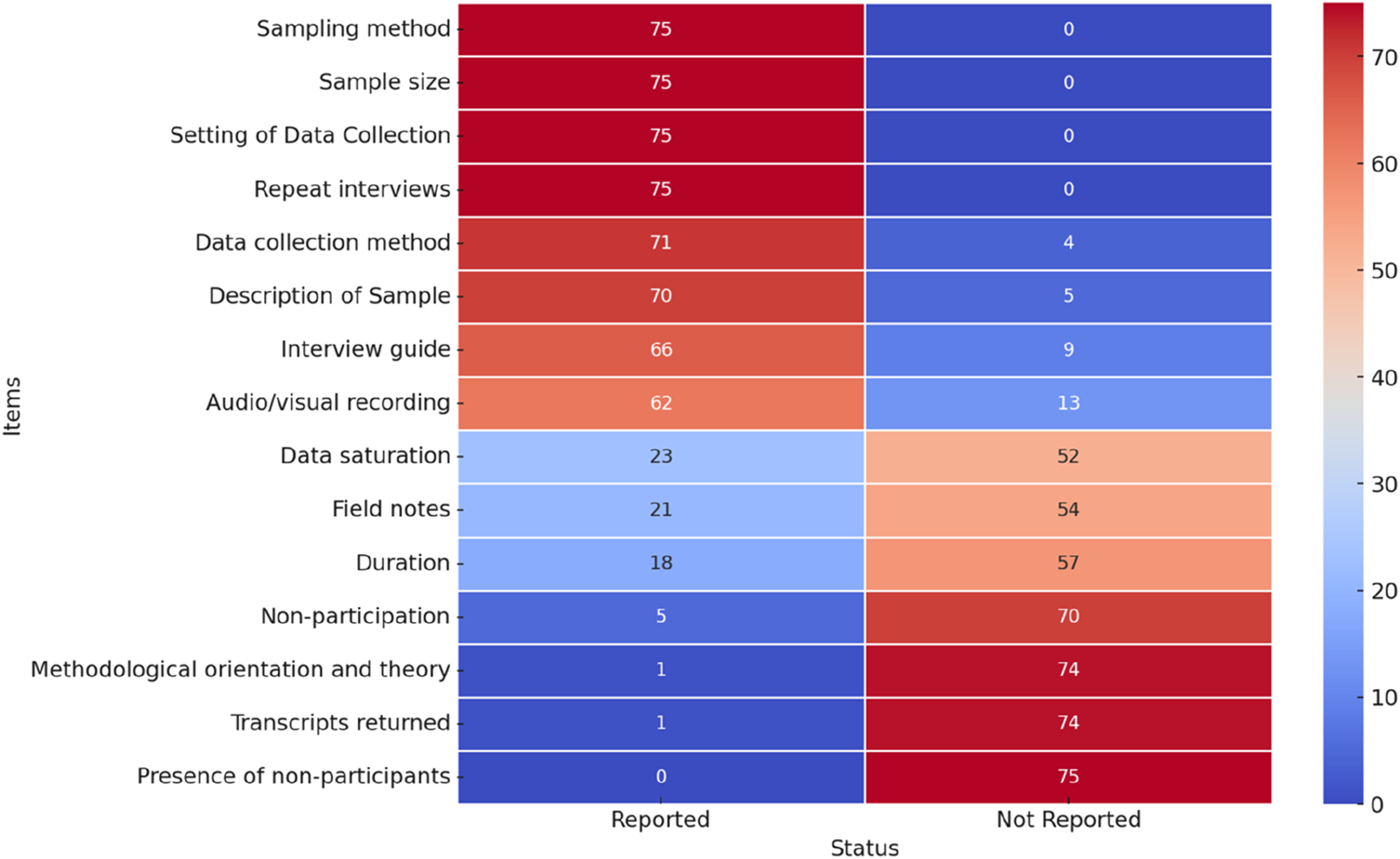
Within the data collection criteria, three were reported in the majority of studies, whereas the other three were not. Methodological orientation and theoretical knowledge were explicitly stated in only one study, suggesting that the qualitative research philosophy in the field of tourism may not be fully established. In all studies, the selection of participants and sampling methods were reported. Additionally, 71 studies clearly indicated how the participants were reached. The number of participants was specified in every study. However, information regarding participants who either refused to participate or dropped out was included in only five studies.
All studies provided information on where the data were collected, but none mentioned whether anyone other than the participants and interviewers was present during the data collection process. Details on sample characteristics, demographic data, interview dates, and timing plans were provided in 70 studies. Furthermore, whether the questions and guidelines used during the interviews were made available was reported in 66 studies. Information regarding repeated interviews was mentioned in all studies.
Information on audio and video recording was provided in 62 studies, whereas the duration of the interviews was not specified in 57 studies. Only one study reported that the transcripts of the interviews were sent back to the participants for verification. Field notes were mentioned in 21 studies, and data saturation was reported in 23 studies.
Analysis and Findings
The “Analysis and Findings” section of the COREQ checklist consists of criteria related to data analysis and reporting. While most of the criteria related to data analysis were not reported, the majority of the criteria related to reporting were adequately addressed. Sorted heatmaps for the Analysis and Findings section are shown in Figure 3. Analysis and Findings Sorted Heatmaps
Information on the number of data coders was provided in 16 studies, and explanations about the coding tree were given in 13 studies. The derivation of themes was explained in all studies. In 24 studies, the use of software for data analysis was mentioned. However, only one study reported receiving feedback from participants on the findings. Direct quotations from participants were included in 70 studies. Consistency between the data and findings was observed in all studies, and themes and sub-themes were clearly presented and discussed.
Overall, while certain criteria were fully reported in most studies, some criteria were missing or inadequately reported. These findings suggest that qualitative research in the field of tourism exhibits methodological shortcomings and requires further improvement.
Discussion
This study examines the reporting quality of qualitative research in the field of tourism by applying the COREQ (Consolidated Criteria for Reporting Qualitative Research) checklist. Moreover, conducting this evaluation through artificial intelligence represents a step toward minimizing researcher subjectivity and enhancing the efficiency of the analysis process. The findings indicate that certain aspects of qualitative research reporting in tourism remain underdeveloped, particularly with regard to the presentation of theoretical frameworks and the details surrounding the researcher–participant relationship.
Firstly, it was observed that methodological orientation and theoretical groundwork were often underreported or omitted. This finding could be interpreted as reflecting a limited internalization of qualitative methods in a research domain where quantitative approaches are traditionally predominant (McGinley et al., 2020). By its nature, qualitative research places critical importance on the researcher’s theoretical assumptions and methodological rationale, as these elements underpin the integrity of the entire study. Similar conclusions about insufficient reporting standards in qualitative studies have been noted in the literature (Godinho et al., 2019; Özden Attepe et al., 2022). Similarly, Paraizo et al. (2017) found that studies did not fully comply with the COREQ checklist, particularly noting the absence of information on data saturation. In this regard, our findings are not exclusive to tourism but rather align with a broader issue observed across multiple disciplines.
The results also suggest that researchers’ personal characteristics and their interactions with participants are largely unreported. In qualitative research, factors such as a researcher’s identity (educational background, professional experience, or specialized training relevant to the method), any pre-existing relationships, and potential interactions with participants are viewed as critical elements of reflexivity (Finlay, 2002). Reporting these elements allows for a more transparent evaluation of potential biases and the dynamics of the research process (Lincoln, 1995). Thus, the absence of such details may indicate a lack of emphasis on reflexivity in these studies.
Another important point is the low rate of reporting on certain analytical criteria, such as participant feedback, detailed coding trees, and the methods used to achieve data saturation. This finding is in line with other studies in the literature. (McGinley et al., 2020). The literature underlines that these elements enhance the credibility of qualitative studies by reinforcing internal validity and reliability (Tong et al., 2007). In particular, insufficient explanations of how data saturation was achieved may lead future researchers to overlook essential methodological details.
Our use of a Custom GPT tool powered by the GPT-4o model offered distinct advantages in terms of efficiency and systematic analysis. However, this approach comes with certain limitations and potential biases. The AI model may not fully capture nuances in the texts, such as local phrasing, cultural differences, or indirect expressions, in the same way that human researchers can. Indeed, the AI was unable to determine researchers’ genders when such details were not explicitly stated in the studies. Yet, by examining the names of researchers and their standing within the field, we were able to identify their genders more accurately than the AI. Although our comparison of human and AI-driven evaluations in 10 articles yielded largely similar results, achieving a complete match in every article proved challenging. Furthermore, relying on a single checklist (COREQ) may have excluded certain reporting standards emphasized by other frameworks (such as SRQR).
Addressing the identified shortcomings requires considerable improvements in both educational and institutional processes. It is recommended that undergraduate and graduate programs dedicate more attention to qualitative methodology training by integrating content related to reporting standards as well as reflexivity and ethical considerations into the curriculum. Such an approach aims to ensure that future researchers acquire a stronger methodological foundation and to prevent improper applications of qualitative methods within the tourism literature. At the institutional level, it would be beneficial to inform editors and reviewers about the requirements of qualitative methods, explicitly reference standards such as COREQ in journal guidelines, and develop guiding materials for authors. Furthermore, methodology workshops organized by universities could provide hands-on support to all stakeholders regarding both qualitative analysis processes and reporting quality, ultimately strengthening theoretical depth and methodological transparency in tourism scholarship.
Overall, these findings highlight the need for greater theoretical depth and methodological transparency in the design and reporting of qualitative studies in tourism. Researchers should more actively utilize checklists such as COREQ during data collection and analysis, and clearly document this usage in their articles. Additionally, providing details on researcher–participant interactions would help elucidate reflexivity, potential biases, and other methodological considerations. As AI-driven tools become more widespread, future research is poised to view such technologies not merely as “accelerators,” but also as systems that can foster consistent reporting practices aligned with the principles of qualitative inquiry.
Conclusion
This study emphasises on determining the quality criteria of qualitative studies in the field of tourism by using AI-supported tools. In line with this objective, qualitative studies published in 2023 in the journals in the field of tourism indexed in Turkish TR Index were analysed. The analysis aimed to evaluate adherence to recognized qualitative research standards, particularly using the COREQ checklist.
Key findings indicate that while qualitative research methods have been extensively adopted in fields such as education, sociology, and psychology within Turkish literature, their use in interdisciplinary areas such as tourism is still evolving. The detailed analysis of 75 qualitative studies published in 2023 revealed that although essential methodological elements such as sampling methods, participant recruitment strategies, and sample sizes were adequately reported, significant shortcomings exist. Specifically, the studies often omitted description of the coding tree from their reports, lacked comprehensive explanations of their methodological frameworks, and inadequately presented field notes.
The implications of these findings underline the necessity for researchers and journal editors in the tourism field to integrate robust qualitative research practices into their studies. Enhancing methodological rigor and transparency, such as clearly presenting interview questions and adequately explaining theoretical frameworks, can greatly improve research credibility and facilitate better comprehension and replication.
Limitations of this study include its exclusive focus on the COREQ checklist, and the narrow scope of analyzing only studies published in 2023 within the TR Index database. Additionally, the findings may not be generalizable to other years or disciplines beyond tourism.
Future research directions should include broader analyses incorporating different qualitative evaluation checklists, examining studies across extended periods, and investigating qualitative research practices in other interdisciplinary fields. Moreover, additional training and methodological workshops are recommended for tourism researchers to enhance the quality and rigor of qualitative research outputs.
Ultimately, this research underscores the critical importance of methodological transparency and rigorous qualitative research practices to advance the reliability and impact of tourism scholarship, highlighting qualitative inquiry as an essential tool in understanding complex interdisciplinary phenomena in tourism research.
Broader Implications and AI’s Role Beyond Tourism
Our study offers insights that extend beyond the tourism field. The observed deficiencies in qualitative reporting – such as scant mention of theoretical frameworks and variable reporting of procedures – may well reflect a broader pattern in qualitative research across disciplines. Previous meta-research in health and nursing sciences similarly found incomplete adherence to reporting standards, suggesting that many fields face challenges in fully implementing checklists like COREQ. Our use of AI to conduct the review also speaks to the growing influence of technology in research. The success of the Custom GPT that we created in efficiently evaluating 75 studies demonstrates how AI can handle large-scale qualitative analysis tasks that would be arduous for human reviewers. This has positive implications for future systematic reviews. As qualitative research proliferates, AI tools might help synthesize methodological trends across of studies, identifying common weaknesses (like lack of data saturation reporting) and strengths.
However, we encourage caution in deploying AI for qualitative analysis. AI lacks human researchers’ contextual understanding and ethical judgment. Over-reliance on AI could inadvertently perpetuate biases and may lead to “deskilling” of researchers in qualitative analysis techniques. It’s crucial for the academic community to view AI as a complement to, rather than a replacement for, expert human analysis. Our findings contribute to this broader conversation by illustrating both the promise and threads of AI’s influence. We show that AI can enhance the efficiency and objectivity of reviewing reporting practices, but we also highlight the need for domain experts to interpret and implement improvements based on those results. Ultimately, embracing AI in qualitative research across disciplines could lead to improved reporting standards and more rigorous studies, provided it is done thoughtfully.
We recommend that other fields conduct similar audits of their qualitative research reporting (possibly with AI support) and that scholars remain critically aware of how AI might shape research processes, interpretations, and quality outcomes in the long run. By discussing these broader implications, we extend the relevance of our study beyond tourism, positioning it within the ongoing evolution of qualitative research in the age of AI.
Limitations
We recognize several limitations of our study, especially regarding the reliance on AI for qualitative analysis. One key limitation is the potential bias or error introduced by the AI tool. While we took steps to create the Custom GPT and validate its outputs, the AI’s interpretations of article content are based on patterns in its training data and may lack the nuanced understanding a human expert brings. For example, Custom GPT might miss context or infer the presence/absence of a COREQ item incorrectly if the reporting in an article is implicit or unusually phrased. Although our manual cross-check on a subset of studies showed high agreement with the AI, subtle biases could still exist. Additionally, the absence of researcher intervention in the coding process, done intentionally to reduce human bias, means we risk losing the benefits of human reflexivity. In qualitative research, human analysts can interpret context, read “between the lines,” and question their own assumptions; an AI may not fully engage in such reflexive practice.
We also only used the COREQ checklist for evaluation, without incorporating other qualitative reporting standards. This singular focus might have missed criteria that other checklists (e.g., SRQR or ENTREQ) deem important, thereby narrowing our assessment of reporting quality. Moreover, our sample is restricted to one year (2023) and one national index, which could limit the generalizability of the findings. Practices in other years or in international journals might differ. Hence, results should be generalized beyond the immediate context with caution. We now clearly state these limitations in the discussion to refine our conclusions. The findings illustrate trends in the sampled literature, but they are not without bias or boundary conditions.
Footnotes
Acknowledgments
This paper originated as a collaborative study within the “Advanced Qualitative Methods” doctoral course at Çanakkale Onsekiz Mart University. The authors wish to thank the editor and the anonymous reviewers for their insightful feedback that helped improve the manuscript. In accordance with SAGE’s AI Policy, the authors utilized artificial intelligence tools to enhance the grammar, syntax, and overall readability of the manuscript.

Ethical Considerations
This work did not involve human or animal research participants; accordingly, no ethical approval was required for this work.
Funding
The authors received no financial support for the research, authorship, and/or publication of this article.
Declaration of Conflicting Interests
The authors declared no potential conflicts of interest with respect to the research, authorship, and/or publication of this article.