




Abstract
Quality is one of the most debated topics in the history of Qualitative Research Methods (QRM). It establishes the benchmarks, norms and values that a researcher should follow when involved in research. Quality is a critical tool for promoting value, effectiveness and efficiency in research processes. Qualitative research is popular in several disciplines such as local governance studies, sociology, education, gender studies, public management, media studies, human resource management, political science etc. The proponents of Qualitative Research (QR) believe that it has unique characteristics compared to quantitative and mixed research methods. Qualitative Research (QR) focuses on understanding lived experiences through narrative inquiry, field observations, focus study groups, and the use of digital photos. The literature on quality advocates for methodological rigor in QR. The discourse of quality in qualitative research is evolving with time and the evolving trends in technology and AI. This review explores the key characteristics of QR and the evolving trends. It provides a meta-summary of the quality benchmarks identified across the various domains of qualitative research literature. It evaluates the advantages and limitations of using Artificial Intelligence in QR. Findings from the literature revealed that there is scholarly attention on quality components: credibility, transferability, dependability, confirmability, and authenticity. The characteristics of qualitative research call for different quality standards such as trustworthiness, reflexivity, contextual sensitivity, and rigour. Overall, the findings indicate that embracing Artificial intelligence (AI) in Qualitative Research presents opportunities and threats. AI’s ability to manage large-scale and multimodal data has enhanced the collection of qualitative data. AI can produce brief summaries or spot reoccurring patterns by offering real-time insights. The authors of this paper recommend that future studies should evaluate how quality standards in QR are interpreted and implemented across different academic disciplines, cultures and contexts.
1. Introduction
The essence of quality in Qualitative Research (QR) is advocated by many scholars across various academic disciplines (Pratt, 2025; Yadav, 2022). Quality research can be defined as a systematic, ethical, and rigorous investigation that employs suitable techniques to generate legitimate, trustworthy, and credible results (Cypress, 2017; Ernest, 2020; Marquina et al., 2022). It is meticulously planned and transparently conducted, thus contributing to theoretical and practical knowledge (Evans et al., 2021; Farkhary, 2025). This study explores how “quality” in qualitative research promotes rigour and enhances the credibility of research findings.
Central to this discussion is the need to embed reliability, validity, and other trustworthiness criteria throughout the research process. Reliability (consistency) basically refers to the degree to which a research procedure yields balanced, consistent, and reproducible results under comparable circumstances (Creswell & Creswell, 2018). Validity on the other hand is a criterion used in qualitative research to assess the accuracy and credibility of the findings. It focusses on whether results appropriately reflect participants’ perceptions and is comparable to internal validity in quantitative research (Lincoln & Guba, 1985). Quality is a concept that has multiple dimensions and meanings in research, industry, and society (Charantimah, 2011; Ernest, 2020; Martin et al., 2020). It involves the entire research process including formulating the research question, gathering data, analysis, and presentation of the results. In addition, it represents a process-based perspective, continuous commitment embedded in the researcher’s actions, decisions, and reflexivity over the course of the research lifecycle rather than a static result.
QR is a method that involves primary data collection where the researcher participates in the research through field observations, administering questionnaires, conducting key informant interviews, and setting up focus group studies (Creswell & Creswell, 2023). On the other hand, QR can be carried out by reviewing literature for example through desk research, document analysis, archival research content analysis, thematic analysis, meta-synthesis, and systematic literature reviews (Morse et al., 2002; Reynolds et al., 2011; Stenfors et al., 2020).
Quality in QR is a continuous process throughout the entire value chain of research from the moment the researcher begins identifying the topic, framing the abstract, research problem, research questions, research objectives, limitations, delimitations, literature review, theoretical or conceptual framework, research methodology (Creswell & Creswell, 2023; Stenfors et al., 2020). Quality is determined by the extent to which research processes correspond to the study’s objectives and research questions. Qualitative research methodology should adhere to the principles of quality; credibility, dependability, confirmability, transferability, and authenticity (Ahmed, 2024; Lincoln & Guba, 1985; William, 2024). Rigor and quality are important in QRM as they ensure everything is done above board. Quality in QR is guaranteed by the methods and processes used by researchers whereas on the other hand, it is determined by the reception of the study by the consumers including the participants, beneficiaries and society (Morse et al., 2002; Reynolds et al., 2011; Stenfors et al., 2020).
2. The Unique Nature of Qualitative Research and Its Implications for Quality
Qualitative Research (QR) can be described as a naturalistic inquiry that deals with non-numerical data (Ahmed, 2025; Chowdhury, 2015). QR is the study of social phenomenon and lived experiences of the participants (Creswell & Creswell, 2023; Fossey et al., 2002). It is context-specific and interpretive thus it explores processes and patterns of development in a society. QR is used to explore the how and why questions, that may not be addressed using quantitative research. Data is collected using instruments such as interviews, field notes, observations, and diaries (Chowdhury, 2015; Creswell & Creswell, 2023).
The qualitative researcher is an active participant in the study but should adhere to principles of reflexivity, eliminate biases and act in the best interest of the study guided by ethical considerations of fairness, objectivity, transparency, accountability and virtue. It predominantly relies on textual data although numerical information can be used to enrich the discussion (Mortelmans, 2025). While quantitative researchers aim to identify relationships between variables and explain their possible causes, qualitative researchers seek to understand situations and events from the perspectives and lived experiences of participants (Fraenkel et al., 2012).
Quality issues in QR can be addressed in various ways, not by a single method (Fossey et al., 2002; Martin et al., 2020). It can be judged through principles such as credibility, dependability, credibility, confirmability, transferability and ethical conduct. The different forms of qualitative research are ethnography, phenomenology, narrative, grounded theory, case study, action research, discourse analysis and interpretive inquiry. Qualitative research stands out because it places more emphasis on the investigation of lived experiences, meanings, and social situations than it does on quantitative measurement (Husbands et al., 2020). It is adaptable to, changing trends and new information and perspectives emerges. Another distinguishing feature is reflexivity, which ensures transparency and authenticity by having researchers critically assess their own impact on the process (Cypress, 2017; Lincoln & Guba, 1985).
Types of Qualitative Research
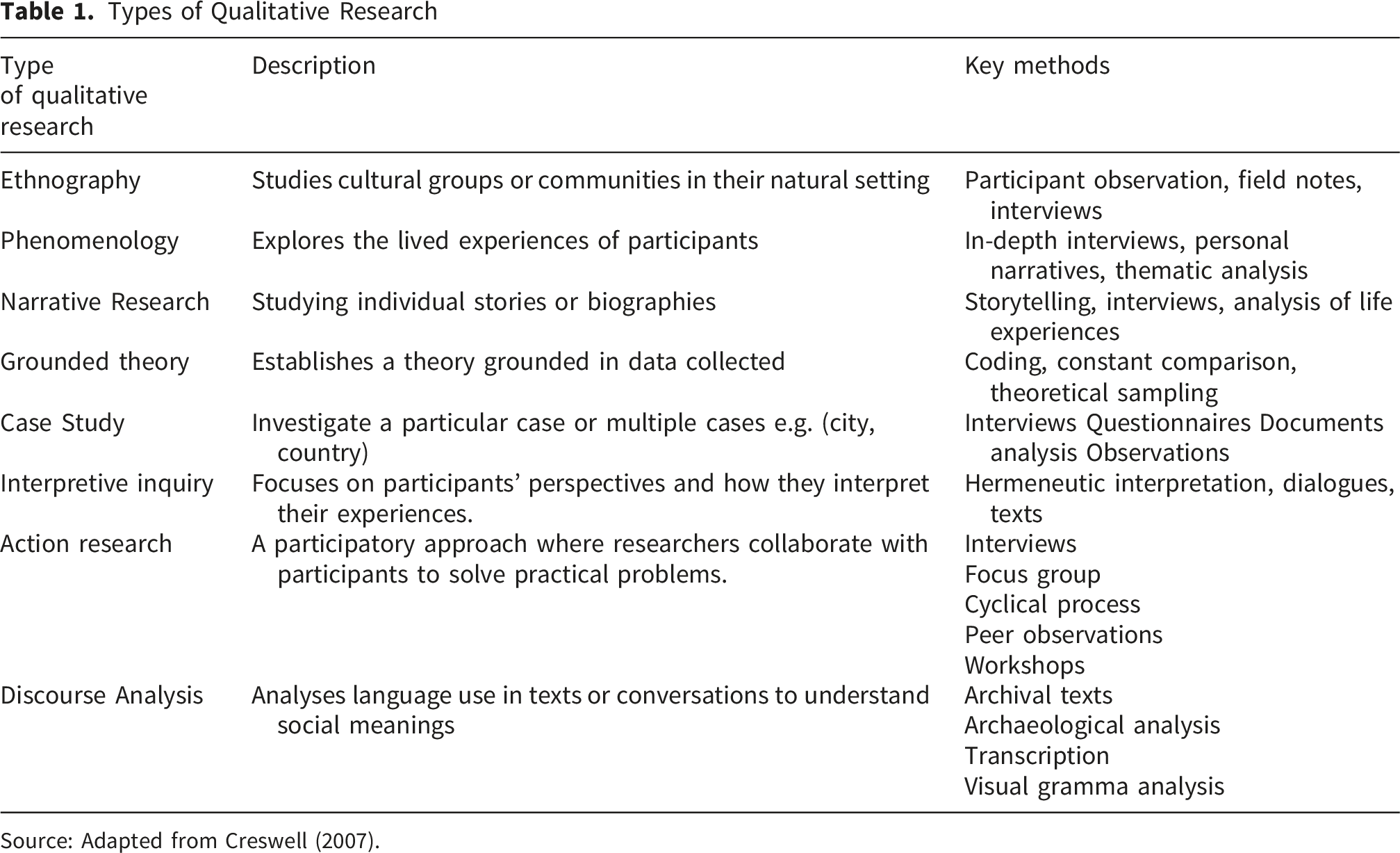
Source: Adapted from Creswell (2007).
Qualitative Research Definitions From Different Perspectives

Tools Inside and Operations Outside NVivo

Source: Adapted from Mortelmans (2025).
Ethnography entails living with and participating in the daily lives of a group to understand their meanings, customs, and social dynamics (Frechette et al., 2020). To understand how people, interpret their daily lives from an insider’s perspective, ethnography research involves extensive fieldwork, participant observation, and data collection. Phenomenology on the other hand focuses on exploring and describing the lived experiences of individuals, aiming to uncover the essence or meaning of a phenomenon as it is perceived from the first-person perspective (Frechette et al., 2020). It focuses on life experiences rather than explaining them through causes or theories. Narrative research is all about examining how people create meaning, identity, and experience throughout time by using the tales they tell about their lives or experiences as data (Dahl & Hoskins, 2021). In narrative research, the researcher collects, analyses, and represents stories of participants. This helps researchers to understand the participants’ experiences, culture, social and historical context.
Instead of testing an existing theory, grounded theory builds a theory that is “grounded” in the empirical facts through inductive and iterative procedures of data collecting, coding, comparison, and theoretical sampling (Paul & Gunter, 2017). Unlike the other types of qualitative research discussed above, in grounded theory the researcher will be focusing on generating an abstract theory which explains processes, actions or interactions that are based on the data systematically collected and analysed during the study.
A case study provides a rich, contextualised understanding of a specific phenomenon by thoroughly examining a bounded system (such as an individual, group, organisation, or event). A case study explores the real life, a contemporary and a bound system over time. The researcher will do this by collecting data through interviews, observations, reports and documents analysis (Creswell & Creswell, 2023). Just like the narrative, it is also contextual, in-depth and involves information gathering from various sources. Interpretive inquiry is a qualitative approach that helps to understand the world through the participants’ eyes (Creswell & Creswell, 2023). This approach recognises multiple realities which are constructed through the lived experiences of human beings. The interpretive function of the researcher, aims to comprehend how individuals make sense of their lived experiences.
Action research is a process through which practitioners study their practices carefully and systematically. Action research is basically collaborative, reflective, context-specific and focused on solving problems. In discourse analysis, the researchers will be studying how languages are used in texts, speeches and communications (Creswell & Creswell, 2023) and this is done with goal of understanding how power, meaning and social realities are constructed in the society through these languages. In discourse analysis, unlike the other types of research, the researcher focuses on language use, social media texts, policy documents etc. It goes beyond literal meaning to gain deeper understanding of ideologies and social norms. This is usually used in disciplines such as local governance studies, sociology, education, gender studies, public management, media studies, human resource management and political science.
From the foregoing, it can be noted that qualitative researchers are engaged in flexible realities in which personal views of research participants are used to shape the research and assist in framing the whole process of inquiry (Draper, 2004; Ernest, 2020). Quality issues are pertinent because they deal with the reality of people in their everyday lives which is based on subjective situations. QR has prioritized the phenomena within the natural settings bringing out rich and context-based insights that are highly dependent (Collingridge & Gantt, 2019). Unlike the quantitative research methods that have relied on standardised measures, in qualitative research the researchers are flexible and context-sensitive. To this end, some academics have challenged the mixed methodology which integrates qualitative research methods and quantitative research methods. They argue that it may promote generalizability in data analysis and may dilute the depth of analysis which is familiar with qualitative research.
Key characteristics of qualitative research that have influenced its consideration are contextual sensitivity, subjectivity reflexivity, and richness of data (Creswell & Creswell, 2023; Fossey et al., 2002). With contextual sensitivity, the research findings should be deeply rooted in some specific settings and contexts (Lim, 2024). According to Tracy (2025), self-reflexivity refers to “the deliberate and thoughtful examination of how one’s past experiences, personal biases, social roles, and perspectives influence their interactions with others and their interpretations of specific situations or contexts”.
Qualitative researchers have to demonstrate interpretations and personality as they play some critical role in shaping outcomes of the research (Creswell & Creswell, 2023). In QR, the researcher is a participant, their subjectivity is shaped by their background, belief systems thus self-reflexivity ensures the researcher filters every observation, interpretation and interaction (Tracy, 2025). Critical reflexivity demands the researcher to confront this influence by interrogating their power and asserting their positionality in the research guided by ethical scholarship values (Bright et al., 2024).
The depth of qualitative data is voluminous, multi-faceted and requires a rigorous and systematic analysis. Rigor and quality are important in QRM because they ensure there is value and consistency in the entire research process. These characteristics of QR highlight the need for a flexible approach that supports the evaluation of quality. This approach help balance universal standards with flexibility required to accommodate diverse paradigms in qualitative research.
From these definitions, it can be concluded that qualitative research seeks to understand the experiences of human beings, social phenomena and behaviours by making an in-depth exploration within the context. In QR, the researchers are focusing on “why” and instead of just focusing on “what” or “how many.” The researcher explores experiences, perceptions and meanings as the researcher uses open data collection methods such as interviews, focus groups and observations thus producing data that is not only rich, but descriptive. It emphasises on the interpretation of data by the researcher and allows new insights to emerge.
QR is designed to address questions that assist in understanding the meaning and the experiences of the various dimensions faced by human beings in their social lives (Collingridge & Gantt, 2019). It is crucial to coach and train beginners in QR and orient them to philosophical perspectives for example the interpretivism and critical research paradigms. However, the criteria for evaluating quality are normally interconnected with the standards of ethics in qualitative research (Ahmed, 2025; Fossey et al., 2002). These include the principles of good practices in research and trustworthiness towards the interpretation of the data.
Perennial debates have persisted over time about the criteria used to evaluate qualitative research (Mays & Pope, 2020). Some qualitative researchers clearly want specific rules to guide them, but this has stirred a debate (Mays & Pope, 2020). For instance, Hammersley (2007) has advocated for a systematic review system that is evidence-based. It becomes essential to understand the criteria used in qualitative research and the role these standards play within the context of qualitative inquiry. This understanding allows qualitative researchers to reach a common agreement. However, a single set of criteria for evaluating QR is not possible. Authors have different methodological orientations over what should count as a rigorous inquiry. However, the end goal of a qualitative study is to produce knowledge and understand social phenomenon and realities.
Qualitative research is now widely used within public health, social sciences, arts, and humanities (Mays & Pope, 2020). However, the quality of research remains a mystery to many researchers within the health services sector. There appear to be considerable debates over the nature of qualitative research within the public sector and how these methods should be judged (Hammersley, 2007). Anti-realists have argued that the quantitative and the qualitative research approaches are different (Collingridge & Gantt, 2019). It becomes impossible to judge qualitative research using conventional criteria such as validity, reliability, and generalisability. Rather, trustworthiness and credibility should be used and it is crucial to note that these quality principles are not applicable in quantitative research. This shows the differences between qualitative and quantitative research. However, there is a stream of literature which suggest that quality within qualitative research can also be assessed using the concepts of relevance and validity that are commonly used in quantitative research. However, these have to be operationalised differently by taking into account the distinctive goals of qualitative research.
It is increasingly accepted within the medical field that qualitative research helps in understanding the complexity of human behaviour, and interactions between diseases and the community (Hammersley, 2007). The medical field needs a greater understanding of the theoretical principles underpinning qualitative research as well. There has also been a considerable debate in public health on whether qualitative and quantitative research methods can be used with the same assessment criteria (Stiles, 1993). However, researchers agree that research perspectives are different.
Four study designs that can be used in qualitative research were identified by (Yıldırım et al., 2025). These include action research, case studies, grounded theory, and phenomenology. Phenomenology investigates occurrences without challenging their stated nature. The goal of using a phenomenological design is to comprehend the basic experiences and responses of people who come into contact with the event. A particular notion or phenomenon is the subject of phenomenological research design. Grounded theory is acknowledged as a method for identifying novel problems and facts based on data that has been gathered and published in a methodical manner (Yıldırım et al., 2025). In the social sciences case study research designs are frequently used. It is a study that attempts to generalise findings to several units relating to a person, community, or organisation (Yıldırım et al., 2025). The researcher may use a variety of data sources when performing a case study, such as documents, archival records, interviews, participant and direct observation, and physical artefacts (technology gadgets, artefacts, etc.). Action research, on the other hand is characterised as a kind of study conducted to enhance the accuracy and fluency of the participants’ own practices, their opinions about these practices, and the situations in which they are used (Yıldırım et al., 2025). The unexpected emergence of an issue is the main feature of action research. The researcher using this approach must comprehend the issue and come up with a solution. The instant application of the acquired data is another important aspect.
The diversity of methodological approaches in qualitative research, results in differences in theoretical, ontological, and epistemological presuppositions, as well as in their comprehension of investigations and methodological focus, which act as a guide for different qualitative research designs (Cena et al., 2024). Since the methods or techniques to employ are practical in nature, researchers have questioned the viability and desirability of establishing general criteria, arguing that decisions regarding how a study can be assessed cannot be predetermined or made in advance of any individual study (Cena et al., 2024). It has been suggested that, in light of these diverse approaches, qualitative research should be assessed using methodological standards of evaluation that would indicate a high-quality study in particular fields, such as phenomenological, grounded theory, discursive, and thematic analysis. Traditional quality criteria or generic markers should also be reformulated.
Having said that, it has to be noted that qualitative research plays a critical role towards the examination of traits. This approach helps in understanding not just what people are doing in the society, but why they are doing it-a key examination of human traits (Creswell & Creswell, 2023). With qualitative research, the researcher is able to explore various emotions and motivations, thus uncovering why people think the way they do, why they feel the way they feel or why they behave in certain manners. This is an approach that examines the context, that is culture, relationships and the environment and how these shape human traits thus offering a full picture of the individual experiences. With this approach, one is also able to capture individual perspectives through narratives and interviews as the participants’ air their views about their own traits and behaviours. It is flexible in data collection as the researchers can follow new insights which becomes useful when one is studying sensitive or complex traits. The researcher can also develop or refine theories about human personality, development and identity using this approach (Creswell & Creswell, 2023).
From the foregoing, validity and reliability criteria have been used to assess the soundness of quantitative research. On the other hand, researchers in qualitative research have developed standards that help judge the rigor of qualitative research studies. In quantitative research, reliability and validity have been used to assess the consistency and accuracy of measurements used in a study. In qualitative, these have been defined as the trustworthiness of the findings to help the researcher persuade the audience that the findings are worth paying attention to (Nassaji, 2020). Four principles of trustworthiness are considered by many qualitative researchers and these are credibility, transferability, dependability, and confirmability (Nassaji, 2020). These are parallel to the concepts of internal validity, external validity, reliability, and objectivity which are more commonly used in quantitative research.
3. Quality Criteria in Qualitative Research: A Meta-Summary
Recent studies have increased attention to the quality criteria that is tailored towards qualitative research. This includes the credibility, transferability, dependability and confirmability. The concept of credibility basically involves the extent to which findings in a research study and the conclusions are viewed by the target audience as authentic (Mutanana, 2024; Nassaji, 2020). These research findings must demonstrate the reality of the phenomenon being investigated. The qualitative researcher must ensure a clear understanding of his or her target population, the contexts under study, and the research processes used must be accurate (Mutanana, 2024). In summary, researchers must ensure findings reflect the participants’ experiences and this can be achieved through techniques such as triangulation. Triangulation is a process that involves multiple data collection modalities and sources (Nassaji, 2020). Triangulation assist the researchers in achieving an accurate and complete understanding of issues under study. This will increase the credibility and the validity of the study.
Transferability shows the extent to which the researchers’ interpretations and conclusions are transferred within similar contexts (Nassaji, 2020). This is supported by Mutanana (2024) who argued that researchers should ensure thorough and rich descriptions of their activities and assumptions. This shows that researchers must provide sufficient details to allow the reader to determine whether these findings are applicable in other contexts. The concept of dependability has been considered an alternative to reliability in quantitative research studies (Mutanana, 2024). Reliability in quantitative research studies implies the consistency of data collection tools that are used or the measures (Creswell & Creswell, 2023). On the other hand, in qualitative research, dependability reflects how some other researchers can safely arrive at the same conclusion if a review is carried out. This can be done through documentation of all the activities. In other words, the researcher has to demonstrate consistency and transparency.
Confirmability is achieved when the researcher presents data in the manner that allows other researchers or intended audience to verify its accuracy (Nassaji, 2020). Researchers must therefore make use of audit trails by recording and rationalizing the steps that were used by the researcher when he or she made decisions during data coding and analysis. Records used for data collection must be available for further evaluation and confirmation. Researchers must ensure that these findings are shaped by the voices of the research participants and that they are free from biases (Mutanana, 2024). This must be supported through reflexivity and peer debriefing. On the other hand, it appears there is an ongoing debate about the applicability of transferability, dependability, and confirmability in some other qualitative approaches such as ethnography, phenomenology, and grounded theory.
4. Quality in Qualitative Research in the Era of Artificial Intelligence
Artificial Intelligence (AI) has globally transformed learning, teaching, and research and has presented many opportunities for the achievement of Sustainable Development Goals (UNESCO, 2023). The adoption of AI in QR is a reality that presents both opportunities and threats to issues related to quality (Gamboa & Díaz-Guerra, 2023; Van Voorst & Ahlin, 2024). AI is the use of computer-aided tools or systems that can undertake human tasks that require logic, intelligence, problem-solving, effort and skills (Rao et al., 2024; Sheikh et al., 2023). The Internet of Things (IoT), digital automation, robots, and chatbots influences education and research (Padma & Don, 2025; UNICEF, 2025). AI tools such as Chat GPT, Jenni AI, Deep Seek, and NVivo’s AI are among the tools used in research today. Otter.ai and NVivo Transcription automatically turn audio and video interviews or focus groups into detailed text. By doing this, researchers may focus more on interpretation and analysis rather than manual transcription because it saves time and lowers human error (Woods et al., 2016).
John McCarthy coined the term artificial intelligence (AI) in 1956 to apply this idea to machines, allowing them to carry out cognitive functions like reasoning and problem-solving that are similar to those of humans. Even though early AI had trouble tackling complicated problems; the 1980s saw a revolution with the emergence of expert systems (McCarthy, 2007). Since then, artificial intelligence (AI) has become a crucial component of scientific research, supporting automated reasoning, data processing, and hypothesis formulation. Today’s AI systems can learn from data, make choices, and act objectively, which greatly improves productivity and lessens human bias in a variety of domains, such as environmental studies, social sciences, and medicine. Through natural language processing, artificial intelligence (AI) has also broadened data collection techniques, allowing chatbots and virtual assistants to perform organised or semi-structured interviews while capturing participants’ words as well as their tone, sentiment, and pauses, thus capturing deeper levels of meaning (Saldaña & Omasta, 2022).
The use of AI in research is still growing, especially in qualitative analysis (Yıldırım et al., 2025). Although there are worries that AI may eventually replace human researchers, its real promise is in supporting and enhancing science rather than displacing it. AI helps researchers concentrate on more in-depth analytical thinking by decreasing burden and improving objectivity, which eventually advances the search for knowledge across disciplines. In another way, AI’s ability to manage large-scale and multimodal data has enhanced the collection of qualitative data. Artificial intelligence (AI) systems are able to collect narratives from vast digital sources, like blogs, online communities, and social media, that would be impossible for human researchers to handle otherwise. This broadens the focus of qualitative research and enables the investigation of larger populations in various settings (Gualtieri & Bazilian, 2021).
The limitations of AI tools include repetitiveness, non-authentic references, false information, and content biases which can compromise quality (Christou, 2023). Therefore, for researchers to ensure quality in QR they must integrate AI by using by blending it with traditional approaches of researching to verify the authenticity of information by checking sources through using search engines such as Google Scholar, Google Books, Science Direct, Academia.edu, Jstor, Scopus, etc.
The use of AI in ethnography qualitative research is yet to humanize experiences and eliminate biases. Ethnography is a research methodology that involves the researcher as part and parcel of the study through lived experience, shared learning, and personal understanding of social phenomena through observations, interviews, and documentary data (Creswell et al., 2007; Reeves et al., 2013). A study by Spennemann (2024) revealed that AI cannot capture human empathy, emotions, experience, and interpretation in qualitative ethnographic interviews, focus groups and observational methods, more so taking into account that these tools often have cultural bias.
Researchers must consider ethical, social, and technological risks associated with using Artificial Intelligence (Christou, 2023) thus, quality can only be guaranteed through training and continuous learning. In delicate qualitative research (QR) settings, handling ethical quandaries using AI tools necessitates paying close attention to privacy, permission, bias, and responsibility. While protecting the identities and intentions of participants, researchers must take into account how AI systems handle and analyse contextually rich, personal data, which frequently involves vulnerable groups. Markham & Buchanan’s (2012) ethical principles for internet research and Boddington’s (2017) work on AI ethics both stress the importance of informed consent, transparency in algorithmic decision-making, and preventing data exploitation. Beyond merely following procedures, ethical QR calls for reflexive practice in which researchers evaluate the ways in which AI affects the interpretation and meaning-making of data. To ensure that technology advances ethical integrity rather than undermines it, researchers may navigate these conundrums ethically by retaining human oversight and implementing ethical AI frameworks like the IEEE’s Ethically Aligned Design.
The integration of AI in ethnography research can only be successful when the researcher is a committed and active participant in the fieldwork; ensuring there is shared trust with participants and is careful to recognize ambiguous and subtle data (Van Voorst & Ahlin, 2024). This means that the use of AI hinges upon the ethnography researcher’s abilities to understand social lived realities. AI tools can assist with data thematic analysis for example NVivo software for qualitative data analysis.
Prompting has taken the centre stage and it can be defined as the process of asking the right question to get quality results from the Language Learning Models (LLMs) such as Chatgbt, Meta AI and Deep Seek AI. Prompting is a skill which helps researchers to establish a mind map of their study. It is critical for Researchers using Chatgpt to develop prompting skills and understand the subject matter, nature of data and conceptual mapping of the study (Zhang et al., 2025). The use of AI prompts in thematic analysis has proved to reduce time spent on extracting themes of large volumes of qualitative texts, data coding, and analysis (Dai et al., 2023). Thematic analysis requires knowledge of using prompts to improve data analysis and reduce the workload and time that might consume researchers whilst on the other hand the quality of work can be affected by poor prompting and lack of skills in using Large Language Models (LLMs) such as Chatgbt (Zhang et al., 2025). According to Roberts et al. (2024), the LLMs such as Chatgbt can produce supercilious and fake material thus the researcher needs to cross reference information to promote credibility and authenticity.
Many research publication houses do not accept AI authorship. However; they accept the use of language editing. The authors have to write a disclaimer indicating the AI tool they used for language editing. Elsevier (n.d) states that “Authors should not list generative AI and AI-assisted technologies as an author or co-author, nor cite AI as an author. Authorship implies responsibilities and tasks that can only be attributed to and performed by humans”. These editorial policies are similar to Springer Nature publishers which also call for human-centric-based research while acknowledging its use in language editing. This clearly shows that there is an ideological positioning which advocates for human thinking in research. Future studies should focus on preservation of human thinking in research and the nexus of Artificial Intelligence. Additionally, as data is gathered, AI can produce brief summaries or spot reoccurring patterns to offer real-time insights that allow researchers to modify their questions and probes while in the field. By providing tools like speech-to-text, translation, and accessibility capabilities that enable participation across languages, disabilities, and geographic locations, AI has significantly increased inclusion. Collectively, these advancements demonstrate how AI enhances the breadth, depth, and accessibility of qualitative research while also speeding up the data collection process.
4.1. Quality Assurance and Integrity in Research
The use of Generative AI tools such as Chatgbt has raised serious concerns about quality assurance and academic integrity in universities and across the research fields. According to the University of Wisconsin (2020), quality assurance (QA) refers to “strategies and policies for ensuring that data integrity, quality, and reliability are maintained at every stage of the project. This includes strategies for preventing errors from entering the datasets, taking precautions before data is collected, and establishing procedures while data is used in a study.” Academic integrity refers to behaviour and conduct that exhibits professional values such as honesty, fairness, trustworthiness, accountability, and transparency in the research process. It has become imminent in today’s world for qualitative researchers to be ethical, avoid plagiarism and academic cheating (Macfarlane, 2010).
AI has presented opportunities and risks to academic integrity with high alerts in universities concerning the quality of research. The introduction of AI as a disruptive innovation challenges Universities to promote quality assurance in research, teaching and learning (Luo, 2024; UNESCO, 2023). An et al. (2025) study reviewed the guidelines used by 50 Universities in America and found that most of the AI policies introduced are not easily accessible to the public, the continuous shift and changes in AI present serious challenges, limited awareness of these policies and communication. It is, therefore, important for future studies that focus on quality in Qualitative Research to evaluate the trends and patterns of AI and their implications for social change.
5. Trends in Qualitative Research
This section evaluates the trends in qualitative research.
5.1. Rigour in Qualitative Research
Qualitative researchers have long emphasized the importance of methodological rigor. Key quality issues that have been discussed in the literature as essential to ensuring such rigour include data quality, ethical considerations and the validity or reliability of data (Mardis et al., 2013; Timonen et al., 2024). Data management is a crucial part of ensuring quality and rigour in the QRM. Effective data management is important in ensuring quality and methodological rigour in QRM. Scholars agree on key ethical principles in research, including confidentiality, informed consent, and the protection of participants’ anonymity (Creswell & Creswell, 2023). On the issue of validity and reliability, rigor in qualitative research can be enhanced through the triangulation of research findings and member checking, which helps to ensure data quality and credibility. In qualitative research, the researchers are encouraged to handle large volumes of data and ensure the safety of data collected. Data files can be stored in cloud applications such as google drive and encrypted electronic files. Data safety in QR involves not only digital security but also the emotional and physical well-being of participants (Aldridge et al., 2010).
While QR has made strides in promoting methodological rigour and quality, there are still some gaps. Mardis et al. (2013) state that certain populations and contexts are underexplored in qualitative research studies. Qualitative researchers must have insights into emerging social issues. Methodological gaps may affect the data collection and analysis processes. Future studies should evaluate strategies to improve QRM. The development of new theoretical frameworks is affecting the quality of qualitative research studies. While the quality of qualitative research methods requires further exploration, there is also a lack of emphasis on the ethical considerations that can safeguard their quality.
Trustworthiness is essential in QR and it enhances the credibility and reliability of research findings (Ahmed, 2024). Establishing trustworthiness in qualitative research is inherently more challenging than in quantitative studies due to its reliance on subjective interpretation (Haq et al., 2023). Therefore, evaluating the quality of data is essential in ensuring the findings contribute meaningfully to theory (Daniel, 2019). Although there are several conflicting criteria’s for assessing QR it is important to note that they have been proposed to enhance quality (Ernest, 2020). These include prolonged engagement, consistent observation, reflective practices, participant validation (member checking), data triangulation, peer debriefing, maintaining an audit or decision trail, conducting inquiry audits, seeking both conforming and disconfirming evidence, finding alternative explanations, providing thick description and demonstrating researcher credibility (Ernest, 2020).
A study by Daniel (2019) proposes the Trustworthiness, Credibility, Audibility and Transferability (TACT) Framework which serves as a practical guide for postgraduate students and novice researchers in Qualitative Research Methodology Figure 1. The trustworthiness, credibility, audibility and transferability (TACT) framework. Source: Daniel (2019)
5.2. Technology Use in Qualitative Research
Emerging trends include the adoption of technology for example data analysis tools such as NVivo and Atlas. These data analysis tools enhance the quality and efficiency of QR. Mortelmans (2025) argues that the use of applications such as Nvivo reduces the workload of qualitative researchers by organizing data however cannot independently produce quality reporting which requires human thinking. Although NVivo is a widely recognized qualitative data analysis software (QDAS), its adoption and use in research still face several challenges. Mortelmans (2025) and Zamawe (2015) have both identified the benefits and limitations of NVivo as a QDAS tool. They argue that NVivo simplifies the coding process for large volumes of textual data, enhancing efficiency in qualitative research. However, the software also presents limitations, including that it has sophisticated advanced features which requires training and practice, the software may experience technical issues that slows its performance, licensing costs and rigid coding. There is also concern that novice researchers may treat NVivo as a substitute for analytical thinking rather than a tool to support research. Future studies can focus on evaluating the limitations of NVivo in qualitative research and its implications to quality.
6. Recommendations for Advancing the Quality Agenda
This research proposes several recommendations based on issues raised in the paper. As highlighted in Sections 2 and 4, when dealing with culturally sensitive situations, ethical considerations are crucial because they guarantee integrity, justice, and respect for people and communities. Failure to acknowledge the unique ideas, values, and traditions of each culture might result in miscommunication, conflict, or exploitation. Trust can be established and meaningful engagement can be fostered by researchers or practitioners who uphold ethical values including informed consent, confidentiality, respect for diversity, and cultural humility. This ethical consciousness protects the rights and dignity of all parties involved, encourages inclusivity, and aids in preventing cultural bias.
As highlighted in Sections 2 and 5 collaborative quality assessment is encouraged among the researchers and the participants. Collaborative quality evaluation between researchers and participants, for instance using action research has to be encouraged because it fosters shared ownership, transparency, and reciprocal learning throughout the study process. Participants’ opinions guarantee results to be precise, culturally relevant. Additionally, this partnership strengthens communities, builds trust, and closes the gap between scholarly understanding and real-world experiences. Therefore, collaborative evaluation improves the research’s ethical integrity and validity while increasing its effect and responsiveness.
Academic peer reviewers should also consider the aspect of quality to ensure a holistic evaluation of the study as shown in Section 2. Quality represents the research’s trustworthiness, rigour, and overall value. As such reviewers should also take quality into account to ensure a comprehensive assessment of the study. Examining the aims’ clarity, the techniques’ suitability, the findings’ ethical soundness, and their connection to theory and practice are all part of evaluating quality. By keeping these factors in mind, peer reviewers can offer fair, helpful criticism that not only points out strengths and shortcomings but also encourages development. Prioritising quality guarantees that the study satisfies scholarly requirements, makes a significant contribution to knowledge, and upholds integrity throughout the investigation.
Qualitative researchers need to explore the potential of using digital tools whilst assessing how they can influence the quality of the whole research process (Section 5.2). Digital tools can improve data collection, analysis, and participant involvement overall, therefore qualitative researchers should investigate their potential. However, it’s important to evaluate how these tools could affect the quality of the study process, taking into account participant involvement, accuracy, depth, and ethical considerations. Researchers may make sure that technology promotes rigorous, credible, and ethically sound inquiry without sacrificing the study’s integrity or richness by critically analysing the advantages and disadvantages of digital technologies.
6.1. Conclusion
The debate about the importance of quality in QR remains pertinent today due to the evolving trends and thinking. Currently, Artificial Intelligence has presented the world with a challenge to rethink quality assurance in the whole value chain process. The discourse of qualitative research as discussed in this paper has been calling for rigour in research. The principles of quality, namely credibility, dependability, transferability, conformity and authenticity have gained traction as the glue that reinforce QR. The paper has discussed the limitations and opportunities in QR. It has been argued that the strength of QR is understanding social phenomenon and lived experiences however, without quality tracking mechanisms such as triangulation, there are risks of producing weak research outcomes. The other major argument raised in the paper is that the integration of AI in QR has raised questions concerning academic integrity and ethics. There is general consensus that AI tools cannot replace the human interpretation and authorship. The future of QR lies in developing AI policy frameworks in universities, training researchers to use AI responsibly and embracing the good aspects of these technological advancements. Moreover, the preservation of human thinking in research remains crucial to the survival of humanity.
Despite being rich in context and depth, qualitative research is subjective in nature and relies on small sample sizes. The researcher’s interpretive lens may create bias, and the reliability and credibility of findings may be impacted by the absence of standardised processes. Furthermore, evaluating rigour across research can be challenging due to the volatility of qualitative methodologies. Future research should critically analyse issues concerning credibility, transferability, dependability, and confirmability of qualitative research studies. This will enhance the quality of qualitative research papers, and embrace transparent and reflective procedures, that clearly demonstrate their epistemological and methodological positions.
Footnotes
Acknowledgements
The authors sincerely express their acknowledgement to the management of Women’s University in Africa and Midlands State University. The universities’ commitment to advancing academic excellence reflects a strong dedication to fostering a vibrant research culture.

Funding
The authors received no financial support for the research, authorship, and/or publication of this article.
Declaration of Conflicting Interests
The authors declared no potential conflicts of interest with respect to the research, authorship, and/or publication of this article.