




Abstract
In all research and all methods, reflexivity and the researcher’s awareness of the environment being studied are both valuable and profound. Qualitative research incorporates a standard of reflexivity, recognizing that the researcher is an instrument who cannot be hidden, ignored, or treated as a disembodied third person. This article serves as a specific invitation to reflexivity. The aim is to cultivate a healthier approach to knowledge production through heightened self-awareness, consciousness, and reflexivity—mesearch.
Introduction
This article aims to awaken, acknowledge, and cultivate awareness of the influence of self on knowledge production. Recognizing the context in which a researcher was and is being formed is reflexivity and awareness. Clarity about identity in research is foundational for understanding how a study produces findings and themes. This is an invitation to prioritize mesearch with research.
The global influx of information and the concurrent disagreement about what constitutes evidence or truth has created a moment of epistemic crisis, but this is not entirely new. In philosophy, physics, mathematics, and management, there is an ongoing investigation into what counts as knowledge and what methods support credible knowledge production. Historically, the verification or codification of knowledge has taken shape through methodological debates and science wars (Renwick, 2012). For instance, the natural and biological sciences emerged from the Enlightenment, emphasizing predictability, replicability, and even credibility for empirical methods that confirmed the laws of nature (Howell, 2013). As social sciences emerged shortly afterward, they encountered inherently greater variability in the complexity of individual and social behavior (Flyvbjerg, 2001; Howell, 2013). This variability in human complexity has left social sciences without the certainty found in natural sciences. Due to their inability to achieve equal predictability or explanatory power, Lewontin (1995) remarked that the field engages in mimicry, stating: “Social science can only engender the scorn of natural scientists and the cynicism of humanists” (p. 29). Put differently, the critique emphasizes that social science lacks the philosophical gravitas of the humanities and the predictability of natural science. This perspective provides insight into the science wars and the debates surrounding the definition of knowledge. Likewise, within social science, qualitative research has sometimes been undervalued or overlooked because of its context-specific and naturalistic methodology, which lacks the replicability of quantitative methods (Flyvbjerg, 2011).
In all research and all methods, reflexivity and the researcher’s awareness of the environment being studied are both valuable and profound. Qualitative research incorporates a standard of reflexivity, recognizing that the researcher is an instrument who cannot be hidden, ignored, or treated as a disembodied third person. Acknowledging this, this article serves as a specific invitation to reflexivity. The aim is to cultivate a healthier approach to knowledge production through heightened self-awareness, consciousness, and reflexivity—mesearch.
The cultivation of deep self-awareness serves as a pathway to clarify the role and influence of the researcher in knowledge production. The acknowledgement and presence of self in research can elicit the fear of subjectivity. A primary assumption in this article is that a researcher’s influence is always present in the study. It is more trustworthy and rigorous to acknowledge and reveal rather than to conceal. An anonymous reviewer highlighted the tension in an early version of this article and raised concerns about a “lack of objectivity.” The reviewer noted: Ontologically, I believe that some semblance of objectivity is crucial. Integrating personal experiences (mesearch) into the research process risks compromising this objectivity, as personal biases and subjective interpretations may influence the research outcomes.
Philosophy and quests for higher forms of consciousness have relied on self-understanding throughout ancient and modern history. Socrates, Aristotle, and Descartes each independently argued that humans should develop the virtue encapsulated in the ancient inscription on a temple in Rome: “Know thyself” (Wilkins, 1917). Whether explicit or implicit, the ability to know something about another person is grounded in the ability to know oneself. When Western philosophy gave rise to social science, methodological theories became codified through applied mathematics, resulting in both quantitative statistical methods and naturalistic qualitative methods (cf., the evolution of Charles Peirce from philosopher pragmatist to logician and statistician in the late 19th century: Brent, 1998).
A perennial example of philosophy inquiry’s evolution into social science can be found in the science of race. Religious beliefs about whether all humans descended from a single source (projected through Adam as the first man) evolved into philosophical ideas about human types, the biological category of race, and the development of racial statistics, significantly influencing social science methods (Zuberi, 2001). In this evolution, the assumption that a researcher is detached and value-free undermines research integrity. For instance, when “natural scientists brought information about non-European people into the home center to be evaluated,” the distance between the observer and the observed lessened self-awareness, leading to the conclusion that “empiricism became the site of a knowledge-authority linked with colonial institutions” (Malcolmson, 2013, p. 9). Similarly, the merging of empiricism, natural science, and social science has increased the authority through knowledge-signaling. This ill-conceived fusion is exemplified by Herrnstein and Murray’s (1994) Bell Curve, which posits a link between intelligence and race based on veiled ideology and flawed methods (Gould, 1996). The authors used IQ tests to claim that variations in the scores along racial categories are inherited. Race science and The Bell Curve have been repeatedly confronted and discredited. However, the perspective continues to reemerge (Bird et al., 2024), demonstrating knowledge production’s need for a self-aware and self-correcting mechanism. In response to The Bell Curve, Gould (1996) wrote: Rather, I criticize the myth that science itself is an objective enterprise, done properly only when scientists can shuck the constraints of their culture and view the world as it is…science must be understood as a social phenomenon…not the work of robots programmed to collect pure information. (p. 53)
To explore this phrase and deepen the understanding of community and self-awareness in qualitative research, I present a set of considerations and themes to guide mesearch toward a more transparent comprehension. The themes include: Social Science Matters, Roots and Fruits of Knowledge, Searching for Me, Reciprocity, and Ethics for the Role of the Researcher. Two central influences are the foundation of these themes. The first is the Western tradition of knowledge production, articulated by Bent Flyvbjerg, who traces an arc of influence from Aristotle to Michel Foucault. Qualitative research can offer methodological guidance for examining complex and challenging phenomena within their context rather than making decontextualized generalizations (Flyvbjerg, 2011). The second influence is Robyn Kimmerer (2013) in her book Braiding Sweetgrass, which integrates Indigenous and Western knowledge frameworks with foundational experiential insights. Merging these two influences creates a vital intersection for the potential of mesearch and qualitative sense-making.
When viewed as an ecology, the entire knowledge production process can deepen research and broaden the possibilities for world-making and hope-building for the future across any discipline or sector of human society. Mesearch requires us to excavate the roots of our engagement in research. Although this approach may not settle a debate, it highlights the importance of qualitative reasoning and the necessity of self-awareness as a cornerstone for effectively applying these methods. The reflexivity in the interplay between object and subject and the rich context of qualitative reasoning is precisely why mesearch is essential.
Social Science Matters
…People of that sort possess practical judgment because they can see what is good for themselves and human beings, and we regard those who manage households and handle political affairs as having such capacity.
Aristotle & Sachs (2002), Nicomachean Ethics (p. 107, 1140b 12–15)
The study of what constitutes knowledge and how it is produced is epistemology, derived from Aristotle’s concept of episteme, which is often translated as science. The word techne, commonly translated as art, refers to a type of practice. A third concept, phronesis, is distinct from both techne and episteme and is less clearly defined in contemporary knowledge production. Aristotle’s vision of phronesis is described in the preceding quote, and “people of that sort” (meaning those who embody it) combine to possess multiple forms of knowledge that contribute to prudence and practical wisdom. Flyvbjerg’s (2001) treatment of these concepts includes that phronesis requires experience and is not limited to concerns with universals. It is useful and embodies a value judgment centered on three questions related to social science: (1) Where are we going? (2) Is this desirable? and (3) What should be done?
The potential of social science to produce knowledge is clearly articulated in Flyvbjerg’s (2001) interpretation of phronesis because it transcends the limitations of analytical and scientific expertise. Phronesis can also be translated as a blend of prudence, practical wisdom, and cultivated intuition. These concepts are vital to social science and distinguish it from attempts to mimic natural science through replicability. Flyvbjerg (2001) summarized: …In their role as phronesis, the social sciences are strongest where the natural sciences are weakest: just as the social sciences have not contributed much to explanatory and predictive theory, neither have the natural sciences contributed to the reflexive analysis and discussion of values and interests, which is the prerequisite for an enlightened political, economic, and cultural development in any society, and which is at the core of phronesis. (p. 3)
Generalizable knowledge typically means that a specific set of accepted rigor conditions has been met, allowing this knowledge to apply universally. To generalize is a knowledge signal and an imposition based on the claim of objective proof. To create generalizable knowledge, one must quantify relationships within the confines of a normal probability distribution (i.e., the bell curve). Nassim Taleb (2017) wrote that, Almost everything in social life is produced by rare but consequential shocks and jumps; all the while, almost everything studied about social life focuses on the “normal,” particularly with the “bell curve” methods of inference that tell you close to nothing. Why? Because the bell curve ignores large deviations, we cannot handle them, yet it makes us confident that we have tamed uncertainty. Its nickname in this book is GIF, Great Intellectual Fraud. (p. xxix). Once constituted, a science does not take up, with all the interconnexions that are proper to it, everything that formed the discursive practice in which it appeared; nor does it dissipate – in order to condemn it to the prehistory of error, prejudice, or imagination – the knowledge that surrounds it…Knowledge is not an epistemological site that disappears in the science that supersedes it. Science (or what is offered as such) is localized in a field of knowledge and plays a role in it. A role that varies according to different discursive formations and is modified with mutations. (p. 184).
Context-dependent knowledge should be utilized and considered more. Understanding context requires bodily presence, and intuition relies on contextualized experiences. Intuition draws from embodied emotional and intellectual experiences, and there is no evidence that “intuition and judgment can be externalized into rules and explanations, which, if followed, lead to the same result as intuitive behavior” (Flyvbjerg, 2001, p. 21). Intuition does not equate to guessing, irrationality, or supernatural inspiration. Intuition is a property. …[G]enuine human experts exhibit thinking and behavior that is rapid, intuitive, holistic, interpretive, and visual and which has no immediate similarity to the slow, analytical reasoning that characterizes rational problem-solving…it seems there is a fundamental jump from analytical problem-solving to genuine human expertise. (Flyvbjerg, 2001, p. 14)
Nietzsche (1968) highlights this by stating: “rationality at any cost…in opposition to the instincts has itself been no more than a form of sickness.” (p. 34). The tension between intuition and analysis, or phronesis and episteme, engages the Cartesian dilemma in which individuals question what is true, leading to anxiety and fear about transitioning from objectivity to nihilism and departing from the Western rational model. The concept of mesearch pertains to the interpretation of phenomena and the role of a researcher. In social science, a blurred line exists between the researcher and the research, the actor and the script, or the object and the subject (Collins & Stockton, 2022). Recognizing the essential role of context now includes understanding the researcher’s self-awareness. Flyvbjerg (2001) noted that within this argument, “the study of society can only be as stable as the self-interpretations of the individuals studied” (p. 33). The fundamental skills required to study any social phenomenon must first be applied to the researchers.
Regarding the role of the knowledge producer, Nietzsche (1966) wrote, “There is a point in every philosophy when the philosopher’s conviction appears on stage” (p. 15). When qualitative reasoning is done well, there is a commitment to search for the things that challenge those convictions (c.f., Maxwell’s (2013) method to search for discrepant cases). Foucault exemplifies the practice of phronesis by rejecting artificial dualisms, such as the tension between relativism and foundationalism, and instead outlines situational ethics. Flyvbjerg (2001) also noted that false dichotomies make it “easy to think but hard to understand” (p. 99). Foucault does not claim to be without a central norm or value guiding his work. For example, Foucault (1984) stated that he aimed to challenge “every abuse of power, whoever the author, whoever the victims.” These norms are made clear, not abstract but explicit, and are not universal, as he practices phronesis in social science. Through situational ethics and historical genealogies, Flyvbjerg (2001, p. 115) draws from Foucault and formulates premises on which a researcher operates: (1) Researchers are both involved in, and partially produced by, the same cultural practices they study; hence, they cannot stand completely outside of that which they study; researchers are not identical with that which they study, however. (2) Practices—what “is done”—are more fundamental than discourses, including theory and theoretical discourses; practices are here understood as a “way of acting and thinking at once.” [Foucault, 1998, p. 463] (3) The meaning of discourses can be understood only as part of society’s ongoing history.
To engage these premises and become a more reflexive researcher, consider three overlapping circles (as in Figure 1) and imagine all the histories, contexts, and commitments that constitute the elements of a researcher and a research study. The central research question for a study (and the researcher who designs and selects the question) exists in a context. These contexts, including the role of community, are addressed in the remainder of the article, and an exercise of reflexivity is presented in the implications. Search Circles.
Both Aristotle and Foucault perceived themselves as integrated within the contexts of their studies. For Foucault, reflexive thought is the most critical intellectual virtue; for Aristotle, it is phronesis. Geertz (1977), using the concept of thick description, and Bourdieu (1977), building the concept of habitus, continued to expand how to understand the observer within the environment. Flyvbjerg summarized this consciousness by advocating discontinuing efforts to emulate natural science in producing predictive theory. Instead, we should avoid ineffective academic activity and engage all our senses to evaluate our past, present, and future. In this way, “We may, in short, arrive at a social science that matters” to serve any endeavor to understand human complexity (Flyvbjerg, 2001, p. 166).
Roots and Fruits of Knowledge
A wild blackberry on a hot California day is delightful. The fruit is sweet and refreshing if you can find a creek and immerse yourself in the bramble without getting too many scrapes. In an era of food delivery, restaurants, and grocery stores, most blackberries are not experienced with damp feet from the creek and wrists grazed by the bramble. In this way, the fruit of our experiences is often disconnected from the roots where it grows. However, a blackberry tastes different when it melts into juice right off the vine compared to the experience of inspecting it in a plastic box in an air-conditioned grocery store. (Figure 2) Sketch of a Blackberry.
Something physical, cerebral, and spiritual is lost when roots are separated from fruits. Roots are a metaphor for the context and nutrients that generate an outcome. Research and knowledge production are rooted in the individual (and the community that shaped them) designing and conducting the research. Understanding roots is a central premise of mesearch. Research is an act of recognizing and producing knowledge—something that occurs in every culture and every language. The research producer is a byproduct of their environment. Their acute awareness of disposition and ways of knowing will, in turn, enhance the depth of research methods. Thus, a core component of mesearch is acknowledging the individual who produces the research, which is also a result of community and environment—wesearch. This turn of phrase is a reminder to emphasize the interdependent proposition of research. The self-awareness component in research cannot be unmoored from the community and environment that formed an individual. Moving beyond individual proclivities to community formation is the active process of wesearch. To study any sector of society, any organization, or any phenomenon, it is essential to understand the connection between the researcher and the research while keeping the roots conceptually linked to the fruits (Collins & Stockton, 2018, 2022). Furthermore, when choosing a place to conduct a research study, the question should be asked: “To whom am I responsible?” With humility, research inquiry can be driven by care, responsibility, and interdependence, enhanced by mesearch and wesearch.
Separating roots from fruits obscures awareness of the conditions that produce byproducts or outcomes. For instance, in interpersonal relationships, individuals are more likely to navigate carefully once they recognize the root causes of specific undesirable behaviors. If someone noticeably reacts to noise or smell, they may be labeled as oversensitive. However, awareness of a previous trauma that triggers a reaction can aid in reframing and processing the response. Consciousness reconnects the byproduct to its root cause. In organizational behavior, we often discuss the fundamental attribution error, which involves externalizing negative causes while internalizing positive ones (Ross, 1977). In simpler terms, it is easier to attribute positive outcomes to ourselves and negative outcomes to others. This error arises from a lack of self-awareness and a disconnect between causes and effects, or roots and fruits, within an organizational ecosystem.
Consider the tragedy of public violence and the persistence of racist behaviors in organizational settings. A government official or a CEO may feel compelled to articulate how these behaviors are disconnected from the communities in which they occur. The violence is framed as an isolated incident or a rogue individual that does not “reflect the values of the community.” 1 If it is not framed as isolated, it may alarm the organization or the public, suggesting that something is wrong in the larger communal fabric of their existence. This sentiment represents an effort to separate violent actions from the environment in which they arise. It exemplifies the bad apple argument, asserting that the supposed rotten fruit is an anomaly rather than a direct product of the root system (Collins & Jun, 2020). The danger in making such a claim is that the culture of the social setting or organization may have cultivated the mindset or behaviors. Nevertheless, this claim separates the roots from the fruits, potentially concealing any connection and diminishing the potential for awareness. This could produce a type of attribution error within the ecosystem.
Roots and fruits, as a holistic metaphor, can reconnect concepts. To be unmoored or unrooted is a perilous way to perceive the world, including human relationships within organizations. Utilizing roots and fruits derives from an ecological approach, considering the whole system. Separation and segmentation diminish awareness and permit a gerrymandered explanation of a phenomenon. When a system is viewed holistically, it becomes more challenging to obfuscate reality. Theodore Roszak emphasized, “Ecology does not systematize by mathematical generalization or materialist reductionism but by the almost sensuous intuiting of natural harmonies…” (1972, p. 400). Kimmerer (2013) illustrates this connection/disconnection by sharing stories about teaching ecology to undergraduate students through trips into the forest. She recounts that they focus on scientific instruments and strive to memorize Latin names rather than trusting and engaging with their senses. She wrote: I had failed to teach the kind of science I had longed for as a young student seeking the secret of Asters and Goldenrod, a science deeper than data. I had given them so much information, all the patterns and processes laid on so thick as to obscure the most important truth…to recognize and respond to the world as a gift. (2013, p. 221)
Students in the forest were introduced to a connection with the living world of plants. Human relationships also form part of the living world, interwoven with many entangled networks and roots. When Kimmerer built a shelter in the forest using natural materials, she needed students to find spruce roots. To do this, they had to excavate the soil to determine which roots were suitable for building—that is, which ones were taut and springy. She wrote: Slip your fingers around it. Tug, and it starts to pull up from the ground, leading you off to the north, so you clear a little channel in that direction to free it. However, then its path is intersected by another coming in from the east, straight and sure as if it knows where it’s going. So you excavate there, too. Dig some more, and then there are three…A dozen roots are exposed, and somehow you need to choose one and follow it without breaking it so you have one great, long continuous strand. It’s not easy. (2013, p. 234)
Searching for Me
After many years of teaching introductory and advanced qualitative courses and serving on numerous dissertation committees, my colleagues and I often reflected on the phrase “mesearch before research.” As professors, advisors, and co-researchers, we employed this phrase to convey to our doctoral students and fellow researchers the necessity of making a concerted effort to recognize our identities in relation to the topics and communities we choose to engage with. Recognizing that mesearch is a fundamental aspect of research involves becoming aware of how the roots are connected to the fruits (i.e., research outputs and publications). The goal is to be mindful of the worlds we inhabit. This process of mesearch requires a profound depth of self-understanding that is essential for any claims about comprehending anything or anyone else. Although the original phrase stated that mesearch comes before research, it more accurately describes an ongoing and iterative dialectical process involving communal recognition or wesearch. It is for new and seasoned researchers. Mesearch acknowledges the influence of our entire being and the witnesses, ancestors, and communities that accompany us and shape our perspective on the work.
If we cannot perceive ourselves clearly or look in the mirror and immediately forget what we look like when we walk away, how can we understand the context of what we are studying? The values, beliefs, attitudes, dispositions, and memories of another person, group, or organization are rooted in perspective. In courses on organizational behavior, I repeatedly emphasize that we often view people as problems within organizations or society instead of learning the shape and contours of their lives and context. This theme recurs throughout the course, especially regarding understanding concepts like the fundamental attribution error. To discern the contours in others, we must first recognize our own (e.g., Figure 3). Therefore, as a class, we reiterate the theme: It is not a people problem but a people puzzle. Once we comprehend our contextual contours and shapes and those of others, we can understand how we fit together in the larger picture. This principle also applies to research that deals with deep human complexity. How can we claim to see others clearly if we cannot articulate our own beliefs, attitudes, and values? The themes of reciprocity and ethics provide a practical approach for advancing reflexivity and mesearch. Seeing the People Puzzle.
Reciprocity
Being disconnected from roots is threatening, especially when combined with power and knowledge. At a conference in Banff, Canada, Johnny Saldana made a presentation that included the notion that research is a gift. It was titled, “Researcher, Analyze Thyself,” and the subsequent article contains the critical line, “You can’t analyze others until you’ve analyzed yourself” (Saldana, 2018, p. 2044). He outlines many components of a style of research that include humility, vulnerability, reflexivity, and a key element—the idea of gifting: Being a qualitative researcher means gifting your ideas. Remember that the root meaning of datum is not something collected but something given. And giving your new ideas about the human condition back to the academic and lay communities is paying it forward, leaving a legacy of qualitative work that contains not just your knowledge but your ways of working and your personal signature. (2018, p. 2044)
Building from an ecological perspective, receiving a gift responsibly inspires a sense of reciprocity. Are we too often trying to take knowledge for ourselves? Are we enamored by our claims of discovering something more than we are engaging in mutual support for something greater? Gratitude and reciprocity have a role in knowledge production and research and wesearch. Kimmer says, “It is our uniquely human gift to express thanks…but I think we are called to go beyond cultures of gratitude, to once again become cultures of reciprocity” (Kimmerer, 2013, p. 189). Reciprocity keeps the gift circulating and also means being open to receiving. It is not one direction; it is not based on the power to produce; it is a cycle of existence. The role of a researcher inquiring about an organization, a community, or a topic like management can benefit from the concept of reciprocity. The knowledge embedded in the organization is already growing and active, and the question for a conscious researcher is to engage in collaboration and an honorable harvest of knowledge thoughtfully.
Kimmerer's (2013) notions of ecology hold the tension between traditional indigenous knowledge and Western knowledge production. Her experiences and understandings are instructive for exploring the connections between mesearch and research. Kimmerer writes with profound wisdom about the Honorable Harvest, which explains the process of drawing resources from the land (i.e., harvesting) in a way that mutually engages in a relationship with the land (making it honorable). There is no fixed or codified set of rules about this type of harvest, and there are variations, but this is the way Kimmerer envisions them: Know the ways of the ones who take care of you so that you may take care of them. Introduce yourself. Be accountable as the one who comes asking for life. Ask permission before taking. Abide by the answer. Never take the first. Never take the last. Take only what you need. Take only that which is given. Never take more than half. Leave some for others. Harvest in a way that minimizes harm. Use it respectfully. Never waste what you have taken. Share. Give thanks for what you have been given. Give a gift, in reciprocity for what you have taken. Sustain the ones who sustain you and the earth will last forever. (2013, p. 183)
When there is no responsibility to the communities and context where research takes place and no sense of reciprocity through mesearch and wesearch, strands of knowledge production have a sordid history. As a sample, racial hierarchies, eugenics, Nazi experiments, the Tuskegee syphilis study, and so many other examples demonstrate how the roots of the Western knowledge production environment have yielded troubling and violent fruits (Zuberi, 2001). Each of those examples occurred in a rigorous research environment using methods and ideas that are, in some ways, considered rigorous and acceptable. Wesearch is part of the context in which a researcher is formed, including the archaeology of disciplines and methods where education takes place. Awareness of these strands is essential for consciousness about knowledge production and information literacy. On an individual level, these strands are an integral part of self-excavation and exploration to understand better how our root system can cognitively hardwire or predispose our logic systems toward certain types of methods. This awareness also demands more than adhering to the frameworks of institutional research and ethics boards.
Cognitive justice is intricately woven into the fabric of social justice (Santos, 2016). Recognizing that knowledge exists in all cultures is a foundation for this article. While some knowledge production systems have become powerful, practical, and influential for masses of people, those are not the only measures of the value of knowledge. Research methods should acknowledge the need for reflexivity to recognize the variety of influences that shape curiosity, questions, topics, methods, and findings. Individuals are shaped, consciously and subconsciously, by everything around them. Root systems transport ideas into the fruits of theories, research questions, designs, and even findings.
In the spirit of an Honorable Harvest (Kimmerer, 2013), we can locate ourselves, our interdependence, and the notion of reciprocity in research: - Research is an expression of how things are, an expectation, and an assumption of something excellent. - Research can be approached as an interdependent proposition that the research is influenced by the context of the researcher and imperfectly transferred to the context of a reader. - Mesearch is not just about who you are and the context that created that. It is also about who you want to become. - Mesearch is an invitation to explore the self, context, ways of knowing, and ways of producing knowledge. - Mesearch is not a new set of methodological jargon. It is not selfish, self-centered, or narcissistic. - Mesearch is an experience that cultivates the recognition that the rules of academic research are often reproduced without an explanation of the context to increase power through a veneer of objectivity. - Wesearch is an interdependent invitation. The search for me is also the search for the context that created me. - Wesearch includes recognizing those who have formed us and awareness of responsibility and reciprocity.
There is no rubric or signal to rank authenticity for mesearch. There are ways to cultivate a conscious disposition and indications of when such cultivation has not been undertaken. However, the research, inquiry, and knowledge production process will be taken as a gift. In that case, the holistic invitation is to not only think about it but also make the implicit aspects of the role more explicit.
Ethics and the Role of the Researcher
Mesearch is designed to be more precise and transparent about the influences that produce knowledge, but it also needs a warning about narcissism. In an attempt to provide an account of human complexity, there is a struggle to decide what counts as data that can produce that knowledge. Franz Boas, an early contributor to anthropology, used harmful tactics while researching Baffin Island (King, 2019). It was costly to human life, and the research ultimately allowed him to make knowledge claims about people groups separate from his own. Recognition of his ethical violations led to his belief that research says more about the researcher than the people being researched. Early in his career, Boas visited the National Museum in Washington, D.C, which was physically organized by a crass formula of “savagery” to “barbarism” to “civilization.” Boas (1887) concluded, “It is my opinion that the main object of ethnological collections should be the dissemination of the fact that civilization is not something absolute, but that it is relative, and that our ideas and conceptions are true only so far as our civilization goes” (p. 589).
Many qualitative articles and dissertations include a subsection in the methodology on the role of the researcher. This is an opportunity to make connections between the choice of theory, connection to the topic, and an explanation of how identity and ideology shape the approach to the research, as well as to reflect on how those within the research might receive the researcher. I resonate with Denzin and Lincoln’s sentiment (2011, p. 11): “We want a social science committed up front to issues of social justice, equity, nonviolence, peace, and universal human rights.” Any method I use to untangle this web cannot be separated from my view of reality, thus making ontology, epistemology, and theory inextricably linked “in ways that shape the task of the researcher” (Kincheloe et al., 2011, p. 170).
Mesearch is an active self-excavation practice that can impact a qualitative research project. The considerations presented in the preceding sections can cultivate habits for being a better producer and consumer of knowledge. Awareness can refine the instrument in qualitative research. The lucidity with which you see yourself is a cornerstone, a foundation, and a prerequisite to engaging in collaborative knowledge production. The ideas here are not just theoretical; they have had and will continue to have real implications and impacts on the populations being “studied” by social science researchers. Mesearch requires the excavation of assumptions about values and then the critical step of making them straightforward to those involved in the sphere of inquiry. It is a quality of being trustworthy, prudent, and self-aware, and can enrich the research process and excellence.
At the core of this understanding is the interplay between an individual, the structure or context around them, and the exchange of internalization and externalization. Suppose we aim to study management in the most profound ways. In that case, it is essential to embody the principles we espouse and account for the risk factor the researcher plays in their research and the values and perceptions infused into the internal/external interplay. Mesearch and wesearch are reminders of the interplay and the importance of how the context being studied is also influencing and being influenced by the research. The acknowledgment, commitment, and inclusion of this phenomenon into research methodologies will enhance the detailed description of the complexities and direct an inquiry that matters.
A Practical Conclusion
Naturalistic observation serves as the foundation of qualitative inquiry. This article concludes with practical ideas on how to reflect on your role in the study. Although the steps are listed, they are not sequential; instead, they provide opportunities to examine the role of researchers thoughtfully. (1) Where do you position yourself on the spectrum of objectivity and subjectivity in research and knowledge production? This is a high-level epistemological question, but practical methods exist to comprehend how you perceive the world. Blakely (2024) addresses the essence of this inquiry in Lost in Ideology, illustrating how deeply ideologies influence behavior. One method to self-evaluate your ideology is to take an assessment. For instance, the Pew Research Center (2021) created an ideology assessment.
2
By completing the evaluation, you can gain insights into the nuances of your ideology and see how you compare to others. Although ideology is often framed as a political phenomenon, it also shapes our understanding of the nature of humanity and knowledge production. (2) Reflexivity involves developing your abilities, framework, and self-correcting mechanisms regarding your perceptions. Galef (2021) distinguishes between scout and soldier mindsets. The soldier mindset is fixed, providing clear direction and purpose. It is rigid and can be crucial for survival, depending on the context. In contrast, the scout mindset is driven by curiosity and the pursuit of alternative explanations. Galef proposes a calibration practice for the scout mindset, consisting of a series of unrelated questions and a confidence rating (e.g., are you 25, 50, 75, or 100% sure of your answer?).
3
Comparing your confidence with the accuracy of your responses can help cultivate an open-minded perspective by assessing what you know that you know. (3) Journaling is a long-standing and diverse tradition of self-reflection. In qualitative research, the art and science of reflection are called analytic memos. For example, Maxwell (2013) guides writing a researcher identity memo, a research relationships memo, and others. Reflecting after a research experience also generates another source of data to code and analyze. One effective way to explore the role of mesearch is by using the reflexive search circles in Figure 4 to clarify the parameters and relationships among the categories of research, mesearch, and wesearch. Consider these questions to use in each circle: - The context I am studying: Who is in this context and how am I responsible to them? Have I been invited to engage in a research collaboration? How does my research question convey my beliefs and leave room for curiosity about how others make sense of the world? - The context I am in: What audience am I trying to reach? What is the contribution I am trying to make? Who is observing my work, and what are their expectations? Who decides whether or not I have made a contribution, and what ideological ripple effects are enforced in those relationships? - The context that formed me: What concepts and values were important in my growth and development? How did relationships, culture, communities, and language shape my view of the world? What events or questions disrupted previously fixed views of human complexity? Who have I learned from and relied upon to understand how to make sense of the world? What ancestors, relatives, elders, and teachers have shaped me, and how? Reflexive Circles.
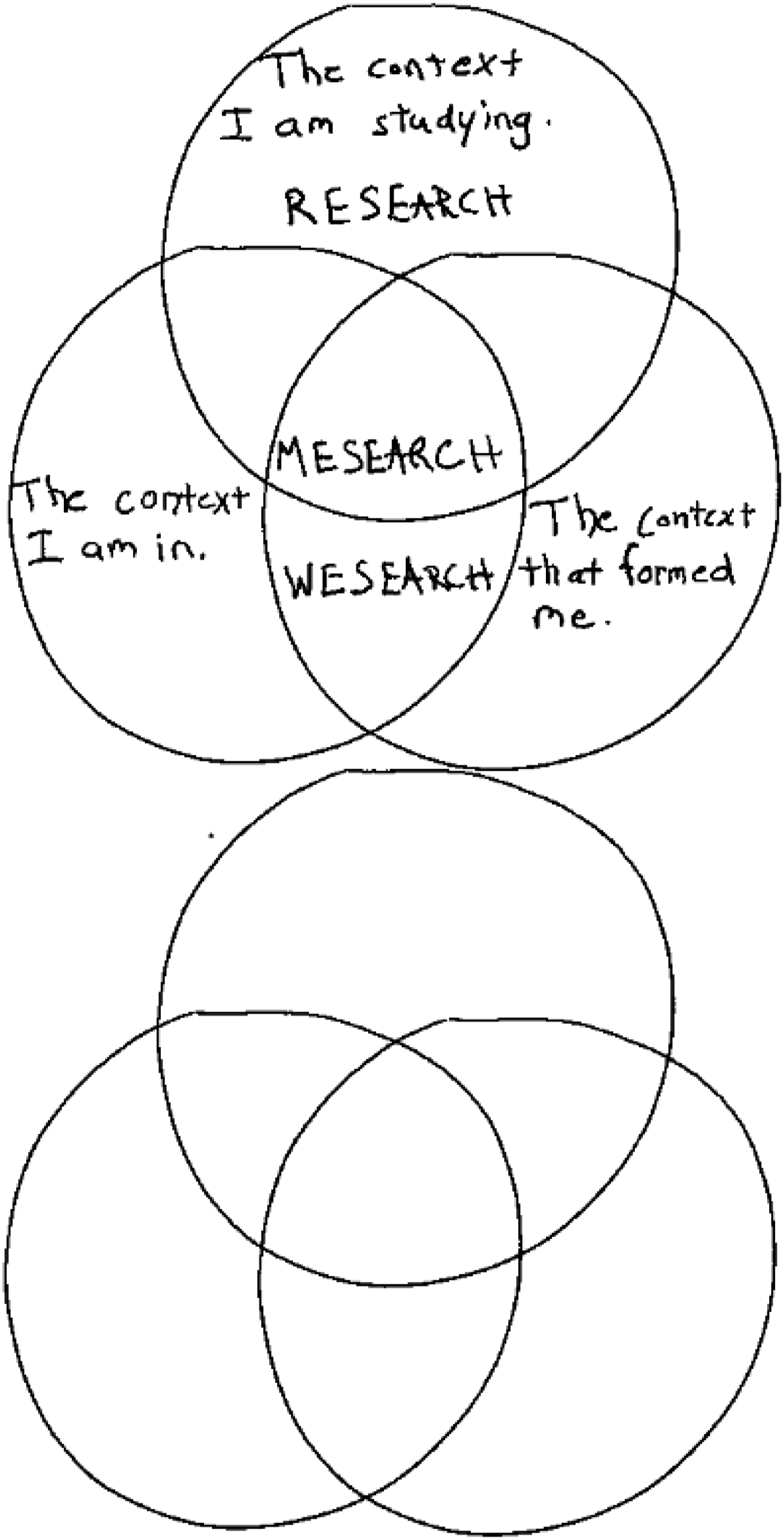
Generating ideas and reflecting on how these categories intersect can yield immediate insights. Taking this a step further involves inviting the communities to whom we are accountable and whose research we impact to share their thoughts and provide feedback. Research often involves the pragmatics of degree attainment, grant applications and reports, class assignments, and professional advancement, but there is an opportunity to have a more holistic and fulfilling approach. If this reflective invitation has inspired a desire to be more direct and aware of your role in research, then acknowledging and engaging in mesearch can improve your practice.
Footnotes
Acknowledgements
I am grateful to Kristy Collins, Paul Begin, Ann Feyerherm, Amy Johnson, Tabatha Jones Jolivet, and the editors and reviewers at IJQM for substantive and thoughtful comments on the concept of mesearch.

Funding
The author received no financial support for the research, authorship, and/or publication of this article.
Declaration of Conflicting Interests
The author declared no potential conflicts of interest with respect to the research, authorship, and/or publication of this article.