




Abstract
During the past two decades across New South Wales and Queensland, koala populations have been in steep decline. Despite being nationally listed as Endangered in 2022, populations have not been stabilised and threats to the long-term survival of koalas remain. Climate change predictions suggest that human-occupied coastal habitats may offer greater protection to koalas from natural disasters such as drought and wildfires, presenting a role for people to play in koala conservation. However, the design of conservation programs is rarely informed by the affected audiences themselves, lowering their probability for success. Acknowledging the need to centre approaches on people who don’t typically think about conservation, this study applied the 5-step design thinking process, a participatory research method focused on driving innovation. A one-day design thinking workshop was conducted in September 2024. Seven design teams were formed and tasked with developing an initiative to support the reporting of koala sightings through citizen science. Each team included participants with diverse experience and expertise, ensuring balanced representation across roles. During the design process, teams received feedback from a citizen jury before presenting final pitches. Citizen jurors were individuals with no prior experience in citizen science or koala conservation. Every participant was given a budget to invest in their favourite design. The top three citizen science program concepts featured customised apps with functionality such as auto-recording koalas, sharing information with other users, and fostering social connectivity. The juries’ selections focused on business partnerships, incentives, and tailored information for users. Notably, the jury selections did not overlap with the top three designs chosen by workshop participants. The inclusion of a citizen jury in a one-day design thinking workshop is a novel contribution. The utility of design thinking as a participatory method is discussed alongside the study’s limitations, offering avenues for future research.
Keywords
Introduction
The koala (Phascolarctos cinereus) is an iconic and flagship species endemic to Australia and loved by many throughout the world (Markwell, 2021; McAlpine et al., 2015; Schlagloth et al., 2018, 2022; Shumway et al., 2015). Once abundant across the eastern seaboard, koala populations in New South Wales and Queensland have experienced dramatic declines, with some regions—such as the “Koala Coast” (Redland City, Logan City, and Brisbane City)—reporting an 80% reduction between 1996 and 2014 (Rhodes et al., 2015). The causes are multifaceted: habitat loss, vehicle strikes, dog attacks, disease, and the escalating impacts of climate change (Beyer et al., 2018; Charalambous et al., 2024; Gonzalez-Astudillo et al., 2017; Rhodes et al., 2015). In response, the Australian government reclassified koalas as Endangered in 2022 within two states (Queensland and New South Wales) and the Australian Capital Territory (Department of Climate Change, Energy, the Environment and Water, nd).
While urban and peri-urban coastal areas may offer some refuge from natural disasters and climate-related threats such as heatwaves, drought, and wildfire (Adams-Hosking et al., 2011; Dowdy, 2020; Reckless et al., 2017), they also present a complex array of anthropogenic hazards. Koalas living in or near human settlements face increased risks from vehicle collisions, dog attacks, habitat fragmentation, and may also have higher exposure to pollutants and disease. Urban development often leads to the loss of mature eucalypt trees—which are critical for koala food and shelter—and can disrupt movement corridors essential for breeding and dispersal (Beyer et al., 2018; Gonzalez-Astudillo et al., 2017). Moreover, the proximity to humans may result in chronic stress and reduced reproductive success (Narayan, 2019). Thus, it is critically important to carefully manage and mitigate these threats in order to ensure these areas function as safe havens rather than ecological traps.
Despite decades of conservation efforts, koala numbers continue to fall. Conservation efforts typically involve wildlife management solutions, wildlife signage, habitat restoration projects, and koala awareness campaigns (Tkaczynski & Rundle-Thiele, 2023). Increasingly, conservationists are turning to community-based strategies to foster broader public engagement. Among these, citizen science—where non-specialist members of the public contribute to scientific data collection—has emerged as an increasingly acknowledged approach (Fraisl et al., 2022) with great potential to support biodiversity monitoring (Pocock et al., 2018). When well designed, citizen science initiatives can not only generate valuable data but also cultivate environmental stewardship and behavioural change (Theobald et al., 2015), while building knowledge, emotional connection, environmental literacy, and a sense of agency (Bonney et al., 2009; Ekins & Zenghelis, 2021; Jordan et al., 2011; Turnbull et al., 2021).
At present, volunteers who participate in citizen science efforts addressing biodiversity conservation are typically intrinsically motivated (Bruyere & Rappe, 2007; Robinson et al., 2021) and tend to hold pro-environmental values (Martin, Christidis, et al., 2016). Unsurprisingly, community members who have strong environmental values are often drawn to participate in conservation efforts. Yet, engaging the broader community in conservation initiatives can be more challenging; approaches that centre on understanding how wider community involvement can be encouraged are needed if anthropogenic factors are to be mitigated.
In Australia, community engagement around koala conservation provides a context in which to examine the potential impact and effectiveness of citizen science. Citizen science initiatives dedicated to koala monitoring are often aided by technology such as mobile apps and coordinated by community organisations and governmental agencies. By reporting koalas’ locations and key attributes such as the presence or absence of disease, members of the public can play a key role in supporting conservation efforts. However, participation in koala-focused citizen science remains limited. In a survey conducted in South East Queensland (SEQ), few residents indicated they had ever reported a koala sighting. Of those who indicated they had attempted to report koala sightings, many experienced challenges such as frustrations with the technology platform’s accessibility and ease of use, the need for education and training, or questions and concerns about how the data were being used (Fechner et al., 2023). These challenges deterred people from either initially or subsequently reporting a sighting. Further, an assessment of one koala citizen science program in SEQ found that while many people were signing up to participate, few were actually following through to report koala sightings using the program’s mobile app. Of those who reported sightings, many only did it once, and a small number of individuals disproportionately contributed the majority of sightings (Foote & Rundle-Thiele, 2025).
Citizen science initiatives often struggle to attract and retain volunteers due to a variety of barriers such as time burdens, uncertainty about the salience of the program due to lack of communication or insufficient feedback mechanisms, and challenges with digital tools (Frensley et al., 2017). Citizen science researchers have stressed the importance of the latter as a key driver of retention and attrition (Martin, Christidis, et al., 2016; Robinson et al., 2021). Thus, without engaging programming and user-friendly technology, even an initiative focused upon a species as universally embraced as the koala will be doomed to fail.
This gap between potential and actual engagement presents an opportunity to rethink how citizen science programs are designed. Rather than imposing top-down solutions, there is growing recognition that conservation initiatives must be co-created with the communities they aim to serve (Cranston et al., 2022). However, within biodiversity conservation, program design is rarely informed by the affected audiences themselves, which lowers their probability for success (Bowie et al., 2020). Notable exceptions exist, with community co-design initiatives gaining traction as a meaningful way to engage and empower community stakeholders to play a key role in the design and evaluation of interventions. In Queensland, Australia, community co-design has previously been used to engage community to mitigate known koala threats such as dog attacks (David et al., 2019; Rundle-Thiele, 2022) or vehicle strikes (Appleby & Ransome, 2022).
Given that citizen science itself is inherently participatory in nature, this scenario therefore presented an ideal opportunity to conduct participatory design research to identify solutions capable of engaging more people to become involved in citizen science programs. This project aims to recruit a more diverse base of residents to actively participate to report koala sightings than is currently occurring.
Design thinking is a participatory research method that can be considered adjacent to and overlapping with co-design. With its focus on driving innovation, design thinking is popular in business settings (Dell’Era et al., 2020; Glen et al., 2014) and has also been increasing in adoption in the public health domain (Bazzano et al., 2017; Heafala et al., 2024), but few instances of use within biodiversity conservation are available. As a participatory research approach, design thinking is associated with several different applied models, with those developed by IDEO, Stanford Design School, and IBM amongst the most influential and widely used (Micheli et al., 2019). Design thinking is a cognitive process and creative practice rooted in humanistic psychological theories that creates value for people by translating needs and problems into tangible designs (Auernhammer & Roth, 2021). Other key attributes of design thinking include creativity and innovation, user-centredness and involvement, problem solving, iteration and experimentation, interdisciplinary collaboration, blending analysis and intuition, and a tolerance for ambiguity and failure (Micheli et al., 2019). While design thinking is typically presented as a stepwise process, it is iterative in nature and has been described as “a system of spaces” consisting of “related activities that together form the continuum of innovation” (Brown, 2008, p. 88).
The present study sought to employ design thinking as a means of informing a 4-year collaborative multidisciplinary koala conservation project involving numerous government, university, and nonprofit partners. The overall project aims are to 1) design an app that is capable of detecting Bluetooth ear tags that are fitted to koalas (Cristescu et al., 2022) and 2) increase community participation in koala conservation. This study addresses aim 2 and is guided by the following two research questions: (1) What citizen science program ideas can koala conservation stakeholders and citizens identify to drive increased participation in citizen science programs aiming to monitor local koala populations? (2) What is the utility and added value of design thinking as a participatory research method within the context of koala citizen science and conservation?
Methods
To address our research questions and engage a broad array of koala conservation stakeholders and citizens, we carried out a one-day in-person design thinking workshop. We followed the Stanford Design School five-stage process that includes: (1) empathise; (2) define; (3) ideate; (4) prototype; and (5) test (Stanford d.school, 2010). Our approach closely aligned to that described in (Willmott et al., 2022), which in turn adapted activities from the “Ideation” stage of the IDEO process (IDEO, 2015).
Ethical approval was obtained from the Griffith University human research ethics committee (2021/580). Before participating in the workshop, all participants signed a consent form after reviewing the project information sheet. The consent form addressed the collection of photos, videos, audio, and all written material generated during the workshop as part of the dataset and indicated that design thinking workshops participants’ identifying information would be de-identified.
Workshop Overview and Recruitment
Design thinking seeks to engage participants with a diversity of lived experience and expertise related to the issue at hand. Purposive sampling was the predominant method of participant recruitment. Purposive sampling was used to ensure a diverse range of perspectives relevant to koala conservation and citizen science. Participants were selected based on their varying levels of experience with conservation activities, geographic location within koala habitats, and demographic diversity (e.g., age, occupation, and community roles). This approach aimed to capture a broad spectrum of motivations, barriers, and values to inform inclusive and representative design outcomes.
The research team collaboratively developed a list of over 100 individuals consisting of representatives from local, state, and federal government, resource management agencies, researchers (e.g., ecologists), conservation organisations, and wildlife carer and advocacy groups. The list also included creative professionals with expertise in storytelling and app design, educators, citizen science experts, tourism groups, and community members who were either familiar with the existing citizen science initiative or had participated themselves. The research team then sent out individual emails with personalised invitations and link to a registration form; recruitment also took the form of follow-up phone calls. Over 60 individuals registered for the workshop, which was held in Brisbane, Queensland, Australia in September 2024.
Convenience sampling was also employed via a Facebook ad targeted to the venue’s postcode in order to recruit a community jury from the local area in proximity to the workshop venue. Individuals who served on the citizen jury received an AUD $80 gift voucher each and were individuals who had not previously participated in koala citizen science programs. Several individuals were invited to participate in the full-day design thinking workshop. Individuals participating in the full-day design thinking process received a gift voucher of AUD $150. Professionals involved in the design thinking workshop were not incentivised beyond the catering and barista service provided for the full-day workshop. The inclusion of a citizen jury recruited through targeted online advertising represents a novel introduction to the design thinking method.
Prior to the workshop, the research team strategically allocated registrants to seven groups, each consisting of a maximum of eight individuals with diverse experience and expertise, ensuring that people with similar affiliation types (e.g., koala researcher, app developer, community member, wildlife carer, behavioural scientist, etc.) were evenly spread across the groups. Participants were from Queensland and New South Wales and represented an equal gender breakdown. Four individuals from the research (and authorship) team participated as group members, while two served as facilitators. The facilitators’ roles were to provide and clarify instructions and ensure groups were completing tasks within the timeframe provided. At the outset of the workshop, the research team identified themselves and the overall purpose and task, which was to create citizen science program ideas. Program ideas aimed to identify approaches that design teams felt would drive increased participation in citizen science to improve local koala monitoring efforts.
Design Thinking Stage 1: Empathising
Figure 1 presents the five stages of the design thinking process, an overview of the activities for each, and representative photos. The first stage of the design thinking process is “empathise,” which allows participants to gain a deeper understanding of the lived experiences of the people at the centre of the design process. Empathy is a multidimensional psychological concept that includes both cognitive and affective components and can be described as the capacity to understand or feel what another person is experiencing (Davis, 1983). Further, empathy has been linked to altruism and thus can be considered a genuine motivator for prosocial behavior (Batson & Shaw, 1991). An Overview of the Design Thinking Process
Creating the conditions for participants to develop empathy is a critical component of design thinking. Empathy, in the context of this method, refers to the intentional effort to understand the experiences, emotions, motivations, and challenges of the people for whom a solution is being designed (Brown, 2008; Stanford d.school, 2010). It is not merely about feeling compassion but about deeply engaging with others’ perspectives to inform more human-centred and contextually relevant solutions. To gain these insights within a workshop setting, designers can be presented with the opportunity to hear from and interact with people directly, or they may listen to or watch recordings of people sharing their stories. They may also review collated materials such as social media posts or documentary footage.
Development of “Personas” for the Empathy Map Activity

The empathy maps served as a foundation for subsequent design activities. For example, insights such as “feels disconnected from others” or “needs to see data influence government policy” were translated into actionable design goals during the “define” stage. These insights informed the creation of “point of view” and “how might we” statements, which explicitly linked user needs to potential solutions. In this way, empathy was not a passive or abstract concept but an active, structured process that shaped the trajectory of idea generation and prototyping.
By grounding the design process in empathy, participants were better able to identify and prioritise features that addressed real-world barriers and motivations. This included both emotional needs (e.g., reassurance, connection, recognition) and practical considerations (e.g., ease of use, feedback, incentives). The emphasis on empathy also helped bridge the gap between expert and lay perspectives, ensuring that the final citizen science program ideas were not only technically sound but also socially resonant.
Participants listened to these recordings and filled out empathy map worksheets (Figure 1) to capture what each person said, did, thought, and felt (Willmott et al., 2022). These insights served as a “roadmap” for the subsequent activities and provided a critical grounding in empathy that participants were able to return to again and again as they moved through the subsequent stages of the design thinking process.
Design Thinking Stage 2: Defining
The define stage allowed participants to further distill and synthesise the information from their empathy maps to create problem statements. A template (Figure 1) was provided to help participants articulate specific goals linked to specific actions, while centring the individuals’ unique needs and points of view. Participants were given the opportunity to develop several “Point Of View statements” on their own, then discuss them in their groups. Following that activity, each group identified one problem to explore together, and applied the “5 Whys” technique (IDEO, 2015; Serrat, 2017) to identify the root cause of the problem by asking “why” five times in a row. Finally, a “How Might We” activity (IDEO, 2015) allowed participants to individually draft several potential solutions to the problems while taking a more systemic view of the landscape in which the problems occur. To provide participants with examples of koala citizen science initiatives that were already in place, participants were provided with a packet of material that included screenshots and QR codes linked to existing mobile apps and data dashboards.
Design Thinking Stage 3: Ideation
The ideate stage consisted of a brainstorming session with the goal of generating as many creative solutions as possible to address the problems outlined in the previous activities. This stage activates participants’ imaginations and stresses that solutions need not be grounded in reality or feasibility, since the intent is to generate “the broadest range of possibilities” (Stanford d.school, 2010). Facilitators guided participants through a brainstorming process of writing ideas on sticky notes where individual design thinking workshop participants first generated ideas using the brainwrite approach (Heafala et al., 2024). Brainwrite encourages individuals to think of three ideas on their own. Each idea is listed onto a Post-It® note. Once a person has thought of three ideas they are asked to pass their three ideas to the person sitting on their right. Participants are then invited to think of a further three ideas. This process continues for as long as people can generate ideas. Next, groups were invited to organise their ideas thematically using any organising framework teams deemed relevant (see Figure 2). Individual participants were next invited to vote for their three favourite ideas using sticky dots. These ideas became the top contenders for each group’s prototyping stage. Brainstorm Example
Design Thinking Stages 4 and 5: Rapid Prototyping and Testing
In the design stage, each table group formed a team. Teams were challenged to develop one of their shortlisted ideas to build a citizen science program. Ideas were tested in an iterative process. The design stage allows participants to quickly develop an idea–without being too emotionally attached to it–and have the freedom and flexibility to “fail quickly and cheaply” (Stanford d.school, 2010). Citizen science program ideas were pitched in two-minute presentations to “citizen juries.” Teams were encouraged to develop visuals and other methods to clearly convey their idea. Participants were provided a storyboarding template they could opt to incorporate into their pitches if they chose to do so (see Figure 3). The pitches were first presented to one of two “citizen juries” which consisted of four to five individuals who had no prior experience with citizen science or koala conservation. Storyboard Example
Jurors provided feedback to the team members in the form of worksheets (feedback grids which captured what they liked, did not like, and would improve about the program ideas presented by design teams). Jurors were also allowed to ask questions. Following this feedback, teams were invited to incorporate feedback and to develop a second iteration of their citizen science program design which they pitched to the second citizen jury team. Teams were then invited to implement a further round of revisions to finalise their citizen science program designs and prepare for their final pitch. In the final pitch (see Figure 4), each team presented their final designs to the entire group of design thinking workshop participants, who then used fictitious money to “invest” in the citizen science programs that they preferred. Investment of money offers each design thinking workshop participant the opportunity to express the extent they would like to see competing citizen science program ideas be developed for piloting in the next phase of the project. All participants received equal sums of money to invest in any citizen science program idea excluding their own team’s idea. Individual participants were invited to distribute their allocated funds however they liked across the remaining six citizen science program ideas presented. Using a worksheet that captured likes and dislikes, design thinking workshop participants were also invited to provide feedback on ideas presented by other teams. Participants were invited to rank the other six groups’ designs in order of preference. Pitch Example
Designing and Testing Citizen Science Program Ideas
Teams were encouraged to gain feedback on their program ideas from citizen juries. Citizen juries were representatives of community who had not previously thought about engaging in a citizen science program. While some participants felt the competition element of the design thinking workshop was a distraction, the need to sell ideas to community members is high since any program design needs to appeal to, attract, and keep citizen scientists. Teams were provided with autonomy enabling them to design and refine citizen science program ideas. Each team approached the task differently. For example, some teams focused on one specific problem while other teams invented entire apps aiming to embed multiple features. Design teams developed their citizen program ideas using storyboarding templates, illustrations, AI-generated imagery, and interactive skits with personas and role playing. They received jury feedback in the form of questions and written comments that helped them refine their citizen science program ideas.
Data Analysis
A qualitative dataset was created through the collection of written materials and video recordings of pitch presentations. All activity worksheets and supporting materials from all stages of the workshop were collected at the end of the day. Data were organised into design team groups. These materials were photographed and transcribed. Video recordings ranging from two to seven minutes were made of the practice pitches with the citizen jury, as well as the final pitches to the entire design thinking workshop group. The videos were converted to audio files and transcribed using the Microsoft Azure transcription service, which was deemed to be safe, secure, and compliant with Australian government and The Griffith University requirements. Transcripts and summaries of the pitches and final designs were shared with the research team to check for accuracy. Brainstorming and pitch data were collaboratively content-analysed (Krippendorff, 2004) to create high-level categories, which were reviewed and confirmed by the full research team. Two researchers independently reviewed the transcribed ideas and collaboratively developed a coding framework based on recurring themes. Codes were iteratively refined through discussion until consensus was reached, ensuring consistency and reliability in categorisation. Microsoft Excel was used to organise, sort, and quantify the frequency of codes across teams, allowing for the identification of dominant themes and patterns in participant-generated ideas.
Results
Over 80 individuals responded to the invitation to participate in the workshop either by registering, or by lodging their interest but indicating they were not available to join due to timing, travel costs, or other logistics. A total of fifty-five people attended the workshop as designers; this included two of the individuals originally recruited for the citizen jury who accepted the invitation to join the workshop. Another nine joined as the citizen jurors who were tasked to provide open and honest feedback to teams about the ideas presented.
Participants included individuals representing nongovernmental organisations (n = 12), universities (n = 11), creative agencies and mobile app developers (n = 10), government/local council (n = 5), experienced or prospective citizen scientists (n = 5), wildlife carers/veterinarians (n = 4), resource management agencies, (n = 3), behaviour change specialists/social scientists (n = 3), educators (n = 1), and tourism agencies (n = 1). While some participants may have represented multiple categories, we attributed their category according to their primary employment or volunteer context.
Developing Empathy and Identifying Problems
Participants completed empathy maps worksheets. Empathy maps required each design thinking workshop participant to capture the stories of the five individuals. The notations included a range of adjectives and observations such as “happy,” “optimistic,” “sad about impact but hopeful,” “demoralised,” “feels disconnected from others,” “eager to make a difference,” “time problem,” and “needs to see data influence government policy.” These insights led to the creation of “point of view” statements that identified user needs, such as specific information, support systems and structures, or general reassurance and guidance. In the final activity of the “define” stage, participants expanded upon their point of view statements to develop “how might we” statements that linked actions to needs and identified specific changes that would result. Some examples of actions participants noted were “inform,” “give support,” “communicate,” “lower barriers,” “give people encouragement,” “increase awareness and accessibility,” and “create a community of practice.” Participants articulated changes such as “create ease and comfort of use,” “engage more schools,” “accommodate low tech literacy,” and “galvanize existing interest within local communities.”
Generating Solutions
Through the brainstorming activity during the ideate stage, design workshop participants generated a total of 282 individual ideas. The most popular ideas as indicated by sticky dot voting included sharing feedback with users, gamification, driving education and awareness, providing incentives and rewards, and allowing reporting without having to log in.
Summary of Potential Solutions Generated Through a Brainstorming Activity
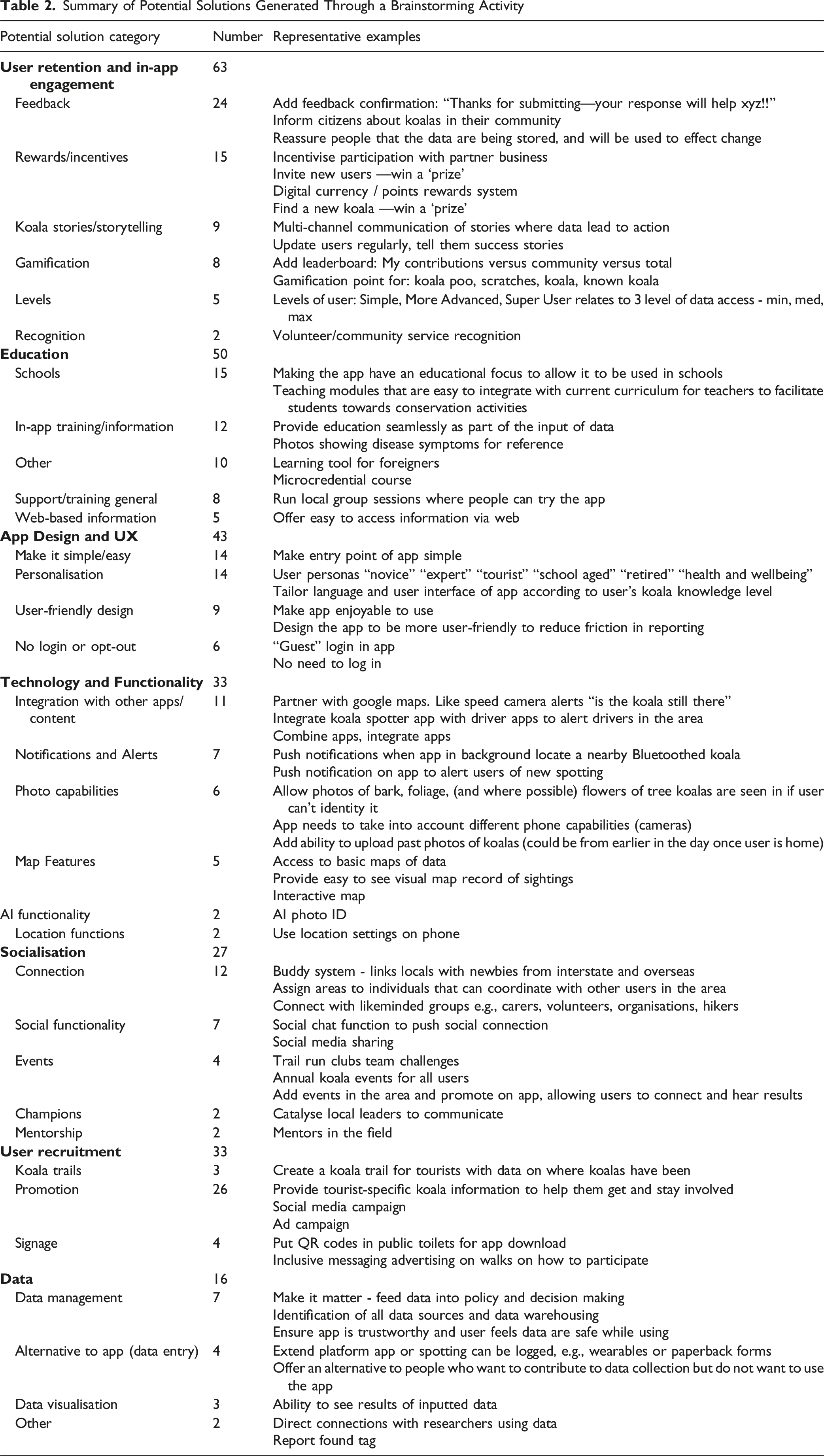
Design Outcomes and Investments
Overview of Citizen Science Program Designs

The three teams that received the highest investments developed a customised app with features such as auto-recording koalas, ensuring that feedback about the koalas was reported back to app users, and approaches that ensured social connectivity. The two citizen juries each deliberated to agree upon their overall favourite design (based on the two practice pitches they had heard); Jury #1 chose a design that featured tie-ins with local businesses and an incentives and rewards scheme. Jury #2 selected an online platform that sought to consolidate and tailor information to users (see Table 3).
Comparative Analysis of Citizen Science Program Ideas
Comparative Analysis of Citizen Science Program Ideas

Discussion
This study outlines the process used to understand citizen preferences for a program aiming to increase community participation in koala monitoring and conservation. Alongside data analysis, the research team reflected on the process itself and identified several key considerations to guide future researchers and practitioners seeking to adopt a design thinking methodology.
From a pragmatic standpoint, this method allowed for the rapid identification of specific strategies and tactics that can be considered by the project team for development, pilot testing, and evaluation. Some commonalities among the ideas contained within the seven designs are evident, indicating their general popularity. For instance, three of the designs incorporated some form of personalisation or tailoring of app features. Other concepts appearing in at least two designs included ensuring social connectivity, partnerships and collaboration, feedback to users, a login-free user experience, and the use of incentives to motivate ongoing participation in the citizen science program. Brainstorming data provided additional insights, since many ideas were explored but did not make it into the teams’ final designs; the prevalence and overlap of many ideas across the teams provide data that can be used to create a citizen science program for testing.
On the whole, the ideas generated by participants were consistent with the citizen science literature and linked to known success factors for community engagement. For instance, the need for citizen science programs to prioritise the functionality and user-friendliness of their technological platforms and mobile apps in particular is well documented (Cigliano et al., 2015; Gharesifard & Wehn, 2016; Liñán et al., 2022; Martin, Christidis, et al., 2016; Martin, Smith, et al., 2016; Robinson et al., 2021). Other factors include the receipt of feedback from program organisers, the presence of quality training opportunities, and the communication of project relevance and salience (Cox et al., 2018; Fischer et al., 2021; Measham & Barnett, 2008; Robinson et al., 2021; West et al., 2021; West & Pateman, 2016).
More specifically, “Choose Your Own Adventure,” which tied for a top three ranking by participants and received the highest score by the review committee, prominently addressed the need for three key factors indicated in the literature and evident in the content analysis of the brainstorming data: the need for a user-friendly online platform and overall experience, the need for feedback (and thus an understanding of program salience), and the desire for social opportunities and connectedness among participants. In contrast, “Koala Eats,” the idea that was amongst the lowest in overall ranking—in that it was not a top three choice of the participants, not chosen by either jury, and ranked next to last by the review committee—did not clearly address those three factors.
Next, the participatory nature of design thinking was a clear asset. By ensuring that a diversity of participants take part, more inclusive and realistic strategies can be developed (Brown, 2008). By centring and elevating community stakeholders and end-users as the “experts,” and designing “with” and not “for” them (Cranston et al., 2022; Willmott et al., 2022), the process promotes buy-in, which in turn can support long-term sustainability of interventions. Further, creating the opportunity to build empathy and centre lived experiences of key audiences is a way of safeguarding against biases that are prevalent in “expert-driven” processes. Rundle-Thiele et al. (2019) noted that incongruence exists between expert and community views, which may explain why community engagement is limited when traditional research and development approaches are applied.
Differences in expert and community views were evident in this design thinking process. Investment voting by design participants was not aligned to citizen jury preferences. This may be due to the fact that different voting mechanisms were used. Citizen jury teams were invited to nominate their favourite citizen science program idea prior to final design team presentations, whereas design workshop participants were invited to allocate funds to one or more ideas they deemed worthy, noting they could not invest in their own program idea. It is possible that differences in voting approaches led to differences in ranking, which represents an opportunity for testing in future research.
However, we have considered another explanation for this difference: the presence or absence of intrinsic motivation. The concept of intrinsic motivation refers to individuals who engage in an activity for the inherent satisfaction and personal meaning it provides, rather than for external rewards or recognition (Ryan & Deci, 2000). In the context of this study, intrinsically motivated participants were those who demonstrated a deep-seated interest in koala conservation, environmental stewardship, or scientific contribution. Their preferences leaned toward features that enhanced the meaningfulness and transparency of their engagement—such as auto-recording koalas using Bluetooth tags and receiving detailed feedback about how their data contributed to conservation outcomes. These features align with psychological needs for autonomy, competence, and relatedness, which are central to intrinsic motivation (Ryan & Deci, 2000). For example, the “Real Data, Real Time, Real Help” design offered multi-level feedback loops that reinforced users’ sense of impact and contribution, a key driver for sustained engagement among intrinsically motivated individuals. The ideas voted by citizen jurors were numbers four and six out of seven as voted by design thinking workshop participants. Citizen jurors who did not have prior experience participating in citizen science programs preferenced citizen science program ideas that included incentives, rewards, partnerships with local businesses, and tailored approaches. These preferences contrasted with features favoured by design thinking workshop participants with more content expertise and who are known to be more intrinsically motivated. This divergence underscores the importance of designing citizen science programs that can appeal to both profiles, particularly for programs seeking to engage a wider audience and thus expand their volunteer base.
Future program development may benefit from integrating dual motivational pathways, ensuring that both intrinsic and extrinsic drivers are addressed to broaden participation and retention. Further, this finding highlights the importance of integrating diverse perspectives early in the design process and ensuring that program ideas are communicated in ways that resonate with both expert and lay audiences. Future participatory design efforts may benefit from dual-track evaluation frameworks that balance technical feasibility with community appeal.
Citizen Juries in the Design Thinking Process
Past design thinking approaches have included citizens in the design thinking process starting with stories in the empathy mapping phase (Willmott et al., 2022) and placement of one citizen within expert design teams (Heafala et al., 2024). This level of citizen involvement occurred in the present study. Notably, this study expanded on past approaches by forming two citizen juries. Jurors did not have prior experience with koala citizen science programs. Citizen juries have been used extensively in health policy (Street et al., 2014). Citizens juries permit citizens to engage with evidence, deliberate, and advise (Street et al., 2014). The incorporation of a citizen jury yielded some interesting outcomes. In past studies, design thinking workshop participant teams have provided feedback for each others’ designs during the iterative rapid prototyping stage of the process (Heafala et al., 2024). The present study removed this component and instead enlisted the jurors to provide their own views through delivery of feedback to design teams. The opportunity to present in front of a jury of strangers unfamiliar with the context at hand and receive their feedback was viewed as a fun and useful component by some design thinking teams. Other teams reported they did not feel their group was particularly helped by the jury, who were comprised of people who had not previously participated in citizen science and whose views were incongruent with their own expert views. If time would allow, both a review by the higher expertise workshop participants and a naïve citizen jury could be an ideal approach to gaining feedback, as they provide very different perspectives and utility.
Limitations and Future Research Directions
The specific materials used within the workshop may drive the ideas that are developed and refined. In this design thinking study all seven teams’ final designs revolved around a mobile app or web platform. The five personal stories that participants listened to early on in the workshop were scripted to incorporate multiple contexts and opportunities for the design of community engagement strategies in addition to referencing the use of mobile apps, but the content within the packet of reference materials was limited to mobile apps and data dashboards. This may have steered the designs towards mobile apps, although discrete non-app ideas were found in the brainstorming data. For instance, creating koala walking trails in natural areas, hosting public events, and developing Kindergarten to Year 12 curricular materials were ideas generated during the brainstorming phase. Several ideas even explicitly suggested there should be an alternative to an app for monitoring koalas and reporting koala sightings. Some teams presented ideas that individuals within the teams were already working on. This suggests team composition may also influence design ideas. Further research is recommended to compare and contrast design thinking processes delivered in parallel with different stories, different team configurations, and reference materials to ascertain the role these play in developed ideas, if at all.
A key consideration in this study is the direct involvement of the research team in the design and facilitation of the citizen science participatory research process. While this engagement enabled a deep understanding of participant perspectives and ensured methodological consistency, it may also have influenced the outcomes. For example, the presence of researchers during the workshop could have shaped participant responses—either by subtly guiding discussions or by creating a perceived expectation to align with researcher values or goals. Additionally, the researchers’ own interests in koala conservation and citizen science may have influenced how data were interpreted or prioritised during analysis. This potential for influence is not uncommon in participatory and qualitative research, where the researcher is often positioned as both facilitator and interpreter. However, it underscores the importance of reflexivity and transparency. In this study, efforts were made to mitigate bias through structured facilitation, the use of pre-developed personas, and collaborative coding processes. Future research could benefit from incorporating independent facilitators or third-party evaluators to reduce potential bias and enhance objectivity. Finally, longitudinal studies could help assess whether the ideas generated through researcher-facilitated co-design translate into sustained behavioural change when implemented in real-world contexts.
The incorporation of a citizen jury is a novel development in the implementation of a one-day design thinking process. Jurors were purposively selected for their lack of previous involvement in citizen science through the use of postcodes. A range of recruitment and incentivisation approaches have been used in citizen juries (Street et al., 2014). Future research is recommended to understand the role recruitment strategies and incentives have on citizen juries. In this study jurors were asked to provide feedback using a feedback grid. Individual jurors outlined what they liked and what they disliked along with any ideas for improvements. Alternative frameworks could be used to guide juror feedback. Future research is recommended to extend on the approach reported in the current study. Funders and experts could be recruited to serve on juries or to consider final pitch presentations. Use of double juries may assist to ensure acceptability of the program ideas for intended program participants while also enabling assessments of feasibility. Finally, this study was limited by not using member-checking following the design thinking workshop to test the ideas and proposed design with citizen scientists who were not part of the process. Future research should include member-checking to gain further feedback on proposed designs.
Design thinking can be implemented over much longer time frames. For example, Brennan and colleagues (2021) implemented a design thinking process informed by the double diamond approach over a two-year period to understand how food waste could be reduced. The one-day design thinking process aims to provide a cost-effective and solution-focused approach capable of yielding designs to inform project planning. Future research is recommended to compare and contrast effectiveness of design thinking process duration. Cost benefit analysis would provide insights to inform research and development investment decision making. Lengthy processes are costly with time and resources tied up in activities which may not in and of themselves yield the outcomes koalas urgently need if populations are to recover. Research that aims to optimise investments will ensure research effort is targeted to maximise intended outcomes (e.g., reduce koala deaths).
The inclusion of a competitive element that allowed participants to “invest” and rank each others’ ideas, with a “winner” emerging at the end of the workshop, was especially viewed as a highlight of the one-day design thinking process. This is a unique feature that helped maintain enthusiasm and engagement throughout the course of a fast-paced and intense day of effort. The reaction to this element suggests that the importance of “fun” in participatory research should not be underestimated.
Providing meaningful opportunities for ongoing engagement is a key feature of genuine participatory research (McKercher, 2020; Sanders & Stappers, 2008). During the recruitment phase, it became evident that interest in participation exceeded the capacity for a one-day workshop, compounded by the fact many people were unable to join due to other commitments or factors such as distance or costs. In response, efforts were made to share outcomes with not only the participants, but a wider group of stakeholders and prospective volunteers, to seek their feedback and assistance with piloting projects, and to explore the creation of a community of practice following the workshop. Future research that aims to identify alternate approaches that could be used to engage people in design processes over time are recommended.
Conclusion
The present study reports the outcomes of a one-day design thinking workshop. Seven citizen science program ideas were developed and refined prior to final pitches which were voted upon by design thinking participants and two citizen juries. The ideas (see Table 3) have not been developed and pilot tested. Opportunities for future research include testing the different ideas developed. Studies are recommended to compare and contrast recommended prototypes. For example, a two-arm trial could be conducted to ascertain whether ideas preferred by citizen jury or design thinking workshop participants yield improved community engagement and koala outcomes.
The endangered status of koalas in most of their range makes it clear that solutions are urgently needed to mitigate known koala threats. Twenty years of increased protection status and management plans have failed to slow down koala population decrease. Large-scale community involvement is necessary to address anthropogenic threats, and innovative solutions to recruit a broader base of citizens into conservation programs are critically needed. Involvement in citizen science programs ensures that residents are aware of koalas in their neighbourhood/area and that they are supported in taking actions to protect koalas (e.g., slowing down when driving and keeping dogs inside at night). Design thinking yielded a range of citizen science program ideas that can be developed for pilot testing and evaluation. This study demonstrates the utility of design thinking within a biodiversity conservation context and contributes an advancement to the method by documenting the addition of a citizen jury. Seven innovative solutions were identified, offering koala conservation stakeholders a range of approaches that can be considered to increase participation in citizen science aiming to support monitoring of local koala populations.
Footnotes
Acknowledgements
We thank our team from Griffith University who provided facilitation support during the workshop and/or assisted with data entry: Sheikh Rahman, Kim Servana, Rebecca Bartlett, and Tashi Dendup. We thank the citizen scientists and stakeholders who gave their time to support this research study.
ORCID iDs

Ethical Approval
The Griffith University human ethics committee approved this study (Ref No: 2021:580).
Informed Consent
Information sheets and consent forms were provided to participants; these included consent for photos and audio recording of interviews and co-design workshop discussions, and assurances that research products such as transcripts would de-identify participants and maintain confidentiality.
Author Contributions
Liz Foote Conceptualization; Project administration; Investigation; Formal analysis; Writing–Original draft preparation, review and editing.
Sharyn Rundle-Thiele Conceptualization, Project administration; Investigation; Writing–Original draft preparation, review and editing; Funding acquisition; Supervision.
Romane Cristescu Conceptualization, Design thinking workshop participant recruitment, Writing–review and editing.
Cathryn Dexter Conceptualization, Design thinking workshop participant recruitment, Writing–review and editing.
Elizabeth Brunton Conceptualization, Design thinking workshop participant recruitment, Writing–review and editing.
Katrin Hohwieler Conceptualization, Design thinking workshop participant recruitment, Writing–review and editing.
Tori Seydel Conceptualization, Data analysis, design thinking workshop participant recruitment, Writing–review and editing.
Funding
The authors disclosed receipt of the following financial support for the research, authorship, and/or publication of this article: Social Marketing @ Griffith funded Dr. Liz Foote’s fellowship and funded citizen jury recruitment, incentives and catering for the design thinking workshop.
Declaration of Conflicting Interests
The authors declared no potential conflicts of interest with respect to the research, authorship, and/or publication of this article.
Data Availability Statement
Data can be made available on request.