




Abstract
Background
Eating is a fundamental physiological need, and a key determinant of athletic performance (Pettersson et al., 2013). Many athletes adopt specific eating behaviors to enhance sports performance, such as targeted weight loss using dehydration prior to competitions (Atkinson, 2011) or dietary restrictions (Arthur-Cameselle & Quatromoni, 2011). However, these performance-oriented behaviors may lead to disordered eating behavior (Reardon et al., 2019). The spectrum of individual eating behaviors in athletes ranges from optimized nutrition to eating disorders (ED), with disordered eating behavior (DEB) situated in between (Wells et al., 2020). Optimized nutrition can be characterized by, among other things, eating behaviors that meet athlete’s physiological needs, avoid restrictive behaviors, and promote a healthy body image, prioritizing both physical and mental well-being. DEB include behaviors such as dietary restriction, purging, excessive exercise, dehydration, and the use of diet pills, but these behaviors are not chronically present and therefore do not meet the diagnostic criteria for an ED (Reardon et al., 2019; Wells et al., 2020). At the opposite end of the spectrum are clinical eating disorders, such as anorexia nervosa, bulimia nervosa, binge eating disorder, and avoidant restrictive food intake disorder (American Psychiatric Association, 2013).
Athletes in lean sports – such as endurance, aesthetic, weight-dependent and gravitational sports – are reported to experience more eating problems, including DEB and ED, compared to those in non-lean sports, such as technical, ball, and power sports (e.g., Chapa et al., 2022; Sundgot-Borgen & Torstveit, 2004; Torstveit et al., 2008). In aesthetic sports, such as synchronized swimming, where thinness is emphasized, DEB is often adopted to conform to perceived body ideals for better performance (Ferrand et al., 2007). Moreover, dieting or skipping meals several times a year is a common practice among these athletes (Ferrand et al., 2007).
Throughout their careers, athletes experience fluctuations in their eating behaviors along a continuum influenced by various factors, such as the training period (e.g., during the off season; Wells et al., 2020). For instance, athletes’ eating behaviors can fluctuate even within a single sports season, with symptoms either improving or worsening between the start and the end of the season (Thompson et al., 2017). In total, 37% of athletes who showed DEB at the beginning of the season continued to adopt DEB 5 months later, while 11% developed an ED, and 52% experienced a reduction in symptoms (i.e., becoming asymptomatic by the end of the season; Thompson et al., 2017). Despite these insights, research on the dynamic nature of eating behaviors in athletes remains scarce, leading to a limited understanding of their individual trajectories along the spectrum of eating behavior over time.
Potential changes in eating behaviors can be explained by the interplay of multiple factors. One theoretical framework for explaining the development of DEB is Petrie and Greenleaf’s (2012) adaptation of Stice's (2001) non-sport etiological model, which incorporates sport-specific influences, such as pressures related to body ideals across different sports disciplines. According to this model, athletes’ eating behaviors are shaped by sociocultural and sport-related pressures linked to body ideals (thinness or muscularity), body dissatisfaction (gap between real and ideal body), drive for muscularity, negative affect (e.g., sadness, shame, anxiety), and dietary restraint (Petrie & Greenleaf, 2012). While comprehensive, this model does not fully capture other athlete-specific factors that may influence DEB nor its variability over a season. Research suggests that additional sport-specific factors play a critical role in DEB – such as weight-related maltreatment (i.e., pressure from coaches or peers to engage in DEB, such as dieting or using laxatives, to achieve an ideal weight for performance), athletic identity (i.e., strong identification with the athletic role, which may lead athletes to prioritize their sport and adopt DEB to attain an ideal body for better performance), and conformity to the sport ethic norms (i.e., adherence to standards like the “no pain, no gain” mentality; e.g., Arthur-Cameselle et al., 2017; Arthur-Cameselle & Quatromoni, 2011; Boudreault et al., 2022; Engel et al., 2003; Gapin & Petruzzello, 2011; Kerr et al., 2006). Additionally, two individual protective factors in adolescent functioning have been shown to reduce DEB and the risk of developing an ED – namely, high self-esteem (e.g., Arthur-Cameselle & Quatromoni, 2011) and effective emotion regulation skills (e.g., Prefit et al., 2019).
The majority of studies that have identified these influential factors of eating behavior are cross-sectional in their design. Consequently, there is a paucity of knowledge regarding the variation of these influencing factors over time. Some studies have examined their dynamics and found that the sport-related pressures regarding weight, body and appearance perceived by athletes (Anderson et al., 2012), as well as dieting (Anderson et al., 2012), the desire to be thin to enhance performance (Krentz & Warschburger, 2013) and body satisfaction (Anderson et al., 2012; Doughty & Hausenblas, 2005) are relatively stable over time. However, Krentz and Warschburger (2013) found that an increased desire for thinness among adolescent athletes over 1 year was associated with an increase in DEB. Further research is needed to elucidate the factors influencing the adoption of DEB or the development of ED, particularly from a longitudinal perspective.
Stress is a significant factor influencing eating behaviors, alongside sociocultural and sport-specific pressures. Among non-athletes, stress has been consistently associated with disturbances in eating behavior, specifically perceived stress (i.e., daily stress and negative events; e.g., Hsu & Raposa, 2021; Karvay et al., 2022; Richardson et al., 2015). For instance, women with high perceived stress levels report more unhealthy eating behaviors (e.g., uncontrolled eating, cognitive restraint, and emotional eating; Richardson et al., 2015). Athletes are exposed to a wide range of stressors, both general (e.g., personal life events unrelated to sport, such as family conflicts or loss of a loved one) and sport-specific (e.g., performance pressure, team dynamics, or individual performance concerns), all of which contribute to heightened perceived stress levels (Sarkar & Fletcher, 2014). Given this increased stress, a higher prevalence of DEB can be hypothesized. These perceived stress levels might fluctuate over a season depending on the experienced pressure to perform, the changing expectations of an athlete’s environment, and as athletes approach competition days (Nicholls et al., 2009). Therefore, the individual’s perception of the current situation as stressful is of particular importance in determining their behavioral and physiological response to stress (McEwen, 1998), including increased activity of the sympathetic branch and decreased activity of the parasympathetic branch of the autonomic nervous system (ANS), resulting in an increase in heart rate (HR) and a decrease in heart rate variability (HRV; Messerli-Bürgy et al., 2016; Thayer et al., 2012). Despite the established links between stress and eating behaviors, there is limited research examining fluctuations in perceived and physiological stress levels over the course of a sports season in athletes, as well as their potential impact on athletes’ eating behaviors. This gap underscores the need for further investigation into how stress dynamics throughout the season may interact with and influence eating patterns in athletes.
Theoretical Framework
By conceptualizing DEB as internal psychological difficulties manifested in individuals through maladaptive eating and exercise behaviors and attitudes, researchers fail to fully account for the complexity of DEB, particularly in terms of their socially and culturally constructed nature over time (Busanich et al., 2014). To address this gap, this project considers young athletes’ eating behaviors as multifaceted practices that must be understood within individual, social, and cultural contexts. To better explore the interplay of these elements and their impact on DEB, a social constructionist perspective (Burr, 2015) is used, as a clinical perspective overlooks the specific conditions of a young athlete’s life. The social constructionist perspective emphasizes the role of narratives as psychological instruments enabling individuals to make sense of the world, their relationships, and their identities (Murray, 2017) and facilitates a deeper understanding of the meanings that athletes ascribe to their eating practices and behaviors (Papathomas & Lavallee, 2014).
Aims
The study aims to explore individual trajectories of eating behaviors during the sports season of synchronized swimmers (a sport considered as high risk for the development of DEB), with a focus on changes across key periods (e.g., before a major competition, at the end of the season), the influence of general and sport-specific factors, and the levels of perceived and physiological stress. Further, the study aims to examine athletes’ interpretation of their stress- and eating-related experiences in daily life of synchronized swimmers by considering the contextualization of these practices within a broader system of influence, such as the sporting culture, to understand how external values and institutions may shape their stress levels and eating behavior.
Method
Justification of Method and Study Design
This study employs a longitudinal mixed methods design to comprehensively explore variations in eating behaviors of female adolescent synchronized swimmers in Switzerland over the course of a sports season. A longitudinal approach allows for capturing fluctuations in eating behaviors across key periods in the season: baseline, competitions, and the end of the season (see Figure 1). The baseline period enables the measurement of variables of interest before the season begins, a phase considered to be less stressful. This period serves as a reference point for assessing intra-individual variability over time. To investigate the effects of stress on eating behaviors, two competitions will be selected as key study periods. Participants will identify the two competitions they perceive as the most stressful during the sports season (e.g., the Swiss championships), ensuring that the data collected reflects moments of heightened psychological and physiological stress. Finally, the end of the season has been chosen as a final study period to assess cumulative changes in eating behaviors throughout the season. Procedure of the Study. Note. ECG = Electrocardiogram, ESM = Experience Sampling Methods.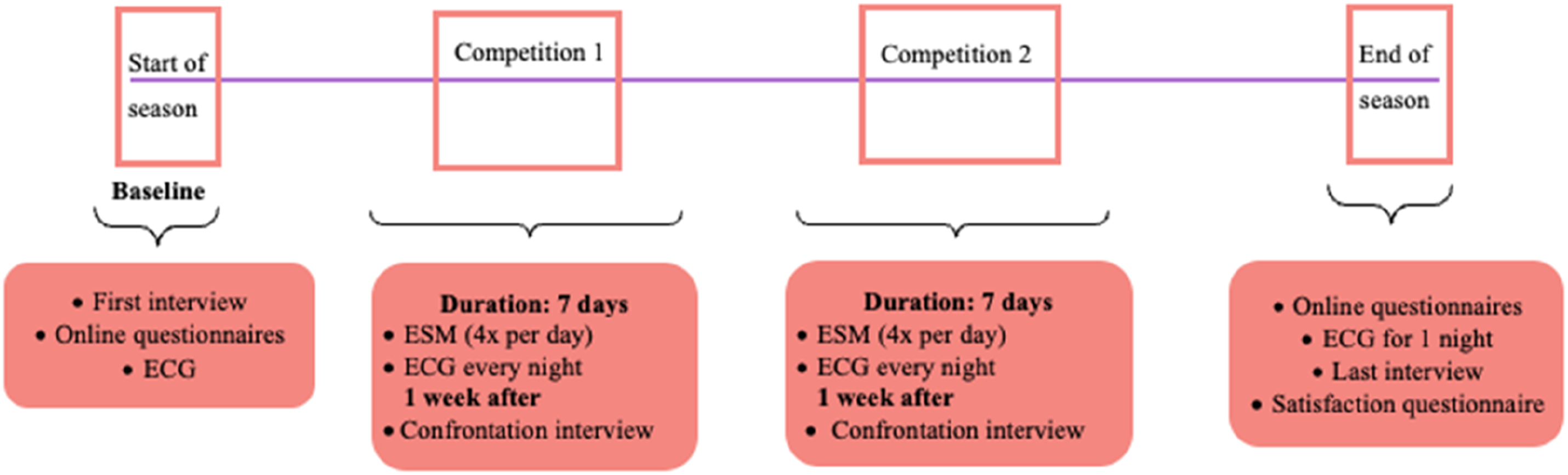
To explore daily fluctuations in eating behaviors, influencing factors, and stress, the present study employs the Experience Sampling Methods (ESM), a structured methodology that captures individuals’ real-time experiences and behaviors in their natural environments (Myin-Germeys et al., 2018; Myin-Germeys & Kuppens, 2022). Participants complete multiple self-evaluations daily over several days, thereby reducing the influence of retrospective bias. ESM allows for the detection of fine intra-individual variability over time (Myin-Germeys & Kuppens, 2022). The daily questionnaires of this study were designed to measure concepts of interest at key moments of the day – upon waking, before training, after training, and before bedtime – to assess their fluctuations in relation to daily activities and training routines, as well as to evaluate potential cumulative effects of their repetition by the end of the day.
From a qualitative perspective, the life story approach (Gramling & Carr, 2004; McAdams, 2001) explores participants' experiences. Lifelines provide a visual representation of the life story by displaying events in chronological order (Gramling & Carr, 2004). In addition, the life story allows to detect the ways in which the synchronized swimmers have shaped their identity over their life (i.e., narrative identity; McAdams & McLean, 2013) and how key figures in their athlete’s life (e.g., coach, family, teammates), as well as existing sport norms (i.e., sport culture), may have influenced the way the athlete interprets and gives meaning to their eating behaviors and practices (Papathomas & Lavallee, 2014).
Data collection, currently ongoing, is expected to conclude by September 2025, covering all measurement periods outlined in the study design.
Recruitment and Participants
Participants were recruited between June 2024 and September 2024. Recruitment techniques included sharing the study flyer on social media (e.g., Instagram), and directly contacting swimming club managers (i.e., by writing to the club president or secretary) or coaches. Inclusion criteria were (a) participants must be 14–20 years old; (b) officially registered in a swimming club in a French-speaking part of Switzerland; (c) taking part in competitions; (d) taking part in organized training sessions (i.e., with a coach, within a defined framework); (e) being fluent in French; (f) giving a written consent for study participation and for the audio recording of the interviews. Participants with severe physical or mental health problem requiring intensive treatment were not eligible for this study and therefore excluded.
While quantitative methods rely on statistical calculations to determine the necessary sample size for a study, such justification is often not consistent for qualitative approaches (Braun & Clarke, 2022b). Therefore, based on the recommendations of Braun and Clarke (2022b) for qualitative methods, a maximum sample size of 10 participants was targeted for this study to ensure a balance between the study’s aims and its methodological approach.
Procedure
Instruments.

Note. Or = original version, Fr = French translation.
First Meeting and Baseline
During the first meeting at the participant’s home, participants receive all study information and sign the consent form. After that, they are asked to participate in a narrative interview and to create a lifeline, including key events and turning points of their sporting career that they consider significant, from their birth to the present day. Materials to increase creativity are provided (rulers, grey pencils, pens, colored pencils and crayons; Gutiérrez-García et al., 2021; Gramling & Carr, 2004). In a second step, the researcher engages the participant in a reflective discussion, using prompts such as “How did it feel?” and “What does this mean to you?” to elicit deeper insights into their emotions and interpretations of significant events (Papathomas & Lavallee, 2014).
Further, participants receive an electrocardiogram (ECG) device (Bodyguard 2, FirstBeat Technology; Oy, Jyväskylä, Finland) for an overnight home measurement to assess heart rate variability and are asked to complete a set of online questionnaires.
Competitions
During Competitions 1 and 2, participants are asked to complete directly onto their smartphone daily questionnaires (see supplemental material for more details) programmed at specific time intervals four times a day for 7 days (3 days before, the day of the competition, and 3 days after): a morning questionnaire (upon waking), a pre-training/competition questionnaire, a post-training/competition questionnaire and an evening questionnaire (before going to bed). If the participant forgets to complete one of these questionnaires, a reminder is sent within 30 min of the first text message. The average time taken to complete a questionnaire is 3–4 minutes. During these 7 days, participants also wear the ECG device overnight, removing it upon waking.
Self-confrontation interviews are conducted with each participant approximately 1 week after the competition to give the researchers time to collect the daily data, generate the time series and analyze them. Time series are generated for each of the daily measured variables and presented visually in the form of a graph. These time series, symbolically retracing the competition week, are presented to the participants to facilitate reflection on their experiences and allow participants to explore the convergences and divergences between their “objective” (as represented by the quantitative data) and “subjective” experience, providing an opportunity for retrospective analysis and verbalization of their lived experiences (Monthuy-Blanc et al., 2008). This method enriches the purely quantitative data by eliciting qualitative insights, as participants recount and contextualize their experiences based on their data.
End of the Season
At the end of the season, the participant completes another series of online questionnaires (same as baseline) and wears the ECG overnight and participates in a final self-confrontation interview. This final interview includes questions about their satisfaction with the study.
Data Analysis
For data analysis of the study, the measurements obtained from the questionnaires, ESM, and ECG will be plotted on graphs to illustrate fluctuations over time. Descriptive statistics, including mean, standard deviation, and range, will provide insights into the average levels and (in)stability of the variables. Time series analysis will focus on within-subject variability, examining changes in variables for the same individual over time (Velicer & Molenaar, 2013). As the aim of this study is to highlight the individual trajectories of athletes, we will not attempt to make statistical comparisons between subjects. This idiographic approach will allow us to measure the effects of stress on the different variables measured over time in each athlete. All analyses will be carried out using R software version 4.2.2 (R Core Team, 2022).
Two complementary approaches will be used for analyzing qualitative data, namely narrative analysis (Murray, 2017) and reflective thematic analysis (Braun & Clarke, 2019, 2022a). Reflective thematic analysis is a recognized and widely used approach to understand people’s behaviors and practices, the meanings they attribute to these practices and behaviors, the factors and processes that shape and influence a particular phenomenon, and the rules and norms that shape these behaviors and practices (Braun & Clarke, 2022b). The narrative analysis complements the thematic approach by delving into the structure, delivery, and socio-cultural context of participants’ stories (Smith & Sparkes, 2012). Three dimensions will be considered: the personal, interpersonal and socio-cultural dimensions (Murray, 2017). The personal dimension concerns the internal structure of the narrative, that is, the way it is organized, the interpersonal dimension focuses on the everyday interpersonal context of the participant, and the socio-cultural dimension considers the wider socio-cultural context (Murray, 2017). In parallel with the narrative analysis, a reflexive thematic analysis is envisaged with the aim of generating themes (i.e., patterns of shared meaning underpinned or unified by a central concept; Braun & Clarke, 2019). To this end, the analysis process will be divided into six phases, as suggested by Braun & Clarke (2006). The first phase will consist of familiarizing ourselves with the dataset by reading and re-reading the data, while making notes in the margins of the transcripts (i.e., noting our observations and analytical ideas). The second stage (i.e., coding) involves generating ‘codes’ that capture important features of the data that are likely to be relevant to answering the various research questions. The codes are then collated to generate initial themes (i.e., the third stage). The fourth stage will involve developing and revising the themes generated in the previous stage, and the fifth stage will involve refining, defining and naming these themes. The themes are generated at the semantic level (i.e., using concepts directly communicated by the participant) and at the latent level (i.e., considering deeper latent concepts). The final stage is writing, i.e., composing the analytical narrative with the data extracts and contextualizing the analysis in relation to the existing literature.
Ethics
The study protocol was approved by the Cantonal commission for Ethics in Human Research (CER-VD) in Switzerland (no. 2024-00496). The study is conducted in accordance with the ethical principles outlined in the Declaration of Helsinki. Before the first meeting with participants, each of them is informed about the aims of the study and their rights and receives enough time to decide on study participation before giving their written consent. In line with ethical principles and best practices in qualitative and quantitative research in psychology, participants can refuse to answer any questions that they are not comfortable with and can withdraw from the study at any time without justification and without further consequences. Confidentiality of the participants’ personal data will be guaranteed throughout the whole of the research process and to reduce identification risk each participant can choose an assumed name for the study participation period. A compensation of CHF 200 will be offered for full study participation. In addition, the research team includes a federally recognized psychotherapist with a specialization in childhood and adolescence psychotherapy, who follows the principal researcher on a weekly basis to discuss questionnaire results, interviews, problems encountered, etc. During these supervisions, if the researcher and supervisor identify clinically relevant eating disorder symptoms in one of the participants, a predefined action plan is implemented. This proposed action plan involves the distribution of a list of accredited therapists to the participant. Any therapy initiated by the participant concurrently with the study will be considered in the interpretation of the results.
Rigor
To ensure methodological rigor in this mixed methods study, we adopt several strategies aligned with core qualitative research quality criteria: credibility, transferability, dependability, and confirmability (Thomas & Magilvy, 2011). Triangulation across quantitative and qualitative data will improve validity and reliability of the study (Flick, 2017). Specifically, the integration of quantitative findings into confrontation interviews allows participants to reflect on and contextualize the data, reinforcing the credibility and deepening the interpretation of results (Thomas & Magilvy, 2011). Throughout the data collection and analysis phases, the first author will write memos in which she records her thoughts, observations, preliminary interpretations, and methodological decisions (Birks et al., 2007). These memos will serve both as reflexive tools and as sources for triangulation with interview data. Additionally, a subset of interviews will be independently coded by another researcher to ensure coding reliability and limit interpretative bias. Although the project is mainly managed by the first author (the PhD student), the last author (her PhD supervisor) closely supervises the research. Regular meetings (once a week) are held to discuss results, emerging themes, and any difficulties encountered. These interactions support critical reflection and help reduce individual bias, thus contributing to the study’s dependability. Furthermore, external experts in youth and adolescence studies, clinical and health psychology, and qualitative methods will be consulted during data analysis and manuscript writing to strengthen interpretative validity and enhance analytical depth. Finally, to ensure transferability and the possibility of replication in other contexts, a detailed description of the methodology, a rich contextual description of the study participants and of the research setting will be provided in the publications as suggested by Thomas and Magilvy (2011).
Discussion
This study will contribute to a deeper understanding of DEB among athletes and its evolution during a sports season. As the project aims at understanding individual trajectories of athlete’s eating behavior, the combined observation of eating behavior changes, eating behavior’s influencing factors (e.g., pressure related to weight, commitment to sport, self-esteem), and the impact of perceived stress levels during challenging periods of performance and non-performance within a sports season will allow us to identify high risk conditions for DEB.
In order to understand eating behavior in an individual context, an innovative and rigorous methodology is used combining both qualitative and quantitative approaches that allow participants to explain and therefore make sense of their responses. This approach shall provide a broader understanding of the influence of sport-related factors on eating behavior, but also how these factors vary over the course of a season, and to what extent these factors have a stronger influence on eating behaviors at specific times of the sports season.
In addition, this study determines whether experienced stress, and more specifically the individual stressors that athletes face in their daily lives and in their sport activity, influence their eating behavior during performance and non-performance periods of the sports season. Further, by measuring perceived and physiological stress at different periods of the sports season, the impact of its potential changes and its association with eating behavior can be detected and shall help to understand high and low risk periods of a sports season. Last, adopting a social constructionist perspective, this research will provide access to the meanings that athletes relate to their eating behaviors and practices, as well as to the diurnal variations in influencing factors, and understand their way to making sense and allows us to contextualize these practices to improve prevention of disordered eating behavior among adolescent athletes in Switzerland.
Supplemental Material
Supplemental Material - Individual Trajectories of Eating Behavior in Adolescent Athletes During a Sports Season
Supplemental Material for Individual Trajectories of Eating Behavior in Adolescent Athletes During a Sports Season by Amandine Franzoni, P. Ruggeri, F. Brodard, and N. Messerli-Bürgy in International Journal of Qualitative Methods
Footnotes

Statements and Declarations
Funding
The authors received no financial support for the research, authorship, and/or publication of this article.
Conflicting Interests
The authors declared no potential conflicts of interest with respect to the research, authorship, and/or publication of this article.
Supplemental Material
Supplemental material for this article is available online.
References
Supplementary Material
Please find the following supplemental material available below.
For Open Access articles published under a Creative Commons License, all supplemental material carries the same license as the article it is associated with.
For non-Open Access articles published, all supplemental material carries a non-exclusive license, and permission requests for re-use of supplemental material or any part of supplemental material shall be sent directly to the copyright owner as specified in the copyright notice associated with the article.
