



Abstract
Many qualitative studies are carried out by interviewing one participant. When understanding the dynamic interactions and consented conclusion of two or more participants is the research focus, single-participant interviews are not adequate as they can only provide a one-sided picture of the phenomenon. Dyadic interviews capture interactions between two participants. However, no reports of triadic interviews in research have been used by researchers with three participants and an interviewer. This article introduces this advanced triadic interview method. It explains and uncovers the process of applications from pre-planning to implementation. Examples of interviewing three participants including a patient, a family caregiver, and a healthcare professional are included to illustrate the dynamic interactions unfolded in the triadic interviews. The role of the interviewer, facilitation skills and analysis of the triadic interviewing method are also explained. The triadic interview is a viable data collection method for studying a phenomenon involving three participants. It has the advantage of accessing both individual and interactional level influences between three participants on individuals’ behaviours simultaneously.
Keywords
Introduction
Interviewing is frequently used to collect qualitative research data to explore and understand a particular phenomenon (Gill et al., 2008; Gubrium & Holstein, 2001). One of the advantages of using interviews in data collection is its ability to explore in-depth and insightful perceptions of a person’s view on a given topic (Kobori et al., 2008). Most often, an interview occurs between a single participant and the researcher. When the research question is about an experience shared by two participants, such as a patient-doctor or parent-child issue, studies interviewing one of the participant or one by one participants individually in two separate interviews may only obtain the views of the participant from a single person’s perspective without the views that stimulated by another participant on the phenomenon. Besides, the spontaneous dynamics of power would not be easily captured in the interview with a single participant and interviewer (Szulc & King, 2022). Morgan and colleagues introduced dyadic interviews as a qualitative research tool as an option to improve the data collection method. Two participants of different roles attend the interview together, the interactional conversations between the two participants and between the participants and the interviewer were captured (Morgan et al., 2013, 2016). This method has been widely adopted in health-related studies, with patients and their caregivers s; or in family studies with parent-child or spouses as the dyad in the interview. Kvalsvik and Øgaard (2021) in their study found dyadic interviews were particularly effective in exploring a topic that often involves a joint decision.
However, there are phenomena involving more than two participants, and their interactions in a process determine the outcome, such as decision-making (Lindholm et al., 2020). A systematic review by Munthe and Westergård (2023) highlights the importance of tripartite relationships among students, teachers, and parents. They recommend studying triadic interaction in the tripartite relationship to understand the communication process at the parent-teacher conference better. Another systematic review by Suen (2024) similarly recommends that accounting for the interactions in a tripartite relationship between a patient, a healthcare provider, and a caregiver could be critical to achieving positive health and social outcomes for the patients. The reviews suggest the impetus of studying triadic interactions for future research. Interviewing three participants at a time, or triadic interviews, can be a solution.
Though there are publications describing triadic interviews, they might be of different meanings. Finch and colleagues (2023) position a three-way exploratory conversation between two interviewers and an interviewee. As for Shibli-Rahhal and Kreiter (2021), the three participants are a clinician interviewing a patient with an accompanying person in the clinical setting and not for research purposes. Based on Morgan’s definition of dyadic interviews as researcher interviewing two persons at a time, triadic interviews logically defined as those with three participants, which are different from the two former usages of the term. In sum, triadic interviews in this article refer to the meeting of one interviewer with three participants simultaneously.
This paper thus aims to unfold the steps for applying triadic interviews in research, including preparation, implementation, and analysis. It also discussed the assessment of appropriateness and special considerations in using triadic interviews. This account is supplemented with examples from a study adopting triadic interviews to understand the dynamic interactions among three participants in Advance Care Planning (ACP) carried out by the authors in 2022, researching the elements of the other two participants that affect one’s intention for ACP.
Comparison of the Different Types of Interviews as Data Collection Methods
There are merits and drawbacks for each type of interviews. Individual interviews which involves one participant with one interviewer, is generally be valued of the more detailed information revealed than other methods and the interaction between the participant and the interviewer (Hofisi et al., 2014) while dyadic interviews enable clarifications with the other participant through sharing their perspectives and experience and generate a greater variability of themes in the interaction process that beyond interview(Morgan, 2016). Focus group interviews aimed to collect multi-partite perspective (McLafferty, 2004; Collier & Morgan, 2002). The participants of focus group interact in the process, yet the interactions and process are not the core of the analysis (Morgan, 2019).
Characteristics of Individual, Dyadic, Triadic Interview and Focus Group.

Triadic Interview
Interviewing three participants from three different roles in the same interview is not a simple extension of adding the number of participants in an interview. An additional individual in the same interview necessarily complicates the dynamic interactions and processes. The interviewer may also need to manage how implicit power dynamics discourage an individual from speaking, especially when one or two participants hold greater hierarchal power over another in the triad. Hence, use of triadic interview as the data collection method requires stringent assessment on its purpose and structured preparation.
Preparation
A triadic interview shares similarities with a dyadic or paired interview, which focuses on the interactions of individuals participating in the same interview to co-construct an experience (Bjørnholt & Farstad, 2014; Morris, 2001; Radcliffe et al., 2013). In this regard, the interview flow needs to accommodate individuals in expressing their views on themselves and other participants or the environment while at the same time receiving feedback from other participants. The flow must also facilitate reciprocal interaction to enable participants to clarify and respond, modify or change their original stance, or create a new perspective on the phenomenon. In addition, the researcher must carefully consider the pairing of participants; either adopting a natural pairing, such as the teacher and student of the same class, or a pairing for study purposes, such as any teacher with any student. Such pairing would influence the recruitment and impact the participants’ interaction in the interview. Studies researching a relationship-based phenomenon much prefer natural pairs, but some studies also interviewed participants separately due to recruitment or ethical challenges (Bhattacharya et al., 2021; Jia et al., 2022). Additionally, Morgan (2016) introduced the steps in the dyadic interviewing process, from selecting participants to the moderator role and analysing results, and key issues such as pair rapport, ethics, confidentiality, and dealing with sensitive topics. These are all applicable to the triadic interview with adaptation to the multiplied interactions.
Selection of Trio Type
A trio can be a natural trio with a pre-existing relationship such as parent-child-teacher or unrelated participants which known as research trio. Yet, there should be one common thread related to the research question among the participants. For example, in a study of examining a new product, the producer – consumer – salesman are linked by the interest in the product yet they have no prior relationships. The choice of type of trio is guided by the study objectives and how these participants would relate to the interview topic and each other. Patients at different stages of illness, caregiving roles of the caregivers and to whom the healthcare professionals are caring for would affect the perceptions of others in the initiation of ACP. For this consideration, the ACP study drew on the natural trio of the patient, caregiver, and responsible healthcare professional to participate in the triadic interview, a natural trio would facilitate participants to engage in the interactions and reflect its tripartite nature in reality. Use of a natural trio in research would need to take note on the recruitment including the time, sequence, the interview process, and concerns about post interview, these would be addressed in the later part of the article.
Sampling & Size
Samples in qualitative research tend to be smaller than in quantitative research to support the depth of case-oriented analysis. They are usually recruited through purposive sampling, i.e., they are selected by their capacity to provide richly textured information relevant to the phenomenon under investigation (Vasileiou et al., 2018). Similar to other interviewing methods, the sample size for triadic interviews is contingent on several factors relating to epistemological, methodological, and practical issues (Baker & Edwards, 2012). As the ACP study aimed to explore the thematic elements of the dynamic interactions affecting one’s intent for ACP, the variability of the trios is more important than the number of trios. In the ACP study, we used a sampling frame guided the study recruitment to maximize the variability of trios and coding the verbatim spontaneously to decide on the number of trios required for the study. Ongoing revision on the practicability of the variety of trios is needed, in the ACP study, all the enrolled experienced doctors working in the hospital have experience in conducting ACP which reflected the reality in the clinical field. Designing the sampling frame should therefore, balance the research rigorous as well as the practicability
Recruitment
The identification of potential participants is vital in all types of interviews. An explicit deliberation to the referring source regarding the target participants and the inclusion and exclusion is essential. When related trios are used in triadic interviews, it is advisable to reserve more time for recruitment as the consent all three trio members is required and finding a time available for three to meet is challenging. Collaborating with organizations connecting with the study population, such as schools, health- and social-care settings, will increase the chance of identifying potential study participants, and the affiliation may enhance recruitment success. The chance to approach all three target participants of a natural trio at the same time is far less than a dyad in the dyadic interview. In the ACP study, the caregiver may be presence in the same occasion, besides, the autonomy to participate in the research may be influenced especially when decision must be made in front of the others. Hence, in the triadic interview, the sequence of recruitment is important.
Researcher using triadic interviews of a natural trio must carefully design the invitation sequence. As one party might have a busier schedule or other commitments which reduce their chance of joining the interview, invitation should first extend to this group in the trios. If the other two members who agreed to participated and being informed the decline of this member, they might associate this decline as personalised rejection and might have impact on their existing relationship. In the ACP study used a trio of patient, patient’s caregiver and healthcare professional, it started by inviting the potential healthcare professional before approaching the patient and his/her family caregiver for two reasons. First, when the healthcare professional accepted the invitation to participate in the triadic interview, the recruitment of patient and caregiver would be focused on those under the care of the healthcare professional. Secondly, it would minimize the unnecessary interpretation of rejection from the healthcare professional. When the patient agreed to participate, they named their family caregiver and the recruitment staff extended the invitation to the family caregiver. When a patient turns down the invitation to participate in the interview, no approach is made to the family caregiver, while the healthcare professional is more accommodating if patient declines to take part in the research. As a result, the patient and the family caregiver were empowered with respect and autonomy, making the recruitment process uneventful.
Implementation of a Triadic Interview
Trio Rapport and Participation
One of the primary concerns of conducting a triadic interview is balancing opportunities for participation. Setting the scene is crucial to ensure all participants have their turn to share on the topic, respond to others, and listen to other participants without interruption to capture all messages. With through preparation before the conversation starts, participants would not feel offended but are psychologically prepared. Some mediation techniques effectively engage and facilitate interactions involving participants with diverse interests (Doyle, 2021; Tan, 2012). The pre-interview chat can stimulate interactive conversation and enable the interviewer to make a preliminary assessment of whether any adjustment in the moderating style is needed. Before the interview starts, the interviewer needs to orientate participants about the interview process and principles, including the equal importance of all participants and the fact that diverse opinions are to be expected and respected. This is more relevant to culture which concerns relationships and hierarchies.
Participation can be facilitated by initiating a more general question at the start, making an open invitation to the trio, and having the trio decide whom to go first. The rationale is that some participants might feel pressured if they are named. However, if the invitation is made directly to a particular participant, it may also be misinterpreted that person has higher authority. On one occasion in the ACP study, the interviewer needed to propose that one participant start because no one indicated a willingness to do so after a lengthy silence. Who to be invited depends on the interviewer’s assessment? In the above situation, the interviewer assessed that all participants were being courteous. The patient was invited to begin because the discussion focused on the patient’s end-of-life care. In this situation, starting with the patient seemed more natural. However, if the interviewer assessed that the patient or family caregiver was not ready to start, they could prompt the healthcare professional subtly, such as by an invitation hand sign. Healthcare professionals are usually more oriented to the interview context and more used to having a sense of control; therefore, they tend to be more responsive to initiating the conversation. In the ACP study, most conversations started naturally without the interviewer’s intervention.
When a participant mentioned another participant, the interviewer would facilitate the named participant and the third participant to respond. The responding participant can agree or disagree with what was said. The participants can also ask for clarification or explanation to deepen or extend the content. For instance, the following exchange occurred in an ACP interview: Patient: She [doctor] is someone I know, so when she suggested discussing how I would like to be cared for in my last phase, I agreed. Doctor: I also found it is easier to talk with her [patient] and her daughter because I have clinical follow-up on her for a period; however, in real life, it may not be feasible to know every patient before discussing ACP for various reasons. I think at least not meeting at the first time is ideal. Patient: Well, ‘knowing’ a person is not just about the number of times you have met; it is a feeling of knowing and confidence.
The above dialogue illustrated that a triadic interview could collect information on participants’ responses, and the interaction of the participants provides information from different perspectives and gives further details on its meaning.
Facilitation can simply mean inviting a response or prompt by an inviting gesture. Reciprocal responses are welcome until participants feel there is no further information to add. Flexibility is also permitted when the current conversation simulates participants to provide additional information regarding the previous conversation. The interviewer would invite participants to elaborate on the shared similarities and differences to expand the depth of knowledge. The interactive interview style aims to promote constructive interaction to gain rich information; neither the sequence nor frequency is fixed. However, the interviewer does have a role in balancing each participant’s opportunities to share.
Power Dynamics
Power dynamics occurs daily in our lives. In interviews, the dynamics can be induced by pre-existing factors such as educational level, professional background, or relationship of the participants involved (Anyan, 2013). Participants, supposedly, have their turn to express their views, and other participants may respond to what is said. Yet in a triadic interview, there might be chances of disagreement between participants with difference in power level, such as teacher and students. The one with lower power might choose to be silent or sharing socially desirable answers. Besides, two participants may form alliances to influence or defend against the other participant during the interview. This power can shift between and among participants during the interview, not necessarily being consistent throughout the interview (Leary, 2020). Thornborrow (2014) described power in discourse as constantly negotiated and constructed between participants. Apart from being aware, the interviewer needs to be ready to accommodate the power dynamics in reality. As the trio members have interdependent relationships all along, the interview would not induce new dynamics although, the interview context is not an ‘normal situation. The interview might offer a new experience to review and reflect on their dynamics under the sensitive facilitation of the interviewer.
Our example of collecting views on the elements of others in one’s intent to initiate ACP in the triadic interview can further illustrate the benefit over risk in the power dynamics. As the study is a conversational discussion of what elements of other two participants are important rather than an actual ACP process of the specific patient, the emotions induced in the actual personalised ACP process was not present. The pre-existing dynamics can still be reflected in the process but to a less intense level.
Our principle in dealing with the power dynamics in triadic interviews is to address the issue openly at the beginning of the interview. The interviewer in the ACP study deliberately used an opening statement to normalize disagreement that may occur in the interview and, simultaneously invited the participants to co-create ground rules to ensure all participants had equal standing. This part usually takes five to 10 minutes but gets the participants ready in working together. The researcher should sensitively monitor the interactions but maintain the least intervention as illustrated in the following extract from the ACP study: Family [son]: She [the patient] does not know what is good for her. Therefore, I need to take charge and make decisions. Patient [with her head facing down]: Yes, my son is more educated, and he knows more. Doctor: Your mother’s wish is important too, because the ACP is about her preference for care in the future, and we need to respect her view. Interviewer: Can you (patient) elaborate on how you would want your son in the ACP discussion?
In a triadic interview, the interviewer can be directive and has a role to balance the opportunity, re-direct the focus of the discussion, or divert the energy from the dynamic to constructive meaning: Interviewer: I heard a common concern but different views on important elements in decision-making. Can I invite each of you to say more about what you consider important in the ACP decision? How about we start with [name of patient]?
Power dynamics are not necessarily destructive and harmful in research using triadic interview but it can also be an opportunity for the researcher to explore a deeper and multi-dimensional understanding of the phenomenon through awareness and appropriate facilitation. The key is how to facilitate the interaction that encourage open and honest communication where each party can express their views without fear of retribution. In the ACP study, the healthcare professional may be perceived with higher power on patients and caregivers resulting less speaking up or hesitate to disagree of the patients and caregivers. Thus, sensitive towards the exist of possible power dynamics among members is important. The interviewer highlighted the purpose of the interview is to uncover and clarify the elements of the other participants that would affect one’s intent to initiate ACP, this raises the participants’ motivation to make their views known and listen to other participants on how they affect the others. In the triadic interviews, participants were also encouraged to give response to a party or make clarification directly or as the third party. Participants in the ACP study revealed they valued this process of the interactions much and understood much more of themselves and other participants than they perceived before the interview. Active intervention by the interviewer would be needed only if there is a continuous dominant state of one party that interrupted or threatened the opportunity of the other participants to give their views.
Role of the Interviewer
Conducting a triadic interview actually is a quartic event. The interviewer, participates as a moderator in the triadic interview, influences the conversation flow between participants and data richness (Morgan et al., 2016). If the interactions among participants is the focus of the study, a less-directive approach is preferable to allow the natural flow of the participants’ communications. It is more likely to capture the eventual discursive changes in participants (Morgan, 2016). At the same time, the interviewer is also responsible for orchestrating the interview in a constructive direction. It is important to set the scene to explain the interview format to all the participants as part of the instructions. For example, in the ACP study, before the interview began, the interviewer explained that the participants owned the communication flow but observed the “listen and feedback” rule and solicited all participants’ commitment to participate actively. The interviewer would maintain non-interferent as far as possible to let the conversation continue unless facilitation was indicated, such as exceeding a reasonable silence or a destructive interruption.
The interviewer must promote constructive interaction to gain rich information. The sequences and frequency of participants’ participation are not fixed. However, the interviewer must observe the opportunity to share with each party. Demonstrating ‘curiosity’ can be a way to invite a relatively quiet participant to share when another participant is more dominant. Notwithstanding, the context and quality of the interaction count more than the length of time each participant talks.
Facilitation Skills
A less-directive moderating approach does not mean no facilitation in the interview. The interviewer must be competent in applying facilitation skills with the right timing. The interviewer needs to apply no more than necessary facilitation, and very often, simply prompting by an inviting gesture is sufficient. Reciprocal responses are welcome until the participants feel they have no further information to add. Flexibility should be applied when current conversation simulates participants, and they want to give additional information about something discussed earlier in the interview. The interviewer would invite the participants to elaborate on their shared similarities and differences to expand the depth of knowledge.
The interviewer can use paraphrasing skills to facilitate interactions or re-direct when the discussion deviates from the focus. A paraphrasing skill used in the interview is to recap the focal message and invite a response, for example, “XX mentioned your XX. How do you perceive this?”. Sometimes, the interviewer also uses themselves to create paraphrasing prompts such as “You seem to want to respond. Is that right?”. Paraphrasing skills can help participants who need more time to digest the information or are less adaptable in the interactional environment. Facilitation can also be a follow-up invitation to elaborate on a response or provide suggestions. These techniques are all generic and require basic facilitation skills but they can stimulate quality interactions, especially at the beginning of the interview. In the experiences of interviewing in our ACP study, we found that two-thirds ofthe interviews (nine out of twelve) could have natural ongoing discussions after the first round of facilitation. Those who required ongoing facilitation were mainly aged patients and spouses; the facilitation involved recaps of conversations; and prompts to encourage participants to comment and elaborate further on their views.
At times, the interviewer may join in to confirm or clarify messages that seem to be unclear or under-elaborated. All participants can re-regulate their views in the interaction process, and reciprocal exchange of ideas is encouraged until no further new information is developed. Before ending the interview, the interviewer can invite all participants to contribute any “free information” regarding the phenomenon that has not been covered in the interview. This practice gives participants a sense of completeness.
Coding & Analysis
While the knowledge of analytic techniques on dyadic interview analysis is still insufficient (Morgan et al., 2016), there is even less guidance on triadic interview analysis. The ACP study referenced Collaco and colleagues’ (2021) multi-perspective analysis framework and adopted a stacking-up coding method to analyze the interview content. In a triadic interview, coding starts as an ordinary interview to structure the themes. As the specific interest is on the interactions between participants, analysis adds the levels of interactions, including individual, dyadic, or triadic levels, further indicating the direction of these interactions. Specifically, the sequences of conversation as well as the sequences of the phenomenon are taken into account to understand the process and influences. The stacking-up coding method can accommodate multi-directional interactions among the participants. For instance, in the ACP triadic interviews, there was a bi-directional interaction found between patients and doctors on ‘talking to someone I know’, but this interaction was not found in the caregiver. The coding method is illustrated in Figure 1, with A refers to the patient, B refers to caregiver of patient, and C as the healthcare professional of the patient. In addition to identifying themes, themes can be classified from an interaction perspective, such as overlaps and contrasts (Eisikovits & Koren, 2010). Interactions analysis.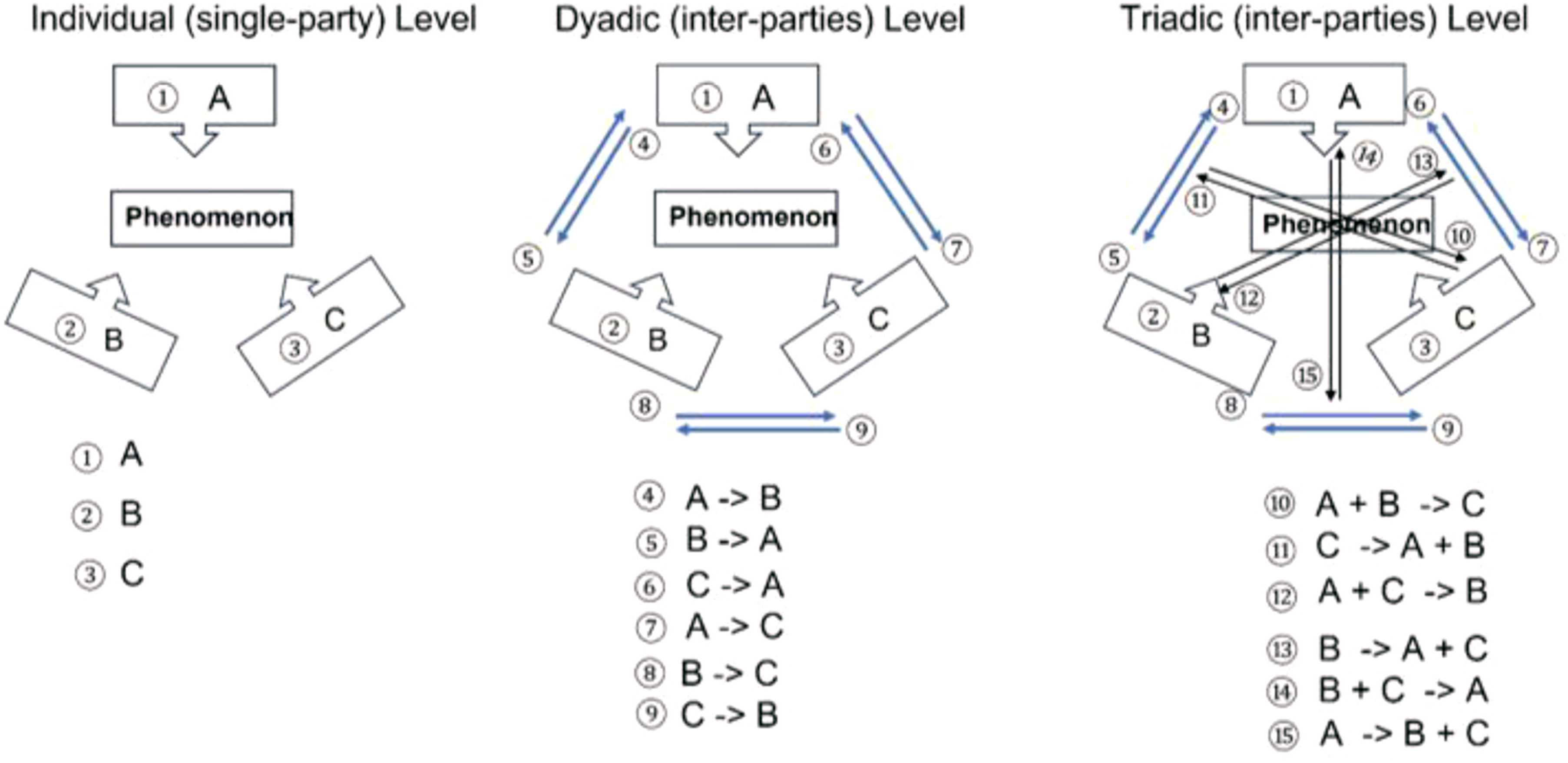
Discussion
Assessment of the Appropriateness of Using Triadic Interviews
Like other data collection methods, the triadic interviewing method should be chosen based on the research objective. The method should match with the initial research question before considering to the benefits and drawbacks of the method, and the acceptance of the interviewees.
Triadic interviews focus on capturing the iterative interactions in which the three participants may respond to each other to clarify understanding by asking questions, adding details, or extending the content to produce richer information about the phenomenon. Examining the dynamic interplay between participants is important not only for research seeking to clarify the characteristics and properties of each participant’s behaviour, but also for research to understand their influence on other participants’ behaviours (Morgan et al., 2013; Szulc & King, 2022). Thus, triadic interview is best suit for research with the objective of studying the interactions. Yet, the potential risks such as the induced impact on the three participants with pre-existing relationships should be assessed ethically. For example, a triadic interview of three staff of different ranks, the expression of the participants may be limited by the preconception of the appraisal experience and may also affect the future appraisal judgement. It does not mean that triadic interview should not be used, but aside from matching the research objective, it should be used when there are benefits over the other traditional methods.
Morgan and his colleagues (2013) highlighted that a crucial consideration in the dyadic interview is that interview participants are genuinely interested in the researched topic and want to know the views of the other participants. Nevertheless, there are challenges when implementing triadic interviews. First, when three participants are involved in the same interview, the balancing of equal opportunity for each to share their views should be managed. Second, moderating the interview that allows naturally-flow interactions among three participants is a demanding skill. Third, analyse the multi-perspective data requires a critical lens and framework. To illustrate these considerations, this article uses our study on patients, family caregivers, and healthcare professionals’ views of the Advance Care Planning (ACP) as an example. The interviews were conducted from August to November 2022 and ethical approvals were obtained from the research institute and the data collection site. ACP is a healthcare activity involving an iterative communication process that discusses the patient’s preferences regarding future end-of-life care (Sudore et al., 2017). Although the contents of ACP concern the patient’s end-of-life care, the other two participants are interconnected by their influential role in providing or impacting the care (Batchelor et al., 2019; Cheung et al., 2020; Suen et al., 2024). In the communication process involving a patient, caregiver, and healthcare professional about the patient’s preferences regarding end-of-life care, each party may influence the response of others and, at the same time, may be influenced by others and lead to a different outcome. The study conducted triadic interviews with the patient, caregiver, and healthcare professional and captured not only the essential elements perceived by individuals on the self and others that would affect the initiation of ACP but also the influence of the dynamic interplay on the intent of initiation, including pushing toward or holding back from initiating ACP.
Special Considerations
Interviewer’s Competency
As discussed earlier, interviewers require the engagement, facilitation, paraphrasing and clarification skills. Compared with single-participant interviews, the demands on the interviewer’s capability in a triadic interview increase, including handling different participants’ reactions, arguments, disagreements, or even conflicts. The sensitivity in understanding the unspoken dynamics and power differences, the sensibly in managing conflicts yet exploring diversities constructively and co-creating commonality are all demands on the interviewer. Having experience working with families or people in a group, equipped with facilitation skills or basic mediation or conflict resolution skills will be an advantage. Nevertheless, the competency of interviewing also comes from good preparation. Understanding the interview objectives, getting to know the participants before the interview, a thoughtful plan for the interview flow, and the contingency arrangement are important.
Interviewer as an Outsider or Insider
The status of the interviewer in the interview is another consideration. In a one-to-three interviewing process, it can be presumed as triadic perceiving the interviewer as an outsider, but it can be perceived as quadric that the interviewer is an insider as the interviewer’s presence in the process is inevitable. The perception of the status of the interviewer would affect the interviewing and the analysis; thus, a clear deliberation and transparency of the interviewing process are important for the readers in the interpretation of the findings.
Conclusion
In summary, this paper introduces the extension of the dyadic interview to triadic interview to accommodate the three participants simultaneously for data collection. Building on the Morgan’s dyadic interview, the considerations unique for triadic interview process staring from considering the suitability, planning, recruiting, implementing and analysis are discussed. Specifically, the competence required by the interview and analyst of data is higher. Triadic interviews can offer rich information from individual and interpersonal perspectives for research on dynamic interactions. It is a viable data collection method for studying a phenomenon involving three participants not only be an efficient way to capture three participants’ perspective but also effective in deepening the collected information and unfold new perspectives through the interactions among participants. However, research using triadic interview is still scant and the appropriateness of using triadic interview as the data collection method is subject to the aims of the research. The interview design and preparation including the sequence of recruitment and set out rules to assure the equal participation, as well as the monitoring of the interaction process are crucial attributes to the quality of the data collection. This article demonstrates the method and navigates the potential challenges with the solutions suggested through the ACP study. The application of triadic interviewing method should not be limited to health phenomena but can be applied to other social and 553 educational topics involving interactions. Research using both individual and triadic interviewing method studying a phenomenon can help to provide further knowledge in the applicability and unique contribution of triadic interview.
Footnotes
Acknowledgments
The authors would like to express gratitude to the clinical teams of Caritas Medical Centre, Hospital Authority; Jockey Club End-of-life Community Care Project, The St. James Settlement; and Hong Kong Association of Gerontology in the recruitment of participants and offering feedback on the methodology.
Declaration of Conflicting Interests
The author(s) declared no potential conflicts of interest with respect to the research, authorship, and/or publication of this article.
Funding
The author(s) received no financial support for the research, authorship, and/or publication of this article.
