




Abstract
Qualitative data collection using online focus groups is increasing in popularity. However this may change the way discussion is created and steered by the participants and facilitators in these focus groups and so potentially influence the data collected. In a focus group study exploring end of life family conversations in African and Caribbean heritage communities, two focus groups were held face-to-face and a further three took place online using the online video conference software, Microsoft teams. Sociograms and an interaction questionnaire were used to analyse participant interactions in each group. The study involved 21 participants across the five groups. The use of sociograms showed that direct participant to participant interactions were rarer in the online groups, most interactions went via the facilitator who as a result retained more power over the direction of the conversation. Participants responses analysed using the interaction questionnaire showed that participants were stimulated by the experiences of others in both contexts. The facilitator found it harder to create rapport in the online groups than in the face-to-face groups where conversation between participants seemed to flow more smoothly. The observer notes suggested that non-verbal communication was less evident in the online groups. In larger groups people made more use of turn taking using the hands-up function and chat box than in smaller groups where all participants could see each other more easily on screen. Researchers need to be aware of the impact of different delivery modalities on group interactions and how this may change the power dynamics of who is controlling the narrative and therefore the data generated. Group facilitators may need find it useful to develop skills needed to maximise the conversational element of online forms of data collection.
Keywords
Introduction
Several benefits have been described to going online in interviews and focus group data collection, such as wider recruitment and increased disclosure (Brighton et al., 2018; Halliday et al., 2021; Mason et al., 2021; Matthews et al., 2018; Tuttas, 2015; Woodyatt et al., 2016). There are also commonly reported limitations associated with technological challenges for participants. However, post the COVID-19 pandemic, the expansion in the use of online video-based communication systems has reduced the number of people who are unfamiliar with such systems, increasing the possibilities for the use of online methods of data collection. This paper explores similarities and differences in participant interaction between online and in person focus groups using data from our qualitative study.
Exemplar Research Study Design: Exploring End of Life Family Conversations in Families of African or Caribbean Heritage.


There is a growing literature exploring how solutions can be found to ensuring a smooth technological experience online (Brighton et al., 2018; Menary et al., 2021). It is likely that online data collection will increase so it is important to understand more fully the impact this may have on data collected.
Influence of Interaction on Generation of Focus Group Data
Focus groups are a popular mode of qualitative data collection as their interactive nature can stimulate discussions and recollections by participants of experiences and events (Synnot et al., 2014). Much of the existing focus group literature reports on the generation of codes and themes from individual participant contributions in the focus group. However, proponents of focus group data collection suggest that the interactions within groups are important and analysis should consider their impact on the data generated (Acocella & Cataldi, 2021; Kitzinger, 1994; Kook et al., 2019; Krueger, 2014; Liamputtong, 2011; Morgan, 2010; Wilkinson, 1998). Morgan (2010) argues that even if the aim of using a focus group is to produce conversations, and the ideas generated are what is of interest rather than how they were created, it is important to take some note of the interactions in the group to determine whether ideas have been dominated by individuals or influenced in particular ways.
Focus groups are typically chosen when the purpose of the research is to gain understanding of how a community perceives a phenomenon, through discussion of divergent or similar views (Krueger, 2014). Focus groups also allow the study of how people engage in collective sense making (Kitzinger, 1994; Wilkinson, 1998), with a focus on co-created knowledge by the group rather than a ‘singular truth’ about the research question and the debates that arise around it (Rodriguez et al., 2011).
A focus group lies somewhere between a meeting, which has been preorganised and has some element of planned structure, and a conversation, where, with a degree of spontaneity, individuals pick up on one another’s contributions (Agar & MacDonald, 1995). Participants can be called by other participants to justify their views about a subject particularly when it is different to that held by others in the group who have also shared an experience (Liamputtong, 2011). Being asked to explain a viewpoint, can result in a deeper sense of processing of that view than perhaps is needed when describing one’s view or experience in a single person interview. As individuals present their experiences and perceptions, other participants become more conscious of their own perceptions and of the way in which that fits with collective elements of their experiences (Morgan & Hoffman, 2018). Group discussion often produces data and particular insights that might not occur when interviewing one person at a time (Ott, 2008; Synnot et al., 2014). Analysis of focus group data can capture the group’s constructed ideas about the phenomenon, when consensus and divergent views exist, how they are dealt with by the group and can raise possible solutions to a presented problem (Acocella & Cataldi, 2021; Lobe et al., 2022).
Moderator and Observer - The Role of the Researchers
The researcher/moderator’s role in a focus group is to be catalytic to encourage group discussion (Acocella & Cataldi, 2021). The success of the moderator role can have an impact on how much this interaction is facilitated and how safe participants feel to engage in this type of dialogue (Kitzinger, 1994, 2013). Interactive focus groups should enable people within the group to have more control of the agenda than in a traditional interview and if moderated well reduces the power of the researcher/moderator to drive the direction of the conversation. The second researcher takes the role of observer and makes notes during the process, noting down both non-verbal interactions and particular interactions between participants or perhaps the way a particular participant reacts to the ongoing conversation. This additional data becomes part of the interpretation of the data collected (Acocella & Cataldi, 2021).
Creating Rapport in Focus Groups to Promote Wider Discussion
Creating rapport within a focus group to enable interactive discussion to take place may need different skills dependant on the composition of the groups and the environment in which they are conducted (Acocella & Cataldi, 2021; Kitzinger, 1994). Whether it is useful for participants to be known to each or not is also debated (Brighton et al., 2018; Tates, 2009; Tates et al., 2009; Watson et al., 2006). People may be guarded in what they express dependant on their experiences and perceptions of the focus group and other participants. Dominance of one participant or subgroup in face-to-face groups is a common issue noted by focus group researchers (Kook et al., 2019; Schneider et al., 2002; Tates et al., 2009). Analysis of focus group interaction processes can pick up how the participants have influenced each other and where disparate views may have been silenced.
In conversations that may be of a sensitive nature, some groups may disclose more thoughts and feelings about personal things in individual interviews rather than in focus groups, such as like women talking about their body image (Kruger et al., 2019). Consideration of particular ethical issues relating to focus groups is important, including consent and confidentiality, if people perhaps reveal more than they expected to within the conversation (Sim & Waterfield, 2019). However peer support of others who have shared experiences has been found to be an enabling factor to encourage discussion about difficult issues (Kook et al., 2019; Seymour et al., 2002). Moving to online methods of data collection may make self-disclosure easier for some participants because they are less visible (Tates et al., 2009; Woodyatt et al., 2016).
Participation in Online Focus Groups
For some rural populations, geographically dispersed professionals, populations of unwell younger people, and vulnerable adults, online focus groups can offer more opportunities to participate than having to travel to a particular destination at a specific time (Brighton et al., 2018; Tates, 2009; Tuttas, 2015). The relative anonymity of online groups can also offer more opportunity for access, noticeable in groups such as young people discussing sensitive topics (Woodyatt et al., 2016). For focus groups to be culturally effective the environment must be intentionally designed to affirm participants (Foley & Timonen, 2015; Kook et al., 2019; Rodriguez et al., 2011).
Being online allows for different formats such as asynchronous online focus groups. Asynchronous discussions can be a particularly helpful format for some people to join a conversation and explore their experiences particularly around sensitive topics (Brüggen & Willems, 2009; Reisner et al., 2018; Synnot et al., 2014). This is illustrated by the popularity of online forum discussions.
Contributions people make in focus groups also seem to differ when conducted online. Over time as technological confidence increases, participants in synchronous online focus groups appear to contribute longer and more varied accounts. What has been less studied is how the interactions between the participants in the groups that are convened online alters and impacts on how the group functions and the data are produced (Morgan & Hoffman, 2018; Shaw et al., 2021). The following analysis is an attempt to explore this using our exemplar qualitative study.
Methods
Analysis of Interaction of Focus Groups
While conducting a research study exploring end of life family conversations in African and Caribbean heritage communities using focus groups, the research team had to transfer from face-to-face data gathering to using online video-based approaches during the covid 19 pandemic in 2020–2022 (Table 1). This experience offered the opportunity to explore the similarities and differences in the interactions in the focus group where the moderating team remained the same, but the delivery modality changed.
Different methods have been used to capture the interactional elements of focus group data (Morgan, 2010). Conversational or discourse analysis techniques have been used to explore the processes of the conversation that takes place such as using sociograms and word counts to explore the dynamics of interaction (Drahota & Dewey, 2008). Some researchers are interested less in the process of conversation that takes place and more in the co creation of meaning and so use a process of questions to explore what types of conversations took place (Kook et al., 2019; Stevens, 1996; Watson et al., 2006; Wilkinson, 1998).
Qualitative Focus Group Interaction Tool
Goffman inspired interactional analysis and positioning theory offers a more in-depth analysis of the construction of a social event within the focus group interaction (Halkier, 2010; Morgan & Hoffman, 2018). Many things impact on what a person may say in a group and how they may defend their point of view, much of which is influenced by their perception of self and their positioning within the power dynamics of the group. Capturing these dynamics using both what is said verbally but also the nonverbal behaviours helps the helps the researcher in their analysis and interpretation of how what is said relates to the experiences of the people in the group. Some of this is captured using a researcher observer and using their field notes, and by analysing the transcripts and the audio and video recordings of the groups to capture dynamics (Greenwood et al., 2017). Steven’s (1996) interaction questionnaire was designed to interrogate these aspects.
Focus Group Interaction- Qualitative Analysis Tool (Stevens, 1996).

Quantitative Focus Group Interaction Tool - Sociograms
Although every focus group is unique, conversational analysis patterns can emerge which can be visualised using a sociogram (Drahota & Dewey, 2008). Generally, arrows between participants illustrate flows of conversations with the weight of the arrow growing with the number of conversational interactions there are between people. The more heavily weighted the arrows are between participants the more interactive the discussion is between them. If the arrows are more heavily weighted between the moderator and each participant, it indicates that the discussion is more like a series of interviews with each group member than an interactive focus group discussion (Figures 1 and 2). Initial stages in creating sociograms. Sociograms of the 5 focus groups (face to face and online video groups).

Analysis of the Nature of the Interactions
Qualitative Analysis of Conversation Interactions.

Findings
Developing and Maintaining Rapport
The two face-to-face focus groups had 5 and 4 participants respectively. These groups occurred in places in which participants were familiar, the first at a shared place of work and the second in the church at which all the participants attended. The groups were started with the provision of a light lunch and a drink during which participants could briefly interact. Formal introductions of Group 1 occurred at the start of the group as they were not all known to each other. The second group knew everyone except the second facilitator who was introduced during the meal. In general, rapport developed easily in the face-to-face groups and a lively discussion ensued up to the allotted time of 1.5 hours and continued after the groups had finished.
The next three focus groups were conducted online, involving 6, 4 and 3 participants. The online focus groups started more quickly as were did not have a pre sessional meal. Rapport was encouraged as they arrived in the virtual space by trying to ensure that all participants had cameras on. The moderator then engaged the group in informal conversation before the formal focus group began but little participant to participant interaction occurred until the more formal introductions at the start of the focus group discussion when everyone in the group had successfully logged on.
Group Discussions – Face-To-Face Focus Groups
The sociograms and qualitative interactions (Figure 1 and Table 2) illustrate that conversation flowed between participants as well as with the moderator, with interactions in Group 1 more prolific than in Group 2. There were several interactions where the participants of the group built on each other’s comments often to shape the direction of discourse (Fragment 1, 2 and 3).
Fragment 1: Face-to-Face Interaction Focus Group 1
Moderator: Well .is he older than you or something .? Adult child (P4FG1): There’s the thing…no he is not older, you know he’s much younger than me. Adult child (P3FG1): Is it that’s he’s the only boy.? Adult child (P4FG1): No he isn’t. I’ve got an older brother. Adult child (P3FG1): Okay sometimes i understand it can be a cultural thing… Others: Yeah. Yeah…Let’s talk to the main man.
Fragment 2: Face-to-Face Interaction Focus Group 1
Discussing who benefits from advance planning conversations: Adult child (P1FG1): So I’m just saying that’s our generation and I’m thinking. Who benefits from having that conversation? Is it for my own benefit or for my relatives benefit? To kind of have that. Moderator: So you’ve done a donor card. If you died… assumingly your husband would be asked. Adult child (P1FG1): No not any more…I've taken out of his hands because he would probably say no for me where I’m saying yes… Adult child (P3FG1): Yeah. Because they’ve taken that away from your relatives now. Yes because relatives were saying that. Adult child (P1FG1): Exactly. But I'm just saying that end of life conversation you're talking about. Do we think it's beneficial to have it? My question is whose benefit, is it? Is it for their benefit or my benefit. because it would be beneficial for me to have that conversation, but I know that family members would find it… Adult child (P3FG1): or confirm that they’re going to die.
The same happened in the second focus group. Group 2 was a group of older people who attended the same church.
Fragment 3: Face-To-Face Interaction Focus Group 2
Older adult (P9FG2): I think it’s the thought of losing me, that’s what they’re afraid about. You know that mom wouldn’t be here. You know, they don’t want to accept that. That’s it, they don’t want to accept. Older adult (P6FG2): because I think I'd agree with you because I don't think my children really thought their Nan would go. Yeah. And I think because she's always been there.
In these focus groups, it was clear from the observer researcher’s memo, all the participants were engaging in active listening to the person speaking using non-verbal facial interactions or body posture to verify this for the speaker. Although there was still a need for the moderator to steer conversations and get them started, participants would enter discussion with other participants.
The participants in the older people’s group told longer stories and spoke more of how they were preparing their children to play a caring role for them. Slight interjections ‘yah’ and mummering’s encouraged the story telling and gave participants a sense of shared experiences. There was mainly consensus in the conversations. There did not appear to be any active silencing of any participants by the others.
In the second group there was an older couple, the male partner, P7, whilst not dominant of the group, did speak more than the others in the group and occasionally made a comment about what he thought his wife thought. In contrast his wife, P8, spoke very little. She admitted that the topic was not something she particularly liked to talk about.
Group Discussions – Online Focus Groups
In all the online focus groups the group dynamics changed with more interactions being initiated by the moderator and most conversations being between the moderator and a particular participant (Figure 2).
In the online focus groups, initially conversation started serially with conversations between the facilitator and individual participants (fragment 4).
Fragment 4 Online Interaction Focus Group 3
Adult child (P11FG3): What I find from my mother’s generation is that they’ve made provisions for their funeral arrangements who’s going to play the organ, what hymns are going to be sung … Moderator: ummmm… silence … and what sort of age were they when they did that? Adult child (P11FG3) ..:oh when I was still in school….. (fairly long descriptive conversation of several things) Moderator: maybe if we first of all, just talk about funeral planning and that kind of thing, what's it like in other people's families? Is it similar or different?... silence Moderator’ participant 12? (by name) Adult child (P12FG3): I was going to say it's .. quite interesting to hear P11’s (by name) explanation. I can relate to a lot of that when I think back for my mom and dad…..(again a fairly lengthy conversation) While this took place two other participants used the raised hand feature, so the moderator called them into speak in turn after participant 12 had finished.
This was followed by quite an active conversation, all participants had interactions with other participants however the arrows to the moderator are noticeably bigger than in the face-to-face groups and the moderator choose who to invite to speak next from those who had raised their electronic hands. This resulted in quite a serial conversation. P11 (FG3) said the least but did have some interactions directly with other participants.
Focus Group 4 ran quite differently. One successful recruitment strategy for the focus groups during the pandemic was via internal communication bulletins in two academic institutions. This resulted in focus group four involving four academic participants and one lay person. The academic participants demonstrated both a real understanding of the research and a keen interest in it, they also had confidence speaking in this type of online space. However serial interviewing was still apparent and P17 (FG4) had to be cued in each time by the moderator. She had joined the group by phone and her lack of camera seemed to reduce her presence in the discussion and the ability of the others to develop a rapport with her.
Focus Group 5 was the smallest group and was with a group of the youngest participants who were reflecting on conversations with and about both their parents and grandparents. The two women knew each other but the male participant was unknown to them both. This group felt the most intense, with participants seated close to their camera’s and facing directly forward. It was not easy to avoid direct eye contact through much of the focus group.
Changes in Group Interactions Between Face-to-Face and Online Groups
From the experience of the researchers, moving online resulted in group dynamic changes. The focus groups became more intense. Rather than having discussions with each other, participants waited to be cued in to engage in conversation. In focus Group 3 and 5 participants used the hands up function and so gave control to the moderator about when and in what order to call people into the conversation. What was noticeable was that some participants interacted very little with each other or not at all. On a screen it is possible to forget that other participants are in the space if they did not have their camera on or if using a screen or device that only shows a certain number of people. It is harder to forget other participants in a face-to-face group (Figure 3 and fragment 5). Position perception of participants in online video meeting and a face-to-face.
Fragment 5 Online Participant Interaction Focus Group
Adult Child (P11fg3): I don’t think mother would care either way. It’s just whether she’s getting the care that she needs at that stage of her life or she’s probably written it down to, but she just hasn’t told me, my family’s very practical about whatever they need. And it also depends on what her ailment is Moderator: Yeah, so for some things, you think she would seek some treatment and for others not all, … Adult Child (P11 fg3) : Oh she would seek treatment for anything because she's made provisions for that, because my mother retired early, so she made provisions for the rest of her life financially. And as I said, she wrote everything down and the same for my father. They have everything planned for whoever has to take care of them, will take care of them and whatever setup is fit…. Pause Moderator: Mm hmm. And what about you others ? Adult Child (P14 fg3) ….(put her electronic hand up) There we go. Yeah, I think similar to P11, my.. my parents would seek treatment for whatever…….
Similarly to the face-to-face groups, there did not seem to be any topics that caused conflict, however with participants being on mute there was a lack of murmured encouragements. There was recognition that cultural norms were different particularly between Caribbean and African heritage cultures, although there were also a number of shared experiences between participants of both cultures. Participants did comment on how the stories of other participants stimulated new thinking for them and they went on to build on the conversation of the others.
Ending the Focus Groups
The online focus groups were brought to a close after an average of an hour. This felt a long enough time to be having this rather intense type of conversation and new topics of conversation were not being generated. None of the participants made use of the chat facility although all had contributed some demographic information in the chat so were aware of its presence. Much like the start of the online groups, the ending seemed more abrupt than face-to-face groups and no further conversation took place in the online chat areas.
Discussion
In this qualitative study exploring family conversations about end-of-life preferences, focus groups were initially conducted face-to-face, this changed to online focus groups due to the need for social isolation procedures during the COVID-19 pandemic. The focus groups were lead and moderated by two researchers who used transcripts, videos, observation memos, a qualitative group discussion analysis tool and sociograms to analyse the construction of the conversations that took place during the groups and the interpersonal dynamics of the conversations. Two themes that arose from that analytic process were associated with the context in which the groups occurred, face to face versus online: 1. Developing and maintaining rapport in the groups and 2. Interactions between participants.
Analysing the interactions in the data it appears that focus groups that take place online risk becoming group interviews where the moderator controls the narrative more than in focus groups that take place face to face.
Developing and Maintaining Rapport in the Groups
For groups of participants who do not know each other, initially rapport is created as people arrive in the research space (Weller, 2017). When meeting in person, people present their whole person and exercises like sharing food and drink allow participants to mingle tentatively, speak to one or two others and appraise one another before the focus groups starts. If these experiences are positive this builds rapport. People joining the online meeting space, if people have cameras on, present with just a head and shoulder image and so participants gain little non-verbal contextual information of their fellow participants as the group convenes. There is little discussion of this phenomenon in the current focus group literature.
Where online rapport has been studied in health care, is mainly with health care professionals holding online patient consultations. Professionals are surprised by how much they rely on non-verbal elements like watching someone walk or how their handshake feels to make judgements about people’s health and engage in conversation about alongside what is said verbally (Primholdt Christensen et al., 2021). In our study, the rapport created in the initial two face-to -face focus groups was more visible to the researchers than that created in the online groups, by how participants interacted with each other directly during the focus group (Figure 2 and Table 3).
Initial conversations in online focus groups can be focused on the technicalities of establishing good internet connections and whether participants can hear and see each other, difficulties with these can result in focus on that individual leaving the others in a position where it is not easy to engage with anyone in the space (Daniels et al., 2019; Foley, 2021; Menary et al., 2021; Shaw et al., 2021; Tuttas, 2015). One benefit of the covid pandemic has been people across societies rapidly becoming more familiar with using web based online platforms for meetings, so these technological problems are diminishing. However presentation of self, prolonged eye contact, engaging in conversations where non-verbal cues are much harder to use to evaluate engagement in the discussion, are all factors that need to be considered when moving data collection online (Bailenson, 2021; Weller, 2017).
An observation of the researchers in our study was how eye contact in the online groups is almost forced. Each person looks straight ahead at the other participants who appear on their screens. They are unaware of their physical position to other participants as viewed by the rest of the group on their screens. Any conversations need to be made to the whole group rather than just the person closest to them. In a face-to-face group people sit further part and when talking to one participant an individual is usually not facing everyone else (Figure 3).
The importance of eye contact and the role it plays in regulating and directing conversation is extensive and detailed (Degutyte & Astell, 2021) with discourse focusing on disrupted conversations when eye contact is not made. During an online focus group conversation, eye contact becomes more intense as each group member is in close eye contact with the others (Figure 3).
This type of eye contact can be normal when people are in close relationships, however engaging in this way with strangers can result in fatigue and a rise in self-consciousness as one can also see one’s own image (Bailenson, 2021; Kaiser et al., 2022). This may explain why the online focus groups finished more quickly and had less of a sense of unfinished conversations than the face-to-face groups, both of which had some ongoing conversations on topic between participants even after the focus group was concluded. This ease and informality of conversation may be lost in the online groups.
In an online group, people can join with their cameras off, so they can present unseen. For some this relative anonymity, increased if cameras are not required, can enhance a sense of safety in expressing personal experiences and thoughts (Gazit et al., 2018; Tates et al., 2009). However, the growing academic literature on making conversation or conducting interactive online education with unseen participants suggests creating and maintaining rapport in these situations is difficult. Participant 17, an adult child, in focus Group 4 was unable to join the focus group using a camera, this impacted on their ability to be seen in the space and be included in the discussion, this may have been a factor in her limited contributions to the conversation. Eye contact available via video conference has been found to enhance rapport in comparison to groups with just audio contact between participants (Bohannon et al., 2013).
More consideration and preparation of introductory exercises, consideration of visibility and more understanding of the impact of multifocal eye contact when facilitating online groups may result in creating better rapport between participants and in the resultant focus group conversations.
Nature of Interactive Conversations - Group Discussion versus Group Interviewing
The depth of what individuals shared was similar in the two groups. In the face-to-face groups this became a deeper shared conversation developed by group members, however in the online groups, it required the moderator to pick up the themes to generate more conversation around them (Fragment 4). Where participants were fairly unknown to each other synchronous online focus groups are shorter, with less in-depth conversations even though more unique codes can be generated (Schneider et al., 2002; Woodyatt et al., 2016). Small conversation prompts, verbal and non-verbal from fellow participants, more prolific in face-to face encounters perhaps promotes deeper and more extended discussions (Weller, 2017). When permission (by raising hands or asking to speak) is needed and non-verbal prompts are lost, the group loses some of its power to control and develop the narrative and a core aim of focus group methodology (Acocella & Cataldi, 2021; Kitzinger, 2013) to reduce the power and control of the moderator by giving is lost.
The pattern was different in focus Group 4 where the participants were academics used to facilitating online group discussions themselves, here similarly to the face-face groups, the conversations were more fluent. Increased fluency is a phenomenon documented by others when focus groups are conversations between experts or professionals used to team communication situations (Brüggen & Willems, 2009; Tuttas, 2015). Itis important to consider when designing studies that include different types of populations, facilitation for one type of group may require different techniques than that of others.
As participants spoke, shared experiences triggered memories and a sense of connection between the participants, this was similar in both types of focus groups and has been noted before (Kook et al., 2019; Seymour et al., 2002). As individual narratives captured in focus groups can result in conflict and disagreement in the group, this is important to note as it impacts on how much the data generated is a shared or negotiated narrative (Onwuegbuzie et al., 2009; Stevens, 1996). The lack of conflict in any of the focus groups, high degree of consensus and recognition of shared experiences indicates that the mode of delivery of the groups did not seem to influence consensus around the topic in question.
Impact of Group Size on Group Dynamics
Group size is a topic well debated in the literature and depends on many different variables like topic, context, and cultural variations. Participants in smaller group sizes feel more comfortable when they have more expertise or things to say on a topic (Krueger & Casey, 2014). In a comparison of 2 person online dyads and 4 person groups, conversation seemed easier in smaller groups on line, however larger groups generated more themes (Lobe & Morgan, 2021). The influence of group size may be heightened by the visibility differences in online focus groups. Verbal and non-verbal cues can be less evident, such as when a participant may want to join in the conversation, groups sizes above 5 can raise difficulties for the moderator and others to facilitate an inclusive discussion (Lobe et al., 2022). The groups in the study were between 3 and 6 participants.
The two face-to-face focus groups had 5 and 4 participants respectively. Both flowed well and appeared similarly comfortable and facilitative of a free-flowing discussions between the participants and moderator. Focus groups 3 and 4 online had 6 and 4 participants, the former felt more formal and longer was needed to facilitate all participants to contribute things. The role of the moderator in determining order and negotiating the conservation was greater. Focus Group 4 with its 4 participants flowed easier between the three more dominant participants, all these participants were academics and so had a practiced online video presence and sat back from their screens. Focus Group 5, the smallest group of three younger participants who all sat quite close to their screens, was different to what has been observed in Lobe and Morgan’s study, where smaller groups resulted in more discussion, for this group discussions were more limited and the sense of looking directly at all the participants felt the most intense.
A larger group discussion may have diluted this sense of unease, in part because the screen contains more faces and the sense of speaking directly to one or two people is lessened. The original group was designed to be 4 participants, but one was unable to attend on the day. Commitment to attending a focus group can be unpredictable, and going online may not reduce this, over recruitment has been suggested to try and ensure a suitable group size (Tuttas, 2015). This may be easier to do when recruiting to online groups where people may not mind being on ‘standby’ if you are not wanting to exceed optimum group sizes (Lobe et al., 2022).
Innovative research exploring lurkers and active participants in online forums, revealed strong links between personality types and online contributions (Gazit et al., 2018). Focus group discussions suggested that unless actively facilitated, lurkers choose to remain passive associated with not feeling a need to contribute or feeling everything they could contribute has already been offered. An adult child, P17 in Fg4 introduced herself by suggesting she was only invited to make up the numbers, as she was the only non-academic in the group, she chose to lurk, and only spoke when cued in by the moderator… P17 who did not have a video on was almost ignored by the rest of the group who could see each other on the screen. The experiences of many lecturers during the pandemic is that students have become increasingly quiet in online spaces and there has been a developing fatigue in engaging in online small group discussions.
Control of the Direction of the Narrative
What is especially noticeable from the sociograms (Figure 2) is how the role of the moderator in raising topics and encouraging conversation flow was quite different in the online groups in comparison to the face-to-face groups. Much of the discussion is initiated by the moderator and interactions go through the moderator (Figure 1 and fragment 4). This can result in group interviewing (Acocella & Cataldi, 2021; Munday, 2006) and reduce the richness that can come from participant to participant negotiation over experiences. This can also happen in face-to-face groups where a dominant participant can interject comments that result in them acting as the study monitor. It is important to ensure skilful moderation to ensure that it is not only the loud voices that are heard in the online group discussion.
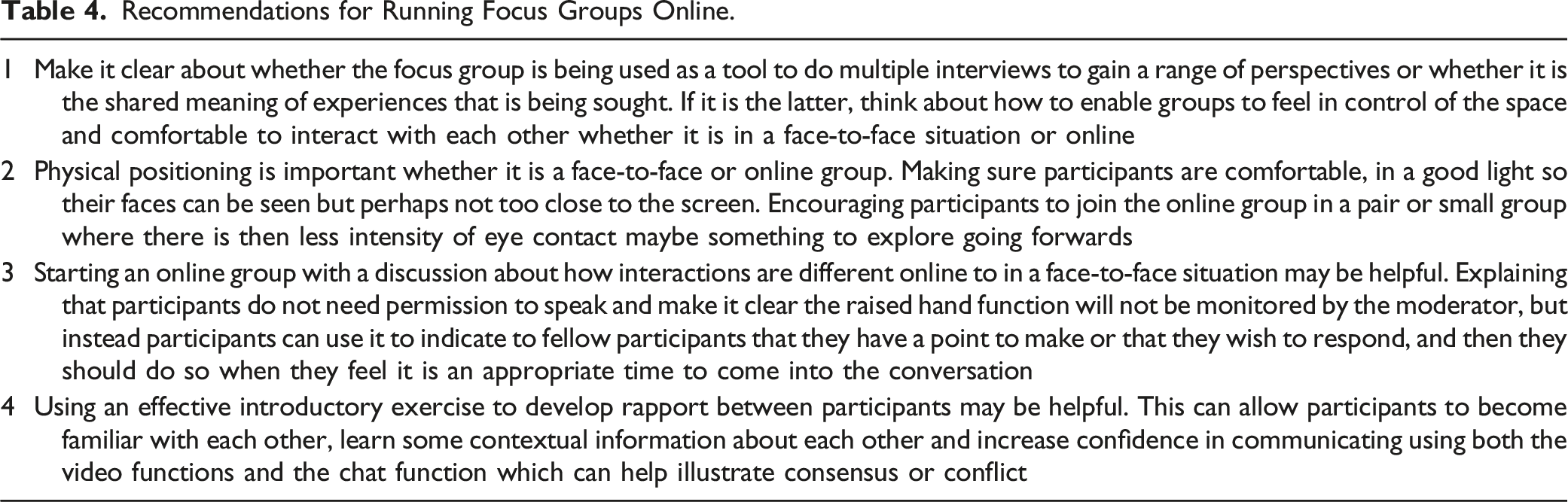
Recommendations for Online Focus Group Moderation
Recommendations for Running Focus Groups Online.
Conclusion
Qualitative researchers are increasingly using online data collection as it reduces complexity of gathering participants, can be less costly in time and traveling costs, and can provide a space in which some participants feel more comfortable to disclose information. Focus groups are used as a data collection method where ideas offered by participants generate thoughts and opinions for other study participants in the group, and the discussion that ensues offers insight into the positionality of different group members on the phenomenon under study. Analysis of the interaction in the focus group is also important in situating the data gathered using the process. Through this discussion, questions have been raised about whether the interaction in focus groups changes when data is collected online and how this can be analysed, considered and perhaps mitigated. It is important to be clear about the rationale for using focus groups as a method of data collection and to ensure these aims are achieved when using this method online.
Footnotes
Acknowledgments
This paper is part of the first author’s PhD study in the Department of Health Research, at Lancaster University in the UK. JDS would like to acknowledge the support of her PhD supervisors, CW and YS and co-researcher KG who have provided valuable support to the data collection, data analysis and creation of this article. Florence Nightingale Foundation Research Scholar 2017/18
Declaration of Conflicting Interests
The author(s) declared no potential conflicts of interest with respect to the research, authorship, and/or publication of this article.
Funding
The author(s) received no financial support for the research, authorship, and/or publication of this article.
